

[2024年05月31日] 無料ISQI Certifications CTAL-TM-001試験問題を使おう
CTAL-TM-001問題集でISQI Certifications必ず合格できる練習問題集
質問 # 36
Given the following figures for the testing on a project, and assuming the failure rate for initial tests remains constant and that all retests pass, what number of tests remain to be run? 3 credits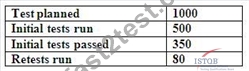
- A. 0
- B. 1
- C. 2
- D. 3
正解:C
質問 # 37
When scheduling performance testing, which of the following approaches would be most advisable? [1]
- A. Requiring all performance tests to pass before starting functional testing
- B. Deferring the start of performance testing until all functional defects have been resolved
- C. Starting the performance testing during unit and integration testing
- D. Leveraging end users to do unit-level performance testing and automated tools for system-level performance testing
正解:C
解説:
Performance testing is the process of determining the speed, responsiveness, and stability of a system under a given workload1. Performance testing should be started as early aspossible in the software development lifecycle, preferably during unit and integration testing, to identify and resolve performance issues before they become costly or risky2. Starting performance testing early can also help to validate the performance requirements, design, and architecture of the system, as well as to optimize the performance testing strategy and scope3. Therefore, option A is the correct answer. Option B is incorrect because deferring the start of performance testing until all functional defects have been resolved can delay the detection and resolution of performance issues, increase the cost and effort of performance testing, and reduce the confidence and quality of the system4. Option C is incorrect because leveraging end users to do unit-level performance testing and automated tools for system-level performance testing can introduce inconsistency, bias, and inefficiency in the performance testing process, as well as compromise the reliability and validity of the performance test results. Option D is incorrect because requiring all performance tests to pass before starting functional testing can create unrealistic or unnecessary expectations, as well as hinder the progress and feedback of the functional testing activities. References: 1: ISTQB Glossary, Performance Testing 2: ISTQB Certified Tester
- Performance Testing (CT-PT)3 3: ISTQB Performance Testing - TesterYou4 4: Performance Testing - ISTQB not-for-profit association : ISTQB - PERFORMANCE TESTING : Performance Testing - ISTQB not-for-profit association
質問 # 38
Your company is installing a third-party enterprise-wide business software package. This is the first time the company has done anything like this.
Which technique would be the best one to use to estimate the testing effort? [3]
- A. Estimated developer effort and lines of code
- B. Industry averages
- C. Past experience with in-house projects
- D. Review of the installation guide
正解:B
質問 # 39
Which of the following are valid reasons for adopting a different life cycle (from the V model), for increments after the first year? 2 credits
i. We do not have a clear understanding of the requirements from a customer perspective.
ii. We see the risk of delivering requested functionality late as being higher than the risk of delivering a lower quality product.
iii. We do not have a budget for additional regression testing which is needed to ensure that existing functionality is not compromised by future iterations.
iv.
The company test strategy does not fit well within the V life cycle model.
- A. (ii) and (iii)
- B. (i) and (ii)
- C. (ii) and (iv)
- D. (i) and (iv)
正解:B
質問 # 40
You are reviewing the project's traceability matrix after the first cycle of testing. You have discovered that new requirements have been introduced and others have changed.
What should you do? [2]
- A. Ask for more time and budget for testing.
- B. Re-assess the test coverage.
- C. Update the "lessons learned" document to avoid future issues similar to this.
- D. Assign the new requirements to a maintenance release, update the test documentation for the changed requirements.
正解:B
解説:
The best action that you should take in this situation is to re-assess the test coverage. This is because the traceability matrix is a document that shows the relationship between the requirements and the test cases, and it can be used to measure the test coverage, which is the degree to which the requirements are tested. If new requirements have been introduced and others have changed, the test coverage may be affected, and some test cases may become obsolete or incomplete. Therefore, you should re-assess the test coverage and update the test cases accordingly, to ensure that the testing is consistent with the current requirements and the test objectives. Traceability Matrix - ISTQB not-for-profit association References: Certified Tester Advanced Level Test Manager (CTAL-TM) - ISTQB not-for-profit association, ISTQB Test Manager Certification - ISTQB Exams Worldwide - ISTQB Official Registration, Traceability Matrix - ISTQB not-for-profit association
質問 # 41
Instead of having an independent test team within the company, the company is considering to outsource testing. What are THREE key challenges that are typical for outsourcing? 1 credit
- A. Clear channels of communications
- B. Test environment more complex
- C. Define expectation for tasks and deliverables
- D. Testing of non-functional requirements
- E. Applying test automation
- F. Possibly different cultures
- G. Audit trail from requirements to test cases
正解:A、C、F
質問 # 42
Consider the following scenario:
Your customer is closely involved in the development project. Requirements are communicated verbally and rarely written down. An iterative development model is being followed and time boxing is used to stay on schedule.
Which of the following statements is true? [3]
- A. Your developers are using a waterfall methodology.
- B. Testing will start when all coding is completed.
- C. A requirements traceability matrix will be created at the start of each iteration.
- D. There is a risk that the system architecture may have to be changed during the development process.
正解:D
解説:
In an iterative development model with close customer involvement and verbal communication of requirements, there is an inherent risk of changes in the system architecture. This is due to the evolving understanding of requirements and the potential for new requirements to emerge as the project progresses.
References:The ISTQB Advanced Level Test Manager syllabus emphasizes the importance of managing risks in iterative development models1. It suggests that test managers should be prepared for changes, including possible alterations to the system architecture, as part of the risk management process23. This approach ensures that the testing strategy remains flexible and responsive to changes throughout the development lifecycle.
質問 # 43
You have investigated different possibilities and selected four of them to present to IT management. Which of the proposals will you most likely give your highest recommendations? 3 credits
- A. Solution from a tool vendor offering to educate two test team members in the use of their easy-to-use test automation capture replay tool over the first 3 month and based on that build the regression test suite. In addition to Vicki, Steve is the only one that has time available to be educated.
- B. Outsourcing of test automation based on an offer from an Asian company, AsiaAutoTest, which has people who are specialists in system level capture-replay automation tools. They also offer training and besides they offer to run and maintain the regression tests in the future.
- C. Internal offer from the development department of XYZ to create the regression package using CppUnit as test automation tool. One of the development groups have very good experiences in automating unit tests, and they are willing to do training as well.
- D. Insourcing of test automation based on an offer from a local company ABC that has people who are specialists in system level capture-replay automation tools and they also do regular training courses in test automation methods and tools. They can then work closely with Vicki.
正解:D
質問 # 44
Your test team is in the process of completing final regression testing one week before the release date. One of your staff has just uncovered a critical defect that causes data corruption.
What should you do? [2]
- A. Update the weekly status charts and change the project status to red
- B. Write a high priority defect and follow the escalation communication plan as defined in your test plan
- C. Write a high priority defect and call the business stakeholders to warn them about it
- D. Update the risks in your test plan to cover data corruption issues and update your test cases to be sure you test for this in the future
正解:B
解説:
The best action that you should take in this situation is to write a high priority defect and follow the escalation communication plan as defined in your test plan. This is because a critical defect that causes data corruption is a serious issue that can affect the quality, functionality, and reliability of the system, and it needs to be reported and resolved as soon as possible. By writing a high priority defect, you can document the details and the impact of the defect, and alert the development team and the project manager about it. By following the escalation communication plan, you can ensure that the defect is communicated to the appropriate stakeholders, such as the business sponsors, the customers, or the senior management, in a timely and effective manner, and that the necessary actions are taken to address the defect. Defect Reporting - ISTQB not-for-profit association References: Certified Tester Advanced Level Test Manager (CTAL-TM) - ISTQB not-for-profit association, ISTQB Test Manager Certification - ISTQB Exams Worldwide - ISTQB Official Registration, Defect Reporting - ISTQB not-for-profit association
質問 # 45
Given is the following defect removal chart reported at the end of system testing - showing total defects detected and closed defects (fixed and successfully retested). A number of open defects are classified as critical. All tests have been executed.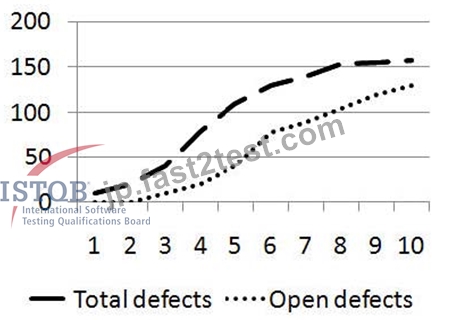
Based on the chart above, what is the most appropriate next test phase? 1 credit
- A. Requirements testing as part of testing regulatory compliance
- B. Another system test cycle to verify defect resolution
- C. Acceptance testing to verify operational requirements
- D. Acceptance testing to verify the business process
正解:B
質問 # 46
Identify the THREE types of formal peer reviews that can be recognized. 1 credit
- A. Assessment
- B. Management review
- C. Walkthrough
- D. Informal review
- E. Audit
- F. Inspection
- G. Technical review
正解:C、F、G
解説:
Explanation/Reference:
Explanation:
質問 # 47
Which one of the following estimation approaches is appropriate at this stage of the project? 2 credits
- A. Create an estimate based on a percentage of the development effort
- B. Create an estimate based on the complexity of the code
- C. Create an estimate based on the credentials of the successful bidder
- D. Create an estimate based on the function point analysis technique and test point analysis
正解:D
質問 # 48
Consider the typical objectives of testing. Which of the following metrics can be used to measure the effectiveness of the testing process in achieving one of those objectives? 1 credit
- A. Percentage of requirements covered
- B. Average number of days between defect discovery and resolution
- C. Percentage of test effort spent on regression testing
- D. Lines of code written per developer per day
正解:A
質問 # 49
Which classification information would be most useful to capture for newly identified defects? [2]
- A. The number of test steps in the test script that found the defect
- B. The name of the configuration manager who built the system
- C. The priority that the business assigned to the project that the defect was found in
- D. The system build that the defect was found in
正解:D
解説:
Capturing the system build information for newly identified defects is crucial as it helps in tracking the defect back to a specific state of the software. This information is essential for developers to understand the context of the defect and for testers to manage regression testing effectively. It allows for precise identification of when the defect was introduced, aiding in quicker resolution and ensuring that similar issues can be prevented in future builds.
References:
* ISTQB Glossary, Distributed Testing1
* Defect Report in ISTQB: Software Engineering - The Knowledge Academy
* ISTQB Advanced Level Test Manager Syllabus, Section 3.2.1
* Defect classification and prioritisation: ISTQB offers a standardised defect classification scheme The most useful classification information to capture for newly identified defects is the system build that the defect was found in. This is because the system build is the version of the software that is compiled, integrated, and tested together. By capturing the system build for each defect, the test team can track and manage the defects more effectively, and identify the root causes and impacts of the defects. The system build can also help to reproduce and verify the defects, and to measure the quality and progress of the software development. Defect Management - ISTQB not-for-profit association References: Certified Tester Advanced Level Test Manager (CTAL-TM) - ISTQB not-for-profit association, ISTQB Test Manager Certification - ISTQB Exams Worldwide - ISTQB Official Registration, Defect Management - ISTQB not-for-profit association
質問 # 50
Which of the following metrics would be most beneficial to collect to determine the effectiveness of a review process? [2]
- A. The elapsed time between each module's review and its corresponding deployment into production
- B. The development language used to create each module that was reviewed
- C. The business criticality of each module that was reviewed
- D. The number of defects found in production for each module that was reviewed
正解:D
解説:
The effectiveness of a review process can be measured by how well it detects and removes defects from the work products being reviewed1. One of the metrics that can indicate the defect detection capability of a review process is the number of defects found in production for each module that was reviewed2. This metric can show how many defects escaped the review process and were not detected until the software was deployed. A lower number of defects found in production means a higher review effectiveness. Therefore, option A is the correct answer. Option B is incorrect because the development language used to create each module that was reviewed is not relevant to the review process effectiveness. Option C is incorrect because the elapsed time between each module's review and its corresponding deployment into production is not a measure of defect detection or removal, but rather a measure of development speed or efficiency. Option D is incorrect because the business criticality of each module that was reviewed is not a measure of defect detection or removal, but rather a measure of risk or priority. References: 1: ISTQB Advanced Level Test Manager Syllabus, Section
2.3.2 2: Software Testing Metrics: What is, Types & Example
質問 # 51
You have just conducted a skills assessment for your team. You decided to rate everyone from 1 to 5 in the skill areas as follows:
5 = expert
4 = proficient
3 = can use this skill effectively but will need some assistance
2 = interested in learning this skill but has only minimal knowledge
1 = not interested in learning this skill
Given these values, you have rated your team as shown in the table below for the designated skill areas: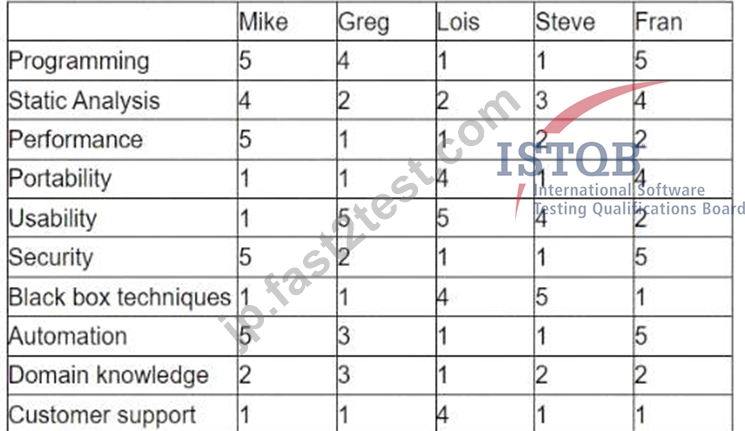
You will be starting to test a new product that is an upgrade from one of your existing end user products. Your testing will include white box, performance, security, usability, and black box. You also have a goal to automate 100% of the smoke test and
50% of the regression tests by the end of the release.
Your team willingly shares knowledge and conducts regular lunch time cross-training sessions.
Your manager wants to know if you would like to bring in someone to help train your team in preparation for this project. In which area could you best utilize this help? [3]
- A. Training in black box techniques
- B. Training in customer support
- C. Training in domain knowledge
- D. Training in automation
正解:D
解説:
Based on the table, the area where your team could best utilize help is training in automation. This is because most of your team members are either not interested in learning this skill or have only minimal knowledge about it. Automation is an important skill for testing, especially for achieving your goal of automating the smoke test and the regression test. Training in automation can help your team to learn how to use various tools and frameworks to create, execute, and maintain automated test scripts. Training in automation can also improve the efficiency, effectiveness, and coverage of your testing process. Best Automation Courses & Certificates OnlineTraining - ISATop Automation Courses Online References:
* Best Automation Courses & Certificates Online
* Training - ISA
* Top Automation Courses Online
質問 # 52
......
ISQI CTAL-TM-001実際の問題とブレーン問題集:https://jp.fast2test.com/CTAL-TM-001-premium-file.html
合格させるCTAL-TM-001試験には更新されたのはCTAL-TM-001試験問題集PDF2024:https://drive.google.com/open?id=17NigMZ7cPqILmqyU2tZr0nLpvmzOpj8z