

PMI-RMP試験問題を今すぐ試そう!最新の[2025年最新] 正解回答付き
練習できるPMI-RMPには認定ガイド問題と解答とトレーニングを提供しています
PMI-RMP認定試験は、170の複数選択の質問で構成されるコンピューターベースのテストです。候補者は試験を完了するのに4時間あり、合格スコアは61%です。この試験では、リスク管理の5つのドメイン、リスク戦略と計画、利害関係者のエンゲージメント、リスクプロセスの促進、リスクモニタリングと報告、専門的なリスク分析の実施をカバーしています。
PMI-RMP認定試験は、リスク管理の分野でキャリアアップを望むプロジェクトマネージャーにとって重要な資格です。試験は、リスクの特定、リスク分析、リスク対応計画、リスク監視と制御などのトピックに焦点を当て、リスク管理の概念、原則、および実践についてカバーしています。この認定資格はグローバルで認められており、様々な産業の雇用者がPMI-RMP認定プロフェッショナルをプロジェクトマネージャーとして採用しています。
質問 # 68
Todd is the project manager of the EST project for his company. His organization has established certain rules in the enterprise environmental factors which affect the approach that Todd takes in managing his project. One of the rules requires Todd to consider the risk attitude of the stakeholders participating in risk analysis. Why must risk attitude be considered as a part of risk analysis?
- A. Risk attitude identifies stakeholders that are hygiene seekers or motivation seekers.
- B. Risk attitude can affect the measurement of probability and impact.
- C. Risk attitude can establish a stakeholder's influence over project decisions.
- D. Risk attitude establishes stakeholders as positive or negative stakeholders.
正解:B
質問 # 69
A project has a significant impact on an organization. Multiple stakeholders expressed concerns regarding the overall project risk during construction of the risk management plan, and they agreed that the risk appetite is low.
What should the project risk manager monitor closely?
- A. Risk management reports
- B. Risk breakdown structure (RBS)
- C. Risk thresholds
- D. Risk response strategies
正解:C
解説:
Explanation
The project risk manager should monitor risk thresholds closely, as they represent the organization's risk appetite. In a project with a low risk appetite, it is essential to ensure that risks are managed within the defined thresholds to address stakeholders' concerns and maintain their confidence in the project's success.
According to the PMI Risk Management Professional (PMI-RMP) Reference Materials, risk thresholds are the measure of acceptable variation around an objective that reflects the risk appetite of the organization1. Risk appetite is the degree of uncertainty an entity is willing to take on in anticipation of a reward2. In this case, the project has a significant impact on the organization and the stakeholders have a low risk appetite, meaning they are not willing to accept much deviation from the project objectives. Therefore, the project risk manager should monitor the risk thresholds closely to ensure that the project risks do not exceed the acceptable level of variation and impact the project performance negatively. By monitoring the risk thresholds, the project risk manager can also identify when risk responses are needed and evaluate their effectiveness.
References: 1: PMI, Practice Standard for Project Risk Management, 2009, p. 20 2: PMI, A Guide to the Project Management Body of Knowledge (PMBOK Guide), Sixth Edition, 2017, p. 720
質問 # 70
An agriculture government agency faces different challenges with farmers and landlords In implementing its ambitious growth strategy. The agency decided to establish an enterprise risk management unit to identify risks, analyze risks, and provide a handbook showing how to handle the surrounding uncertainty.
What should the risk management expert recommend the agency do first to identify risks and develop the handbook?
- A. Conduct meetings, facilitated workshops, and interviews with stakeholders to identify potential risks.
- B. Hire an agriculture expert who can develop the required handbook and discuss it with the agriculture minister.
- C. Follow standard risk Identification tools dedicated for agriculture and tailor them to the environment.
- D. Prepare a list of the key resources that will be used to compile a risk management plan.
正解:A
解説:
Explanation
According to the PMBOK Guide1, risk identification is the process of determining which risks may affect the project and documenting their characteristics. It involves the use of various techniques to gather information from different sources and perspectives, such as stakeholders, experts, historical data, assumptions, and environmental factors. Some of the common techniques for risk identification are meetings, facilitated workshops, interviews, brainstorming, checklists, questionnaires, SWOT analysis, and root cause analysis. These techniques help to elicit the knowledge and opinions of the participants, and to generate a comprehensive list of potential risks that can be further analyzed and prioritized. In this case, the risk management expert should recommend the agency to conduct meetings, facilitated workshops, and interviews with stakeholders to identify potential risks and develop the handbook. This will help to understand the context and objectives of the agency, the expectations and concerns of the farmers and landlords, the challenges and opportunities in the agriculture sector, and the possible sources and impacts of uncertainty. The risk management expert can then use the information gathered from these techniques to create a risk register and a risk management plan, which can form the basis of the handbook. This is part of the Identify Risks process in the PMBOK Guide1. References: 1: A Guide to the Project Management Body of Knowledge (PMBOK Guide) - Sixth Edition Engaging stakeholders through meetings, workshops, and interviews is crucial for risk identification, as it allows the agency to gather diverse perspectives and insights on potential risks. This approach is more effective than relying solely on standard tools or hiring an expert.
質問 # 71
Which of the following events would result in a baseline update?
- A. One of your key project team resources has left your team and no replacement is available.
- B. Your customer has approved a change request broadening the project scope and increasing the budget.
- C. Your project is behind schedule and you want your baseline to reflect estimated actual completion.
- D. One of the risks identified in the Risk Management Plan occurs resulting in a schedule delay.
正解:B
質問 # 72
A project manager has been assigned to a project that is just starting. The organization has a very low risk appetite towards this project due to constraints on budget and schedule. The project stakeholders are very engaged on the project and want to ensure that there is clear visibility on the project risks and progress.
How should the project manager handle stakeholder expectations?
- A. Add buffers to the schedule to accommodate risk.
- B. Develop a communication plan to share updates on risks.
- C. Ensure the risk register includes all identified risks.
- D. Discuss the risk response strategies with the stakeholders.
正解:B
解説:
Explanation
The project manager should discuss the risk response strategies with the stakeholders to handle their expectations. This will help the project manager to align the risk responses with the stakeholder's risk appetite, preferences, and expectations. It will also help the project manager to obtain the stakeholder's support and approval for the risk responses. This is the best way to ensure clear visibility on the project risks and progress.
Adding buffers to the schedule to accommodate risk (option A) is not a good practice, as it may create false expectations and hide the true impact of risk. Ensuring the risk register includes all identified risks (option B) is important, but it is not enough to handle stakeholder expectations. The project manager also needs to communicate the risk register to the stakeholders and discuss the risk responses with them. Developing a communication plan to share updates on risks (option D) is also a good practice, but it is not sufficient to handle stakeholder expectations. The project manager also needs to involve the stakeholders in the risk response planning process and obtain their feedback and approval. References: PMI, The Standard for Risk Management in Portfolios, Programs, and Projects, 2019, p. 97; PMI, A Guide to the Project Management Body of Knowledge (PMBOK Guide), 6th ed., 2017, p. 407.
The project manager should develop a communication plan to share updates on risks (D) to handle stakeholder expectations, especially since the organization has a low risk appetite and stakeholders are very engaged. This approach ensures that stakeholders are regularly informed about the project's risks and progress, addressing their concerns and expectations. This is supported by the PMI's PMBOK Guide, Sixth Edition.
質問 # 73
The risk manager is about to go on medical leave, but before departing, conducts a risk response planning review meeting with stakeholders. A new risk manager is assigned to the project, and during the first status meeting an issue is identified.
What is the appropriate course of action in this case?
- A. Perform a risk reserve analysis.
- B. Delegate to the action owner.
- C. Implement an action plan to resolve the issue.
- D. Perform a project review.
正解:A
質問 # 74
The risk register contains which of the following?
- A. Identified risks and potential responses
- B. Risk related contract decisions
- C. Identified risks and updates to scope baseline
- D. Risk management plan
正解:A
質問 # 75
Some project risks are applicable for the project's lifecycle while others risks are only applicable to specific project activities. When should project risks be closed?
- A. When the stakeholders agree a risk is no longer applicable
- B. When iterative data analysis determines the risk is not applicable
- C. When the risk has been realized and can no longer happen again
- D. When the forecast activity date has been met or exceeded
正解:A
解説:
Project risks should be closed when the stakeholders agree a risk is no longer applicable. This ensures that risks are actively managed and only relevant risks are considered throughout the project lifecycle.
According to the PMI Risk Management Professional (PMI-RMP) Reference Materials, project risks are uncertain events or conditions that may have a positive or negative effect on one or more project objectives1. Project risks can be closed when they are no longer applicable to the project or its activities. The process of closing project risks involves verifying that the risk responses have been completed, documenting the outcomes, and evaluating the effectiveness of the risk management process2. The decision to close a project risk should be made by the stakeholders who are responsible for or affected by the risk, as they are the ones who can determine whether the risk is still relevant or not. Therefore, the correct answer is B. When the stakeholders agree a risk is no longer applicable.
質問 # 76
A project manager realizes the team undertaking the project work has fallen behind the planned schedule. The risk manager identifies a new risk resulting from this delay and will need to understand how this will affect the project deadline.
Which kind of numerical analysis should be performed to understand the worst-case scenarios?
- A. Root cause analysis
- B. Earned value analysis
- C. Qualitative risk analysis
- D. Sensitivity analysis
正解:D
解説:
Explanation
sensitivity analysis is a technique that helps to determine which risks have the most potential impact on the project. It examines the extent to which the uncertainty of each project element affects the objective being examined when all other uncertain elements are held at their baseline values. Sensitivity analysis is often used to assess the risk exposure of the project schedule and cost, and to identify the critical risks that need to be managed. In this case, the risk manager needs to understand how the new risk resulting from the delay will affect the project deadline, which is the objective being examined. By performing sensitivity analysis, the risk manager can compare the relative importance and interaction of the new risk with other existing risks, and determine the worst-case scenarios for the project completion date. Sensitivity analysis can also help to prioritize risks for response planning and to develop contingency reserves. This is part of the Perform Quantitative Risk Analysis process in the PMBOK Guide2. References: 1: PMI Risk Management Professional (PMI-RMP) Examination Content Outline 2: A Guide to the Project Management Body of Knowledge (PMBOK Guide) - Sixth Edition
質問 # 77
Lisa is the project manager of the SQL project for her company. She has completed the risk response planning with her project team and is now ready to update the risk register to reflect the risk response. Which of the following statements best describes the level of detail Lisa should include with the risk responses she has created?
- A. The level of detail is set of project risk governance.
- B. The level of detail should correspond with the priority ranking.
- C. The level of detail must define exactly the risk response for each identified risk.
- D. The level of detail is set by historical information.
正解:B
質問 # 78
In a project to promote public health and mitigate health risks, the national health authorities intend to take actions to limit the risks of harmful insects by using pesticides; however, it is expected that some residents will have negative health effects due to the use of the pesticides but according to the assessment completed by the health authorities, not moving forward with this plan will have much more serious consequences on public health rather than following through with the original plan.
How should the project manager address this concern with the health authorities?
- A. Assess and record associated secondary risks and proceed to treat them as any other risks.
- B. Consult with health experts to provide a risk trigger before using pesticides that will impact the residents.
- C. Suspend the project as the secondary risk will negatively impact residents' health which is not acceptable.
- D. Proceed with the project as normal since a minor number of residents will be effected negatively.
正解:A
解説:
Explanation
The project manager should assess and record associated secondary risks and proceed to treat them as any other risks. This involves identifying and evaluating the potential negative health effects of using pesticides and developing a plan to mitigate these risks. While it is important to consider the concerns of residents, the health authorities have determined that not moving forward with the plan will have more serious consequences on public health.
質問 # 79
You are working with the project stakeholders to analyze and prioritize their requirements for the project.
One of the project requirements is to achieve a high-level of customer satisfaction for the project deliverable. What is the danger in this project requirement?
- A. Achieving customer satisfaction is a risk as the project manager cannot control how satisfied the customer will be with the project deliverables.
- B. Achieving customer satisfaction should always map to the quality requirements for the project.
- C. Achieving customer satisfaction is a subjective requirement and entails a high level of risk of being successfully accomplished.
- D. Achieving customer satisfaction is an assumption and should be documented in the project scope.
正解:C
質問 # 80
Ruth is the project manager of ISFH project for her company. This project is forty percent complete and it appears that some risk events are going to happen in the project that will have an adverse affect on the project. Ruth creates a change request regarding the risks. Is this a valid response?
- A. Yes, change requests can ask for additional funds to pay for the risk impact.
- B. Yes, change requests can be recommended for corrective actions for contingency plans.
- C. No, change requests should not address risks, only risk response strategies should be issued.
- D. No, change requests should not address pending risks, but only scope changes.
正解:B
質問 # 81
A two-year project with a budget of US$2 million has completed about 60% of the work at the end of the first year. The actual cost incurred to complete the remaining 40% of work is about USS1.5 million. As a part of performing a specialized risk analysis, the calculated schedule performance index (SPI) is 1.2 and cost performance index (CPI) is 0.53.
How should the risk manager interpret such a low CPI value?
- A. The actual reported costs are inaccurate.
- B. The cost related risks are effectively managed.
- C. The cost control processes is ineffective.
- D. The cost baseline is inaccurate.
正解:D
解説:
Explanation
A low CPI value (0.53) indicates that the project is over budget. This may be due to an inaccurate cost baseline, which means the initial budget estimation was not correct. This would not necessarily mean that cost control processes are ineffective, actual reported costs are inaccurate, or cost-related risks are effectively managed.
質問 # 82
You are working as a project manager in your organization. You are nearing the final stages of project execution and looking towards the final risk monitoring and controlling activities. For your project archives, which one of the following is an output of risk monitoring and control?
- A. Risk audits
- B. Quantitative risk analysis
- C. Requested changes
- D. Qualitative risk analysis
正解:C
質問 # 83
Which of the following techniques examines the degree to which organizational strengths offset threats and opportunities that may serve to overcome weaknesses?
- A. Delphi
- B. Expert Judgment
- C. SWOT Analysis
- D. Brainstorming
正解:C
質問 # 84
A project lihat was in the execution phase for the last six months was put on hold and was eventually cancelled after numerous scope related challenges. It was decided to re-plan the scope and divide the project into multiple projects to have better insight into end objectives. As part of the project start up. the project manager is developing the risk planning for the project.
What three artifacts should the project manager consult or review during this process? (Choose three.)
- A. Lessons learned registers from analogous projects
- B. Risk register
- C. Code of regulations
- D. Risk management plan
- E. Project contracts
正解:A、D、E
解説:
The project manager should consult or review project contracts, lessons learned registers from analogous projects, and the risk management plan to develop an effective risk planning for the project.
According to the PMBOKGuide, the risk management plan is one of the key inputs for the plan risk management process, which is the first process in the project risk management knowledge area. The risk management plan describes how risk management activities will be structured and performed throughout the project. It includes information such as the methodology, roles and responsibilities, budget, timing, risk categories, definitions of risk probability and impact, probability and impact matrix, revised stakeholders' risk tolerances, reporting formats, and tracking (page 409). Therefore, option D is the correct answer.
The project contracts are also an important input for the plan risk management process, as they may contain terms and conditions that can create or affect various project risks. For example, contracts may include clauses related to penalties, incentives, warranties, intellectual property rights, termination, force majeure, arbitration, indemnification, etc. The project manager should review the project contracts to identify any potential sources of risk and plan appropriate responses (page 410). Therefore, option A is the correct answer.
The lessons learned registers from analogous projects are another valuable input for the plan risk management process, as they provide historical information and knowledge that can help the project manager identify and analyze risks, as well as plan risk responses. The lessons learned registers may contain information such as the risks that occurred, the root causes of the risks, the risk triggers, the effectiveness of the risk responses, the residual and secondary risks, the risk owners, the risk ratings, the risk trends, etc. The project manager should consult the lessons learned registers from similar or comparable projects to learn from past experiences and avoid repeating mistakes (page 411). Therefore, option B is the correct answer.
The risk register is not an input for the plan risk management process, but an output. The risk register is a document that contains the list of identified risks, their causes, potential responses, and other relevant information. The risk register is created during the identify risks process, which is the second process in the project risk management knowledge area. The risk register is then updated and refined throughout the project as more information becomes available and new risks emerge (page 414). Therefore, option C is incorrect.
The code of regulations is not an input for the plan risk management process, but a type of enterprise environmental factor. Enterprise environmental factors are the conditions, not under the control of the project team, that influence, constrain, or direct the project. The code of regulations refers to the rules and standards that govern the project's industry, domain, or sector. The code of regulations may affect the project's scope, schedule, cost, quality, resources, communications, procurement, and risk management. The project manager should consider the code of regulations when planning risk management activities, but it is not an artifact that needs to be reviewed or consulted (page 38). Therefore, option E is incorrect.
質問 # 85 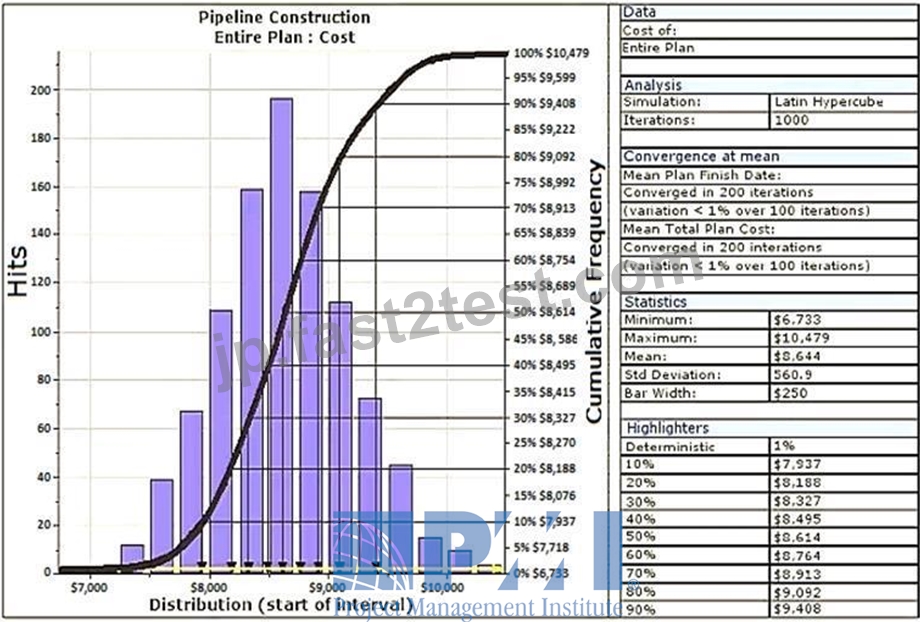
The project values are in thousands. What is the average cost of the project?
- A. US$8,614,000
- B. US$8,764,000
- C. US$8,495,000
- D. US$8,619,000
正解:A
質問 # 86
The project manager is reviewing the lessons learned from a previous similar project. The previous project was delayed due to the delay in delivery of a gas turbine generator (GTG). Construction of the previous project had to be shut down unexpectedly to wait for the late delivery of the GTG.
What should the project manager do first?
- A. Interview the other project manager to learn more details.
- B. Include the risk in the register and communicate with the stakeholders.
- C. Communicate with the client to provide the previous shutdown plan.
- D. Review and update the project schedule.
正解:B
解説:
Explanation
The project manager should first gather more information about the previous project's issues by interviewing the other project manager. This will help in understanding the root causes of the delay and how to prevent similar issues in the current project before taking further action.
The project manager should first include the risk of delay in delivery of the GTG in the risk register and communicate with the stakeholders about the potential impact and response strategies. This is part of the risk identification process, which is the first step in risk management. The risk register is a document that records the identified risks, their causes, effects, probabilities, impacts, and response plans. The project manager should communicate with the stakeholders to ensure that they are aware of the risk and its implications, and to obtain their feedback and support. The project manager should also update the risk register as new information becomes available or as the risk status changes. The other options are not the first actions that the project manager should take. Communicating with the client to provide the previous shutdown plan is part of the risk response process, which comes after the risk identification and analysis processes. Reviewing and updating the project schedule is part of the schedule management process, which is not directly related to risk management.
Interviewing the other project manager to learn more details is a technique that can be used to identify risks, but it is not the first action that the project manager should take. The project manager should first document the risk in the risk register and communicate with the stakeholders before seeking more information from other sources. References: 3, 4, 5
質問 # 87
A risk manager and project team are managing a software system project, which is expected to be completed within 12 months. The project is currently halfway through, and the team has just delivered the second version of the prototype. During the weekly status meeting, a team member reported that an important stakeholder is facing an issue, which will likely result in a change request that is outside the scope of the current prototype.
What should the risk manager advise the team to do first?
- A. Mitigate the risk by asking the team member to gather more information.
- B. Add the risk to the risk register and gather information about its probability and impact.
- C. Arrange a meeting with the stakeholder to discuss the risk and information.
- D. Add the risk to the issue log and revisit it when there is more information.
正解:B
質問 # 88
What are common examples used to communicate risk probability and impact?
- A. Risk checklist, risk assessment, regression analysis, and assumption and constraint analysis.
- B. Probability distributions, sensitivity analysis, modeling and simulation, and probability and impact matrix
- C. Monitor Risks process, assumption and constraint analysis, modeling and simulation, and risk register
- D. Monitor Risks process, multi-dimensional risk assessment, control chart, and Monte Carlo simulation
正解:D
質問 # 89
The risk manager is facilitating risk planning activities with the team. The team is documenting all the check points along the way that might indicate delays on critical deliverables.
What is this an example of?
- A. Risk categories
- B. Risk triggers
- C. Risk registers
- D. Risk responses
正解:B
解説:
The team is documenting all the checkpoints along the way that might indicate delays on critical deliverables, which is an example of risk triggers. Risk triggers are events or conditions that indicate a risk may be about to occur or has already occurred, helping the project team to monitor and respond to risks effectively.
Risk triggers are indicators or warning signs that a risk event is about to occur or has occurred. They help to monitor the status of risks and initiate risk responses when needed. Documenting risk triggers is part of the Plan Risk Responses process, which aims to develop options and actions to enhance opportunities and reduce threats to project objectives. Reference: The Standard for Risk Management in Portfolios, Programs, and Projects, page 78; PMBOK Guide, 6th edition, page 402.
質問 # 90
There are five outputs of the risk monitoring and controlling process. Which one of the following is NOT an output of the process?
- A. Change requests
- B. Vendor contracts
- C. Risk register updates
- D. Organizational process assets updates
正解:B
質問 # 91
A risk manager and relevant stakeholders have completed a risk response plan for a project. They have identified and planned responses to the known risks; however, a risk owner has identified and reported some residual risks not previously addressed.
What should the risk manager do first?
- A. Develop a residual risk management plan to manage the residual risks.
- B. Record the residual risks in the watch list for future reference.
- C. Implement the contingency plan when the residual risks occur.
- D. Analyze, document, and communicate the residual risks to stakeholders.
正解:D
解説:
Explanation
Residual risks are the risks that remain after the risk response plan has been implemented. They are the risks that are accepted by the project team and stakeholders as part of the project. Residual risks may have low probability or impact, but they still need to be monitored and controlled throughout the project. The first thing that the risk manager should do when a risk owner identifies and reports some residual risks is to analyze, document, and communicate them to the relevant stakeholders. The risk manager should assess the probability and impact of the residual risks, and determine if they require any further response or contingency plan. The risk manager should also update the risk register and the risk report with the information about the residual risks, and share them with the stakeholders who need to be aware of them. This will help the project team and stakeholders to be prepared for any potential occurrence of the residual risks, and to take appropriate actions if needed. References: PMI, The Standard for Risk Management in Portfolios, Programs, and Projects, 2019, p.
94-95, 101.
質問 # 92
Which risk response is acceptable for both positive and negative risk events?
- A. Enhancing
- B. Transferring
- C. Sharing
- D. Acceptance
正解:D
解説:
Explanation/Reference:
質問 # 93
......
PMI-RMP認定は、プロジェクト管理業界で高く評価され、世界的に認められています。これは、保持者がどのプロジェクトでもリスクを効果的に管理するための知識、スキル、経験を持っていることを示しています。認定は、雇用主にとって高く求められるため、保持者に新しいキャリアの機会を提供します。さらに、認定は、プロジェクト管理の専門的な発展と継続的な学習への取り組みを証明し、どの組織にとっても貴重な資産となります。
試験準備には欠かさない!トップクラスのPMI PMI-RMP試験アプリ学習ガイド練習問題最新版:https://jp.fast2test.com/PMI-RMP-premium-file.html
無料PMI PMI-RMPテスト練習問題試験問題集:https://drive.google.com/open?id=1AICYtgbPQpIvbF4JpOVgmmDB0m7Ky_O7