

無料PMI-RMP試験ブレーン問題集認定ガイド問題と解答
PMI-RMP認定概要最新のPMI-RMPPDF問題集
PMI-RMP認定試験の対象となるには、候補者はプロジェクトリスク管理と30時間のリスク管理教育において少なくとも3年の経験が必要です。この試験では、リスクの識別、リスク分析と評価、リスク対応計画、リスクの監視と制御などのトピックについて説明します。これは、170の複数選択の質問で構成される4時間のコンピューターベースの試験です。試験の合格スコアは61%です。成功した候補者にはPMI-RMP認定が授与されます。これは3年間有効であり、継続教育と専門能力開発活動を通じて更新する必要があります。
PMI-RMP認定は、プロジェクト管理業界で高く評価され、世界的に認められています。これは、保持者がどのプロジェクトでもリスクを効果的に管理するための知識、スキル、経験を持っていることを示しています。認定は、雇用主にとって高く求められるため、保持者に新しいキャリアの機会を提供します。さらに、認定は、プロジェクト管理の専門的な発展と継続的な学習への取り組みを証明し、どの組織にとっても貴重な資産となります。
質問 # 49
Which risk response is acceptable for both positive and negative risk events?
- A. Acceptance
- B. Sharing
- C. Enhancing
- D. Transferring
正解:A
質問 # 50
A risk manager of a complex project has identified a risk and believes a deeper understanding of the source and likelihood is necessary. How should the risk manager proceed?
- A. Analyze the assumptions and constraints
- B. Develop and employ an Ishikawa diagram
- C. Perform a review of project documents
- D. Create prompt lists for expert interviews
正解:B
解説:
An Ishikawa diagram (also known as a fishbone or cause-and-effect diagram) is a tool used to identify and analyze the root causes and sources of a risk. It helps the risk manager gain a deeper understanding of the risk source and likelihood. (Reference: PMBOK Guide, 6th Edition, p. 139) An Ishikawa diagram, also known as a fishbone diagram or a cause-and-effect diagram, is a tool that can help the risk manager to analyze the root causes of a risk and to identify the factors that influence its occurrence and impact. An Ishikawa diagram can also help to visualize the relationships among different causes and to prioritize the most significant ones. By developing and employing an Ishikawa diagram, the risk manager can gain a deeper understanding of the source and likelihood of the risk and plan appropriate responses accordingly. Reference: The Standard for Risk Management in Portfolios, Programs, and Projects, page 72; PMBOK Guide, 6th edition, page 398.
質問 # 51
You are the project manager for GHY Project and are working to create a risk response for a negative risk. You and the project team have identified the risk that the project may not complete on time, as required by the management, due to the creation of the user guide for the software you're creating. You have elected to hire an external writer in order to satisfy the requirements and to alleviate the risk event. What type of risk response have you elected to use in this instance?
- A. Avoidance
- B. Transference
- C. Sharing
- D. Exploiting
正解:B
質問 # 52
Towards the end of definitive design, project costs have increased to the point where it will be classified as a capital asset project. The customer has expressed they want one final total project completion date and will afford no extensions after it is established.
How should the risk manager proceed?
- A. Update the assumptions/exclusions register with the new information.
- B. Update the risk register and prepare for the Monte Carlo analysis.
- C. Perform a quantitative risk analysis and update the results.
- D. Perform a qualitative risk analysis and update the results.
正解:C
解説:
Explanation
The risk manager should perform a quantitative risk analysis to determine the potential impact of risks on the project's completion date. This will help in providing a more accurate projectcompletion date to the customer, considering the risks and their potential effects on the project schedule.
質問 # 53
You are the project manager of the GHE Project. You have identified the following risks with the characteristics as shown in the following figure: How much capital should the project set aside for the risk contingency reserve?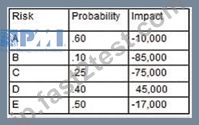
- A. $232,000
- B. $41,750
- C. $142,000
- D. $23,750
正解:D
質問 # 54
A risk manager completed risk response planning for a project that is currently in the execution phase. During a periodic review of the risk register, the project manager recognizes that some key secondary risks have not been considered.
Who should the project manager hold accountable for missing the risks?
- A. The risk owners
- B. The audit team
- C. The risk manager
- D. The discipline engineers
正解:C
解説:
Explanation
The risk manager is responsible for ensuring that all risks, including secondary risks, are identified and addressed during the risk response planning process. If key secondary risks were missed, the risk manager should be held accountable. (Reference: Project Management Institute. A Guide to the Project Management Body of Knowledge (PMBOK Guide) - Sixth Edition, Section 11.5) The risk manager is responsible for identifying and analyzing risks, as well as planning and implementing risk responses. Secondary risks are those risks that arise as a direct result of implementing a risk response to a specific risk. The risk manager should have considered the potential secondary risks during the risk response planning and updated the risk register accordingly. The project manager should hold the risk manager accountable for missing the secondary risks and ensure that they are properly addressed12 References: 1: PMI Risk Management Professional (PMI-RMP) Handbook, page 10 2: A Guide to the Project Management Body of Knowledge (PMBOK Guide) - Seventh Edition, page 11.2.2.1
質問 # 55
A home solar panel project has many internal and external stakeholders including households, businesses, community groups, electric utility companies, local government officials, landlords, and investors. What should the project manager do when engaging stakeholders?
- A. Communicate response strategies to all stakeholders.
- B. Consider stakeholders' positions and opinions regarding the project's output.
- C. Ignore any risks beyond stakeholders' tolerance.
- D. Include all stakeholders in the project's governance.
正解:B
解説:
The project manager should consider stakeholders' positions and opinions regarding the project's output when engaging stakeholders. This approach helps to address stakeholders' concerns, expectations, and potential objections, and it can lead to better decision-making and more successful project outcomes. It is important for the project manager to maintain open communication with stakeholders and to be responsive to their needs and perspectives.
According to the PMI Risk Management Professional (PMI-RMP)Examination Content Outline, one of the tasks under the domain of stakeholder engagement is to "engage stakeholders by communicating with them to understand their positions and opinions regarding the project's output, and to ensure that their interests are considered in the risk management process" (Task 1.3). This implies that the project manager should consider stakeholders' perspectives and expectations when engaging them, and not ignore, exclude, or impose on them. Therefore, option D is the correct answer.
Option A is incorrect because not all stakeholders need to be involved in the project's governance, which is the set of policies, processes, and procedures that define how the project is managed and controlled. The project's governance should be determined by the project sponsor and the project management office (PMO), and only include those stakeholders who have authority and responsibility for the project's success.
Option B is incorrect because communicating response strategies to all stakeholders is not a stakeholder engagement activity, but a risk communication activity. The project manager should communicate response strategies to the relevant stakeholders who are assigned to implement or monitor them, and not to all stakeholders indiscriminately.
Option C is incorrect because ignoring any risks beyond stakeholders' tolerance is not a stakeholder engagement activity, but a risk attitude activity. The project manager should identify and assess all risks that may affect the project's objectives, regardless of stakeholders' tolerance levels. The project manager should also consult with stakeholders to determine their risk appetite, threshold, and attitude, and use this information to prioritize and respond to risks accordingly.
質問 # 56
As per the risk analysis process carried out for a project, two risks are registered. The probability risk A will occur is 40% and its monetary impact to the project is US$100,000. The probability risk B will occur is 60% and its monetary impact to the project is US$20,000.
What is the total contingency budget that should be created?
- A. US$52,000
- B. US$80,000
- C. US$120,000
- D. US$68,000
正解:A
解説:
Explanation
The total contingency budget that should be created is US$52,000. This is calculated by multiplying the probability of each risk occurring by its monetary impact and then adding the results together: (0.4 * 100000)
+ (0.6 * 20000) = 40000 + 12000 = 52000. This calculation takes into account the likelihood of each risk occurring and its potential impact on the project.
質問 # 57
A risk manager is confident that they have identified and quantified the risks and opportunities for a project. When presenting their work to management, on what areas should the risk manager focus? (Choose two.)
- A. Risks related to cost that will impact the major projects that are currently in the execution phase
- B. Risk mitigation actions that will require work from stakeholders
- C. Huge opportunities that possibly bring an additional 30% return for 10 projects in the next year
- D. Risks as they apply to the organization's overall risk management philosophy and strategic ambition
- E. Risks that are tied to the success of the organization
正解:D、E
解説:
According to the PMBOK Guide, 6th edition, Section 11.1.3.1, Enterprise Environmental Factors, one of the factors that can influence the Plan Risk Management process is the organization's risk attitude, appetite, tolerance, and thresholds. These terms describe the degree of uncertainty that an organization is willing to accept in pursuit of its goals, and how it approaches, operates, and responds to risk. Therefore, when presenting their work to management, the risk manager should focus on the risks that are tied to the success of the organization, and the risks as they apply to the organization's overall risk management philosophy and strategic ambition. These aspects can help the management to understand the alignment of the project risks with the organizational objectives and values, and to make informed decisions about risk responses. The other options are less relevant or too specific for a management presentation, and may not reflect the organization's risk attitude or priorities. Reference: PMBOK Guide, 6th edition, Section 11.1.3.1, Enterprise Environmental Factors1 The risk manager should focus on risks that are directly tied to the success of the organization and those that align with the organization's risk management philosophy and strategic ambition. This will ensure that management is informed about the most relevant risks and opportunities for the project.
質問 # 58
Henry is the project manager of the QBG Project for his company. This project has a budget of $4,576,900 and is expected to last 18 months to complete. The CIO, a stakeholder in the project, has introduced a scope change request for additional deliverables as part of the project work. What component of the change control system would review the proposed changes' impact on the features and functions of the project's product?
- A. Scope change control system
- B. Cost change control system
- C. Integrated change control
- D. Configuration management system
正解:D
解説:
Explanation/Reference:
質問 # 59
A company is preparing a formal response to bid for an infrastructure engineering, procurement, and construction project. When should a risk register be developed to identify risks?
- A. When a client project kick-off meeting is held to introduce risk assessment process to the client.
- B. After a project budget is set up with a purchase order to charge hours for a risk workshop.
- C. During the project execution phase to allow the project manager to understand the risk attitudes of stakeholders.
- D. Before a formal bid response is provided to the client to gain a greater understanding of the project's risk profile.
正解:D
解説:
A risk register should be developed before submitting a formal bid response to help the company understand the project's risk profile and account for potential risks in their proposal. This allows the company to make informed decisions about cost, schedule, and resources. (Reference: Project Management Institute. A Guide to the Project Management Body of Knowledge (PMBOKGuide) - Sixth Edition, Section 11.2) A risk register is a document that is used as a risk management tool to identify potential setbacks within a project. A risk register is typically created at the start of a project (before it begins), and is regularly referenced and updated throughout the life of a project through deliberate risk monitoring and control1. A risk register is an important component of any successful risk management process and helps mitigate potential project delays that could arise. A risk register is shared with project stakeholders to ensure information is stored in one accessible place2. A risk register also helps to establish a hierarchy of risks, starting with the most impactful. The goal should be to have a path to mitigating those risks, reducing the harm they cause, or eliminating them. The register should also outline what's considered an acceptable level of risk and how to set up insurance to help offset the impacts3. Therefore, a risk register should be developed before a formal bid response is provided to the client to gain a greater understanding of the project's risk profile. This will help to estimate the project costs, schedule, and scope more accurately and realistically, as well as to identify the contingency plans and reserves needed to deal with the potential risks. Developing a risk register during the project execution phase, when a client project kick-off meeting is held, or after a project budget is set up with a purchase order are all too late to effectively identify and manage the risks that could affect the project success. Reference: 2, 3, 1, 4
質問 # 60
During the design phase the project team is exploring various architecture options. After reviewing the results of design pilot, two conflicting infrastructure pieces were identified.
What action should the project manager take?
- A. Update the assumptions log and assess the risk associated with it.
- B. Confirm the results through a second pilot.
- C. Escalate the situation and request approval to move forward.
- D. Reassess the design for the two pieces.
正解:A
解説:
Explanation
When conflicting infrastructure pieces are identified, the project manager should update the assumptions log to reflect the new information and assess the risks associated with the conflicting pieces. This allows the project manager to make informed decisions about how to address potential issues and avoid future problems.
(Reference: Project Management Institute. A Guide to the Project Management Body of Knowledge (PMBOK Guide) - Sixth Edition, Section 11.3)
質問 # 61
A project manager is creating a risk response plan. However, every time a risk response is suggested, another risk is identified that is caused by the response. Which of the following is the BEST thing for the project manager to do?
- A. Document the new risks and continue the Plan Risk Responses process.
- B. Spend more time making sure the risk responses are clearly defined.
- C. Make sure the project work is better understood.
- D. Get more people involved in the Identify Risks process since risks have been missed.
正解:A
質問 # 62 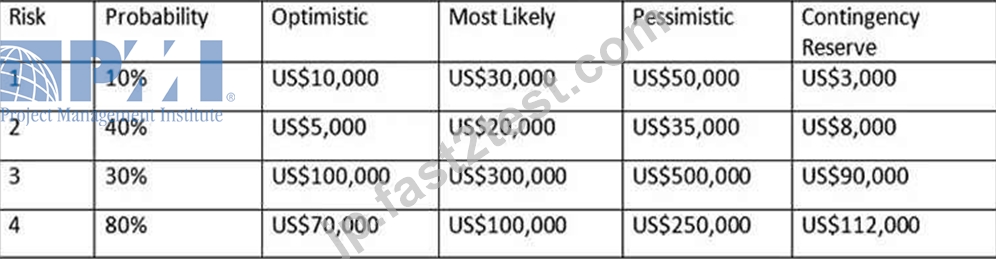
Contingency Reserve Total: US$213,000
Due to a mitigation strategy, Risk 4's probability has been reduced to 40%. What would be the new contingency reserve total?
- A. US$92,400
- B. US$145,800
- C. Unable to calculate a total due to lack of pertinent information.
- D. US$157,000
正解:D
質問 # 63
Which of the following is an effective channel for risk mitigation assistance, project risk visibility and risk escalation support?
- A. Board of directors
- B. Change control board (CCB)
- C. Project management office (PMO)
- D. Project steering committee
正解:B
質問 # 64
What are the supporting elements for effective risk management?
- A. Trained core people, matrix organization, simple scalable process, and tools and techniques
- B. Competent people, supportive organization, simple scalable process, and tools and techniques
- C. Competent people, collaborative organization, rigorous process, and tools and techniques
- D. Competent people, functional organization, policy, and tools and techniques
正解:B
質問 # 65
......
ベストなPMI PMI-RMP学習ガイドと問題集には2025:https://jp.fast2test.com/PMI-RMP-premium-file.html
トップクラスPMI PMI-RMP試験材料で学習ガイド!練習問題バージョンで挑もう:https://drive.google.com/open?id=1n-EFIFguzI26fCovtRRbpyBGSKpvz-DC