

Google Professional-Machine-Learning-Engineer試験問題(更新されたのは2024年)100%リアル問題解答
合格させるGoogle Professional-Machine-Learning-Engineer試験最速合格
この認定を取得するには、候補者は機械学習とクラウドコンピューティングに関連する幅広いトピックをカバーする厳格な試験に合格する必要があります。試験は、複数選択とシナリオベースの質問で構成されており、候補者は試験を完了するために2時間半が与えられます。試験はオンラインで管理されており、世界中のどこからでも取得できます。試験に合格すると、候補者はLinkedInプロファイル、履歴書、またはWebサイトに表示できるデジタルバッジを受け取り、機械学習の分野とGoogle Cloudプラットフォームの習熟度を示していることを示します。この認定は、業界の専門家によって認識され、個人が機械学習とクラウドコンピューティングの分野でキャリアを前進させるのに役立ちます。
質問 # 143
You are developing an ML model in a Vertex Al Workbench notebook. You want to track artifacts and compare models during experimentation using different approaches. You need to rapidly and easily transition successful experiments to production as you iterate on your model implementation. What should you do?
- A. 1 Create a Vertex Al pipeline with parameters you want to track as arguments to your Pipeline Job Use the Metrics. Model, and Dataset artifact types from the Kubeflow Pipelines DSL as the inputs and outputs of the components in your pipeline.
2. Associate the pipeline with your experiment when you submit the job. - B. 1. Initialize the Vertex SDK with the name of your experiment Log parameters and metrics for each experiment, save your dataset to a Cloud Storage bucket and upload the models to Vertex Al Model Registry.
2 After a successful experiment create a Vertex Al pipeline. - C. 1 Initialize the Vertex SDK with the name of your experiment Log parameters and metrics for each experiment, and attach dataset and model artifacts as inputs and outputs to each execution.
2 After a successful experiment create a Vertex Al pipeline. - D. 1 Create a Vertex Al pipeline Use the Dataset and Model artifact types from the Kubeflow Pipelines.DSL as the inputs and outputs of the components in your pipeline.
正解:C
解説:
2. In your training component use the Vertex Al SDK to create an experiment run Configure the log_params and log_metrics functions to track parameters and metrics of your experiment.
質問 # 144
A Data Science team is designing a dataset repository where it will store a large amount of training data commonly used in its machine learning models. As Data Scientists may create an arbitrary number of new datasets every day, the solution has to scale automatically and be cost-effective. Also, it must be possible to explore the data using SQL.
Which storage scheme is MOST adapted to this scenario?
- A. Store datasets as files in Amazon S3.
- B. Store datasets as global tables in Amazon DynamoDB.
- C. Store datasets as tables in a multi-node Amazon Redshift cluster.
- D. Store datasets as files in an Amazon EBS volume attached to an Amazon EC2 instance.
正解:A
質問 # 145
A Machine Learning Specialist must build out a process to query a dataset on Amazon S3 using Amazon Athena. The dataset contains more than 800,000 records stored as plaintext CSV files. Each record contains
200 columns and is approximately 1.5 MB in size. Most queries will span 5 to 10 columns only.
How should the Machine Learning Specialist transform the dataset to minimize query runtime?
- A. Convert the records to Apache Parquet format.
- B. Convert the records to GZIP CSV format.
- C. Convert the records to XML format.
- D. Convert the records to JSON format.
正解:A
解説:
Using compressions will reduce the amount of data scanned by Amazon Athena, and also reduce your S3 bucket storage. It's a Win-Win for your AWS bill. Supported formats: GZIP, LZO, SNAPPY (Parquet) and ZLIB.
Reference: https://www.cloudforecast.io/blog/using-parquet-on-athena-to-save-money-on-aws/
質問 # 146
You deployed an ML model into production a year ago. Every month, you collect all raw requests that were sent to your model prediction service during the previous month. You send a subset of these requests to a human labeling service to evaluate your model'sperformance. After a year, you notice that your model's performance sometimes degrades significantly after a month, while other times it takes several months to notice any decrease in performance. The labeling service is costly, but you also need to avoid large performance degradations. You want to determine how often you should retrain your model to maintain a high level of performance while minimizing cost. What should you do?
- A. Train an anomaly detection model on the training dataset, and run all incoming requests through this model. If an anomaly is detected, send the most recent serving data to the labeling service.
- B. Identify temporal patterns in your model's performance over the previous year. Based on these patterns, create a schedule for sending serving data to the labeling service for the next year.
- C. Compare the cost of the labeling service with the lost revenue due to model performance degradation over the past year. If the lost revenue is greater than the cost of the labeling service, increase the frequency of model retraining; otherwise, decrease the model retraining frequency.
- D. Run training-serving skew detection batch jobs every few days to compare the aggregate statistics of the features in the training dataset with recent serving data. If skew is detected, send the most recent serving data to the labeling service.
正解:D
解説:
The best option for determining how often to retrain your model to maintain a high level of performance while minimizing cost is to run training-serving skew detection batch jobs every few days. Training-serving skew refers to the discrepancy between the distributions of the features in the training dataset and the serving data. This can cause the model to perform poorly on the new data, as it is not representative of the data that the model was trained on. By running training-serving skew detection batch jobs, you can monitor the changes in the feature distributions over time, and identify when the skew becomes significant enough to affect the model performance. If skew is detected, you can send the most recent serving data to the labeling service, and use the labeled data to retrain your model. This option has the following benefits:
* It allows you to retrain your model only when necessary, based on the actual data changes, rather than on a fixed schedule or a heuristic. This can save you the cost of the labeling service and the retraining process, and also avoid overfitting or underfitting your model.
* It leverages the existing tools and frameworks for training-serving skew detection, such as TensorFlow
* Data Validation (TFDV) and Vertex Data Labeling. TFDV is a library that can compute and visualize descriptive statistics for your datasets, and compare the statistics across different datasets. Vertex Data Labeling is a service that can label your data with high quality and low latency, using either human labelers or automated labelers.
* It integrates well with the MLOps practices, such as continuous integration and continuous delivery (CI/CD), which can automate the workflow of running the skew detection jobs, sending the data to the labeling service, retraining the model, and deploying the new model version.
The other options are less optimal for the following reasons:
* Option A: Training an anomaly detection model on the training dataset, and running all incoming requests through this model, introduces additional complexity and overhead. This option requires building and maintaining a separate model for anomaly detection, which can be challenging and time-consuming. Moreover, this option requires running the anomaly detection model on every request, which can increase the latency and resource consumption of the prediction service. Additionally, this option may not capture the subtle changes in the feature distributions that can affect the model performance, as anomalies are usually defined as rare or extreme events.
* Option B: Identifying temporal patterns in your model's performance over the previous year, and creating a schedule for sending serving data to the labeling service for the next year, introduces additional assumptions and risks. This option requires analyzing the historical data and model performance, and finding the patterns that can explain the variations in the model performance over time. However, this can be difficult and unreliable, as the patterns may not be consistent or predictable, and may depend on various factors that are not captured by the data. Moreover, this option requires creating a schedule based on the past patterns, which may not reflect the future changes in the data or the environment. This can lead to either sending too much or too little data to the labeling service, resulting in either wasted cost or degraded performance.
* Option C: Comparing the cost of the labeling service with the lost revenue due to model performance degradation over the past year, and adjusting the frequency of model retraining accordingly, introduces additional challenges and trade-offs. This option requires estimating the cost of the labeling service and the lost revenue due to model performance degradation, which can be difficult and inaccurate, as they may depend on various factors that are not easily quantifiable or measurable. Moreover, this option requires finding the optimal balance between the cost and the performance, which can be subjective and variable, as different stakeholders may have different preferences and expectations. Furthermore, this option may not account for the potential impact of the model performance degradation on other aspects of the business, such as customer satisfaction, retention, or loyalty.
質問 # 147
You work at a large organization that recently decided to move their ML and data workloads to Google Cloud. The data engineering team has exported the structured data to a Cloud Storage bucket in Avro format. You need to propose a workflow that performs analytics, creates features, and hosts the features that your ML models use for online prediction How should you configure the pipeline?
- A. Ingest the Avro files into Cloud Spanner to perform analytics Use a Dataflow pipeline to create the features and store them in BigQuery for online prediction.
- B. Ingest the Avro files into Cloud Spanner to perform analytics. Use a Dataflow pipeline to create the features. and store them in Vertex Al Feature Store for online prediction.
- C. Ingest the Avro files into BigQuery to perform analytics Use a Dataflow pipeline to create the features, and store them in Vertex Al Feature Store for online prediction.
- D. Ingest the Avro files into BigQuery to perform analytics Use BigQuery SQL to create features and store them in a separate BigQuery table for online prediction.
正解:C
質問 # 148
Your team needs to build a model that predicts whether images contain a driver's license, passport, or credit card. The data engineering team already built the pipeline and generated a dataset composed of 10,000 images with driver's licenses, 1,000 images with passports, and 1,000 images with credit cards. You now have to train a model with the following label map: ['driversjicense', 'passport', 'credit_card']. Which loss function should you use?
- A. Sparse categorical cross-entropy
- B. Binary cross-entropy
- C. Categorical hinge
- D. Categorical cross-entropy
正解:D
解説:
- **Categorical entropy** is better to use when you want to **prevent the model from giving more importance to a certain class**. Or if the **classes are very unbalanced** you will get a better result by using Categorical entropy.
- But **Sparse Categorical Entropy** is a more optimal coice if you have a huge amount of classes, enough to make a lot of memory usage, so since sparse categorical entropy uses less columns it **uses less memory**.
https://stats.stackexchange.com/questions/326065/cross-entropy-vs-sparse-cross-entropy-when-to-use-one-over-the-other
質問 # 149
A city wants to monitor its air quality to address the consequences of air pollution. A Machine Learning Specialist needs to forecast the air quality in parts per million of contaminates for the next 2 days in the city. As this is a prototype, only daily data from the last year is available.
Which model is MOST likely to provide the best results in Amazon SageMaker?
- A. Use the Amazon SageMaker Linear Learner algorithm on the single time series consisting of the full year of data with a predictor_typeof regressor.
- B. Use Amazon SageMaker Random Cut Forest (RCF) on the single time series consisting of the full year of data.
- C. Use the Amazon SageMaker Linear Learner algorithm on the single time series consisting of the full year of data with a predictor_typeof classifier.
- D. Use the Amazon SageMaker k-Nearest-Neighbors (kNN) algorithm on the single time series consisting of the full year of data with a predictor_typeof regressor.
正解:A
解説:
Explanation/Reference: https://aws.amazon.com/blogs/machine-learning/build-a-model-to-predict-the-impact-of-weather- on-urban-air-quality-using-amazon-sagemaker/?ref=Welcome.AI
質問 # 150
Your team is building an application for a global bank that will be used by millions of customers. You built a forecasting model that predicts customers1 account balances 3 days in the future. Your team will use the results in a new feature that will notify users when their account balance is likely to drop below $25. How should you serve your predictions?
- A. 1. Create a Pub/Sub topic for each user
2 Deploy a Cloud Function that sends a notification when your model predicts that a user's account balance will drop below the $25 threshold. - B. 1 Build a notification system on Firebase
- C. 1. Create a Pub/Sub topic for each user
2. Deploy an application on the App Engine standard environment that sends a notification when your model predicts that a user's account balance will drop below the $25 threshold - D. 1. Build a notification system on Firebase
2. Register each user with a user ID on the Firebase Cloud Messaging server, which sends a notification when the average of all account balance predictions drops below the $25 threshold
正解:B
解説:
2. Register each user with a user ID on the Firebase Cloud Messaging server, which sends a notification when your model predicts that a user's account balance will drop below the $25 threshold Explanation:
Firebase is designed for exactly this sort of scenario. Also, it would not be possible to create millions of pubsub topics due to GCP quotas https://cloud.google.com/pubsub/quotas#quotas
https://firebase.google.com/docs/cloud-messaging
質問 # 151
You are building a TensorFlow text-to-image generative model by using a dataset that contains billions of images with their respective captions. You want to create a low maintenance, automated workflow that reads the data from a Cloud Storage bucket collects statistics, splits the dataset into training/validation/test datasets performs data transformations, trains the model using the training/validation datasets. and validates the model by using the test dataset. What should you do?
- A. Use the TensorFlow Extended (TFX) SDK to create multiple components that use Dataflow and Vertex Al services Deploy the workflow on Vertex Al Pipelines.
- B. Use the Apache Airflow SDK to create multiple operators that use Dataflow and Vertex Al services Deploy the workflow on Cloud Composer.
- C. Use the MLFlow SDK and deploy it on a Google Kubernetes Engine Cluster Create multiple components that use Dataflow and Vertex Al services.
- D. Use the Kubeflow Pipelines (KFP) SDK to create multiple components that use Dataflow and Vertex Al services Deploy the workflow on Vertex Al Pipelines.
正解:A
質問 # 152
Your data science team has requested a system that supports scheduled model retraining, Docker containers, and a service that supports autoscaling and monitoring for online prediction requests. Which platform components should you choose for this system?
- A. Vertex AI Pipelines and App Engine
- B. Cloud Composer, BigQuery ML, and Vertex AI Prediction
- C. Vertex AI Pipelines, Vertex AI Prediction, and Vertex AI Model Monitoring
- D. Cloud Composer, Vertex AI Training with custom containers, and App Engine
正解:C
解説:
* Option A is incorrect because Vertex AI Pipelines and App Engine do not meet all the requirements of the system. Vertex AI Pipelines is a service that allows you to create, run, andmanage ML workflows using TensorFlow Extended (TFX) components or custom components1. App Engine is a service that allows you to build and deploy scalable web applications using standard or flexible environments2. However, App Engine does not support Docker containers in the standard environment, and does not provide a dedicated service for online prediction and monitoring of ML models3.
* Option B is correct because Vertex AI Pipelines, Vertex AI Prediction, and Vertex AI Model Monitoring meet all the requirements of the system. Vertex AI Prediction is a service that allows you to deploy and serve ML models for online or batch prediction, with support for autoscaling and custom containers4. Vertex AI Model Monitoring is a service that allows you to monitor the performance and fairness of your deployed models, and get alerts for any issues or anomalies5.
* Option C is incorrect because Cloud Composer, BigQuery ML, and Vertex AI Prediction do not meet all the requirements of the system. Cloud Composer is a service that allows you to create, schedule, and
* manage workflows using Apache Airflow. BigQuery ML is a service that allows you to create and use ML models within BigQuery using SQL queries. However, BigQuery ML does not support custom containers, and Vertex AI Prediction does not support scheduled model retraining or model monitoring.
* Option D is incorrect because Cloud Composer, Vertex AI Training with custom containers, and App Engine do not meet all the requirements of the system. Vertex AI Training is a service that allows you to train ML models using built-in algorithms or custom containers. However, Vertex AI Training does not support online prediction or model monitoring, and App Engine does not support Docker containers in the standard environment or online prediction and monitoring of ML models3.
References:
* Vertex AI Pipelines overview
* App Engine overview
* Choosing an App Engine environment
* Vertex AI Prediction overview
* Vertex AI Model Monitoring overview
* [Cloud Composer overview]
* [BigQuery ML overview]
* [BigQuery ML limitations]
* [Vertex AI Training overview]
質問 # 153
You are designing an architecture with a serverless ML system to enrich customer support tickets with informative metadata before they are routed to a support agent. You need a set of models to predict ticket priority, predict ticket resolution time, and perform sentiment analysis to help agents make strategic decisions when they process support requests. Tickets are not expected to have any domain-specific terms or jargon.
The proposed architecture has the following flow: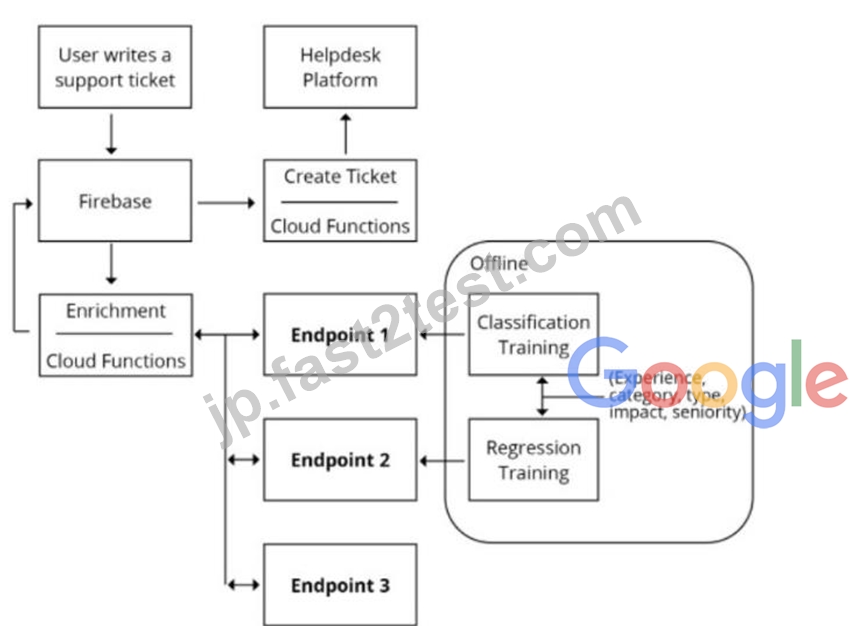
Which endpoints should the Enrichment Cloud Functions call?
- A. 1 = Vertex Al. 2 = Vertex Al. 3 = AutoML Natural Language
- B. 1 = Vertex Al. 2 = Vertex Al. 3 = Cloud Natural Language API
- C. 1 = Cloud Natural Language API. 2 = Vertex Al, 3 = Cloud Vision API
- D. 1 = Vertex Al. 2 = Vertex Al. 3 = AutoML Vision
正解:B
解説:
https://cloud.google.com/architecture/architecture-of-a-serverless-ml-model#architecture The architecture has the following flow:
A user writes a ticket to Firebase, which triggers a Cloud Function.
-The Cloud Function calls 3 different endpoints to enrich the ticket:
-An AI Platform endpoint, where the function can predict the priority.
-An AI Platform endpoint, where the function can predict the resolution time.
-The Natural Language API to do sentiment analysis and word salience.
-For each reply, the Cloud Function updates the Firebase real-time database.
-The Cloud Function then creates a ticket into the helpdesk platform using the RESTful API.
質問 # 154
You work for a toy manufacturer that has been experiencing a large increase in demand. You need to build an ML model to reduce the amount of time spent by quality control inspectors checking for product defects. Faster defect detection is a priority. The factory does not have reliable Wi-Fi. Your company wants to implement the new ML model as soon as possible. Which model should you use?
- A. AutoML Vision Edge mobile-low-latency-1 model
- B. AutoML Vision Edge mobile-high-accuracy-1 model
- C. AutoML Vision model
- D. AutoML Vision Edge mobile-versatile-1 model
正解:C
質問 # 155
You work for a large hotel chain and have been asked to assist the marketing team in gathering predictions for a targeted marketing strategy. You need to make predictions about user lifetime value (LTV) over the next 30 days so that marketing can be adjusted accordingly. The customer dataset is in BigQuery, and you are preparing the tabular data for training with AutoML Tables. This data has a time signal that is spread across multiple columns. How should you ensure that AutoML fits the best model to your data?
- A. Submit the data for training without performing any manual transformations, and indicate an appropriate column as the Time column Allow AutoML to split your data based on the time signal provided, and reserve the more recent data for the validation and testing sets
- B. Manually combine all columns that contain a time signal into an array Allow AutoML to interpret this array appropriately Choose an automatic data split across the training, validation, and testing sets
- C. Submit the data for training without performing any manual transformations Use the columns that have a time signal to manually split your data Ensure that the data in your validation set is from 30 days after the data in your training set and that the data in your testing set is from 30 days after your validation set
- D. Submit the data for training without performing any manual transformations Allow AutoML to handle the appropriate transformations Choose an automatic data split across the training, validation, and testing sets
正解:C
質問 # 156
You work with a team of researchers to develop state-of-the-art algorithms for financial analysis. Your team develops and debugs complex models in TensorFlow. You want to maintain the ease of debugging while also reducing the model training time. How should you set up your training environment?
- A. Configure a v3-8 TPU node Use Cloud Shell to SSH into the Host VM to train and debug the model.
- B. Configure a v3-8 TPU VM SSH into the VM to tram and debug the model.
- C. Configure a M-standard-4 VM with 4 NVIDIA P100 GPUs SSH into the VM and use Parameter Server Strategy to train the model.
- D. Configure a M-standard-4 VM with 4 NVIDIA P100 GPUs SSH into the VM and use MultiWorkerMirroredStrategy to train the model.
正解:B
解説:
A TPU VM is a virtual machine that has direct access to a Cloud TPU device. TPU VMs provide a simpler and more flexible way to use Cloud TPUs, as they eliminate the need for a separate host VM and network setup. TPU VMs also support interactive debugging tools such as TensorFlow Debugger (tfdbg) and Python Debugger (pdb), which can help researchers develop and troubleshoot complex models. A v3-8 TPU VM has
8 TPU cores, which can provide high performance and scalability for training large models. SSHing into the TPU VM allows the user to run and debug the TensorFlow code directly on the TPU device, without any network overhead or data transfer issues. References:
* 1: TPU VMs Overview
* 2: TPU VMs Quickstart
* 3: Debugging TensorFlow Models on Cloud TPUs
質問 # 157
You have been tasked with deploying prototype code to production. The feature engineering code is in PySpark and runs on Dataproc Serverless. The model training is executed by using a Vertex Al custom training job. The two steps are not connected, and the model training must currently be run manually after the feature engineering step finishes. You need to create a scalable and maintainable production process that runs end-to-end and tracks the connections between steps. What should you do?
- A. Create a Vertex Al Workbench notebook Use the notebook to submit the Dataproc Serverless feature engineering job Use the same notebook to submit the custom model training job Run the notebook cells sequentially to tie the steps together end-to-end
- B. Create a Vertex Al Workbench notebook Initiate an Apache Spark context in the notebook, and run the PySpark feature engineering code Use the same notebook to run the custom model training job in TensorFlow Run the notebook cells sequentially to tie the steps together end-to-end
- C. Use the Kubeflow pipelines SDK to write code that specifies two components
- The first is a Dataproc Serverless component that launches the feature engineering job
- The second is a custom component wrapped in the
creare_cusrora_rraining_job_from_ccraponent Utility that launches the custom model training job. - D. Create a Vertex Al Pipelines job to link and run both components Use the Kubeflow pipelines SDK to write code that specifies two components
- The first component initiates an Apache Spark context that runs the PySpark feature engineering code
- The second component runs the TensorFlow custom model training code Create a Vertex Al Pipelines job to link and run both components
正解:C
質問 # 158
Your company manages a video sharing website where users can watch and upload videos. You need to create an ML model to predict which newly uploaded videos will be the most popular so that those videos can be prioritized on your company's website.
Which result should you use to determine whether the model is successful?
- A. The model predicts videos as popular if the user who uploads them has over 10,000 likes.
- B. The Pearson correlation coefficient between the log-transformed number of views after 7 days and 30 days after publication is equal to 0.
- C. The model predicts 95% of the most popular videos measured by watch time within 30 days of being uploaded.
- D. The model predicts 97.5% of the most popular clickbait videos measured by number of clicks.
正解:C
質問 # 159
A company wants to classify user behavior as either fraudulent or normal. Based on internal research, a Machine Learning Specialist would like to build a binary classifier based on two features: age of account and transaction month. The class distribution for these features is illustrated in the figure provided.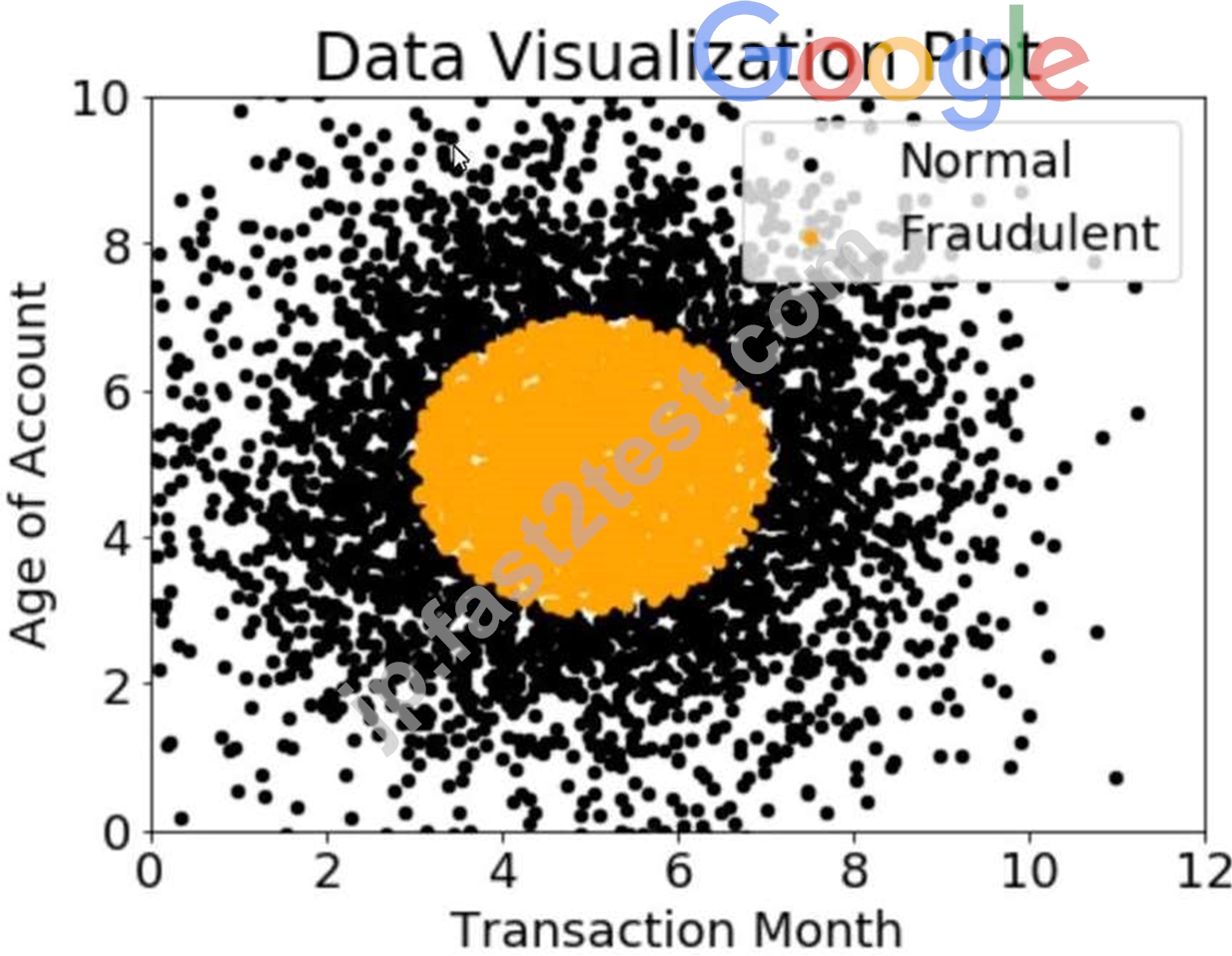
Based on this information, which model would have the HIGHEST accuracy?
- A. Logistic regression
- B. Support vector machine (SVM) with non-linear kernel
- C. Long short-term memory (LSTM) model with scaled exponential linear unit (SELU)
- D. Single perceptron with tanh activation function
正解:B
質問 # 160
You trained a text classification model. You have the following SignatureDefs: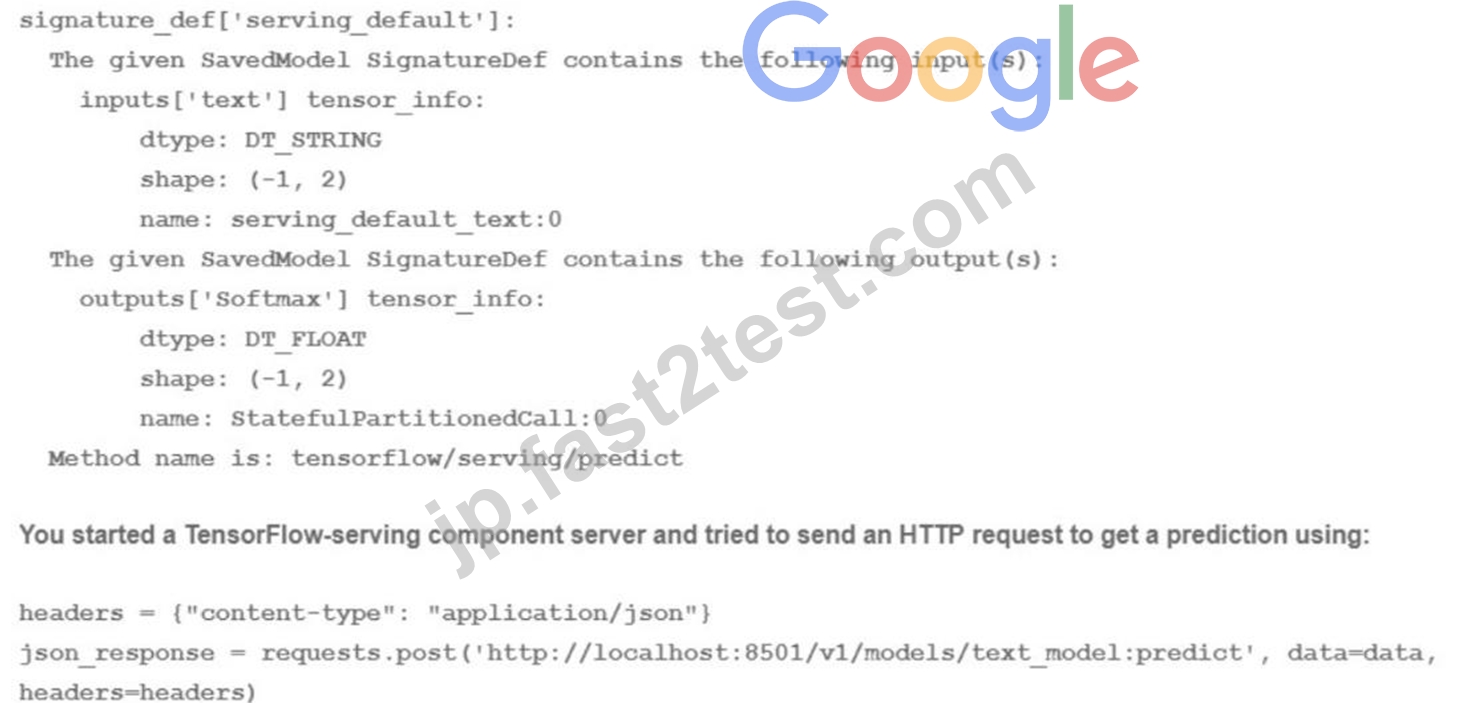
What is the correct way to write the predict request?
- A. data = json.dumps({"signature_name": "serving_default, "instances": [['a', 'b\ 'c'1, [d\ 'e\ T]]})
- B. data = json dumps({"signature_name": f,serving_default", "instances": [['a', 'b'], [c\ 'd'], ['e\ T]]})
- C. data = json.dumps({"signature_name": "serving_default'\ "instances": [fab', 'be1, 'cd']]})
- D. data = json dumps({"signature_name": "serving_default"! "instances": [['a', 'b', "c", 'd', 'e', 'f']]})
正解:B
解説:
https://stackoverflow.com/questions/37956197/what-is-the-negative-index-in-shape-arrays-used-for-tensorflow
質問 # 161
......
Google Professional Machine Learning Engineer認定試験は、Google Cloudプラットフォームで機械学習モデルとシステムの設計と実装に習熟しようとする個人にとって、非常に人気の高い資格です。この認定は、機械学習の概念と機械学習モデルの構築と展開における実践的な経験を持つ強固な基盤を持つ専門家向けに設計されています。
リアルGoogle Professional-Machine-Learning-Engineer試験問題 [更新されたのは2024年]:https://jp.fast2test.com/Professional-Machine-Learning-Engineer-premium-file.html
準備Professional-Machine-Learning-Engineer問題解答でProfessional-Machine-Learning-Engineer試験問題集:https://drive.google.com/open?id=1MD-3imVkYDmM0FOM9RjhWRfP-JuLzlp0