

2023年最新の実際のProfessional-Machine-Learning-Engineer問題集最新Google練習テスト問題集ゲット
Professional-Machine-Learning-Engineer問題集PDFでProfessional-Machine-Learning-Engineerリアル試験問題解答
質問 # 48
A Machine Learning Specialist is required to build a supervised image-recognition model to identify a cat. The ML Specialist performs some tests and records the following results for a neural network-based image classifier:
Total number of images available = 1,000
Test set images = 100 (constant test set)
The ML Specialist notices that, in over 75% of the misclassified images, the cats were held upside down by their owners.
Which techniques can be used by the ML Specialist to improve this specific test error?
- A. Increase the dropout rate for the second-to-last layer.
- B. Increase the number of layers for the neural network.
- C. Increase the training data by adding variation in rotation for training images.
- D. Increase the number of epochs for model training
正解:D
質問 # 49
You were asked to investigate failures of a production line component based on sensor readings. After receiving the dataset, you discover that less than 1% of the readings are positive examples representing failure incidents. You have tried to train several classification models, but none of them converge. How should you resolve the class imbalance problem?
- A. Use the class distribution to generate 10% positive examples
- B. Downsample the data with upweighting to create a sample with 10% positive examples
- C. Use a convolutional neural network with max pooling and softmax activation
- D. Remove negative examples until the numbers of positive and negative examples are equal
正解:C
質問 # 50
A Machine Learning Specialist is using an Amazon SageMaker notebook instance in a private subnet of a corporate VPC. The ML Specialist has important data stored on the Amazon SageMaker notebook instance's Amazon EBS volume, and needs to take a snapshot of that EBS volume. However, the ML Specialist cannot find the Amazon SageMaker notebook instance's EBS volume or Amazon EC2 instance within the VPC.
Why is the ML Specialist not seeing the instance visible in the VPC?
- A. Amazon SageMaker notebook instances are based on the Amazon ECS service within customer accounts.
- B. Amazon SageMaker notebook instances are based on AWS ECS instances running within AWS service accounts.
- C. Amazon SageMaker notebook instances are based on the EC2 instances within the customer account, but they run outside of VPCs.
- D. Amazon SageMaker notebook instances are based on EC2 instances running within AWS service accounts.
正解:D
解説:
Explanation/Reference: https://docs.aws.amazon.com/sagemaker/latest/dg/gs-setup-working-env.html
質問 # 51
Your organization manages an online message board A few months ago, you discovered an increase in toxic language and bullying on the message board. You deployed an automated text classifier that flags certain comments as toxic or harmful. Now some users are reporting that benign comments referencing their religion are being misclassified as abusive Upon further inspection, you find that your classifier's false positive rate is higher for comments that reference certain underrepresented religious groups. Your team has a limited budget and is already overextended. What should you do?
- A. Remove the model and replace it with human moderation.
- B. Replace your model with a different text classifier.
- C. Raise the threshold for comments to be considered toxic or harmful
- D. Add synthetic training data where those phrases are used in non-toxic ways
正解:D
解説:
This approach would help to improve the performance of the classifier by providing it with more examples of the religious phrases being used in non-toxic ways. This would allow the classifier to better differentiate between toxic and non-toxic comments that reference these religious groups. Additionally, synthetic data is a cost-effective way to improve the performance of an existing model without requiring a significant investment in human resources.
質問 # 52
You are an ML engineer at a manufacturing company. You need to build a model that identifies defects in products based on images of the product taken at the end of the assembly line. You want your model to preprocess the images with lower computation to quickly extract features of defects in products. Which approach should you use to build the model?
- A. Reinforcement learning
- B. Recurrent Neural Networks (RNN)
- C. Convolutional Neural Networks (CNN)
- D. Recommender system
正解:C
解説:
Convolutional Neural Networks (CNNs) are well-suited to image classification tasks such as identifying defects in products based on images. CNNs use convolutional layers that effectively extract features from images and can be trained to identify patterns in the images. The architecture of CNNs is optimized for image processing tasks and can be more efficient for extracting features from images than other types of neural networks.
Reinforcement learning is a type of machine learning that is used for problems with a delayed reward, such as game playing or robotics. Recommender system is used for recommending products or content to users based on their preferences. Recurrent Neural Networks (RNNs) are used for sequential data such as time series or natural language processing.
質問 # 53
A Data Engineer needs to build a model using a dataset containing customer credit card information How can the Data Engineer ensure the data remains encrypted and the credit card information is secure?
- A. Use AWS KMS to encrypt the data on Amazon S3 and Amazon SageMaker, and redact the credit card numbers from the customer data with AWS Glue.
- B. Use an IAM policy to encrypt the data on the Amazon S3 bucket and Amazon Kinesis to automatically discard credit card numbers and insert fake credit card numbers.
- C. Use an Amazon SageMaker launch configuration to encrypt the data once it is copied to the SageMaker instance in a VPC. Use the SageMaker principal component analysis (PCA) algorithm to reduce the length of the credit card numbers.
- D. Use a custom encryption algorithm to encrypt the data and store the data on an Amazon SageMaker instance in a VPC. Use the SageMaker DeepAR algorithm to randomize the credit card numbers.
正解:C
解説:
Explanation/Reference: https://docs.aws.amazon.com/sagemaker/latest/dg/pca.html
質問 # 54
You recently joined a machine learning team that will soon release a new project. As a lead on the project, you are asked to determine the production readiness of the ML components. The team has already tested features and data, model development, and infrastructure. Which additional readiness check should you recommend to the team?
- A. Ensure that training is reproducible
- B. Ensure that all hyperparameters are tuned
- C. Ensure that feature expectations are captured in the schema
- D. Ensure that model performance is monitored
正解:A
解説:
https://static.googleusercontent.com/media/research.google.com/en//pubs/archive/aad9f93b86b7addfea4c419b9100c6cdd26cacea.pdf
質問 # 55
You have trained a text classification model in TensorFlow using Al Platform. You want to use the trained model for batch predictions on text data stored in BigQuery while minimizing computational overhead. What should you do?
- A. Export the model to BigQuery ML.
- B. Deploy and version the model on Al Platform.
- C. Use Dataflow with the SavedModel to read the data from BigQuery
- D. Submit a batch prediction job on Al Platform that points to the model location in Cloud Storage.
正解:A
質問 # 56
A company is using Amazon Polly to translate plaintext documents to speech for automated company announcements. However, company acronyms are being mispronounced in the current documents.
How should a Machine Learning Specialist address this issue for future documents?
- A. Convert current documents to SSML with pronunciation tags.
- B. Create an appropriate pronunciation lexicon.
- C. Output speech marks to guide in pronunciation.
- D. Use Amazon Lex to preprocess the text files for pronunciation
正解:A
解説:
Explanation/Reference: https://docs.aws.amazon.com/polly/latest/dg/ssml.html
質問 # 57
You work for a large social network service provider whose users post articles and discuss news. Millions of comments are posted online each day, and more than 200 human moderators constantly review comments and flag those that are inappropriate. Your team is building an ML model to help human moderators check content on the platform. The model scores each comment and flags suspicious comments to be reviewed by a human. Which metric(s) should you use to monitor the model's performance?
- A. Number of messages flagged by the model per minute confirmed as being inappropriate by humans.
- B. Precision and recall estimates based on a random sample of 0.1% of raw messages each minute sent to a human for review
- C. Number of messages flagged by the model per minute
- D. Precision and recall estimates based on a sample of messages flagged by the model as potentially inappropriate each minute
正解:A
質問 # 58
A machine learning (ML) specialist wants to secure calls to the Amazon SageMaker Service API. The specialist has configured Amazon VPC with a VPC interface endpoint for the Amazon SageMaker Service API and is attempting to secure traffic from specific sets of instances and IAM users. The VPC is configured with a single public subnet.
Which combination of steps should the ML specialist take to secure the traffic? (Choose two.)
- A. Add a SageMaker Runtime VPC endpoint interface to the VPC.
- B. Add a VPC endpoint policy to allow access to the IAM users.
- C. Modify the security group on the endpoint network interface to restrict access to the instances.
- D. Modify the ACL on the endpoint network interface to restrict access to the instances.
- E. Modify the users' IAM policy to allow access to Amazon SageMaker Service API calls only.
正解:B、C
解説:
Explanation/Reference: https://aws.amazon.com/blogs/machine-learning/private-package-installation-in-amazon- sagemaker-running-in-internet-free-mode/
質問 # 59
You trained a text classification model. You have the following SignatureDefs: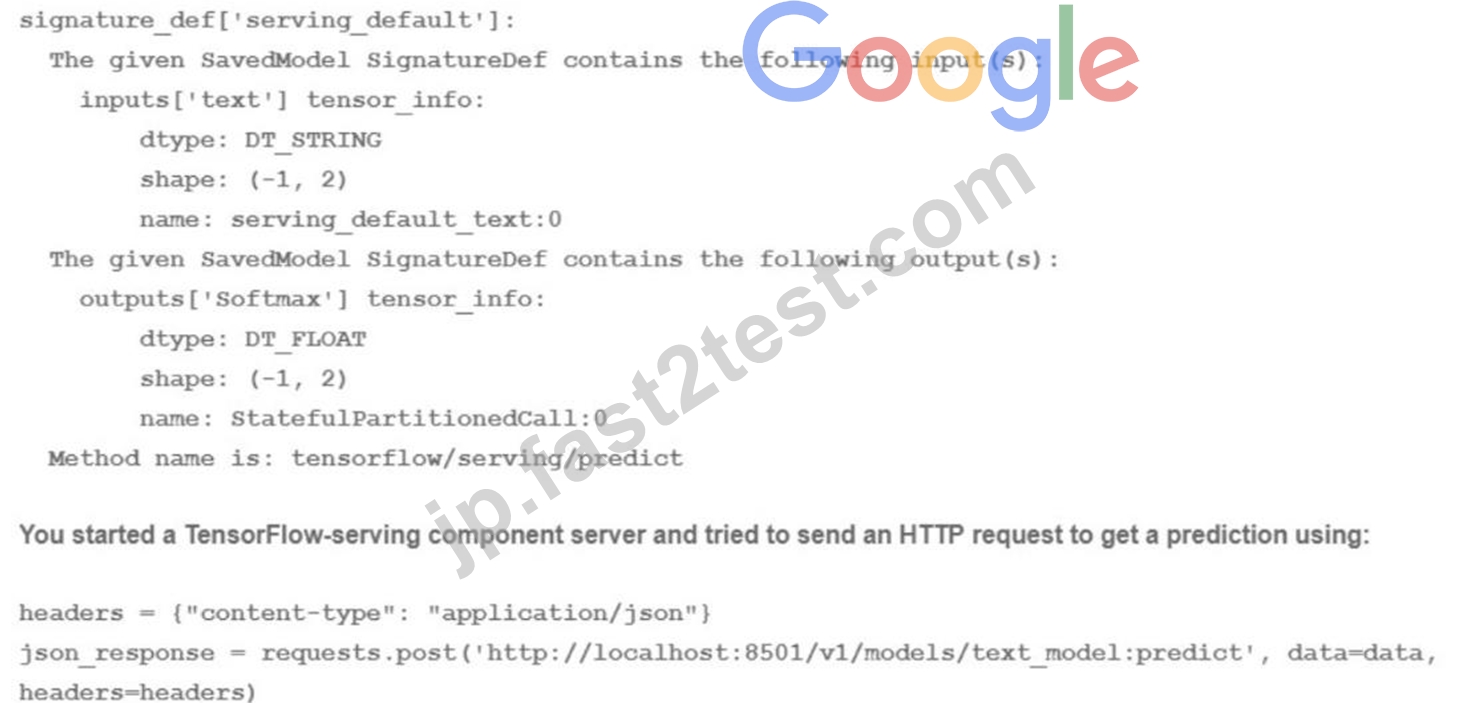
What is the correct way to write the predict request?
- A. data = json.dumps({"signature_name": "serving_default'\ "instances": [fab', 'be1, 'cd']]})
- B. data = json dumps({"signature_name": f,serving_default", "instances": [['a', 'b'], [c\ 'd'], ['e\ T]]})
- C. data = json.dumps({"signature_name": "serving_default, "instances": [['a', 'b\ 'c'1, [d\ 'e\ T]]})
- D. data = json dumps({"signature_name": "serving_default"! "instances": [['a', 'b', "c", 'd', 'e', 'f']]})
正解:C
質問 # 60
A city wants to monitor its air quality to address the consequences of air pollution. A Machine Learning Specialist needs to forecast the air quality in parts per million of contaminates for the next 2 days in the city. As this is a prototype, only daily data from the last year is available.
Which model is MOST likely to provide the best results in Amazon SageMaker?
- A. Use the Amazon SageMaker Linear Learner algorithm on the single time series consisting of the full year of data with a predictor_typeof regressor.
- B. Use the Amazon SageMaker Linear Learner algorithm on the single time series consisting of the full year of data with a predictor_typeof classifier.
- C. Use the Amazon SageMaker k-Nearest-Neighbors (kNN) algorithm on the single time series consisting of the full year of data with a predictor_typeof regressor.
- D. Use Amazon SageMaker Random Cut Forest (RCF) on the single time series consisting of the full year of data.
正解:A
解説:
Explanation/Reference: https://aws.amazon.com/blogs/machine-learning/build-a-model-to-predict-the-impact-of-weather- on-urban-air-quality-using-amazon-sagemaker/?ref=Welcome.AI
質問 # 61
A Machine Learning Specialist must build out a process to query a dataset on Amazon S3 using Amazon Athena. The dataset contains more than 800,000 records stored as plaintext CSV files. Each record contains
200 columns and is approximately 1.5 MB in size. Most queries will span 5 to 10 columns only.
How should the Machine Learning Specialist transform the dataset to minimize query runtime?
- A. Convert the records to XML format.
- B. Convert the records to GZIP CSV format.
- C. Convert the records to JSON format.
- D. Convert the records to Apache Parquet format.
正解:D
解説:
Using compressions will reduce the amount of data scanned by Amazon Athena, and also reduce your S3 bucket storage. It's a Win-Win for your AWS bill. Supported formats: GZIP, LZO, SNAPPY (Parquet) and ZLIB.
Reference: https://www.cloudforecast.io/blog/using-parquet-on-athena-to-save-money-on-aws/
質問 # 62
A Data Science team within a large company uses Amazon SageMaker notebooks to access data stored in Amazon S3 buckets. The IT Security team is concerned that internet-enabled notebook instances create a security vulnerability where malicious code running on the instances could compromise data privacy. The company mandates that all instances stay within a secured VPC with no internet access, and data communication traffic must stay within the AWS network.
How should the Data Science team configure the notebook instance placement to meet these requirements?
- A. Associate the Amazon SageMaker notebook with a private subnet in a VPC. Ensure the VPC has a NAT gateway and an associated security group allowing only outbound connections to Amazon S3 and Amazon SageMaker.
- B. Associate the Amazon SageMaker notebook with a private subnet in a VPC. Use IAM policies to grant access to Amazon S3 and Amazon SageMaker.
- C. Associate the Amazon SageMaker notebook with a private subnet in a VPC. Place the Amazon SageMaker endpoint and S3 buckets within the same VPC.
- D. Associate the Amazon SageMaker notebook with a private subnet in a VPC. Ensure the VPC has S3 VPC endpoints and Amazon SageMaker VPC endpoints attached to it.
正解:D
質問 # 63
You work for a magazine distributor and need to build a model that predicts which customers will renew their subscriptions for the upcoming year. Using your company's historical data as your training set, you created a TensorFlow model and deployed it to AI Platform. You need to determine which customer attribute has the most predictive power for each prediction served by the model. What should you do?
- A. Use the What-If tool in Google Cloud to determine how your model will perform when individual features are excluded. Rank the feature importance in order of those that caused the most significant performance drop when removed from the model.
- B. Use the AI Explanations feature on AI Platform. Submit each prediction request with the 'explain' keyword to retrieve feature attributions using the sampled Shapley method.
- C. Stream prediction results to BigQuery. Use BigQuery's CORR(X1, X2) function to calculate the Pearson correlation coefficient between each feature and the target variable.
- D. Use AI Platform notebooks to perform a Lasso regression analysis on your model, which will eliminate features that do not provide a strong signal.
正解:A
質問 # 64
You are developing models to classify customer support emails. You created models with TensorFlow Estimators using small datasets on your on-premises system, but you now need to train the models using large datasets to ensure high performance. You will port your models to Google Cloud and want to minimize code refactoring and infrastructure overhead for easier migration from on-prem to cloud. What should you do?
- A. Use Kubeflow Pipelines to train on a Google Kubernetes Engine cluster.
- B. Create a Managed Instance Group with autoscaling
- C. Create a cluster on Dataproc for training
- D. Use Al Platform for distributed training
正解:D
解説:
Explanation:
質問 # 65
You are working on a Neural Network-based project. The dataset provided to you has columns with different ranges. While preparing the data for model training, you discover that gradient optimization is having difficulty moving weights to a good solution. What should you do?
- A. Change the partitioning step to reduce the dimension of the test set and have a larger training set.
- B. Use feature construction to combine the strongest features.
- C. Use the representation transformation (normalization) technique.
- D. Improve the data cleaning step by removing features with missing values.
正解:C
解説:
https://developers.google.com/machine-learning/data-prep/transform/transform-numeric
- NN models needs features with close ranges
- SGD converges well using features in [0, 1] scale
- The question specifically mention "different ranges"
Documentation - https://developers.google.com/machine-learning/data-prep/transform/transform-numeric
質問 # 66
You are an ML engineer in the contact center of a large enterprise. You need to build a sentiment analysis tool that predicts customer sentiment from recorded phone conversations. You need to identify the best approach to building a model while ensuring that the gender, age, and cultural differences of the customers who called the contact center do not impact any stage of the model development pipeline and results. What should you do?
- A. Convert the speech to text and extract sentiments based on the sentences
- B. Convert the speech to text and build a model based on the words
- C. Extract sentiment directly from the voice recordings
- D. Convert the speech to text and extract sentiment using syntactical analysis
正解:D
解説:
To ensure that gender, age, and cultural differences of the customers who called the contact center do not impact any stage of the model development pipeline and results, it is important to focus on the meaning and context of the conversation, rather than the characteristics of the speaker.
Converting the speech to text and then using syntactical analysis to extract sentiment will allow you to focus on the meaning and context of the conversation, rather than characteristics of the speaker. This approach will also give you more data to work with, as you can analyze the entire conversation, rather than just the voice recordings.
質問 # 67
You want to rebuild your ML pipeline for structured data on Google Cloud. You are using PySpark to conduct data transformations at scale, but your pipelines are taking over 12 hours to run. To speed up development and pipeline run time, you want to use a serverless tool and SQL syntax. You have already moved your raw data into Cloud Storage. How should you build the pipeline on Google Cloud while meeting the speed and processing requirements?
- A. Ingest your data into BigQuery using BigQuery Load, convert your PySpark commands into BigQuery SQL queries to transform the data, and then write the transformations to a new table
- B. Ingest your data into Cloud SQL convert your PySpark commands into SQL queries to transform the data, and then use federated queries from BigQuery for machine learning
- C. Convert your PySpark into SparkSQL queries to transform the data and then run your pipeline on Dataproc to write the data into BigQuery.
- D. Use Data Fusion's GUI to build the transformation pipelines, and then write the data into BigQuery
正解:C
質問 # 68
You trained a text classification model. You have the following SignatureDefs:
What is the correct way to write the predict request?
- A. data = json.dumps({"signature_name": "serving_default'\ "instances": [fab', 'be1, 'cd']]})
- B. data = json dumps({"signature_name": f,serving_default", "instances": [['a', 'b'], [c\ 'd'], ['e\ T]]})
- C. data = json.dumps({"signature_name": "serving_default, "instances": [['a', 'b\ 'c'1, [d\ 'e\ T]]})
- D. data = json dumps({"signature_name": "serving_default"! "instances": [['a', 'b', "c", 'd', 'e', 'f']]})
正解:D
質問 # 69
You are developing models to classify customer support emails. You created models with TensorFlow Estimators using small datasets on your on-premises system, but you now need to train the models using large datasets to ensure high performance. You will port your models to Google Cloud and want to minimize code refactoring and infrastructure overhead for easier migration from on-prem to cloud. What should you do?
- A. Use Kubeflow Pipelines to train on a Google Kubernetes Engine cluster.
- B. Create a cluster on Dataproc for training
- C. Use Al Platform for distributed training
- D. Create a Managed Instance Group with autoscaling
正解:D
質問 # 70
You developed an ML model with Al Platform, and you want to move it to production. You serve a few thousand queries per second and are experiencing latency issues. Incoming requests are served by a load balancer that distributes them across multiple Kubeflow CPU-only pods running on Google Kubernetes Engine (GKE). Your goal is to improve the serving latency without changing the underlying infrastructure. What should you do?
- A. Switch to the tensorflow-model-server-universal version of TensorFlow Serving
- B. Recompile TensorFlow Serving using the source to support CPU-specific optimizations Instruct GKE to choose an appropriate baseline minimum CPU platform for serving nodes
- C. Significantly increase the max_enqueued_batches TensorFlow Serving parameter
- D. Significantly increase the max_batch_size TensorFlow Serving parameter
正解:D
質問 # 71
You work for a magazine publisher and have been tasked with predicting whether customers will cancel their annual subscription. In your exploratory data analysis, you find that 90% of individuals renew their subscription every year, and only 10% of individuals cancel their subscription. After training a NN Classifier, your model predicts those who cancel their subscription with 99% accuracy and predicts those who renew their subscription with 82% accuracy. How should you interpret these results?
- A. This is a good result because the accuracy across both groups is greater than 80%.
- B. This is not a good result because the model is performing worse than predicting that people will always renew their subscription.
- C. This is not a good result because the model should have a higher accuracy for those who renew their subscription than for those who cancel their subscription.
- D. This is a good result because predicting those who cancel their subscription is more difficult, since there is less data for this group.
正解:D
質問 # 72
You are an ML engineer at a global car manufacturer. You need to build an ML model to predict car sales in different cities around the world. Which features or feature crosses should you use to train city-specific relationships between car type and number of sales?
- A. Three individual features binned latitude, binned longitude, and one-hot encoded car type
- B. One feature obtained as an element-wise product between latitude, longitude, and car type
- C. Two feature crosses as a element-wise product the first between binned latitude and one-hot encoded car type, and the second between binned longitude and one-hot encoded car type
- D. One feature obtained as an element-wise product between binned latitude, binned longitude, and one-hot encoded car type
正解:A
質問 # 73
......
Professional-Machine-Learning-Engineerプレミアム試験エンジンPDFをダウンロード:https://jp.fast2test.com/Professional-Machine-Learning-Engineer-premium-file.html
Professional-Machine-Learning-Engineer試験 [2023] 問題集でGoogleのPDF問題:https://drive.google.com/open?id=1kn30cNTYYoBtm__vzEm2W6Fcmojj-k0u