

2023年10月18日に更新された最新のFast2test Professional-Machine-Learning-Engineer試験問題リアルProfessional-Machine-Learning-Engineer問題集で
Professional-Machine-Learning-Engineer別格な問題集で最上級の成績にさせるProfessional-Machine-Learning-Engineer問題
Google Professional Machine Learning Engineer 認定試験に備えるには、機械学習の概念や技術についての確固たる理解が必要です。また、TensorFlow、Keras、PyTorchなどの人気のある機械学習フレームワークを使用した経験も必要です。さらに、機械学習アプリケーションにおけるこれらのプラットフォームの使用に重点を置いた試験であるため、Google Cloud Platformなどのクラウドコンピューティングプラットフォームにも精通している必要があります。
質問 # 86
A Machine Learning Specialist is packaging a custom ResNet model into a Docker container so the company can leverage Amazon SageMaker for training. The Specialist is using Amazon EC2 P3 instances to train the model and needs to properly configure the Docker container to leverage the NVIDIA GPUs.
What does the Specialist need to do?
- A. Build the Docker container to be NVIDIA-Docker compatible.
- B. Set the GPU flag in the Amazon SageMaker CreateTrainingJob request body.
- C. Bundle the NVIDIA drivers with the Docker image.
- D. Organize the Docker container's file structure to execute on GPU instances.
正解:C
質問 # 87
A Machine Learning Specialist working for an online fashion company wants to build a data ingestion solution for the company's Amazon S3-based data lake.
The Specialist wants to create a set of ingestion mechanisms that will enable future capabilities comprised of:
* Real-time analytics
* Interactive analytics of historical data
* Clickstream analytics
* Product recommendations
Which services should the Specialist use?
- A. Amazon Athena as the data catalog; Amazon Kinesis Data Streams and Amazon Kinesis Data Analytics for historical data insights; Amazon DynamoDB streams for clickstream analytics; AWS Glue to generate personalized product recommendations
- B. AWS Glue as the data catalog; Amazon Kinesis Data Streams and Amazon Kinesis Data Analytics for historical data insights; Amazon Kinesis Data Firehose for delivery to Amazon ES for clickstream analytics; Amazon EMR to generate personalized product recommendations
- C. Amazon Athena as the data catalog: Amazon Kinesis Data Streams and Amazon Kinesis Data Analytics for near-real-time data insights; Amazon Kinesis Data Firehose for clickstream analytics; AWS Glue to generate personalized product recommendations
- D. AWS Glue as the data catalog; Amazon Kinesis Data Streams and Amazon Kinesis Data Analytics for real- time data insights; Amazon Kinesis Data Firehose for delivery to Amazon ES for clickstream analytics; Amazon EMR to generate personalized product recommendations
正解:D
解説:
Explanation
質問 # 88
You are designing an ML recommendation model for shoppers on your company's ecommerce website. You will use Recommendations Al to build, test, and deploy your system. How should you develop recommendations that increase revenue while following best practices?
- A. Use the "Frequently Bought Together' recommendation type to increase the shopping cart size for each order.
- B. Because it will take time to collect and record product data, use placeholder values for the product catalog to test the viability of the model.
- C. Import your user events and then your product catalog to make sure you have the highest quality event stream
- D. Use the "Other Products You May Like" recommendation type to increase the click-through rate
正解:A
解説:
Frequently bought together' recommendations aim to up-sell and cross-sell customers by providing product.
質問 # 89
You work on the data science team for a multinational beverage company. You need to develop an ML model to predict the company's profitability for a new line of naturally flavored bottled waters in different locations. You are provided with historical data that includes product types, product sales volumes, expenses, and profits for all regions. What should you use as the input and output for your model?
- A. Use latitude, longitude, and product type as features. Use revenue and expenses as model outputs.
- B. Use latitude, longitude, and product type as features. Use profit as model output.
- C. Use product type and the feature cross of latitude with longitude, followed by binning, as features. Use profit as model output.
- D. Use product type and the feature cross of latitude with longitude, followed by binning, as features. Use revenue and expenses as model outputs.
正解:C
質問 # 90
Machine Learning Specialist is building a model to predict future employment rates based on a wide range of economic factors. While exploring the data, the Specialist notices that the magnitude of the input features vary greatly. The Specialist does not want variables with a larger magnitude to dominate the model.
What should the Specialist do to prepare the data for model training?
- A. Apply quantile binning to group the data into categorical bins to keep any relationships in the data by replacing the magnitude with distribution.
- B. Apply normalization to ensure each field will have a mean of 0 and a variance of 1 to remove any significant magnitude.
- C. Apply the Cartesian product transformation to create new combinations of fields that are independent of the magnitude.
- D. Apply the orthogonal sparse bigram (OSB) transformation to apply a fixed-size sliding window to generate new features of a similar magnitude.
正解:B
解説:
Explanation/Reference: https://docs.aws.amazon.com/machine-learning/latest/dg/data-transformations-reference.html
質問 # 91
You trained a text classification model. You have the following SignatureDefs: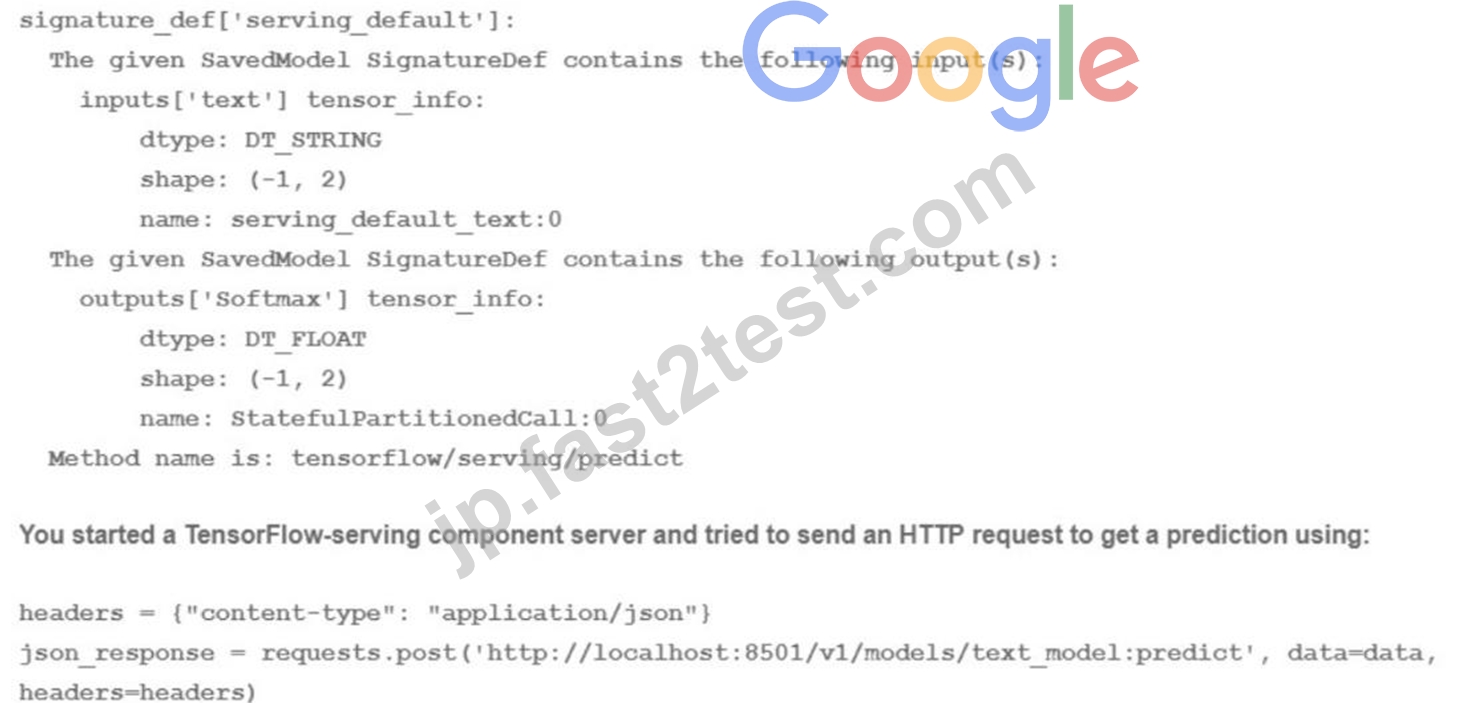
What is the correct way to write the predict request?
- A. data = json dumps({"signature_name": f,serving_default", "instances": [['a', 'b'], [c\ 'd'], ['e\ T]]})
- B. data = json.dumps({"signature_name": "serving_default'\ "instances": [fab', 'be1, 'cd']]})
- C. data = json dumps({"signature_name": "serving_default"! "instances": [['a', 'b', "c", 'd', 'e', 'f']]})
- D. data = json.dumps({"signature_name": "serving_default, "instances": [['a', 'b\ 'c'1, [d\ 'e\ T]]})
正解:D
質問 # 92
You built and manage a production system that is responsible for predicting sales numbers. Model accuracy is crucial, because the production model is required to keep up with market changes. Since being deployed to production, the model hasn't changed; however the accuracy of the model has steadily deteriorated. What issue is most likely causing the steady decline in model accuracy?
- A. Incorrect data split ratio during model training, evaluation, validation, and test
- B. Lack of model retraining
- C. Poor data quality
- D. Too few layers in the model for capturing information
正解:B
解説:
Retraining is needed as the market is changing. its how the Model keep updated and predictions accuracy.
質問 # 93
You are an ML engineer at a global shoe store. You manage the ML models for the company's website. You are asked to build a model that will recommend new products to the user based on their purchase behavior and similarity with other users. What should you do?
- A. Build a classification model
- B. Build a collaborative-based filtering model
- C. Build a regression model using the features as predictors
- D. Build a knowledge-based filtering model
正解:B
解説:
Reference:
https://developers.google.com/machine-learning/recommendation/collaborative/basics
https://cloud.google.com/architecture/recommendations-using-machine-learning-on-compute-engine#filtering_the_data
質問 # 94
Your data science team has requested a system that supports scheduled model retraining, Docker containers, and a service that supports autoscaling and monitoring for online prediction requests. Which platform components should you choose for this system?
- A. Cloud Composer, BigQuery ML, and Vertex AI Prediction
- B. Vertex AI Pipelines, Vertex AI Prediction, and Vertex AI Model Monitoring
- C. Cloud Composer, Vertex AI Training with custom containers, and App Engine
- D. Vertex AI Pipelines and App Engine
正解:D
質問 # 95
You trained a text classification model. You have the following SignatureDefs:
What is the correct way to write the predict request?
- A. data = json dumps({"signature_name": f,serving_default", "instances": [['a', 'b'], [c\ 'd'], ['e\ T]]})
- B. data = json dumps({"signature_name": "serving_default"! "instances": [['a', 'b', "c", 'd', 'e', 'f']]})
- C. data = json.dumps({"signature_name": "serving_default'\ "instances": [fab', 'be1, 'cd']]})
- D. data = json.dumps({"signature_name": "serving_default, "instances": [['a', 'b\ 'c'1, [d\ 'e\ T]]})
正解:B
質問 # 96
Which of the following metrics should a Machine Learning Specialist generally use to compare/evaluate machine learning classification models against each other?
- A. Area Under the ROC Curve (AUC)
- B. Misclassification rate
- C. Recall
- D. Mean absolute percentage error (MAPE)
正解:A
質問 # 97
As the lead ML Engineer for your company, you are responsible for building ML models to digitize scanned customer forms. You have developed a TensorFlow model that converts the scanned images into text and stores them in Cloud Storage. You need to use your ML model on the aggregated data collected at the end of each day with minimal manual intervention. What should you do?
- A. Create a serving pipeline in Compute Engine for prediction
- B. Deploy the model on Al Platform and create a version of it for online inference.
- C. Use the batch prediction functionality of Al Platform
- D. Use Cloud Functions for prediction each time a new data point is ingested
正解:C
解説:
https://cloud.google.com/ai-platform/prediction/docs/batch-predict
質問 # 98
You work for an online publisher that delivers news articles to over 50 million readers. You have built an AI model that recommends content for the company's weekly newsletter. A recommendation is considered successful if the article is opened within two days of the newsletter's published date and the user remains on the page for at least one minute.
All the information needed to compute the success metric is available in BigQuery and is updated hourly. The model is trained on eight weeks of data, on average its performance degrades below the acceptable baseline after five weeks, and training time is 12 hours. You want to ensure that the model's performance is above the acceptable baseline while minimizing cost. How should you monitor the model to determine when retraining is necessary?
- A. Use Vertex AI Model Monitoring to detect skew of the input features with a sample rate of 100% and a monitoring frequency of two days.
- B. Schedule a weekly query in BigQuery to compute the success metric.
- C. Schedule a cron job in Cloud Tasks to retrain the model every week before the newsletter is created.
- D. Schedule a daily Dataflow job in Cloud Composer to compute the success metric.
正解:B
解説:
Scheduling a weekly query in BigQuery to compute the success metric is a cost-effective way to monitor the model's performance. BigQuery allows you to run complex queries on large datasets in a cost-effective and performant manner. By using BigQuery, you can compute the success metric on a regular basis without incurring the additional costs of other services such as Vertex AI or Cloud Composer.
Additionally, by scheduling the query to run weekly, you can ensure that you are monitoring the model's performance in a timely manner, while still providing enough time for the model to degrade below the acceptable baseline. You can then use the results of the query to determine when retraining is necessary.
質問 # 99
You work for a retailer that sells clothes to customers around the world. You have been tasked with ensuring that ML models are built in a secure manner. Specifically, you need to protect sensitive customer data that might be used in the models. You have identified four fields containing sensitive data that are being used by your data science team: AGE, IS_EXISTING_CUSTOMER, LATITUDE_LONGITUDE, and SHIRT_SIZE. What should you do with the data before it is made available to the data science team for training purposes?
- A. Use principal component analysis (PCA) to reduce the four sensitive fields to one PCA vector.
- B. Tokenize all of the fields using hashed dummy values to replace the real values.
- C. Coarsen the data by putting AGE into quantiles and rounding LATITUDE_LONGTTUDE into single precision. The other two fields are already as coarse as possible.
- D. Remove all sensitive data fields, and ask the data science team to build their models using non-sensitive data.
正解:B
質問 # 100
You have built a model that is trained on data stored in Parquet files. You access the data through a Hive table hosted on Google Cloud. You preprocessed these data with PySpark and exported it as a CSV file into Cloud Storage. After preprocessing, you execute additional steps to train and evaluate your model. You want to parametrize this model training in Kubeflow Pipelines. What should you do?
- A. Remove the data transformation step from your pipeline.
- B. Deploy Apache Spark at a separate node pool in a Google Kubernetes Engine cluster. Add a ContainerOp to your pipeline that invokes a corresponding transformation job for this Spark instance.
- C. Add a ContainerOp to your pipeline that spins a Dataproc cluster, runs a transformation, and then saves the transformed data in Cloud Storage.
- D. Containerize the PySpark transformation step, and add it to your pipeline.
正解:B
質問 # 101
A company that promotes healthy sleep patterns by providing cloud-connected devices currently hosts a sleep tracking application on AWS. The application collects device usage information from device users. The company's Data Science team is building a machine learning model to predict if and when a user will stop utilizing the company's devices. Predictions from this model are used by a downstream application that determines the best approach for contacting users.
The Data Science team is building multiple versions of the machine learning model to evaluate each version against the company's business goals. To measure long-term effectiveness, the team wants to run multiple versions of the model in parallel for long periods of time, with the ability to control the portion of inferences served by the models.
Which solution satisfies these requirements with MINIMAL effort?
- A. Build and host multiple models in Amazon SageMaker Neo to take into account different types of medical devices. Programmatically control which model is invoked for inference based on the medical device type.
- B. Build and host multiple models in Amazon SageMaker. Create a single endpoint that accesses multiple models. Use Amazon SageMaker batch transform to control invoking the different models through the single endpoint.
- C. Build and host multiple models in Amazon SageMaker. Create multiple Amazon SageMaker endpoints, one for each model. Programmatically control invoking different models for inference at the application layer.
- D. Build and host multiple models in Amazon SageMaker. Create an Amazon SageMaker endpoint configuration with multiple production variants. Programmatically control the portion of the inferences served by the multiple models by updating the endpoint configuration.
正解:B
質問 # 102
A Machine Learning Specialist wants to determine the appropriate
SageMakerVariantInvocationsPerInstancesetting for an endpoint automatic scaling configuration.
The Specialist has performed a load test on a single instance and determined that peak requests per second (RPS) without service degradation is about 20 RPS. As this is the first deployment, the Specialist intends to set the invocation safety factor to 0.5.
Based on the stated parameters and given that the invocations per instance setting is measured on a per- minute basis, what should the Specialist set as the SageMakerVariantInvocationsPerInstance setting?
- A. 2,400
- B. 0
- C. 1
- D. 2
正解:D
質問 # 103
You need to build classification workflows over several structured datasets currently stored in BigQuery. Because you will be performing the classification several times, you want to complete the following steps without writing code: exploratory data analysis, feature selection, model building, training, and hyperparameter tuning and serving. What should you do?
- A. Use Al Platform Notebooks to run the classification model with pandas library
- B. Run a BigQuery ML task to perform logistic regression for the classification
- C. Use Al Platform to run the classification model job configured for hyperparameter tuning
- D. Configure AutoML Tables to perform the classification task
正解:B
解説:
BigQuery ML supports supervised learning with the logistic regression model type.
質問 # 104
......
Professional-Machine-Learning-Engineer試験問題集でベストProfessional-Machine-Learning-Engineer試験問題を試そう:https://jp.fast2test.com/Professional-Machine-Learning-Engineer-premium-file.html
手に入れよう!最新Professional-Machine-Learning-Engineer認定有効な試験問題集解答:https://drive.google.com/open?id=1MD-3imVkYDmM0FOM9RjhWRfP-JuLzlp0