

[2023年10月21日]Fast2test Professional-Machine-Learning-Engineer試験練習テスト問題(更新された150問あります)
合格させるGoogle Professional-Machine-Learning-Engineer試験情報と無料練習テスト
質問 # 48
Your team has been tasked with creating an ML solution in Google Cloud to classify support requests for one of your platforms. You analyzed the requirements and decided to use TensorFlow to build the classifier so that you have full control of the model's code, serving, and deployment. You will use Kubeflow pipelines for the ML platform. To save time, you want to build on existing resources and use managed services instead of building a completely new model. How should you build the classifier?
- A. Use the Natural Language API to classify support requests
- B. Use an established text classification model on Al Platform as-is to classify support requests
- C. Use AutoML Natural Language to build the support requests classifier
- D. Use an established text classification model on Al Platform to perform transfer learning
正解:D
解説:
the model cannot work as-is as the classes to predict will likely not be the same; we need to use transfer learning to retrain the last layer and adapt it to the classes we need
質問 # 49
A Machine Learning Specialist at a company sensitive to security is preparing a dataset for model training. The dataset is stored in Amazon S3 and contains Personally Identifiable Information (PII).
The dataset:
* Must be accessible from a VPC only.
* Must not traverse the public internet.
How can these requirements be satisfied?
- A. Create a VPC endpoint and use Network Access Control Lists (NACLs) to allow traffic between only the given VPC endpoint and an Amazon EC2 instance.
- B. Create a VPC endpoint and use security groups to restrict access to the given VPC endpoint and an Amazon EC2 instance
- C. Create a VPC endpoint and apply a bucket access policy that allows access from the given VPC endpoint and an Amazon EC2 instance.
- D. Create a VPC endpoint and apply a bucket access policy that restricts access to the given VPC endpoint and the VPC.
正解:D
質問 # 50
You need to build classification workflows over several structured datasets currently stored in BigQuery. Because you will be performing the classification several times, you want to complete the following steps without writing code: exploratory data analysis, feature selection, model building, training, and hyperparameter tuning and serving. What should you do?
- A. Use Al Platform Notebooks to run the classification model with pandas library
- B. Use Al Platform to run the classification model job configured for hyperparameter tuning
- C. Run a BigQuery ML task to perform logistic regression for the classification
- D. Configure AutoML Tables to perform the classification task
正解:A
質問 # 51
A Machine Learning Specialist is implementing a full Bayesian network on a dataset that describes public transit in New York City. One of the random variables is discrete, and represents the number of minutes New Yorkers wait for a bus given that the buses cycle every 10 minutes, with a mean of 3 minutes.
Which prior probability distribution should the ML Specialist use for this variable?
- A. Normal distribution
- B. Uniform distribution
- C. Poisson distribution
- D. Binomial distribution
正解:D
質問 # 52
You work on a data science team at a bank and are creating an ML model to predict loan default risk. You have collected and cleaned hundreds of millions of records worth of training data in a BigQuery table, and you now want to develop and compare multiple models on this data using TensorFlow and Vertex AI. You want to minimize any bottlenecks during the data ingestion state while considering scalability. What should you do?
- A. Use TensorFlow I/O's BigQuery Reader to directly read the data.
- B. Convert the data into TFRecords, and use tf.data.TFRecordDataset() to read them.
- C. Use the BigQuery client library to load data into a dataframe, and use tf.data.Dataset.from_tensor_slices() to read it.
- D. Export data to CSV files in Cloud Storage, and use tf.data.TextLineDataset() to read them.
正解:A
解説:
TensorFlow I/O's BigQuery Reader allows you to directly read data from BigQuery tables into your TensorFlow model without the need to export the data to a separate file format. This can minimize any bottlenecks during the data ingestion stage and also it can increase the scalability. By using BigQuery Reader, you can easily read large amounts of data from BigQuery and use it to train your model without having to worry about the performance impact of reading from a dataframe or CSV file.
You can use the tfio.BigQueryRecordDataset which will return a dataset of dictionaries, and where each key corresponds to a table column and each value corresponds to the value in that column.
質問 # 53
You are training an object detection model using a Cloud TPU v2. Training time is taking longer than expected. Based on this simplified trace obtained with a Cloud TPU profile, what action should you take to decrease training time in a cost-efficient way?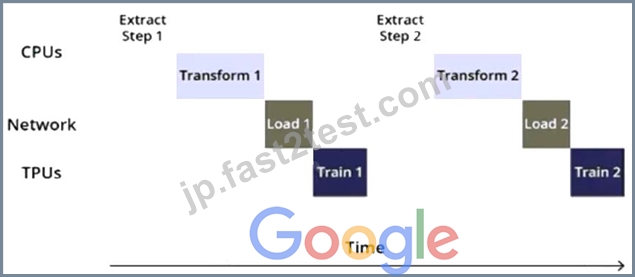
- A. Move from Cloud TPU v2 to 8 NVIDIA V100 GPUs and increase batch size.
- B. Rewrite your input function to resize and reshape the input images.
- C. Rewrite your input function using parallel reads, parallel processing, and prefetch.
- D. Move from Cloud TPU v2 to Cloud TPU v3 and increase batch size.
正解:D
質問 # 54
You are an ML engineer at a bank. You have developed a binary classification model using AutoML Tables to predict whether a customer will make loan payments on time. The output is used to approve or reject loan requests. One customer's loan request has been rejected by your model, and the bank's risks department is asking you to provide the reasons that contributed to the model's decision. What should you do?
- A. Use the correlation with target values in the data summary page.
- B. Use local feature importance from the predictions.
- C. Vary features independently to identify the threshold per feature that changes the classification.
- D. Use the feature importance percentages in the model evaluation page.
正解:D
質問 # 55
You started working on a classification problem with time series data and achieved an area under the receiver operating characteristic curve (AUC ROC) value of 99% for training data after just a few experiments. You haven't explored using any sophisticated algorithms or spent any time on hyperparameter tuning. What should your next step be to identify and fix the problem?
- A. Address data leakage by applying nested cross-validation during model training.
- B. Address the model overfitting by tuning the hyperparameters to reduce the AUC ROC value.
- C. Address the model overfitting by using a less complex algorithm.
- D. Address data leakage by removing features highly correlated with the target value.
正解:A
解説:
https://towardsdatascience.com/time-series-nested-cross-validation-76adba623eb9
質問 # 56
You are designing an architecture with a serverless ML system to enrich customer support tickets with informative metadata before they are routed to a support agent. You need a set of models to predict ticket priority, predict ticket resolution time, and perform sentiment analysis to help agents make strategic decisions when they process support requests. Tickets are not expected to have any domain-specific terms or jargon.
The proposed architecture has the following flow: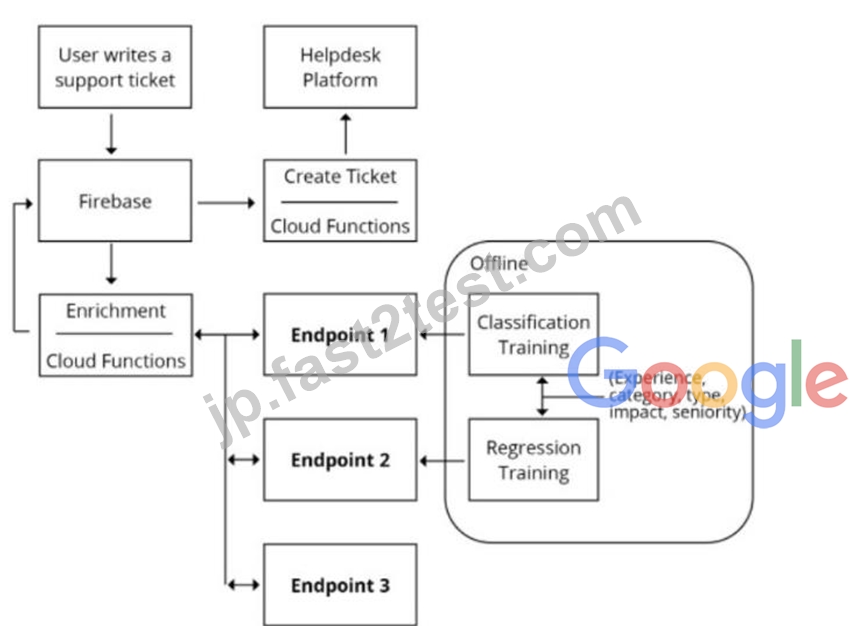
Which endpoints should the Enrichment Cloud Functions call?
- A. 1 = Al Platform, 2 = Al Platform, 3 = AutoML Natural Language
- B. 1 = Al Platform, 2 = Al Platform, 3 = Cloud Natural Language API
- C. 1 = cloud Natural Language API, 2 = Al Platform, 3 = Cloud Vision API
- D. 1 = Al Platform, 2 = Al Platform, 3 = AutoML Vision
正解:B
解説:
https://cloud.google.com/architecture/architecture-of-a-serverless-ml-model#architecture The architecture has the following flow:
A user writes a ticket to Firebase, which triggers a Cloud Function.
-The Cloud Function calls 3 different endpoints to enrich the ticket:
-An AI Platform endpoint, where the function can predict the priority.
-An AI Platform endpoint, where the function can predict the resolution time.
-The Natural Language API to do sentiment analysis and word salience.
-For each reply, the Cloud Function updates the Firebase real-time database.
-The Cloud Function then creates a ticket into the helpdesk platform using the RESTful API.
質問 # 57
You need to execute a batch prediction on 100 million records in a BigQuery table with a custom TensorFlow DNN regressor model, and then store the predicted results in a BigQuery table. You want to minimize the effort required to build this inference pipeline. What should you do?
- A. Load the TensorFlow SavedModel in a Dataflow pipeline. Use the BigQuery I/O connector with a custom function to perform the inference within the pipeline, and write the results to BigQuery.
- B. Import the TensorFlow model with BigQuery ML, and run the ml.predict function.
- C. Create a Dataflow pipeline to convert the data in BigQuery to TFRecords. Run a batch inference on Vertex AI Prediction, and write the results to BigQuery.
- D. Use the TensorFlow BigQuery reader to load the data, and use the BigQuery API to write the results to BigQuery.
正解:B
質問 # 58
You are an ML engineer at a global car manufacturer. You need to build an ML model to predict car sales in different cities around the world. Which features or feature crosses should you use to train city-specific relationships between car type and number of sales?
- A. One feature obtained as an element-wise product between latitude, longitude, and car type
- B. Two feature crosses as a element-wise product the first between binned latitude and one-hot encoded car type, and the second between binned longitude and one-hot encoded car type
- C. One feature obtained as an element-wise product between binned latitude, binned longitude, and one-hot encoded car type
- D. Three individual features binned latitude, binned longitude, and one-hot encoded car type
正解:D
質問 # 59
A data scientist needs to identify fraudulent user accounts for a company's ecommerce platform. The company wants the ability to determine if a newly created account is associated with a previously known fraudulent user.
The data scientist is using AWS Glue to cleanse the company's application logs during ingestion.
Which strategy will allow the data scientist to identify fraudulent accounts?
- A. Search for duplicate accounts in the AWS Glue Data Catalog.
- B. Execute the built-in FindDuplicates Amazon Athena query.
- C. Create a FindMatches machine learning transform in AWS Glue.
- D. Create an AWS Glue crawler to infer duplicate accounts in the source data.
正解:C
解説:
Explanation/Reference: https://docs.aws.amazon.com/glue/latest/dg/machine-learning.html
質問 # 60
You are an ML engineer at a bank. You have developed a binary classification model using AutoML Tables to predict whether a customer will make loan payments on time. The output is used to approve or reject loan requests. One customer's loan request has been rejected by your model, and the bank's risks department is asking you to provide the reasons that contributed to the model's decision. What should you do?
- A. Use the correlation with target values in the data summary page.
- B. Use the feature importance percentages in the model evaluation page.
- C. Use local feature importance from the predictions.
- D. Vary features independently to identify the threshold per feature that changes the classification.
正解:C
解説:
This would allow you to identify which features contributed the most to the model's decision, which would in turn help you to better explain why the model rejected the customer's loan request.
Varying features independently could also be a useful approach, as this would help to identify specific threshold values that change the classification. However, this strategy would be more time-consuming and would not provide as much insight into the inner-workings of the model compared to using local feature importance.
質問 # 61
You are an ML engineer responsible for designing and implementing training pipelines for ML models. You need to create an end-to-end training pipeline for a TensorFlow model. The TensorFlow model will be trained on several terabytes of structured dat a. You need the pipeline to include data quality checks before training and model quality checks after training but prior to deployment. You want to minimize development time and the need for infrastructure maintenance. How should you build and orchestrate your training pipeline?
- A. Create the pipeline using Kubeflow Pipelines domain-specific language (DSL) and predefined Google Cloud components. Orchestrate the pipeline using Kubeflow Pipelines deployed on Google Kubernetes Engine.
- B. Create the pipeline using Kubeflow Pipelines domain-specific language (DSL) and predefined Google Cloud components. Orchestrate the pipeline using Vertex AI Pipelines.
- C. Create the pipeline using TensorFlow Extended (TFX) and standard TFX components. Orchestrate the pipeline using Vertex AI Pipelines.
- D. Create the pipeline using TensorFlow Extended (TFX) and standard TFX components. Orchestrate the pipeline using Kubeflow Pipelines deployed on Google Kubernetes Engine.
正解:C
質問 # 62
You work with a data engineering team that has developed a pipeline to clean your dataset and save it in a Cloud Storage bucket. You have created an ML model and want to use the data to refresh your model as soon as new data is available. As part of your CI/CD workflow, you want to automatically run a Kubeflow Pipelines training job on Google Kubernetes Engine (GKE). How should you architect this workflow?
- A. Configure your pipeline with Dataflow, which saves the files in Cloud Storage After the file is saved, start the training job on a GKE cluster
- B. Use App Engine to create a lightweight python client that continuously polls Cloud Storage for new files As soon as a file arrives, initiate the training job
- C. Use Cloud Scheduler to schedule jobs at a regular interval. For the first step of the job. check the timestamp of objects in your Cloud Storage bucket If there are no new files since the last run, abort the job.
- D. Configure a Cloud Storage trigger to send a message to a Pub/Sub topic when a new file is available in a storage bucket. Use a Pub/Sub-triggered Cloud Function to start the training job on a GKE cluster
正解:D
質問 # 63
You are training a TensorFlow model on a structured data set with 100 billion records stored in several CSV files. You need to improve the input/output execution performance. What should you do?
- A. Load the data into BigQuery and read the data from BigQuery.
- B. Load the data into Cloud Bigtable, and read the data from Bigtable
- C. Convert the CSV files into shards of TFRecords, and store the data in the Hadoop Distributed File System (HDFS)
- D. Convert the CSV files into shards of TFRecords, and store the data in Cloud Storage
正解:B
質問 # 64
A company wants to predict the sale prices of houses based on available historical sales data. The target variable in the company's dataset is the sale price. The features include parameters such as the lot size, living area measurements, non-living area measurements, number of bedrooms, number of bathrooms, year built, and postal code. The company wants to use multi-variable linear regression to predict house sale prices.
Which step should a machine learning specialist take to remove features that are irrelevant for the analysis and reduce the model's complexity?
- A. Plot a histogram of the features and compute their standard deviation. Remove features with high variance.
- B. Run a correlation check of all features against the target variable. Remove features with low target variable correlation scores.
- C. Plot a histogram of the features and compute their standard deviation. Remove features with low variance.
- D. Build a heatmap showing the correlation of the dataset against itself. Remove features with low mutual correlation scores.
正解:B
質問 # 65
A trucking company is collecting live image data from its fleet of trucks across the globe. The data is growing rapidly and approximately 100 GB of new data is generated every day. The company wants to explore machine learning uses cases while ensuring the data is only accessible to specific IAM users.
Which storage option provides the most processing flexibility and will allow access control with IAM?
- A. Configure Amazon EFS with IAM policies to make the data available to Amazon EC2 instances owned by the IAM users.
- B. Setup up Amazon EMR with Hadoop Distributed File System (HDFS) to store the files, and restrict access to the EMR instances using IAM policies.
- C. Use an Amazon S3-backed data lake to store the raw images, and set up the permissions using bucket policies.
- D. Use a database, such as Amazon DynamoDB, to store the images, and set the IAM policies to restrict access to only the desired IAM users.
正解:B
解説:
Explanation
質問 # 66
A Machine Learning Specialist has completed a proof of concept for a company using a small data sample, and now the Specialist is ready to implement an end-to-end solution in AWS using Amazon SageMaker. The historical training data is stored in Amazon RDS.
Which approach should the Specialist use for training a model using that data?
- A. Move the data to Amazon ElastiCache using AWS DMS and set up a connection within the notebook to pull data in for fast access.
- B. Move the data to Amazon DynamoDB and set up a connection to DynamoDB within the notebook to pull data in.
- C. Push the data from Microsoft SQL Server to Amazon S3 using an AWS Data Pipeline and provide the S3 location within the notebook.
- D. Write a direct connection to the SQL database within the notebook and pull data in
正解:C
質問 # 67
......
あなたを合格させるGoogle試験にはProfessional-Machine-Learning-Engineer試験問題集:https://jp.fast2test.com/Professional-Machine-Learning-Engineer-premium-file.html
Professional-Machine-Learning-Engineer試験問題集PDF更新された問題集にはFast2test試験合格保証付き:https://drive.google.com/open?id=1kn30cNTYYoBtm__vzEm2W6Fcmojj-k0u