

あなたを必ず合格させるProfessional-Machine-Learning-Engineer問題集PDF 2025年最新のに更新されたのは290問あります
Google Professional-Machine-Learning-Engineerリアル試験問題と解答を無料で提供いたします
Google Professional Machine Learning Engineer Certificationを取得することは、雇用主やクライアントに対して、Google Cloud Platform上で効果的な機械学習ソリューションを設計および実装するために必要なスキルと知識を持っていることを証明することになります。これは、データサイエンティスト、ソフトウェアエンジニア、およびその他の専門家が機械学習とクラウドコンピューティングのスキルを開発する上で貴重な資格となります。
質問 # 136
You work for a public transportation company and need to build a model to estimate delay times for multiple transportation routes. Predictions are served directly to users in an app in real time. Because different seasons and population increases impact the data relevance, you will retrain the model every month. You want to follow Google-recommended best practices. How should you configure the end-to-end architecture of the predictive model?
- A. Use a model trained and deployed on BigQuery ML and trigger retraining with the scheduled query feature in BigQuery
- B. Configure Kubeflow Pipelines to schedule your multi-step workflow from training to deploying your model.
- C. Use Cloud Composer to programmatically schedule a Dataflow job that executes the workflow from training to deploying your model
- D. Write a Cloud Functions script that launches a training and deploying job on Ai Platform that is triggered by Cloud Scheduler
正解:A
質問 # 137
You are designing an architecture with a serverless ML system to enrich customer support tickets with informative metadata before they are routed to a support agent. You need a set of models to predict ticket priority, predict ticket resolution time, and perform sentiment analysis to help agents make strategic decisions when they process support requests. Tickets are not expected to have any domain-specific terms or jargon.
The proposed architecture has the following flow: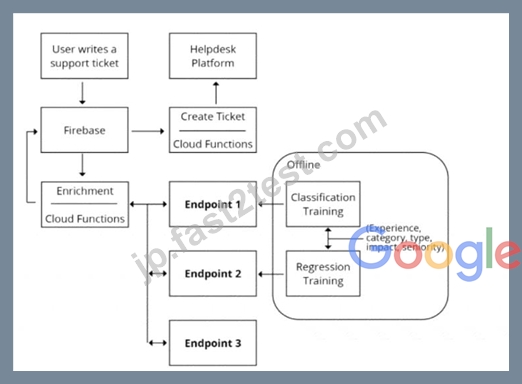
Which endpoints should the Enrichment Cloud Functions call?
- A. 1 = Vertex Al. 2 = Vertex Al. 3 = AutoML Natural Language
- B. 1 = Vertex Al. 2 = Vertex Al. 3 = Cloud Natural Language API
- C. 1 = Vertex Al. 2 = Vertex Al. 3 = AutoML Vision
- D. 1 = Cloud Natural Language API. 2 = Vertex Al, 3 = Cloud Vision API
正解:B
解説:
Vertex AI is a unified platform for building and deploying ML models on Google Cloud. It supports both custom and AutoML models, and provides various tools and services for ML development, such as Vertex Pipelines, Vertex Vizier, Vertex Explainable AI, and Vertex Feature Store. Vertex AI can be used to create models for predicting ticket priority and resolution time, as these are domain-specific tasks that require custom training data and evaluation metrics. Cloud Natural Language API is a pre-trained service that provides natural language understanding capabilities, such as sentiment analysis, entity analysis, syntax analysis, and content classification. Cloud Natural Language API can be used toperform sentiment analysis on the support tickets, as this is a general task that does not require domain-specific knowledge or jargon. The other options are not suitable for the given architecture. AutoML Natural Language and AutoML Vision are services that allow users to create custom natural language and vision models using their own data and labels. They are not needed for sentiment analysis, as Cloud Natural Language API already provides this functionality. Cloud Vision API is a pre-trained service that provides image analysis capabilities, such as object detection, face detection, text detection, and image labeling. It is not relevant for the support tickets, as they are not expected to have any images. References:
* Vertex AI documentation
* Cloud Natural Language API documentation
質問 # 138
Your work for a textile manufacturing company. Your company has hundreds of machines and each machine has many sensors. Your team used the sensory data to build hundreds of ML models that detect machine anomalies Models are retrained daily and you need to deploy these models in a cost-effective way. The models must operate 24/7 without downtime and make sub millisecond predictions. What should you do?
- A. Deploy a Dataflow batch pipeline with the Runlnference API. and use model refresh.
- B. Deploy a Dataflow streaming pipeline and a Vertex Al Prediction endpoint with autoscaling.
- C. Deploy a Dataflow streaming pipeline with the Runlnference API and use automatic model refresh.
- D. Deploy a Dataflow batch pipeline and a Vertex Al Prediction endpoint.
正解:C
解説:
A Dataflow streaming pipeline is a cost-effective way to process large volumes of real-time data from sensors. The RunInference API is a Dataflow transform that allows you to run online predictions on your streaming data using your ML models. By using the RunInference API, you can avoid the latency and cost of using a separate prediction service. The automatic model refresh feature enables you to update your models in the pipeline without redeploying the pipeline. This way, you can ensure that your models are always up-to-date and accurate. By deploying a Dataflow streaming pipeline with the RunInference API and using automatic model refresh, you can achieve sub-millisecond predictions, 24/7 availability, and low operational overhead for your ML models. Reference:
Dataflow documentation
RunInference API documentation
Automatic model refresh documentation
Preparing for Google Cloud Certification: Machine Learning Engineer Professional Certificate
質問 # 139
A Machine Learning Specialist wants to determine the appropriate
SageMakerVariantInvocationsPerInstancesetting for an endpoint automatic scaling configuration.
The Specialist has performed a load test on a single instance and determined that peak requests per second (RPS) without service degradation is about 20 RPS. As this is the first deployment, the Specialist intends to set the invocation safety factor to 0.5.
Based on the stated parameters and given that the invocations per instance setting is measured on a per- minute basis, what should the Specialist set as the SageMakerVariantInvocationsPerInstance setting?
- A. 0
- B. 1
- C. 2,400
- D. 2
正解:B
質問 # 140
You have trained a text classification model in TensorFlow using Al Platform. You want to use the trained model for batch predictions on text data stored in BigQuery while minimizing computational overhead. What should you do?
- A. Export the model to BigQuery ML.
- B. Deploy and version the model on Al Platform.
- C. Submit a batch prediction job on Al Platform that points to the model location in Cloud Storage.
- D. Use Dataflow with the SavedModel to read the data from BigQuery
正解:A
質問 # 141
Your organization wants to make its internal shuttle service route more efficient. The shuttles currently stop at all pick-up points across the city every 30 minutes between 7 am and 10 am. The development team has already built an application on Google Kubernetes Engine that requires users to confirm their presence and shuttle station one day in advance. What approach should you take?
- A. 1. Build a reinforcement learning model with tree-based classification models that predict the presence of passengers at shuttle stops as agents and a reward function around a distance-based metric
2. Dispatch an appropriately sized shuttle and provide the map with the required stops based on the simulated outcome. - B. 1. Build a tree-based regression model that predicts how many passengers will be picked up at each shuttle station.
2. Dispatch an appropriately sized shuttle and provide the map with the required stops based on the prediction. - C. 1. Build a tree-based classification model that predicts whether the shuttle should pick up passengers at each shuttle station.
2. Dispatch an available shuttle and provide the map with the required stops based on the prediction - D. 1. Define the optimal route as the shortest route that passes by all shuttle stations with confirmed attendance at the given time under capacity constraints.
2 Dispatch an appropriately sized shuttle and indicate the required stops on the map
正解:B
解説:
This answer is correct because it uses a regression model to estimate the number of passengers at each shuttle station, which is a continuous variable. A tree-based regression model can handle both numerical and categorical features, such as the time of day, the location of the station, and the weather conditions. Based on the predicted number of passengers, the organization can dispatch a shuttle that has enough capacity and provide a map that shows the required stops. This way, the organization can optimize the shuttle service route and reduce the waiting time and fuel consumption. Reference:
[Tree-based regression models]
質問 # 142
You are developing an ML model in a Vertex Al Workbench notebook. You want to track artifacts and compare models during experimentation using different approaches. You need to rapidly and easily transition successful experiments to production as you iterate on your model implementation. What should you do?
- A. 1 Create a Vertex Al pipeline Use the Dataset and Model artifact types from the Kubeflow Pipelines.DSL as the inputs and outputs of the components in your pipeline.
- B. 1. Initialize the Vertex SDK with the name of your experiment Log parameters and metrics for each experiment, save your dataset to a Cloud Storage bucket and upload the models to Vertex Al Model Registry.
2 After a successful experiment create a Vertex Al pipeline. - C. 1 Create a Vertex Al pipeline with parameters you want to track as arguments to your Pipeline Job Use the Metrics. Model, and Dataset artifact types from the Kubeflow Pipelines DSL as the inputs and outputs of the components in your pipeline.
2. Associate the pipeline with your experiment when you submit the job. - D. 1 Initialize the Vertex SDK with the name of your experiment Log parameters and metrics for each experiment, and attach dataset and model artifacts as inputs and outputs to each execution.
2 After a successful experiment create a Vertex Al pipeline.
正解:D
解説:
2. In your training component use the Vertex Al SDK to create an experiment run Configure the log_params and log_metrics functions to track parameters and metrics of your experiment.
質問 # 143
You created a model that uses BigQuery ML to perform linear regression. You need to retrain the model on the cumulative data collected every week. You want to minimize the development effort and the scheduling cost. What should you do?
- A. Use the BigQuery API Connector and Cloud Scheduler to trigger. Workflows every week that retrains the model.
- B. Create a pipeline in Vertex Al Pipelines that executes the retraining query and use the Cloud Scheduler API to run the query weekly.
- C. Use Cloud Scheduler to trigger a Cloud Function every week that runs the query for retraining the model.
- D. Use BigQuerys scheduling service to run the model retraining query periodically.
正解:B
解説:
BigQuery is a serverless data warehouse that allows you to perform SQL queries on large-scale data.
BigQuery ML is a feature of BigQuery that enables you to create and execute machine learning models using standard SQL queries. You can use BigQuery ML to perform linear regression on your data and create a model. BigQuery also provides a scheduling service that allows you to create and manage recurring SQL queries. You can use BigQuery's scheduling service to run the model retraining query periodically, such as every week. You can specify the destination table for the query results, and the schedule options, such as start date, end date, frequency, and time zone. You can also monitor the status and history of your scheduled queries. This solution can help you retrain the model on the cumulative data collected every week, while minimizing the development effort and the scheduling cost. References:
* BigQuery ML | Google Cloud
* Scheduling queries | BigQuery
質問 # 144
Your company manages an application that aggregates news articles from many different online sources and sends them to users. You need to build a recommendation model that will suggest articles to readers that are similar to the articles they are currently reading. Which approach should you use?
- A. Encode all articles into vectors using word2vec, and build a model that returns articles based on vector similarity.
- B. Manually label a few hundred articles, and then train an SVM classifier based on the manually classified articles that categorizes additional articles into their respective categories.
- C. Create a collaborative filtering system that recommends articles to a user based on the user's past behavior.
- D. Build a logistic regression model for each user that predicts whether an article should be recommended to a user.
正解:C
質問 # 145
You are developing an ML model that uses sliced frames from video feed and creates bounding boxes around specific objects. You want to automate the following steps in your training pipeline: ingestion and preprocessing of data in Cloud Storage, followed by training and hyperparameter tuning of the object model using Vertex AI jobs, and finallydeploying the model to an endpoint. You want to orchestrate the entire pipeline with minimal cluster management. What approach should you use?
- A. Use Vertex AI Pipelines with Kubeflow Pipelines SDK.
- B. Use Kubeflow Pipelines on Google Kubernetes Engine.
- C. Use Cloud Composer for the orchestration.
- D. Use Vertex AI Pipelines with TensorFlow Extended (TFX) SDK.
正解:D
解説:
* Option A is incorrect because using Kubeflow Pipelines on Google Kubernetes Engine is not the most convenient way to orchestrate the entire pipeline with minimal cluster management. Kubeflow Pipelines is an open-source platform that allows you to build, run, and manage ML pipelines using containers1. Google Kubernetes Engine is a service that allows you to create and manage clusters of virtual machines that run Kubernetes, an open-source system for orchestrating containerized applications2. However, this option requires more effort and resources than option B, as it involves creating and configuring the clusters, installing and maintaining Kubeflow Pipelines, and writing and running the pipeline code.
* Option B is correct because using Vertex AI Pipelines with TensorFlow Extended (TFX) SDK is the best way to orchestrate the entire pipeline with minimal cluster management. Vertex AI Pipelines is a service that allows you to create and run scalable and portable ML pipelines on Google Cloud3. TensorFlow Extended (TFX) is a framework that provides a set of components and libraries for building production-ready ML pipelines using TensorFlow4. You can use Vertex AI Pipelines with TFX SDK to ingest and preprocess the data in Cloud Storage, train and tune the object model using Vertex AI jobs, and deploy the model to an endpoint, using predefined or custom components. Vertex AI Pipelines handles the underlying infrastructure and orchestration for you, so you don't need to worry about cluster management or scalability.
* Option C is incorrect because using Vertex AI Pipelines with Kubeflow Pipelines SDK is not the most suitable way to orchestrate the entire pipeline with minimal cluster management. Kubeflow Pipelines SDK is a library that allows you to build and run ML pipelines using Kubeflow Pipelines5. You can use Vertex AI Pipelines with Kubeflow Pipelines SDK to create and run ML pipelines on Google Cloud, using containers. However, this option is less convenient and consistent than option B, as it requires you to use different APIs and tools for different steps of the pipeline, such as Vertex AI SDK for training and deployment, and Kubeflow Pipelines SDK for ingestion and preprocessing. Moreover, this option does not leverage the benefits of TFX, such as the standard components, the metadata store, or the ML Metadata library.
* Option D is incorrect because using Cloud Composer for the orchestration is not the most efficient way to orchestrate the entire pipeline with minimal cluster management. Cloud Composer is a service that allows you to create and run workflows using Apache Airflow, an open-source platform for
* orchestrating complex tasks. You can use Cloud Composer to orchestrate the entire pipeline, by creating and managing DAGs (directed acyclic graphs) that define the dependencies and order of the tasks.
However, this option is more complex andcostly than option B, as it involves creating and configuring the environments, installing and maintaining Airflow, and writing and running the DAGs.
References:
* Kubeflow Pipelines documentation
* Google Kubernetes Engine documentation
* Vertex AI Pipelines documentation
* TensorFlow Extended documentation
* Kubeflow Pipelines SDK documentation
* [Cloud Composer documentation]
* [Vertex AI documentation]
* [Cloud Storage documentation]
* [TensorFlow documentation]
質問 # 146
You work for a large retailer and you need to build a model to predict customer churn. The company has a dataset of historical customer data, including customer demographics, purchase history, and website activity.
You need to create the model in BigQuery ML and thoroughly evaluate its performance. What should you do?
- A. Create a linear regression model in BigQuery ML and register the model in Vertex Al Model Registry Evaluate the model performance in Vertex Al.
- B. Create a logistic regression model in BigQuery ML and register the model in Vertex Al Model Registry.
Evaluate the model performance in Vertex Al. - C. Create a logistic regression model in BigQuery ML Use the ml.confusion_matrix function to evaluate the model performance.
- D. Create a linear regression model in BigQuery ML Use the ml. evaluate function to evaluate the model performance.
正解:B
解説:
Customer churn is a binary classification problem, where the target variable is whether a customer has churned or not. Therefore, a logistic regression model is more suitable than a linear regression model, which is used for regression problems. A logistic regression model can output the probability of a customer churning, which can be used to rank the customers by their churn risk and take appropriate actions1.
BigQuery ML is a service that allows you to create and execute machine learning models in BigQuery using standard SQL queries2. You can use BigQuery ML to create a logistic regression model for customer churn prediction by using the CREATE MODEL statement and specifying the LOGISTIC_REG model type3. You can use the historical customer data as the input table for the model, and specify the features and the label columns3.
Vertex AI Model Registry is a central repository where you can manage the lifecycle of your ML models4. You can import models from various sources, such as BigQuery ML, AutoML, or custom models, and assign them to different versions and aliases4. You can also deploy models to endpoints, which are resources that provide a service URL for online prediction.
By registering the BigQuery ML model in Vertex AI Model Registry, you can leverage the Vertex AI features to evaluate and monitor the model performance4. You can use Vertex AI Experiments to track and compare the metrics of different model versions, such as accuracy, precision, recall, and AUC. You can also use Vertex AI Explainable AI to generate feature attributions that show how much each input feature contributed to the model's prediction.
The other options are not suitable for your scenario, because they either use the wrong model type, such as linear regression, or they do not use Vertex AI to evaluate the model performance, which would limit the insights and actions you can take based on the model results.
References:
* Logistic Regression for Machine Learning
* Introduction to BigQuery ML | Google Cloud
* Creating a logistic regression model | BigQuery ML | Google Cloud
* Introduction to Vertex AI Model Registry | Google Cloud
* [Deploy a model to an endpoint | Vertex AI | Google Cloud]
* [Vertex AI Experiments | Google Cloud]
質問 # 147
Your data science team is training a PyTorch model for image classification based on a pre-trained RestNet model. You need to perform hyperparameter tuning to optimize for several parameters. What should you do?
- A. Convert the model to a TensorFlow model, and run a hyperparameter tuning job on AI Platform.
- B. Create a Kuberflow Pipelines instance, and run a hyperparameter tuning job on Katib.
- C. Run a hyperparameter tuning job on AI Platform using custom containers.
- D. Convert the model to a Keras model, and run a Keras Tuner job.
正解:C
解説:
AI Platform supports hyperparameter tuning for PyTorch models using custom containers. This allows you to use any Python dependencies and libraries that are not included in the pre-built AI Platform Training runtime versions. You can also use a pre-trained model such as ResNet as a base for your custom model. To run a hyperparameter tuning job on AI Platform using custom containers, you need to do the following steps:
Create a Dockerfile that defines the container image for your training application. The Dockerfile should install PyTorch and any other dependencies, copy your training code and configuration files, and set the entrypoint for the container.
Build the container image and push it to Container Registry or another accessible registry.
Create a YAML file that defines the configuration for your hyperparameter tuning job. The YAML file should specify the container image URI, the training input and output paths, the hyperparameters to tune, the metric to optimize, and the tuning algorithm and budget.
Submit the hyperparameter tuning job to AI Platform using the gcloud command-line tool or the AI Platform Training API.
Reference:
Hyperparameter tuning overview
Using custom containers
PyTorch on AI Platform Training
質問 # 148
You work for a retail company. You have created a Vertex Al forecast model that produces monthly item sales predictions. You want to quickly create a report that will help to explain how the model calculates the predictions. You have one month of recent actual sales data that was not included in the training dataset. How should you generate data for your report?
- A. Train another model by using the same training dataset as the original and exclude some columns. Using the actual sales data create one batch prediction job by using the new model and another one with the original model Compare the two sets of predictions in the report.
- B. Create a batch prediction job by using the actual sates data and configure the job settings to generate feature attributions. Compare the results in the report.
- C. Generate counterfactual examples by using the actual sales data Create a batch prediction job using the actual sales data and the counterfactual examples Compare the results in the report.
- D. Create a batch prediction job by using the actual sales data Compare the predictions to the actuals in the report.
正解:B
解説:
According to the official exam guide1, one of the skills assessed in the exam is to "explain the predictions of a trained model". Vertex AI provides feature attributions using Shapley Values, a cooperative game theory algorithm that assigns credit to each feature in a model for a particular outcome2. Feature attributions can help you understand how the model calculates the predictions and debug or optimize the model accordingly. You can use Forecasting with AutoML or Tabular Workflow for Forecasting to generate and query local feature attributions2. The other options are not relevant or optimal for this scenario. Reference:
Professional ML Engineer Exam Guide
Feature attributions for forecasting
Google Professional Machine Learning Certification Exam 2023
Latest Google Professional Machine Learning Engineer Actual Free Exam Questions
質問 # 149
You are building a custom image classification model and plan to use Vertex Al Pipelines to implement the end-to-end training. Your dataset consists of images that need to be preprocessed before they can be used to train the model. The preprocessing steps include resizing the images, converting them to grayscale, and extracting features. You have already implemented some Python functions for the preprocessing tasks. Which components should you use in your pipeline'?
- A.

- B.

- C.

- D.

正解:B
質問 # 150
You recently built the first version of an image segmentation model for a self-driving car. After deploying the model, you observe a decrease in the area under the curve (AUC) metric. When analyzing the video recordings, you also discover that the model fails in highly congested traffic but works as expected when there is less traffic. What is the most likely reason for this result?
- A. AUC is not the correct metric to evaluate this classification model.
- B. Too much data representing congested areas was used for model training.
- C. The model is overfitting in areas with less traffic and underfitting in areas with more traffic.
- D. Gradients become small and vanish while backpropagating from the output to input nodes.
正解:C
解説:
The most likely reason for the observed result is that the model is overfitting in areas with less traffic and underfitting in areas with more traffic. Overfitting means that the model learns the specific patterns and noise in the training data, but fails to generalize well to new and unseen data. Underfitting means that the model is not able to capture the complexity and variability of the data, and performs poorly on both training and test data. In this case, the model might have learned to segment the images well when there is less traffic, but it might not have enough data or features to handle the more challenging scenarios when there is more traffic. This could lead to a decrease in the AUC metric, which measures the ability of the model to distinguish between different classes. AUC is a suitable metric for this classification model, as it is not affected by class imbalance or threshold selection. The other options are not likely to be the reason for the result, as they are not related to the traffic density. Too much data representing congested areas would not cause the model to fail in those areas, but rather help the model learn better. Gradients vanishing or exploding is a problem that occurs during the training process, not after the deployment, and it affects the whole model, not specific scenarios. Reference:
Image Segmentation: U-Net For Self Driving Cars
Intelligent Semantic Segmentation for Self-Driving Vehicles Using Deep Learning Sharing Pixelopolis, a self-driving car demo from Google I/O built with TensorFlow Lite Google Cloud launches machine learning engineer certification Google Professional Machine Learning Engineer Certification Professional ML Engineer Exam Guide Preparing for Google Cloud Certification: Machine Learning Engineer Professional Certificate
質問 # 151
You work for a retailer that sells clothes to customers around the world. You have been tasked with ensuring that ML models are built in a secure manner. Specifically, you need to protect sensitive customer data that might be used in the models. You have identified four fields containing sensitive data that are being used by your data science team: AGE, IS_EXISTING_CUSTOMER, LATITUDE_LONGITUDE, and SHIRT_SIZE.
What should you do with the data before it is made available to the data science team for training purposes?
- A. Use principal component analysis (PCA) to reduce the four sensitive fields to one PCA vector.
- B. Remove all sensitive data fields, and ask the data science team to build their models using non-sensitive data.
- C. Tokenize all of the fields using hashed dummy values to replace the real values.
- D. Coarsen the data by putting AGE into quantiles and rounding LATITUDE_LONGTTUDE into single precision. The other two fields are already as coarse as possible.
正解:D
解説:
The best option for protecting sensitive customer data that might be used in the ML models is to coarsen the data by putting AGE into quantiles and rounding LATITUDE_LONGITUDE into single precision. This option has the following advantages:
* It preserves the utility and relevance of the data for the ML models, as the coarsened data still captures the essential information and patterns that the models need to learn. For example, putting AGE into quantiles can group the customers into different age ranges, which can be useful for predicting their preferences or behavior. Rounding LATITUDE_LONGITUDE into single precision can reduce the precision of the location data, but still retain the general geographic region of the customers, which can be useful for personalizing the recommendations or offers.
* It reduces the risk of exposing the personal or private information of the customers, as the coarsened data makes it harder to identify or re-identify the individual customers from the data. For example, putting AGE into quantiles can hide the exact age of the customers, which can be considered sensitive or confidential. Rounding LATITUDE_LONGITUDE into single precision can obscure the exact location of the customers, which can be considered sensitive or confidential.
The other options are less optimal for the following reasons:
* Option A: Tokenizing all of the fields using hashed dummy values to replace the real values eliminates the utility and relevance of the data for the ML models, as the tokenized data loses all the information and patterns that the models need to learn. For example, tokenizing AGE using hashed dummy values can make the data meaningless and irrelevant, as the models cannot learn anything from the random tokens. Tokenizing LATITUDE_LONGITUDE using hashed dummy values can make the data meaningless and irrelevant, as the models cannot learn anything from the random tokens.
* Option B: Using principal component analysis (PCA) to reduce the four sensitive fields to one PCA vector reduces the utility and relevance of the data for the ML models, as the PCA vector may not capture all the information and patterns that the models need to learn. For example, using PCA to reduce AGE, IS_EXISTING_CUSTOMER, LATITUDE_LONGITUDE, and SHIRT_SIZE to one PCA vector can lose some information or introduce noise in the data, as the PCA vector is a linear combination of the original features, which may not reflect their true relationship or importance. Moreover, using PCA to reduce the four sensitive fields to one PCA vector may not reduce the risk of exposing the personal or private information of the customers,as the PCA vector may still be reversible or linkable to the original data, depending on the amount of variance explained by the PCA vector and the availability of the PCA transformation matrix.
* Option D: Removing all sensitive data fields, and asking the data science team to build their models using non-sensitive data reduces the utility and relevance of the data for the ML models, as the non-sensitive data may not contain enough information and patterns that the models need to learn. For example, removing AGE, IS_EXISTING_CUSTOMER, LATITUDE_LONGITUDE, and SHIRT_SIZE from the data can make the data insufficient and unrepresentative, as the models may not be able to learn the factors that influence the customers' preferences or behavior. Moreover, removing all sensitive data fields from the data may not be necessary or feasible, as the data protection legislation may allow the use of sensitive data for the ML models, as long as the data is processed in a secure and ethical manner, and the customers' consent and rights are respected.
References:
* Protecting Sensitive Data and AI Models with Confidential Computing | NVIDIA Technical Blog
* Training machine learning models from sensitive data | Fast Data Science
* Securing ML applications. Model security and protection - Medium
* Security of AI/ML systems, ML model security | Cossack Labs
* Vulnerabilities, security and privacy for machine learning models
質問 # 152
You work for a company that provides an anti-spam service that flags and hides spam posts on social media platforms. Your company currently uses a list of 200,000 keywords to identify suspected spam posts. If a post contains more than a few of these keywords, the post is identified as spam. You want to start using machine learning to flag spam posts for human review. What is the main advantage of implementing machine learning for this business case?
- A. A much longer keyword list can be used to flag spam posts.
- B. New problematic phrases can be identified in spam posts.
- C. Posts can be compared to the keyword list much more quickly.
- D. Spam posts can be flagged using far fewer keywords.
正解:B
解説:
The main advantage of implementing machine learning for this business case is that new problematic phrases can be identified in spam posts. This is because machine learning can learn from the data and the feedback, and adapt to the changing patterns and trends of spam posts. Machine learning can also capture the semantic and contextual meaning of the posts, and not just rely on the presence or absence of keywords. By using machine learning, you can improve the accuracy and coverage of your anti-spam service, and detect new and emerging types of spam posts that may not be captured by the keyword list.
The other options are not advantages of implementing machine learning for this business case for the following reasons:
* A. Posts can be compared to the keyword list much more quickly is not an advantage, as it does not improve the quality or effectiveness of the anti-spam service. It only improves the efficiency of the service, which is not the primary objective. Moreover, machine learning may not necessarily be faster than the keyword list, depending on the complexity and size of the model and the data.
* C. A much longer keyword list can be used to flag spam posts is not an advantage, as it does not address the limitations or challenges of the keyword list approach. It only increases the size and complexity of the keyword list, which can make it harder to maintain and update. Moreover, a longer keyword list may not improve the accuracy or coverage of the anti-spam service, as it may introduce more false positives or false negatives, or miss new and emerging types of spam posts.
* D. Spam posts can be flagged using far fewer keywords is not an advantage, as it does not reflect the capabilities or benefits of machine learning. It only reduces the size and complexity of the keyword list, which can make it easier to maintain and update. However, using fewer keywords may not improve the accuracy or coverage of the anti-spam service, as it may lose some information or meaning of the posts, or miss some types of spam posts.
References:
* Professional ML Engineer Exam Guide
* Preparing for Google Cloud Certification: Machine Learning Engineer Professional Certificate
* Google Cloud launches machine learning engineer certification
* Machine Learning for Spam Detection
* Spam Detection Using Machine Learning
質問 # 153
Your data science team has requested a system that supports scheduled model retraining, Docker containers, and a service that supports autoscaling and monitoring for online prediction requests. Which platform components should you choose for this system?
- A. Cloud Composer, Vertex AI Training with custom containers, and App Engine
- B. Vertex AI Pipelines, Vertex AI Prediction, and Vertex AI Model Monitoring
- C. Cloud Composer, BigQuery ML, and Vertex AI Prediction
- D. Vertex AI Pipelines and App Engine
正解:D
質問 # 154
......
Google Professional Machine Learning Engineer認定は、業界で非常に評価されており、この分野の専門知識を持つ個人にとって優れたキャリアの機会につながる可能性があります。この認定は、機械学習モデルを設計、開発、展開する候補者の能力の証であり、機械学習やデータサイエンスのキャリアを求めている人にとって貴重な資産となる可能性があります。さらに、この認定は、Googleクラウドテクノロジーに関する候補者の知識と、それらを効果的に使用して実際の問題を解決する能力を示しています。
合格できるGoogle Professional-Machine-Learning-Engineer試験情報と無料練習テスト:https://jp.fast2test.com/Professional-Machine-Learning-Engineer-premium-file.html
2025年最新のの問題Professional-Machine-Learning-Engineer問題集を試そう!更新されたGoogle試験が合格できます:https://drive.google.com/open?id=1kn30cNTYYoBtm__vzEm2W6Fcmojj-k0u