

最新のGoogle Professional-Machine-Learning-Engineer試験問題解答がズラリ
Professional-Machine-Learning-Engineer試験練習テスト問題(更新された290問あります)
Google Professional Machine Learning Engineer Examは、機械学習の分野で非常に求められている認定です。 Google Cloud Platform Technologiesを使用して、機械学習モデルとワークフローの設計と実装に豊富な経験を持つ専門家を対象としています。この試験では、データの前処理、機能エンジニアリング、モデル選択、ハイパーパラメーターチューニング、モデル評価、展開など、幅広いトピックをカバーしています。この試験に合格すると、候補者は、Google Cloudプラットフォームに生産グレードの機械学習モデルを設計、開発、展開するために必要なスキルと知識を持っていることが示されています。
質問 # 39
You are developing ML models with Al Platform for image segmentation on CT scans. You frequently update your model architectures based on the newest available research papers, and have to rerun training on the same dataset to benchmark their performance. You want to minimize computation costs and manual intervention while having version control for your code. What should you do?
- A. Create an automated workflow in Cloud Composer that runs daily and looks for changes in code in Cloud Storage using a sensor.
- B. Use the gcloud command-line tool to submit training jobs on Al Platform when you update your code
- C. Use Cloud Build linked with Cloud Source Repositories to trigger retraining when new code is pushed to the repository
- D. Use Cloud Functions to identify changes to your code in Cloud Storage and trigger a retraining job
正解:C
解説:
Developing ML models with AI Platform for image segmentation on CT scans requires a lot of computation and experimentation, as image segmentation is a complex and challenging task that involves assigning a label to each pixel in an image. Image segmentation can be used for various medical applications, such as tumor detection, organ segmentation, or lesion localization1 To minimize the computation costs and manual intervention while having version control for the code, one should use Cloud Build linked with Cloud Source Repositories to trigger retraining when new code is pushed to the repository. Cloud Build is a service that executes your builds on Google Cloud Platform infrastructure. Cloud Build can import source code from Cloud Source Repositories, Cloud Storage, GitHub, or Bitbucket, execute a build to your specifications, and produce artifacts such as Docker containers or Java archives2 Cloud Build allows you to set up automated triggers that start a build when changes are pushed to a source code repository. You can configure triggers to filter the changes based on the branch, tag, or file path3 Cloud Source Repositories is a service that provides fully managed private Git repositories on Google Cloud Platform. Cloud Source Repositories allows you to store, manage, and track your code using the Git version control system. You can also use Cloud Source Repositories to connect to other Google Cloud services, such as Cloud Build, Cloud Functions, or Cloud Run4 To use Cloud Build linked with Cloud Source Repositories to trigger retraining when new code is pushed to the repository, you need to do the following steps:
* Create a Cloud Source Repository for your code, and push your code to the repository. You can use the Cloud SDK, Cloud Console, or Cloud Source Repositories API to create and manage your repository5
* Create a Cloud Build trigger for your repository, and specify the build configuration and the trigger settings. You can use the Cloud SDK, Cloud Console, or Cloud Build API to create and manage your trigger.
* Specify the steps of the build in a YAML or JSON file, such as installing the dependencies, running the tests, building the container image, and submitting the training job to AI Platform. You can also use the Cloud Build predefined or custom build steps to simplify your build configuration.
* Push your new code to the repository, and the trigger will start the build automatically. You can monitor the status and logs of the build using the Cloud SDK, Cloud Console, or Cloud Build API.
The other options are not as easy or feasible. Using Cloud Functions to identify changes to your code in Cloud Storage and trigger a retraining job is not ideal, as Cloud Functions has limitations on the memory, CPU, and execution time, and does not provide a user interface for managing and tracking your builds. Using the gcloud command-line tool to submit training jobs on AI Platform when you update your code is not optimal, as it requires manual intervention and does not leverage the benefits of Cloud Build and its integration with Cloud Source Repositories. Creating an automated workflow in Cloud Composer that runs daily and looks for changes in code in Cloud Storage using a sensor is not relevant, as Cloud Composer is mainly designed for orchestrating complex workflows across multiple systems, and does not provide a version control system for your code.
References: 1: Image segmentation 2: Cloud Build overview 3: Creating and managing build triggers 4: Cloud Source Repositories overview 5: Quickstart: Create a repository : [Quickstart: Create a build trigger] : [Configuring builds] : [Viewing build results]
質問 # 40
You work at a large organization that recently decided to move their ML and data workloads to Google Cloud.
The data engineering team has exported the structured data to a Cloud Storage bucket in Avro format. You need to propose a workflow that performs analytics, creates features, and hosts the features that your ML models use for online prediction How should you configure the pipeline?
- A. Ingest the Avro files into BigQuery to perform analytics Use BigQuery SQL to create features and store them in a separate BigQuery table for online prediction.
- B. Ingest the Avro files into Cloud Spanner to perform analytics Use a Dataflow pipeline to create the features and store them in BigQuery for online prediction.
- C. Ingest the Avro files into BigQuery to perform analytics Use a Dataflow pipeline to create the features, and store them in Vertex Al Feature Store for online prediction.
- D. Ingest the Avro files into Cloud Spanner to perform analytics. Use a Dataflow pipeline to create the features. and store them in Vertex Al Feature Store for online prediction.
正解:C
解説:
BigQuery is a service that allows you to store and query large amounts of data in a scalable and cost-effective way. You can use BigQuery to ingest the Avro files from the Cloud Storage bucket and perform analytics on the structured data. Avro is a binary file format that can store complex data types and schemas. You can use the bq load command or the BigQuery API to load the Avro files into a BigQuery table. You can then use SQL queries to analyze the data and generate insights. Dataflow is a service that allows you to create and run scalable and portable data processing pipelines on Google Cloud. You can use Dataflow to create the features for your ML models, such as transforming, aggregating, and encoding the data. You can use the Apache Beam SDK to write your Dataflow pipeline code in Python or Java. You can also use the built-in transforms or custom transforms to apply the feature engineering logic to your data. Vertex AI Feature Store is a service that allows you to store and manage your ML features on Google Cloud. You can use Vertex AI Feature Store to host the features that your ML models use for online prediction. Online prediction is a type of prediction that provides low-latency responses to individual or small batches of input data. You can use the Vertex AI Feature Store API to write the features from your Dataflow pipeline to a feature store entity type. You can then use the Vertex AI Feature Store online serving API to read the features from the feature store and pass them to your ML models for online prediction. By using BigQuery, Dataflow, and Vertex AI Feature Store, you can configure a pipeline that performs analytics, creates features, and hosts the features that your ML models use for online prediction. References:
* BigQuery documentation
* Dataflow documentation
* Vertex AI Feature Store documentation
* Preparing for Google Cloud Certification: Machine Learning Engineer Professional Certificate
質問 # 41
You need to design an architecture that serves asynchronous predictions to determine whether a particular mission-critical machine part will fail. Your system collects data from multiple sensors from the machine.
You want to build a model that will predict a failure in the next N minutes, given the average of each sensor's data from the past 12 hours. How should you design the architecture?
- A. 1. HTTP requests are sent by the sensors to your ML model, which is deployed as a microservice and exposes a REST API for prediction
2. Your application queries a Vertex AI endpoint where you deployed your model.
3. Responses are received by the caller application as soon as the model produces the prediction. - B. 1. Export the data to Cloud Storage using the BigQuery command-line tool
2. Submit a Vertex AI batch prediction job that uses your trained model in Cloud Storage to perform scoring on the preprocessed data.
3. Export the batch prediction job outputs from Cloud Storage and import them into BigQuery. - C. 1. Export your data to Cloud Storage using Dataflow.
2. Submit a Vertex AI batch prediction job that uses your trained model in Cloud Storage to perform scoring on the preprocessed data.
3. Export the batch prediction job outputs from Cloud Storage and import them into Cloud SQL. - D. 1. Events are sent by the sensors to Pub/Sub, consumed in real time, and processed by a Dataflow stream processing pipeline.
2. The pipeline invokes the model for prediction and sends the predictions to another Pub/Sub topic.
3. Pub/Sub messages containing predictions are then consumed by a downstream system for monitoring.
正解:D
解説:
* Reasoning: The question asks for a design that serves asynchronous predictions to determine whether a machine part will fail. This means that the predictions do not need to be returned immediately to the sensors, but can be processed in batches and sent to a downstream system for monitoring. Option B is the only one that uses a streaming data pipeline with Pub/Sub and Dataflow, which can handle real- time data ingestion, processing, and prediction. Option B also invokes the model for prediction, which is required by the question. The other options either use synchronous predictions (option A), batch predictions (options C and D), or do not invoke the model for prediction (option D).
* References: You can learn more about the differences between synchronous, asynchronous, and batch predictions in Vertex AI from this document. You can also find examples of how to use Pub/Sub and Dataflow for streaming data pipelines from this tutorial and this codelab.
質問 # 42
You are building a custom image classification model and plan to use Vertex Al Pipelines to implement the end-to-end training. Your dataset consists of images that need to be preprocessed before they can be used to train the model. The preprocessing steps include resizing the images, converting them to grayscale, and extracting features. You have already implemented some Python functions for the preprocessing tasks. Which components should you use in your pipeline'?
- A.

- B.

正解:A
質問 # 43
You want to migrate a scikrt-learn classifier model to TensorFlow. You plan to train the TensorFlow classifier model using the same training set that was used to train the scikit-learn model and then compare the performances using a common test set. You want to use the Vertex Al Python SDK to manually log the evaluation metrics of each model and compare them based on their F1 scores and confusion matrices. How should you log the metrics?
- A.

- B.

- C.

- D.

正解:A
解説:
To log the metrics of a machine learning model in TensorFlow using the Vertex AI Python SDK, you should utilize the aiplatform.log_metrics function to log the F1 score and aiplatform.
log_classification_metrics function to log the confusion matrix. These functions allow users to manually record and store evaluation metrics for each model, facilitating an efficient comparison based on specific performance indicators like F1 scores and confusion matrices. References: The answer can be verified from official Google Cloud documentation and resources related to Vertex AI and TensorFlow.
* Vertex AI Python SDK reference | Google Cloud
* Logging custom metrics | Vertex AI
* Migrating from scikit-learn to TensorFlow | TensorFlow
質問 # 44
You have built a model that is trained on data stored in Parquet files. You access the data through a Hive table hosted on Google Cloud. You preprocessed these data with PySpark and exported it as a CSV file into Cloud Storage. After preprocessing, you execute additional steps to train and evaluate your model. You want to parametrize this model training in Kubeflow Pipelines. What should you do?
- A. Deploy Apache Spark at a separate node pool in a Google Kubernetes Engine cluster. Add a ContainerOp to your pipeline that invokes a corresponding transformation job for this Spark instance.
- B. Remove the data transformation step from your pipeline.
- C. Add a ContainerOp to your pipeline that spins a Dataproc cluster, runs a transformation, and then saves the transformed data in Cloud Storage.
- D. Containerize the PySpark transformation step, and add it to your pipeline.
正解:C
解説:
The best option for parametrizing the model training in Kubeflow Pipelines is to add a ContainerOp to the pipeline that spins a Dataproc cluster, runs a transformation, and then saves the transformed data in Cloud Storage. This option has the following advantages:
It allows the data transformation to be performed as part of the Kubeflow Pipeline, which can ensure the consistency and reproducibility of the data processing and the model training. By adding a ContainerOp to the pipeline, you can define the parameters and the logic of the data transformation step, and integrate it with the other steps of the pipeline, such as the model training and evaluation.
It leverages the scalability and performance of Dataproc, which is a fully managed service that runs Apache Spark and Apache Hadoop clusters on Google Cloud. By spinning a Dataproc cluster, you can run the PySpark transformation on the Parquet files stored in the Hive table, and take advantage of the parallelism and speed of Spark. Dataproc also supports various features and integrations, such as autoscaling, preemptible VMs, and connectors to other Google Cloud services, that can optimize the data processing and reduce the cost.
It simplifies the data storage and access, as the transformed data is saved in Cloud Storage, which is a scalable, durable, and secure object storage service. By saving the transformed data in Cloud Storage, you can avoid the overhead and complexity of managing the data in the Hive table or the Parquet files. Moreover, you can easily access the transformed data from Cloud Storage, using various tools and frameworks, such as TensorFlow, BigQuery, or Vertex AI.
The other options are less optimal for the following reasons:
Option A: Removing the data transformation step from the pipeline eliminates the parametrization of the model training, as the data processing and the model training are decoupled and independent. This option requires running the PySpark transformation separately from the Kubeflow Pipeline, which can introduce inconsistency and unreproducibility in the data processing and the model training. Moreover, this option requires managing the data in the Hive table or the Parquet files, which can be cumbersome and inefficient.
Option B: Containerizing the PySpark transformation step, and adding it to the pipeline introduces additional complexity and overhead. This option requires creating and maintaining a Docker image that can run the PySpark transformation, which can be challenging and time-consuming. Moreover, this option requires running the PySpark transformation on a single container, which can be slow and inefficient, as it does not leverage the parallelism and performance of Spark.
Option D: Deploying Apache Spark at a separate node pool in a Google Kubernetes Engine cluster, and adding a ContainerOp to the pipeline that invokes a corresponding transformation job for this Spark instance introduces additional complexity and cost. This option requires creating and managing a separate node pool in a Google Kubernetes Engine cluster, which is a fully managed service that runs Kubernetes clusters on Google Cloud. Moreover, this option requires deploying and running Apache Spark on the node pool, which can be tedious and costly, as it requires configuring and maintaining the Spark cluster, and paying for the node pool usage.
質問 # 45
You are deploying a new version of a model to a production Vertex Al endpoint that is serving traffic You plan to direct all user traffic to the new model You need to deploy the model with minimal disruption to your application What should you do?
- A. 1. Create a new endpoint.
2. Create a new model Set the parentModel parameter to the model ID of the currently deployed model and set it as the default version Upload the model to Vertex Al Model Registry
3. Deploy the new model to the new endpoint and set the new model to 100% of the traffic - B. 1 Create a new model Set the parentModel parameter to the model ID of the currently deployed model Upload the model to Vertex Al Model Registry.
2 Deploy the new model to the existing endpoint and set the new model to 100% of the traffic. - C. 1 Create a new endpoint.
2 Create a new model Set it as the default version Upload the model to Vertex Al Model Registry.
3. Deploy the new model to the new endpoint.
4 Update Cloud DNS to point to the new endpoint - D. 1, Create a new model Set it as the default version Upload the model to Vertex Al Model Registry
2 Deploy the new model to the existing endpoint
正解:B
解説:
The best option for deploying a new version of a model to a production Vertex AI endpoint that is serving traffic, directing all user traffic to the new model, and deploying the model with minimal disruption to your application, is to create a new model, set the parentModel parameter to the model ID of the currently deployed model, upload the model to Vertex AI Model Registry, deploy the new model to the existing endpoint, and set the new model to 100% of the traffic. This option allows you to leverage the power and simplicity of Vertex AI to update your model version and serve online predictions with low latency. Vertex AI is a unified platform for building and deploying machine learning solutions on Google Cloud. Vertex AI can deploy a trained model to an online prediction endpoint, which can provide low-latency predictions for individual instances. A model is a resource that represents a machine learning model that you can use for prediction. A model can have one or more versions, which are different implementations of the same model. A model version can have different parameters, code, or data than another version of the same model. A model version can help you experiment and iterate on your model, and improve the model performance and accuracy. A parentModel parameter is a parameter that specifies the model ID of the model that the new model version is based on. A parentModel parameter can help you inherit the settings and metadata of the existing model, and avoid duplicating the model configuration. Vertex AI Model Registry is a service that can store and manage your machine learning models on Google Cloud. Vertex AI Model Registry can help you upload and organize your models, and track the model versions and metadata. An endpoint is a resource that provides the service endpoint (URL) you use to request the prediction. An endpoint can have one or more deployed models, which are instances of model versions that are associated with physical resources. A deployed model can help you serve online predictions with low latency, and scale up or down based on the traffic. By creating a new model, setting the parentModel parameter to the model ID of the currently deployed model, uploading the model to Vertex AI Model Registry, deploying the new model to the existing endpoint, and setting the new model to 100% of the traffic, you can deploy a new version of a model to a production Vertex AI endpoint that is serving traffic, direct all user traffic to the new model, and deploy the model with minimal disruption to your application1.
The other options are not as good as option C, for the following reasons:
* Option A: Creating a new endpoint, creating a new model, setting it as the default version, uploading the model to Vertex AI Model Registry, deploying the new model to the new endpoint, and updating Cloud DNS to point to the new endpoint would require more skills and steps than creating a new model, setting the parentModel parameter to the model ID of the currently deployed model, uploading the model to Vertex AI Model Registry, deploying the new model to the existing endpoint, and setting the new model to 100% of the traffic. Cloud DNS is a service that can provide reliable and scalable Domain Name System (DNS) services on Google Cloud. Cloud DNS can help you manage your DNS records, and resolve domain names to IP addresses. By updating Cloud DNS to point to the new endpoint, you can redirect the user traffic to the new endpoint, and avoid breaking the existing application. However, creating a new endpoint, creating a new model, setting it as the default version, uploading the model to Vertex AI Model Registry, deploying the new model to the new endpoint, and updating Cloud DNS to point to the new endpoint would require more skills and steps than creating a new model, setting the parentModel parameter to the model ID of the currently deployed model, uploading the model to Vertex AI Model Registry, deploying the new model to the existing endpoint, and setting the new model to
100% of the traffic. You would need to write code, create and configure the new endpoint, create and configure the new model, upload the model to Vertex AI Model Registry, deploy the model to the new endpoint, and update Cloud DNS to point to the new endpoint. Moreover, this option would create a new endpoint, which can increase the maintenance and management costs2.
* Option B: Creating a new endpoint, creating a new model, setting the parentModel parameter to the model ID of the currently deployed model and setting it as the default version, uploading the model to Vertex AI Model Registry, and deploying the new model to the new endpoint and setting the new model to 100% of the traffic would require more skills and steps than creating a new model, setting the parentModel parameter to the model ID of the currently deployed model, uploading the model to Vertex
* AI Model Registry, deploying the new model to the existing endpoint, and setting the new model to
100% of the traffic. A parentModel parameter is a parameter that specifies the model ID of the model that the new model version is based on. A parentModel parameter can help you inherit the settings and metadata of the existing model, and avoid duplicating the model configuration. A default version is a model version that is used for prediction when no other version is specified. A default version can help you simplify the prediction request, and avoid specifying the model version every time. By setting the parentModel parameter to the model ID of the currently deployed model and setting it as the default version, you can create a new model that is based on the existing model, and use it for prediction without specifying the model version. However, creating a new endpoint, creating a new model, setting the parentModel parameter to the model ID of the currently deployed model and setting it as the default version, uploading the model to Vertex AI Model Registry, and deploying the new model to the new endpoint and setting the new model to 100% of the traffic would require more skills and steps than creating a new model, setting the parentModel parameter to the model ID of the currently deployed model, uploading the model to Vertex AI Model Registry, deploying the new model to the existing endpoint, and setting the new model to 100% of the traffic. You would need to write code, create and configure the new endpoint, create and configure the new model, upload the model to Vertex AI Model Registry, and deploy the model to the new endpoint. Moreover, this option would create a new endpoint, which can increase the maintenance and management costs2.
* Option D: Creating a new model, setting it as the default version, uploading the model to Vertex AI Model Registry, and deploying the new model to the existing endpoint would not allow you to inherit the settings and metadata of the existing model, and could cause errors or poor performance. A default version is a model version that is used for prediction when no other version is specified. A default version can help you simplify the prediction request, and avoid specifying the model version every time.
By setting the new model as the default version, you can use the new model for prediction without specifying the model version. However, creating a new model, setting it as the default version, uploading the model to Vertex AI Model Registry, and deploying the new model to the existing endpoint would not allow you to inherit the settings and metadata of the existing model, and could cause errors or poor performance. You would need to write code, create and configure the new model, upload the model to Vertex AI Model Registry, and deploy the model to the existing endpoint. Moreover, this option would not set the parentModel parameter to the model ID of the currently deployed model, which could prevent you from inheriting the settings and metadata of the existing model, and cause inconsistencies or conflicts between the model versions2.
References:
* Preparing for Google Cloud Certification: Machine Learning Engineer, Course 3: Production ML Systems, Week 2: Serving ML Predictions
* Google Cloud Professional Machine Learning Engineer Exam Guide, Section 3: Scaling ML models in production, 3.1 Deploying ML models to production
* Official Google Cloud Certified Professional Machine Learning Engineer Study Guide, Chapter 6:
Production ML Systems, Section 6.2: Serving ML Predictions
* Vertex AI
* Cloud DNS
質問 # 46
Your organization's call center has asked you to develop a model that analyzes customer sentiments in each call. The call center receives over one million calls daily, and data is stored in Cloud Storage. The data collected must not leave the region in which the call originated, and no Personally Identifiable Information (Pll) can be stored or analyzed. The data science team has a third-party tool for visualization and access which requires a SQL ANSI-2011 compliant interface. You need to select components for data processing and for analytics. How should the data pipeline be designed?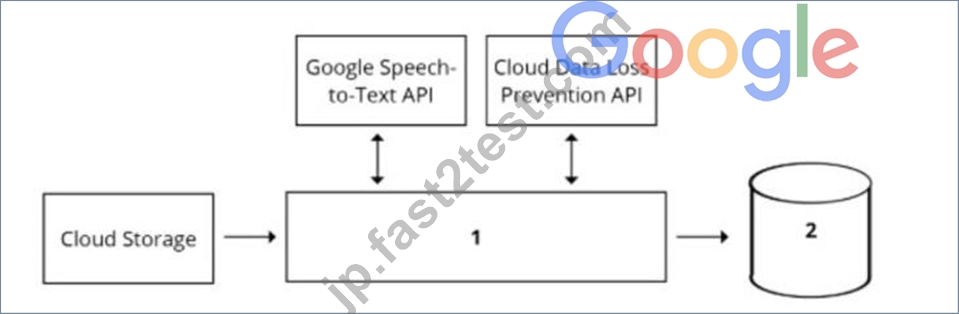
- A. 1 = Pub/Sub, 2 = Datastore
- B. 1 = Dataflow, 2 = Cloud SQL
- C. 1 = Dataflow, 2 = BigQuery
- D. 1 = Cloud Function, 2 = Cloud SQL
正解:C
解説:
https://github.com/GoogleCloudPlatform/dataflow-contact-center-speech-analysis
質問 # 47
You are training models in Vertex Al by using data that spans across multiple Google Cloud Projects You need to find track, and compare the performance of the different versions of your models Which Google Cloud services should you include in your ML workflow?
- A. Dataplex. Vertex Al Experiments, and Vertex Al ML Metadata
- B. Vertex Al Pipelines, Vertex Al Feature Store, and Vertex Al Experiments
- C. Dataplex. Vertex Al Feature Store and Vertex Al TensorBoard
- D. Vertex Al Pipelines: Vertex Al Experiments and Vertex Al Metadata
正解:D
質問 # 48
A Machine Learning Specialist is working with a large cybersecurity company that manages security events in real time for companies around the world. The cybersecurity company wants to design a solution that will allow it to use machine learning to score malicious events as anomalies on the data as it is being ingested. The company also wants be able to save the results in its data lake for later processing and analysis.
What is the MOST efficient way to accomplish these tasks?
- A. Ingest the data into Apache Spark Streaming using Amazon EMR, and use Spark MLlib with k-means to perform anomaly detection. Then store the results in an Apache Hadoop Distributed File System (HDFS) using Amazon EMR with a replication factor of three as the data lake.
- B. Ingest the data and store it in Amazon S3. Have an AWS Glue job that is triggered on demand transform the new data. Then use the built-in Random Cut Forest (RCF) model within Amazon SageMaker to detect anomalies in the data.
- C. Ingest the data using Amazon Kinesis Data Firehose, and use Amazon Kinesis Data Analytics Random Cut Forest (RCF) for anomaly detection. Then use Kinesis Data Firehose to stream the results to Amazon S3.
- D. Ingest the data and store it in Amazon S3. Use AWS Batch along with the AWS Deep Learning AMIs to train a k-means model using TensorFlow on the data in Amazon S3.
正解:A
質問 # 49
You are designing an ML recommendation model for shoppers on your company's ecommerce website. You will use Recommendations Al to build, test, and deploy your system. How should you develop recommendations that increase revenue while following best practices?
- A. Because it will take time to collect and record product data, use placeholder values for the product catalog to test the viability of the model.
- B. Use the "Frequently Bought Together' recommendation type to increase the shopping cart size for each order.
- C. Import your user events and then your product catalog to make sure you have the highest quality event stream
- D. Use the "Other Products You May Like" recommendation type to increase the click-through rate
正解:C
質問 # 50
You are developing a mode! to detect fraudulent credit card transactions. You need to prioritize detection because missing even one fraudulent transaction could severely impact the credit card holder. You used AutoML to tram a model on users' profile information and credit card transaction data. After training the initial model, you notice that the model is failing to detect many fraudulent transactions. How should you adjust the training parameters in AutoML to improve model performance?
Choose 2 answers
- A. Add more negative examples to the training set.
- B. Add more positive examples to the training set.
- C. Decrease the score threshold.
- D. Reduce the maximum number of node hours for training.
- E. Increase the score threshold.
正解:B、C
解説:
The best options for adjusting the training parameters in AutoML to improve model performance are to decrease the score threshold and add more positive examples to the training set. These options can help increase the detection rate of fraudulent transactions, which is the priority for this use case. The score threshold is a parameter that determines the minimum probability score that a prediction must have to be classified as positive. Decreasing the score threshold can increase the recall of the model, which is the proportion of actual positive cases that are correctly identified. Increasing the recall can help reduce the number of false negatives, which are fraudulent transactions that are missed by the model. However, decreasing the score threshold can also decrease the precision of the model, which is the proportion of positive predictions that are actually correct. Decreasing the precision can increase the number of false positives, which are legitimate transactions that are flagged as fraudulent by the model. Therefore, there is a trade-off between recall and precision, and the optimal score threshold depends on the business objective and the cost of errors1. Adding more positive examples to the training set can help balance the data distribution and improve the model performance. Positive examples are the instances that belong to the target class, which in this case are fraudulent transactions. Negative examples are the instances that belong to the other class, which in this case are legitimate transactions. Fraudulent transactions are usually rare and imbalanced compared to legitimate transactions, which can cause the model to be biased towards the majority class and fail to learn the characteristics of the minority class. Adding more positive examples can help the model learn more features and patterns of the fraudulent transactions, and increase the detection rate2.
The other options are not as good as options B and C, for the following reasons:
* Option A: Increasing the score threshold would decrease the detection rate of fraudulent transactions, which is the opposite of the desired outcome. Increasing the score threshold would decrease the recall of the model, which is the proportion of actual positive cases that are correctly identified. Decreasing the recall would increase the number of false negatives, which are fraudulent transactions that are missed by the model. Increasing the score threshold would increase the precision of the model, which is the proportion of positive predictions that are actually correct. Increasing the precision would decrease the number of false positives, which are legitimate transactions that are flagged as fraudulent by the model. However, in this use case, the cost of false negatives is much higher than the cost of false positives, so increasing the score threshold is not a good option1.
* Option D: Adding more negative examples to the training set would not improve the model performance, and could worsen the data imbalance. Negative examples are the instances that belong to the other class, which in this case are legitimate transactions. Legitimate transactions are usually abundant and dominant compared to fraudulent transactions, which can cause the model to be biased towards the majority class and fail to learn the characteristics of the minority class. Adding more negative examples would exacerbate this problem, and decrease the detection rate of the fraudulent transactions2.
* Option E: Reducing the maximum number of node hours for training would not improve the model performance, and could limit the model optimization. Node hours are the units of computation that are used to train an AutoML model. The maximum number of node hours is a parameter that determines the upper limit of node hours that can be used for training. Reducing the maximum number of node hours would reduce the training time and cost, but also the model quality and accuracy. Reducing the maximum number of node hours would limit the number of iterations, trials, and evaluations that the model can perform, and prevent the model from finding the optimal hyperparameters and architecture3.
References:
* Preparing for Google Cloud Certification: Machine Learning Engineer, Course 5: Responsible AI, Week 4: Evaluation
* Google Cloud Professional Machine Learning Engineer Exam Guide, Section 2: Developing high- quality ML models, 2.2 Handling imbalanced data
* Official Google Cloud Certified Professional Machine Learning Engineer Study Guide, Chapter 4: Low- code ML Solutions, Section 4.3: AutoML
* Understanding the score threshold slider
* Handling imbalanced data sets in machine learning
* AutoML Vision pricing
質問 # 51
You work for a toy manufacturer that has been experiencing a large increase in demand. You need to build an ML model to reduce the amount of time spent by quality control inspectors checking for product defects.
Faster defect detection is a priority. The factory does not have reliable Wi-Fi. Your company wants to implement the new ML model as soon as possible. Which model should you use?
- A. AutoML Vision Edge mobile-high-accuracy-1 model
- B. AutoML Vision Edge mobile-versatile-1 model
- C. AutoML Vision Edge mobile-low-latency-1 model
- D. AutoML Vision model
正解:C
解説:
AutoML Vision Edge is a service that allows you to create custom image classification and object detection models that can run on edge devices, such as mobile phones, tablets, or IoT devices1. AutoMLVision Edge offers four types of models that vary in size, accuracy, and latency: mobile-versatile-1,mobile-low-latency-1, mobile-high-accuracy-1, and mobile-core-ml-low-latency-12. Each model has its own trade-offs and use cases, depending on the device specifications and the application requirements.
For the use case of building an ML model to reduce the amount of time spent by quality control inspectors checking for product defects, the best model to use is the AutoML Vision Edge mobile-low-latency-1 model. This model is optimized for fast inference on mobile devices, with a latency of less than 50 milliseconds on a Pixel 1 phone2. Faster defect detection is a priority for the toy manufacturer, and the factory does not have reliable Wi-Fi, so a low-latency model that can run on the device without internet connection is ideal. The mobile-low-latency-1 model also has a small size of less than 4 MB, which makes it easy to deploy and update2. The mobile-low-latency-1 model has a slightly lower accuracy than the mobile-high-accuracy-1 model, but it is still suitable for most image classification tasks2. Therefore, the AutoML Vision Edge mobile-low-latency-1 model is the best option for this use case.
References:
* AutoML Vision Edge documentation
* AutoML Vision Edge model types
質問 # 52
You trained a text classification model. You have the following SignatureDefs: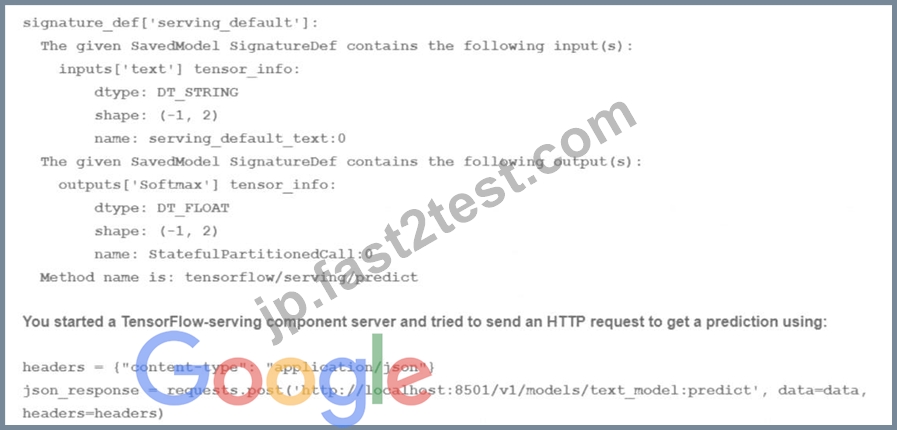
What is the correct way to write the predict request?
- A. data = json dumps({"signature_name": "serving_default"! "instances": [['a', 'b', "c", 'd', 'e', 'f']]})
- B. data = json.dumps({"signature_name": "serving_default, "instances": [['a', 'b\ 'c'1, [d\ 'e\ T]]})
- C. data = json dumps({"signature_name": f,serving_default", "instances": [['a', 'b'], [c\ 'd'], ['e\ T]]})
- D. data = json.dumps({"signature_name": "serving_default'\ "instances": [fab', 'be1, 'cd']]})
正解:C
解説:
A predict request is a way to send data to a trained model and get predictions in return. A predict request can be written in different formats, such as JSON, protobuf, or gRPC, depending on the service and the platform that are used to host and serve the model. A predict request usually contains the following information:
* The signature name: This is the name of the signature that defines the inputs and outputs of the model.
A signature is a way to specify the expected format, type, and shape of the data that the model can accept and produce. A signature can be specified when exporting or saving the model, or it can be automatically inferred by the service or the platform. A model can have multiple signatures, but only one can be used for each predict request.
* The instances: This is the data that is sent to the model for prediction. The instances can be a single instance or a batch of instances, depending on the size and shape of the data. The instances should match the input specification of the signature, such as the number, name, and type of the input tensors.
For the use case of training a text classification model, the correct way to write the predict request is D. data = json.dumps({"signature_name": "serving_default", "instances": [['a', 'b'], ['c', 'd'], ['e', 'f']]}) This option involves writing the predict request in JSON format, which is a common and convenient format for sending and receiving data over the web. JSON stands for JavaScript Object Notation, and it is a way to represent data as a collection of name-value pairs or an ordered list of values. JSON can be easily converted to and from Python objects using the json module.
This option also involves using the signature name "serving_default", which is the default signature name that is assigned to the model when it is saved or exported without specifying a custom signature name. The serving_default signature defines the input and output tensors of the model based on the SignatureDef that is shown in the image. According to the SignatureDef, the model expects an input tensor called "text" that has a shape of (-1, 2) and a type of DT_STRING, and produces an output tensor called "softmax" that has a shape of (-1, 2) and a type of DT_FLOAT. The -1 in the shape indicates that the dimension can vary depending on the number of instances, and the 2 indicates that the dimension is fixed at 2. The DT_STRING and DT_FLOAT indicate that the data type is string and float, respectively.
This option also involves sending a batch of three instances to the model for prediction. Each instance is a list of two strings, such as ['a', 'b'], ['c', 'd'], or ['e', 'f']. These instances match the input specification of the signature, as they have a shape of (3, 2) and a type of string. The model will process these instances and produce a batch of three predictions, each with a softmax output that has a shape of (1, 2) and a type of float.
The softmax output is a probability distribution over the two possible classes that the model can predict, such as positive or negative sentiment.
Therefore, writing the predict request as data = json.dumps({"signature_name": "serving_default",
"instances": [['a', 'b'], ['c', 'd'], ['e', 'f']]}) is the correct and valid way to send data to the text classification model and get predictions in return.
References:
* [json - JSON encoder and decoder]
質問 # 53
You are creating a model training pipeline to predict sentiment scores from text-based product reviews. You want to have control over how the model parameters are tuned, and you will deploy the model to an endpoint after it has been trained You will use Vertex Al Pipelines to run the pipeline You need to decide which Google Cloud pipeline components to use What components should you choose?
- A.

- B.

- C.

- D.

正解:D
解説:
According to the web search results, Vertex AI Pipelines is a serverless orchestrator for running ML pipelines, using either the KFP SDK or TFX1. Vertex AI Pipelines provides a set of prebuilt components that can be used to perform common ML tasks, such as training, evaluation, deployment, and more2. Vertex AI ModelEvaluationOp and ModelDeployOp are two such components that can be used to evaluate and deploy a model to an endpoint for online inference3. However, Vertex AI Pipelines does not provide a prebuilt component for hyperparameter tuning. Therefore, to have control over how the model parameters are tuned, you need to use a custom component that calls the Vertex AI HyperparameterTuningJob service4. Therefore, option A is the best way to decide which Google Cloud pipeline components to use for the given use case, as it includes a custom component for hyperparameter tuning, and prebuilt components for model evaluation and deployment. The other options are not relevant or optimal for this scenario. References:
* Vertex AI Pipelines
* Google Cloud Pipeline Components
* Vertex AI ModelEvaluationOp and ModelDeployOp
* Vertex AI HyperparameterTuningJob
* Google Professional Machine Learning Certification Exam 2023
* Latest Google Professional Machine Learning Engineer Actual Free Exam Questions
質問 # 54
You work for a large social network service provider whose users post articles and discuss news. Millions of comments are posted online each day, and more than 200 human moderators constantly review comments and flag those that are inappropriate. Your team is building an ML model to help human moderators check content on the platform. The model scores each comment and flags suspicious comments to be reviewed by a human.
Which metric(s) should you use to monitor the model's performance?
- A. Precision and recall estimates based on a sample of messages flagged by the model as potentially inappropriate each minute
- B. Precision and recall estimates based on a random sample of 0.1% of raw messages each minute sent to a human for review
- C. Number of messages flagged by the model per minute confirmed as being inappropriate by humans.
- D. Number of messages flagged by the model per minute
正解:A
解説:
* Precision measures the fraction of messages flagged by the model that are actually inappropriate, while recall measures the fraction of inappropriate messages that are flagged by the model. These metrics are useful for evaluating how well the model can identify and filter out inappropriate comments.
* Option A is not a good metric because it does not account for the accuracy of the model. The model might flag many messages that are not inappropriate, or miss many messages that are inappropriate.
* Option B is better than option A, but it still does not account for the recall of the model. The model might flag only a few messages that are highly likely to be inappropriate, but miss many other messages that are less obvious but still inappropriate.
* Option C is not a good metric because it does not focus on the messages that are flagged by the model.
The random sample of 0.1% of raw messages might contain very few inappropriate messages, making the precision and recall estimates unreliable.
質問 # 55
You work on the data science team at a manufacturing company. You are reviewing the company's historical sales data, which has hundreds of millions of records. For your exploratory data analysis, you need to calculate descriptive statistics such as mean, median, and mode; conduct complex statistical tests for hypothesis testing; and plot variations of the features over time You want to use as much of the sales data as possible in your analyses while minimizing computational resources. What should you do?
- A. Use BigQuery to calculate the descriptive statistics. Use Vertex Al Workbench user-managed notebooks to visualize the time plots and run the statistical analyses.
- B. Spin up a Vertex Al Workbench user-managed notebooks instance and import the dataset Use this data to create statistical and visual analyses
- C. Visualize the time plots in Google Data Studio. Import the dataset into Vertex Al Workbench user-managed notebooks Use this data to calculate the descriptive statistics and run the statistical analyses
正解:A
解説:
D Use BigQuery to calculate the descriptive statistics, and use Google Data Studio to visualize the time plots. Use Vertex Al Workbench user-managed notebooks to run the statistical analyses.
Explanation:
BigQuery is a powerful tool for analyzing large datasets and can be used to quickly calculate descriptive statistics, such as mean, median, and mode, on large amounts of data. By using BigQuery, you can analyze the entire dataset and minimize the computational resources required for your analyses.
Once you have calculated the descriptive statistics, you can use Vertex Al Workbench user-managed notebooks to visualize the time plots and run the statistical analyses. Vertex Al Workbench allows you to interactively explore the data, create visualizations, and perform advanced statistical analysis. It's also possible to run these notebooks on a powerful GPU which will help to increase the speed of the analysis.
質問 # 56
You work for a magazine publisher and have been tasked with predicting whether customers will cancel their annual subscription. In your exploratory data analysis, you find that 90% of individuals renew their subscription every year, and only 10% of individuals cancel their subscription. After training a NN Classifier, your model predicts those who cancel their subscription with 99% accuracy and predicts those who renew their subscription with 82% accuracy. How should you interpret these results?
- A. This is a good result because the accuracy across both groups is greater than 80%.
- B. This is not a good result because the model is performing worse than predicting that people will always renew their subscription.
- C. This is a good result because predicting those who cancel their subscription is more difficult, since there is less data for this group.
- D. This is not a good result because the model should have a higher accuracy for those who renew their subscription than for those who cancel their subscription.
正解:B
解説:
This is not a good result because the model is performing worse than predicting that people will always renew their subscription. This option has the following reasons:
* It indicates that the model is not learning from the data, but rather memorizing the majority class. Since
90% of the individuals renew their subscription every year, the model can achieve a 90% accuracy by simply predicting that everyone will renew their subscription, without considering the features or the patterns in the data. However, the model's accuracy for predicting those who renew their subscription is
* only 82%, which is lower than the baseline accuracy of 90%. This suggests that the model is overfitting to the minority class (those who cancel their subscription), and underfitting to the majority class (those who renew their subscription).
* It implies that the model is not useful for the business problem, as it cannot identify the customers who are at risk of churning. The goal of predicting whether customers will cancel their annual subscription is to prevent customer churn and increase customer retention. However, the model's accuracy for predicting those who cancel their subscription is 99%, which is too high and unrealistic, as it means that the model can almost perfectly identify the customers who will churn, without any false positives or false negatives. This may indicate that the model is cheating or exploiting some leakage in the data, such as a feature that reveals the outcome of the prediction. Moreover, the model's accuracy for predicting those who renew their subscription is 82%, which is too low and unreliable, as it means that the model can miss many customers who will churn, and falsely label them as renewing customers. This can lead to losing customers and revenue, and failing to take proactive actions to retain them.
References:
* How to Evaluate Machine Learning Models: Classification Metrics | Machine Learning Mastery
* Imbalanced Classification: Predicting Subscription Churn | Machine Learning Mastery
質問 # 57
You have trained a model by using data that was preprocessed in a batch Dataflow pipeline Your use case requires real-time inference. You want to ensure that the data preprocessing logic is applied consistently between training and serving. What should you do?
- A. Batch the real-time requests by using a time window and then use the Dataflow pipeline to preprocess the batched requests. Send the preprocessed requests to the endpoint.
- B. Perform data validation to ensure that the input data to the pipeline is the same format as the input data to the endpoint.
- C. Refactor the transformation code in the batch data pipeline so that it can be used outside of the pipeline Share this code with the end users of the endpoint.
- D. Refactor the transformation code in the batch data pipeline so that it can be used outside of the pipeline Use the same code in the endpoint.
正解:D
解説:
According to the official exam guide1, one of the skills assessed in the exam is to "design, build, and productionalize ML models to solve business challenges using Google Cloud technologies". Dataflow2 is a fully managed, fast, and easy-to-use service for running Apache Spark and Apache Hadoop clusters on Google Cloud. Dataflow supports both batch and streaming data processing pipelines. However, if your use case requires real-time inference, you need to ensure that the data preprocessing logic is applied consistently between training and serving. One way to achieve this is to refactor the transformation code in the batch data pipeline so that it can be used outside of the pipeline, and use the same code in the endpoint. This way, you can avoid data skew and drift issues that might arise from using different preprocessing methods for training and serving. Therefore, option B is the best way to ensure the data preprocessing logic is applied consistently between training and serving. The other options are not relevant or optimal for this scenario. Reference:
Professional ML Engineer Exam Guide
Dataflow
Google Professional Machine Learning Certification Exam 2023
Latest Google Professional Machine Learning Engineer Actual Free Exam Questions
質問 # 58
......
Google Professional Machine Learning Engineer認定試験は、機械学習技術を扱う専門家のスキルと知識をテストするように設計されています。この試験は、高度にスケーラブルで信頼性の高い機械学習モデルを設計、構築、展開する能力を測定します。この認定は、機械学習分野でキャリアを進めたい専門家にとって理想的であり、業界の多くのトップ雇用主に認められています。
あなたを合格させるGoogle試験にはProfessional-Machine-Learning-Engineer試験問題集:https://jp.fast2test.com/Professional-Machine-Learning-Engineer-premium-file.html
合格させるProfessional-Machine-Learning-Engineer試験情報と無料練習テスト:https://drive.google.com/open?id=1kn30cNTYYoBtm__vzEm2W6Fcmojj-k0u