

2026年最新のPMIテストPfMP問題集豪華セット無料最新の問題集をゲット!
完全版PfMP練習テスト767特別な問題と解答が待ってます!今すぐゲットせよ!
質問 # 177
Your sponsor has urged you to analyze Portfolio Risk before the end-of-week governance board meeting as the CEO will be present and is interested in Portfolio risk data in particular. Currently, you do not have adequate risk information in order to analyze data and give recommendations. Which tool is the most suitable for you to use in this case?
- A. Weighted Ranking and Scoring Techniques
- B. Delphi
- C. Graphical Analytical methods
- D. Cumulative distribution
正解:B
質問 # 178
You are managing a big portfolio and have a lot of stakeholders, whether external or internal. You know that stakeholder engagement is crucial to the success of the portfolio and realize that in order to have proper stakeholders engagement you will need to
- A. Update your communication management plan
- B. Engage regularly with key stakeholders through formal and informal communication means
- C. Develop a well-structured RACI matrix
- D. Meet regularly with all stakeholders
正解:C
質問 # 179
When it comes to managing the portfolio value, one of the junior portfolio managers came to you asking about the relation between cost-benefit analysis and the efficient frontier analysis. What should your answer to her be?
- A. Efficient frontiers are not static, and organizations should monitor cost-benefit ratios on a continual basis
- B. Efficient frontier tracks the realized value against planned costs; thus is another way of cost-benefit analysis
- C. The Efficient frontier analysis is used while performing the Cost-benefit analysis in order to get the confidence factor in the estimates
- D. Cost-Benefit analysis are not static, and organizations should monitor the efficient frontier ratios on a continual basis
正解:A
解説:
In accordance with the Standard for Portfolio Management, specifically within the Portfolio Value Management and Optimize Portfolio processes, the relationship between financial metrics and portfolio modeling is dynamic.
The reasoning for choosing Option B is based on the following verified principles:
The Dynamic Nature of Portfolios: An Efficient Frontier is a graphical representation of the set of optimal portfolios that offer the highest expected return (benefit) for a defined level of risk or cost. Because market conditions, organizational strategy, and component performance change, the "Frontier" itself shifts. It is not a
"set-and-forget" model.
Cost-Benefit Analysis (CBA) as an Input: CBA provides the underlying data (the "benefit" and the "cost") for each component. As these ratios fluctuate-due to scope creep, resource cost increases, or shifting market value-the position of those components on the Efficient Frontier changes.
Continuous Monitoring: To maintain an optimal portfolio, the Portfolio Manager must continually monitor these cost-benefit ratios. If a component's benefit drops or its cost rises significantly, it may fall off the Efficient Frontier, signaling that the portfolio should be rebalanced or the component terminated.
Why other options are incorrect:
A). Confidence factor in estimates: This describes Quantitative Risk Analysis (like Monte Carlo simulations), not the primary purpose of Efficient Frontier analysis, which is about optimization and balancing.
C). Realized value against planned costs: This describes Earned Value Management (EVM) or Benefits Realization Tracking. The Efficient Frontier is a predictive/modeling tool used for selection and optimization, not just a tracking mechanism for historical data.
D). Cost-benefit analysis are not static... monitor efficient frontier ratios: While the first part is true, the terminology "efficient frontier ratios" is technically inaccurate. Organizations monitor the cost-benefit ratios of individual components to determine their position on the frontier; they do not monitor "frontier ratios."
質問 # 180
The above figure shows the relationship between supply and demand. Which area do you want to minimize?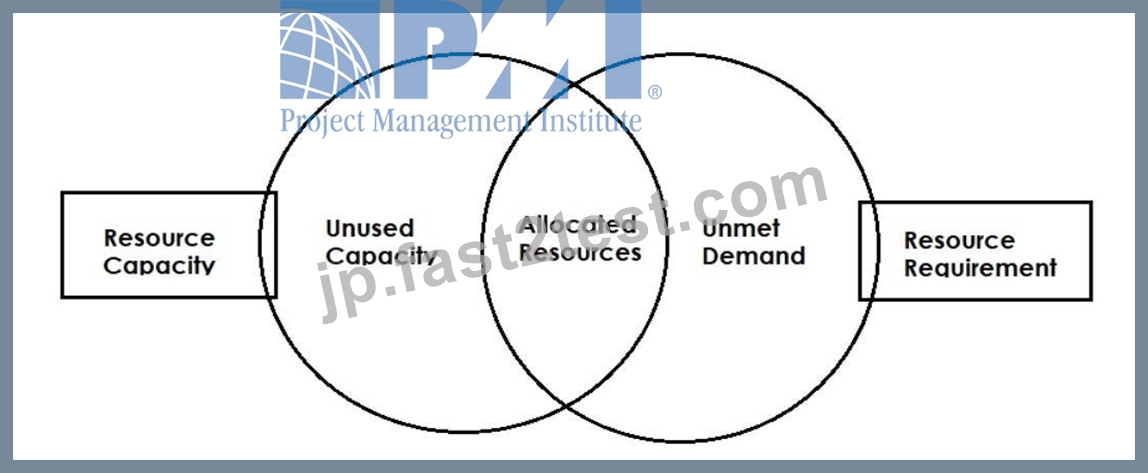
- A. Resource Capacity
- B. Resource Requirement
- C. Unused Capacity
- D. Allocated Resources
正解:C
質問 # 181
Your company has multiple portfolios on the way and a variety of different clients and industries. Risk levels are high due to recent governmental regulations and the company has recently been penalized due to a non- compliance to one of the standards. You know that you need to closely managing this. As a result, you will be come out with
- A. Portfolio Management Plan updates, Portfolio updates, Portfolio Reports, Enterprise Environmental Factors updates
- B. Portfolio Management Plan updates, Organizational Process Assets updates, Portfolio Process Assets updates, Portfolio updates
- C. Portfolio Management Plan updates, Organizational Process Assets updates, Portfolio Reports, Enterprise Environmental Factors updates
- D. Portfolio Management Plan updates, Organizational Process Assets updates, Portfolio Process Assets updates, Portfolio Reports
正解:B
解説:
Based on theStandard for Portfolio Management(PMI), the scenario describes a situation where the Portfolio Manager is reacting to high risk levels and a failure in compliance by reinforcing thePortfolio Risk ManagementandGovernanceframeworks. This process typically occurs during theDevelop Portfolio Management PlanorManage Portfolio Riskphases.
When addressing a critical failure such as "non-compliance to standards" and "new governmental regulations," the Portfolio Manager must produce several key outputs to stabilize the portfolio:
Portfolio Management Plan updates: The overarching plan must be revised to include more stringent compliance checks, updated risk management strategies, and new governance protocols to prevent future penalties.
Organizational Process Assets (OPAs) updates: Lessons learned from the penalty and the new regulatory requirements are documented and integrated into the organization's knowledge base to benefit other current and future portfolios.
Portfolio Process Assets (PPAs) updates: This includes specific updates to the active portfolio's tools, such as theRisk Register,Compliance Checklists, andReporting Templatestailored to the new regulations.
Portfolio updates: Because new regulations often require changes to the components themselves (e.g., adding a compliance project, terminating a non-compliant program, or shifting priorities), the "Portfolio" (the list of authorized components and their attributes) must be updated to reflect these strategic shifts.
Why other options are incorrect:
Options A, C, and D (Portfolio Reports): While reporting is important, a "Report" is a communication of status. The scenario focuses on themanagementandremediationof a structural compliance failure, which requires updating the foundational management documents and assets rather than just issuing a status report.
Options A and C (EEF updates): Enterprise Environmental Factors (like governmental regulations) are typicallyinputsto the process. While the portfolio management activity reacts to them, it does not "update" the government regulations themselves as an output.
By focusing onOption B, the Portfolio Manager ensures that the organization's rules (PMP), historical knowledge (OPAs), active tools (PPAs), and the actual work being done (Portfolio) are all aligned to meet the new regulatory standards.
質問 # 182
As part of the portfolio communication management, multiple documents are prepared in order to effectively manage communications. The Stakeholder matrix is one of the prepared documents, what does it include?
- A. Stakeholders quadrants showing the level of interest and influence
- B. Representation of all of the communication for the portfolio and their frequency over a period of time
- C. Intended recipients, communication vehicles, frequency and communication areas
- D. Stakeholders roles, interests, expectations and groups
正解:D
解説:
Explanation
The Stakeholder matrix contains stakeholders roles, interests, expectations and groups
質問 # 183
Assume your food additive company performed a capacity analysis and found some resources had not maintained their skill sets and basically were not as productive as others in the company. Rather than have a massive reorganization, instead the executives decided to eliminate the jobs of these staff members, many of whom had been in the company for more than 20 years. Morale among the existing staff is low as people fear there will be more layoffs. Plus the government issued a new regulation that requires an additional Food and Drug Administration quality check before a new additive can be submitted for regulatory approval. One member of the executive team wants to acquire another company to enhance market share, and the existing plants in the Asia Pacific region require infrastructure upgrades. Given resource shortages, only one component can be selected to be added to the portfolio. The Board should select:
- A. Component B-to add staff to work with the FDA trained in quality management
- B. Component D-to upgrade the AP's plant infrastructure
- C. Component C-to acquire the competitor to increase market share
- D. Component A-to enhance employee morale
正解:A
解説:
According to theStandard for Portfolio Management, when evaluating and selecting portfolio components under extreme resource constraints, the Portfolio Manager and the Board must prioritizeComplianceandStrategic Alignment. While multiple options offer business value, legal and regulatory requirements must be addressed first to ensure the organization's "License to Operate." The rationale forOption Bis as follows:
Regulatory Compliance (Mandatory Constraint):The government has issued anew regulationrequiring a specific FDA quality check. Failure to comply with regulatory mandates is a "showstopper" risk that can lead to legal penalties, the inability to bring products to market, and a complete halt in revenue generation for new additives.
Addressing Resource Gaps:The capacity analysis identified a lack of productivity and skills in the current workforce. By selecting Component B, the company directly addresses theCapability Gapby bringing in specialized staff who are trained in the specific quality management protocols required by the FDA.
Protecting the Pipeline:Without the FDA quality check, none of the company's future additives can be submitted for approval. Therefore, Component B is the only option that ensures the long-term viability of the portfolio's product pipeline.
Why the other options are incorrect:
Option A (Enhance morale):While morale is important for organizational health, "Employee Morale" projects are typically considered secondary to mandatory regulatory requirements when only one choice is possible.
Option C (Acquire competitor):A merger or acquisition is a high-risk, high-resource strategic move.
Attempting an acquisition while the company is facing resource shortages, skill gaps, and regulatory non- compliance would likely lead to an unsuccessful integration and further financial strain.
Option D (Upgrade infrastructure):Infrastructure upgrades are essential for maintenance and operational efficiency. However, unlike a new government regulation, these are often "discretionary" or can be deferred, whereas regulatory compliance cannot be ignored without severe consequences to the firm's legal standing.
質問 # 184
While defining the portfolio mix, the portfolio manager performs a categorization of the portfolio components based on multiple categorization criteria. Which of the following is considered as a portfolio component category?
- A. Risk Reduction
- B. All of the options
- C. Process Improvement
- D. Continuous Improvement
正解:B
解説:
According to theStandard for Portfolio Management,Categorizationis the process of grouping portfolio components into "buckets" based on common strategic goals, business outcomes, or investment themes. This allows the portfolio manager to balance the portfolio and ensure that resources are not all concentrated in a single area (e.g., only in "Run the Business" vs. "Grow the Business").
The rationale forOption Cis as follows:
Standard Categories:Organizations typically define categories that align with their specific strategic pillars.
The options provided represent common, industry-standard categories:
Continuous Improvement (A):Focuses on incremental changes to existing products or services to maintain quality and efficiency.
Risk Reduction (B):Includes components designed to mitigate organizational threats, such as cybersecurity upgrades, compliance projects, or disaster recovery planning.
Process Improvement (D):Focuses on optimizing internal workflows, reducing waste, and increasing operational throughput (e.g., Six Sigma or Lean initiatives).
Strategic Balancing:By using these categories, a portfolio manager can perform aGap Analysisto see if the current mix of investments matches the executive vision. For example, if the strategy is "Innovation," but
90% of the portfolio is categorized as "Continuous Improvement," the portfolio is misaligned.
Other common categories include:
Regulatory/Compliance:Mandatory work required by law.
New Product Development:Innovative work to capture new markets.
Infrastructure/Maintenance:Keeping the lights on and updating core systems.
By grouping components into these categories, the portfolio manager can apply differentWeighted Scoring Modelsto each. For instance, a "Risk Reduction" component might be scored heavily on safety, while an
"Innovation" component is scored on market potential.
質問 # 185
While managing portfolio communications, the portfolio manager needs to account for the communication needs of the component teams in order for them to stay in the loop of the big picture. Which of the following can be of interest to this group of stakeholders?
- A. To know about the portfolio changes, risks and issues that may affect their components, and to do interdependency management in order to cover any dependent component's issues
- B. To know about the portfolio changes, risks and issues that may affect their components
- C. To be informed regularly of the portfolio progress so they can adjust their work accordingly
- D. To be informed of all portfolio changes so they can assess which changes affect their components
正解:B
解説:
Explanation
The only option which is correct and which relates to this group of stakeholders is to know about the portfolio changes, risks and issues that may affect their components
質問 # 186
You're performing capability and capacity analysis to develop a portfolio performance management plan. What may be included in the capability and capacity analysis? (Choose two.)
- A. Resource management tools
- B. What-if scenarios
- C. Cost-benefit analysis
- D. Business value analysis
正解:A、B
質問 # 187
As part of the Portfolio Communication, the Portfolio Manager analyzes the raw data assimilated from the portfolio process assets and from the stakeholder analysis. This analysis aims to isolate the data that hold value to the receiving audience. Which tool can the portfolio manager use to help him in performing this analysis?
- A. Elicitation
- B. Stakeholder Analysis
- C. Communication Requirements Analysis
- D. Communication Methods
正解:C
質問 # 188
You are managing a large portfolio and know that you will need to constantly show the progress and status of the portfolio in meeting. For this you have developed a robust roadmap using BI tools. The Portfolio Roadmap is an important document that is referenced throughout the portfolio life cycle. Which of the following is correct regarding the Portfolio Roadmap purpose and focus?
- A. Can be used to influence the portfolio's success
- B. High-level prioritization mapping of the portfolio
- C. Corresponds to the means to the "to-be" vision
- D. Forecasts how and when the portfolio will deliver value to the organization
正解:C
解説:
In accordance with the Standard for Portfolio Management, the Portfolio Roadmap is a strategic document that bridges the gap between high-level strategy and tactical execution. It is the primary tool used to visualize the intended evolution of the portfolio.
The reasoning for choosing Option B is based on the following verified principles:
Strategic Pathing: The Roadmap is defined as the functional document that provides a visual representation of the portfolio's progress. It illustrates the transition from the current state ("as-is") to the desired future state ("to-be" vision) by mapping out the dependencies and chronological flow of components.
The "Means" to the Goal: While the Strategic Plan defines the destination, the Roadmap provides the "means"
-the specific sequencing of programs and projects required to reach that destination. It shows how the organization will move toward its strategic objectives over time.
Chronological Mapping: Unlike a static plan, the Roadmap allows stakeholders to see the logical dependencies and milestones. This visualization is critical for managing expectations regarding the pace of organizational transformation and the realization of the "to-be" vision.
Why other options are incorrect:
A). High-level prioritization mapping: Prioritization is a process that results in a ranked list of components.
While the Roadmap reflects the results of prioritization, its primary purpose is the chronological and dependency mapping of those components, not the act of prioritization itself (which is documented in the Strategic Plan).
C). Used to influence the portfolio's success: This is a vague statement. While a good roadmap aids communication, it is not a "tool to influence success" in a formal technical sense. Success is influenced by governance, risk management, and execution quality.
D). Forecasts how and when the portfolio will deliver value: This is a common point of confusion. The document that focuses specifically on the timing and realization of benefits is the Portfolio Performance Management Plan (or a Benefits Realization Plan). The Roadmap focuses on the timing of the components themselves, whereas value delivery is often a lagging outcome documented in performance reports.
質問 # 189
Your sponsor is under a lot of pressure from the management because the portfolio has been hit by multiple risks already and the situation is going towards its termination. Your sponsor asked you to prepare him an analysis to show the probable ROI and the confidence level in it. Which approach is the best one in this case?
- A. Monte Carlo Analysis
- B. Scenario Analysis
- C. SWOT Analysis
- D. What-if Analysis
正解:A
質問 # 190
As part of the Portfolio Communication, the Portfolio Manager analyzes the raw data assimilated from the portfolio process assets and from the stakeholder analysis. This analysis aims to isolate the data that hold value to the receiving audience. Which tool can the portfolio manager use to help him in performing this analysis?
- A. Elicitation
- B. Stakeholder Analysis
- C. Communication Requirements Analysis
- D. Communication Methods
正解:C
解説:
According to the Standard for Portfolio Management (PMI), when a Portfolio Manager is tasked with filtering, organizing, and isolating specific data to ensure it holds value for a target audience, they are performing Communication Requirements Analysis.
Defining the Tool: Communication Requirements Analysis is the analytical technique used to determine the information needs of portfolio stakeholders. It looks at the type, format, value, and frequency of information required.
Isolating Value: The core of this process is to ensure that stakeholders are not overwhelmed with "raw data" but instead receive "information" that is actionable and relevant to their specific role in the governance structure.
Inputs to the Analysis: As noted in the question, the manager uses Portfolio Process Assets (existing templates and historical data) and Stakeholder Analysis (who the stakeholders are and their influence/interest) as inputs to determine exactly what needs to be communicated.
Why other options are incorrect:
A). Communication Methods: These are the delivery mechanisms (e.g., push, pull, interactive) used after you know what needs to be sent.
B). Elicitation: This is a technique primarily used in requirement gathering for project scope or business analysis, not specifically for filtering portfolio status data.
C). Stakeholder Analysis: While this is an input mentioned in the question, it is the foundation for the work, not the specific tool used to isolate the data value for the communication itself.
By performing Communication Requirements Analysis, the Portfolio Manager ensures that the Governance Board receives strategic insights while the Component Managers receive operational details, thereby optimizing the communication flow.
質問 # 191
You are a portfolio manager for a company with volatile market conditions and continuous strategic changes. It is always important for you to use methods such as simu-lation techniques, flowcharts and decision trees to be able to balance the portfolio with the actual needs. Which of the following tools and techniques you are using in this case?
- A. Probability Analysis
- B. Capability and Capacity Analysis
- C. SWOT Analysis
- D. Cost-Benefit analysis
正解:A
質問 # 192
You are the portfolio management for a big corporate with existence in 3 continents. While planning the performance management and in particular the dashboards and reporting tools, which of the following options is the most important to account for the different geographical locations?
- A. Organizational Process Assets
- B. Portfolio Process Assets
- C. Enterprise Environmental Factors (EEFs)
- D. A good sponsor to back you up
正解:C
解説:
Explanation
EEFs are internal or external conditions, not under the control of the portfolio organization, which influence, constrain, or direct a portfolio's success. The most important option here is to target the different cultures, languages, and other overseas differences between the geographical locations
質問 # 193
The sponsor came to you asking for a high level timeline to depict the approach that you will take to execute this portfolio. What tools and techniques is useful in your case?
- A. Prioritization Analysis, Interdependency Analysis, Cost-Benefit Analysis
- B. Strategic Alignment Analysis, Prioritization Analysis, Portfolio Component Inventory
- C. Gap Analysis, Readiness Assessment, Stakeholder Analysis
- D. Scenario Analysis, Capability & Capacity Analysis
正解:A
質問 # 194
Due to multiple issues, there were changes in the reporting process in your portfolio; the meetings with their frequencies have been changed and this will also affect the reporting cycle times. In order to meet this new change you will update which of the following documents?
- A. Communication Strategy Matrix
- B. Communication Calendar
- C. PMIS
- D. Communication Matrix
正解:B
解説:
Explanation
The communication calendar is a representation of all of the communications for the portfolio and their frequency over a period of time.
質問 # 195
One of the key stakeholders came to you asking you to add more metrics because she thinks that it would give the portfolio management a better view of the actual progress. For her the more metrics you have the better.
What should your opinion be regarding this?
- A. You should disagree and escalate this to the governance board
- B. You should disagree and communicate a clear message to the stakeholder that it does not matter how many metrics you have as long as you can fully report the progress
- C. You should agree as having more metrics is better and because you do not want to say no to a key stakeholder
- D. You should agree, as having more metrics is better
正解:B
解説:
In professional Portfolio Management, the focus is on quality and relevance of data, not the sheer quantity of metrics. This principle is deeply embedded in the Portfolio Performance Management and Portfolio Strategic Management domains of the Standard for Portfolio Management.
The Principle of "Lean" Reporting: According to the Portfolio Management Plan, metrics must be directly mapped to Key Performance Indicators (KPIs) that measure strategic alignment and value delivery. Adding excessive metrics-often referred to as "vanity metrics"-creates "noise" and information overload, which can obscure actual progress and delay critical decision-making.
Resource Efficiency: Collecting, analyzing, and reporting on metrics requires time and organizational resources. In Portfolio Resource Management, it is considered inefficient to dedicate resources to tracking data that does not drive a specific governance decision or provide unique insight into the Portfolio Roadmap.
Portfolio Communication Management Plan: This document defines the information needs of stakeholders.
While it is important to manage stakeholder expectations (as per the Portfolio Stakeholder Engagement Plan), the portfolio manager's duty is to maintain the integrity of the reporting system. You must explain that a targeted set of metrics that provide a "single version of the truth" is superior to a high volume of redundant or irrelevant data.
Why not Escalate (Option D)? Escalation to the governance board is a last resort for significant risks or resource conflicts. A disagreement over reporting style should first be handled through direct communication and stakeholder management techniques.
The goal is to ensure that the Portfolio Dashboard remains a clear, actionable tool for the governance board, rather than a cluttered collection of statistics that lack strategic context.
質問 # 196
......
[2026年08月] 合格させるPMI PfMP試験一発合格保証:https://drive.google.com/open?id=1hAukf-p-7JGJm98qdMgrifRuzLJrUVRO
あなたの合格率を上げろうPfMP試験問題集:https://jp.fast2test.com/PfMP-premium-file.html