

PDF無料ダウンロードにはCAPM有効な練習テスト問題
CAPMテストエンジンお試しセット、CAPM問題集PDF
質問 488
What is a tool to improve team performance?
- A. Staffing plan
- B. Performance reports
- C. External feedback
- D. Co-location
正解: D
解説:
Explanation/Reference:
Explanation:
9.3.2.5 Colocation
Colocation, also referred to as "tight matrix," involves placing many or all of the most active project team members in the same physical location to enhance their ability to perform as a team. Colocation can be temporary, such as at strategically important times during the project, or for the entire project. Colocation strategies can include a team meeting room (sometimes called "war room"), places to post schedules, and other conveniences that enhance communication and a sense of community. While colocation is considered a good strategy, the use of virtual teams can bring benefits such as the use of more skilled resources, reduced costs, less travel, and relocation expenses and the proximity of team members to suppliers, customers, or other key stakeholders.
Process: 9.3 Develop Project Team
Definition: The process of improving competencies, team member interaction, and overall team environment to enhance project performance. The key benefit of this process is that it results in improved teamwork, enhanced people skills and competencies, motivated employees, reduced staff turnover rates, and improved overall project performance.
Key Benefit: The key benefit of this process is that it results in improved teamwork, enhanced people skills and competencies, motivated employees, reduced staff turnover rates, and improved overall project performance.
Inputs
1. Human resource management plan
2. Project staff assignments
3. Resource calendars
Tools & Techniques
1. Interpersonal skills
2. Training
3. Team-building activities
4. Ground rules
5. Colocation
6. Recognition and rewards
7. Personnel assessment tools
Outputs
1. Team performance assessments
2. Enterprise environmental factors updates
質問 489
One of the objectives of a quality audit is to:
- A. identify all of the gaps or shortcomings.
- B. highlight the need for root cause analysis.
- C. share the process documentation among stakeholders.
- D. offer assistance with non-value-added activities.
正解: A
解説:
Section: Volume E
Explanation/Reference:
質問 490
In which type of organizational structure are staff members grouped by specialty?
- A. Projectized
- B. Balanced
- C. Matrix
- D. Functional
正解: D
解説:
Section: Volume D
Explanation
質問 491
An element of the project scope statement is:
- A. A summary budget.
- B. Acceptance criteria.
- C. A stakeholder list.
- D. High-level risks.
正解: B
解説:
Section: Volume A
Explanation:
5.3.3.1 Project Scope Statement
The project scope statement is the description of the project scope, major deliverables, assumptions, and constraints. The project scope statement documents the entire scope, including project and product scope. It describes, in detail, the project's deliverables and the work required to create those deliverables. It also provides a common understanding of the project scope among project stakeholders. It may contain explicit scope exclusions that can assist in managing stakeholder expectations. It enables the project team to perform more detailed planning, guides the project team's work during execution, and provides the baseline for evaluating whether requests for changes or additional work are contained within or outside the project's boundaries.
The degree and level of detail to which the project scope statement defines the work that will be performed and the work that is excluded can help determine how well the project management team can control the overall project scope. The detailed project scope statement, either directly, or by reference to other documents, includes the following:
Product scope description. Progressively elaborates the characteristics of the product, service, or result
described in the project charter and requirements documentation.
Acceptance criteria. A set of conditions that is required to be met before deliverables are accepted.
Deliverable. Any unique and verifiable product, result, or capability to perform a service that is required to be
produced to complete a process, phase, or project. Deliverables also include ancillary results, such as project management reports and documentation. These deliverables may be described at a summary level or in great detail.
Project exclusion. Generally identifies what is excluded from the project. Explicitly stating what is out of
scope for the project helps to manage stakeholders' expectations.
Constraints. A limiting factor that affects the execution of a project or process. Constraints identified with the
project scope statement list and describe the specific internal or external restrictions or limitations associated with the project scope that affect the execution of the project, for example, a predefined budget or any imposed dates or schedule milestones that are issued by the customer or performing organization. When a project is performed under an agreement, contractual provisions will generally be constraints. Information on constraints may be listed in the project scope statement or in a separate log.
Assumptions. A factor in the planning process that is considered to be true, real, or certain, without proof or
demonstration. Also describes the potential impact of those factors if they prove to be false.
Project teams frequently identify, document, and validate assumptions as part of their planning process.
Information on assumptions may be listed in the project scope statement or in a separate log.
Although the project charter and the project scope statement are sometimes perceived as containing a certain degree of redundancy, they are different in the level of detail contained in each. The project charter contains high level information, while the project scope statement contains a detailed description of the scope elements.
These elements are progressively elaborated throughout the project. Table 5-1 describes some of the key elements for each document.
Table 5-1. Elements of the Project Charter and Project Scope Statement
Project Charter
Project purpose or justification
Measurable project objectives
and related success criteria
High-level requirements
High-level project description
High-level risks
Summary milestone schedule
Summary budget
Stakeholder list
Project approval requirements
(what constitutes success, who decides it, who signs off)
Assigned project manager,
responsibility, and authority level
Name and authority of the sponsor or other person(s) authorizing the project charter
Project Scope Statement
Project scope description (progressively elaborated)
Acceptance criteria
Project deliverables
Project exclusions
Project constraints
Project assumptions
質問 492
At the completion of a project, a report is prepared that details the outcome of the research conducted on a global trend during the project.
Which item did this project create?
- A. Improvement
- B. Product
- C. Service
- D. Result
正解: D
質問 493
The cost of nonconformance in a project includes:
- A. training
- B. testing
- C. rework
- D. inspections
正解: C
質問 494
Which of the following response strategies are appropriate for negative risks or threats?
- A. Exploit, Enhance, Share, or Accept
- B. Mitigate, Share, Avoid, or Accept
- C. Share, Accept, Transfer, or Mitigate
- D. Avoid, Mitigate, Transfer, or Accept
正解: D
解説:
Section: Volume E
Explanation
Explanation:
11.5.2.1 Strategies for Negative Risks or Threats
Three strategies, which typically deal with threats or risks that may have negative impacts on project objectives if they occur, are: avoid, transfer, and mitigate. The fourth strategy, accept, can be used for negative risks or threats as well as positive risks or opportunities. Each of these risk response strategies have varied and unique influence on the risk condition. These strategies should be chosen to match the risk's probability and impact on the project's overall objectives. Avoidance and mitigation strategies are usually good strategies for critical risks with high impact, while transference and acceptance are usually good strategies for threats that are less critical and with low overall impact. The four strategies for dealing with negative risks or threats are further described as follows:
Avoid. Risk avoidance is a risk response strategy whereby the project team acts to eliminate the threat or
protect the project from its impact. It usually involves changing the project management plan to eliminate the threat entirely. The project manager may also isolate the project objectives from the risk's impact or change the objective that is in jeopardy. Examples of this include extending the schedule, changing the strategy, or reducing scope. The most radical avoidance strategy is to shut down the project entirely. Some risks that arise early in the project can be avoided by clarifying requirements, obtaining information, improving communication, or acquiring expertise.
Transfer. Risk transference is a risk response strategy whereby the project team shifts the impact of a threat
to a third party, together with ownership of the response. Transferring the risk simply gives another party responsibility for its management-it does not eliminate it. Transferring does not mean disowning the risk by transferring it to a later project or another person without his or her knowledge or agreement. Risk transference nearly always involves payment of a risk premium to the party taking on the risk. Transferring liability for risk is most effective in dealing with financial risk exposure. Transference tools can be quite diverse and include, but are not limited to, the use of insurance, performance bonds, warranties, guarantees, etc. Contracts or agreements may be used to transfer liability for specified risks to another party. For example, when a buyer has capabilities that the seller does not possess, it may be prudent to transfer some work and its concurrent risk contractually back to the buyer. In many cases, use of a cost-plus contract may transfer the cost risk to the buyer, while a fixed-price contract may transfer risk to the seller.
Mitigate. Risk mitigation is a risk response strategy whereby the project team acts to reduce the probability of
occurrence or impact of a risk. It implies a reduction in the probability and/or impact of an adverse risk to be within acceptable threshold limits. Taking early action to reduce the probability and/or impact of a risk occurring on the project is often more effective than trying to repair the damage after the risk has occurred. Adopting less complex processes, conducting more tests, or choosing a more stable supplier are examples of mitigation actions. Mitigation may require prototype development to reduce the risk of scaling up from a bench-scale model of a process or product. Where it is not possible to reduce probability, a mitigation response might address the risk impact by targeting linkages that determine the severity. For example, designing redundancy into a system may reduce the impact from a failure of the original component.
Accept. Risk acceptance is a risk response strategy whereby the project team decides to acknowledge the
risk and not take any action unless the risk occurs. This strategy is adopted where it is not possible or cost- effective to address a specific risk in any other way. This strategy indicates that the project team has decided not to change the project management plan to deal with a risk, or is unable to identify any other suitable response strategy. This strategy can be either passive or active. Passive acceptance requires no action except to document the strategy, leaving the project team to deal with the risks as they occur, and to periodically review the threat to ensure that it does not change significantly. The most common active acceptance strategy is to establish a contingency reserve, including amounts of time, money, or resources to handle the risks.
質問 495
Which are examples of processes that may be used once or at predefined points in the project life cycle?
- A. Define Activities and Acquire Resources
- B. Control Schedule and Conduct Procurements
- C. Monitor Communications and Control Costs
- D. Develop Project Charter and Close Project or Phase
正解: D
解説:
Explanation/Reference:
Reference: https://www.greycampus.com/opencampus/project-management-professional/closing-a- project-or-phase
質問 496
Which of the following risk response strategies involves allocating ownership of a positive risk to a third party?
- A. Mitigate
- B. Share
- C. Transfer
- D. Avoid
正解: B
解説:
Section: Volume C
Explanation/Reference:
質問 497
What type of planning is used where the work to be accomplished in the near term is planned in detail, while work in the future is planned at a higher level?
- A. Rolling wave planning
- B. Dependency determination
- C. Short term planning
- D. Finish-to-start planning
正解: A
解説:
Section: Volume C
Explanation:
6.2.2.2 Rolling Wave Planning
Rolling wave planning is an iterative planning technique in which the work to be accomplished in the near term is planned in detail, while the work in the future is planned at a higher level. It is a form of progressive elaboration.
Therefore, work can exist at various levels of detail depending on where it is in the project life cycle. During early strategic planning, when information is less defined, work packages may be decomposed to the known level of detail. As more is known about the upcoming events in the near term, work packages can be decomposed into activities.
質問 498
Stakeholder communication requirements should be included as a component of:
- A. the stakeholder register
- B. the project management plan
- C. organizational process assets
- D. enterprise environmental factors
正解: B
質問 499
Which process includes prioritizing risks for subsequent further analysis or action by assessing and combining their probability of occurrence and impact?
- A. Plan Risk Management
- B. Plan Risk Responses
- C. Perform Qualitative Risk Analysis
- D. Perform Quantitative Risk Analysis
正解: C
質問 500
Risk responses reflect an organization's perceived balance between:
- A. risk taking and risk avoidance.
- B. identified risk and analyzed risk.
- C. varying degrees of risk.
- D. known risk and unknown risk.
正解: A
解説:
Section: Volume E
Explanation/Reference:
質問 501
The correct equation for schedule variance (SV) is earned value:
- A. divided by planned value [EV/PV],
- B. divided by actual cost [EV/AC].
- C. minus actual cost [EV - AC].
- D. minus planned value [EV - PV].
正解: D
質問 502
Which Project Time Management process includes bottom-up estimating as a tool or technique?
- A. Develop Schedule
- B. Sequence Activities
- C. Estimate Activity Durations
- D. Estimate Activity Resources
正解: D
質問 503
Which of the following Process Groups covers all Project Management Knowledge Areas?
- A. Executing
- B. Planning
- C. Monitoring and Controlling
- D. Initiating
正解: B
質問 504
The scope management plan is a subsidiary of which project document?
- A. Schedule management plan
- B. Project management plan
- C. Resource management plan
- D. Quality management plan
正解: B
解説:
Section: Volume C
Explanation:
4.2.3.1 Project Management Plan
The project management plan is the document that describes how the project will be executed, monitored, and controlled. It integrates and consolidates all of the subsidiary plans and baselines from the planning processes.
Project baselines include, but are not limited to:
Scope baseline (Section 5.4.3.1),
Schedule baseline (Section 6.6.3.1), and
Cost baseline (Section 7.3.3.1).
Subsidiary plans include, but are not limited to:
Scope management plan (Section 5.1.3.1),
Requirements management plan (Section 5.1.3.2),
Schedule management plan (Section 6.1.3.1),
Cost management plan (Section 7.1.3.1),
Quality management plan (Section 8.1.3.1),
Process improvement plan (Section 8.1.3.2),
Human resource management plan (Section 9.1.3.1),
Communications management plan (Section 10.1.3.1),
Risk management plan (Section 11.1.3.1),
Procurement management plan (Section 12.1.3.1), and
Stakeholder management plan (Section 13.2.3.1).
Among other things, the project management plan may also include the following:
Life cycle selected for the project and the processes that will be applied to each phase;
Details of the tailoring decisions specified by the project management team as follows:
○ Project management processes selected by the project management team,
○ Level of implementation for each selected process,
○ Descriptions of the tools and techniques to be used for accomplishing those processes, and
○ Description of how the selected processes will be used to manage the specific project, including the dependencies and interactions among those processes and the essential inputs and outputs.
Description of how work will be executed to accomplish the project objectives;
Change management plan that documents how changes will be monitored and controlled;
Configuration management plan that documents how Configuration management will be performed;
Description of how the integrity of the project baselines will be maintained;
Requirements and techniques for communication among stakeholders; and
Key management reviews for content, the extent of, and timing to address, open issues and pending
decisions.
The project management plan may be either summary level or detailed, and may be composed of one or more subsidiary plans. Each of the subsidiary plans is detailed to the extent required by the specific project. Once the project management plan is baselined, it may only be changed when a change request is generated and approved through the Perform Integrated Change Control process.
質問 505
Who determines which dependencies are mandatory during the Sequence Activities process?
- A. Project team
- B. Project manager
- C. External stakeholders
- D. Internal stakeholders
正解: A
質問 506
The following is a network diagram for a project.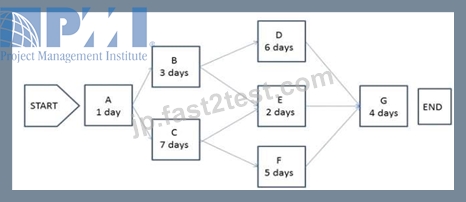
The shortest non-critical path for the project is how many days in duration?
- A. 0
- B. 1
- C. 2
- D. 3
正解: B
解説:
Section: Volume B
質問 507
Which process is usually a rapid and cost-effective means of establishing priorities for Plan Risk Responses?
- A. Plan Risk Management
- B. Identify Risks
- C. Perform Qualitative Risk Analysis
- D. Perform Quantitative Risk Analysis
正解: C
質問 508
Plan Communications Management develops an approach and plan for project communications based on stakeholders' needs and requirements and:
- A. Available organizational assets
- B. Enterprise environmental factors
- C. Interpersonal skills
- D. Project staff assignments
正解: A
解説:
Explanation/Reference:
Explanation:
Process: 10.1 Plan Communications Management
Definition: The process of developing an appropriate approach and plan for project communications based on stakeholder's information needs and requirements, and available organizational assets.
Key Benefit: The key benefit of this process is that it identifies and documents the approach to communicate most effectively and efficiently with stakeholders.
Inputs
1. Project management plan
2. Stakeholder register
3. Enterprise environmental factors
4. Organizational process assets
Tools & Techniques
1. Communication requirements analysis
2. Communication technology
3. Communication models
4. Communication methods
5. Meetings
Outputs
1. Communications management plan
2. Project documents updates
質問 509
Which is the best way for a project manager to ensure efficient and frequent communication with management and stakeholders in an agile/adaptive environment?
- A. Create personalized emails for each stakeholder, asking for requests and reviewing objectives with them periodically.
- B. Post project artifacts in a transparent fashion and engage stakeholders on a regular basis.
- C. Create a social network and post news there.
- D. Make surveys among the stakeholders and meet with the team once a month.
正解: B
解説:
Explanation/Reference:
Explanation
Open, frequent, and informal communication is the cornerstone of agile managed projects. The best form of communication is face to face conversations. Agile teams working in a collocated space that supports communication is ideal. Planning communications management that hinders or places boundaries on those conversations is counterproductive. A project manager needs to encourage more communication, not less. A project manager also needs to support the capturing and flow of communication between stakeholders. Scheduling more communication checkpoints, such as daily standup meetings, increases the communication exchanges. And, when possible, posting and distributing information to the team aids communication flow - whether in physical locations, digitized, or both. Withholding conversations or enforcing extended quiet times is the antithesis of good communication flow.
質問 510
......
あなたを合格させるPMI Certification CAPM試験問題集で2022年05月13日には1090問あります:https://jp.fast2test.com/CAPM-premium-file.html
最新のPMI CAPMPDFと問題集で(2022)無料試験問題解答:https://drive.google.com/open?id=1nU_tQqUpsI1F8Cpx_bAvaHYRCY4O0FAn