

2025年最新の有効なDP-700リアル試験問題(更新された)100%問題集と練習試験合格させます
[更新されたのは2025年]Microsoft DP-700問題準備には無料サンプルのPDF
Microsoft DP-700 認定試験の出題範囲:
| トピック | 出題範囲 |
|---|---|
| トピック 1 |
|
| トピック 2 |
|
| トピック 3 |
|
質問 # 42
You have a Fabric workspace that contains a warehouse named Warehouse1. Warehouse! contains a table named Customer. Customer contains the following data.
You have an internal Microsoft Entra user named User1 that has an email address of [email protected].
You need to provide User1 with access to the Customer table. The solution must prevent User1 from accessing the CreditCard column.
How should you complete the statement? To answer, select the appropriate options in the answer area.
NOTE: Each correct selection is worth one point.
正解:
解説:
Explanation:
質問 # 43
Note: This question is part of a series of questions that present the same scenario. Each question in the series contains a unique solution that might meet the stated goals. Some question sets might have more than one correct solution, while others might not have a correct solution.
After you answer a question in this section, you will NOT be able to return to it. As a result, these questions will not appear in the review screen.
You have a KQL database that contains two tables named Stream and Reference. Stream contains streaming data in the following format.
Reference contains reference data in the following format.
Both tables contain millions of rows.
You have the following KQL queryset.
You need to reduce how long it takes to run the KQL queryset.
Solution: You add the make_list() function to the output columns.
Does this meet the goal?
- A. Yes
- B. No
正解:B
解説:
Adding an aggregation like make_list() would require additional processing and memory, which could make the query slower.
質問 # 44
HOTSPOT
You have a Fabric workspace that contains a warehouse named DW1. DW1 contains the following tables and columns.
You need to create an output that presents the summarized values of all the order quantities by year and product. The results must include a summary of the order quantities at the year level for all the products.
How should you complete the code? To answer, select the appropriate options in the answer area.
NOTE: Each correct selection is worth one point.
正解:
解説: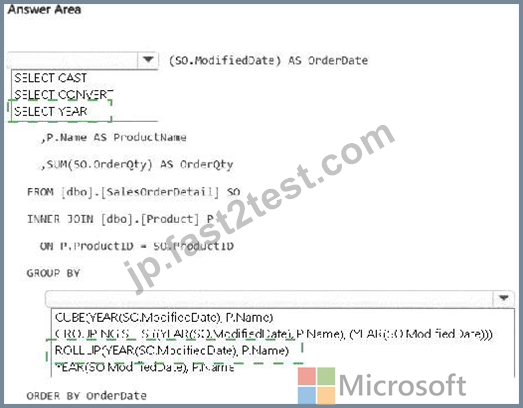
Explanation:
質問 # 45
You have a Fabric workspace that contains a lakehouse named Lakehousel.
You plan to create a data pipeline named Pipeline! to ingest data into Lakehousel. You will use a parameter named paraml to pass an external value into Pipeline1!. The paraml parameter has a data type of int You need to ensure that the pipeline expression returns param1 as an int value.
How should you specify the parameter value?
- A. "@pipeline(). parameters. paraml"
- B. "@{pipeline().parameters.paraml}"
- C. "@{pipeline().parameters.paraml}-
- D. "@{pipeline().parameters.[paraml]}"
正解:B
質問 # 46
Your company has three newly created data engineering teams named Team1, Team2, and Team3 that plan to use Fabric. The teams have the following personas:
* Team1 consists of members who currently use Microsoft Power BI. The team wants to transform data by using by a low-code approach.
* Team2 consists of members that have a background in Python programming. The team wants to use PySpark code to transform data.
* Team3 consists of members who currently use Azure Data Factory. The team wants to move data between source and sink environments by using the least amount of effort.
You need to recommend tools for the teams based on their current personas.
What should you recommend for each team? To answer, select the appropriate options in the answer area.
NOTE: Each correct selection is worth one point.
正解:
解説:
Explanation:
質問 # 47
You have a Fabric workspace that contains a data pipeline named Pipeline! as shown in the exhibit.
(Click the Exhibit tab.) What will occur the next time Pipelinel tuns?
- A. Copy.kdi will run first, and then Execute procedurel will run.
- B. Copy.kdi will run and Execute procedurel will be skipped.
- C. Execute procedure1 will run first, and then Copy_kdi will run.
- D. Both activities will run simultaneously.
- E. Execute procedurel will run and Copy_kdi will be skipped.
- F. Both activities will be skipped.
正解:F
質問 # 48
You have an Azure SQL database named DB1.
In a Fabric workspace, you deploy an eventstream named EventStreamDBI to stream record changes from DB1 into a lakehouse.
You discover that events are NOT being propagated to EventStreamDBI.
You need to ensure that the events are propagated to EventStreamDBI.
What should you do?
- A. Enable change data capture (CDC) for DB1.
- B. Create an Azure Stream Analytics job.
- C. Enable Extended Events for DB1.
- D. Create a read-only replica of DB1.
正解:A
質問 # 49
You need to ensure that the data analysts can access the gold layer lakehouse.
What should you do?
- A. Share the lakehouse with the DataAnalysts group and grant the Read all SQL Endpoint data permission.
- B. Add the DataAnalyst group to the Viewer role for WorkspaceA.
- C. Share the lakehouse with the DataAnalysts group and grant the Read all Apache Spark permission.
- D. Share the lakehouse with the DataAnalysts group and grant the Build reports on the default semantic model permission.
正解:A
解説:
Data Analysts' Access Requirements must only have read access to the Delta tables in the gold layer and not have access to the bronze and silver layers.
The gold layer data is typically queried via SQL Endpoints. Granting the Read all SQL Endpoint data permission allows data analysts to query the data using familiar SQL-based tools while restricting access to the underlying files.
質問 # 50
You have a Fabric F32 capacity that contains a workspace. The workspace contains a warehouse named DW1 that is modelled by using MD5 hash surrogate keys.
DW1 contains a single fact table that has grown from 200 million rows to 500 million rows during the past year.
You have Microsoft Power BI reports that are based on Direct Lake. The reports show year-over-year values.
Users report that the performance of some of the reports has degraded over time and some visuals show errors.
You need to resolve the performance issues. The solution must meet the following requirements:
Provide the best query performance.
Minimize operational costs.
Which should you do?
- A. Create views.
- B. Change the MD5 hash to SHA256.
- C. Increase the capacity.
C Enable V-Order - D. Modify the surrogate keys to use a different data type.
正解:D
解説:
In this case, the key issue causing performance degradation likely stems from the use of MD5 hash surrogate keys. MD5 hashes are 128-bit values, which can be inefficient for large datasets like the 500 million rows in your fact table. Using a more efficient data type for surrogate keys (such as integer or bigint) would reduce the storage and processing overhead, leading to better query performance. This approach will improve performance while minimizing operational costs because it reduces the complexity of querying and indexing, as smaller data types are generally faster and more efficient to process.
質問 # 51
You have a KQL database that contains a table named Readings.
You need to build a KQL query to compare the Meter-Reading value of each row to the previous row base on the ilmestamp value A sample of the expected output is shown in the following table.

正解:
解説:
Explanation:
質問 # 52
Your company has three newly created data engineering teams named Team1, Team2, and Team3 that plan to use Fabric. The teams have the following personas:
* Team1 consists of members who currently use Microsoft Power BI. The team wants to transform data by using by a low-code approach.
* Team2 consists of members that have a background in Python programming. The team wants to use PySpark code to transform data.
* Team3 consists of members who currently use Azure Data Factory. The team wants to move data between source and sink environments by using the least amount of effort.
You need to recommend tools for the teams based on their current personas.
What should you recommend for each team? To answer, select the appropriate options in the answer area.
NOTE: Each correct selection is worth one point.
正解:
解説:
Explanation:
質問 # 53
You have two Fabric notebooks named Load_Salesperson and Load_Orders that read data from Parquet files in a lakehouse. Load_Salesperson writes to a Delta table named dim_salesperson. Load.Orders writes to a Delta table named fact_orders and is dependent on the successful execution of Load_Salesperson.
You need to implement a pattern to dynamically execute Load_Salesperson and Load_Orders in the appropriate order by using a notebook.
How should you complete the code? To answer, drag the appropriate values the correct targets. Each value may be used once, more than once, or not at all. You may need to drag the split bar between panes or scroll to view content.
NOTE: Each correct selection is worth one point.
正解:
解説:
Explanation:
Topic 2, Contoso, LtdCase Study
This is a case study. Case studies are not timed separately. You can use as much exam time as you would like to complete each case. However, there may be additional case studies and sections on this exam. You must manage your time to ensure that you are able to complete all questions included on this exam in the time provided.
To answer the questions included in a case study, you will need to reference information that is provided in the case study. Case studies might contain exhibits and other resources that provide more information about the scenario that is described in the case study. Each question is independent of the other questions in this case study.
At the end of this case study, a review screen will appear. This screen allows you to review your answers and to make changes before you move to the next section of the exam. After you begin a new section, you cannot return to this section.
To start the case study
To display the first question in this case study, click the Next button. Use the buttons in the left pane to explore the content of the case study before you answer the questions. Clicking these buttons displays information such as business requirements, existing environment, and problem statements. If the case study has an All Information tab, note that the information displayed is identical to the information displayed on the subsequent tabs. When you are ready to answer a question, click the Question button to return to the question.
Overview. Company Overview
Contoso, Ltd. is an online retail company that wants to modernize its analytics platform by moving to Fabric.
The company plans to begin using Fabric for marketing analytics.
Overview. IT Structure
The company's IT department has a team of data analysts and a team of data engineers that use analytics systems.
The data engineers perform the ingestion, transformation, and loading of data. They prefer to use Python or SQL to transform the data.
The data analysts query data and create semantic models and reports. They are qualified to write queries in Power Query and T-SQL.
Existing Environment. Fabric
Contoso has an F64 capacity named Cap1. All Fabric users are allowed to create items.
Contoso has two workspaces named WorkspaceA and WorkspaceB that currently use Pro license mode.
Existing Environment. Source Systems
Contoso has a point of sale (POS) system named POS1 that uses an instance of SQL Server on Azure Virtual Machines in the same Microsoft Entra tenant as Fabric. The host virtual machine is on a private virtual network that has public access blocked. POS1 contains all the sales transactions that were processed on the company's website.
The company has a software as a service (SaaS) online marketing app named MAR1. MAR1 has seven entities. The entities contain data that relates to email open rates and interaction rates, as well as website interactions. The data can be exported from MAR1 by calling REST APIs. Each entity has a different endpoint.
Contoso has been using MAR1 for one year. Data from prior years is stored in Parquet files in an Amazon Simple Storage Service (Amazon S3) bucket. There are 12 files that range in size from 300 MB to 900 MB and relate to email interactions.
Existing Environment. Product Data
POS1 contains a product list and related data. The data comes from the following three tables:
Products
ProductCategories
ProductSubcategories
In the data, products are related to product subcategories, and subcategories are related to product categories.
Existing Environment. Azure
Contoso has a Microsoft Entra tenant that has the following mail-enabled security groups:
DataAnalysts: Contains the data analysts
DataEngineers: Contains the data engineers
Contoso has an Azure subscription.
The company has an existing Azure DevOps organization and creates a new project for repositories that relate to Fabric.
Existing Environment. User Problems
The VP of marketing at Contoso requires analysis on the effectiveness of different types of email content. It typically takes a week to manually compile and analyze the data. Contoso wants to reduce the time to less than one day by using Fabric.
The data engineering team has successfully exported data from MAR1. The team experiences transient connectivity errors, which causes the data exports to fail.
Requirements. Planned Changes
Contoso plans to create the following two lakehouses:
Lakehouse1: Will store both raw and cleansed data from the sources
Lakehouse2: Will serve data in a dimensional model to users for analytical queries Additional items will be added to facilitate data ingestion and transformation.
Contoso plans to use Azure Repos for source control in Fabric.
Requirements. Technical Requirements
The new lakehouses must follow a medallion architecture by using the following three layers: bronze, silver, and gold. There will be extensive data cleansing required to populate the MAR1 data in the silver layer, including deduplication, the handling of missing values, and the standardizing of capitalization.
Each layer must be fully populated before moving on to the next layer. If any step in populating the lakehouses fails, an email must be sent to the data engineers.
Data imports must run simultaneously, when possible.
The use of email data from the Amazon S3 bucket must meet the following requirements:
Minimize egress costs associated with cross-cloud data access.
Prevent saving a copy of the raw data in the lakehouses.
Items that relate to data ingestion must meet the following requirements:
The items must be source controlled alongside other workspace items.
Ingested data must land in the bronze layer of Lakehouse1 in the Delta format.
No changes other than changes to the file formats must be implemented before the data lands in the bronze layer.
Development effort must be minimized and a built-in connection must be used to import the source data.
In the event of a connectivity error, the ingestion processes must attempt the connection again.
Lakehouses, data pipelines, and notebooks must be stored in WorkspaceA. Semantic models, reports, and dataflows must be stored in WorkspaceB.
Once a week, old files that are no longer referenced by a Delta table log must be removed.
Requirements. Data Transformation
In the POS1 product data, ProductID values are unique. The product dimension in the gold layer must include only active products from product list. Active products are identified by an IsActive value of 1.
Some product categories and subcategories are NOT assigned to any product. They are NOT analytically relevant and must be omitted from the product dimension in the gold layer.
Requirements. Data Security
Security in Fabric must meet the following requirements:
The data engineers must have read and write access to all the lakehouses, including the underlying files.
The data analysts must only have read access to the Delta tables in the gold layer.
The data analysts must NOT have access to the data in the bronze and silver layers.
The data engineers must be able to commit changes to source control in WorkspaceA.
質問 # 54
HOTSPOT
You are processing streaming data from an external data provider.
You have the following code segment.
For each of the following statements, select Yes if the statement is true. Otherwise, select No.
NOTE: Each correct selection is worth one point.
正解:
解説:
Explanation:
Litware from New York will be displayed at the top of the result set - Yes The data is sorted first by Location in descending order and then by UnitsSold in descending order. Since
"New York" is alphabetically the last Location, it will appear first in the result set. Within "New York", Litware has the highest UnitsSold (1000), so it will be displayed at the top.
Fabrikam in Seattle will have value = 2 in the Rank column - No
The row_rank_dense function assigns dense ranks based on UnitsSold within each location. In "Seattle":
Contoso has UnitsSold = 300 # Rank 1
Litware has UnitsSold = 100 # Rank 2
Fabrikam also has UnitsSold = 100, so it shares the same rank (2) as Litware.
Litware in San Francisco will have the same value in the Rank column as Litware in New York - No The rank is calculated separately for each location. In "San Francisco":
Both Relecloud and Litware have UnitsSold = 500, so they share the same rank (1).
In "New York", Litware has the highest UnitsSold = 1000 # Rank 1.
Since ranks are calculated independently for each location, Litware in San Francisco does not share the same rank as Litware in New York.
質問 # 55
HOTSPOT
You have a Fabric workspace that contains two lakehouses named Lakehouse1 and Lakehouse2. Lakehouse1 contains staging data in a Delta table named Orderlines. Lakehouse2 contains a Type 2 slowly changing dimension (SCD) dimension table named Dim_Customer.
You need to build a query that will combine data from Orderlines and Dim_Customer to create a new fact table named Fact_Orders. The new table must meet the following requirements:
Enable the analysis of customer orders based on historical attributes.
Enable the analysis of customer orders based on the current attributes.
How should you complete the statement? To answer, select the appropriate options in the answer area.
NOTE: Each correct selection is worth one point.
正解:
解説:
質問 # 56
You have a Fabric capacity that contains a workspace named Workspace1. Workspace1 contains a lakehouse named Lakehouse1, a data pipeline, a notebook, and several Microsoft Power BI reports.
A user named User1 wants to use SQL to analyze the data in Lakehouse1.
You need to configure access for User1. The solution must meet the following requirements:
What should you do?
- A. Assign User1 the Member role for Workspace1. Share Lakehouse1 with User1 and select Read all SQL endpoint data.
- B. Assign User1 the Viewer role for Workspace1. Share Lakehouse1 with User1 and select Read all SQL endpoint data.
- C. Share Lakehouse1 with User1 directly and select Build reports on the default semantic model.
- D. Share Lakehouse1 with User1 directly and select Read all SQL endpoint data.
正解:B
解説:
To meet the specified requirements for User1, the solution must ensure:
Read access to the table data in Lakehouse1: User1 needs permission to access the data within Lakehouse1. By sharing Lakehouse1 with User1 and selecting the Read all SQL endpoint data option, User1 will be able to query the data via SQL endpoints.
Prevent Apache Spark usage: By sharing the lakehouse directly and selecting the SQL endpoint data option, you specifically enable SQL-based access to the data, preventing User1 from using Apache Spark to query the data.
Prevent access to other items in Workspace1: Assigning User1 the Viewer role for Workspace1 ensures that User1 can only view the shared items (in this case, Lakehouse1), without accessing other resources such as notebooks, pipelines, or Power BI reports within Workspace1.
This approach provides the appropriate level of access while restricting User1 to only the required resources and preventing access to other workspace assets.
質問 # 57
You have an Azure Event Hubs data source that contains weather data.
You ingest the data from the data source by using an eventstream named Eventstream1. Eventstream1 uses a lakehouse as the destination.
You need to batch ingest only rows from the data source where the City attribute has a value of Kansas. The filter must be added before the destination. The solution must minimize development effort.
What should you use for the data processor and filtering? To answer, select the appropriate options in the answer area.
NOTE: Each correct selection is worth one point.
正解:
解説:
質問 # 58
You have a Fabric warehouse named DW1 that loads data by using a data pipeline named Pipeline1. Pipeline1 uses a Copy data activity with a dynamic SQL source. Pipeline1 is scheduled to run every 15 minutes.
You discover that Pipeline1 keeps failing.
You need to identify which SQL query was executed when the pipeline failed.
What should you do?
- A. From Monitoring hub, select the latest failed run of Pipeline1, and then view the input JSON.
- B. From Real-time hub, select Fabric events, and then review the details of Microsoft.Fabric.
ItemReadFailed. - C. From Real-time hub, select Fabric events, and then review the details of Microsoft. Fabric.
ItemUpdateFailed. - D. From Monitoring hub, select the latest failed run of Pipeline1, and then view the output JSON.
正解:A
解説:
The input JSON contains the configuration details and parameters passed to the Copy data activity during execution, including the dynamically generated SQL query.
Viewing the input JSON for the failed pipeline run provides direct insight into what query was executed at the time of failure.
質問 # 59
HOTSPOT
You need to troubleshoot the ad-hoc query issue.
How should you complete the statement? To answer, select the appropriate options in the answer area.
NOTE: Each correct selection is worth one point.
正解:
解説:

質問 # 60
......
DP-700豪華セット学習ガイドにはオンライン試験エンジン:https://jp.fast2test.com/DP-700-premium-file.html
2025年最新の認定サンプル問題DP-700問題集と練習試験:https://drive.google.com/open?id=1kEUJsRQogJdpwELgJ5erQ103tSUVOJ6X