

[2025年04月]更新のDP-700試験問題と有効なDP-700問題集PDF
DP-700ブレーン問題集学習ガイドにはヒントとコツで試験合格を目指そう
質問 # 24
You need to populate the MAR1 data in the bronze layer.
Which two types of activities should you include in the pipeline? Each correct answer presents part of the solution.
NOTE: Each correct selection is worth one point.
- A. ForEach
- B. Stored procedure
- C. Copy data
- D. WebHook
正解:A、C
解説:
MAR1 has seven entities, each accessible via a different API endpoint. A ForEach activity is required to iterate over these endpoints to fetch data from each one. It enables dynamic execution of API calls for each entity.
The Copy data activity is the primary mechanism to extract data from REST APIs and load it into the bronze layer in Delta format. It supports native connectors for REST APIs and Delta, minimizing development effort.
質問 # 25
You have a Fabric workspace named Workspace1.
You plan to integrate Workspace1 with Azure DevOps.
You will use a Fabric deployment pipeline named deployPipeline1 to deploy items from Workspace1 to higher environment workspaces as part of a medallion architecture. You will run deployPipeline1 by using an API call from an Azure DevOps pipeline.
You need to configure API authentication between Azure DevOps and Fabric.
Which type of authentication should you use?
- A. workspace identity
- B. managed private endpoint
- C. service principal
- D. Microsoft Entra username and password
正解:C
解説:
When integrating Azure DevOps with Fabric (Workspace1), using a service principal is the recommended authentication method. A service principal provides a way for applications (such as an Azure DevOps pipeline) to authenticate and interact with resources securely. It allows Azure DevOps to authenticate API calls to Fabric without requiring direct user credentials. This method is ideal for automating tasks such as deploying items through a Fabric deployment pipeline.
質問 # 26
You have a Fabric workspace named Workspace1 that contains a notebook named Notebook1.
In Workspace1, you create a new notebook named Notebook2.
You need to ensure that you can attach Notebook2 to the same Apache Spark session as Notebook1.
What should you do?
- A. Increase the number of executors.
- B. Enable dynamic allocation for the Spark pool.
- C. Change the runtime version.
- D. Enable high concurrency for notebooks.
正解:D
解説:
To ensure that Notebook2 can attach to the same Apache Spark session as Notebook1, you need to enable high concurrency for notebooks. High concurrency allows multiple notebooks to share a Spark session, enabling them to run within the same Spark context and thus share resources like cached data, session state, and compute capabilities. This is particularly useful when you need notebooks to run in sequence or together while leveraging shared resources.
質問 # 27
You have a Fabric workspace that contains a lakehouse named Lakehouse1.
In an external data source, you have data files that are 500 GB each. A new file is added every day.
You need to ingest the data into Lakehouse1 without applying any transformations. The solution must meet the following requirements Trigger the process when a new file is added.
Provide the highest throughput.
Which type of item should you use to ingest the data?
- A. Data pipeline
- B. Streaming dataset
- C. Dataflow Gen2
- D. Event stream
正解:D
解説:
To ingest large files (500 GB each) from an external data source into Lakehouse1 with high throughput and to trigger the process when a new file is added, an Eventstream is the best solution.
An Eventstream in Fabric is designed for handling real-time data streams and can efficiently ingest large files as soon as they are added to an external source. It is optimized for high throughput and can be configured to trigger upon detecting new files, allowing for fast and continuous ingestion of data with minimal delay.
質問 # 28
You have an Azure event hub. Each event contains the following fields:
BikepointID
Street
Neighbourhood
Latitude
Longitude
No_Bikes
No_Empty_Docks
You need to ingest the events. The solution must only retain events that have a Neighbourhood value of Chelsea, and then store the retained events in a Fabric lakehouse.
What should you use?
- A. a KQL queryset
- B. an eventstream
- C. a streaming dataset
- D. Apache Spark Structured Streaming
正解:B
解説:
An eventstream is the best solution for ingesting data from Azure Event Hub into Fabric, while applying filtering logic such as retaining only the events that have a Neighbourhood value of "Chelsea." Eventstreams in Microsoft Fabric are designed for handling real-time data streams and can apply transformation logic directly on incoming events. In this case, the eventstream can filter events based on the Neighbourhood field before storing the retained events in a Fabric lakehouse.
Eventstreams are well-suited for stream processing, such as this case where you need to filter out only specific data (events with a Neighbourhood of "Chelsea") before storing it in the lakehouse.
質問 # 29
You have three users named User1, User2, and User3.
You have the Fabric workspaces shown in the following table.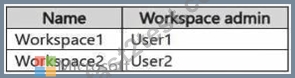
You have a security group named Group1 that contains User1 and User3.
The Fabric admin creates the domains shown in the following table.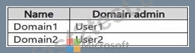
User1 creates a new workspace named Workspace3.
You add Group1 to the default domain of Domain1.
For each of the following statements, select Yes if the statement is true. Otherwise, select No.
NOTE: Each correct selection is worth one point.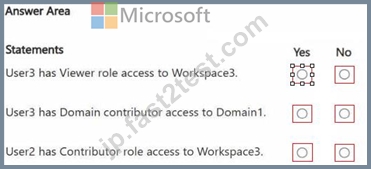
正解:
解説: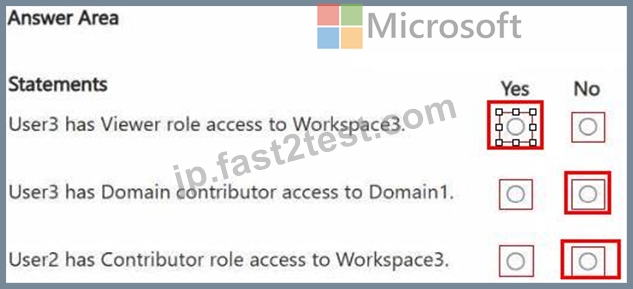
質問 # 30
You have a Fabric workspace that contains a warehouse named DW1. DW1 is loaded by using a notebook named Notebook1.
You need to identify which version of Delta was used when Notebook1 was executed.
What should you use?
- A. the Admin monitoring workspace
- B. the Microsoft Fabric Capacity Metrics app
- C. Real-Time hub
- D. OneLake data hub
- E. Fabric Monitor
正解:A
解説:
To identify the version of Delta used when Notebook1 was executed, you should use the Admin monitoring workspace. The Admin monitoring workspace allows you to track and monitor detailed information about the execution of notebooks and jobs, including the underlying versions of Delta or other technologies used. It provides insights into execution details, including versions and configurations used during job runs, making it the most appropriate choice for identifying the Delta version used during the execution of Notebook1.
質問 # 31
You are implementing the following data entities in a Fabric environment:
Entity1: Available in a lakehouse and contains data that will be used as a core organization entity Entity2: Available in a semantic model and contains data that meets organizational standards Entity3: Available in a Microsoft Power BI report and contains data that is ready for sharing and reuse Entity4: Available in a Power BI dashboard and contains approved data for executive-level decision making Your company requires that specific governance processes be implemented for the data.
You need to apply endorsement badges to the entities based on each entity's use case.
Which badge should you apply to each entity? To answer, drag the appropriate badges the correct entities. Each badge may be used once, more than once, or not at all. You may need to drag the split bar between panes or scroll to view content.
NOTE: Each correct selection is worth one point.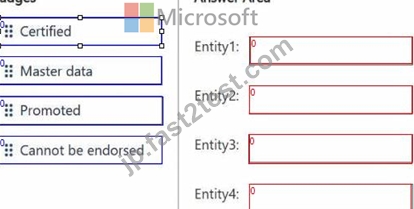
正解:
解説: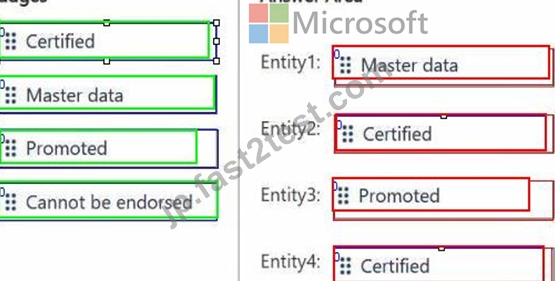
質問 # 32
Your company has a team of developers. The team creates Python libraries of reusable code that is used to transform data.
You create a Fabric workspace name Workspace1 that will be used to develop extract, transform, and load (ETL) solutions by using notebooks.
You need to ensure that the libraries are available by default to new notebooks in Workspace1.
Which three actions should you perform in sequence? To answer, move the appropriate actions from the list of actions to the answer area and arrange them in the correct order.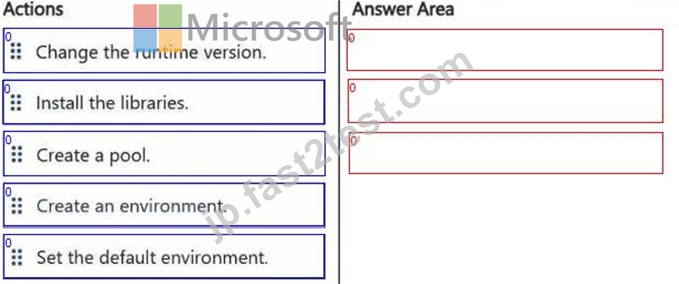
正解:
解説: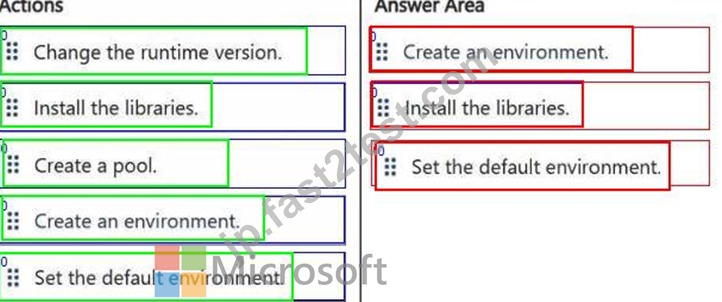
質問 # 33
You have a Fabric workspace named Workspace1 that contains a warehouse named Warehouse1.
You plan to deploy Warehouse1 to a new workspace named Workspace2.
As part of the deployment process, you need to verify whether Warehouse1 contains invalid references. The solution must minimize development effort.
What should you use?
- A. a Python script
- B. a deployment pipeline
- C. a T-SQL script
- D. a database project
正解:A
解説:
A deployment pipeline in Fabric allows you to deploy assets like warehouses, datasets, and reports between different workspaces (such as from Workspace1 to Workspace2). One of the key features of a deployment pipeline is the ability to check for invalid references before deployment. This can help identify issues with assets, such as broken links or dependencies, ensuring the deployment is successful without introducing errors. This is the most efficient way to verify references and manage the deployment with minimal development effort.
質問 # 34
You have a Fabric workspace named Workspace1 that contains a lakehouse named Lakehouse1. Lakehouse1 contains the following tables:
Orders
Customer
Employee
The Employee table contains Personally Identifiable Information (PII).
A data engineer is building a workflow that requires writing data to the Customer table, however, the user does NOT have the elevated permissions required to view the contents of the Employee table.
You need to ensure that the data engineer can write data to the Customer table without reading data from the Employee table.
Which three actions should you perform? Each correct answer presents part of the solution.
NOTE: Each correct selection is worth one point.
- A. Migrate the Employee table from Lakehouse1 to Lakehouse2.
- B. Assign the data engineer the Viewer role for Workspace1.
- C. Share Lakehouse1 with the data engineer.
- D. Assign the data engineer the Contributor role for Workspace1.
- E. Assign the data engineer the Viewer role for Workspace2.
- F. Assign the data engineer the Contributor role for Workspace2.
- G. Create a new workspace named Workspace2 that contains a new lakehouse named Lakehouse2.
正解:A、C、D
解説:
To meet the requirements of ensuring that the data engineer can write data to the Customer table without reading data from the Employee table (which contains Personally Identifiable Information, or PII), you can implement the following steps:
Share Lakehouse1 with the data engineer.
By sharing Lakehouse1 with the data engineer, you provide the necessary access to the data within the lakehouse. However, this access should be controlled through roles and permissions, which will allow writing to the Customer table but prevent reading from the Employee table.
Assign the data engineer the Contributor role for Workspace1.
Assigning the Contributor role for Workspace1 grants the data engineer the ability to perform actions such as writing to tables (e.g., the Customer table) within the workspace. This role typically allows users to modify and manage data without necessarily granting them access to view all data (e.g., PII data in the Employee table).
Migrate the Employee table from Lakehouse1 to Lakehouse2.
To prevent the data engineer from accessing the Employee table (which contains PII), you can migrate the Employee table to a separate lakehouse (Lakehouse2) or workspace (Workspace2). This separation of sensitive data ensures that the data engineer's access is restricted to the Customer table in Lakehouse1, while the Employee table can be managed separately and protected under different access controls.
質問 # 35
Note: This question is part of a series of questions that present the same scenario. Each question in the series contains a unique solution that might meet the stated goals. Some question sets might have more than one correct solution, while others might not have a correct solution.
After you answer a question in this section, you will NOT be able to return to it. As a result, these questions will not appear in the review screen.
You have a Fabric eventstream that loads data into a table named Bike_Location in a KQL database. The table contains the following columns:
You need to apply transformation and filter logic to prepare the data for consumption. The solution must return data for a neighbourhood named Sands End when No_Bikes is at least 15. The results must be ordered by No_Bikes in ascending order.
Solution: You use the following code segment:
Does this meet the goal?
- A. Yes
- B. no
正解:A
解説:
Filter Condition: It correctly filters rows where Neighbourhood is "Sands End" and No_Bikes is greater than or equal to 15.
Sorting: The sorting is explicitly done by No_Bikes in ascending order using sort by No_Bikes asc.
Projection: It projects the required columns (BikepointID, Street, Neighbourhood, No_Bikes, No_Empty_Docks, Timestamp), which minimizes the data returned for consumption.
質問 # 36
You need to ensure that the data analysts can access the gold layer lakehouse.
What should you do?
- A. Share the lakehouse with the DataAnalysts group and grant the Read all Apache Spark permission.
- B. Share the lakehouse with the DataAnalysts group and grant the Build reports on the default semantic model permission.
- C. Share the lakehouse with the DataAnalysts group and grant the Read all SQL Endpoint data permission.
- D. Add the DataAnalyst group to the Viewer role for WorkspaceA.
正解:C
解説:
Data Analysts' Access Requirements must only have read access to the Delta tables in the gold layer and not have access to the bronze and silver layers.
The gold layer data is typically queried via SQL Endpoints. Granting the Read all SQL Endpoint data permission allows data analysts to query the data using familiar SQL-based tools while restricting access to the underlying files.
質問 # 37
You have a Fabric workspace that contains a Real-Time Intelligence solution and an eventhouse.
Users report that from OneLake file explorer, they cannot see the data from the eventhouse.
You enable OneLake availability for the eventhouse.
What will be copied to OneLake?
- A. only the existing data in the eventhouse
- B. only new data added to the eventhouse
- C. both new data and existing data in the eventhouse
- D. only data added to new databases that are added to the eventhouse
- E. no data
正解:C
解説:
When you enable OneLake availability for an eventhouse, both new and existing data in the eventhouse will be copied to OneLake. This feature ensures that data, whether newly ingested or already present, becomes available for access through OneLake, making it easier for users to interact with and explore the data directly from OneLake file explorer.
質問 # 38
Note: This question is part of a series of questions that present the same scenario. Each question in the series contains a unique solution that might meet the stated goals. Some question sets might have more than one correct solution, while others might not have a correct solution.
After you answer a question in this section, you will NOT be able to return to it. As a result, these questions will not appear in the review screen.
You have a KQL database that contains two tables named Stream and Reference. Stream contains streaming data in the following format.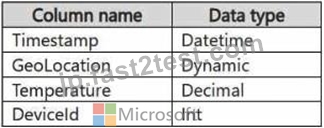
Reference contains reference data in the following format.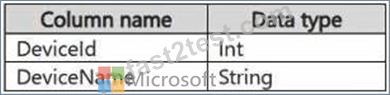
Both tables contain millions of rows.
You have the following KQL queryset.
You need to reduce how long it takes to run the KQL queryset.
Solution: You change the join type to kind=outer.
Does this meet the goal?
- A. Yes
- B. No
正解:B
解説:
An outer join will include unmatched rows from both tables, increasing the dataset size and processing time. It does not improve query performance.
質問 # 39
You have a Fabric workspace that contains a warehouse named Warehouse1. Data is loaded daily into Warehouse1 by using data pipelines and stored procedures.
You discover that the daily data load takes longer than expected.
You need to monitor Warehouse1 to identify the names of users that are actively running queries.
Which view should you use?
- A. sys.dm_exec_sessions
- B. sys.dm_exec_requests
- C. queryinsights.frequently_run_queries
- D. queryinsights.long_running_queries
- E. sys.dm_exec_connections
正解:A
解説:
sys.dm_exec_sessions provides real-time information about all active sessions, including the user, session ID, and status of the session. You can filter on session status to see users actively running queries.
質問 # 40
You have a Fabric workspace that contains a warehouse named Warehouse1. Data is loaded daily into Warehouse1 by using data pipelines and stored procedures.
You discover that the daily data load takes longer than expected.
You need to monitor Warehouse1 to identify the names of users that are actively running queries.
Which view should you use?
- A. sys.dm_exec_sessions
- B. sys.dm_exec_requests
- C. queryinsights.frequently_run_queries
- D. queryinsights.long_running_queries
- E. sys.dm_exec_connections
正解:A
解説:
sys.dm_exec_sessions provides real-time information about all active sessions, including the user, session ID, and status of the session. You can filter on session status to see users actively running queries.
質問 # 41
You have a Fabric workspace that contains a lakehouse named Lakehouse1. Lakehouse1 contains a Delta table named Table1.
You analyze Table1 and discover that Table1 contains 2,000 Parquet files of 1 MB each.
You need to minimize how long it takes to query Table1.
What should you do?
- A. Run the OPTIMIZE and VACUUM commands.
- B. Disable V-Order and run the VACUUM command.
- C. Disable V-Order and run the OPTIMIZE command.
正解:A
解説:
Problem Overview:
Solution:
Commands and Their Roles:
- Compacts small Parquet files into larger files to improve query performance.
- It supports optional features like V-Order, which organizes data for efficient scanning.
- Removes old, unreferenced data files and metadata from the Delta table.
- Running VACUUM after OPTIMIZE ensures unnecessary files are cleaned up, reducing storage overhead and improving performance.
質問 # 42
You have two Fabric workspaces named Workspace1 and Workspace2.
You have a Fabric deployment pipeline named deployPipeline1 that deploys items from Workspace1 to Workspace2. DeployPipeline1 contains all the items in Workspace1.
You recently modified the items in Workspaces1.
The workspaces currently contain the items shown in the following table.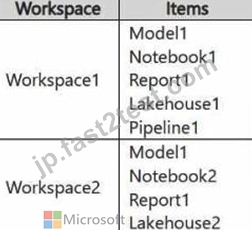
Items in Workspace1 that have the same name as items in Workspace2 are currently paired.
You need to ensure that the items in Workspace1 overwrite the corresponding items in Workspace2. The solution must minimize effort.
What should you do?
- A. Rename each item in Workspace2 to have the same name as the items in Workspace1.
- B. Back up the items in Workspace2, and then run deployPipeline1.
- C. Run deployPipeline1 without modifying the items in Workspace2.
- D. Delete all the items in Workspace2, and then run deployPipeline1.
正解:C
解説:
When running a deployment pipeline in Fabric, if the items in Workspace1 are paired with the corresponding items in Workspace2 (based on the same name), the deployment pipeline will automatically overwrite the existing items in Workspace2 with the modified items from Workspace1. There's no need to delete, rename, or back up items manually unless you need to keep versions. By simply running deployPipeline1, the pipeline will handle overwriting the existing items in Workspace2 based on the pairing, ensuring the latest version of the items is deployed with minimal effort.
質問 # 43
Your company has a sales department that uses two Fabric workspaces named Workspace1 and Workspace2.
The company decides to implement a domain strategy to organize the workspaces.
You need to ensure that a user can perform the following tasks:
Create a new domain for the sales department.
Create two subdomains: one for the east region and one for the west region.
Assign Workspace1 to the east region subdomain.
Assign Workspace2 to the west region subdomain.
The solution must follow the principle of least privilege.
Which role should you assign to the user?
- A. domain contributor
- B. domain admin
- C. workspace Admin
- D. Fabric admin
正解:B
解説:
To implement a domain strategy and manage subdomains within Fabric, the domain admin role is the appropriate role for the user. A domain admin has the permissions necessary to:
Create a new domain (for the sales department).
Create subdomains (for the east and west regions).
Assign workspaces (such as Workspace1 and Workspace2) to the appropriate subdomains.
The domain admin role allows for managing the structure and organization of workspaces in the context of domains and subdomains while maintaining the principle of least privilege by limiting the user's access to managing the domain structure specifically.
質問 # 44
You need to create the product dimension.
How should you complete the Apache Spark SQL code? To answer, select the appropriate options in the answer area.
NOTE: Each correct selection is worth one point.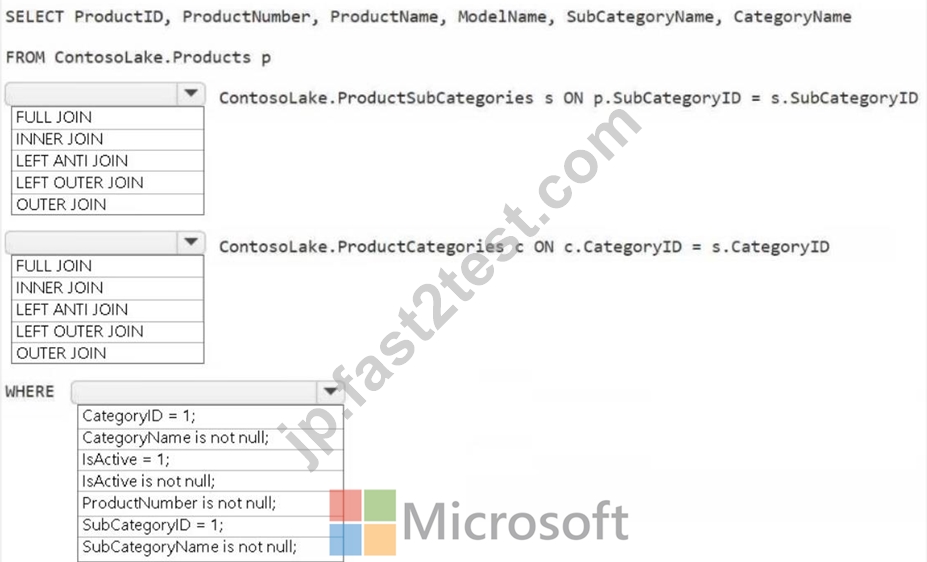
正解:
解説: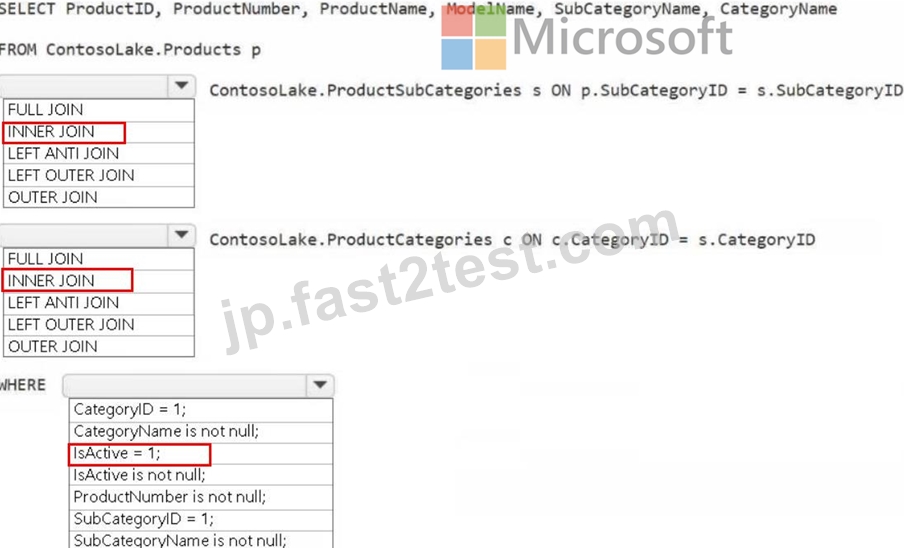
質問 # 45
You have a Fabric workspace that contains a semantic model named Model1.
You need to dynamically execute and monitor the refresh progress of Model1.
What should you use?
- A. dynamic management views in Azure Data Studio
- B. a semantic link in a notebook
- C. dynamic management views in Microsoft SQL Server Management Studio
- D. Monitoring hub
正解:B
質問 # 46
You have a Fabric workspace that contains a lakehouse named Lakehouse1. Data is ingested into Lakehouse1 as one flat table. The table contains the following columns.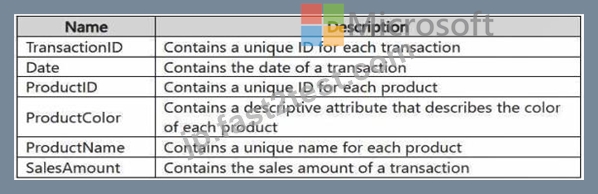
You plan to load the data into a dimensional model and implement a star schema. From the original flat table, you create two tables named FactSales and DimProduct. You will track changes in DimProduct.
You need to prepare the data.
Which three columns should you include in the DimProduct table? Each correct answer presents part of the solution.
NOTE: Each correct selection is worth one point.
- A. SalesAmount
- B. ProductID
- C. Date
- D. TransactionID
- E. ProductName
- F. ProductColor
正解:B、E、F
解説:
In a star schema, the DimProduct table serves as a dimension table that contains descriptive attributes about products. It will provide context for the FactSales table, which contains transactional data. The following columns should be included in the DimProduct table:
ProductName: The ProductName is an important descriptive attribute of the product, which is needed for analysis and reporting in a dimensional model.
ProductColor: ProductColor is another descriptive attribute of the product. In a star schema, it makes sense to include attributes like color in the dimension table to help categorize products in the analysis.
ProductID: ProductID is the primary key for the DimProduct table, which will be used to join the FactSales table to the product dimension. It's essential for uniquely identifying each product in the model.
質問 # 47
You have a Fabric workspace that contains a warehouse named Warehouse1. Warehouse1 contains the following tables and columns.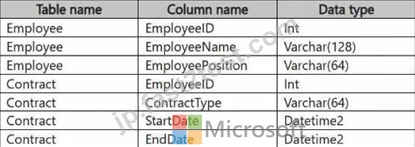
You need to denormalize the tables and include the ContractType and StartDate columns in the Employee table. The solution must meet the following requirements:
How should you complete the statement? To answer, select the appropriate options in the answer area.
NOTE: Each correct selection is worth one point.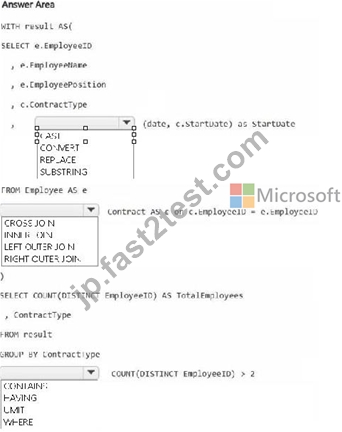
正解:
解説: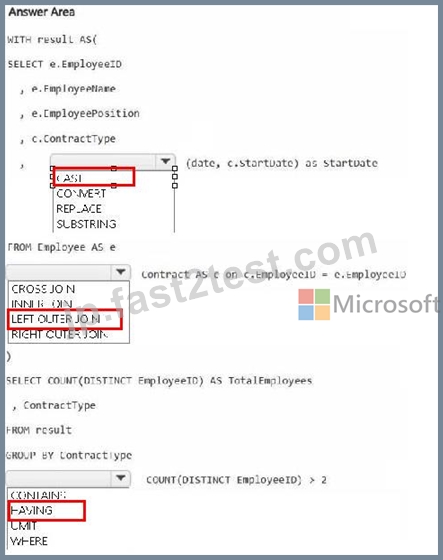
質問 # 48
You have a Fabric workspace that contains an eventstream named Eventstream1. Eventstream1 processes data from a thermal sensor by using event stream processing, and then stores the data in a lakehouse.
You need to modify Eventstream1 to include the standard deviation of the temperature.
Which transform operator should you include in the Eventstream1 logic?
- A. Group by
- B. Expand
- C. Union
- D. Aggregate
正解:D
解説:
To compute the standard deviation of the temperature from the thermal sensor data, you would use the Aggregate transform operator in Eventstream1. The Aggregate operator allows you to apply functions like sum, average, count, and statistical functions like standard deviation across a group of rows or events. This operator is ideal for operations that require summarizing or computing statistics over a dataset, such as calculating the standard deviation.
質問 # 49
......
DP-700試験問題無料PDFダウンロード 最近更新された問題です:https://jp.fast2test.com/DP-700-premium-file.html
DP-700認定試験問題集には70練習テスト問題:https://drive.google.com/open?id=1GEkKnhsGAxx6aPEykjjnC5WIKSbRamsx