

DP-700リアルな試験問題DP-700練習問題集
厳密検証されたDP-700試験問題集と解答で無料提供のDP-700問題と正解付き
質問 # 27
You have a Fabric workspace named Workspace1.
You plan to integrate Workspace1 with Azure DevOps.
You will use a Fabric deployment pipeline named deployPipeline1 to deploy items from Workspace1 to higher environment workspaces as part of a medallion architecture. You will run deployPipeline1 by using an API call from an Azure DevOps pipeline.
You need to configure API authentication between Azure DevOps and Fabric.
Which type of authentication should you use?
- A. service principal
- B. managed private endpoint
- C. workspace identity
- D. Microsoft Entra username and password
正解:A
解説:
When integrating Azure DevOps with Fabric (Workspace1), using a service principal is the recommended authentication method. A service principal provides a way for applications (such as an Azure DevOps pipeline) to authenticate and interact with resources securely. It allows Azure DevOps to authenticate API calls to Fabric without requiring direct user credentials. This method is ideal for automating tasks such as deploying items through a Fabric deployment pipeline.
質問 # 28
You have a Fabric workspace that contains a warehouse named Warehouse1.
You have an on-premises Microsoft SQL Server database named Database1 that is accessed by using an on-premises data gateway.
You need to copy data from Database1 to Warehouse1.
Which item should you use?
- A. an eventstream
- B. a Dataflow Gen1 dataflow
- C. a data pipeline
- D. an Apache Spark job definition
正解:C
解説:
To copy data from an on-premises Microsoft SQL Server database (Database1) to a warehouse (Warehouse1) in Fabric, a data pipeline is the most appropriate tool. A data pipeline in Fabric is designed to move data between various data sources and destinations, including on-premises databases like SQL Server, and cloud-based storage like Fabric warehouses. The data pipeline can handle the connection through an on-premises data gateway, which is required to access on-premises data. This solution facilitates the orchestration of data movement and transformations if needed.
質問 # 29
You have five Fabric workspaces.
You are monitoring the execution of items by using Monitoring hub.
You need to identify in which workspace a specific item runs.
Which column should you view in Monitoring hub?
- A. Activity name
- B. Start time
- C. Submitter
- D. Capacity
- E. Location
- F. Item type
- G. Job type
正解:E
解説:
To identify in which workspace a specific item runs in Monitoring hub, you should view the Location column. This column indicates the workspace where the item is executed. Since you have multiple workspaces and need to track the execution of items across them, the Location column will show you the exact workspace associated with each item or job execution.
質問 # 30
Note: This question is part of a series of questions that present the same scenario. Each question in the series contains a unique solution that might meet the stated goals. Some question sets might have more than one correct solution, while others might not have a correct solution.
After you answer a question in this section, you will NOT be able to return to it. As a result, these questions will not appear in the review screen.
You have a Fabric eventstream that loads data into a table named Bike_Location in a KQL database. The table contains the following columns:
You need to apply transformation and filter logic to prepare the data for consumption. The solution must return data for a neighbourhood named Sands End when No_Bikes is at least 15. The results must be ordered by No_Bikes in ascending order.
Solution: You use the following code segment:
Does this meet the goal?
- A. Yes
- B. no
正解:A
解説:
Filter Condition: It correctly filters rows where Neighbourhood is "Sands End" and No_Bikes is greater than or equal to 15.
Sorting: The sorting is explicitly done by No_Bikes in ascending order using sort by No_Bikes asc.
Projection: It projects the required columns (BikepointID, Street, Neighbourhood, No_Bikes, No_Empty_Docks, Timestamp), which minimizes the data returned for consumption.
質問 # 31
You have a Fabric workspace that contains a warehouse named Warehouse1.
You have an on-premises Microsoft SQL Server database named Database1 that is accessed by using an on-premises data gateway.
You need to copy data from Database1 to Warehouse1.
Which item should you use?
- A. a Dataflow Gen1 dataflow
- B. a data pipeline
- C. a notebook
- D. a KQL queryset
正解:B
解説:
To copy data from an on-premises Microsoft SQL Server database (Database1) to a warehouse (Warehouse1) in Microsoft Fabric, the best option is to use a data pipeline. A data pipeline in Fabric allows for the orchestration of data movement, from source to destination, using connectors, transformations, and scheduled workflows. Since the data is being transferred from an on-premises database and requires the use of a data gateway, a data pipeline provides the appropriate framework to facilitate this data movement efficiently and reliably.
質問 # 32
Note: This question is part of a series of questions that present the same scenario. Each question in the series contains a unique solution that might meet the stated goals. Some question sets might have more than one correct solution, while others might not have a correct solution.
After you answer a question in this section, you will NOT be able to return to it. As a result, these questions will not appear in the review screen.
You have a KQL database that contains two tables named Stream and Reference. Stream contains streaming data in the following format.
Reference contains reference data in the following format.
Both tables contain millions of rows.
You have the following KQL queryset.
You need to reduce how long it takes to run the KQL queryset.
Solution: You change the join type to kind=outer.
Does this meet the goal?
- A. Yes
- B. No
正解:B
解説:
An outer join will include unmatched rows from both tables, increasing the dataset size and processing time. It does not improve query performance.
質問 # 33
You have a Fabric workspace that contains a semantic model named Model1.
You need to dynamically execute and monitor the refresh progress of Model1.
What should you use?
- A. dynamic management views in Azure Data Studio
- B. Monitoring hub
- C. a semantic link in a notebook
- D. dynamic management views in Microsoft SQL Server Management Studio
正解:C
解説:
Semantic models in Microsoft Fabric are part of Power BI datasets and require refreshes to stay updated with the latest data.
Dynamically executing and monitoring the refresh progress requires a tool or approach that integrates with Fabric's capabilities for semantic models.
質問 # 34
You are implementing the following data entities in a Fabric environment:
Entity1: Available in a lakehouse and contains data that will be used as a core organization entity Entity2: Available in a semantic model and contains data that meets organizational standards Entity3: Available in a Microsoft Power BI report and contains data that is ready for sharing and reuse Entity4: Available in a Power BI dashboard and contains approved data for executive-level decision making Your company requires that specific governance processes be implemented for the data.
You need to apply endorsement badges to the entities based on each entity's use case.
Which badge should you apply to each entity? To answer, drag the appropriate badges the correct entities. Each badge may be used once, more than once, or not at all. You may need to drag the split bar between panes or scroll to view content.
NOTE: Each correct selection is worth one point.
正解:
解説:
質問 # 35
Note: This question is part of a series of questions that present the same scenario. Each question in the series contains a unique solution that might meet the stated goals. Some question sets might have more than one correct solution, while others might not have a correct solution.
After you answer a question in this section, you will NOT be able to return to it. As a result, these questions will not appear in the review screen.
You have a KQL database that contains two tables named Stream and Reference. Stream contains streaming data in the following format.
Reference contains reference data in the following format.
Both tables contain millions of rows.
You have the following KQL queryset.
You need to reduce how long it takes to run the KQL queryset.
Solution: You move the filter to line 02.
Does this meet the goal?
- A. No
- B. Yes
正解:B
解説:
Moving the filter to line 02: Filtering the Stream table before performing the join operation reduces the number of rows that need to be processed during the join. This is an effective optimization technique for queries involving large datasets.
質問 # 36
You are processing streaming data from an external data provider.
You have the following code segment.
For each of the following statements, select Yes if the statement is true. Otherwise, select No.
NOTE: Each correct selection is worth one point.
正解:
解説:
Topic 2, Contoso, Ltd
Overview
This is a case study. Case studies are not timed separately. You can use as much exam time as you would like to complete each case. However, there may be additional case studies and sections on this exam. You must manage your time to ensure that you are able to complete all questions included on this exam in the time provided.
To answer the questions included in a case study, you will need to reference information that is provided in the case study. Case studies might contain exhibits and other resources that provide more information about the scenario that is described in the case study. Each question is independent of the other questions in this case study.
At the end of this case study, a review screen will appear. This screen allows you to review your answers and to make changes before you move to the next section of the exam. After you begin a new section, you cannot return to this section.
To start the case study
To display the first question in this case study, click the Next button. Use the buttons in the left pane to explore the content of the case study before you answer the questions. Clicking these buttons displays information such as business requirements, existing environment, and problem statements. If the case study has an All Information tab, note that the information displayed is identical to the information displayed on the subsequent tabs. When you are ready to answer a question, click the Question button to return to the question.
Overview. Company Overview
Contoso, Ltd. is an online retail company that wants to modernize its analytics platform by moving to Fabric. The company plans to begin using Fabric for marketing analytics.
Overview. IT Structure
The company's IT department has a team of data analysts and a team of data engineers that use analytics systems.
The data engineers perform the ingestion, transformation, and loading of data. They prefer to use Python or SQL to transform the data.
The data analysts query data and create semantic models and reports. They are qualified to write queries in Power Query and T-SQL.
Existing Environment. Fabric
Contoso has an F64 capacity named Cap1. All Fabric users are allowed to create items.
Contoso has two workspaces named WorkspaceA and WorkspaceB that currently use Pro license mode.
Existing Environment. Source Systems
Contoso has a point of sale (POS) system named POS1 that uses an instance of SQL Server on Azure Virtual Machines in the same Microsoft Entra tenant as Fabric. The host virtual machine is on a private virtual network that has public access blocked. POS1 contains all the sales transactions that were processed on the company's website.
The company has a software as a service (SaaS) online marketing app named MAR1. MAR1 has seven entities. The entities contain data that relates to email open rates and interaction rates, as well as website interactions. The data can be exported from MAR1 by calling REST APIs. Each entity has a different endpoint.
Contoso has been using MAR1 for one year. Data from prior years is stored in Parquet files in an Amazon Simple Storage Service (Amazon S3) bucket. There are 12 files that range in size from 300 MB to 900 MB and relate to email interactions.
Existing Environment. Product Data
POS1 contains a product list and related data. The data comes from the following three tables:
In the data, products are related to product subcategories, and subcategories are related to product categories.
Existing Environment. Azure
Contoso has a Microsoft Entra tenant that has the following mail-enabled security groups:
Contoso has an Azure subscription.
The company has an existing Azure DevOps organization and creates a new project for repositories that relate to Fabric.
Existing Environment. User Problems
The VP of marketing at Contoso requires analysis on the effectiveness of different types of email content. It typically takes a week to manually compile and analyze the data. Contoso wants to reduce the time to less than one day by using Fabric.
The data engineering team has successfully exported data from MAR1. The team experiences transient connectivity errors, which causes the data exports to fail.
Requirements. Planned Changes
Contoso plans to create the following two lakehouses:
Additional items will be added to facilitate data ingestion and transformation.
Contoso plans to use Azure Repos for source control in Fabric.
Requirements. Technical Requirements
The new lakehouses must follow a medallion architecture by using the following three layers: bronze, silver, and gold. There will be extensive data cleansing required to populate the MAR1 data in the silver layer, including deduplication, the handling of missing values, and the standardizing of capitalization.
Each layer must be fully populated before moving on to the next layer. If any step in populating the lakehouses fails, an email must be sent to the data engineers.
Data imports must run simultaneously, when possible.
The use of email data from the Amazon S3 bucket must meet the following requirements:
Items that relate to data ingestion must meet the following requirements:
Lakehouses, data pipelines, and notebooks must be stored in WorkspaceA. Semantic models, reports, and dataflows must be stored in WorkspaceB.
Once a week, old files that are no longer referenced by a Delta table log must be removed.
Requirements. Data Transformation
In the POS1 product data, ProductID values are unique. The product dimension in the gold layer must include only active products from product list. Active products are identified by an IsActive value of 1.
Some product categories and subcategories are NOT assigned to any product. They are NOT analytically relevant and must be omitted from the product dimension in the gold layer.
Requirements. Data Security
Security in Fabric must meet the following requirements:
質問 # 37
You have a Google Cloud Storage (GCS) container named storage1 that contains the files shown in the following table.
You have a Fabric workspace named Workspace1 that has the cache for shortcuts enabled. Workspace1 contains a lakehouse named Lakehouse1. Lakehouse1 has the shortcuts shown in the following table.
You need to read data from all the shortcuts.
Which shortcuts will retrieve data from the cache?
- A. Products only
- B. Products, Stores, and Trips
- C. Trips only
- D. Stores only
- E. Stores and Products only
- F. Products and Trips only
正解:E
解説:
When reading data from shortcuts in Fabric (in this case, from a lakehouse like Lakehouse1), the cache for shortcuts helps by storing the data locally for quick access. The last accessed timestamp and the cache expiration rules determine whether data is fetched from the cache or from the source (Google Cloud Storage, in this case).
Products: The ProductFile.parquet was last accessed 12 hours ago. Since the cache has data available for up to 12 hours, it is likely that this data will be retrieved from the cache, as it hasn't been too long since it was last accessed.
Stores: The StoreFile.json was last accessed 4 hours ago, which is within the cache retention period. Therefore, this data will also be retrieved from the cache.
Trips: The TripsFile.csv was last accessed 48 hours ago. Given that it's outside the typical caching window (assuming the cache has a maximum retention period of around 24 hours), it would not be retrieved from the cache. Instead, it will likely require a fresh read from the source.
質問 # 38
You have a Fabric workspace that contains a warehouse named DW1. DW1 contains the following tables and columns.
You need to create an output that presents the summarized values of all the order quantities by year and product. The results must include a summary of the order quantities at the year level for all the products.
How should you complete the code? To answer, select the appropriate options in the answer area.
NOTE: Each correct selection is worth one point.
正解:
解説:
質問 # 39
You have an Azure event hub. Each event contains the following fields:
BikepointID
Street
Neighbourhood
Latitude
Longitude
No_Bikes
No_Empty_Docks
You need to ingest the events. The solution must only retain events that have a Neighbourhood value of Chelsea, and then store the retained events in a Fabric lakehouse.
What should you use?
- A. Apache Spark Structured Streaming
- B. an eventstream
- C. a streaming dataset
- D. a KQL queryset
正解:B
解説:
An eventstream is the best solution for ingesting data from Azure Event Hub into Fabric, while applying filtering logic such as retaining only the events that have a Neighbourhood value of "Chelsea." Eventstreams in Microsoft Fabric are designed for handling real-time data streams and can apply transformation logic directly on incoming events. In this case, the eventstream can filter events based on the Neighbourhood field before storing the retained events in a Fabric lakehouse.
Eventstreams are well-suited for stream processing, such as this case where you need to filter out only specific data (events with a Neighbourhood of "Chelsea") before storing it in the lakehouse.
質問 # 40
You have a Fabric eventhouse that contains a KQL database. The database contains a table named TaxiData. The following is a sample of the data in TaxiData.
You need to build two KQL queries. The solution must meet the following requirements:
How should you complete each query? To answer, drag the appropriate values the correct targets. Each value may be used once, more than once, or not at all. You may need to drag the split bar between panes or scroll to view content.
NOTE: Each correct selection is worth one point.
正解:
解説:
質問 # 41
You have a Fabric workspace named Workspace1_DEV that contains the following items:
You create a deployment pipeline named Pipeline1 to move items from Workspace1_DEV to a new workspace named Workspace1_TEST.
You deploy all the items from Workspace1_DEV to Workspace1_TEST.
For each of the following statements, select Yes if the statement is true. Otherwise, select No.
NOTE: Each correct selection is worth one point.
正解:
解説:
質問 # 42
You have a Fabric workspace that contains a lakehouse named Lakehouse1.
In an external data source, you have data files that are 500 GB each. A new file is added every day.
You need to ingest the data into Lakehouse1 without applying any transformations. The solution must meet the following requirements Trigger the process when a new file is added.
Provide the highest throughput.
Which type of item should you use to ingest the data?
- A. KQL queryset
- B. Dataflow Gen2
- C. Data pipeline
- D. Environment
正解:C
解説:
To efficiently ingest large data files (500 GB each) into Lakehouse1 with high throughput and trigger the process when a new file is added, a Data pipeline is the most suitable solution. Data pipelines in Fabric are ideal for orchestrating data movement and can be configured to automatically trigger based on file arrivals or other events. This solution meets both requirements: ingesting the data without transformations (since you just need to copy the data) and triggering the process when new files are added.
Topic 1, Litware, Inc
Overview
This is a case study. Case studies are not timed separately. You can use as much exam time as you would like to complete each case. However, there may be additional case studies and sections on this exam. You must manage your time to ensure that you are able to complete all questions included on this exam in the time provided.
To answer the questions included in a case study, you will need to reference information that is provided in the case study. Case studies might contain exhibits and other resources that provide more information about the scenario that is described in the case study. Each question is independent of the other questions in this case study.
At the end of this case study, a review screen will appear. This screen allows you to review your answers and to make changes before you move to the next section of the exam. After you begin a new section, you cannot return to this section.
To start the case study
To display the first question in this case study, click the Next button. Use the buttons in the left pane to explore the content of the case study before you answer the questions. Clicking these buttons displays information such as business requirements, existing environment, and problem statements. If the case study has an All Information tab, note that the information displayed is identical to the information displayed on the subsequent tabs. When you are ready to answer a question, click the Question button to return to the question.
Overview
Litware, Inc. is a publishing company that has an online bookstore and several retail bookstores worldwide. Litware also manages an online advertising business for the authors it represents.
Existing Environment. Fabric Environment
Litware has a Fabric workspace named Workspace1. High concurrency is enabled for Workspace1.
The company has a data engineering team that uses Python for data processing.
Existing Environment. Data Processing
The retail bookstores send sales data at the end of each business day, while the online bookstore constantly provides logs and sales data to a central enterprise resource planning (ERP) system.
Litware implements a medallion architecture by using the following three layers: bronze, silver, and gold. The sales data is ingested from the ERP system as Parquet files that land in the Files folder in a lakehouse. Notebooks are used to transform the files in a Delta table for the bronze and silver layers. The gold layer is in a warehouse that has V-Order disabled.
Litware has image files of book covers in Azure Blob Storage. The files are loaded into the Files folder.
Existing Environment. Sales Data
Month-end sales data is processed on the first calendar day of each month. Data that is older than one month never changes.
In the source system, the sales data refreshes every six hours starting at midnight each day.
The sales data is captured in a Dataflow Gen1 dataflow. When the dataflow runs, new and historical data is captured. The dataflow captures the following fields of the source:
A table named AuthorSales stores the sales data that relates to each author. The table contains a column named AuthorEmail. Authors authenticate to a guest Fabric tenant by using their email address.
Existing Environment. Security Groups
Litware has the following security groups:
Existing Environment. Performance Issues
Business users perform ad-hoc queries against the warehouse. The business users indicate that reports against the warehouse sometimes run for two hours and fail to load as expected. Upon further investigation, the data engineering team receives the following error message when the reports fail to load: "The SQL query failed while running." The data engineering team wants to debug the issue and find queries that cause more than one failure.
When the authors have new book releases, there is often an increase in sales activity. This increase slows the data ingestion process.
The company's sales team reports that during the last month, the sales data has NOT been up-to-date when they arrive at work in the morning.
Requirements. Planned Changes
Litware recently signed a contract to receive book reviews. The provider of the reviews exposes the data in Amazon Simple Storage Service (Amazon S3) buckets.
Litware plans to manage Search Engine Optimization (SEO) for the authors. The SEO data will be streamed from a REST API.
Requirements. Version Control
Litware plans to implement a version control solution in Fabric that will use GitHub integration and follow the principle of least privilege.
Requirements. Governance Requirements
To control data platform costs, the data platform must use only Fabric services and items. Additional Azure resources must NOT be provisioned.
Requirements. Data Requirements
Litware identifies the following data requirements:
質問 # 43
You have a Fabric workspace that contains a lakehouse named Lakehouse1. Lakehouse1 contains a Delta table named Table1.
You analyze Table1 and discover that Table1 contains 2,000 Parquet files of 1 MB each.
You need to minimize how long it takes to query Table1.
What should you do?
- A. Run the OPTIMIZE and VACUUM commands.
- B. Disable V-Order and run the VACUUM command.
- C. Disable V-Order and run the OPTIMIZE command.
正解:A
解説:
Problem Overview:
Solution:
Commands and Their Roles:
- Compacts small Parquet files into larger files to improve query performance.
- It supports optional features like V-Order, which organizes data for efficient scanning.
- Removes old, unreferenced data files and metadata from the Delta table.
- Running VACUUM after OPTIMIZE ensures unnecessary files are cleaned up, reducing storage overhead and improving performance.
質問 # 44
Your company has a sales department that uses two Fabric workspaces named Workspace1 and Workspace2.
The company decides to implement a domain strategy to organize the workspaces.
You need to ensure that a user can perform the following tasks:
Create a new domain for the sales department.
Create two subdomains: one for the east region and one for the west region.
Assign Workspace1 to the east region subdomain.
Assign Workspace2 to the west region subdomain.
The solution must follow the principle of least privilege.
Which role should you assign to the user?
- A. workspace Admin
- B. Fabric admin
- C. domain admin
- D. domain contributor
正解:C
解説:
To implement a domain strategy and manage subdomains within Fabric, the domain admin role is the appropriate role for the user. A domain admin has the permissions necessary to:
Create a new domain (for the sales department).
Create subdomains (for the east and west regions).
Assign workspaces (such as Workspace1 and Workspace2) to the appropriate subdomains.
The domain admin role allows for managing the structure and organization of workspaces in the context of domains and subdomains while maintaining the principle of least privilege by limiting the user's access to managing the domain structure specifically.
質問 # 45
You have a Fabric workspace that contains an eventhouse and a KQL database named Database1. Database1 has the following:
Policy1 sends data from Table1 to Table2.
The following is a sample of the data in Table2.
Recently, the following actions were performed on Table1:
You plan to load additional records to Table2.
Which two records will load from Table1 to Table2? Each correct answer presents a complete solution.
NOTE: Each correct selection is worth one point.
- A.

- B.

- C.

- D.

正解:A、B
解説:
Changes to Table1 Structure:
Impact of Changes:
Record B:
Accepted because it fully matches Table2's structure and data types.
Record D:
Accepted because it fully matches Table2's structure and data types.
質問 # 46
You have two Fabric workspaces named Workspace1 and Workspace2.
You have a Fabric deployment pipeline named deployPipeline1 that deploys items from Workspace1 to Workspace2. DeployPipeline1 contains all the items in Workspace1.
You recently modified the items in Workspaces1.
The workspaces currently contain the items shown in the following table.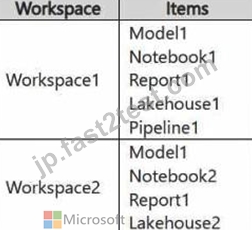
Items in Workspace1 that have the same name as items in Workspace2 are currently paired.
You need to ensure that the items in Workspace1 overwrite the corresponding items in Workspace2. The solution must minimize effort.
What should you do?
- A. Delete all the items in Workspace2, and then run deployPipeline1.
- B. Rename each item in Workspace2 to have the same name as the items in Workspace1.
- C. Run deployPipeline1 without modifying the items in Workspace2.
- D. Back up the items in Workspace2, and then run deployPipeline1.
正解:C
解説:
When running a deployment pipeline in Fabric, if the items in Workspace1 are paired with the corresponding items in Workspace2 (based on the same name), the deployment pipeline will automatically overwrite the existing items in Workspace2 with the modified items from Workspace1. There's no need to delete, rename, or back up items manually unless you need to keep versions. By simply running deployPipeline1, the pipeline will handle overwriting the existing items in Workspace2 based on the pairing, ensuring the latest version of the items is deployed with minimal effort.
質問 # 47
......
無料でゲット!高評価Microsoft DP-700試験問題集を今すぐダウンロード!:https://jp.fast2test.com/DP-700-premium-file.html
あなたを合格させるDP-700無料最新問題集でMicrosoft練習テストしよう:https://drive.google.com/open?id=1GEkKnhsGAxx6aPEykjjnC5WIKSbRamsx