

CWNP CWAP-404認定試験問題集には190練習テスト問題があります
最新CWAP-404試験問題集には高得点で一発合格
CWNP CWAP-404 認定試験の出題範囲:
| トピック | 出題範囲 |
|---|---|
| トピック 1 |
|
| トピック 2 |
|
| トピック 3 |
|
| トピック 4 |
|
質問 # 96
Which one of the following is not an 802.11 Management frame?
- A. Action
- B. Authentication
- C. PS-Poll
- D. Beacon
正解:C
解説:
Explanation
A PS-Poll (Power Save Poll) frame is not an 802.11 management frame. A PS-Poll frame is a type of control frame that is used by a STA in power save mode to request data frames from an AP. A STA in power save mode can conserve battery power by periodically sleeping and waking up. When a STA sleeps, it cannot receive any data frames from the AP, so it informs the AP of its power save status by setting a bit in its MAC header. The AP then buffers any data frames destined for the sleeping STA until it wakes up. When a STA wakes up, it sends a PS-Poll frame to the AP, indicating its association ID and requesting any buffered data frames. The AP thenresponds with one or more data frames, followed by an ACK or BA frame from the STA.
The other options are not correct, as they are types of 802.11 management frames. An Action frame is used to perform various management actions, such as spectrum management, QoS management, radio measurement, etc. A Beacon frame is used to advertise the presence and capabilities of an AP or BSS. An Authentication frame is used to establish or terminate an authentication relationship between a STA and an AP. References: [Wireless Analysis Professional Study Guide CWAP-404], Chapter 6: 802.11 Frame Exchanges, page 169-170
質問 # 97
As it pertains to HT L-SIG TXOP Protection, what statement is true?
- A. An L-SIG TXOP protected frame exchange sequence always begins with an RTS/CTS or a CTS- to-Self.
- B. L-SIG TXOP Protection is specified for the purpose of protecting OFDM (802.11a/g) and HT- OFDM (802.11n) transmissions from HR/DSSS stations.
- C. Support for L-SIG TXOP Protection is indicated in the HT Capabilities Info field of (re)association request frames sent by ERP, OFDM, and HT-OFDM stations.
- D. Support for L-SIG TXOP Protection is indicated by HT stations in the L-SIG field of the PLCP header of HT-mixed format frames.
正解:A
質問 # 98
Shown is a screenshot of a wireless protocol analyzer displaying the decode information for a single 802.11 encrypted data + CF-Poll frame. The infrastructure BSS on which this information was captured is using WEP and this particular frame was sent from a client station (STA) to an access point (AP).
As a protocol analyst, how would you explain the existence of this frame on the wireless medium given the information in the decode?
- A. The access point is operating as a repeater, and clients must poll repeater access points in order to transmit data frames through them.
- B. The IEEE 802.11 network is using both version 1 and version 2 protocols simultaneously. This unexpected frame is from the version 2 protocol set.
- C. The frame was sent by a client station that does not comply with IEEE HR/DSSS standard to an access point that is Wi-Fi certified.
- D. The frame was misinterpreted because of insufficient information received by the analyzer due to frame corruption.
正解:D
質問 # 99
Which one of the following statements is not true concerning DTIMs?
- A. Buffered Broadcast and Multicast traffic will be transmitted following a DTIM
- B. Every Beacon frame must contain a DTIM
- C. DTIM stands for Delivery Traffic Indication Map
- D. The DTIM interval can dictate when an STA will wake up to listen to beacon frames
正解:B
解説:
Explanation
Every Beacon frame must contain a DTIM is not a true statement concerning DTIMs. DTIM stands for Delivery Traffic Indication Message, and it is a subfield within the TIM (Traffic Indication Map) element in a Beacon frame. The DTIM indicates how many Beacon frames (including the current one) will appear before the next DTIM. For example, if the DTIM interval is set to 3, it means that every third Beacon frame will contain a DTIM. Buffered broadcast and multicast traffic will be transmitted following a DTIM, so that STAs in power save mode can wake up and receive them. The DTIM interval can also dictate when an STA will wake up to listen to Beacon frames, as some STAs may choose to only listen to Beacon frames that contain a DTIM . References: CWAP-404 Certified Wireless Analysis Professional Study and Reference Guide, Chapter
6: MAC Sublayer Frame Exchanges, page 200; CWAP-404 CertifiedWireless Analysis Professional Study and Reference Guide, Chapter 6: MAC Sublayer Frame Exchanges, page 201.
質問 # 100
A manager at a retail outlet has complained that an incident occurred allowing a STA to launch an attack against another STA connected to their public Wi-Fi hotspot. He has asked you to troubleshoot the situation and verify that all possible measured are being taken to prevent this.
What configuration should you check in the AP?
- A. Captive portal Internet gateway
- B. Client-to-client direct communications
- C. DNS settings
- D. Inter-VAP filtering
正解:D
質問 # 101
Using a portable analyzer you perform a packet capture next to a client STA and you can see that the STA is associated to a BSS. You observe the STA sending packets to the AP and the AP sending packets to the STA. Less the 2% of all packets are retransmissions. You move to capture packets by the AP and, while the retry rate is still very low, you now only see unidirectional traffic from the AP to the client. How do you explain this behavior?
- A. The portable analyzer has a lower receive sensitivity than the AP and while it can't capture the packets from the client STA, the AP can receive them OK.
- B. There is a transmit power mismatch between the client and the AP and while the client can hear the Aps traffic, the AP cannot hear the client.
- C. The STA is transmitting data using more spatial streams than the potable analyzer can support
- D. The portable analyzer is too close to the AP causing CCI, blinding the AP to the client's packets
正解:A
解説:
Receive sensitivity is the minimum signal level that a receiver can detect and decode. Different devices may have different receive sensitivity levels depending on their hardware specifications and antenna configurations. In this scenario, the portable analyzer has a lower receive sensitivity than the AP, meaning that it requires a stronger signal to capture the packets from the client STA.
The AP, on the other hand, has a higher receive sensitivity and can receive the packets from the client STA even if they have a weaker signal. This explains why the portable analyzer can only see unidirectional traffic from the AP to the client when capturing near the AP.
質問 # 102
You have been recently hired as the wireless network administrator for an organization spread across seven locations. They have deployed more than 100 APs, but they have not been managed in either an automated or manual process for more than 18 months.
Given this length of time, what is one of the first things you should evaluate from a support perspective?
- A. The VLANs in use
- B. The firmware revision
- C. The channels in use
- D. The data rates allowed
正解:B
質問 # 103
When evaluating modulation and coding schemes, you must determine the best coding rate available.
In 802.11 MCS tables, what is the best coding rate from the perspective of highest data rates?
- A. 3/4
- B. 5/6
- C. 2/3
- D. 1/2
正解:B
質問 # 104
In which element of a Beacon frame would you look to identity the current HT protection mode in which an AP is operating?
- A. ERP Information Element
- B. HT Operations Element
- C. HT Capabilities Element
- D. HT Protection Element
正解:B
解説:
Explanation
The HT protection mode in which an AP is operating can be identified by looking at the HT Operations element in a Beacon frame. The HT Operations element is a part of the Beacon frame that contains information about the High Throughput (HT) capabilities and operation of an 802.11n BSS. The HT Operations element has a field called HT Protection, which indicates how the BSS protects its HT transmissions from interference or collisions with non-HT devices or BSSs. The HT Protection field can have four values: No Protection, Nonmember Protection, 20 MHz Protection, or Non-HT Mixed Mode. The other options are not correct, as they do not contain information about the HT protection mode. The HT Protection element does not exist, the ERP Information element is used for Extended Rate PHY (ERP) protection mode for 802.11g devices, and the HT Capabilities element is used for indicating the supported HT features of an individual device. References: [Wireless Analysis Professional Study Guide CWAP-404], Chapter 5: 802.11 MAC Sublayer, page 125-126
質問 # 105
The To DS bit is set to 0 and the From DS is set to 1.
What best describes this 802.11 frame?
- A. A frame being transmitted directly from one client STA to another
- B. A frame being transmitted from an AP to a client STA
- C. A frame being transmitted in a mesh BSS
- D. A frame being transmitted from a client STA to an AP
正解:B
質問 # 106
When using Wireshark for protocol analysis, what filter will allow you to see only beacon frames?
- A. wlan.fc.type_subtype = =0x0b
- B. wlan.fc.type_subtype = =0x04
- C. wlan.fc.type_subtype = =0x05
- D. wlan.fc.type_subtype = =0x08
正解:D
質問 # 107
Your wireless network troubleshooting kit includes an antenna with the following specifications:
Gain: 5 dBi
Azimuth Beamwidth: 55 degrees
Elevation Beamwidth: 50 degrees
Frequency Range: 2.4 - 2.5 GHz and 4.9 - 5.9 GHz
Polarization: Linear
Impedance: 50 Ohms
For what aspect of network troubleshooting would this antenna be most useful?
- A. Finding the physical location of an interfering transmitter to identify and remove the source
- B. Identifying problems with Fresnel zone clearance in long range (10+ miles / 16+ km) point-to- point links
- C. Capturing BSS-wide CRC error and retry statistics in most indoor WLAN environments
- D. Matching transmit and receive capabilities for most client stations to reproduce client reception issues
- E. Increasing resolution bandwidth (RBW) on a spectrum analyzer to improve signature identification features
正解:A
質問 # 108
Which one of the these is the most important in the WLAN troubleshooting methodology among those listed?
- A. Obtain detailed knowledge of the wireless vendors debug and logging options
- B. Observe the problem
- C. Interview the network manager about the issues being experienced
- D. Talk to the end users about their experiences
正解:B
解説:
Observing the problem is the most important step in the WLAN troubleshooting methodology among those listed. This step involves capturing and analyzing the relevant data from the wireless network, such as packets, frames, spectrum, and performance metrics. Observing the problem helps to verify the existence and scope of the issue, identify the root cause and possible solutions, and validate the results of any actions taken. The other steps are also important, but they are not as critical as observing the problem.
質問 # 109
Given: The exhibit shows a small network environment with dual-band APs.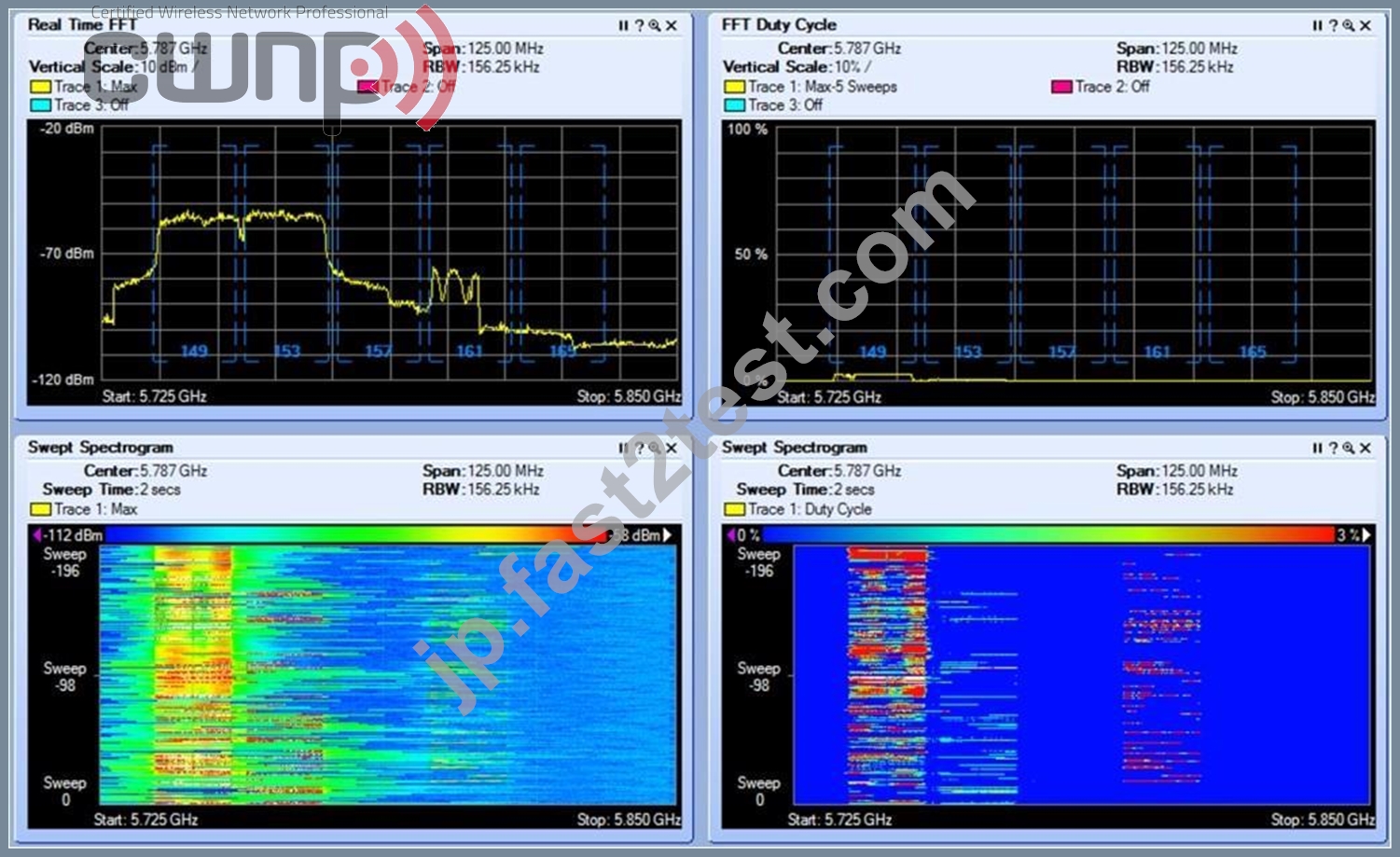
What is true of the network shown in this spectrum analyzer trace?
- A. There are at least three APs operating in this environment.
They are operating on channels 149, 153, and 161. - B. There are two 40 MHz BSSs in this environment.
One AP has some 40 MHz traffic while the other AP has no client traffic. - C. Two 802.11a APs are near the spectrum analyzer and are heavily utilized on channels 149 and
153. - D. Only one AP in this network is configured to use the upper UNII band (UNII-3).
All other APs are in lower 5 GHz channels.
正解:B
質問 # 110
When performing protocol analysis, you capture an 802.1 lac data frame on channel 52, transmitted at MCS 8.
At what data rate was the PHY Preamble transmitted?
- A. 54 Mbps
- B. 78 Mbps
- C. 6 Mbps
- D. 86.7 Mbps
正解:C
解説:
Explanation
The data rate at which the PHY preamble was transmitted is 6 Mbps. The PHY preamble is a part of the PPDU that is transmitted before the PHY header and the PSDU. The PHY preamble consists of a series of training fields that help the receiver to detect and synchronize with the signal. The PHY preamble is always transmitted at a fixed data rate that depends on the type of PPDU (e.g., OFDM, HT, VHT, HE). For an 802.1 lac data frame on channel 52, which uses VHT PPDUs, the data rate for the PHY preamble is 6 Mbps. This data rate does not depend on MCS (Modulation and Coding Scheme), which only affects the data rate for the PSDU. References: [Wireless Analysis Professional Study Guide CWAP-404], Chapter 4: 802.11 Physical Layer, page 99-100
質問 # 111
When a 5 GHz HT station in a 40 MHz BSS desires to protect a 40 MHz transmission from an OFDM station using an RTS/CTS or CTS-to-Self exchange, what frame format is used for the RTS and/or CTS frames?
- A. HT-mixed format
- B. Phased Coexistence PPDU
- C. Dual-CTS
- D. HT-greenfield format
- E. Non-HT Duplicate
正解:E
質問 # 112
What HT PPDU format is shown in the exhibit?
- A. Non-HT duplicate format
- B. ERP-OFDM format
- C. Non-HT format
- D. HT-greenfield format
- E. HT-mixed format
- F. Dual Training Field format
正解:E
質問 # 113
......
無料提供中CWAP-404ブレーン問題集とCWAP-404リアル試験問題を試そう:https://jp.fast2test.com/CWAP-404-premium-file.html