

2024年最新の実際に出る無料CWNP CWAP-404試験問題集と解答
CWAP-404練習テストエンジンで今すぐ試そう190試験問題
質問 # 93
You are concerned with management overhead in your WLAN. When evaluating the network, you note that each dual-band AP provides for 4 SSIDs in each band with three secure SSIDs and one Open System SSID. The network runs only 802.11ac APs and uses 20 MHz channels in 2.4 GHz and 400 MHz channels in 5 GHz.
What can you do to reduce the impact of beacon frames on CCI and channel utilization?
- A. Use the same security across all SSIDs
- B. Disable SSID broadcasting
- C. Use only 40 MHz channels
- D. Increase the beacon interval
正解:B
質問 # 94
What is the function of the PHY layer?
- A. Convert PPDUs to MSDUs for transmissions and MSDUs to PPDUs for receptions
- B. Convert PPDUs to PSDUs for transmissions and PSDUs to PPDUs for receptions
- C. Convert PSDUs to PPDUs for transmissions and PPDUs to PSDUs for receptions
- D. Convert MSDUs to PPDUs for transmissions and PPDUs to MSDUs for receptions
正解:C
解説:
The function of the PHY layer is to convert PSDUs to PPDUs for transmissions and PPDUs to PSDUs for receptions. A PSDU (PHY Service Data Unit) is the data unit that is passed from the MAC layer to the PHY layer for transmission, or from the PHY layer to the MAC layer for reception. A PPDU (PHY Protocol Data Unit) is the data unit that is transmitted or received over the wireless medium by the PHY layer. A PPDU consists of a PSDU and a PHY header, which contains information such as modulation, coding, and data rate. The PHY layer adds or removes the PHY header to or from the PSDU during the conversion process.
質問 # 95
ABC Company requires the ability to identify and quickly locate rogue devices. ABC has chosen an overlay WIPS solution with Wi-Fi sensors that use dipole antennas to perform this task. No other sensors are included. Use your knowledge of location tracking techniques to answer the question.
Which one of the following location methods is not available in the described system?
- A. Time Difference of Arrival (TDoA)
- B. GPS Positioning
- C. RF Fingerprinting
- D. Trilateration of RSSI measurements
正解:B
質問 # 96
An RST frame should be acknowledged by which frame?
- A. Block Ack
- B. CTS
- C. Ack
- D. RTS-Ack
正解:B
解説:
An RTS (Request to Send) frame should be acknowledged by a CTS (Clear to Send) frame. An RTS and CTS frame are types of control frames that are used to implement a virtual carrier sense mechanism called RTS/CTS. RTS/CTS is a technique that helps to avoid collisions and hidden node problems in wireless transmissions. When a STA (station) wants to send a data frame, it first sends an RTS frame to the intended receiver, indicating the duration of the transmission. The receiver then responds with a CTS frame, also indicating the duration of the transmission. The other STAs in the vicinity hear either the RTS or the CTS frame and update their NAV (Network Allocation Vector) timers accordingly, deferring their access to the medium until the transmission is over. The sender then sends the data frame, followed by an ACK (Acknowledgement) frame from the receiver. The other options are not correct, as they are not used to acknowledge an RTS frame. An ACK frame is used to acknowledge a data frame, not an RTS frame. An RTS-Ack frame does not exist, as there is no such type of control frame in 802.11. A Block Ack (BA) frame is used to acknowledge multiple data frames in a single frame, not an RTS frame.
質問 # 97
According to the 802.11n-2009 amendment, what security requirement is specified for HT BSSs?
- A. All unicast traffic transmitted by an HT station and destined to an HT station must use AES- CCMP.
- B. HT BSSs are prevented from supporting WEP.
- C. TKIP cannot be supported in an HT BSS.
- D. HT BSSs must mandatorily support 802.11r FT.
- E. In an RSN, HT stations may not communicate with one another using TKIP.
正解:E
質問 # 98
As a WLAN consultant, you have been asked to troubleshoot a problem with a single wireless client station (Station-Z). Your customer informs you that other wireless client stations are not having problems with wireless connectivity, and that Station-Z is configured in the same manner as all other wireless client stations on the network. Station-Z is showing an unusually high retransmission count in its client utility statistics. Using a wireless protocol analyzer, where and how should you begin troubleshooting this problem? (Choose 2)
- A. Position the analyzer near the access point. See if Station-Z's frames are reaching the access point and if so, analyze their signal strength.
- B. Position the analyzer halfway between Station-Z and the access point. Measure the distance between Station-Z and the access point.
- C. Position the analyzer near Station-Z. Analyze the frames Station-Z is receiving, looking for delayed ACK frames.
- D. Position the analyzer halfway between Station-Z and the access point. Analyze the data rate at which frames are sent and how long they take to be received.
- E. Position the analyzer near Station-Z. Analyze Station-Z's transmissions and acknowledgements.
Look for RF and obstacle-induced interference.
正解:A、E
質問 # 99
A PHY Header is added to the PSDU at which layer?
- A. LLC
- B. PHY
- C. Network
- D. MAC
正解:B
解説:
Explanation
A PHY header is added to the PSDU at the PHY layer. A PHY header is a part of the PPDU that contains information such as modulation, coding, and data rate. The PHY header is added by the PHY layer when it converts a PSDU to a PPDU for transmission, or removed by the PHY layer when it converts a PPDU to a PSDU for reception. The other layers do not add or remove a PHY header. References: [Wireless Analysis Professional Study Guide CWAP-404], Chapter 4: 802.11 Physical Layer, page 97-98
質問 # 100
Given: The exhibit shows a small network environment with dual-band APs.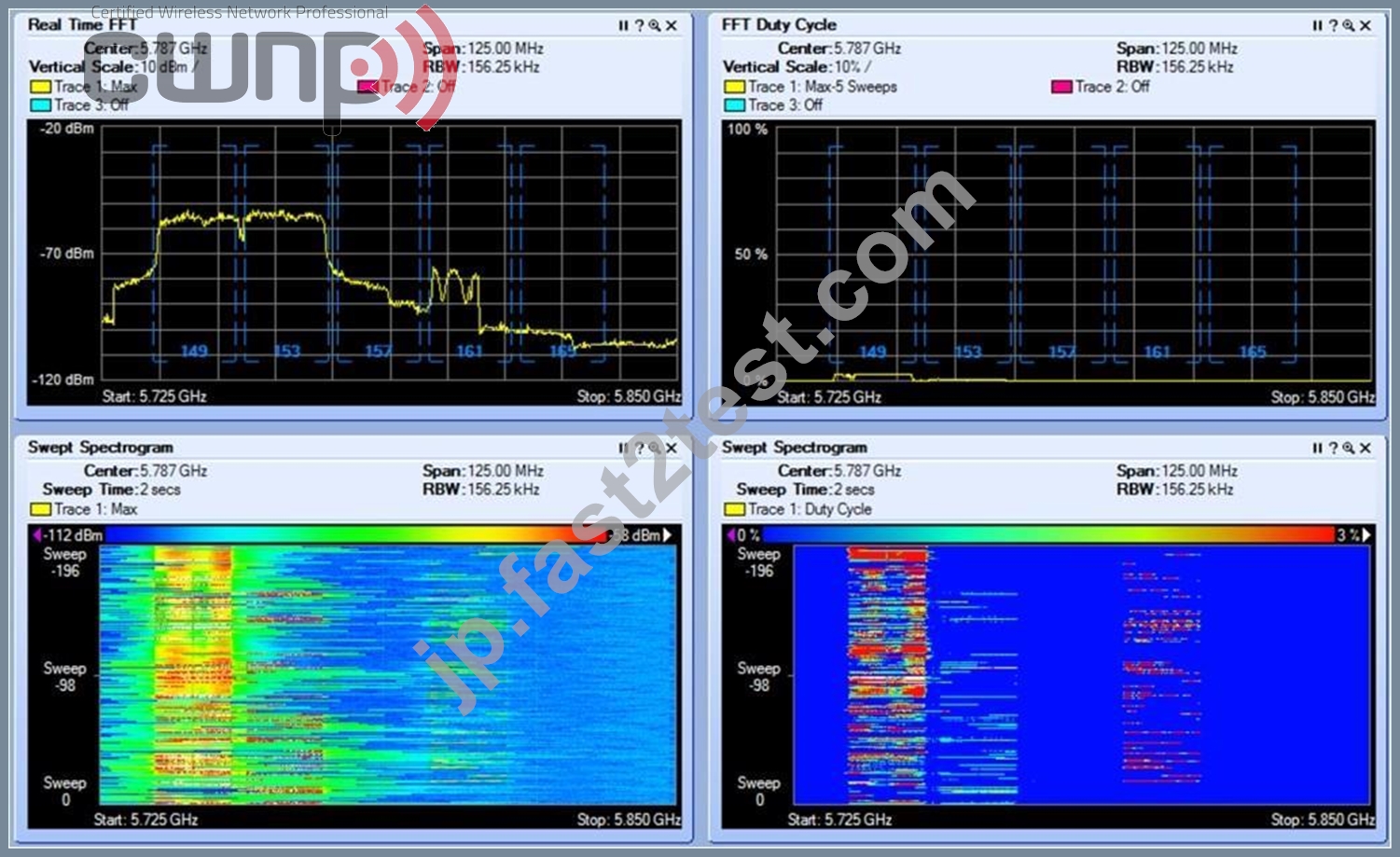
What is true of the network shown in this spectrum analyzer trace?
- A. There are two 40 MHz BSSs in this environment.
One AP has some 40 MHz traffic while the other AP has no client traffic. - B. Two 802.11a APs are near the spectrum analyzer and are heavily utilized on channels 149 and
153. - C. Only one AP in this network is configured to use the upper UNII band (UNII-3).
All other APs are in lower 5 GHz channels. - D. There are at least three APs operating in this environment.
They are operating on channels 149, 153, and 161.
正解:A
質問 # 101
What does the value of the Listen Interval field in an Association Request frame indicate?
- A. How often a STA in power save mode wakes up to listen to Beacon frames
- B. How long a STA waits for an Ack before retransmitting the frame
- C. How long a STA performing active scanning will listen for Probe Responses before changing channels
- D. How often a STA will go off channel to look for other BSSs
正解:A
解説:
Explanation
The value of the Listen Interval field in an Association Request frame indicates how often a STA in power save mode wakes up to listen to Beacon frames. The Listen Interval is expressed in units of Beacon Intervals (typically 100 TU or 102.4 ms). For example, if the Listen Interval is set to 10, it means that the STA will wake up every 10 Beacon Intervals (or about 1 second) to check for buffered frames at the AP. The Listen Interval is used by the AP to determine how long it can hold frames for a STA in power save mode before discarding them . References: CWAP-404 Certified Wireless Analysis Professional Study and Reference Guide, Chapter 6: MAC Sublayer Frame Exchanges, page 197; CWAP-404 Certified Wireless Analysis Professional Study and Reference Guide, Chapter 6: MAC Sublayer Frame Exchanges, page 198.
質問 # 102
What is an AIFS?
- A. A variable Interframe Space introduced by 802.lie to help prioritize medium access for different Access Categories
- B. The shortest period of time a STA can sleep
- C. A form of aggregation performed at the PHY layer based on 802.lie UP values interpreted from DSCP values
- D. A medium access method introduced by 802.lln, but never implemented
正解:A
解説:
Explanation
An AIFS is a variable interframe space introduced by 802.11e to help prioritize medium access for different Access Categories (ACs). An interframe space is a period of time that a STA (station) has to wait before attempting to access the medium. An AIFS is a type of interframe space that varies depending on the AC of the traffic. An AC is a logical queue that corresponds to a QoS (Quality of Service) level for different types of traffic. There are four ACs defined by 802.11e: AC_VO (Voice), AC_VI (Video), AC_BE (Best Effort), and AC_BK (Background). Each AC has a different AIFSN (Arbitration Interframe Space Number) value, which determines how long it has to wait before attempting to access the medium. A lower AIFSN value means a higher priority and a shorter waiting time. The other options are not correct, as they do not describe what an AIFS is. An AIFS is not a medium access method introduced by 802.11n, but never implemented, as it is part of the 802.11e standard and widely used in QoS-enabled WLANs. An AIFS is not a form of aggregation performed at the PHY layer based on 802.11e UP values interpreted from DSCP values, as aggregation is a technique that combines multiple frames into one larger frame to improve efficiency and throughput, not prioritization or medium access. An AIFS is not the shortest period of time a STA can sleep, as sleeping is a power saving mode that allows a STA to conserve battery power by periodically turning off its radio, not accessing the medium. References: [Wireless Analysis Professional Study Guide CWAP-404], Chapter 7: QoS Analysis, page 194-195
質問 # 103
Which common feature of a Spectrum Analyzer would be the best to help you locate a non-
802.11 interference source?
- A. Max hold
- B. Location filter
- C. Device finder
- D. Waterfall plot
正解:C
解説:
The device finder is a common feature of a spectrum analyzer that helps locate a non-802.11 interference source. The device finder uses a directional antenna to measure the signal strength of a specific frequency or signal source. By pointing the antenna in different directions, the device finder can indicate the direction and distance of the interference source. The device finder can also filter out other signals that are not related to the interference source. The other options are not correct, as they do not help locate a non-802.11 interference source. Max hold and min hold are features that show the maximum and minimum RF power levels over time, respectively.
Location filter is a feature that filters out signals that are not from a specific location or area.
質問 # 104
The To DS bit is set to 0 and the From DS is set to 1.
What best describes this 802.11 frame?
- A. A frame being transmitted directly from one client STA to another
- B. A frame being transmitted in a mesh BSS
- C. A frame being transmitted from an AP to a client STA
- D. A frame being transmitted from a client STA to an AP
正解:C
質問 # 105
As the WLAN engineer in your organization, you must troubleshoot performance problems related to co- channel interference (CCI).
What is a good measurement of CCI impact in addition to the number of APs seen on a channel?
- A. Non-Wi-Fi device count
- B. The frequency used
- C. Utilization
- D. Retries
正解:B
質問 # 106
Given a protocol analyzer can decrypt WPA2-PSK data packets providing the PSK and SSID are configured in the analyzer software. When performing packet capture (in a non-FT environment) which frames are required in order for PSK frame decryption to be possible?
- A. Authentication
- B. 4-Way Handshake
- C. Reassociation
- D. Probe Response
正解:B
解説:
Explanation
The 4-way handshake is the process that establishes the pairwise transient key (PTK) between the client and the AP in WPA2-PSK. The PTK is derived from the PSK, the SSID, and some random numbers exchanged in the handshake frames. The PTK is used to encrypt and decrypt the data frames between the client and the AP. Therefore, in order to decrypt WPA2-PSK data packets, a protocol analyzer needs to capture the 4-way handshake frames and have the PSK and SSID configured in the analyzer software12 References:
CWAP-404 Study Guide, Chapter 3: 802.11 MAC Layer Frame Formats and Technologies, page 87 CWAP-404 Objectives, Section 3.5: Analyze security exchanges
質問 # 107
You're the WLAN administrator for a large retailer based at the HQ in New York. The London-based office has been complaining about WLAN disconnections around lunch time each day. You suspect this might be interference from the staff microwave, how might you test your theory from the New York office?
- A. Access the microwave remotely and run a diagnostic check
- B. Place one of the London APs into spectrum analyzer mode and monitor the situation over lunch time
- C. Ask a local member of staff to take some pictures of the microwave, including some close-ups of the door seal so that you can assess it
- D. Ask a local member of staff to change the frequency of the microwave and see if the disconnections stop
正解:B
解説:
Explanation
The best way to test the theory of microwave interference from the New York office is to use a remote spectrum analyzer. By placing one of the London APs into spectrum analyzer mode, you can capture and analyze the RF spectrum in the London office over lunch time. You can then look for any signs of microwave interference, such as high duty cycle, high amplitude, or frequency hopping on the 2.4 GHz band. This method does not require any physical access tothe microwave or any changes to its frequency. References: [Wireless Analysis Professional Study Guide], Chapter 3: Spectrum Analysis, page 64
質問 # 108
The PHY layer provides framing by adding a header to create what type of data unit?
- A. MPDU
- B. PSDU
- C. PPDU
- D. MSDU
正解:C
解説:
Explanation
The PHY layer provides framing by adding a header to create a PPDU. A PPDU (PHY Protocol Data Unit) is the data unit that is transmitted or received over the wireless medium by the PHY layer. A PPDU consists of a PSDU (PHY Service Data Unit) and a PHY header, which contains information such as modulation, coding, and data rate. The PHY layer adds the PHY header to the PSDU to create a PPDU for transmission, or removes the PHY header from the PPDU to extract the PSDU for reception. The other options are not correct, as they are not created by adding a header at the PHY layer. An MPDU (MAC Protocol Data Unit) is created by adding a MAC header and FCS to an MSDU (MAC Service Data Unit) at the MAC layer. An MSDU is the data unit that is passed from the LLC sublayer to the MAC sublayer or vice versa. References: [Wireless Analysis Professional Study Guide CWAP-404], Chapter 4: 802.11 Physical Layer, page 97-98
質問 # 109
Using a portable analyzer you perform a packet capture next to a client STA and you can see that the STA is associated to a BSS. You observe the STA sending packets to the AP and the AP sending packets to the STA.
Less than 2% of all packets are retransmissions. You move to capture packets by the AP and, while the retry rate is still less than 2%, you now only see unidirectional traffic from the AP to the client. How do you explain this behavior?
- A. The STA is transmitting data using more spatial streams than the potable analyzer can support
- B. The portable analyzer has a lower receive sensitivity than the AP and while it can't capture the packets from the client STA, the AP can receive them OK
- C. There is a transmit power mismatch between the client and the AP and while the client can hear the APs traffic, the AP cannot hear the client
- D. The portable analyzer is too close to the AP causing CCI, blinding the AP to the clients packets
正解:B
解説:
Explanation
Receive sensitivity is the minimum signal level that a receiver can detect and decode. Different devices may have different receive sensitivity levels depending on their hardware specifications and antenna configurations.
In this scenario, the portable analyzer has a lower receive sensitivity than the AP, meaning that it requires a stronger signal to capture the packets from the client STA. The AP, on the other hand, has a higher receive sensitivity and can receive the packets from the client STA even if they have a weaker signal. This explains why the portable analyzer can only see unidirectional traffic from the AP to the client when capturing near the AP5 References:
CWAP-403 Study Guide, Chapter 4: PHY Layer Analysis, page 121
CWAP-403 Objectives, Section 4.3: Analyze PHY layer metrics
質問 # 110
Given: Shown are frames captured from an IEEE 802.1X/LEAP authentication.
This WLAN is a Robust Security Network (RSN) using the CCMP cipher suite.
Using the information given in the screenshot, calculate how long it takes for only the frames that are part of the 4-Way handshake to complete.
- A. 237.753 ms
- B. 243.743 ms
- C. 210.443 ms
- D. 5.820 ms
- E. 3.018 ms
正解:D
質問 # 111
Where would you look in a packet trace file to identify the configured Minimum Basic Rate (MBR) of a BSS?
- A. In the Minimum Basic Rate Element in a Beacon frame
- B. In the MBR Information Element in an Association Response frame
- C. Supported Rates & Extended Supported Rates elements in a Beacon frame
- D. In the MBR Action frame
正解:C
解説:
Explanation
The configured Minimum Basic Rate (MBR) of a BSS can be identified by looking at the Supported Rates and Extended Supported Rates elements in a Beacon frame. A Beacon frame is a type of management frame that is transmitted by an AP to advertise its presence and capabilities to potential clients. A Beacon frame contains various information elements (IEs) that provide details about the BSS configuration and operation. The Supported Rates andExtended Supported Rates IEs list the data rates that are supported by the AP for data transmission. The MBR is the lowest data rate among these supported rates that is required for all clients to join and communicate with the BSS. The MBR is usually marked with a flag bit in these IEs to indicate its mandatory status. The other options are not correct, as they do not exist or do not indicate the MBR of a BSS. References: [Wireless Analysis Professional Study Guide CWAP-404], Chapter 5: 802.11 MAC Sublayer, page 123-124
質問 # 112
......
試験合格保証付きのCWAP Wi-Fi Analysis CWAP-404試験問題集:https://jp.fast2test.com/CWAP-404-premium-file.html