

100%無料CWAP-404試験問題集で試験を簡単に合格させるFast2test
無料CWAP-404試験問題CWAP-404実際のリアル試験問題
質問 # 94
You work as an SE for a value-added reseller. A client has an existing deployment of 802.11n Aps and wants to upgrade several BSSs to 802.11ac.
What hardware feature of some enterprise Aps may allow for this without a forklift upgrade?
- A. Converting the 802.11n radio to an 802.11ac radio through software
- B. Adding an 802.11ac module to the existing APs
- C. Simply check the Enable 802.11ac checkbox in the web-based configuration interface
- D. Replace the antennas with 802.11ac antennas
正解:B
質問 # 95
To effect Preauthentication, a STA's supplicant sends an IEEE 802.1X/EAPoL Start message.
How is the EAPoL Start message addressed?
- A. DA = BSSID of the targeted AP; RA = Ethernet MAC of the targeted AP
- B. DA = MAC of default gateway; RA = BSSID of the AP to which the STA is associated
- C. DA = MAC of the default gateway; RA = Ethernet MAC of the targeted AP
- D. DA = BSSID of targeted AP; RA = BSSID of the AP to which the STA is associated
正解:D
質問 # 96
You have implemented centralized, infrastructure-based spectrum analysis.
The Aps are configured to perform spectrum analysis in an ad-hoc manner and will go offline as Aps to perform this duty when needed.
What unique method of spectrum analysis monitoring is provided by this solution that is not typically available in a laptop-based analyzer?
- A. RBW adjustments
- B. Web-based viewing
- C. Real-time FFT
- D. Band selection
正解:A
質問 # 97
You are troubleshooting throughput problems for a WLAN cell. The cell is provisioned with an
802.11ac dual-band AP. Users connected with both 5 GHz and 2.4 GHz connections are reporting performance problems. The AP settings are properly optimized. No interface issues have been detected (either co- channel interference or non-Wi-Fi interference) and the number of associated users is low.
What should you analyze to resolve the issue?
- A. The antennas used on the client devices
- B. The 5 GHz radio configuration
- C. the Ethernet uplink and the network infrastructure
- D. The 2.4 GHz radio configuration
正解:C
質問 # 98
Which common feature of a Spectrum Analyzer would be the best to help you locate a non-
802.11 interference source?
- A. Device finder
- B. Max hold
- C. Location filter
- D. Waterfall plot
正解:A
解説:
The device finder is a common feature of a spectrum analyzer that helps locate a non-802.11 interference source. The device finder uses a directional antenna to measure the signal strength of a specific frequency or signal source. By pointing the antenna in different directions, the device finder can indicate the direction and distance of the interference source. The device finder can also filter out other signals that are not related to the interference source. The other options are not correct, as they do not help locate a non-802.11 interference source. Max hold and min hold are features that show the maximum and minimum RF power levels over time, respectively.
Location filter is a feature that filters out signals that are not from a specific location or area.
質問 # 99
Shown is a screenshot of a wireless protocol analyzer displaying the decode information for a single 802.11 encrypted data + CF-Poll frame. The infrastructure BSS on which this information was captured is using WEP and this particular frame was sent from a client station (STA) to an access point (AP).
As a protocol analyst, how would you explain the existence of this frame on the wireless medium given the information in the decode?
- A. The frame was sent by a client station that does not comply with IEEE HR/DSSS standard to an access point that is Wi-Fi certified.
- B. The access point is operating as a repeater, and clients must poll repeater access points in order to transmit data frames through them.
- C. The IEEE 802.11 network is using both version 1 and version 2 protocols simultaneously. This unexpected frame is from the version 2 protocol set.
- D. The frame was misinterpreted because of insufficient information received by the analyzer due to frame corruption.
正解:D
質問 # 100
Which one of the following statements is not true concerning DTIMs?
- A. DTIM stands for Delivery Traffic Indication Map
- B. Every Beacon frame must contain a DTIM
- C. The DTIM interval can dictate when an STA will wake up to listen to beacon frames
- D. Buffered Broadcast and Multicast traffic will be transmitted following a DTIM
正解:B
解説:
Explanation
Every Beacon frame must contain a DTIM is not a true statement concerning DTIMs. DTIM stands for Delivery Traffic Indication Message, and it is a subfield within the TIM (Traffic Indication Map) element in a Beacon frame. The DTIM indicates how many Beacon frames (including the current one) will appear before the next DTIM. For example, if the DTIM interval is set to 3, it means that every third Beacon frame will contain a DTIM. Buffered broadcast and multicast traffic will be transmitted following a DTIM, so that STAs in power save mode can wake up and receive them. The DTIM interval can also dictate when an STA will wake up to listen to Beacon frames, as some STAs may choose to only listen to Beacon frames that contain a DTIM . References: CWAP-404 Certified Wireless Analysis Professional Study and Reference Guide, Chapter
6: MAC Sublayer Frame Exchanges, page 200; CWAP-404 CertifiedWireless Analysis Professional Study and Reference Guide, Chapter 6: MAC Sublayer Frame Exchanges, page 201.
質問 # 101
How many frames are exchanged for 802.11 authentication in the 6 GHz band when WPA3-Enterprise is not used, and a passphrase is used instead?
- A. 0
- B. 1
- C. 2
- D. 3
正解:A
解説:
Explanation
Two frames are exchanged for 802.11 authentication in the 6 GHz band when WPA3-Enterprise is not used, and a passphrase is used instead. Authentication is a process that establishes an identity relationship between a STA (station) and an AP (access point) before joining a BSS (Basic Service Set). There are two types of authentication methods defined by 802.11: Open System Authentication and Shared Key Authentication. Open System Authentication does not require any credentials or security information from a STA to join a BSS, and it consists of two frames: an Authentication Request frame sent by the STA to the AP, and an Authentication Response frame sent by the AP to the STA. Shared Key Authentication requires a shared secret key from a STA to join a BSS, and it consists of four frames: two challenge-response frames in addition to the request-response frames. However, Shared Key Authentication uses WEP (Wired Equivalent Privacy) as its encryption algorithm, which is insecure and deprecated. In the 6 GHz band, which is a newly available frequency band for WLANs, Shared Key Authentication is prohibited by the 802.11 standard, as it poses security and interference risks for other users and services in the band. The 6 GHz band requires all WLANs to use WPA3-Personal or WPA3-Enterprise encryption methods, which are more secure and robust than previous encryption methods such as WPA2 or WEP. WPA3-Personal uses a passphrase to derive a PMK (Pairwise Master Key), while WPA3-Enterprise uses an authentication server to obtain a PMK. Both methods use SAE (Simultaneous Authentication of Equals) as their authentication protocol, which replaces PSK (Pre-Shared Key) or EAP (Extensible Authentication Protocol). SAE consists of two frames: an SAE Commit frame sent by both parties to exchange elliptic curve parameters and nonces, and an SAE Confirm frame sent by both parties to verify each other's identities and generate a PMK. Therefore, when WPA3-Enterprise is not used, and a passphrase is used instead in the 6 GHz band, only two frames are exchanged for 802.11 authentication:
an SAECommit frame and an SAE Confirm frame. References: [Wireless Analysis Professional Study Guide CWAP-404], Chapter 8: Security Analysis, page 220-221
質問 # 102
Which one of the statements regarding the Frame Control field in an 802.11 MAC header is true?
- A. The Frame Control field contains subfields, and soma in 1-bit flags
- B. The Frame Control field is used to communicate the duration value
- C. The Frame Control field is always set to 0
- D. Only Control frames have a Frame Control field
正解:A
解説:
Explanation
The statement that the Frame Control field contains subfields, and some 1-bit flags is true. The Frame Control field is a 2-byte field in the MAC header that contains information about the type, subtype, and characteristics of a frame. The Frame Control field is divided into several subfields, each with a specific function and length.
Some of these subfields are 1-bit flags, which can be set to 0 or 1 to indicate a certain condition or status. For example, the To DS and From DS subfields are 1-bit flags that indicate whether a frame is destined for or originated from the DS (Distribution System). The other statements are not true, as they do not describe the Frame Control field correctly. All types of frames (management, control, and data) have a Frame Control field, not just control frames. The Frame Control field is not used to communicate the duration value, which is a separate field in the MAC header. The Frame Control field is not always set to 0, as it varies depending on the type, subtype, and characteristics of each frame. References: [Wireless Analysis Professional Study Guide CWAP-404], Chapter 5: 802.11 MAC Sublayer, page 113-114
質問 # 103
A client is operating in an unstable RF environment. Out of five data frames transmitted to the client it only receives four. The client sends a Block Ack to acknowledge the receipt of these four frames but due to frame corruption the Block Ack is not received by the AP. Which frames will be retransmitted'
- A. Only the data frame which was corrupted
- B. All data frames
- C. Both the corrupted data and Block Ack
- D. Only the Block Ack
正解:B
解説:
Explanation
All data frames will be retransmitted in this scenario. This is because the AP uses a Block Ack (BA) mechanism to acknowledge the receipt of multiple data frames from a client in a single frame. The BA contains a bitmap that indicates which data frames were received correctly and which were not. If the BA is not received by the AP due to frame corruption, the AP will assume that none of the data frames were received by the client and will retransmit all of them. The other options are not correct, as they do not account for the loss of the BA or the use of the bitmap. References: [Wireless Analysis Professional Study Guide CWAP-404], Chapter 6: 802.11 Frame Exchanges, page 167-168
質問 # 104
What is the formula used to calculate the Duration field value in an RTS frame?
- A. RTS Duration field = Data or management to be sent frame duration
- B. RTS Duration field = Data or management frame to be sent duration + CTS duration
- C. RTS Duration field = Data or management frame to be sent duration + CTS duration + one ACK duration + three SIFS
- D. RTS Duration field = CTS duration
正解:C
質問 # 105
When configuring a long term, forensic packet capture and saving all packets to disk which of the following is not a consideration?
- A. Total capture storage space
- B. Individual trace file size
- C. Real-time packet decodes
- D. Analyzer location
正解:C
解説:
Real-time packet decodes are not a consideration when configuring a long-term, forensic packet capture and saving all packets to disk. Real-time packet decodes are useful for live analysis and troubleshooting, but they consume CPU and memory resources that could affect the performance of the capture process. For a long-term, forensic packet capture, it is more important to consider the analyzer location, the total capture storage space, and the individual trace file size. These factors affect the quality and quantity of the captured packets and the ease of post-capture analysis.
質問 # 106
What types of wireless systems are illustrated?
- A. A Bluetooth v2.0 file transfer and a 40 MHz HT AP on channels 11, 7 (primary, secondary)
- B. An ERP IEEE 802.11 system using channel 6 and Bluetooth v1.2 discovery
- C. An 802.11 HR/DSSS system using channel 2 and a digital FHSS phone
- D. A 2.4 GHz cordless phone on channel 14 and a wireless RFID reader
正解:B
質問 # 107
When an originator QoS STA initiates a BlockAck agreement with a recipient QoS STA, what is the first frame sent by the originator?
- A. BlockAckPolicyReq
- B. BlockAckSetupReq
- C. ActionBAReq
- D. BlockAckReq
- E. ADDBA Request
正解:E
質問 # 108
As the WLAN engineer in your organization, you must troubleshoot performance problems related to co- channel interference (CCI).
What is a good measurement of CCI impact in addition to the number of APs seen on a channel?
- A. The frequency used
- B. Utilization
- C. Non-Wi-Fi device count
- D. Retries
正解:A
質問 # 109
Given: The exhibit shows a small network environment with dual-band APs.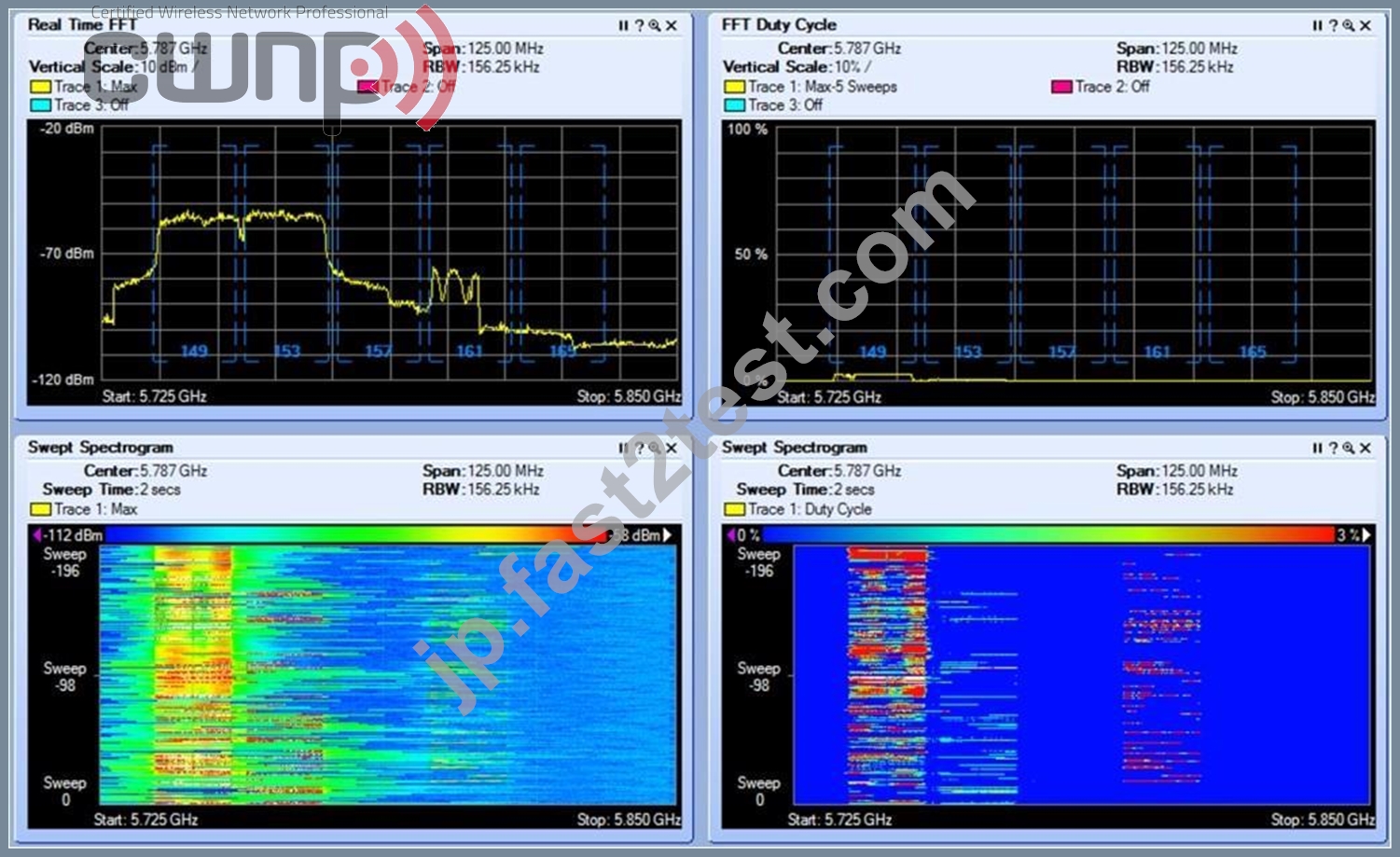
What is true of the network shown in this spectrum analyzer trace?
- A. Two 802.11a APs are near the spectrum analyzer and are heavily utilized on channels 149 and
153. - B. There are at least three APs operating in this environment.
They are operating on channels 149, 153, and 161. - C. Only one AP in this network is configured to use the upper UNII band (UNII-3).
All other APs are in lower 5 GHz channels. - D. There are two 40 MHz BSSs in this environment.
One AP has some 40 MHz traffic while the other AP has no client traffic.
正解:D
質問 # 110
Which statements are true regarding frame acknowledgement in an IEEE 802.11 WLAN? (Choose 3)
- A. Probe request acknowledgement (sending of a Probe Response frame) is configurable in the access point and is always linked to SSID broadcast configuration in Beacons.
- B. The RA field of ACK frames is always obtained from the Address 2 field in the corresponding frame being acknowledged.
- C. Following non-QoS Data frames with the More Fragments bit set to 1, the Duration/ID field of the ACK frame is set to a value equal to two SIFS plus the next Data fragment and its ACK.
- D. Data frame fragments are acknowledged individually (with an ACK frame).
- E. A client station's Reassociation Request frames are only acknowledged with a Reassociation Response from the access point and not with an ACK frame.
- F. In an EDCA BSS, encrypted Data frames are only acknowledged by client stations, never by access points.
正解:B、C、D
質問 # 111
Recently, three rogue APs have been connected to the network and later discovered. You want to prevent future rogue AP installations as much as possible.
What is the first step to eliminating or reducing rogue APs on the network?
- A. Define a direct policy that stipulates the ramifications of installing unauthorized devices
- B. Use IPSec between every AP and the network infrastructure
- C. Enable rogue detection in the existing authorized APs
- D. Create a hash of the MAC addresses of all authorized devices and continually scan for non- matching hashes
正解:C
質問 # 112
You are performing a multiple adapter channel aggregation capture to troubleshoot a VoIP roaming problem and would like to measure the roaming time from the last VoIP packet sent on the old AP's channel to the first VoIP packet sent on the new AP's channel. Which timing column in the packet view would measure this for you?
- A. Relative
- B. Delta
- C. Absolute
- D. Roaming
正解:D
解説:
The "Roaming" timing column specifically measures the time elapsed between the last packet on the old AP's channel and the first packet on the new AP's channel, providing valuable information about the roaming time in VoIP troubleshooting scenarios.
質問 # 113
......
最新100%合格率保証付きの素晴らしいCWAP-404試験問題PDF:https://jp.fast2test.com/CWAP-404-premium-file.html