

CAMS日本語リアルな試験問題CAMS日本語練習問題集
厳密検証されたCAMS日本語試験問題集と解答で無料提供のCAMS日本語問題と正解付き
質問 # 240
制裁審査要件には、金融機関が次のことを行う必要があることが含まれます。
- A. 制裁リストに記載されている個人の銀行口座を直ちに凍結します。
- B. 顧客と取引の記録を、政府機関が提供する定期的に更新される制裁リストと比較します。
- C. 制裁リストに名前が載っている個人を警察に通報します。
- D. 制裁リストに記載されているエンティティの銀行口座を直ちに閉鎖します。
正解:B
解説:
Explanation
Compare customer and transaction records against periodically updated sanctions lists provided by governmental bodies. This is stated in the Certified Anti-Money Laundering Specialist (the 6th edition) manual on page 595, which states: "Sanctions screening requirements include that a financial institution should compare customer and transaction records against periodically updated sanctions lists provided by governmental bodies."
質問 # 241
非協力国と準州を定義する金融行動タスクフォースの基準のうち、次のどれですか?
- A. 金融行動タスクフォース40勧告で述べられているように、「疑わしい」取引ではなく「異常な」取引を報告するシステムの確立
- B. 金融機関による受益者識別の複数のソースに関する効果的な法律
- C. マネージャーおよび受益者の経歴の評価を含む、金融機関のライセンスおよび作成に関する不適切なルール
- D. 政府の情報に対するニーズと合理的にバランスのとれた銀行秘密条項の存在
正解:C
質問 # 242 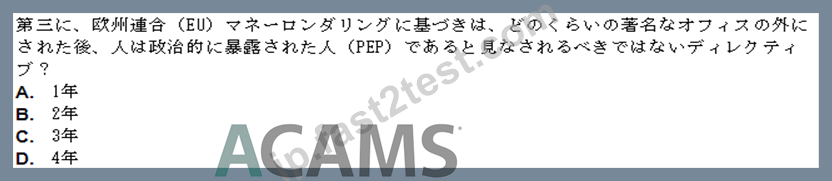
- A. Option D
- B. Option A
- C. Option C
- D. Option B
正解:B
質問 # 243
他の国と交換されるAML情報を保護するために当局は何をすべきですか?
- A. 調査が完了したら、情報を破棄します。
- B. 裁判所の命令を通じて交換された情報の機密性を確保するために、裁判所のシステムを使用します。
- C. 交換された情報にアクセスする人との秘密保持契約の使用を要求します。
- D. 国内の情報源から受け取った同様の情報を保護するため、交換された情報を保護します。
正解:C
解説:
Reference:
https://cfatf-gafic.org/index.php/documents/fatf-40r/406fatf-recommendation-40-other-forms-of-international-co
質問 # 244
サイバーセキュリティ リスクは、次のような個人情報の盗難につながる可能性があります。
- A. 偽のトランザクションを実行します。
- B. 偽のパスワードを発行する。
- C. 個人データ プロセッサのバグの特定。
- D. 個人の個人データの侵害。
正解:D
解説:
Explanation
Identity theft is a form of fraud or cheating of identity in which someone wrongfully obtains and uses another person's personal data in some way that involves fraud or deception, typically for economic gain. By compromising an individual's personal data, such as their Social Security Number, bank account numbers, or other personal information, a cybercriminal can use it to gain access to credit cards or other financial accounts, or to open new accounts in the victim's name.
質問 # 245
法執行機関は金融機関 (FI) の調査を行っており、広範かつ不当に押し付けがましい要求を提出しました。 FL の最も適切な応答はどれですか?
- A. 会社の取締役会および主要な上級管理職とその要求に異議を唱えます。
- B. 法執行機関への迅速な対応を通じてリクエストを絞り込みます。
- C. 含まれる情報量が許容できないため、リクエストを無視します。
- D. 期間に関係なく、すべてのドキュメントが収集できるまで応答を遅らせます。
正解:B
解説:
Financial institutions (FIs) are required to cooperate with law enforcement agencies (LEAs) in their investigations of money laundering, terrorist financing, and other financial crimes. However, sometimes LEAs may submit requests for information or documents that are overly broad, unduly intrusive, or unreasonable in scope or volume. Such requests may pose challenges or risks for FIs, such as violating customer privacy, compromising data security, disrupting business operations, or incurring excessive costs.
The most appropriate response for an FI in such a situation is to narrow the request through a prompt response to the LEA. This means that the FI should communicate with the LEA as soon as possible to clarify the purpose, scope, and relevance of the request, and to negotiate a more reasonable and proportionate request that meets the LEA's needs and the FI's capabilities. The FI should also explain the potential difficulties or consequences of complying with the original request, and propose alternative or additional sources of information that may be more useful or accessible. The FI should document the communication and the agreed terms of the request, and comply with the request in a timely and accurate manner.
By narrowing the request through a prompt response, the FI can demonstrate its good faith and willingness to cooperate with the LEA, while also protecting its own interests and obligations. This can help avoid or resolve any conflicts or misunderstandings between the FI and the LEA, and facilitate a more efficient and effective investigation.
References:
Requests by Law Enforcement for Financial Institutions to Maintain Accounts EFFECTIVE SUPERVISION AND ENFORCEMENT BY AML/CFT SUPERVISORS OF THE FINANCIAL SECTOR AND LAW ENFORCEMENT Bank Secrecy Act/Anti-Money Laundering: Requests by Law Enforcement for Financial Institutions to Maintain Accounts Support of Law Enforcement ACAMS CAMS Certification Study Guide 6th Edition
質問 # 246
金融機関が AML 法に違反した場合、どのような評判リスクの結果に直面する可能性がありますか?
- A. 罰金
- B. 注目度の高い顧客の喪失
- C. 財産差し押さえ
- D. 行動を監視するための監査コストの増加
正解:A
解説:
Explanation
According to the Certified Anti-Money Laundering Specialist (CAMS) Manual [1], 6th edition, financial entities that violate Anti-Money Laundering (AML) laws can face several reputational risks such as loss of high-profile customers, seizure of assets, increased audit costs to monitor behavior, and monetary penalties.
For example, the US Treasury's Financial Crimes Enforcement Network (FinCEN) imposes civil money penalties on "persons who willfully violate, attempt to violate, conspire to violate, or cause any violation of any provision of the Bank Secrecy Act or its implementing regulations." (CAMS Manual, 6th edition, page
26).
質問 # 247
ある小売銀行がクレジットカード事業を買収したばかりです。銀行のマネーロンダリング防止ポリシーでは、新入社員は入社日から30日以内に訓練され、すべての従業員に年1回再教育訓練が提供されることが求められています。
銀行の既存のマネーロンダリング防止トレーニングは、新たに買収したクレジットカード事業の従業員に提供するのに十分ですか?
- A. いいえ、マネーロンダリング防止トレーニングは、クレジットカードビジネス向けに対面で提供する必要があります。
- B. はい、既存のトレーニングは、銀行が従う必要があるマネーロンダリング防止規則をカバーしています。
- C. いいえ、マネーロンダリング防止トレーニングは、ビジネスに固有のリスクに合わせて調整する必要があります。
- D. はい、既存のトレーニングは銀行のポリシー、手順、およびプロセスを対象としています。
正解:C
解説:
The bank's existing anti-money laundering training is not adequate to be delivered to the employees of the newly acquired credit card business, because anti-money laundering training needs to be tailored and focused on the risks specific to the business. Credit card businesses face different types of money laundering risks than retail banks, such as card-not-present fraud, identity theft, card skimming, and prepaid card abuse. Therefore, the anti-money laundering training for credit card businesses should cover the specific red flags, indicators, typologies, and mitigation measures related to these risks, as well as the relevant laws and regulations that apply to credit card businesses.
References:
CAMS Study Guide, 6th Edition, Chapter 4, Section 4.31
CAMS Study Guide, 6th Edition, Chapter 5, Section 5.21
Certification Candidate Handbook, Section 3.22
Latest CAMS Exam Questions, Question 433
質問 # 248
テロ関連資金を移動するための3つの導管は、一般的にテロ資金調達を支持していますか? 3つの答えを選んでください
- A. 現金宅配便
- B. 銀行および/またはその他の正式な金融システム
- C. 非公式の金融システム
- D. 外貨両替会社
正解:A、C、D
解説:
Dealers in antiques, precious metals, precious stones, jewelry, and art are advised to follow these practices to reduce the element of money laundering risk:
Verify the identities of all new vendors and customers and conduct due diligence on them. This is to ensure that the dealers know who they are dealing with and can assess the risk level of each customer or vendor. Due diligence may include obtaining and verifying identification documents, checking against sanctions lists or watchlists, obtaining information on the source and purpose of funds, and applying a risk-based approach to the level and frequency of due diligence.
Avoid accepting cash payment from the buyers. This is to prevent the dealers from being used as a conduit for laundering illicit cash or facilitating cash smuggling. Cash transactions are more difficult to trace and may indicate attempts to evade reporting or record-keeping requirements. Dealers should encourage the use of non-cash payment methods, such as bank transfers, cheques, or credit cards, and keep records of all payment transactions.
Insist all vendors submit an appropriate license issued by enforcement agencies authorizing the sale.
This is to ensure that the dealers are not involved in the trade of stolen, smuggled, or counterfeit goods, which may be linked to money laundering or other criminal activities. Dealers should verify the authenticity and validity of the licenses and keep copies of them for record-keeping purposes.
References:
FATF Guidance on the Risk-Based Approach for Dealers in Precious Metals and Stones, pages 9-10,
13-14, 17-18, 21-22
AML-CFT Handbook for Dealers in Precious Metals and Stones, pages 25-26, 37-38, 52-53 The anti-money laundering framework for precious stones and metals dealers in Singapore, pages 7-8,
11-12, 15-16
Dealers in Precious Metals, Stones or Jewels Required to Establish Anti-Money Laundering Programs, pages 2-3, 6-7, 10-11
質問 # 249
金融機関のマネーロンダリング防止の専門家は、2004年以降、特定の個人のすべての取引記録を提供するための法的要求を受け取っています。
- A. 2004年以降のその個人のすべての電信送金
- B. 2004年以降のその個人のすべての証券取引活動
- C. 2004年以降のその個人の月次明細書および取引活動
- D. 2004年以降にその個人によって開かれたアカウントの署名カード
正解:A、B、C
質問 # 250
会計士がお金を洗うために一般的に使用されている3つの方法はどれですか。 (3つ選択してください。)
- A. アカウント間で現金を転送するための導管として機能する
- B. 身元を隠したい人の代理人として行動する
- C. 過剰な現金を隠すために収入を過大評価する
- D. 税控除を受けるための所得の過小評価
- E. 法廷でクライアントを代理
正解:A、B、C
質問 # 251 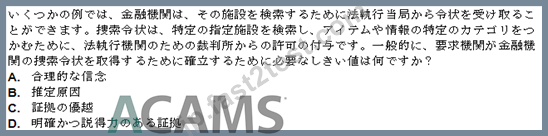
- A. Option D
- B. Option A
- C. Option C
- D. Option B
正解:B
質問 # 252
共助条約 (MLAT) の特徴はどれですか? (3 つを選択します。)
- A. MLAT には 2 つの国のみが含まれます。
- B. MLAT は、外国で証拠や情報を収集するのに役立ちます。
- C. MLAT は公開されておらず、国際法の下で拘束力もありません。
- D. MLAT は、証拠を送信するための法的根拠を提供していません。
- E. MLAT は協力して国間の犯罪と闘います。
- F. 条約パートナーから銀行記録を取得するために MLAT を使用することはできません。
正解:A、B、E
解説:
Mutual Legal Assistance Treaties (MLATs) are characteristics of D. only involving two countries, E.
cooperatively combating crime between countries, and F. being useful for gathering evidence and intelligence in a foreign country. MLATs are public and binding under international law (A), can be used for obtaining banking records from treaty partners (B), and provide a legal basis for transmitting evidence .
質問 # 253
顧客は10年間、地元の信用機関で口座を開設しています。アカウントは同じ金額の預金を週に2回受け取り、疑わしい行動の兆候を示したことはありません。監視ソフトウェアは、過去数か月で、アカウントがアカウント履歴と一致しないいくつかの大きな預金を受け取ったことを示しました。
尋ねられたとき、顧客は、彼女が最近不動産の一部を販売したと述べ、それは販売証明で裏付けられています。
コンプライアンス担当者は次に次のうちどれを行う必要がありますか?
- A. これらの異常なトランザクションをさらに調査します。
- B. 関係当局に疑わしい取引報告書を提出します。
- C. 疑わしいトランザクションレポートを提出しない理由を文書化します。
- D. 地元のファイナンシャルインテリジェンスユニットに相談してください。
正解:B
質問 # 254
経済制裁の最終的な目標は次のとおりです。
- A. テロリストが貿易から利益を得るのを防ぎます。
- B. 国の評判を守ります。
- C. 制裁対象国の利益を減らします。
- D. 国家安全保障を保護します。
正解:D
解説:
Economic sanctions are penalties imposed by one or more countries against another country, group, or individual for violating international norms or threatening national interests1. The ultimate goal of economic sanctions is to protect national security by changing the behavior or policies of the target, or by weakening its capabilities or resources2. Sanctions can be used to advance various foreign policy objectives, such as counterterrorism, nonproliferation, democracy promotion, human rights protection, conflict resolution, and cybersecurity1. Sanctions can take different forms, such as travel bans, asset freezes, trade embargoes, arms restrictions, and aid reductions1. Sanctions can be applied unilaterally by one country, or multilaterally by a coalition of countries or an international organization, such as the United Nations or the European Union1.
References:
1: What Are Economic Sanctions? | Council on Foreign Relatio
2: How Economic Sanctions Work - Investopedia
Reference: https://www.investopedia.com/articles/economics/10/economic-sanctions.asp
質問 # 255
疑わしい取引レポートの裏付け文書の金融機関による法執行機関への開示に関して、真実は何ですか?
- A. リリースされたすべてのドキュメントのコピーもアカウント所有者の弁護士に提供する必要があります
- B. 金融機関は、アカウント所有者にリクエストを通知できます
- C. ドキュメントはメールを使用してできるだけ早く提供する必要があります
- D. リクエストが法執行機関の代表者からのものであることを確認します
正解:D
質問 # 256 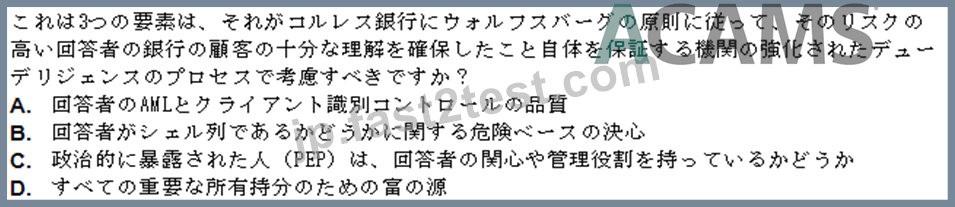
- A. Option B
- B. Option A
- C. Option D
- D. Option C
正解:A、B、C
質問 # 257
ある企業が、高リスク国の個人向けに 100,000 米ドルの貯蓄機能を備えた生命保険契約を契約しました。この保険は、未知の第三者から毎月現金の預け入れを受け取ります。デポジットの最小限の部分が投資され、残りは月末までに引き出されます。マネーロンダリングのリスクとして考慮すべき状況はどれですか? (2 つ選択してください。)
- A. 100,000 米ドルの保険は高額で疑わしいとみなされます。
- B. 保険証券に現金を預ける身元不明の第三者
- C. 高リスク国の国民向けの貯蓄機能付き生命保険契約
- D. 月末までの定期保険の引き出し
- E. 国内個人向け保険を契約する高リスク国に設立された会社
正解:B、D
解説:
According to the ACAMS CAMS Study Guide (the 6th edition), one of the common methods of money laundering in the insurance sector is to purchase policies with illicit funds, overpay premiums, and then cancel or surrender the policies to receive refunds or payouts1. This allows criminals to move and disguise the source of their funds through the insurance company. Therefore, the regular withdrawals from the policy by the end of the month could indicate a money laundering scheme. Moreover, the FATF Guidance for a Risk-Based Approach for the Life Insurance Sector states that unidentified third parties depositing cash to the policy could also pose a high money laundering risk, as cash transactions are difficult to trace and third parties may act as intermediaries or nominees for the real beneficiaries2. Therefore, the insurance company should conduct enhanced due diligence on the policyholder and the third parties, and monitor the transactions for any suspicious activity.
References:
ACAMS CAMS Study Guide (the 6th edition), Chapter 2: Money Laundering Risks and Methods, page
671
FATF Guidance for a Risk-Based Approach for the Life Insurance Sector, pages 18-192
質問 # 258
......
無料でゲット!高評価ACAMS CAMS日本語試験問題集を今すぐダウンロード!:https://jp.fast2test.com/CAMS-JP-premium-file.html