

[2025年06月]更新のMicrosoft DP-203試験基本問題には解答が付きます
2025年最新の実際に出るMicrosoft DP-203試験問題集と解答
質問 # 189
You have two Azure Storage accounts named Storage1 and Storage2. Each account holds one container and has the hierarchical namespace enabled. The system has files that contain data stored in the Apache Parquet format.
You need to copy folders and files from Storage1 to Storage2 by using a Data Factory copy activity. The solution must meet the following requirements:
No transformations must be performed.
The original folder structure must be retained.
Minimize time required to perform the copy activity.
How should you configure the copy activity? To answer, select the appropriate options in the answer area.
NOTE: Each correct selection is worth one point.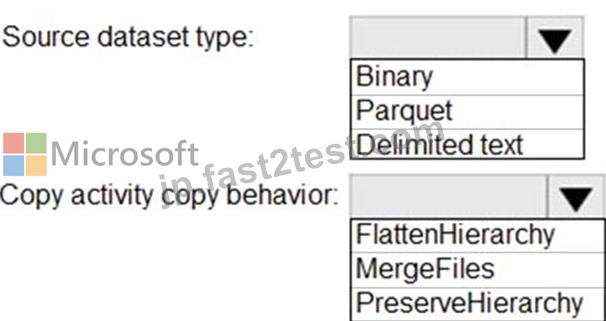
正解:
解説: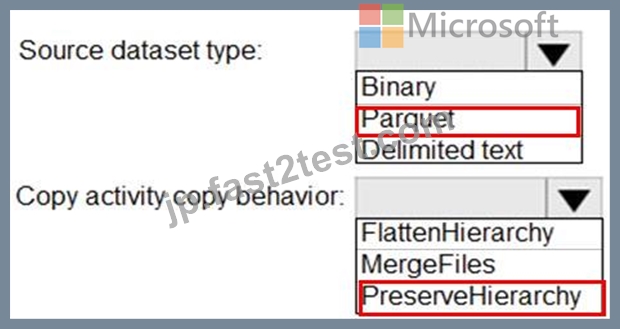
Reference:
https://docs.microsoft.com/en-us/azure/data-factory/format-parquet
https://docs.microsoft.com/en-us/azure/data-factory/connector-azure-data-lake-storage
質問 # 190
You have a table in an Azure Synapse Analytics dedicated SQL pool. The table was created by using the following Transact-SQL statement.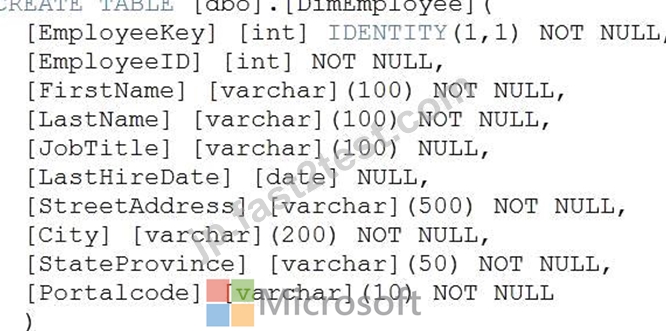
You need to alter the table to meet the following requirements:
* Ensure that users can identify the current manager of employees.
* Support creating an employee reporting hierarchy for your entire company.
* Provide fast lookup of the managers' attributes such as name and job title.
Which column should you add to the table?
- A. [ManagerEmployeeID] [int] NULL
- B. [ManagerName] [varchar](200) NULL
- C. [ManagerEmployeeKey] [int] NULL
- D. [ManagerEmployeeID] [smallint] NULL
正解:A
解説:
Use the same definition as the EmployeeID column.
Reference:
https://docs.microsoft.com/en-us/analysis-services/tabular-models/hierarchies-ssas-tabular
質問 # 191
You have an Azure Synapse Analytics dedicated SQL pool mat contains a table named dbo.Users.
You need to prevent a group of users from reading user email addresses from dbo.Users. What should you use?
- A. Transparent Data Encryption (TDD
- B. row-level security
- C. column-level security
- D. Dynamic data masking
正解:D
質問 # 192
You have an Azure Data Lake Storage Gen 2 account named storage1.
You need to recommend a solution for accessing the content in storage1. The solution must meet the following requirements:
List and read permissions must be granted at the storage account level.
Additional permissions can be applied to individual objects in storage1.
Security principals from Microsoft Azure Active Directory (Azure AD), part of Microsoft Entra, must be used for authentication.
What should you use? To answer, drag the appropriate components to the correct requirements. Each component may be used once, more than once, or not at all. You may need to drag the split bar between panes or scroll to view content.
NOTE: Each correct selection is worth one point.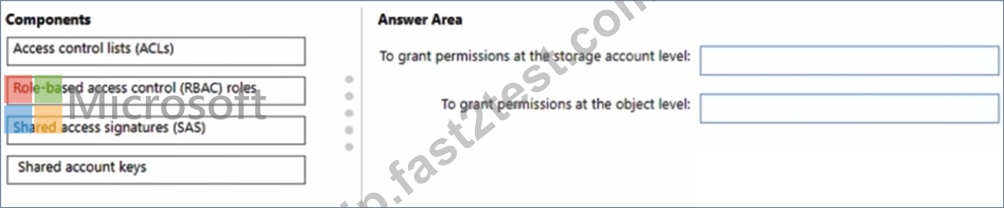
正解:
解説: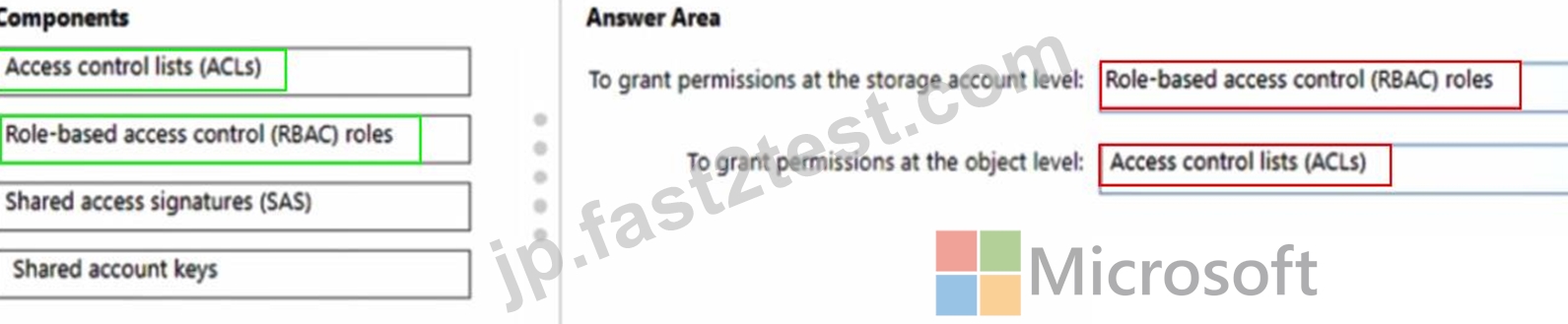
質問 # 193
Note: This question is part of a series of questions that present the same scenario. Each question in the series contains a unique solution that might meet the stated goals. Some question sets might have more than one correct solution, while others might not have a correct solution.
After you answer a question in this scenario, you will NOT be able to return to it. As a result, these questions will not appear in the review screen.
You have an Azure Storage account that contains 100 GB of files. The files contain text and numerical values.
75% of the rows contain description data that has an average length of 1.1 MB.
You plan to copy the data from the storage account to an Azure SQL data warehouse.
You need to prepare the files to ensure that the data copies quickly.
Solution: You modify the files to ensure that each row is less than 1 MB.
Does this meet the goal?
- A. No
- B. Yes
正解:B
解説:
Explanation
When exporting data into an ORC File Format, you might get Java out-of-memory errors when there are large text columns. To work around this limitation, export only a subset of the columns.
References:
https://docs.microsoft.com/en-us/azure/sql-data-warehouse/guidance-for-loading-data
質問 # 194
You have an Azure Active Directory (Azure AD) tenant that contains a security group named Group1. You have an Azure Synapse Analytics dedicated SQL pool named dw1 that contains a schema named schema1.
You need to grant Group1 read-only permissions to all the tables and views in schema1. The solution must use the principle of least privilege.
Which three actions should you perform in sequence? To answer, move the appropriate actions from the list of actions to the answer area and arrange them in the correct order.
NOTE: More than one order of answer choices is correct. You will receive credit for any of the correct orders you select.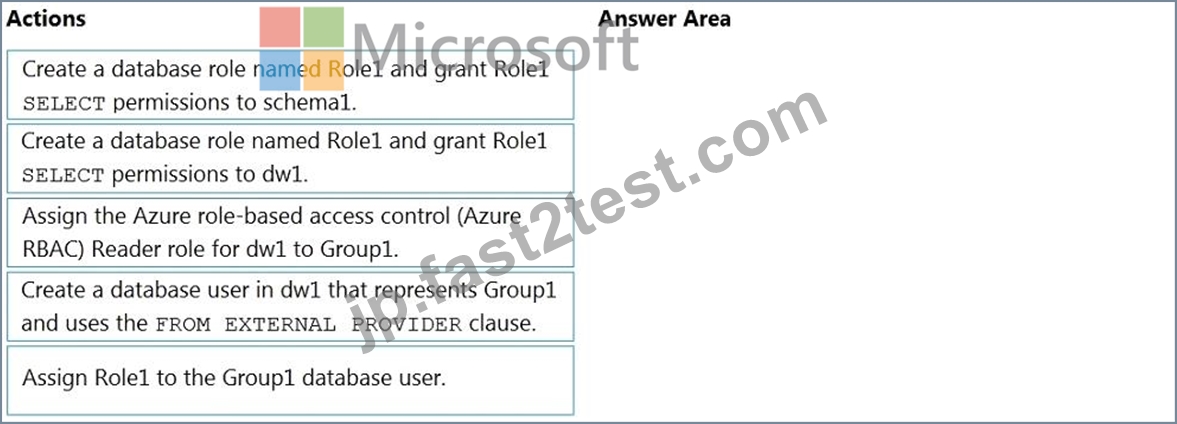
正解:
解説: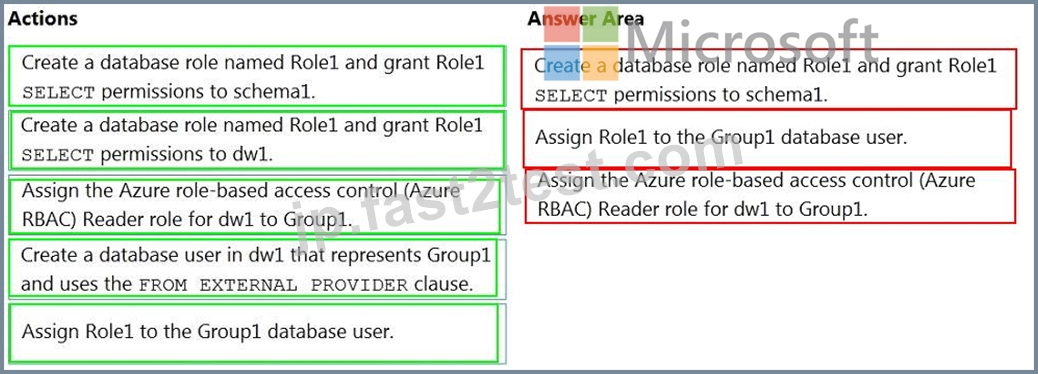
Reference:
https://docs.microsoft.com/en-us/azure/data-share/how-to-share-from-sql
質問 # 195
You are designing an Azure Stream Analytics job to process incoming events from sensors in retail environments.
You need to process the events to produce a running average of shopper counts during the previous 15 minutes, calculated at five-minute intervals.
Which type of window should you use?
- A. snapshot
- B. tumbling
- C. hopping
- D. sliding
正解:B
解説:
Explanation
Tumbling windows are a series of fixed-sized, non-overlapping and contiguous time intervals. The following diagram illustrates a stream with a series of events and how they are mapped into 10-second tumbling windows.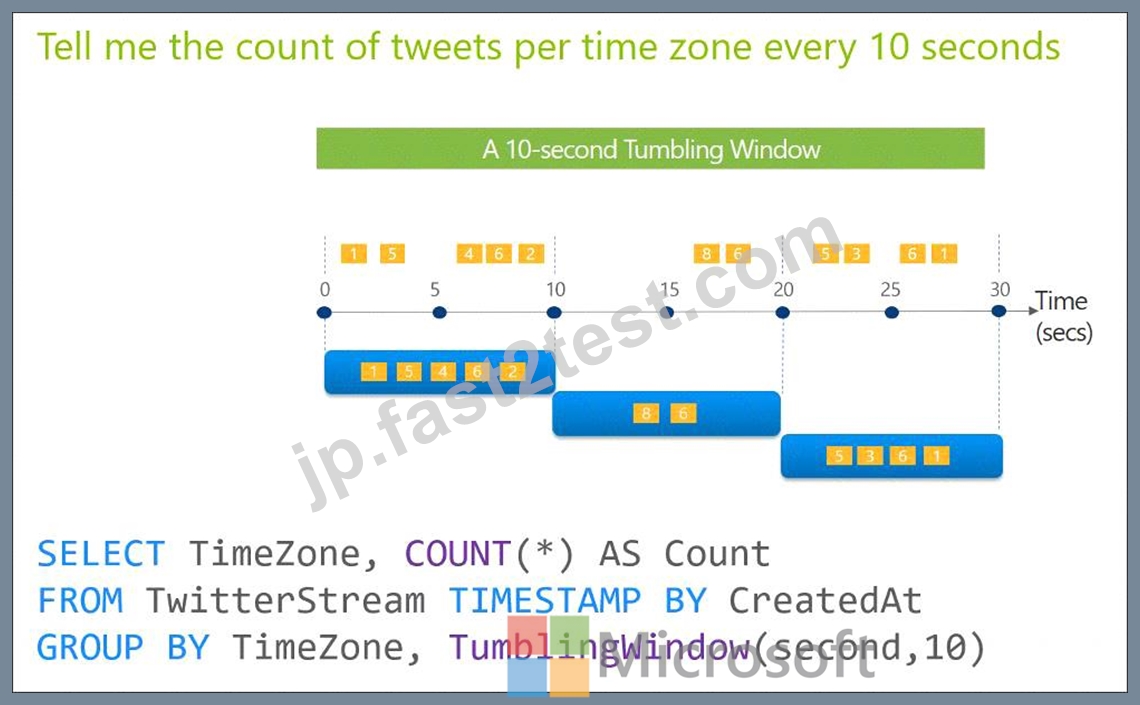
Reference:
https://docs.microsoft.com/en-us/stream-analytics-query/tumbling-window-azure-stream-analytics
質問 # 196
You are creating an Azure Data Factory data flow that will ingest data from a CSV file, cast columns to specified types of data, and insert the data into a table in an Azure Synapse Analytics dedicated SQL pool.
The CSV file contains columns named username, comment and date.
The data flow already contains the following:
* A source transformation
* A Derived Column transformation to set the appropriate types of data
* A sink transformation to land the data in the pool
You need to ensure that the data flow meets the following requirements;
* All valid rows must be written to the destination table.
* Truncation errors in the comment column must be avoided proactively.
* Any rows containing comment values that will cause truncation errors upon insert must be written to a file in blob storage.
Which two actions should you perform? Each correct answer presents part of the solution. NOTE: Each correct selection is worth one point
- A. Add a filter transformation that filters out rows which will cause truncation errors.
- B. Add a select transformation that selects only the rows which will cause truncation errors.
- C. Add a sink transformation that writes the rows to a file in blob storage.
- D. Add a Conditional Split transformation that separates the rows which will cause truncation errors.
正解:C、D
質問 # 197
You have an Azure Data Lake Storage Gen2 container.
Data is ingested into the container, and then transformed by a data integration application. The data is NOT modified after that. Users can read files in the container but cannot modify the files.
You need to design a data archiving solution that meets the following requirements:
New data is accessed frequently and must be available as quickly as possible.
Data that is older than five years is accessed infrequently but must be available within one second when requested.
Data that is older than seven years is NOT accessed. After seven years, the data must be persisted at the lowest cost possible.
Costs must be minimized while maintaining the required availability.
How should you manage the data? To answer, select the appropriate options in the answer area.
NOTE: Each correct selection is worth one point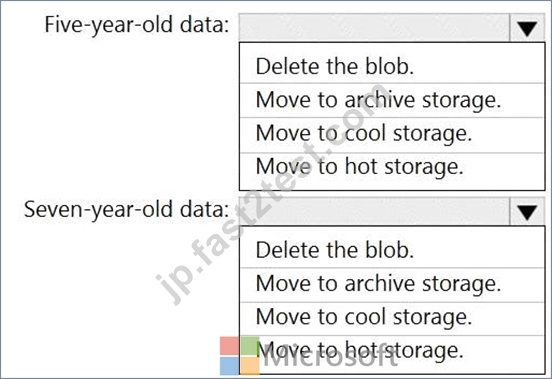
正解:
解説: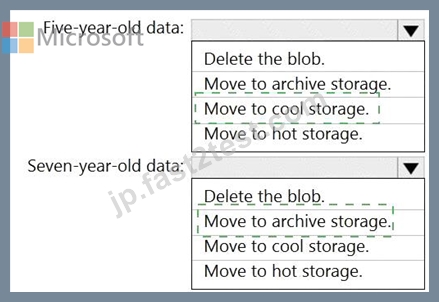
Explanation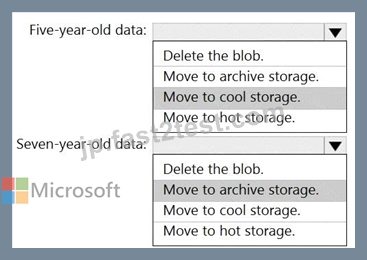
Box 1: Move to cool storage
Box 2: Move to archive storage
Archive - Optimized for storing data that is rarely accessed and stored for at least 180 days with flexible latency requirements, on the order of hours.
The following table shows a comparison of premium performance block blob storage, and the hot, cool, and archive access tiers.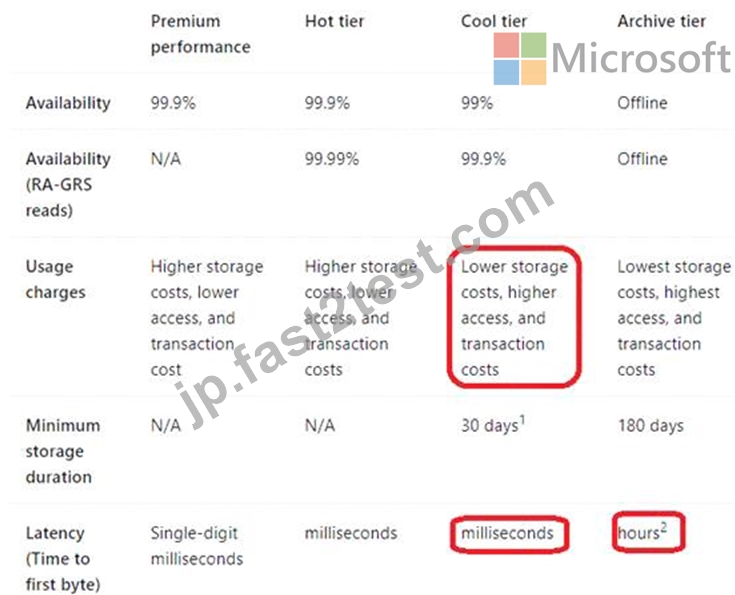
Reference:
https://docs.microsoft.com/en-us/azure/storage/blobs/storage-blob-storage-tiers Explanation:
Box 1: Replicated
Replicated tables are ideal for small star-schema dimension tables, because the fact table is often distributed on a column that is not compatible with the connected dimension tables. If this case applies to your schema, consider changing small dimension tables currently implemented as round-robin to replicated.
Box 2: Replicated
Box 3: Replicated
Box 4: Hash-distributed
For Fact tables use hash-distribution with clustered columnstore index. Performance improves when two hash tables are joined on the same distribution column.
Reference:
https://azure.microsoft.com/en-us/updates/reduce-data-movement-and-make-your-queries-more-efficient-with-th
https://azure.microsoft.com/en-us/blog/replicated-tables-now-generally-available-in-azure-sql-data-warehouse/
質問 # 198
You are designing an Azure Synapse Analytics dedicated SQL pool.
You need to ensure that you can audit access to Personally Identifiable information (PII).
What should you include in the solution?
- A. column-level security
- B. sensitivity classifications
- C. dynamic data masking
- D. row-level security (RLS)
正解:A
質問 # 199
You need to implement an Azure Databricks cluster that automatically connects to Azure Data lake Storage Gen2 by using Azure Active Directory (Azure AD) integration. How should you configure the new clutter? To answer, select the appropriate options in the answers area. NOTE: Each correct selection is worth one point.
正解:
解説:
Explanation:
https://docs.azuredatabricks.net/spark/latest/data-sources/azure/adls-passthrough.html
質問 # 200
You use Azure Data Factory to prepare data to be queried by Azure Synapse Analytics serverless SQL pools.
Files are initially ingested into an Azure Data Lake Storage Gen2 account as 10 small JSON files. Each file contains the same data attributes and data from a subsidiary of your company.
You need to move the files to a different folder and transform the data to meet the following requirements:
Provide the fastest possible query times.
Automatically infer the schema from the underlying files.
How should you configure the Data Factory copy activity? To answer, select the appropriate options in the answer area.
NOTE: Each correct selection is worth one point.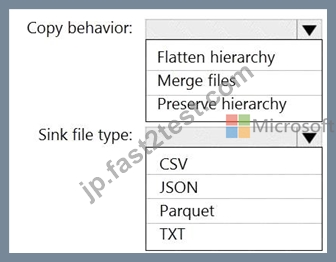
正解:
解説: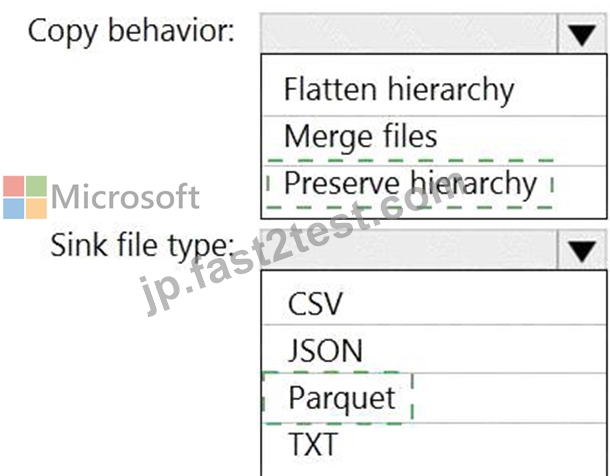
Explanation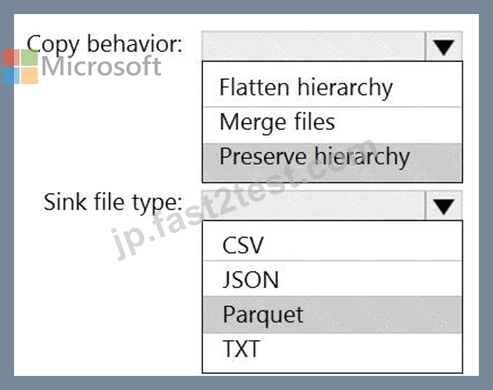
Box 1: Preserver herarchy
Compared to the flat namespace on Blob storage, the hierarchical namespace greatly improves the performance of directory management operations, which improves overall job performance.
Box 2: Parquet
Azure Data Factory parquet format is supported for Azure Data Lake Storage Gen2.
Parquet supports the schema property.
Reference:
https://docs.microsoft.com/en-us/azure/storage/blobs/data-lake-storage-introduction
https://docs.microsoft.com/en-us/azure/data-factory/format-parquet
質問 # 201
You have two Azure Storage accounts named Storage1 and Storage2. Each account holds one container and has the hierarchical namespace enabled. The system has files that contain data stored in the Apache Parquet format.
You need to copy folders and files from Storage1 to Storage2 by using a Data Factory copy activity. The solution must meet the following requirements:
No transformations must be performed.
The original folder structure must be retained.
Minimize time required to perform the copy activity.
How should you configure the copy activity? To answer, select the appropriate options in the answer area.
NOTE: Each correct selection is worth one point.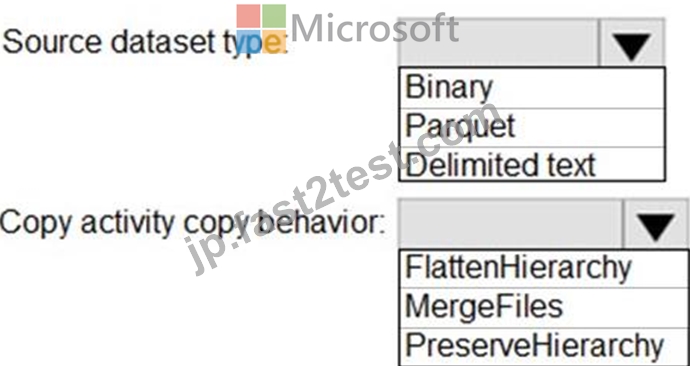
正解:
解説: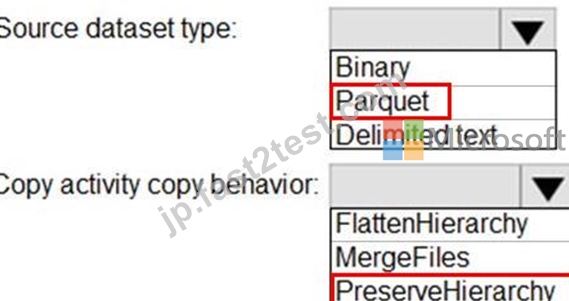
Reference:
https://docs.microsoft.com/en-us/azure/data-factory/format-parquet
https://docs.microsoft.com/en-us/azure/data-factory/connector-azure-data-lake-storage
質問 # 202
You have an Azure Data Lake Storage Gen2 account named account1 that stores logs as shown in the following table.
You do not expect that the logs will be accessed during the retention periods.
You need to recommend a solution for account1 that meets the following requirements:
Automatically deletes the logs at the end of each retention period
Minimizes storage costs
What should you include in the recommendation? To answer, select the appropriate options in the answer are a.
NOTE: Each correct selection is worth one point.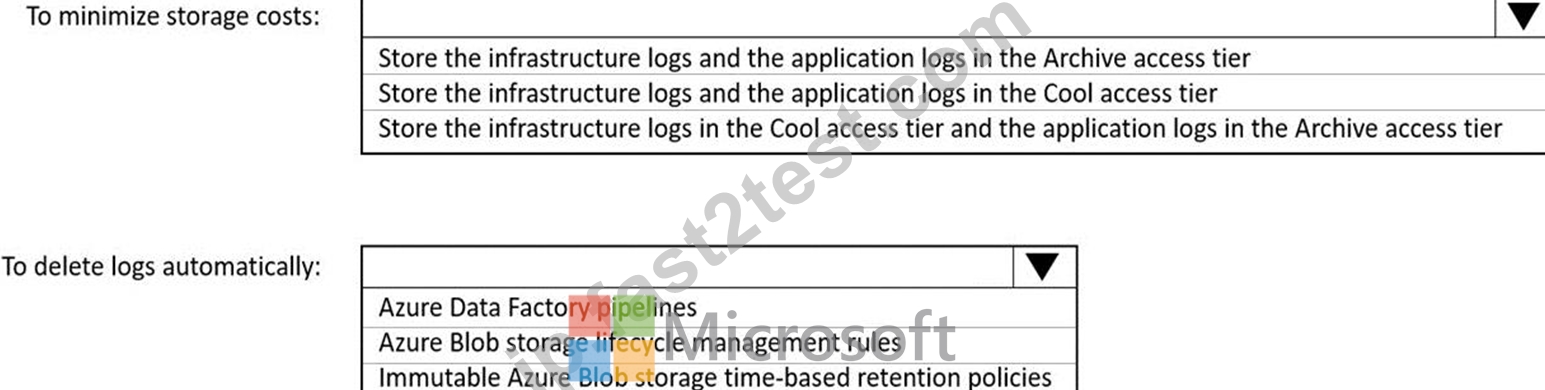
正解:
解説: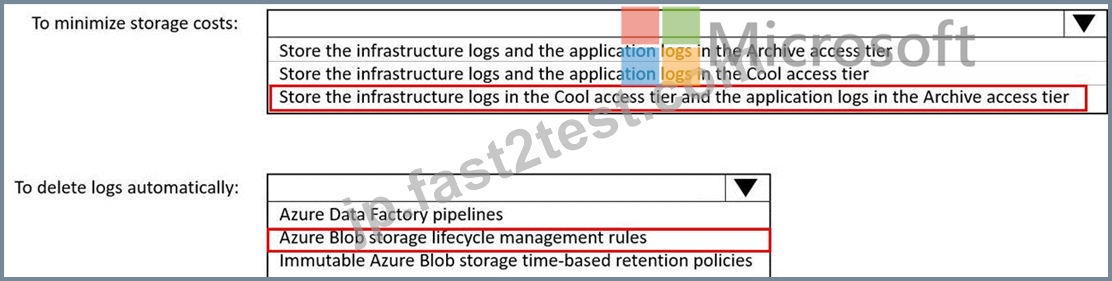
Reference:
https://docs.microsoft.com/en-us/azure/storage/blobs/access-tiers-overview
質問 # 203
You have an Azure subscription that contains an Azure Cosmos DB analytical store and an Azure Synapse Analytics workspace named WS 1. WS1 has a serverless SQL pool name Pool1.
You execute the following query by using Pool1.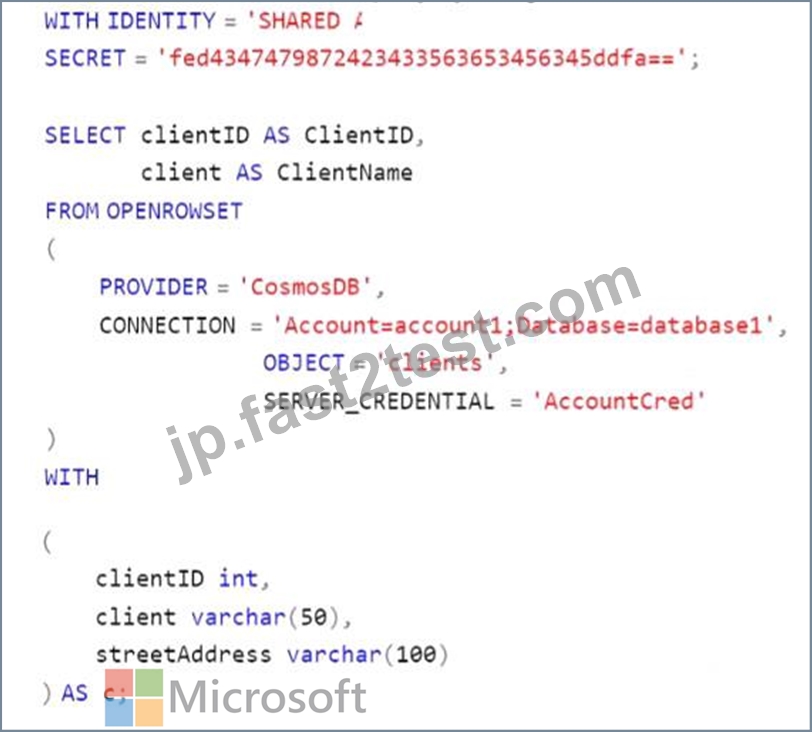
For each of the following statements, select Yes if the statement is true. Otherwise, select No.
NOTE: Each correct selection is worth one point.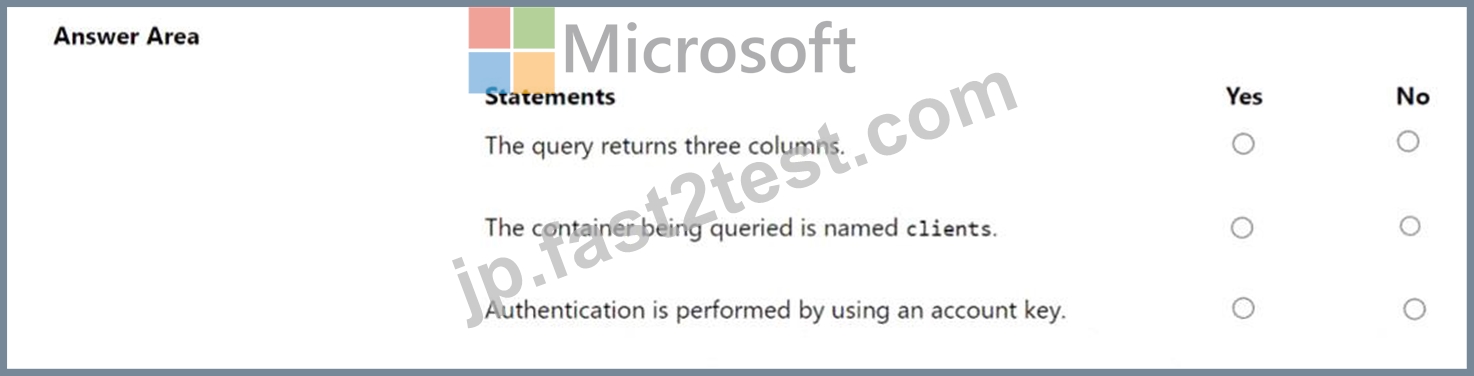
正解:
解説: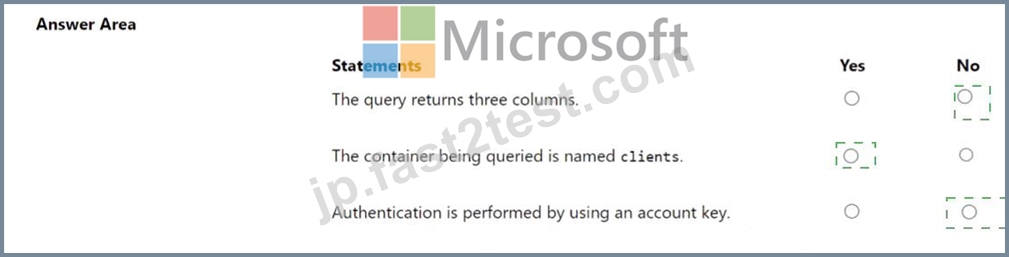
Explanation: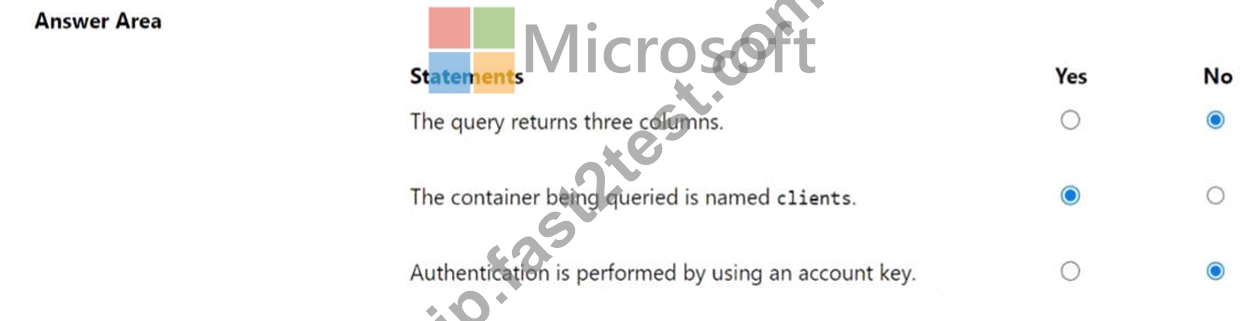
質問 # 204
You have an Apache Spark DataFrame named temperatures. A sample of the data is shown in the following table.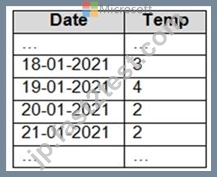
You need to produce the following table by using a Spark SQL query.
How should you complete the query? To answer, drag the appropriate values to the correct targets. Each value may be used once, more than once, or not at all. You may need to drag the split bar between panes or scroll to view content.
NOTE: Each correct selection is worth one point.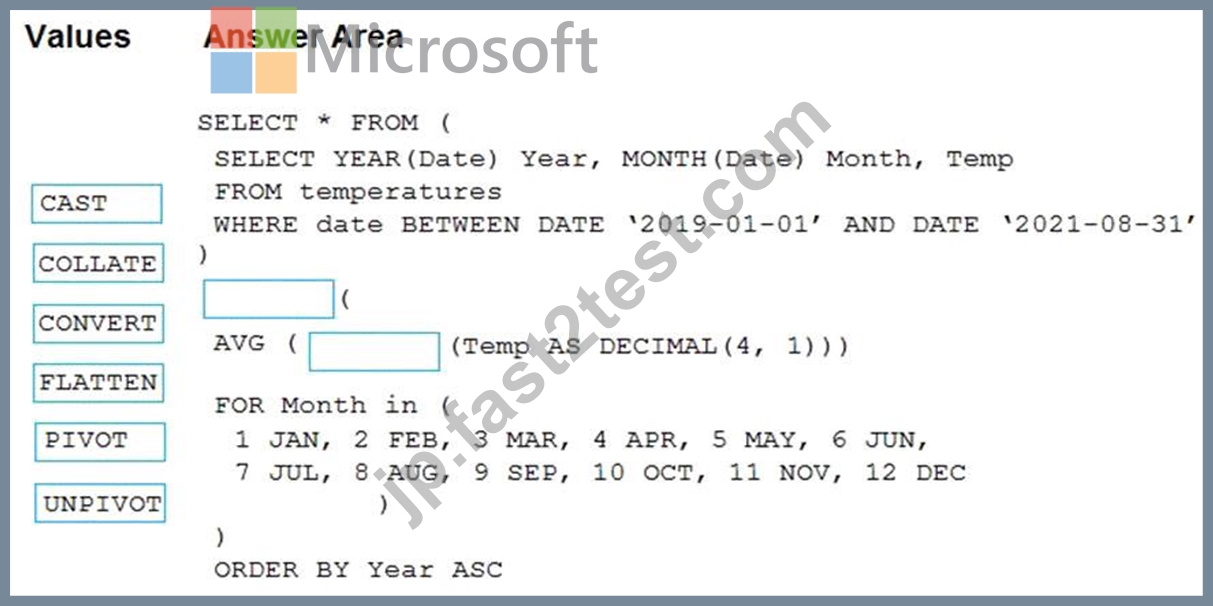
正解:
解説: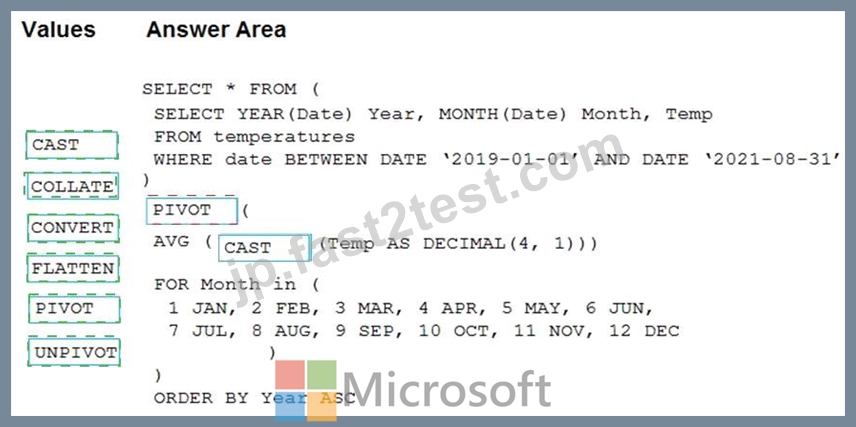
Explanation
Text Description automatically generated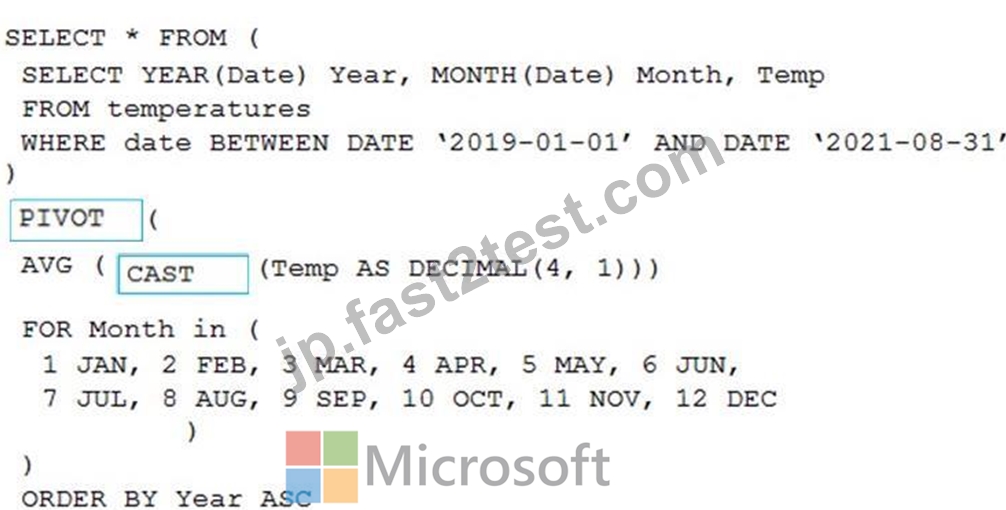
Box 1: PIVOT
PIVOT rotates a table-valued expression by turning the unique values from one column in the expression into multiple columns in the output. And PIVOT runs aggregations where they're required on any remaining column values that are wanted in the final output.
Reference:
https://learnsql.com/cookbook/how-to-convert-an-integer-to-a-decimal-in-sql-server/
https://docs.microsoft.com/en-us/sql/t-sql/queries/from-using-pivot-and-unpivot
質問 # 205
......
合格保証付きのMicrosoft Certified: Azure Data Engineer Associate DP-203試験問題集:https://jp.fast2test.com/DP-203-premium-file.html
DP-203練習テストエンジンで今すぐ使おう358試験問題:https://drive.google.com/open?id=1L3fCd1WEC4rTDvGgH_1CEudEr3uHcvTE