

[2024年12月09日] 最新のDP-203試験の的確なData Engineering on Microsoft AzureのPDF問題
DP-203試験問題を練習するならFast2test顕著なData Engineering on Microsoft Azure試験練習問題集
DP-203認定試験は、データの専門家がスキルを向上させ、潜在的な雇用主に専門知識を実証する優れた方法です。この認定はグローバルに認識されており、データエンジニアリングのキャリアを前進させようとする個人にとって貴重な資産です。さらに、Microsoft Azureはますます人気が高まっており、Microsoft Azureでデータソリューションを設計および実装できるデータエンジニアリングの専門家に対する需要が高まっています。したがって、DP-203認定試験に合格することは、競争に先んじて、Microsoft Azureのデータエンジニアリングの専門知識を実証する素晴らしい方法です。
質問 # 90
You have an Azure Data Lake Storage account that has a virtual network service endpoint configured.
You plan to use Azure Data Factory to extract data from the Data Lake Storage account. The data will then be loaded to a data warehouse in Azure Synapse Analytics by using PolyBase.
Which authentication method should you use to access Data Lake Storage?
- A. managed identity authentication
- B. shared access key authentication
- C. service principal authentication
- D. account key authentication
正解:A
解説:
Reference:
https://docs.microsoft.com/en-us/azure/data-factory/connector-azure-sql-data-warehouse#use-polybase-to-load-
質問 # 91
Note: This question is part of a series of questions that present the same scenario. Each question in the series contains a unique solution that might meet the stated goals. Some question sets might have more than one correct solution, while others might not have a correct solution.
After you answer a question in this section, you will NOT be able to return to it. As a result, these questions will not appear in the review screen.
You plan to create an Azure Databricks workspace that has a tiered structure. The workspace will contain the following three workloads:
* A workload for data engineers who will use Python and SQL.
* A workload for jobs that will run notebooks that use Python, Scala, and SOL.
* A workload that data scientists will use to perform ad hoc analysis in Scala and R.
The enterprise architecture team at your company identifies the following standards for Databricks environments:
* The data engineers must share a cluster.
* The job cluster will be managed by using a request process whereby data scientists and data engineers provide packaged notebooks for deployment to the cluster.
* All the data scientists must be assigned their own cluster that terminates automatically after 120 minutes of inactivity. Currently, there are three data scientists.
You need to create the Databricks clusters for the workloads.
Solution: You create a Standard cluster for each data scientist, a Standard cluster for the data engineers, and a High Concurrency cluster for the jobs.
Does this meet the goal?
- A. No
- B. Yes
正解:A
解説:
Explanation
We need a High Concurrency cluster for the data engineers and the jobs.
Note: Standard clusters are recommended for a single user. Standard can run workloads developed in any language: Python, R, Scala, and SQL.
A high concurrency cluster is a managed cloud resource. The key benefits of high concurrency clusters are that they provide Apache Spark-native fine-grained sharing for maximum resource utilization and minimum query latencies.
Reference:
https://docs.azuredatabricks.net/clusters/configure.html
質問 # 92
You are designing the folder structure for an Azure Data Lake Storage Gen2 account.
You identify the following usage patterns:
* Users will query data by using Azure Synapse Analytics serverless SQL pools and Azure Synapse Analytics serverless Apache Spark pods.
* Most queries will include a filter on the current year or week.
* Data will be secured by data source.
You need to recommend a folder structure that meets the following requirements:
* Supports the usage patterns
* Simplifies folder security
* Minimizes query times
Which folder structure should you recommend?
- A.

- B.

- C.

- D.

- E.

正解:B
解説:
Data will be secured by data source. -> Use DataSource as top folder.
Most queries will include a filter on the current year or week -> Use \YYYY\WW\ as subfolders.
Common Use Cases
A common use case is to filter data stored in a date (and possibly time) folder structure such as /YYYY/MM/DD/ or /YYYY/MM/YYYY-MM-DD/. As new data is generated/sent/copied/moved to the storage account, a new folder is created for each specific time period. This strategy organises data into a maintainable folder structure.
質問 # 93
You plan to create an Azure Data Lake Storage Gen2 account
You need to recommend a storage solution that meets the following requirements:
* Provides the highest degree of data resiliency
* Ensures that content remains available for writes if a primary data center fails What should you include in the recommendation? To answer, select the appropriate options in the answer area.
正解:
解説:
https://docs.microsoft.com/en-us/azure/storage/common/storage-disaster-recovery-guidance?toc=/azure/storage/blobs/toc.json
https://docs.microsoft.com/en-us/answers/questions/32583/azure-data-lake-gen2-disaster-recoverystorage-acco.html
質問 # 94
You have the following Azure Stream Analytics query.
For each of the following statements, select Yes if the statement is true. Otherwise, select No.
NOTE: Each correct selection is worth one point.
正解:
解説:
Explanation
Box 1: Yes
You can now use a new extension of Azure Stream Analytics SQL to specify the number of partitions of a stream when reshuffling the data.
The outcome is a stream that has the same partition scheme. Please see below for an example:
WITH step1 AS (SELECT * FROM [input1] PARTITION BY DeviceID INTO 10),
step2 AS (SELECT * FROM [input2] PARTITION BY DeviceID INTO 10)
SELECT * INTO [output] FROM step1 PARTITION BY DeviceID UNION step2 PARTITION BY DeviceID Note: The new extension of Azure Stream Analytics SQL includes a keyword INTO that allows you to specify the number of partitions for a stream when performing reshuffling using a PARTITION BY statement.
Box 2: Yes
When joining two streams of data explicitly repartitioned, these streams must have the same partition key and partition count.
Box 3: Yes
10 partitions x six SUs = 60 SUs is fine.
Note: Remember, Streaming Unit (SU) count, which is the unit of scale for Azure Stream Analytics, must be adjusted so the number of physical resources available to the job can fit the partitioned flow. In general, six SUs is a good number to assign to each partition. In case there are insufficient resources assigned to the job, the system will only apply the repartition if it benefits the job.
Reference:
https://azure.microsoft.com/en-in/blog/maximize-throughput-with-repartitioning-in-azure-stream-analytics/
質問 # 95
You need to design an analytical storage solution for the transactional data. The solution must meet the sales transaction dataset requirements.
What should you include in the solution? To answer, select the appropriate options in the answer area.
NOTE: Each correct selection is worth one point.
正解:
解説:
Explanation
Graphical user interface, text, application, table Description automatically generated
Box 1: Round-robin
Round-robin tables are useful for improving loading speed.
Scenario: Partition data that contains sales transaction records. Partitions must be designed to provide efficient loads by month.
Box 2: Hash
Hash-distributed tables improve query performance on large fact tables.
Reference:
https://docs.microsoft.com/en-us/azure/synapse-analytics/sql-data-warehouse/sql-data-warehouse-tables-distribu
質問 # 96
You are building an Azure Stream Analytics job to identify how much time a user spends interacting with a feature on a webpage.
The job receives events based on user actions on the webpage. Each row of data represents an event. Each event has a type of either 'start' or 'end'.
You need to calculate the duration between start and end events.
How should you complete the query? To answer, select the appropriate options in the answer area.
NOTE: Each correct selection is worth one point.
正解:
解説:
Reference:
https://docs.microsoft.com/en-us/azure/stream-analytics/stream-analytics-stream-analytics-query-patterns
質問 # 97
You have an Azure Data Lake Storage Gen2 account named adls2 that is protected by a virtual network.
You are designing a SQL pool in Azure Synapse that will use adls2 as a source.
What should you use to authenticate to adls2?
- A. a shared key
- B. an Azure Active Directory (Azure AD) user
- C. a managed identity
- D. a shared access signature (SAS)
正解:C
解説:
Managed identity for Azure resources is a feature of Azure Active Directory. The feature provides Azure services with an automatically managed identity in Azure AD. You can use the Managed Identity capability to authenticate to any service that support Azure AD authentication.
Managed Identity authentication is required when your storage account is attached to a VNet.
Reference:
https://docs.microsoft.com/en-us/azure/synapse-analytics/sql-data-warehouse/quickstart-bulk-load-copy-tsql-examples
質問 # 98
You need to design a data retention solution for the Twitter feed data records. The solution must meet the customer sentiment analytics requirements.
Which Azure Storage functionality should you include in the solution?
- A. soft delete
- B. lifecycle management
- C. change feed
- D. time-based retention
正解:B
解説:
Scenario: Purge Twitter feed data records that are older than two years.
Data sets have unique lifecycles. Early in the lifecycle, people access some data often. But the need for access often drops drastically as the data ages. Some data remains idle in the cloud and is rarely accessed once stored. Some data sets expire days or months after creation, while other data sets are actively read and modified throughout their lifetimes. Azure Storage lifecycle management offers a rule-based policy that you can use to transition blob data to the appropriate access tiers or to expire data at the end of the data lifecycle.
Reference:
https://docs.microsoft.com/en-us/azure/storage/blobs/lifecycle-management-overview This is a case study. Case studies are not timed separately. You can use as much exam time as you would like to complete each case. However, there may be additional case studies and sections on this exam. You must manage your time to ensure that you are able to complete all questions included on this exam in the time provided.
To answer the questions included in a case study, you will need to reference information that is provided in the case study. Case studies might contain exhibits and other resources that provide more information about the scenario that is described in the case study. Each question is independent of the other questions in this case study.
At the end of this case study, a review screen will appear. This screen allows you to review your answers and to make changes before you move to the next section of the exam. After you begin a new section, you cannot return to this section.
To start the case study
To display the first question in this case study, click the Next button. Use the buttons in the left pane to explore the content of the case study before you answer the questions. Clicking these buttons displays information such as business requirements, existing environment, and problem statements. If the case study has an All Information tab, note that the information displayed is identical to the information displayed on the subsequent tabs. When you are ready to answer a question, click the Question button to return to the question.
Overview
Litware, Inc. owns and operates 300 convenience stores across the US. The company sells a variety of packaged foods and drinks, as well as a variety of prepared foods, such as sandwiches and pizzas.
Litware has a loyalty club whereby members can get daily discounts on specific items by providing their membership number at checkout.
Litware employs business analysts who prefer to analyze data by using Microsoft Power BI, and data scientists who prefer analyzing data in Azure Databricks notebooks.
Topic 2, Litware, inc.
Requirements
Business Goals
Litware wants to create a new analytics environment in Azure to meet the following requirements:
See inventory levels across the stores. Data must be updated as close to real time as possible.
Execute ad hoc analytical queries on historical data to identify whether the loyalty club discounts increase sales of the discounted products.
Every four hours, notify store employees about how many prepared food items to produce based on historical demand from the sales data.
Technical Requirements
Litware identifies the following technical requirements:
Minimize the number of different Azure services needed to achieve the business goals.
Use platform as a service (PaaS) offerings whenever possible and avoid having to provision virtual machines that must be managed by Litware.
Ensure that the analytical data store is accessible only to the company's on-premises network and Azure services.
Use Azure Active Directory (Azure AD) authentication whenever possible.
Use the principle of least privilege when designing security.
Stage Inventory data in Azure Data Lake Storage Gen2 before loading the data into the analytical data store. Litware wants to remove transient data from Data Lake Storage once the data is no longer in use. Files that have a modified date that is older than 14 days must be removed.
Limit the business analysts' access to customer contact information, such as phone numbers, because this type of data is not analytically relevant.
Ensure that you can quickly restore a copy of the analytical data store within one hour in the event of corruption or accidental deletion.
Planned Environment
Litware plans to implement the following environment:
The application development team will create an Azure event hub to receive real-time sales data, including store number, date, time, product ID, customer loyalty number, price, and discount amount, from the point of sale (POS) system and output the data to data storage in Azure.
Customer data, including name, contact information, and loyalty number, comes from Salesforce, a SaaS application, and can be imported into Azure once every eight hours. Row modified dates are not trusted in the source table.
Product data, including product ID, name, and category, comes from Salesforce and can be imported into Azure once every eight hours. Row modified dates are not trusted in the source table.
Daily inventory data comes from a Microsoft SQL server located on a private network.
Litware currently has 5 TB of historical sales data and 100 GB of customer data. The company expects approximately 100 GB of new data per month for the next year.
Litware will build a custom application named FoodPrep to provide store employees with the calculation results of how many prepared food items to produce every four hours.
Litware does not plan to implement Azure ExpressRoute or a VPN between the on-premises network and Azure.
質問 # 99
You have an Azure Synapse serverless SQL pool.
You need to read JSON documents from a file by using the OPENROWSET function.
How should you complete the query? To answer, select the appropriate options in the answer area.
NOTE: Each correct selection is worth one point.
正解:
解説:
Explanation
質問 # 100
You have an Azure subscription that contains the resources shown in the following table.
You need to ingest the Parquet files from storage1 to SQL1 by using pipeline1. The solution must meet the following requirements:
* Minimize complexity.
* Ensure that additional columns in the files are processed as strings.
* Ensure that files containing additional columns are processed successfully.
How should you configure pipeline1? To answer, select the appropriate options in the answer area.
NOTE: Each correct selection is worth one point.
正解:
解説:
Explanation:
質問 # 101
You need to implement an Azure Databricks cluster that automatically connects to Azure Data Lake Storage Gen2 by using Azure Active Directory (Azure AD) integration.
How should you configure the new cluster? To answer, select the appropriate options in the answer area.
NOTE: Each correct selection is worth one point.
正解:
解説:
Reference:
https://docs.azuredatabricks.net/spark/latest/data-sources/azure/adls-passthrough.html
質問 # 102
You use Azure Data Lake Storage Gen2 to store data that data scientists and data engineers will query by using Azure Databricks interactive notebooks. Users will have access only to the Data Lake Storage folders that relate to the projects on which they work.
You need to recommend which authentication methods to use for Databricks and Data Lake Storage to provide the users with the appropriate access. The solution must minimize administrative effort and development effort.
Which authentication method should you recommend for each Azure service? To answer, select the appropriate options in the answer area.
NOTE: Each correct selection is worth one point.
正解:
解説:
Explanation
Table Description automatically generated
Box 1: Personal access tokens
You can use storage shared access signatures (SAS) to access an Azure Data Lake Storage Gen2 storage account directly. With SAS, you can restrict access to a storage account using temporary tokens with fine-grained access control.
You can add multiple storage accounts and configure respective SAS token providers in the same Spark session.
Box 2: Azure Active Directory credential passthrough
You can authenticate automatically to Azure Data Lake Storage Gen1 (ADLS Gen1) and Azure Data Lake Storage Gen2 (ADLS Gen2) from Azure Databricks clusters using the same Azure Active Directory (Azure AD) identity that you use to log into Azure Databricks. When you enable your cluster for Azure Data Lake Storage credential passthrough, commands that you run on that cluster can read and write data in Azure Data Lake Storage without requiring you to configure service principal credentials for access to storage.
After configuring Azure Data Lake Storage credential passthrough and creating storage containers, you can access data directly in Azure Data Lake Storage Gen1 using an adl:// path and Azure Data Lake Storage Gen2 using an abfss:// path:
Reference:
https://docs.microsoft.com/en-us/azure/databricks/data/data-sources/azure/adls-gen2/azure-datalake-gen2-sas-acc
https://docs.microsoft.com/en-us/azure/databricks/security/credential-passthrough/adls-passthrough
質問 # 103
You are building an Azure Data Factory solution to process data received from Azure Event Hubs, and then ingested into an Azure Data Lake Storage Gen2 container.
The data will be ingested every five minutes from devices into JSON files. The files have the following naming pattern.
/{deviceType}/in/{YYYY}/{MM}/{DD}/{HH}/{deviceID}_{YYYY}{MM}{DD}HH}{mm}.json You need to prepare the data for batch data processing so that there is one dataset per hour per deviceType.
The solution must minimize read times.
How should you configure the sink for the copy activity? To answer, select the appropriate options in the answer area.
NOTE: Each correct selection is worth one point.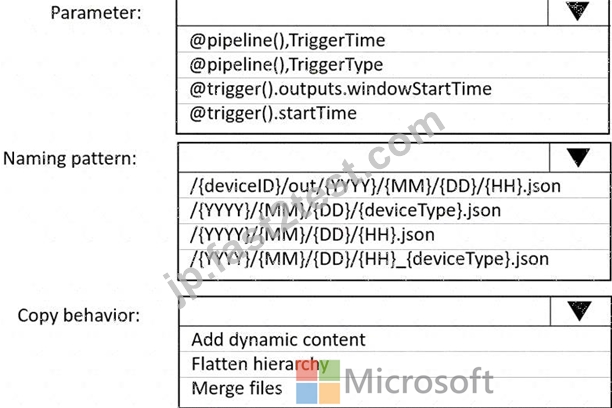
正解:
解説:
Explanation
Box 1: @trigger().startTime
startTime: A date-time value. For basic schedules, the value of the startTime property applies to the first occurrence. For complex schedules, the trigger starts no sooner than the specified startTime value.
Box 2: /{YYYY}/{MM}/{DD}/{HH}_{deviceType}.json
One dataset per hour per deviceType.
Box 3: Flatten hierarchy
- FlattenHierarchy: All files from the source folder are in the first level of the target folder. The target files have autogenerated names.
Reference:
https://docs.microsoft.com/en-us/azure/data-factory/concepts-pipeline-execution-triggers
https://docs.microsoft.com/en-us/azure/data-factory/connector-file-system
質問 # 104
You have an Azure subscription that contains a Microsoft Purview account named MP1, an Azure data factory named DF1, and a storage account named storage. MP1 is configured
10 scan storage1. DF1 is connected to MP1 and contains 3 dataset named DS1. DS1 references 2 file in storage.
In DF1, you plan to create a pipeline that will process data from DS1.
You need to review the schema and lineage information in MP1 for the data referenced by DS1.
Which two features can you use to locate the information? Each correct answer presents a complete solution.
NOTE: Each correct answer is worth one point.
- A. the search bar in the Azure portal
- B. the search bar in the Microsoft Purview governance portal
- C. the Storage browser of storage1 in the Azure portal
- D. the search bar in Azure Data Factory Studio
正解:B、C
解説:
* The search bar in the Microsoft Purview governance portal: This is a feature that allows you to search for assets in your data estate using keywords, filters, and facets. You can use the search bar to find the files in storage1 that are referenced by DS1, and then view their schema and lineage information in the asset details page12.
* The search bar in Azure Data Factory Studio: This is a feature that allows you to search for datasets, linked services, pipelines, and other resources in your data factory. You can use the search bar to find DS1 in DF1, and then view its schema and lineage information in the dataset details page. You can also click on the Open in Purview button to open the corresponding asset in MP13.
The two features that can be used to locate the schema and lineage information for the data referenced by DS1 are the search bar in Azure Data Factory Studio and the search bar in the Microsoft Purview governance portal.
The search bar in Azure Data Factory Studio allows you to search for the dataset DS1 and view its properties and lineage. This can help you locate information about the source and destination data stores, as well as the transformations that were applied to the data.
The search bar in the Microsoft Purview governance portal allows you to search for the storage account and view its metadata, including schema and lineage information. This can help you understand the different data assets that are stored in the storage account and how they are related to each other.
The Storage browser of storage1 in the Azure portal may allow you to view the files that are stored in the storage account, but it does not provide lineage or schema information for those files. Similarly, the search bar in the Azure portal may allow you to search for resources in the Azure subscription, but it does not provide detailed information about the data assets themselves.
References:
* What is Azure Purview?
* Use Azure Data Factory Studio
質問 # 105
You are processing streaming data from vehicles that pass through a toll booth.
You need to use Azure Stream Analytics to return the license plate, vehicle make, and hour the last vehicle passed during each 10-minute window.
How should you complete the query? To answer, select the appropriate options in the answer area.
NOTE: Each correct selection is worth one point.
正解:
解説:
Explanation:
Graphical user interface, text, application Description automatically generated
Box 1: MAX
The first step on the query finds the maximum time stamp in 10-minute windows, that is the time stamp of the last event for that window. The second step joins the results of the first query with the original stream to find the event that match the last time stamps in each window.
Query:
WITH LastInWindow AS
(
SELECT
MAX(Time) AS LastEventTime
FROM
Input TIMESTAMP BY Time
GROUP BY
TumblingWindow(minute, 10)
)
SELECT
Input.License_plate,
Input.Make,
Input.Time
FROM
Input TIMESTAMP BY Time
INNER JOIN LastInWindow
ON DATEDIFF(minute, Input, LastInWindow) BETWEEN 0 AND 10
AND Input.Time = LastInWindow.LastEventTime
Box 2: TumblingWindow
Tumbling windows are a series of fixed-sized, non-overlapping and contiguous time intervals.
Box 3: DATEDIFF
DATEDIFF is a date-specific function that compares and returns the time difference between two DateTime fields, for more information, refer to date functions.
Reference:
https://docs.microsoft.com/en-us/stream-analytics-query/tumbling-window-azure-stream-analytics
質問 # 106
Note: This question is part of a series of questions that present the same scenario. Each question in the series contains a unique solution that might meet the stated goals. Some question sets might have more than one correct solution, while others might not have a correct solution.
After you answer a question in this scenario, you will NOT be able to return to it. As a result, these questions will not appear in the review screen.
You have an Azure Storage account that contains 100 GB of files. The files contain text and numerical values. 75% of the rows contain description data that has an average length of 1.1 MB.
You plan to copy the data from the storage account to an Azure SQL data warehouse.
You need to prepare the files to ensure that the data copies quickly.
Solution: You modify the files to ensure that each row is more than 1 MB.
Does this meet the goal?
- A. No
- B. Yes
正解:A
解説:
Instead modify the files to ensure that each row is less than 1 MB.
References:
https://docs.microsoft.com/en-us/azure/sql-data-warehouse/guidance-for-loading-data
質問 # 107
You have an Azure Synapse Analytics dedicated SQL pool named Pool1 and an Azure Data Lake Storage Gen2 account named Account1.
You plan to access the files in Account1 by using an external table.
You need to create a data source in Pool1 that you can reference when you create the external table.
How should you complete the Transact-SQL statement? To answer, select the appropriate options in the answer area.
NOTE: Each correct selection is worth one point.
正解:
解説:
Reference:
https://docs.microsoft.com/en-us/azure/synapse-analytics/sql/develop-tables-external-tables
質問 # 108
You have an Azure Stream Analytics job that receives clickstream data from an Azure event hub.
You need to define a query in the Stream Analytics job. The query must meet the following requirements:
* Count the number of clicks within each 10-second window based on the country of a visitor.
* Ensure that each click is NOT counted more than once.
How should you define the Query?
- A. SELECT Country, Count(*) AS Count
FROM ClickStream TIMESTAMP BY CreatedAt
GROUP BY Country, TumblingWindow(second, 10) - B. SELECT Country, Count(*) AS Count
FROM ClickStream TIMESTAMP BY CreatedAt
GROUP BY Country, SessionWindow(second, 5, 10) - C. SELECT Country, Avg(*) AS Average
FROM ClickStream TIMESTAMP BY CreatedAt
GROUP BY Country, HoppingWindow(second, 10, 2) - D. SELECT Country, Avg(*) AS Average
FROM ClickStream TIMESTAMP BY CreatedAt
GROUP BY Country, SlidingWindow(second, 10)
正解:A
解説:
Explanation
Tumbling window functions are used to segment a data stream into distinct time segments and perform a function against them, such as the example below. The key differentiators of a Tumbling window are that they repeat, do not overlap, and an event cannot belong to more than one tumbling window.
Example:
Reference:
https://docs.microsoft.com/en-us/azure/stream-analytics/stream-analytics-window-functions
質問 # 109
Note: This question is part of a series of questions that present the same scenario. Each question in the series contains a unique solution that might meet the stated goals. Some question sets might have more than one correct solution, while others might not have a correct solution.
After you answer a question in this section, you will NOT be able to return to it. As a result, these questions will not appear in the review screen.
You are designing an Azure Stream Analytics solution that will analyze Twitter dat a.
You need to count the tweets in each 10-second window. The solution must ensure that each tweet is counted only once.
Solution: You use a hopping window that uses a hop size of 10 seconds and a window size of 10 seconds.
Does this meet the goal?
- A. No
- B. Yes
正解:A
解説:
Instead use a tumbling window. Tumbling windows are a series of fixed-sized, non-overlapping and contiguous time intervals.
Reference:
https://docs.microsoft.com/en-us/stream-analytics-query/tumbling-window-azure-stream-analytics
質問 # 110
You store files in an Azure Data Lake Storage Gen2 container. The container has the storage policy shown in the following exhibit.
Use the drop-down menus to select the answer choice that completes each statement based on the information presented in the graphic.
NOTE: Each correct selection Is worth one point.
正解:
解説:
Reference:
https://docs.microsoft.com/en-us/dotnet/api/microsoft.azure.management.storage.fluent.models.managementpolicybaseblob.tiertocool
質問 # 111
You have an Azure Synapse Analytics dedicated SQL pool named Pool1 and an Azure Data Lake Storage Gen2 account named Account1.
You plan to access the files in Account1 by using an external table.
You need to create a data source in Pool1 that you can reference when you create the external table.
How should you complete the Transact-SQL statement? To answer, select the appropriate options in the answer area.
NOTE: Each correct selection is worth one point.
正解:
解説:
Reference:
https://docs.microsoft.com/en-us/azure/synapse-analytics/sql/develop-tables-external-tables
質問 # 112
You have an Azure Synapse Analytics dedicated SQL pool.
You need to create a table named FactInternetSales that will be a large fact table in a dimensional model.
FactInternetSales will contain 100 million rows and two columns named SalesAmount and OrderQuantity.
Queries executed on FactInternetSales will aggregate the values in SalesAmount and OrderQuantity from the last year for a specific product. The solution must minimize the data size and query execution time.
How should you complete the code? To answer, select the appropriate options in the answer area.
NOTE: Each correct selection is worth one point.
正解:
解説:
Explanation
Box 1: (CLUSTERED COLUMNSTORE INDEX
CLUSTERED COLUMNSTORE INDEX
Columnstore indexes are the standard for storing and querying large data warehousing fact tables. This index uses column-based data storage and query processing to achieve gains up to 10 times the query performance in your data warehouse over traditional row-oriented storage. You can also achieve gains up to 10 times the data compression over the uncompressed data size. Beginning with SQL Server 2016 (13.x) SP1, columnstore indexes enable operational analytics: the ability to run performant real-time analytics on a transactional workload.
Note: Clustered columnstore index
A clustered columnstore index is the physical storage for the entire table.
Diagram Description automatically generated
To reduce fragmentation of the column segments and improve performance, the columnstore index might store some data temporarily into a clustered index called a deltastore and a B-tree list of IDs for deleted rows. The deltastore operations are handled behind the scenes. To return the correct query results, the clustered columnstore index combines query results from both the columnstore and the deltastore.
Box 2: HASH([ProductKey])
A hash distributed table distributes rows based on the value in the distribution column. A hash distributed table is designed to achieve high performance for queries on large tables.
Choose a distribution column with data that distributes evenly
Reference: https://docs.microsoft.com/en-us/sql/relational-databases/indexes/columnstore-indexes-overview
https://docs.microsoft.com/en-us/azure/synapse-analytics/sql-data-warehouse/sql-data-warehouse-tables-overview
https://docs.microsoft.com/en-us/azure/synapse-analytics/sql-data-warehouse/sql-data-warehouse-tables-distribu
質問 # 113
......
Microsoft DP-203(Microsoft Azure上のデータエンジニアリング)試験は、Azureプラットフォーム上でデータエンジニアリング技術を扱うプロフェッショナルのスキルと知識をテストするために設計されています。これは、Azure上でデータソリューションを設計、実装、管理する候補者の能力を検証する認定試験です。この試験では、データストレージ、データ処理、データ分析、データ可視化など、さまざまなトピックをカバーしています。また、Azure Data Factory、Azure Databricks、Azure Stream Analytics、Azure HDInsightなど、さまざまなAzureサービスの使用もカバーしています。
試験問題と解答はDP-203学習ガイド問題解答:https://jp.fast2test.com/DP-203-premium-file.html
練習用DP-203にはFast2test顕著な問題集はあなたをData Engineering on Microsoft Azure試験合格させます合格させる:https://drive.google.com/open?id=17ILQ0UUYRzvmt5bm3Tn7Oc4LErOU-iGO