

[2025年03月] 無料DP-100試験問題をゲット!DP-100実際の無料試験問題
検証済みのDP-100問題集と445格別な問題
DP-100試験は、データサイエンスの概念に関する候補者の知識と、実際のシナリオでこれらの概念を適用する能力をテストする一連の複数選択質問で構成されています。この試験は困難なように設計されており、候補者は試験を試みる前に十分な時間を費やすことが奨励されています。 Microsoftは、オンラインコース、調査ガイド、練習試験など、候補者が準備できるように、さまざまなトレーニングリソースを提供しています。
Microsoft DP-100の認定を取得することで、雇用主や顧客にデータサイエンスソリューションをAzure上で設計・実装するスキルと知識を持っていることを示します。また、最新の技術やベストプラクティスについての継続的な学習と最新の技術に追いつく意欲を持っていることも示します。
質問 # 88
The finance team asks you to train a model using data in an Azure Storage blob container named finance-data.
You need to register the container as a datastore in an Azure Machine Learning workspace and ensure that an error will be raised if the container does not exist.
How should you complete the code? To answer, select the appropriate options in the answer area.
NOTE: Each correct selection is worth one point.
正解:
解説:
Explanation:
Box 1: register_azure_blob_container
Register an Azure Blob Container to the datastore.
Box 2: create_if_not_exists = False
Create the file share if it does not exists, defaults to False.
Reference:
https://docs.microsoft.com/en-us/python/api/azureml-core/azureml.core.datastore.datastore
質問 # 89
You are using C-Support Vector classification to do a multi-class classification with an unbalanced training dataset. The C-Support Vector classification using Python code shown below:
You need to evaluate the C-Support Vector classification code.
Which evaluation statement should you use? To answer, select the appropriate options in the answer area.
NOTE: Each correct selection is worth one point.
正解:
解説:
Explanation:
Box 1: Automatically adjust weights inversely proportional to class frequencies in the input data The "balanced" mode uses the values of y to automatically adjust weights inversely proportional to class frequencies in the input data as n_samples / (n_classes * np.bincount(y)).
Box 2: Penalty parameter
Parameter: C : float, optional (default=1.0)
Penalty parameter C of the error term.
References:
https://scikit-learn.org/stable/modules/generated/sklearn.svm.SVC.html
質問 # 90
You create an Azure Machine Learning workspace and set up a development environment. You plan to train a deep neural network (DNN) by using the Tensorflow framework and by using estimators to submit training scripts.
You must optimize computation speed for training runs.
You need to choose the appropriate estimator to use as well as the appropriate training compute target configuration.
Which values should you use? To answer, select the appropriate options in the answer area.
NOTE: Each correct selection is worth one point.
正解:
解説:
Reference:
https://docs.microsoft.com/en-us/python/api/azureml-train-core/azureml.train.dnn
質問 # 91
You are building an intelligent solution using machine learning models.
The environment must support the following requirements:
Data scientists must build notebooks in a cloud environment
Data scientists must use automatic feature engineering and model building in machine learning pipelines.
Notebooks must be deployed to retrain using Spark instances with dynamic worker allocation.
Notebooks must be exportable to be version controlled locally.
You need to create the environment.
Which four actions should you perform in sequence? To answer, move the appropriate actions from the list of actions to the answer area and arrange them in the correct order.
正解:
解説:
Explanation:
Step 1: Create an Azure HDInsight cluster to include the Apache Spark Mlib library Step 2: Install Microsot Machine Learning for Apache Spark You install AzureML on your Azure HDInsight cluster.
Microsoft Machine Learning for Apache Spark (MMLSpark) provides a number of deep learning and data science tools for Apache Spark, including seamless integration of Spark Machine Learning pipelines with Microsoft Cognitive Toolkit (CNTK) and OpenCV, enabling you to quickly create powerful, highly-scalable predictive and analytical models for large image and text datasets.
Step 3: Create and execute the Zeppelin notebooks on the cluster
Step 4: When the cluster is ready, export Zeppelin notebooks to a local environment.
Notebooks must be exportable to be version controlled locally.
References:
https://docs.microsoft.com/en-us/azure/hdinsight/spark/apache-spark-zeppelin-notebook
https://azuremlbuild.blob.core.windows.net/pysparkapi/intro.html
質問 # 92
You use Azure Machine Learning Studio to build a machine learning experiment.
You need to divide data into two distinct datasets.
Which module should you use?
- A. Assign Data to Clusters
- B. Load Trained Model
- C. Split Data
- D. Group Data into Bins
正解:D
解説:
The Group Data into Bins module supports multiple options for binning data. You can customize how the bin edges are set and how values are apportioned into the bins.
References:
https://docs.microsoft.com/en-us/azure/machine-learning/studio-module-reference/group-data-into-bins
質問 # 93
You are preparing to build a deep learning convolutional neural network model for image classification. You create a script to train the model using CUDA devices.
You must submit an experiment that runs this script in the Azure Machine Learning workspace.
The following compute resources are available:
* a Microsoft Surface device on which Microsoft Office has been installed. Corporate IT policies prevent the installation of additional software
* a Compute Instance named ds-workstation in the workspace with 2 CPUs and 8 GB of memory
* an Azure Machine Learning compute target named cpu-cluster with eight CPU-based nodes
* an Azure Machine Learning compute target named gpu-cluster with four CPU and GPU-based nodes You need to specify the compute resources to be used for running the code to submit the experiment, and for running the script in order to minimize model training time.
Which resources should the data scientist use? To answer, select the appropriate options in the answer area.
NOTE: Each correct selection is worth one point.
正解:
解説: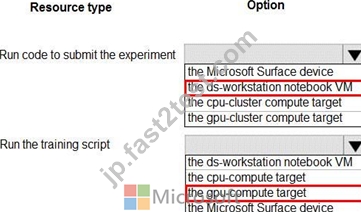
質問 # 94
You are tuning a hyperparameter for an algorithm. The following table shows a data set with different hyperparameter, training error, and validation errors.
Use the drop-down menus to select the answer choice that answers each question based on the information presented in the graphic.
正解:
解説:
).
Reference:
https://medium.com/comet-ml/organizing-machine-learning-projects-project-management-guidelines-2d2b85651bbd
質問 # 95
You create a new Azure subscription. No resources are provisioned in the subscription.
You need to create an Azure Machine Learning workspace.
What are three possible ways to achieve this goal? Each correct answer presents a complete solution.
NOTE: Each correct selection is worth one point.
- A. Run Python code that uses the Azure ML SDK library and calls the Workspace.get method with name, subscription_id, and resource_group parameters.
- B. Run Python code that uses the Azure ML SDK library and calls the Workspace.create method with name, subscription_id, resource_group, and location parameters.
- C. Use an Azure Resource Management template that includes a Microsoft.MachineLearningServices/ workspaces resource and its dependencies.
- D. Navigate to Azure Machine Learning studio and create a workspace.
- E. Use the Azure Command Line Interface (CLI) with the Azure Machine Learning extension to call the az group create function with --name and --location parameters, and then the az ml workspace create function, specifying -w and -g parameters for the workspace name and resource group.
正解:C、D、E
解説:
Explanation
B: You can use an Azure Resource Manager template to create a workspace for Azure Machine Learning.
Example:
{"type": "Microsoft.MachineLearningServices/workspaces",
...
C: You can create a workspace for Azure Machine Learning with Azure CLI Install the machine learning extension.
Create a resource group: az group create --name <resource-group-name> --location <location> To create a new workspace where the services are automatically created, use the following command: az ml workspace create -w <workspace-name> -g <resource-group-name> D: You can create and manage Azure Machine Learning workspaces in the Azure portal.
* Sign in to the Azure portal by using the credentials for your Azure subscription.
* In the upper-left corner of Azure portal, select + Create a resource.
* Use the search bar to find Machine Learning.
* Select Machine Learning.
* In the Machine Learning pane, select Create to begin.
Reference:
https://docs.microsoft.com/en-us/azure/machine-learning/how-to-create-workspace-template
https://docs.microsoft.com/en-us/azure/machine-learning/how-to-manage-workspace-cli
https://docs.microsoft.com/en-us/azure/machine-learning/how-to-manage-workspace
質問 # 96
You create a binary classification model using Azure Machine Learning Studio.
You must use a Receiver Operating Characteristic (RO C) curve and an F1 score to evaluate the model.
You need to create the required business metrics.
How should you complete the experiment? To answer, select the appropriate options in the dialog box in the answer area.
NOTE: Each correct selection is worth one point.

正解:
解説:
質問 # 97
The finance team asks you to train a model using data in an Azure Storage blob container named finance-data.
You need to register the container as a datastore in an Azure Machine Learning workspace and ensure that an error will be raised if the container does not exist.
How should you complete the code? To answer, select the appropriate options in the answer area.
NOTE: Each correct selection is worth one point.
正解:
解説:
Explanation:
Box 1: register_azure_blob_container
Register an Azure Blob Container to the datastore.
Box 2: create_if_not_exists = False
Create the file share if it does not exists, defaults to False.
Reference:
https://docs.microsoft.com/en-us/python/api/azureml-core/azureml.core.datastore.datastore
質問 # 98
you create an Azure Machine learning workspace named workspace1. The workspace contains a Python SOK v2 notebook mat uses Mallow to correct model coaxing men's anal arracks from your local computer.
Vou must reuse the notebook to run on Azure Machine I earning compute instance m workspace.
You need to comminute to log training and artifacts from your data science code.
What should you do?
- A. Log in to workspace1.
- B. Instantiate the MLClient class.
- C. Instantiate the job class.
- D. Configure the tracking URL.
正解:D
質問 # 99
You run an automated machine learning experiment in an Azure Machine Learning workspace. Information about the run is listed in the table below:
You need to write a script that uses the Azure Machine Learning SDK to retrieve the best iteration of the experiment run. Which Python code segment should you use?
- A.

- B.

- C.

- D.

正解:C
解説:
The get_output method on automl_classifier returns the best run and the fitted model for the last invocation.
Overloads on get_output allow you to retrieve the best run and fitted model for any logged metric or for a particular iteration.
In [ ]:
best_run, fitted_model = local_run.get_output()
Reference:
https://notebooks.azure.com/azureml/projects/azureml-getting-started/html/how-to-use-azureml/automated-mach
質問 # 100
You use an Azure Machine Learning workspace.
You have a trained model that must be deployed as a web service. Users must authenticate by using Azure Active Directory.
What should you do?
- A. Deploy the model to Azure Kubernetes Service (AKS). During deployment, set the auch. enabled parameter of the target configuration object to true
- B. Deploy the model to Azure Kubernetes Service (AKS). During deployment, set the token_auth_enabled parameter of the target configuration object to true
- C. Deploy the model to Azure Container Instances. During deployment, set the auch_enabled parameter of the target configuration object to true
- D. Deploy the model to Azure Container Instances. During deployment, set the coken_auch_enabled parameter of the target configuration object to true
正解:B
解説:
To control token authentication, use the token_auth_enabled parameter when you create or update a deployment Token authentication is disabled by default when you deploy to Azure Kubernetes Service.
Note: The model deployments created by Azure Machine Learning can be configured to use one of two authentication methods:
key-based: A static key is used to authenticate to the web service.
token-based: A temporary token must be obtained from the Azure Machine Learning workspace (using Azure Active Directory) and used to authenticate to the web service.
Reference:
https://docs.microsoft.com/en-us/azure/machine-learning/how-to-authenticate-web-service
質問 # 101
You create machine learning models by using Azure Machine Learning.
You plan to train and score models by using a variety of compute contexts. You also plan to create a new compute resource in Azure Machine Learning studio.
You need to select the appropriate compute types.
Which compute types should you select? To answer, drag the appropriate compute types to the correct requirements. Each compute type may be used once, more than once, or not at all. You may need to drag the split bar between panes or scroll to view content.
NOTE: Each correct selection is worth one point.
正解:
解説:
質問 # 102
You deploy a model in Azure Container Instance.
You must use the Azure Machine Learning SDK to call the model API.
You need to invoke the deployed model using native SDK classes and methods.
How should you complete the command? To answer, select the appropriate options in the answer areas.
NOTE: Each correct selection is worth one point.
正解:
解説:
Reference:
https://docs.microsoft.com/bs-latn-ba/azure/machine-learning/how-to-deploy-azure-container-instance
https://docs.microsoft.com/en-us/azure/machine-learning/how-to-troubleshoot-deployment
質問 # 103
You are performing a filter based feature selection for a dataset 10 build a multi class classifies by using Azure Machine Learning Studio.
The dataset contains categorical features that are highly correlated to the output label column.
You need to select the appropriate feature scoring statistical method to identify the key predictors. Which method should you use?
- A. Spearman correlation
- B. Chi-squared
- C. Person correlation
- D. Kendall correlation
正解:C
解説:
Explanation
Pearson's correlation statistic, or Pearson's correlation coefficient, is also known in statistical models as the r value. For any two variables, it returns a value that indicates the strength of the correlation Pearson's correlation coefficient is the test statistics that measures the statistical relationship, or association, between two continuous variables. It is known as the best method of measuring the association between variables of interest because it is based on the method of covariance. It gives information about the magnitude of the association, or correlation, as well as the direction of the relationship.
Reference:
https://docs.microsoft.com/en-us/azure/machine-learning/studio-module-reference/filter-based-feature-selection
https://www.statisticssolutions.com/pearsons-correlation-coefficient/
質問 # 104
......
最新100%合格率保証-素晴らしいDP-100試験問題PDF:https://jp.fast2test.com/DP-100-premium-file.html
DP-100問題集には合格保証が付きます合格できるDP-100試験:https://drive.google.com/open?id=1fVUhCzJNeHJn7YFGUc27bkesy6cZXspf