

無料でゲット!2024年最新のに更新されたMicrosoft DP-100試験問題と解答
DP-100問題集PDFとテストエンジン試験問題
質問 # 98
You create a training pipeline using the Azure Machine Learning designer. You upload a CSV file that contains the data from which you want to train your model.
You need to use the designer to create a pipeline that includes steps to perform the following tasks:
Select the training features using the pandas filter method.
Train a model based on the naive_bayes.GaussianNB algorithm.
Return only the Scored Labels column by using the query SELECT [Scored Labels] FROM t1; Which modules should you use? To answer, drag the appropriate modules to the appropriate locations. Each module name may be used once, more than once, or not at all. You may need to drag the split bar between panes or scroll to view content.
NOTE: Each correct selection is worth one point.
正解:
解説:
質問 # 99
You create an Azure Machine Learning workspace.
You must configure an event-driven workflow to automatically trigger upon completion of training runs in the workspace. The solution must minimize the administrative effort to configure the trigger.
You need to configure an Azure service to automatically trigger the workflow.
Which Azure service should you use?
- A. Event Grid subscription
- B. Event Hubs Capture
- C. Azure Automation runbook
- D. Event Hubs consumer
正解:A
質問 # 100
You create a Python script named train.py and save it in a folder named scripts. The script uses the scikit-learn framework to train a machine learning model.
You must run the script as an Azure Machine Learning experiment on your local workstation.
You need to write Python code to initiate an experiment that runs the train.py script.
How should you complete the code segment? To answer, select the appropriate options in the answer area.
NOTE: Each correct selection is worth one point.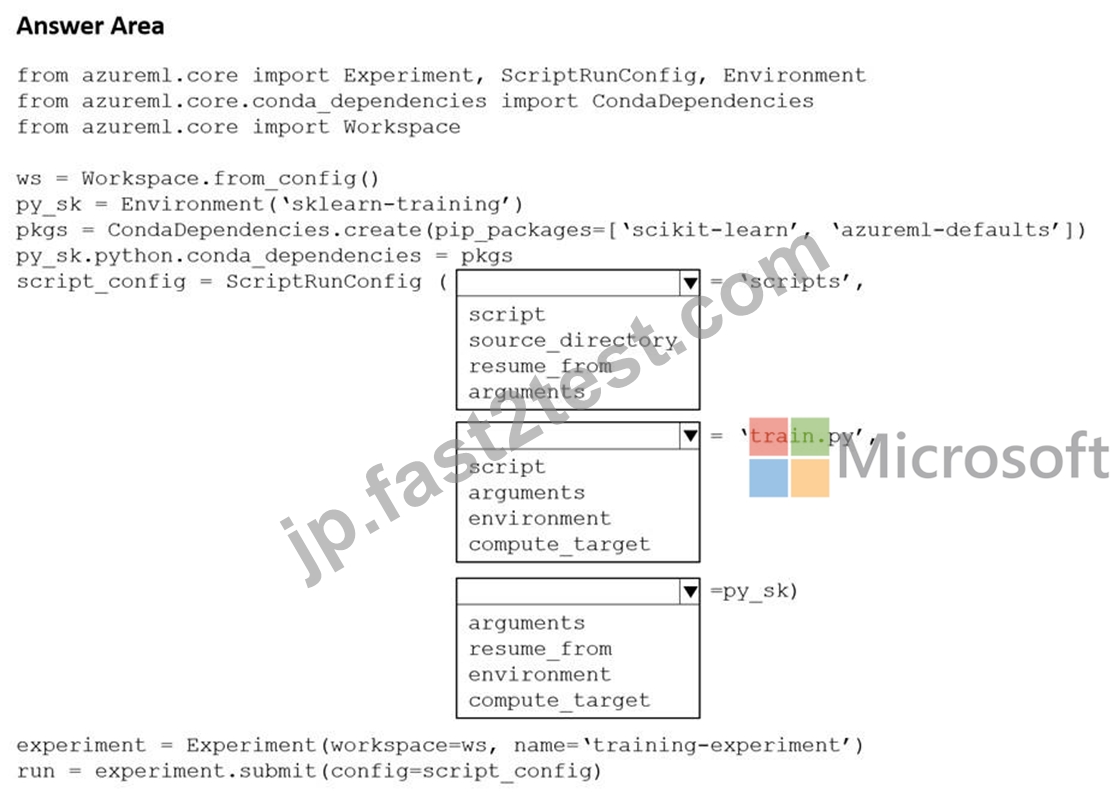
正解:
解説:
Reference:
https://docs.microsoft.com/en-us/python/api/azureml-core/azureml.core.scriptrunconfig
質問 # 101
You are a lead data scientist for a project that tracks the health and migration of birds. You create a multi-image classification deep learning model that uses a set of labeled bird photos collected by experts. You plan to use the model to develop a cross-platform mobile app that predicts the species of bird captured by app users.
You must test and deploy the trained model as a web service. The deployed model must meet the following requirements:
An authenticated connection must not be required for testing.
The deployed model must perform with low latency during inferencing.
The REST endpoints must be scalable and should have a capacity to handle large number of requests when multiple end users are using the mobile application.
You need to verify that the web service returns predictions in the expected JSON format when a valid REST request is submitted.
Which compute resources should you use? To answer, select the appropriate options in the answer area.
NOTE: Each correct selection is worth one point.
正解:
解説: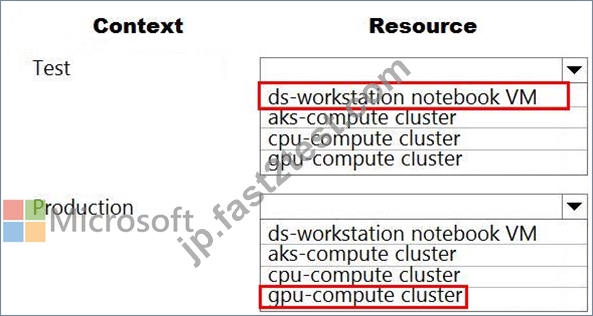
Reference:
https://docs.microsoft.com/en-us/azure/machine-learning/data-science-virtual-machine/dsvm-common-identity
https://docs.microsoft.com/en-us/azure/architecture/reference-architectures/ai/training-deep-learning
質問 # 102
Your Azure Machine Learning workspace has a dataset named real_estate_dat a. A sample of the data in the dataset follows.
You want to use automated machine learning to find the best regression model for predicting the price column.
You need to configure an automated machine learning experiment using the Azure Machine Learning SDK.
How should you complete the code? To answer, select the appropriate options in the answer area.
NOTE: Each correct selection is worth one point.
正解:
解説:
Reference:
https://docs.microsoft.com/en-us/python/api/azureml-train-automl-client/azureml.train.automl.automlconfig.automlconfig?view=azure-ml-py
質問 # 103
You are creating a binary classification by using a two-class logistic regression model.
You need to evaluate the model results for imbalance.
Which evaluation metric should you use?
- A. Mean Absolute Error
- B. Accuracy
- C. Relative Absolute Error
- D. Root Mean Square Error
- E. Relative Squared Error
- F. AUC Curve
正解:F
解説:
One can inspect the true positive rate vs. the false positive rate in the Receiver Operating Characteristic (ROC) curve and the corresponding Area Under the Curve (AUC) value. The closer this curve is to the upper left corner, the better the classifier's performance is (that is maximizing the true positive rate while minimizing the false positive rate). Curves that are close to the diagonal of the plot, result from classifiers that tend to make predictions that are close to random guessing.
References:
https://docs.microsoft.com/en-us/azure/machine-learning/studio/evaluate-model-performance#evaluating-a- binary-classification-model
質問 # 104
You deploy a model as an Azure Machine Learning real-time web service using the following code.
The deployment fails.
You need to troubleshoot the deployment failure by determining the actions that were performed during deployment and identifying the specific action that failed.
Which code segment should you run?
- A. service.update_deployment_state()
- B. service.state
- C. service.serialize()
- D. service.get_logs()
正解:D
解説:
Explanation
You can print out detailed Docker engine log messages from the service object. You can view the log for ACI, AKS, and Local deployments. The following example demonstrates how to print the logs.
# if you already have the service object handy
print(service.get_logs())
# if you only know the name of the service (note there might be multiple services with the same name but different version number) print(ws.webservices['mysvc'].get_logs()) Reference:
https://docs.microsoft.com/en-us/azure/machine-learning/how-to-troubleshoot-deployment
質問 # 105
You are developing a machine learning, experiment by using Azure. The following images show the input and output of a machine learning experiment:
Use the drop-down menus to select the answer choice that answers each question based on the information presented in the graphic.
NOTE: Each correct selection is worth one point.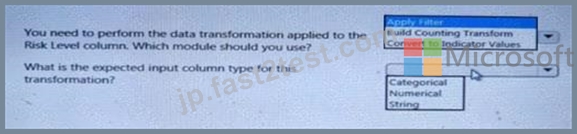
正解:
解説: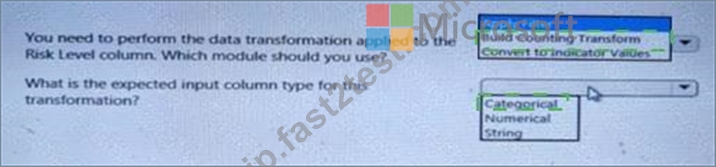
質問 # 106
You are performing sentiment analysis using a CSV file that includes 12,000 customer reviews written in a short sentence format. You add the CSV file to Azure Machine Learning Studio and configure it as the starting point dataset of an experiment. You add the Extract N-Gram Features from Text module to the experiment to extract key phrases from the customer review column in the dataset.
You must create a new n-gram dictionary from the customer review text and set the maximum n-gram size to trigrams.
What should you select? To answer, select the appropriate options in the answer area.
NOTE: Each correct selection is worth one point.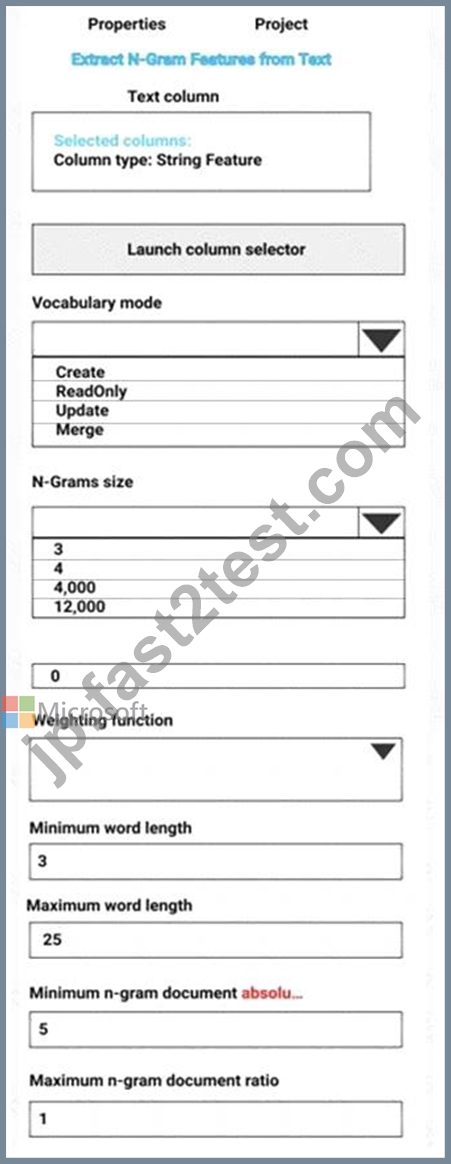
正解:
解説: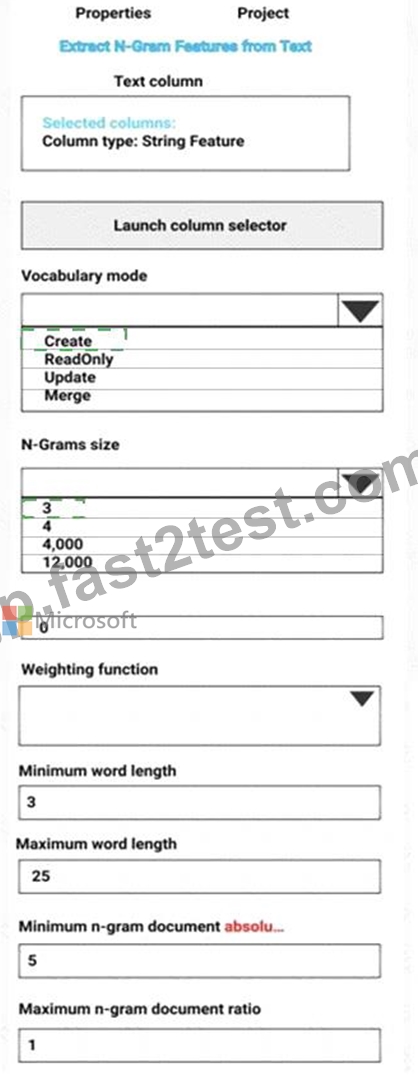
Explanation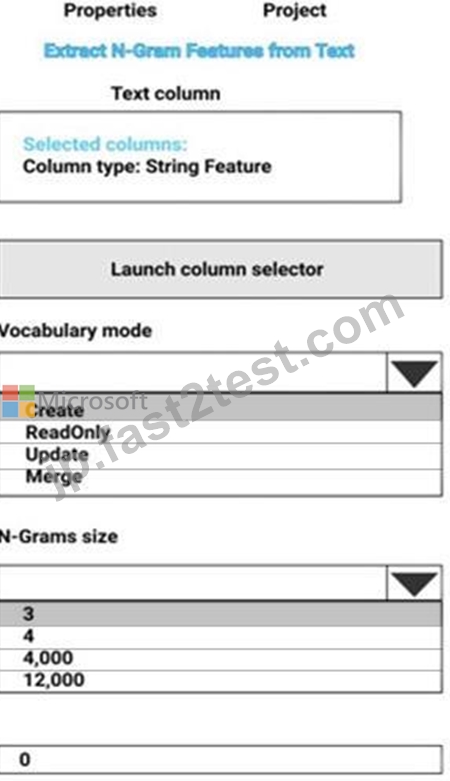

Vocabulary mode: Create
For Vocabulary mode, select Create to indicate that you are creating a new list of n-gram features.
N-Grams size: 3
For N-Grams size, type a number that indicates the maximum size of the n-grams to extract and store. For example, if you type 3, unigrams, bigrams, and trigrams will be created.
Weighting function: Leave blank
The option, Weighting function, is required only if you merge or update vocabularies. It specifies how terms in the two vocabularies and their scores should be weighted against each other.
References:
https://docs.microsoft.com/en-us/azure/machine-learning/studio-module-reference/extract-n-gram-features-from-
質問 # 107
You plan to use a Deep Learning Virtual Machine (DLVM) to train deep learning models using Compute Unified Device Architecture (CUDA) computations.
You need to configure the DLVM to support CUDA.
What should you implement?
- A. Intel Software Guard Extensions (Intel SGX) technology
- B. Graphic Processing Unit (GPU)
- C. Solid State Drives (SSD)
- D. High Random Access Memory (RAM) configuration
- E. Computer Processing Unit (CPU) speed increase by using overcloking
正解:B
解説:
A Deep Learning Virtual Machine is a pre-configured environment for deep learning using GPU instances.
Reference:
https://azuremarketplace.microsoft.com/en-au/marketplace/apps/microsoft-ads.dsvm-deep-learning
質問 # 108
You use Azure Machine Learning to train and register a model.
You must deploy the model into production as a real-time web service to an inference cluster named service-compute that the IT department has created in the Azure Machine Learning workspace.
Client applications consuming the deployed web service must be authenticated based on their Azure Active Directory service principal.
You need to write a script that uses the Azure Machine Learning SDK to deploy the model. The necessary modules have been imported.
How should you complete the code? To answer, select the appropriate options in the answer area.
NOTE: Each correct selection is worth one point.
正解:
解説: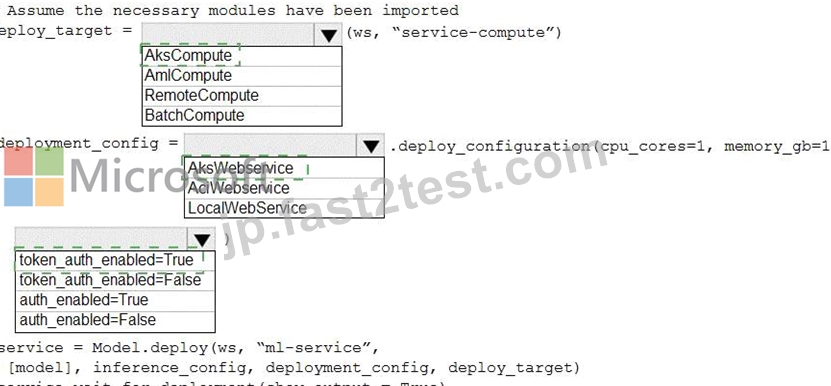
Explanation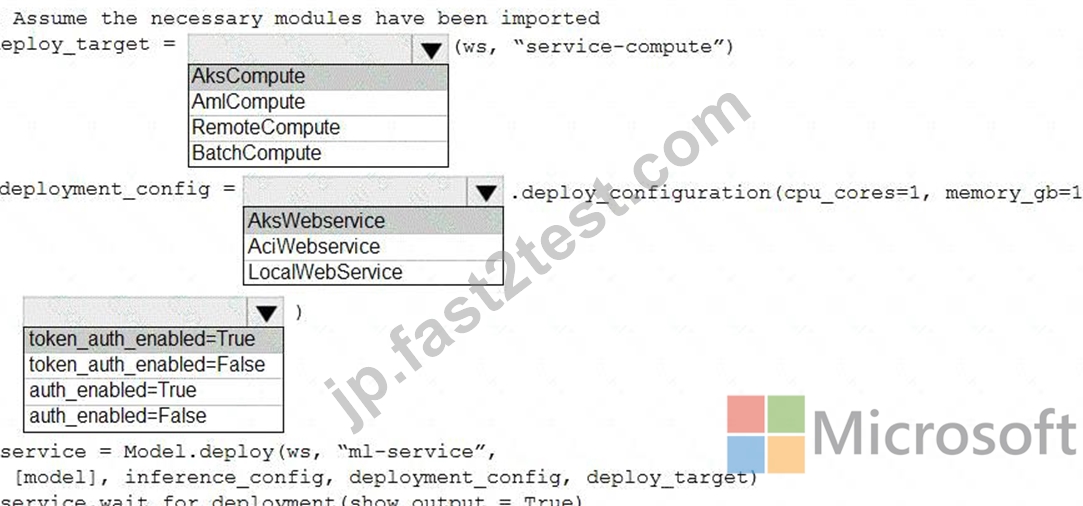
Box 1: AksCompute
Example:
aks_target = AksCompute(ws,"myaks")
# If deploying to a cluster configured for dev/test, ensure that it was created with enough
# cores and memory to handle this deployment configuration. Note that memory is also used by
# things such as dependencies and AML components.
deployment_config = AksWebservice.deploy_configuration(cpu_cores = 1, memory_gb = 1) service = Model.deploy(ws, "myservice", [model], inference_config, deployment_config, aks_target) Box 2: AksWebservice Box 3: token_auth_enabled=Yes Whether or not token auth is enabled for the Webservice.
Note: A Service principal defined in Azure Active Directory (Azure AD) can act as a principal on which authentication and authorization policies can be enforced in Azure Databricks.
The Azure Active Directory Authentication Library (ADAL) can be used to programmatically get an Azure AD access token for a user.
Reference:
https://docs.microsoft.com/en-us/azure/machine-learning/how-to-deploy-azure-kubernetes-service
https://docs.microsoft.com/en-us/azure/databricks/dev-tools/api/latest/aad/service-prin-aad-token
質問 # 109
You have a Python data frame named salesData in the following format:
The data frame must be unpivoted to a long data format as follows:
You need to use the pandas.melt() function in Python to perform the transformation.
How should you complete the code segment? To answer, select the appropriate options in the answer area.
NOTE: Each correct selection is worth one point.
正解:
解説: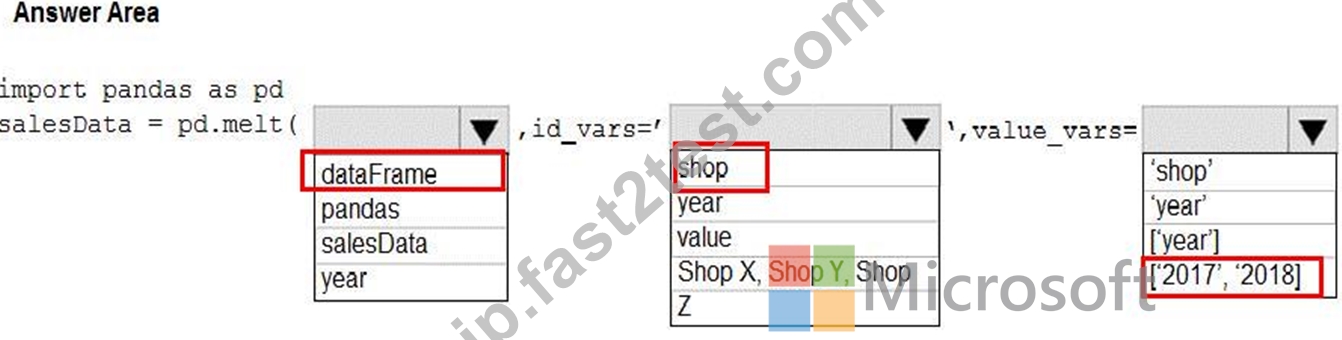
Reference:
https://pandas.pydata.org/pandas-docs/stable/reference/api/pandas.melt.html
質問 # 110
You are hired as a data scientist at a winery. The previous data scientist used Azure Machine Learning.
You need to review the models and explain how each model makes decisions.
Which explainer modules should you use? To answer, select the appropriate options in the answer area.
NOTE: Each correct selection is worth one point.
正解:
解説: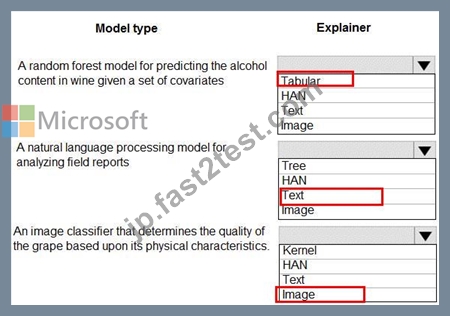
Reference:
https://medium.com/microsoftazure/automated-and-interpretable-machine-learning-d07975741298
質問 # 111
You have a model with a large difference between the training and validation error values.
You must create a new model and perform cross-validation.
You need to identify a parameter set for the new model using Azure Machine Learning Studio.
Which module you should use for each step? To answer, drag the appropriate modules to the correct steps. Each module may be used once or more than once, or not at all. You may need to drag the split bar between panes or scroll to view content.
NOTE: Each correct selection is worth one point.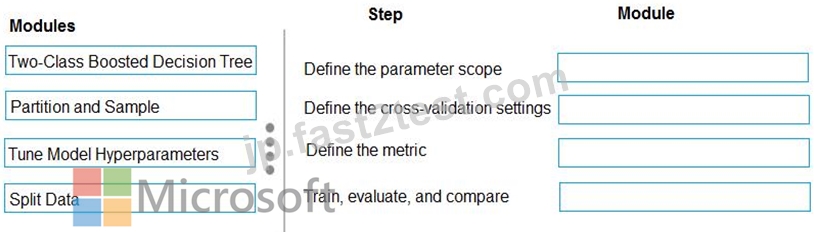
正解:
解説:
Reference:
https://docs.microsoft.com/en-us/azure/machine-learning/studio-module-reference/partition-and-sample
質問 # 112
You need to obtain the output from the pipeline execution. Where will you find the output?
- A. the Inference Clusters tab in Machine Learning studio
- B. a file named parallel_run_step.txt located in the output folder
- C. the Activity Log in the Azure portal for the Machine Learning workspace
- D. the digitjdentification.py script
- E. the debug log
正解:B
解説:
output_action (str): How the output is to be organized. Currently supported values are 'append_row' and 'summary_only'.
* 'append_row' - All values output by run() method invocations will be aggregated into one unique file named parallel_run_step.txt that is created in the output location.
* 'summary_only'
Reference:
https://docs.microsoft.com/en-us/python/api/azureml-contrib-pipeline-steps/azureml.contrib.pipeline.steps.parallelrunconfig
質問 # 113
You have an Azure Machine Learning workspace named workspace1 that is accessible from a public endpoint.
The workspace contains an Azure Blob storage datastore named store1 that represents a blob container in an Azure storage account named account1. You configure workspace1 and account1 to be accessible by using private endpoints in the same virtual network.
You must be able to access the contents of store1 by using the Azure Machine Learning SDK for Python. You must be able to preview the contents of store1 by using Azure Machine Learning studio.
You need to configure store1.
What should you do? To answer, select the appropriate options in the answer area.
NOTE: Each correct selection is worth one point.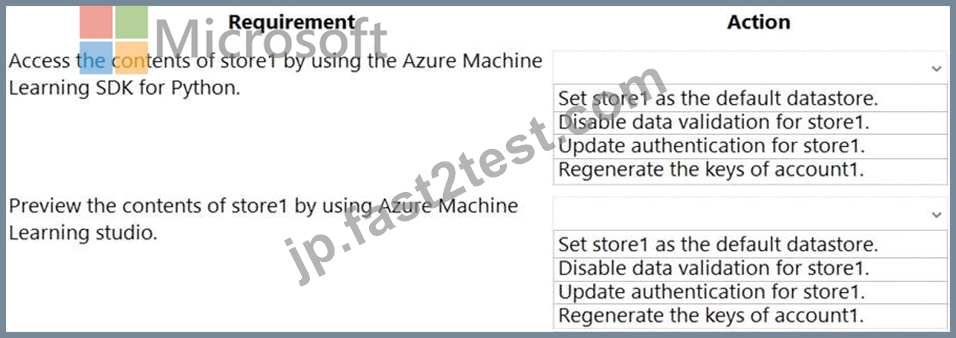
正解:
解説:
Explanation
Text, table Description automatically generated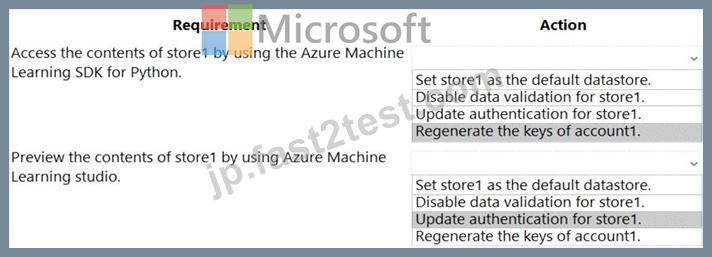
Box 1: Regenerate the keys of account1.
Azure Blob Storage support authentication through Account key or SAS token.
To authenticate your access to the underlying storage service, you can provide either your account key, shared access signatures (SAS) tokens, or service principal Box 2: Update the authentication for store1.
For Azure Machine Learning studio users, several features rely on the ability to read data from a dataset; such as dataset previews, profiles and automated machine learning. For these features to work with storage behind virtual networks, use a workspace managed identity in the studio to allow Azure Machine Learning to access the storage account from outside the virtual network.
Note: Some of the studio's features are disabled by default in a virtual network. To re-enable these features, you must enable managed identity for storage accounts you intend to use in the studio.
The following operations are disabled by default in a virtual network:
Preview data in the studio.
Reference:
https://docs.microsoft.com/en-us/azure/machine-learning/how-to-access-data
質問 # 114
You are using the Azure Machine Learning Service to automate hyperparameter exploration of your neural network classification model.
You must define the hyperparameter space to automatically tune hyperparameters using random sampling according to following requirements:
* The learning rate must be selected from a normal distribution with a mean value of 10 and a standard deviation of 3.
* Batch size must be 16, 32 and 64.
* Keep probability must be a value selected from a uniform distribution between the range of 0.05 and 0.1.
You need to use the param_sampling method of the Python API for the Azure Machine Learning Service.
How should you complete the code segment? To answer, select the appropriate options in the answer area.
NOTE: Each correct selection is worth one point.
正解:
解説:
Explanation:
In random sampling, hyperparameter values are randomly selected from the defined search space. Random sampling allows the search space to include both discrete and continuous hyperparameters.
Example:
from azureml.train.hyperdrive import RandomParameterSampling
param_sampling = RandomParameterSampling( {
"learning_rate": normal(10, 3),
"keep_probability": uniform(0.05, 0.1),
"batch_size": choice(16, 32, 64)
}
Reference:
https://docs.microsoft.com/en-us/azure/machine-learning/service/how-to-tune-hyperparameters
質問 # 115
Note: This question is part of a series of questions that present the same scenario. Each question in the series contains a unique solution that might meet the stated goals. Some question sets might have more than one correct solution, while others might not have a correct solution.
After you answer a question in this section, you will NOT be able to return to it. As a result, these questions will not appear in the review screen.
You create a model to forecast weather conditions based on historical data.
You need to create a pipeline that runs a processing script to load data from a datastore and pass the processed data to a machine learning model training script.
Solution: Run the following code:
Does the solution meet the goal?
- A. No
- B. Yes
正解:A
解説:
train_step is missing.
Reference:
https://docs.microsoft.com/en-us/python/api/azureml-pipeline-core/azureml.pipeline.core.pipelinedata?view=azure-ml-py
質問 # 116
......
Microsoft DP-100試験は、データ探索と準備、データモデリング、機械学習アルゴリズム、およびデータ可視化など、データサイエンスに関連する様々なトピックをカバーしています。この試験は、また、Azure Machine Learning、Azure Databricks、およびAzure HDInsightなどのデータサイエンスのためのAzureサービスを使用する能力を評価します。試験の準備には、オンラインコースを受講し、トレーニングセッションに参加し、Microsoftが提供するサンプル問題やラボで練習することができます。Microsoft DP-100試験に合格することで、候補者はAzure上でのデータサイエンスソリューションの設計と実装における専門知識を証明し、キャリアアップと業界での認知を得ることができます。
検証済みのDP-100テスト問題集と解答で正確な410問題と解答あります:https://jp.fast2test.com/DP-100-premium-file.html
最新をゲットせよ!DP-100認定有効な試験問題集解答:https://drive.google.com/open?id=1CZ2dqQTCp9NHAum47CCej2ag4WqtYYMq