

更新済みの2024年04月 DP-100試験練習テスト問題
検証済みDP-100問題集と解答100%一発合格保証で更新された問題集
DP-100試験は、データセットの作成と管理、予測モデルの構築とトレーニング、モデルの本番環境への展開、モデルのパフォーマンスのモニタリングと最適化など、さまざまなトピックをカバーしています。候補者は、Azure Machine Learning、Azure Databricks、その他のAzureデータサービスとともに、PythonやRなどのツールを使用してデータソリューションを設計および実装する能力を証明する必要があります。
Microsoft DP-100: Azure 上でのデータサイエンスソリューションの設計と実装は、Azure 上でデータサイエンスソリューションの設計と実装のスキルを証明するための貴重な認定資格です。様々なトピックをカバーし、候補者がこれらのスキルを実世界のシナリオに適用できる能力を証明する必要があります。Microsoft DP-100 の認定を取得することで、データサイエンスの分野でのキャリアアップや機会の拡大につながることがあります。
質問 # 19
You are evaluating a Python NumPy array that contains six data points defined as follows:
data = [10, 20, 30, 40, 50, 60]
You must generate the following output by using the k-fold algorithm implantation in the Python Scikit-learn machine learning library:
train: [10 40 50 60], test: [20 30]
train: [20 30 40 60], test: [10 50]
train: [10 20 30 50], test: [40 60]
You need to implement a cross-validation to generate the output.
How should you complete the code segment? To answer, select the appropriate code segment in the dialog box in the answer area.
NOTE: Each correct selection is worth one point.
正解:
解説:
Explanation
Box 1: k-fold
Box 2: 3
K-Folds cross-validator provides train/test indices to split data in train/test sets. Split dataset into k consecutive folds (without shuffling by default).
The parameter n_splits ( int, default=3) is the number of folds. Must be at least 2.
Box 3: data
Example: Example:
>>>
>>> from sklearn.model_selection import KFold
>>> X = np.array([[1, 2], [3, 4], [1, 2], [3, 4]])
>>> y = np.array([1, 2, 3, 4])
>>> kf = KFold(n_splits=2)
>>> kf.get_n_splits(X)
2
>>> print(kf)
KFold(n_splits=2, random_state=None, shuffle=False)
>>> for train_index, test_index in kf.split(X):
print("TRAIN:", train_index, "TEST:", test_index)
X_train, X_test = X[train_index], X[test_index]
y_train, y_test = y[train_index], y[test_index]
TRAIN: [2 3] TEST: [0 1]
TRAIN: [0 1] TEST: [2 3]
References:
https://scikit-learn.org/stable/modules/generated/sklearn.model_selection.KFold.html
質問 # 20
You define a datastore named ml-data for an Azure Storage blob container. In the container, you have a folder named train that contains a file named data.csv. You plan to use the file to train a model by using the Azure Machine Learning SDK.
You plan to train the model by using the Azure Machine Learning SDK to run an experiment on local compute.
You define a DataReference object by running the following code:
You need to load the training data.
Which code segment should you use?

- A. Option D
- B. Option E
- C. Option A
- D. Option C
- E. Option B
正解:B
解説:
Example:
data_folder = args.data_folder
# Load Train and Test data
train_data = pd.read_csv(os.path.join(data_folder, 'data.csv'))
Reference:
https://www.element61.be/en/resource/azure-machine-learning-services-complete-toolbox-ai
質問 # 21
You plan to implement an Azure Machine Learning solution. You have the following requirements:
* Run a Jupyter notebook to interactively tram a machine learning model.
* Deploy assets and workflows for machine learning proof of concept by using scripting rather than custom programming.
You need to select a development technique for each requirement
Which development technique should you use? To answer, select the appropriate options in the answer area.
NOTE: Each correct selection is worth one point.
正解:
解説:
質問 # 22
You need to configure the Edit Metadata module so that the structure of the datasets match. Which configuration options should you select? To answer, select the appropriate options in the answer area.
NOTE: Each correct selection is worth one point.

正解:
解説:
Explanation
質問 # 23
You need to configure the Feature Based Feature Selection module based on the experiment requirements and datasets.
How should you configure the module properties? To answer, select the appropriate options in the dialog box in the answer area.
NOTE: Each correct selection is worth one point.
正解:
解説:
Explanation:
Box 1: Mutual Information.
The mutual information score is particularly useful in feature selection because it maximizes the mutual information between the joint distribution and target variables in datasets with many dimensions.
Box 2: MedianValue
MedianValue is the feature column, , it is the predictor of the dataset.
Scenario: The MedianValue and AvgRoomsinHouse columns both hold data in numeric format. You need to select a feature selection algorithm to analyze the relationship between the two columns in more detail.
References:
https://docs.microsoft.com/en-us/azure/machine-learning/studio-module-reference/filter-based-feature-selection
質問 # 24
You need to define an evaluation strategy for the crowd sentiment models.
Which three actions should you perform in sequence? To answer, move the appropriate actions from the list of actions to the answer area and arrange them in the correct order.
正解:
解説: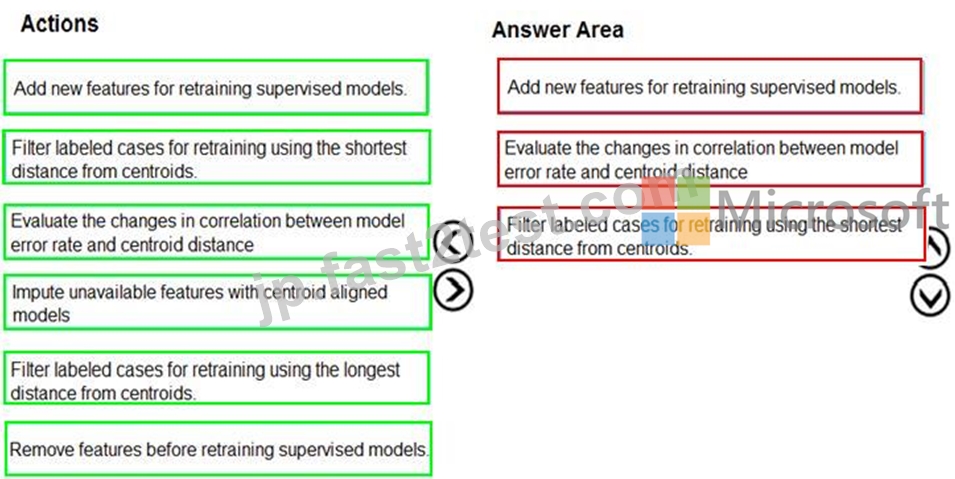
Explanation:
Scenario:
Experiments for local crowd sentiment models must combine local penalty detection data.
Crowd sentiment models must identify known sounds such as cheers and known catch phrases. Individual crowd sentiment models will detect similar sounds.
Note: Evaluate the changed in correlation between model error rate and centroid distance In machine learning, a nearest centroid classifier or nearest prototype classifier is a classification model that assigns to observations the label of the class of training samples whose mean (centroid) is closest to the observation.
References:
https://en.wikipedia.org/wiki/Nearest_centroid_classifier
https://docs.microsoft.com/en-us/azure/machine-learning/studio-module-reference/sweep-clustering
質問 # 25
You create a multi-class image classification deep learning model.
The model must be retrained monthly with the new image data fetched from a public web portal. You create an Azure Machine Learning pipeline to fetch new data, standardize the size of images and retrain the model.
You need to use the Azure Machine Learning Python SEX v2 to configure the schedule for the pipeline. The schedule should be defined by using the frequency and interval properties with frequency set to month' and interval set to "1:
Which three classes should you instantiate in sequence"' To answer, move the appropriate actions from the list of actions to the answer area and arrange them in the correct order.
正解:
解説:
1 - PipelineJob
2 - RecurrenceTrigger
3 - JobSchedule
質問 # 26
Note: This question is part of a series of questions that present the same scenario. Each question in the series contains a unique solution that might meet the stated goals. Some question sets might have more than one correct solution, while others might not have a correct solution.
After you answer a question in this section, you will NOT be able to return to it. As a result, these questions will not appear in the review screen.
You have a Python script named train.py in a local folder named scripts. The script trains a regression model by using scikit-learn. The script includes code to load a training data file which is also located in the scripts folder.
You must run the script as an Azure ML experiment on a compute cluster named aml-compute.
You need to configure the run to ensure that the environment includes the required packages for model training. You have instantiated a variable named aml-compute that references the target compute cluster.
Solution: Run the following code:
Does the solution meet the goal?
- A. No
- B. Yes
正解:A
解説:
Explanation
The scikit-learn estimator provides a simple way of launching a scikit-learn training job on a compute target. It is implemented through the SKLearn class, which can be used to support single-node CPU training.
Example:
from azureml.train.sklearn import SKLearn
}
estimator = SKLearn(source_directory=project_folder,
compute_target=compute_target,
entry_script='train_iris.py'
)
Reference:
https://docs.microsoft.com/en-us/azure/machine-learning/how-to-train-scikit-learn
質問 # 27
You have an Azure Machine Learning workspace
You plan to use the Azure Machine Learning SDK for Python v1 to submit a job to run a training script.
You need to complete the script to ensure that it will execute the training script.
How should you complete the script? To answer, select the appropriate options in the answer area.
NOTE: Each correct selection is worth one point
正解:
解説:
See below image
質問 # 28
You are using the Hyperdrive feature in Azure Machine Learning to train a model.
You configure the Hyperdrive experiment by running the following code:
For each of the following statements, select Yes if the statement is true. Otherwise, select No.
NOTE: Each correct selection is worth one point.
正解:
解説:
Explanation:
Box 1: Yes
In random sampling, hyperparameter values are randomly selected from the defined search space. Random sampling allows the search space to include both discrete and continuous hyperparameters.
Box 2: Yes
learning_rate has a normal distribution with mean value 10 and a standard deviation of 3.
Box 3: No
keep_probability has a uniform distribution with a minimum value of 0.05 and a maximum value of 0.1.
Box 4: No
number_of_hidden_layers takes on one of the values [3, 4, 5].
Reference:
https://docs.microsoft.com/en-us/azure/machine-learning/how-to-tune-hyperparameters
質問 # 29
You create an experiment in Azure Machine Learning Studio- You add a training dataset that contains 10.000 rows. The first 9.000 rows represent class 0 (90 percent). The first 1.000 rows represent class 1 (10 percent).
The training set is unbalanced between two Classes. You must increase the number of training examples for class 1 to 4,000 by using data rows. You add the Synthetic Minority Oversampling Technique (SMOTE) module to the experiment.
You need to configure the module.
Which values should you use? To answer, select the appropriate options in the dialog box in the answer area.
NOTE: Each correct selection is worth one point.
正解:
解説:
質問 # 30
Note: This question is part of a series of questions that present the same scenario. Each question in the series contains a unique solution that might meet the stated goals. Some question sets might have more than one correct solution, while others might not have a correct solution.
After you answer a question in this section, you will NOT be able to return to it. As a result, these questions will not appear in the review screen.
You create a model to forecast weather conditions based on historical data.
You need to create a pipeline that runs a processing script to load data from a datastore and pass the processed data to a machine learning model training script.
Solution: Run the following code:
Does the solution meet the goal?
- A. Yes
- B. No
正解:A
解説:
The two steps are present: process_step and train_step
Note:
Data used in pipeline can be produced by one step and consumed in another step by providing a PipelineData object as an output of one step and an input of one or more subsequent steps.
PipelineData objects are also used when constructing Pipelines to describe step dependencies. To specify that a step requires the output of another step as input, use a PipelineData object in the constructor of both steps.
For example, the pipeline train step depends on the process_step_output output of the pipeline process step:
from azureml.pipeline.core import Pipeline, PipelineData
from azureml.pipeline.steps import PythonScriptStep
datastore = ws.get_default_datastore()
process_step_output = PipelineData("processed_data", datastore=datastore) process_step = PythonScriptStep(script_name="process.py", arguments=["--data_for_train", process_step_output], outputs=[process_step_output], compute_target=aml_compute, source_directory=process_directory) train_step = PythonScriptStep(script_name="train.py", arguments=["--data_for_train", process_step_output], inputs=[process_step_output], compute_target=aml_compute, source_directory=train_directory) pipeline = Pipeline(workspace=ws, steps=[process_step, train_step]) Reference:
https://docs.microsoft.com/en-us/python/api/azureml-pipeline-core/azureml.pipeline.core.pipelinedata?view=azure-ml-py
質問 # 31
You are creating a machine learning model. You have a dataset that contains null rows.
You need to use the Clean Missing Data module in Azure Machine Learning Studio to identify and resolve the null and missing data in the dataset.
Which parameter should you use?
- A. Remove entire row
- B. Hot Deck
- C. Remove entire column
- D. Replace with mean
正解:C
解説:
Remove entire row: Completely removes any row in the dataset that has one or more missing values. This is useful if the missing value can be considered randomly missing.
References:
https://docs.microsoft.com/en-us/azure/machine-learning/studio-module-reference/clean-missing-data
質問 # 32
You are tuning a hyperparameter for an algorithm. The following table shows a data set with different hyperparameter, training error, and validation errors.
Use the drop-down menus to select the answer choice that answers each question based on the information presented in the graphic.
正解:
解説:
Reference:
https://medium.com/comet-ml/organizing-machine-learning-projects-project-management-guidelines-2d2b85651bbd
質問 # 33
You create an experiment in Azure Machine Learning Studio- You add a training dataset that contains 10.000 rows. The first 9.000 rows represent class 0 (90 percent). The first 1.000 rows represent class 1 (10 percent).
The training set is unbalanced between two Classes. You must increase the number of training examples for class 1 to 4,000 by using data rows. You add the Synthetic Minority Oversampling Technique (SMOTE) module to the experiment.
You need to configure the module.
Which values should you use? To answer, select the appropriate options in the dialog box in the answer area.
NOTE: Each correct selection is worth one point.
正解:
解説:
質問 # 34
You are running a training experiment on remote compute in Azure Machine Learning.
The experiment is configured to use a conda environment that includes the mlflow and azureml-contrib-run packages.
You must use MLflow as the logging package for tracking metrics generated in the experiment.
You need to complete the script for the experiment.
How should you complete the code? To answer, select the appropriate options in the answer area.
NOTE: Each correct selection is worth one point.
正解:
解説:
Reference:
https://docs.microsoft.com/en-us/azure/machine-learning/how-to-use-mlflow
質問 # 35
You are developing a machine learning, experiment by using Azure. The following images show the input and output of a machine learning experiment:
Use the drop-down menus to select the answer choice that answers each question based on the information presented in the graphic.
NOTE: Each correct selection is worth one point.
正解:
解説:
質問 # 36
You need to configure the Feature Based Feature Selection module based on the experiment requirements and datasets.
How should you configure the module properties? To answer, select the appropriate options in the dialog box in the answer area.
NOTE: Each correct selection is worth one point.
正解:
解説:
Explanation:
Box 1: Mutual Information.
The mutual information score is particularly useful in feature selection because it maximizes the mutual information between the joint distribution and target variables in datasets with many dimensions.
Box 2: MedianValue
MedianValue is the feature column, , it is the predictor of the dataset.
Scenario: The MedianValue and AvgRoomsinHouse columns both hold data in numeric format. You need to select a feature selection algorithm to analyze the relationship between the two columns in more detail.
References:
https://docs.microsoft.com/en-us/azure/machine-learning/studio-module-reference/filter-based-feature-selection
質問 # 37
You manage an Azure Machine Learning won pace named workspace 1 by using the Python SDK v2. You create a Gene-al Purpose v2 Azure storage account named mlstorage1. The storage account includes a pulley accessible container name micOTtalnerl. The container stores 10 blobs with files in the CSV format.
You must develop Python SDK v2 code to create a data asset referencing all blobs in the container named mtcontamer1.
You need to complete the Python SDK v2 code.
How should you complete the code? To answer select the appropriate options in the answer area.
NOTE: Each correct selection is worth one point.
正解:
解説:
質問 # 38
Note: This question is part of a series of questions that present the same scenario. Each question in the series contains a unique solution that might meet the stated goals. Some question sets might have more than one correct solution, while others might not have a correct solution.
After you answer a question in this section, you will NOT be able to return to it. As a result, these questions will not appear in the review screen.
You create an Azure Machine Learning service datastore in a workspace. The datastore contains the following files:
* /data/2018/Q1 .csv
* /data/2018/Q2.csv
* /data/2018/Q3.csv
* /data/2018/Q4.csv
* /data/2019/Q1.csv
All files store data in the following format:
id,M,f2,l
1,1,2,0
2,1,1,1
32,10
You run the following code:
You need to create a dataset named training_data and load the data from all files into a single data frame by using the following code:
Solution: Run the following code:
Does the solution meet the goal?
- A. Yes
- B. No
正解:A
質問 # 39
Your Azure Machine Learning workspace has a dataset named real_estate_dat a. A sample of the data in the dataset follows.
You want to use automated machine learning to find the best regression model for predicting the price column.
You need to configure an automated machine learning experiment using the Azure Machine Learning SDK.
How should you complete the code? To answer, select the appropriate options in the answer area.
NOTE: Each correct selection is worth one point.
正解:
解説:
Reference:
https://docs.microsoft.com/en-us/python/api/azureml-train-automl-client/azureml.train.automl.automlconfig.automlconfig?view=azure-ml-py
質問 # 40
......
DP-100試験は、データサイエンスの概念を理解し、Azureサービスでの実践的な経験が必要な難しい認定試験です。しかし、この試験に合格することでデータサイエンス分野の専門家にとって多くのキャリアチャンスが開かれます。合格者は、Azure上でのデータサイエンスソリューションの設計と実装の専門知識を証明できるため、今日の求人市場で非常に求められるスキルとなります。
究極の準備用無料ガイドDP-100試験問題と解答:https://drive.google.com/open?id=1IvuNAA0GqlvbyFDHt01oMfoxwryjfJt7
合格できるMicrosoft Azure DP-100試験問題集には410問があります:https://jp.fast2test.com/DP-100-premium-file.html