

2023年最新のに更新されたのはDP-100テストエンジンとPDFで完全版無料問題集保証!
最新のMicrosoft Azure DP-100実際の無料試験問題
質問 35
You are performing feature scaling by using the scikit-learn Python library for x.1 x2, and x3 features.
Original and scaled data is shown in the following image.
Use the drop-down menus to select the answer choice that answers each question based on the information presented in the graphic.
NOTE: Each correct selection is worth one point.
正解:
解説:
References:
http://benalexkeen.com/feature-scaling-with-scikit-learn/
質問 36
Note: This question is part of a series of questions that present the same scenario. Each question in the series contains a unique solution that might meet the stated goals. Some question sets might have more than one correct solution, while others might not have a correct solution.
After you answer a question in this section, you will NOT be able to return to it. As a result, these questions will not appear in the review screen.
You create an Azure Machine Learning service datastore in a workspace. The datastore contains the following files:
* /data/2018/Q1 .csv
* /data/2018/Q2.csv
* /data/2018/Q3.csv
* /data/2018/Q4.csv
* /data/2019/Q1.csv
All files store data in the following format:
id,M,f2,l
1,1,2,0
2,1,1,1
32,10
You run the following code:
You need to create a dataset named training_data and load the data from all files into a single data frame by using the following code:
Solution: Run the following code:
Does the solution meet the goal?
- A. No
- B. Yes
正解: B
質問 37
You are a lead data scientist for a project that tracks the health and migration of birds. You create a multi-image classification deep learning model that uses a set of labeled bird photos collected by experts. You plan to use the model to develop a cross-platform mobile app that predicts the species of bird captured by app users.
You must test and deploy the trained model as a web service. The deployed model must meet the following requirements:
* An authenticated connection must not be required for testing.
* The deployed model must perform with low latency during inferencing.
* The REST endpoints must be scalable and should have a capacity to handle large number of requests when multiple end users are using the mobile application.
You need to verify that the web service returns predictions in the expected JSON format when a valid REST request is submitted.
Which compute resources should you use? To answer, select the appropriate options in the answer area.
NOTE: Each correct selection is worth one point.
正解:
解説:
Explanation:
Box 1: ds-workstation notebook VM
An authenticated connection must not be required for testing.
On a Microsoft Azure virtual machine (VM), including a Data Science Virtual Machine (DSVM), you create local user accounts while provisioning the VM. Users then authenticate to the VM by using these credentials.
Box 2: gpu-compute cluster
Image classification is well suited for GPU compute clusters
Reference:
https://docs.microsoft.com/en-us/azure/machine-learning/data-science-virtual-machine/dsvm-common-identity
https://docs.microsoft.com/en-us/azure/architecture/reference-architectures/ai/training-deep-learning
質問 38
YOU have a data-set that contains over 150 features. You use the dataset to train a Support Vector Machine (SVM) binary classifirer.
You need to use the Permutation Feature Importance module in Azure Machine Learning Studio to compute a set of feature importance scores for the dataset.
In which order should you perform the actions? To answer move al actions from from the list of Actions to the answer area and arrange them in the correct order.
正解:
解説:
質問 39
You deploy a model as an Azure Machine Learning real-time web service using the following code.
The deployment fails.
You need to troubleshoot the deployment failure by determining the actions that were performed during deployment and identifying the specific action that failed.
Which code segment should you run?
- A. service.get_logs()
- B. service.state
- C. service.serialize()
- D. service.update_deployment_state()
正解: A
解説:
You can print out detailed Docker engine log messages from the service object. You can view the log for ACI, AKS, and Local deployments. The following example demonstrates how to print the logs.
# if you already have the service object handy
print(service.get_logs())
# if you only know the name of the service (note there might be multiple services with the same name but different version number) print(ws.webservices['mysvc'].get_logs()) Reference:
https://docs.microsoft.com/en-us/azure/machine-learning/how-to-troubleshoot-deployment
質問 40
You are a lead data scientist for a project that tracks the health and migration of birds. You create a multi-class image classification deep learning model that uses a set of labeled bird photographs collected by experts.
You have 100,000 photographs of birds. All photographs use the JPG format and are stored in an Azure blob container in an Azure subscription.
You need to access the bird photograph files in the Azure blob container from the Azure Machine Learning service workspace that will be used for deep learning model training. You must minimize data movement.
What should you do?
- A. Copy the bird photographs to the blob datastore that was created with your Azure Machine Learning service workspace.
- B. Create an Azure Data Lake store and move the bird photographs to the store.
- C. Create an Azure Cosmos DB database and attach the Azure Blob containing bird photographs storage to the database.
- D. Create and register a dataset by using TabularDataset class that references the Azure blob storage containing bird photographs.
- E. Register the Azure blob storage containing the bird photographs as a datastore in Azure Machine Learning service.
正解: E
解説:
We recommend creating a datastore for an Azure Blob container. When you create a workspace, an Azure blob container and an Azure file share are automatically registered to the workspace.
Reference:
https://docs.microsoft.com/en-us/azure/machine-learning/how-to-access-data
質問 41
You need to configure the Edit Metadata module so that the structure of the datasets match. Which configuration options should you select? To answer, select the appropriate options in the answer area.
NOTE: Each correct selection is worth one point.

正解:
解説:
質問 42
You are using a decision tree algorithm. You have trained a model that generalizes well at a tree depth equal to
10.
You need to select the bias and variance properties of the model with varying tree depth values.
Which properties should you select for each tree depth? To answer, select the appropriate options in the answer area.
正解:
解説:
Explanation
In decision trees, the depth of the tree determines the variance. A complicated decision tree (e.g. deep) has low bias and high variance.
Note: In statistics and machine learning, the bias-variance tradeoff is the property of a set of predictive models whereby models with a lower bias in parameter estimation have a higher variance of the parameter estimates across samples, and vice versa. Increasing the bias will decrease the variance. Increasing the variance will decrease the bias.
References:
https://machinelearningmastery.com/gentle-introduction-to-the-bias-variance-trade-off-in-machine-learning/
質問 43
Note: This question is part of a series of questions that present the same scenario. Each question in the series contains a unique solution that might meet the stated goals. Some question sets might have more than one correct solution, while others might not have a correct solution.
After you answer a question in this section, you will NOT be able to return to it. As a result, these questions will not appear in the review screen.
You are creating a new experiment in Azure Machine Learning Studio.
One class has a much smaller number of observations than the other classes in the training set.
You need to select an appropriate data sampling strategy to compensate for the class imbalance.
Solution: You use the Scale and Reduce sampling mode.
Does the solution meet the goal?
- A. Yes
- B. No
正解: B
解説:
Instead use the Synthetic Minority Oversampling Technique (SMOTE) sampling mode.
Note: SMOTE is used to increase the number of underepresented cases in a dataset used for machine learning. SMOTE is a better way of increasing the number of rare cases than simply duplicating existing cases.
References:
https://docs.microsoft.com/en-us/azure/machine-learning/studio-module-reference/smote
質問 44
You have a feature set containing the following numerical features: X, Y, and Z.
The Poisson correlation coefficient (r-value) of X, Y, and Z features is shown in the following image:
Use the drop-down menus to select the answer choice that answers each question based on the information presented in the graphic.
NOTE: Each correct selection is worth one point.
正解:
解説:
Box 1: 0.859122
Box 2: a positively linear relationship
+1 indicates a strong positive linear relationship
-1 indicates a strong negative linear correlation
0 denotes no linear relationship between the two variables.
References:
https://docs.microsoft.com/en-us/azure/machine-learning/studio-module-reference/compute-linear-correlation
質問 45 
For each of the following statements, select Yes if the statement is true. Otherwise, select No. NOTE: Each correct selection is worth one point.
正解:
解説:
質問 46
You are using the Azure Machine Learning Service to automate hyperparameter exploration of your neural network classification model.
You must define the hyperparameter space to automatically tune hyperparameters using random sampling according to following requirements:
* The learning rate must be selected from a normal distribution with a mean value of 10 and a standard deviation of 3.
* Batch size must be 16, 32 and 64.
* Keep probability must be a value selected from a uniform distribution between the range of 0.05 and 0.1.
You need to use the param_sampling method of the Python API for the Azure Machine Learning Service.
How should you complete the code segment? To answer, select the appropriate options in the answer area.
NOTE: Each correct selection is worth one point.
正解:
解説:
Explanation:
In random sampling, hyperparameter values are randomly selected from the defined search space. Random sampling allows the search space to include both discrete and continuous hyperparameters.
Example:
from azureml.train.hyperdrive import RandomParameterSampling
param_sampling = RandomParameterSampling( {
"learning_rate": normal(10, 3),
"keep_probability": uniform(0.05, 0.1),
"batch_size": choice(16, 32, 64)
}
Reference:
https://docs.microsoft.com/en-us/azure/machine-learning/service/how-to-tune-hyperparameters
質問 47
You run an automated machine learning experiment in an Azure Machine Learning workspace. Information about the run is listed in the table below:
You need to write a script that uses the Azure Machine Learning SDK to retrieve the best iteration of the experiment run. Which Python code segment should you use?
A)
B)
C)
D)
- A. Option C
- B. Option A
- C. Option B
- D. Option D
正解: B
解説:
Explanation
The get_output method on automl_classifier returns the best run and the fitted model for the last invocation.
Overloads on get_output allow you to retrieve the best run and fitted model for any logged metric or for a particular iteration.
In [ ]:
best_run, fitted_model = local_run.get_output()
Reference:
https://notebooks.azure.com/azureml/projects/azureml-getting-started/html/how-to-use-azureml/automated-mach
質問 48
You are tuning a hyperparameter for an algorithm. The following table shows a data set with different hyperparameter, training error, and validation errors.

正解:
解説:
質問 49
You are evaluating a completed binary classification machine learning model.
You need to use the precision as the valuation metric.
Which visualization should you use?
- A. Violin pilot
- B. Gradient descent
- C. Binary classification confusion matrix
- D. Box pilot
正解: C
解説:
Explanation/Reference:
References:
https://machinelearningknowledge.ai/confusion-matrix-and-performance-metrics-machine-learning/ Perform Feature Engineering Testlet 1 Case study Overview You are a data scientist in a company that provides data science for professional sporting events. Models will use global and local market data to meet the following business goals:
* Understand sentiment of mobile device users at sporting events based on audio from crowd reactions.
* Assess a user's tendency to respond to an advertisement.
* Customize styles of ads served on mobile devices.
* Use video to detect penalty events
Current environment
* Media used for penalty event detection will be provided by consumer devices. Media may include images and videos captured during the sporting event and shared using social media. The images and videos will have varying sizes and formats.
* The data available for model building comprises of seven years of sporting event media. The sporting event media includes; recorded video transcripts or radio commentary, and logs from related social media feeds captured during the sporting events.
* Crowd sentiment will include audio recordings submitted by event attendees in both mono and stereo formats.
Penalty detection and sentiment
* Data scientists must build an intelligent solution by using multiple machine learning models for penalty event detection.
* Data scientists must build notebooks in a local environment using automatic feature engineering and model building in machine learning pipelines.
* Notebooks must be deployed to retrain by using Spark instances with dynamic worker allocation.
* Notebooks must execute with the same code on new Spark instances to recode only the source of the data.
* Global penalty detection models must be trained by using dynamic runtime graph computation during training.
* Local penalty detection models must be written by using BrainScript.
* Experiments for local crowd sentiment models must combine local penalty detection data.
* Crowd sentiment models must identify known sounds such as cheers and known catch phrases. Individual crowd sentiment models will detect similar sounds.
* All shared features for local models are continuous variables.
* Shared features must use double precision. Subsequent layers must have aggregate running mean and standard deviation metrics available.
Advertisements
During the initial weeks in production, the following was observed:
* Ad response rated declined.
* Drops were not consistent across ad styles.
* The distribution of features across training and production data are not consistent Analysis shows that, of the 100 numeric features on user location and behavior, the 47 features that come from location sources are being used as raw features. A suggested experiment to remedy the bias and variance issue is to engineer 10 linearly uncorrelated features.
* Initial data discovery shows a wide range of densities of target states in training data used for crowd sentiment models.
* All penalty detection models show inference phases using a Stochastic Gradient Descent (SGD) are running too slow.
* Audio samples show that the length of a catch phrase varies between 25%-47% depending on region
* The performance of the global penalty detection models shows lower variance but higher bias when comparing training and validation sets. Before implementing any feature changes, you must confirm the bias and variance using all training and validation cases.
* Ad response models must be trained at the beginning of each event and applied during the sporting event.
* Market segmentation models must optimize for similar ad response history.
* Sampling must guarantee mutual and collective exclusively between local and global segmentation models that share the same features.
* Local market segmentation models will be applied before determining a user's propensity to respond to an advertisement.
* Ad response models must support non-linear boundaries of features.
* The ad propensity model uses a cut threshold is 0.45 and retrains occur if weighted Kappa deviated from
0.1 +/- 5%.
* The ad propensity model uses cost factors shown in the following diagram: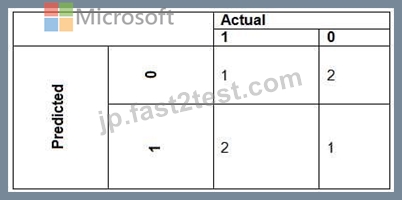
* The ad propensity model uses proposed cost factors shown in the following diagram:
* Performance curves of current and proposed cost factor scenarios are shown in the following diagram:
質問 50
You need to define a process for penalty event detection.
Which three actions should you perform in sequence? To answer, move the appropriate actions from the list of actions to the answer area and arrange them in the correct order.
正解:
解説:
質問 51
You need to visually identify whether outliers exist in the Age column and quantify the outliers before the outliers are removed.
Which three Azure Machine Learning Studio modules should you use in sequence? To answer, move the appropriate modules from the list of modules to the answer area and arrange them in the correct order.
正解:
解説:
Explanation:
You can use the Clip Values module in Azure Machine Learning Studio, to identify and optionally replace data values that are above or below a specified threshold. This is useful when you want to remove outliers or replace them with a mean, a constant, or other substitute value.
References:
https://blogs.msdn.microsoft.com/azuredev/2017/05/27/data-cleansing-tools-in-azure-machine-learning/
https://docs.microsoft.com/en-us/azure/machine-learning/studio-module-reference/clip-values
質問 52
Note: This question is part of a series of questions that present the same scenario. Each question in the series contains a unique solution that might meet the stated goals. Some question sets might have more than one correct solution, while others might not have a correct solution.
After you answer a question in this section, you will NOT be able to return to it. As a result, these questions will not appear in the review screen.
You are creating a new experiment in Azure Machine Learning Studio.
One class has a much smaller number of observations than the other classes in the training set.
You need to select an appropriate data sampling strategy to compensate for the class imbalance.
Solution: You use the Scale and Reduce sampling mode.
Does the solution meet the goal?
- A. Yes
- B. No
正解: B
解説:
Instead use the Synthetic Minority Oversampling Technique (SMOTE) sampling mode.
Note: SMOTE is used to increase the number of underepresented cases in a dataset used for machine learning. SMOTE is a better way of increasing the number of rare cases than simply duplicating existing cases.
Reference:
https://docs.microsoft.com/en-us/azure/machine-learning/studio-module-reference/smote
質問 53
You plan to provision an Azure Machine Learning Basic edition workspace for a data science project.
You need to identify the tasks you will be able to perform in the workspace.
Which three tasks will you be able to perform? Each correct answer presents a complete solution.
NOTE: Each correct selection is worth one point.
D
- A. Use the designer to train a model by dragging and dropping pre-defined modules.
- B. Create an Azure Kubernetes Service (AKS) inference cluster.
- C. Create a tabular dataset that supports versioning.
- D. Create a Compute Instance and use it to run code in Jupyter notebooks.
- E. Use the Automated Machine Learning user interface to train a model.
正解: B,C,D
解説:
Reference:
https://azure.microsoft.com/en-us/pricing/details/machine-learning/
質問 54
You are creating an experiment by using Azure Machine Learning Studio.
You must divide the data into four subsets for evaluation. There is a high degree of missing values in the data. You must prepare the data for analysis.
You need to select appropriate methods for producing the experiment.
Which three modules should you run in sequence? To answer, move the appropriate actions from the list of actions to the answer area and arrange them in the correct order.
NOTE: More than one order of answer choices is correct. You will receive credit for any of the correct orders you select.
正解:
解説:
Explanation:
The Clean Missing Data module in Azure Machine Learning Studio, to remove, replace, or infer missing values.
Incorrect Answers:
Latent Direchlet Transformation: Latent Dirichlet Allocation module in Azure Machine Learning Studio, to group otherwise unclassified text into a number of categories. Latent Dirichlet Allocation (LDA) is often used in natural language processing (NLP) to find texts that are similar. Another common term is topic modeling.
Build Counting Transform: Build Counting Transform module in Azure Machine Learning Studio, to analyze training data. From this data, the module builds a count table as well as a set of count-based features that can be used in a predictive model.
Missing Value Scrubber: The Missing Values Scrubber module is deprecated.
Feature hashing: Feature hashing is used for linguistics, and works by converting unique tokens into integers.
Replace discrete values: the Replace Discrete Values module in Azure Machine Learning Studio is used to generate a probability score that can be used to represent a discrete value. This score can be useful for understanding the information value of the discrete values.
References:
https://docs.microsoft.com/en-us/azure/machine-learning/studio-module-reference/clean-missing-data
質問 55
......
DP-100問題集には更新された練習テストと266独特な問題:https://jp.fast2test.com/DP-100-premium-file.html
最新の100%試験合格率爆上がり DP-100問題集PDF:https://drive.google.com/open?id=1fVUhCzJNeHJn7YFGUc27bkesy6cZXspf