

[2023年更新]DP-100はMicrosoft Azureリアルな無料試験練習テスト
無料Microsoft Azure DP-100試験問題を提供します
Microsoft DP-100認定試験は、キャリアを促進しようとしているデータサイエンスの専門家にとって貴重な資格です。候補者は、Azureでデータサイエンスソリューションを設計および実装するために必要なスキルと知識を持ち、データサイエンスの分野で新しいキャリアの機会を開くことができることを雇用主に示しています。
質問 # 43
You use Azure Machine Learning to implement hyperparameter tuning with a Bandit early termination policy.
The policy uses a slack_factor set to 01. an evaluation interval set to 1, and an evaluation delay set to b.
You need to evaluate the outcome of the early termination policy
What should you evaluate? To answer, select the appropriate options m the answer area.
NOTE: Each correct selection is worth one point.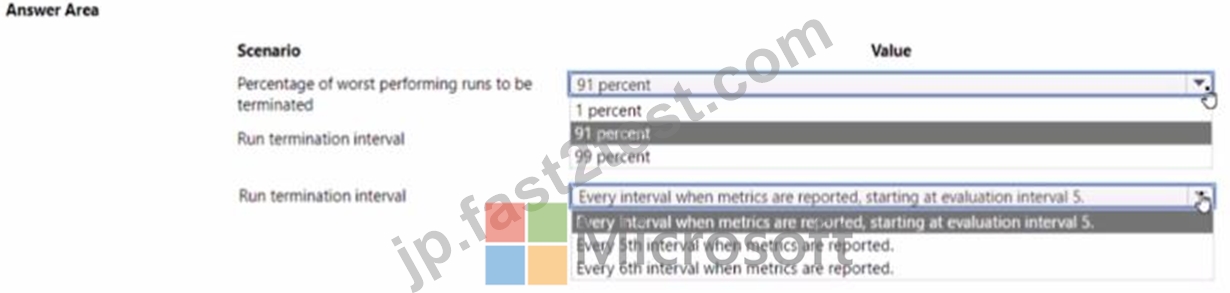
正解:
解説: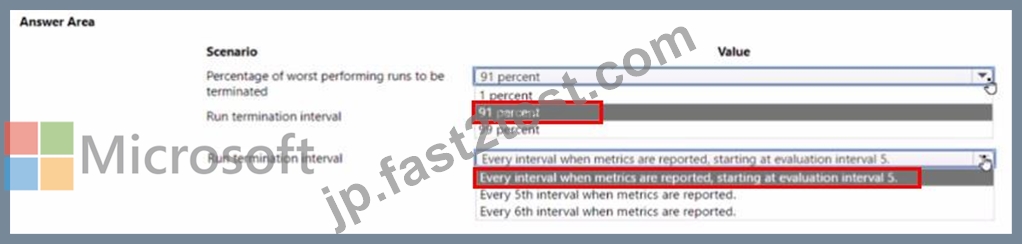
質問 # 44
Note: This question is part of a series of questions that present the same scenario. Each question in the series contains a unique solution that might meet the stated goals. Some question sets might have more than one correct solution, while others might not have a correct solution.
After you answer a question in this section, you will NOT be able to return to it. As a result, these questions will not appear in the review screen.
You create a model to forecast weather conditions based on historical data.
You need to create a pipeline that runs a processing script to load data from a datastore and pass the processed data to a machine learning model training script.
Solution: Run the following code: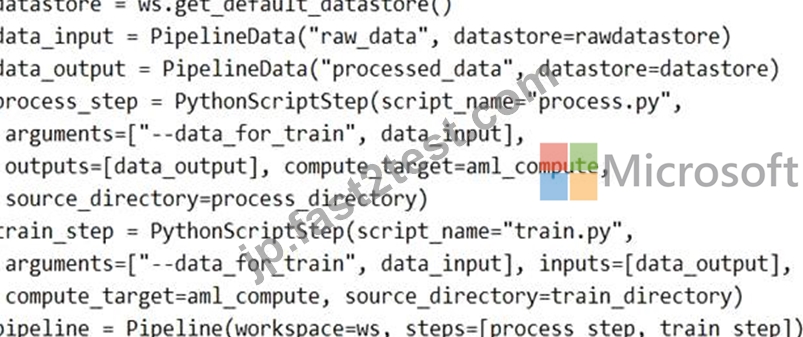
Does the solution meet the goal?
- A. No
- B. Yes
正解:A
解説:
Explanation
Note: Data used in pipeline can be produced by one step and consumed in another step by providing a PipelineData object as an output of one step and an input of one or more subsequent steps.
Compare with this example, the pipeline train step depends on the process_step_output output of the pipeline process step:
from azureml.pipeline.core import Pipeline, PipelineData
from azureml.pipeline.steps import PythonScriptStep
datastore = ws.get_default_datastore()
process_step_output = PipelineData("processed_data", datastore=datastore) process_step = PythonScriptStep(script_name="process.py", arguments=["--data_for_train", process_step_output], outputs=[process_step_output], compute_target=aml_compute, source_directory=process_directory) train_step = PythonScriptStep(script_name="train.py", arguments=["--data_for_train", process_step_output], inputs=[process_step_output], compute_target=aml_compute, source_directory=train_directory) pipeline = Pipeline(workspace=ws, steps=[process_step, train_step]) Reference:
https://docs.microsoft.com/en-us/python/api/azureml-pipeline-core/azureml.pipeline.core.pipelinedata?view=azu
質問 # 45
You need to select a feature extraction method.
Which method should you use?
- A. Spearman correlation
- B. Pearson's correlation
- C. Mutual information
- D. Mann-Whitney test
正解:A
解説:
Spearman's rank correlation coefficient assesses how well the relationship between two variables can be described using a monotonic function.
Note: Both Spearman's and Kendall's can be formulated as special cases of a more general correlation coefficient, and they are both appropriate in this scenario.
Scenario: The MedianValue and AvgRoomsInHouse columns both hold data in numeric format. You need to select a feature selection algorithm to analyze the relationship between the two columns in more detail.
References:
質問 # 46
You configure a Deep Learning Virtual Machine for Windows.
You need to recommend tools and frameworks to perform the following:
Build deep rwur.il network (DNN) models.
Perform interactive data exploration and visualization.
Which tools and frameworks should you recommend? To answer, drag the appropriate tools to the correct tasks. Each tool may be used once, more than once, or not at all. You may need to drag the split bar between panes or scroll to view content.
NOTE: Each correct selection is worth one point.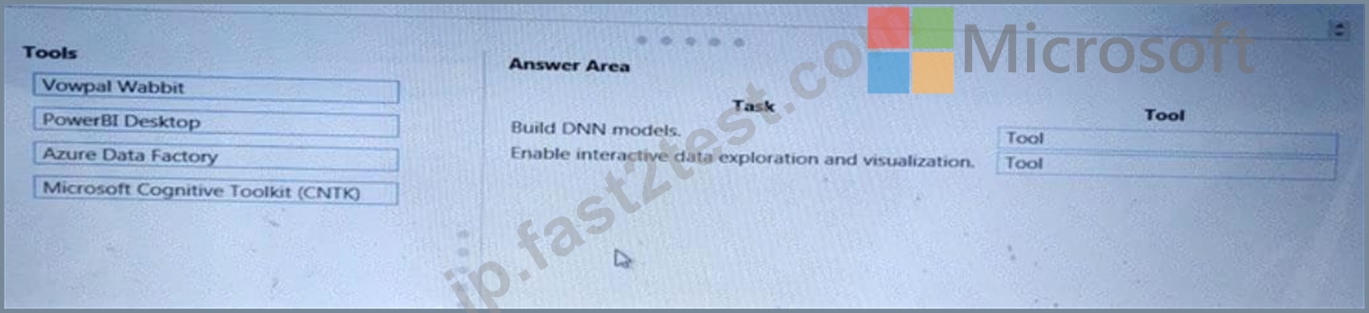
正解:
解説:
質問 # 47
You need to define an evaluation strategy for the crowd sentiment models.
Which three actions should you perform in sequence? To answer, move the appropriate actions from the list of actions to the answer area and arrange them in the correct order.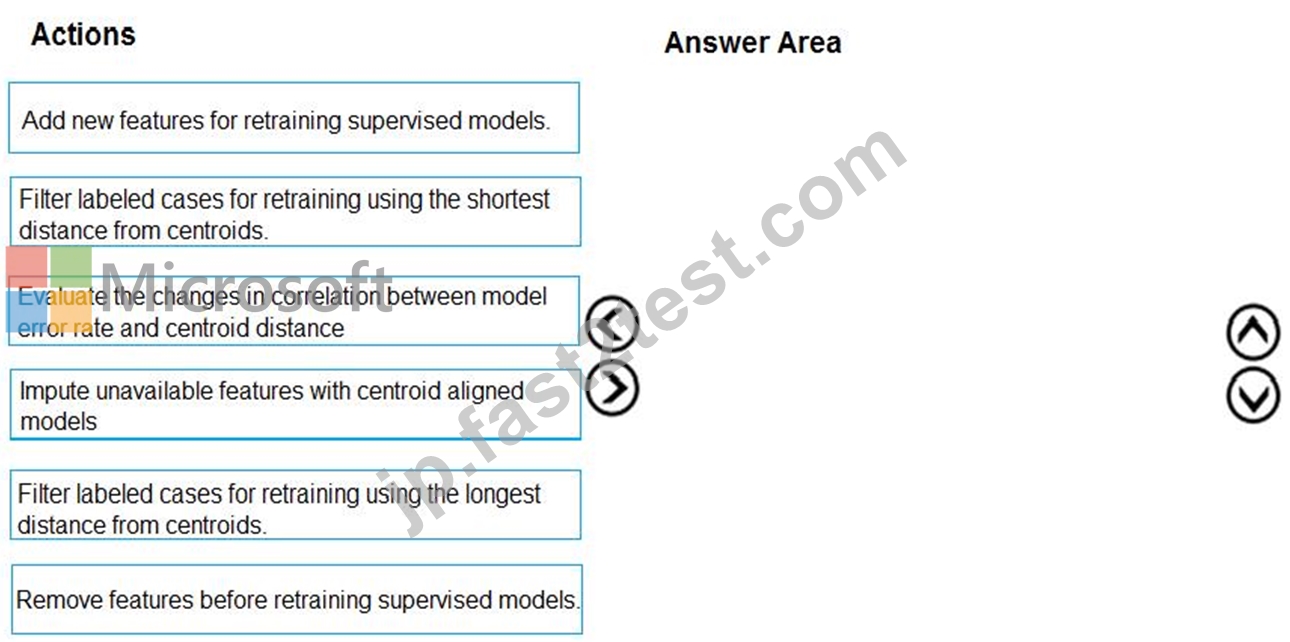
正解:
解説: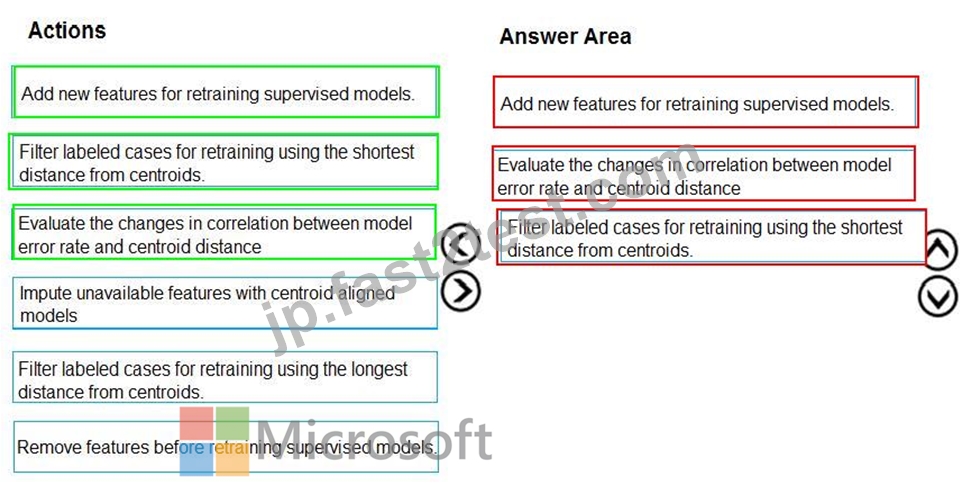
Explanation:
Scenario:
Experiments for local crowd sentiment models must combine local penalty detection data.
Crowd sentiment models must identify known sounds such as cheers and known catch phrases. Individual crowd sentiment models will detect similar sounds.
Note: Evaluate the changed in correlation between model error rate and centroid distance In machine learning, a nearest centroid classifier or nearest prototype classifier is a classification model that assigns to observations the label of the class of training samples whose mean (centroid) is closest to the observation.
References:
https://en.wikipedia.org/wiki/Nearest_centroid_classifier
https://docs.microsoft.com/en-us/azure/machine-learning/studio-module-reference/sweep-clustering
Topic 2, Two Case study
Overview
You are a data scientist for Fabrikam Residences, a company specializing in quality private and commercial property in the United States. Fabrikam Residences is considering expanding into Europe and has asked you to investigate prices for private residences in major European cities. You use Azure Machine Learning Studio to measure the median value of properties. You produce a regression model to predict property prices by using the Linear Regression and Bayesian Linear Regression modules.
Datasets
There are two datasets in CSV format that contain property details for two cities, London and Paris, with the following columns:
The two datasets have been added to Azure Machine Learning Studio as separate datasets and included as the starting point of the experiment.
Dataset issues
The AccessibilityToHighway column in both datasets contains missing values. The missing data must be replaced with new data so that it is modeled conditionally using the other variables in the data before filling in the missing values.
Columns in each dataset contain missing and null values. The dataset also contains many outliers. The Age column has a high proportion of outliers. You need to remove the rows that have outliers in the Age column. The MedianValue and AvgRoomsinHouse columns both hold data in numeric format. You need to select a feature selection algorithm to analyze the relationship between the two columns in more detail.
Model fit
The model shows signs of overfitting. You need to produce a more refined regression model that reduces the overfitting.
Experiment Requirements
You must set up the experiment to cross-validate the Linear Regression and Bayesian Linear Regression modules to evaluate performance.
In each case, the predictor of the dataset is the column named MedianValue. An initial investigation showed that the datasets are identical in structure apart from the MedianValue column. The smaller Paris dataset contains the MedianValue in text format, whereas the larger London dataset contains the MedianValue in numerical format. You must ensure that the datatype of the MedianValue column of the Paris dataset matches the structure of the London dataset.
You must prioritize the columns of data for predicting the outcome. You must use non-parameters statistics to measure the relationships.
You must use a feature selection algorithm to analyze the relationship between the MedianValue and AvgRoomsinHouse columns.
Model training
Given a trained model and a test dataset, you need to compute the permutation feature importance scores of feature variables. You need to set up the Permutation Feature Importance module to select the correct metric to investigate the model's accuracy and replicate the findings.
You want to configure hyperparameters in the model learning process to speed the learning phase by using hyperparameters. In addition, this configuration should cancel the lowest performing runs at each evaluation interval, thereby directing effort and resources towards models that are more likely to be successful.
You are concerned that the model might not efficiently use compute resources in hyperparameter tuning. You also are concerned that the model might prevent an increase in the overall tuning time. Therefore, you need to implement an early stopping criterion on models that provides savings without terminating promising jobs.
Testing
You must produce multiple partitions of a dataset based on sampling using the Partition and Sample module in Azure Machine Learning Studio. You must create three equal partitions for cross-validation. You must also configure the cross-validation process so that the rows in the test and training datasets are divided evenly by properties that are near each city's main river. The data that identifies that a property is near a river is held in the column named NextToRiver. You want to complete this task before the data goes through the sampling process.
When you train a Linear Regression module using a property dataset that shows data for property prices for a large city, you need to determine the best features to use in a model. You can choose standard metrics provided to measure performance before and after the feature importance process completes. You must ensure that the distribution of the features across multiple training models is consistent.
Data visualization
You need to provide the test results to the Fabrikam Residences team. You create data visualizations to aid in presenting the results.
You must produce a Receiver Operating Characteristic (ROC) curve to conduct a diagnostic test evaluation of the model. You need to select appropriate methods for producing the ROC curve in Azure Machine Learning Studio to compare the Two-Class Decision Forest and the Two-Class Decision Jungle modules with one another.
質問 # 48
You need to define an evaluation strategy for the crowd sentiment models.
Which three actions should you perform in sequence? To answer, move the appropriate actions from the list of actions to the answer area and arrange them in the correct order.
正解:
解説:
1 - Add new features for retraining supervised models.
2 - Evaluate the changes in correlation between model error rate and centroid distance
3 - Filter labeled cases for retraining using the shortest distance from centroids.
Reference:
https://en.wikipedia.org/wiki/Nearest_centroid_classifier
https://docs.microsoft.com/en-us/azure/machine-learning/studio-module-reference/sweep-clustering
質問 # 49
You create a binary classification model using Azure Machine Learning Studio.
You must use a Receiver Operating Characteristic (RO C) curve and an F1 score to evaluate the model.
You need to create the required business metrics.
How should you complete the experiment? To answer, select the appropriate options in the dialog box in the answer area.
NOTE: Each correct selection is worth one point.

正解:
解説: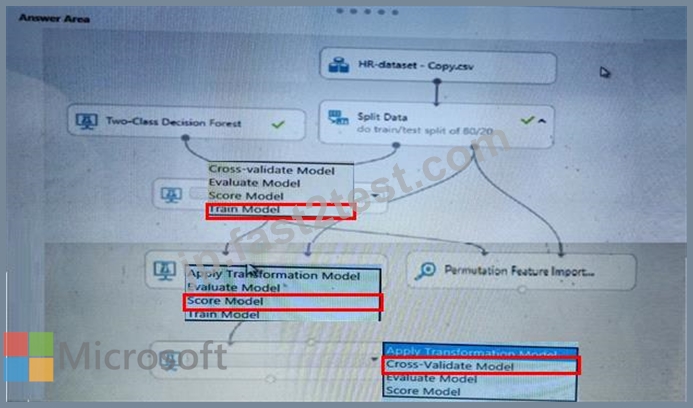
質問 # 50
You are using a decision tree algorithm. You have trained a model that generalizes well at a tree depth equal to
10.
You need to select the bias and variance properties of the model with varying tree depth values.
Which properties should you select for each tree depth? To answer, select the appropriate options in the answer area.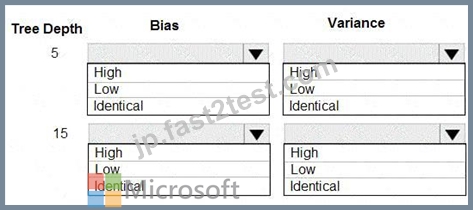
正解:
解説: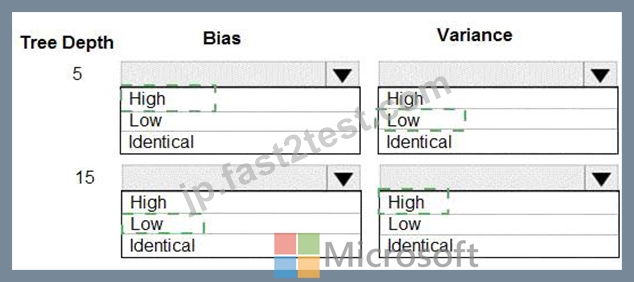
Explanation
In decision trees, the depth of the tree determines the variance. A complicated decision tree (e.g. deep) has low bias and high variance.
Note: In statistics and machine learning, the bias-variance tradeoff is the property of a set of predictive models whereby models with a lower bias in parameter estimation have a higher variance of the parameter estimates across samples, and vice versa. Increasing the bias will decrease the variance. Increasing the variance will decrease the bias.
References:
https://machinelearningmastery.com/gentle-introduction-to-the-bias-variance-trade-off-in-machine-learning/
質問 # 51
You manage an Azure Machine Learning workspace named workspace1 by using the Python SDK v2.
You must register datastores in workspace1 for Azure Blob and Azure Data Lake Gen2 storage to meet the following requirements:
* Data scientists accessing the datastore must have the same level of access.
* Access must be restricted to specified containers or folders.
You need to configure a security access method used to register the Azure Blob and Azure Data lake Gen? storage in workspace1. Which security access method should you configure? To answer, select the appropriate options in the answers area.
NOTE: Each correct selection is worth one point.
正解:
解説:
質問 # 52
You register a model that you plan to use in a batch inference pipeline.
The batch inference pipeline must use a ParallelRunStep step to process files in a file dataset. The script has the ParallelRunStep step runs must process six input files each time the inferencing function is called.
You need to configure the pipeline.
Which configuration setting should you specify in the ParallelRunConfig object for the PrallelRunStep step?
- A. error_threshold= "6"
- B. mini_batch_size= "6"
- C. node_count= "6"
- D. process_count_per_node= "6"
正解:C
解説:
node_count is the number of nodes in the compute target used for running the ParallelRunStep.
Reference:
https://docs.microsoft.com/en-us/python/api/azureml-contrib-pipeline-steps/azureml.contrib.pipeline.steps.parallelrunconfig?view=azure-ml-py
質問 # 53
You need to replace the missing data in the AccessibilityToHighway columns.
How should you configure the Clean Missing Data module? To answer, select the appropriate options in the answer area.
NOTE: Each correct selection is worth one point.
正解:
解説:
Reference:
https://docs.microsoft.com/en-us/azure/machine-learning/studio-module-reference/clean-missing-data
質問 # 54
You are developing a deep learning model by using TensorFlow. You plan to run the model training workload on an Azure Machine Learning Compute Instance.
You must use CUDA-based model training.
You need to provision the Compute Instance.
Which two virtual machines sizes can you use? To answer, select the appropriate virtual machine sizes in the answer area.
NOTE: Each correct selection is worth one point.
正解:
解説:
Reference:
https://www.infoworld.com/article/3299703/what-is-cuda-parallel-programming-for-gpus.html
質問 # 55
You have a dataset that contains 2,000 rows. You are building a machine learning classification model by using Azure Learning Studio. You add a Partition and Sample module to the experiment.
You need to configure the module. You must meet the following requirements:
Divide the data into subsets
Assign the rows into folds using a round-robin method
Allow rows in the dataset to be reused
How should you configure the module? To answer, select the appropriate options in the dialog box in the answer area.
NOTE: Each correct selection is worth one point.
正解:
解説: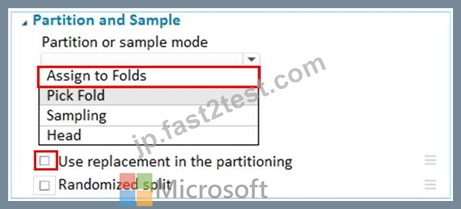
Explanation:
Use the Split data into partitions option when you want to divide the dataset into subsets of the data. This option is also useful when you want to create a custom number of folds for cross-validation, or to split rows into several groups.
Add the Partition and Sample module to your experiment in Studio (classic), and connect the dataset.
For Partition or sample mode, select Assign to Folds.
Use replacement in the partitioning: Select this option if you want the sampled row to be put back into the pool of rows for potential reuse. As a result, the same row might be assigned to several folds.
If you do not use replacement (the default option), the sampled row is not put back into the pool of rows for potential reuse. As a result, each row can be assigned to only one fold.
Randomized split: Select this option if you want rows to be randomly assigned to folds.
If you do not select this option, rows are assigned to folds using the round-robin method.
References:
https://docs.microsoft.com/en-us/azure/machine-learning/studio-module-reference/partition-and-sample
質問 # 56
You are a data scientist building a deep convolutional neural network (CNN) for image classification.
The CNN model you built shows signs of overfitting.
You need to reduce overfitting and converge the model to an optimal fit.
Which two actions should you perform? Each correct answer presents a complete solution.
NOTE: Each correct selection is worth one point.
- A. Add an additional dense layer with 512 input units.
- B. Reduce the amount of training data.
- C. Use training data augmentation
- D. Add L1/L2 regularization.
- E. Add an additional dense layer with 64 input units
正解:B、D
解説:
References:
https://machinelearningmastery.com/how-to-reduce-overfitting-in-deep-learning-with-weight-regularization/
https://en.wikipedia.org/wiki/Convolutional_neural_network
質問 # 57
You need to identify the methods for dividing the data according, to the testing requirements.
Which properties should you select? To answer, select the appropriate option-, m the answer are a. NOTE: Each correct selection is worth one point.
正解:
解説:
質問 # 58
You are analyzing a raw dataset that requires cleaning.
You must perform transformations and manipulations by using Azure Machine Learning Studio.
You need to identify the correct modules to perform the transformations.
Which modules should you choose? To answer, drag the appropriate modules to the correct scenarios. Each module may be used once, more than once, or not at all.
You may need to drag the split bar between panes or scroll to view content.
NOTE: Each correct selection is worth one point.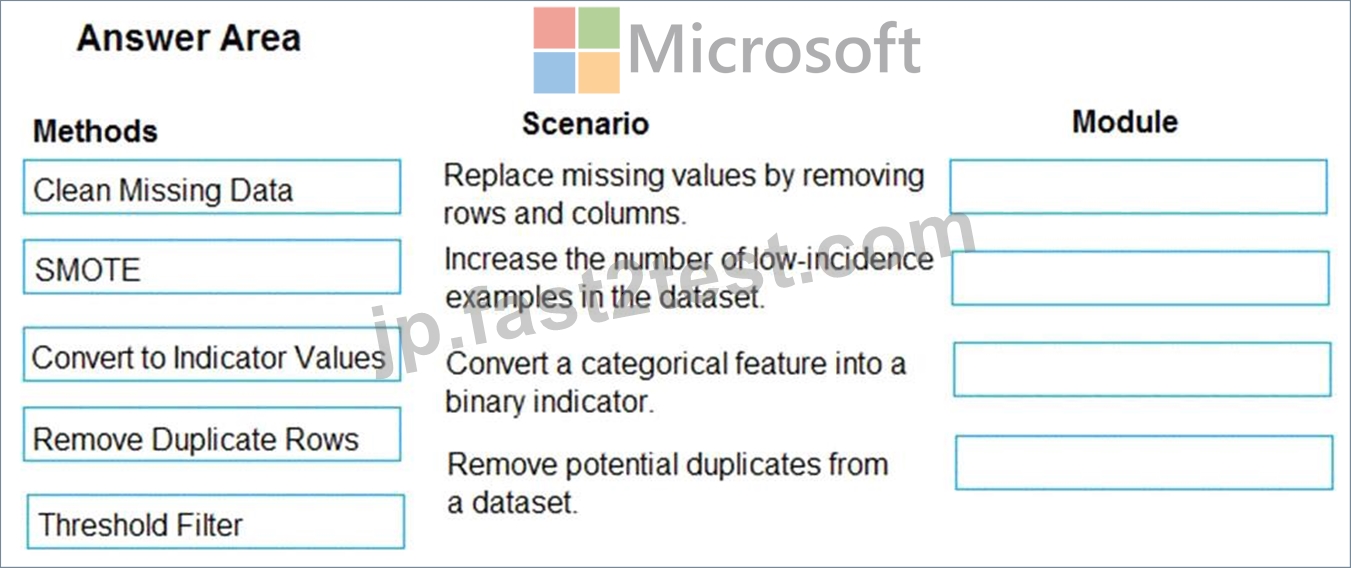
正解:
解説:
Explanation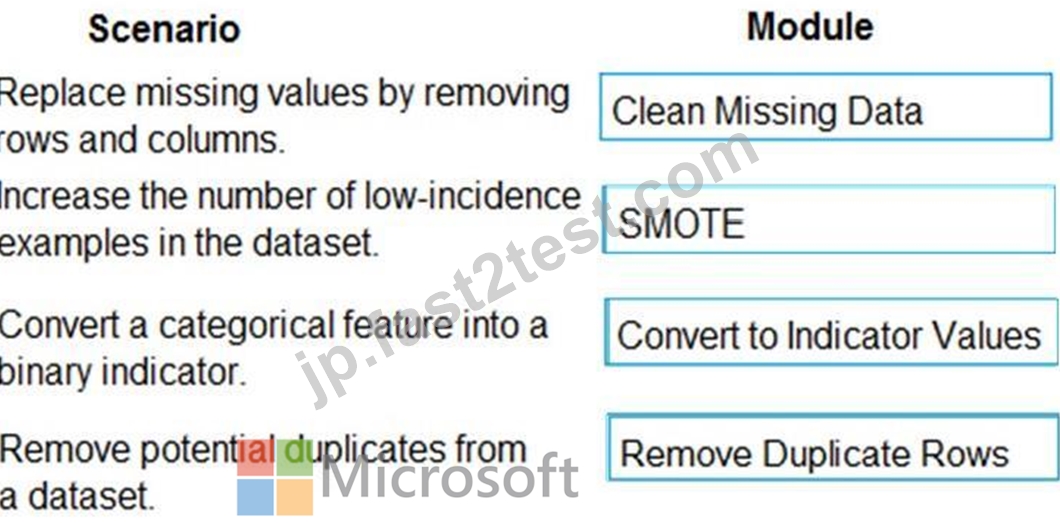
Box 1: Clean Missing Data
Box 2: SMOTE
Use the SMOTE module in Azure Machine Learning Studio to increase the number of underepresented cases in a dataset used for machine learning. SMOTE is a better way of increasing the number of rare cases than simply duplicating existing cases.
Box 3: Convert to Indicator Values
Use the Convert to Indicator Values module in Azure Machine Learning Studio. The purpose of this module is to convert columns that contain categorical values into a series of binary indicator columns that can more easily be used as features in a machine learning model.
Box 4: Remove Duplicate Rows
References:
https://docs.microsoft.com/en-us/azure/machine-learning/studio-module-reference/smote
https://docs.microsoft.com/en-us/azure/machine-learning/studio-module-reference/convert-to-indicator-values
質問 # 59
You train and register a model by using the Azure Machine Learning SDK on a local workstation. Python 3.6 and Visual Studio Code are installed on the workstation.
When you try to deploy the model into production as an Azure Kubernetes Service (AKS)-based web service, you experience an error in the scoring script that causes deployment to fail.
You need to debug the service on the local workstation before deploying the service to production.
Which four actions should you perform in sequence? To answer, move the appropriate actions from the list of actions to the answer area and arrange them in the correct order.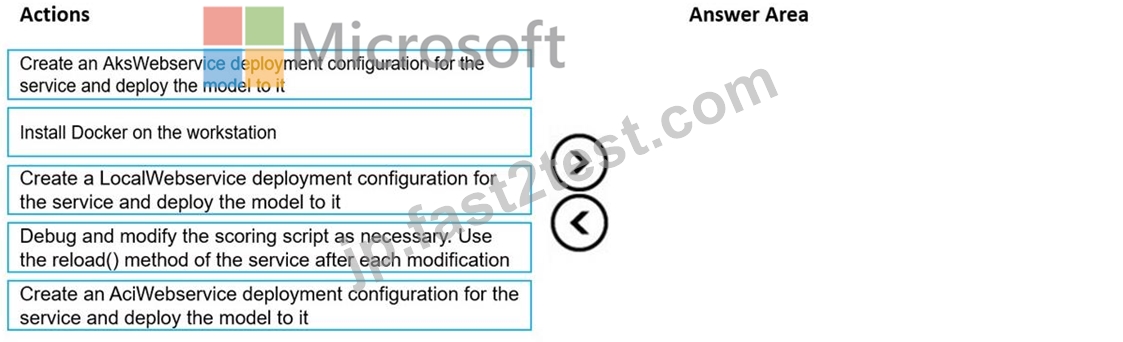
正解:
解説: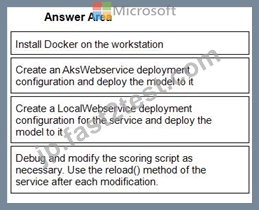
1 - Install Docker on the workstation
2 - Create an AksWebservice deployment configuration and deploy the model to it
3 - Create a LocalWebservice deployment configuration for the service and deploy the model to it
4 - Debug and modify the scoring script as necessary. Use the reload() method of the service after each modification.
Reference:
https://docs.microsoft.com/en-us/azure/machine-learning/how-to-deploy-azure-kubernetes-service
https://docs.microsoft.com/en-us/azure/machine-learning/how-to-troubleshoot-deployment-local
質問 # 60
You need to identify the methods for dividing the data according, to the testing requirements.
Which properties should you select? To answer, select the appropriate option-, m the answer area. NOTE: Each correct selection is worth one point.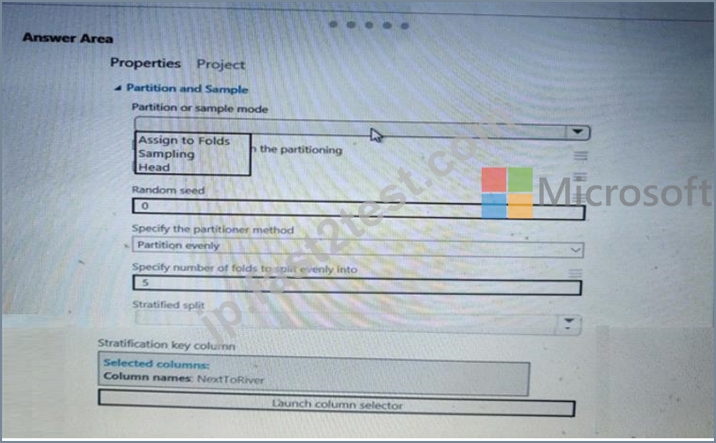
正解:
解説:
質問 # 61
You plan to run a Python script as an Azure Machine Learning experiment.
The script must read files from a hierarchy of folders. The files will be passed to the script as a dataset argument.
You must specify an appropriate mode for the dataset argument.
Which two modes can you use? Each correct answer presents a complete solution.
NOTE: Each correct selection is worth one point.
- A. as_upload()
- B. as mount ()
- C. to_pandas_dataframe ()
- D. as_download()
正解:D
解説:
Reference:
https://docs.microsoft.com/en-us/python/api/azureml-core/azureml.data.filedataset?view=azure-ml-py
質問 # 62
You create a binary classification model. The model is registered in an Azure Machine Learning workspace. You use the Azure Machine Learning Fairness SDK to assess the model fairness.
You develop a training script for the model on a local machine.
You need to load the model fairness metrics into Azure Machine Learning studio.
What should you do?
- A. Implement the upload_dashboard_dictionary function
- B. Implement the creace_group_metric_sec function
- C. Upload the training script
- D. Implement the download_dashboard_by_upload_id function
正解:A
解説:
import azureml.contrib.fairness package to perform the upload:
from azureml.contrib.fairness import upload_dashboard_dictionary, download_dashboard_by_upload_id Reference:
https://docs.microsoft.com/en-us/azure/machine-learning/how-to-machine-learning-fairness-aml
質問 # 63
You are using the Azure Machine Learning Service to automate hyperparameter exploration of your neural network classification model.
You must define the hyperparameter space to automatically tune hyperparameters using random sampling according to following requirements:
* The learning rate must be selected from a normal distribution with a mean value of 10 and a standard deviation of 3.
* Batch size must be 16, 32 and 64.
* Keep probability must be a value selected from a uniform distribution between the range of 0.05 and 0.1.
You need to use the param_sampling method of the Python API for the Azure Machine Learning Service.
How should you complete the code segment? To answer, select the appropriate options in the answer area.
NOTE: Each correct selection is worth one point.
正解:
解説:
Explanation:
In random sampling, hyperparameter values are randomly selected from the defined search space. Random sampling allows the search space to include both discrete and continuous hyperparameters.
Example:
from azureml.train.hyperdrive import RandomParameterSampling
param_sampling = RandomParameterSampling( {
"learning_rate": normal(10, 3),
"keep_probability": uniform(0.05, 0.1),
"batch_size": choice(16, 32, 64)
}
Reference:
https://docs.microsoft.com/en-us/azure/machine-learning/service/how-to-tune-hyperparameters
質問 # 64
You tram and register a model by using the Azure Machine Learning Python SDK v2 in a local workstation.
Python 3.7 and Visual Studio Code are instated on the workstation.
When you try to deploy the model into production to a Kubernetes online endpoint you experience an error in the scoring script that causes deployment to fail.
You need to debug the service on the local workstation before deploying the service to production.
Which three actions should you perform m sequence? To answer, move the appropriate actions from the list of actions from the answer area and arrange them in the correct order.
正解:
解説:
Explanation
質問 # 65
You need to set up the Permutation Feature Importance module according to the model training requirements.
Which properties should you select? To answer, select the appropriate options in the answer area.
NOTE: Each correct selection is worth one point.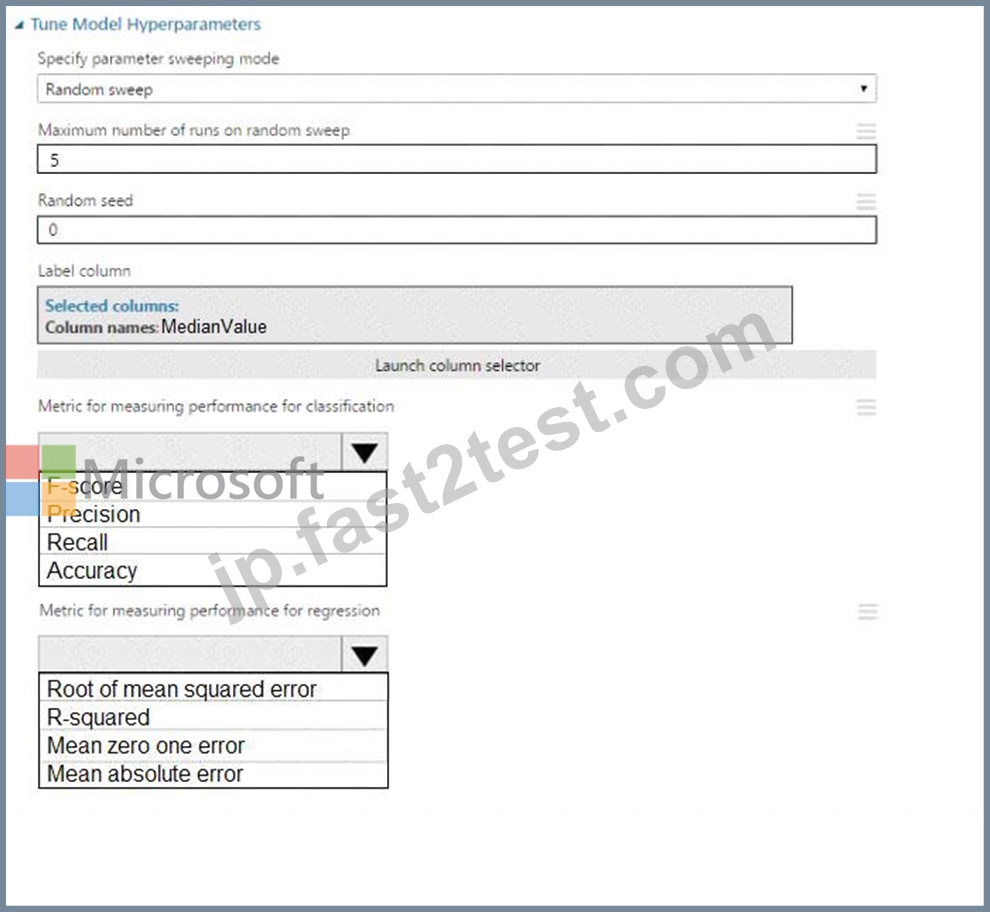
正解:
解説:
Explanation
Box 1: Accuracy
Scenario: You want to configure hyperparameters in the model learning process to speed the learning phase by using hyperparameters. In addition, this configuration should cancel the lowest performing runs at each evaluation interval, thereby directing effort and resources towards models that are more likely to be successful.
Box 2: R-Squared
質問 # 66
You need to configure the Permutation Feature Importance module for the model training requirements.
What should you do? To answer, select the appropriate options in the dialog box in the answer area.
NOTE: Each correct selection is worth one point.
正解:
解説: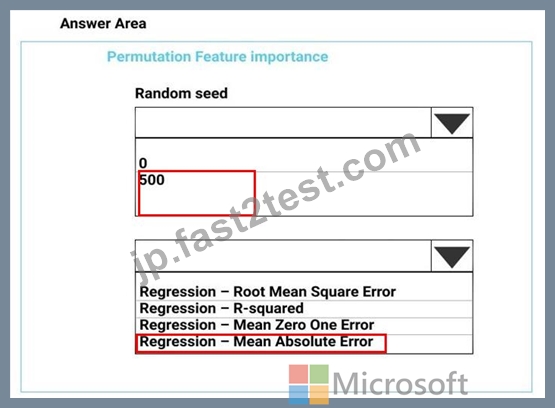
Reference:
https://docs.microsoft.com/en-us/azure/machine-learning/studio-module-reference/permutation-feature-importance
質問 # 67
You need to define an evaluation strategy for the crowd sentiment models.
Which three actions should you perform in sequence? To answer, move the appropriate actions from the list of actions to the answer area and arrange them in the correct order.
正解:
解説:
1 - Define a cross-entropy function activation
2 - Add cost functions for each target state.
3 - Evaluated the distance error metric.
Reference:
https://www.analyticsvidhya.com/blog/2018/04/fundamentals-deep-learning-regularization-techniques/
Topic 2, Overview
Datasets
There are two datasets in CSV format that contain property details for two cities, London and Paris, with the following columns:
The two datasets have been added to Azure Machine Learning Studio as separate datasets and included as the starting point of the experiment.
Dataset issues
The AccessibilityToHighway column in both datasets contains missing values. The missing data must be replaced with new data so that it is modeled conditionally using the other variables in the data before filling in the missing values.
Columns in each dataset contain missing and null values. The dataset also contains many outliers. The Age column has a high proportion of outliers. You need to remove the rows that have outliers in the Age column. The MedianValue and AvgRoomsinHouse columns both hold data in numeric format. You need to select a feature selection algorithm to analyze the relationship between the two columns in more detail.
Model fit
The model shows signs of overfitting. You need to produce a more refined regression model that reduces the overfitting.
Experiment Requirements
You must set up the experiment to cross-validate the Linear Regression and Bayesian Linear Regression modules to evaluate performance.
In each case, the predictor of the dataset is the column named MedianValue. An initial investigation showed that the datasets are identical in structure apart from the MedianValue column. The smaller Paris dataset contains the MedianValue in text format, whereas the larger London dataset contains the MedianValue in numerical format. You must ensure that the datatype of the MedianValue column of the Paris dataset matches the structure of the London dataset.
You must prioritize the columns of data for predicting the outcome. You must use non-parameters statistics to measure the relationships.
You must use a feature selection algorithm to analyze the relationship between the MedianValue and AvgRoomsinHouse columns.
Model training
Given a trained model and a test dataset, you need to compute the permutation feature importance scores of feature variables. You need to set up the Permutation Feature Importance module to select the correct metric to investigate the model's accuracy and replicate the findings.
You want to configure hyperparameters in the model learning process to speed the learning phase by using hyperparameters. In addition, this configuration should cancel the lowest performing runs at each evaluation interval, thereby directing effort and resources towards models that are more likely to be successful.
You are concerned that the model might not efficiently use compute resources in hyperparameter tuning. You also are concerned that the model might prevent an increase in the overall tuning time. Therefore, you need to implement an early stopping criterion on models that provides savings without terminating promising jobs.
Testing
You must produce multiple partitions of a dataset based on sampling using the Partition and Sample module in Azure Machine Learning Studio. You must create three equal partitions for cross-validation. You must also configure the cross-validation process so that the rows in the test and training datasets are divided evenly by properties that are near each city's main river. The data that identifies that a property is near a river is held in the column named NextToRiver. You want to complete this task before the data goes through the sampling process.
When you train a Linear Regression module using a property dataset that shows data for property prices for a large city, you need to determine the best features to use in a model. You can choose standard metrics provided to measure performance before and after the feature importance process completes. You must ensure that the distribution of the features across multiple training models is consistent.
Data visualization
You need to provide the test results to the Fabrikam Residences team. You create data visualizations to aid in presenting the results.
You must produce a Receiver Operating Characteristic (ROC) curve to conduct a diagnostic test evaluation of the model. You need to select appropriate methods for producing the ROC curve in Azure Machine Learning Studio to compare the Two-Class Decision Forest and the Two-Class Decision Jungle modules with one another.
質問 # 68
......
この試験は、Azure上でデータサイエンスソリューションを設計および実装する能力を評価する、多肢選択式の問題およびパフォーマンスベースのタスクで構成されています。候補者は3時間で試験を完了し、合格スコア700以上を達成する必要があります。
Microsoft DP-100リアルな問題と知能問題集:https://jp.fast2test.com/DP-100-premium-file.html
DP-100問題集でMicrosoft Azure高確率練習問題集:https://drive.google.com/open?id=1IvuNAA0GqlvbyFDHt01oMfoxwryjfJt7