

2025年最新の実際のFast2test AD0-E716問題集PDFで100%合格率を保証します
無料Adobe AD0-E716試験問題と解答
質問 # 37
An Adobe Commerce developer has created a new shipping carrier Everything has been implemented and the collectRates() and getAllowedMethodsQ functions can be seen below: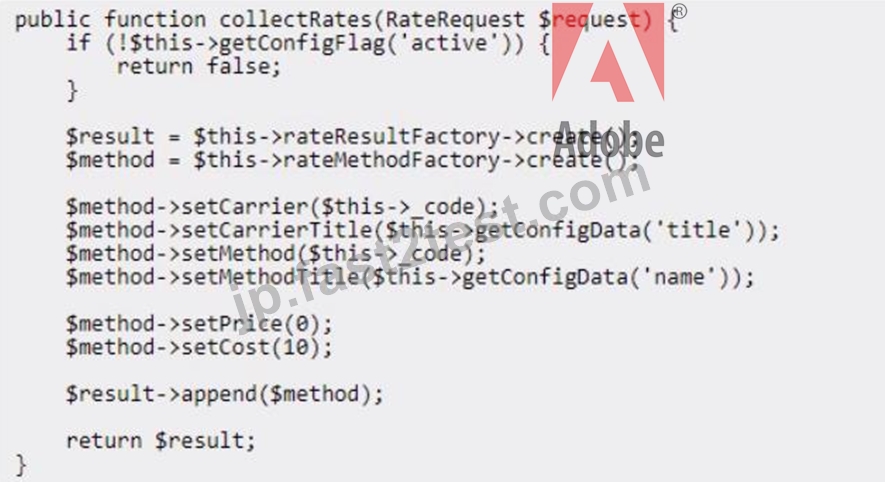

Given the above code, what would be the displayed cost of the shipping method and final amount charged to the customer?
- A. The shipping method would display $0 and customers would pay $0 for using the new shipping method.
- B. The shipping method would display $10 and customers would pay $10 for using the new shipping method.
- C. The shipping method would display SO but customers would pay a $10 handling fee for their order.
正解:C
解説:
In this custom shipping carrier implementation, the collectRates() function sets the displayed price for the shipping method to $0 using $method->setPrice(0);. However, the cost of the shipping method is set to $10 using $method->setCost(10);.
* Displayed Price vs. Handling Fee:
* The setPrice() method controls what is displayed as the shipping cost to the customer during checkout, which in this case is set to $0.
* The setCost() method controls the internal cost of the shipping method. This may include handling fees or other adjustments but is not directly visible to the customer.
* Why Option A is Correct:
* Customers will see a $0 price for this shipping method in the checkout. However, a $10 cost is set internally and could be added to the final amount as a handling fee or cost adjustment.
* Option B is incorrect because it does not consider the setCost() method. Option C is incorrect because it misinterprets the $10 value as directly displayed to the customer.
* References:
* Magento DevDocs on Shipping Methods
* Adobe Commerce documentation on Creating Custom Shipping Methods
質問 # 38
What are two ways to access the PHP error logs on Adobe Commerce Cloud? (Choose Two.)
- A. Navigate to the dedicated entry in the Project Web Interface.
- B. Connect to the the servers via SSH and localize the log files.
- C. Use the dedicated command from Cloud CLI for Commerce.
- D. Use the Adobe Admin Log application.
正解:B、C
解説:
Two ways to access the PHP error logs on Adobe Commerce Cloud are to use the dedicated command from Cloud CLI for Commerce and to connect to the servers via SSH and localize the log files. The Cloud CLI for Commerce is a command-line tool that allows developers to interact with their Adobe Commerce Cloud projects and environments. The developer can use the command magento-cloud log php to view or download the PHP error logs from any environment.
In Adobe Commerce Cloud, accessing PHP error logs can be done through the Cloud CLI or by directly connecting to the server via SSH.
* Cloud CLI for Accessing Logs:
* The Cloud CLI provides commands to access various logs, including PHP error logs, which can be accessed easily without directly connecting to the server.
* SSH for Direct Log Access:
* For more hands-on control or specific log inspection, SSH allows you to connect to the server and directly access log files located typically in the /var/log directory on Adobe Commerce Cloud environments.
* Why Options A and C are Correct:
* These two methods provide direct and official ways to access error logs on Adobe Commerce Cloud.
* Option B is incorrect as the Project Web Interface does not have a dedicated PHP error log entry.
Option D is incorrect as there is no Adobe Admin Log application.
* References:
* Adobe Commerce Cloud documentation on Accessing Logs
質問 # 39
An Adobe Commerce developer has created a before plugin for the save() function within the Magento\Framework\App\cache\Proxy class. The purpose of this plugin is to add a prefix on all cache identifiers that fulfill certain criteria.
Why is the plugin not executing as expected?
- A. Another around plugin defined for the same function does not call the callable.
- B. Cache identifiers are immutable and cannot be changed.
- C. The target ClaSS implements Magento\Framework\ObjectManager\NoninterceptableInterface.
正解:C
解説:
According to the Plugins (Interceptors) guide for Magento 2 developers, plugins are class methods that modify the behavior of public class methods by intercepting them and running code before, after, or around them.
However, some classes in Magento 2 implement the NoninterceptableInterface interface, which prevents plugins from being generated for them. The Magento\Framework\App\cache\Proxy class is one of them, as it extends from Magento\Framework\ObjectManager\NoninterceptableInterface. Therefore, the plugin is not executing as expected because the target class implements NoninterceptableInterface. Verified References:
https://devdocs.magento.com/guides/v2.3/extension-dev-guide/plugins.html
質問 # 40
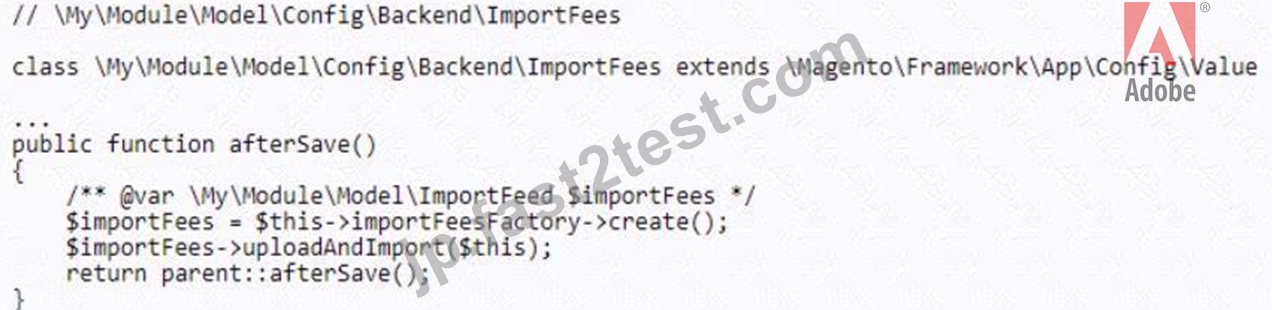
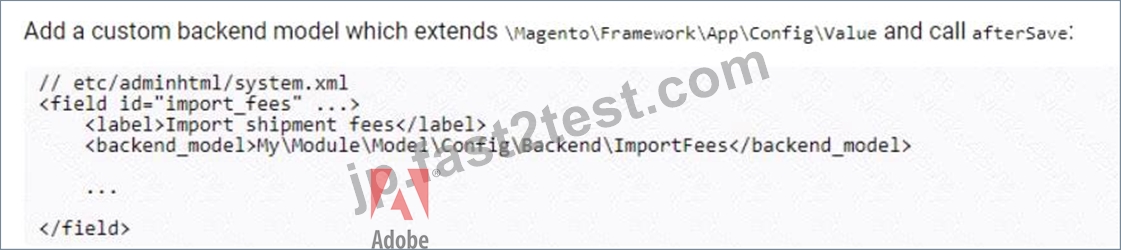
A logistics company with an Adobe Commerce extension sends a list of reviewed shipment fees to all its clients every month in a CSV file. The merchant then uploads this CSV file to a "file upload" field in admin configuration of Adobe Commerce.
What are the two requirements to display the "file upload" field and process the actual CSV import? (Choose two.)
- A.

- B.

- C.
- D.
正解:C、D
解説:
To display the "file upload" field and process the actual CSV import, the following two requirements must be met:
* The developer must create a new system configuration setting that specifies the path to the CSV file.
* The developer must create a new controller action that handles the file upload and import process.
The system.xml file is used to define system configuration settings. The following XML snippet shows how to define a new system configuration setting for the CSV file path:
XML
<config>
<system>
<config>
<shipment_fees_csv_path>/path/to/csv/file</shipment_fees_csv_path>
</config>
</system>
</config>
The Controller\Adminhtml\ShipmentFees controller class is used to handle the file upload and import process.
The following code shows how to create a new controller action that handles the file upload and import process:
PHP
public function uploadAction()
{
$file = $this->getRequest()->getFile('shipment_fees_csv_file');
if ($file->isUploaded()) {
$importer = new ShipmentFeesImporter();
$importer->import($file);
}
return $this->redirect('adminhtml/system_config/edit/section/shipment_fees');
}
質問 # 41
A developer is working on an Adobe Commerce Cloud project and wants to get connection data for the environment's deployed services. The developer has all of the necessary permissions to do this.
Which two options would the developer take to get the connection credentials? (Choose Two.)
- A. Get the data from the Project Web Interface dedicated section.
- B. Connect to server via SSH and read $_ENV['services'] variable.
- C. Execute ece-tools env:config:show services Command.
- D. Run the magento-cloud relationships CLI Command.
正解:B、D
解説:
Two options to get the connection credentials for the environment's deployed services are to run the magento-cloud relationships CLI command and to connect to the server via SSH and read $_ENV['services'] variable. The magento-cloud relationships CLI command displays information about the relationships between an environment and its services, such as database, cache, search, etc. The developer can use this command to get the connection data for each service in JSON format. Alternatively, the developer can connect to the server via SSH and read the $_ENV['services'] variable, which contains the same information as the CLI command output. Verified Reference: [Magento 2.4 DevDocs] 3
質問 # 42
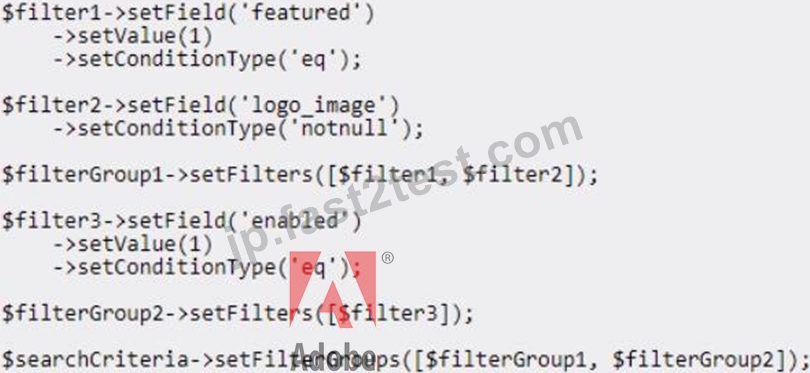
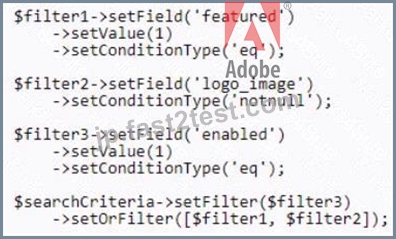
An Adobe Commerce developer is working on a module to manage custom brand entities and wants to replicate the following SQL query using SearchCriteria:
- A.
- B.
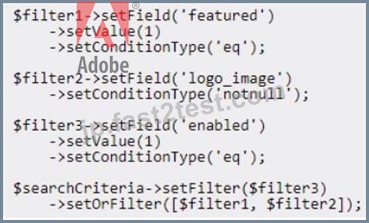
- C.

正解:B
解説:
The following SearchCriteria query will replicate the SQL query:
$searchCriteria = new \Magento\Framework\Api\SearchCriteriaBuilder();
$searchCriteria->addFilter('name', 'Brand 1', 'eq');
$searchCriteria->addFilter('status', 1, 'eq');
$brandCollection = $this->brandRepository->getList($searchCriteria);
質問 # 43
An Adobe Commerce Cloud project is using Enhanced Integration Environments with two install a new payment module.
The developer is using Cloud CLI for Commerce tool.
What would a developer do to test this new feature under the integration environment?
- A. 1. Duplicate one of the integration environment branches.
2. Create a new active branch from integration and install the module.
3. Push the changes. - B. 1. Create a new branch from integration and install the module.
2. Push the changes.
3. Branch active status check is not necessary. - C. 1. Deactivate one of the active integration environment branches.
2. Create a new active branch from integration and install the module.
3. Push the changes.
正解:C
解説:
The developer can test the new feature under the integration environment by deactivating one of the active integration environment branches, creating a new active branch from integration and installing the module, and pushing the changes. This is because Enhanced Integration Environments have a limit of four active branches at a time, and each branch has its own dedicated database and services. The developer can use the Cloud CLI for Commerce tool to manage the branches and deploy the code changes. Verified References:
[Magento 2.4 DevDocs] 1
質問 # 44
An Adobe Commerce developer has created a module that adds a product attribute to all product types via a Data Patch-According to best practices, how would the developer ensure this product attribute is removed in the event that the module is uninstalled at a later date?
- A. Add an Uninstall.php file extending \l1agento\Framework\Setup\UninstallInterface tO the module's Setup directory and implement the uninstall method.
- B. Add instructions to the module's README.md file instructing merchants and developers that they must manually remove this attribute if they want to uninstall the module.
- C. Make the Data Patch implement \Magento\Framework\setup\Patch\PatchRevertabieinterface and implement the revert method to remove the product attribute.
正解:C
解説:
According to the Develop data and schema patches guide for Magento 2 developers, data patches can also implement PatchRevertabieinterface to provide rollback functionality for their changes. The revert() method contains the instructions to undo the data modifications made by the patch. To ensure that the product attribute is removed when the module is uninstalled, the developer should make the data patch implement PatchRevertabieinterface and implement the revert method to remove the product attribute using EavSetupFactory or AttributeRepositoryInterface. Verified References: https://devdocs.magento.com/guides
/v2.3/extension-dev-guide/declarative-schema/data-patches.html
質問 # 45
The developer is required to convert a modules database scripts from old install/upgrade setup files to a data patches format and does not want to apply database changes that were already done by install/upgrade scripts.
The current module version is 1.5.4.
What would be the recommended solution to skip changes that were already applied via old format (install/upgrade scripts)?
- A. This is not possible. A module cannot implement both data patch and install scripts.
- B. Inside apply() method, check for module version and run the code if version is less than 1.5.4.
- C. Implement Patchversioninterface and return 1.5.4 on the getversion() method.
正解:C
解説:
According to the Develop data and schema patches guide for Magento 2 developers, data patches are classes that contain data modification instructions. They are defined in a <Vendor>/<Module_Name>/Setup/Patch/Data/<Patch_Name>.php file and implement MagentoFrameworkSetupPatchDataPatchInterface. Data patches can also implement Patchversioninterface to specify the module version that the patch is associated with. The getVersion() method returns the module version as a string. To skip changes that were already applied via old format (install/upgrade scripts), the developer should implement Patchversioninterface and return 1.5.4 on the getVersion() method. This way, the data patch will only be applied if the module version is greater than or equal to 1.5.4. Verified Reference: https://devdocs.magento.com/guides/v2.3/extension-dev-guide/declarative-schema/data-patches.html
質問 # 46
An Adobe Commerce developer is asked to implement a 15% surcharge for all users from a 'Wholesale' customer group. Keeping best practices in mind, what is a correct to accomplish this?
- A. Declare a new total collector class to calculate the modified total if the current user is in the group, register it in the module's etc/sales .xml file, modify the checkout_cart_index.xml and checkout_index_index.xml layouts to include a new child in the totals block.
- B. Create a Cart Price Rule that applies only to the 'Wholesale' group. Specify no conditions for the rule, and in the Actions section, specify for the rule to apply a "Percent of product price discount", with the 'Discount Amount" field set to -15.
- C. Create an Observer to the cataiog_product_get_final_price event. Check if the current customer is in the 'Wholesale' group, and if so, retrieve the
正解:C
解説:
product from the $observer->getEventC) data and Call $product->setData('final_price', $product->getData( 'final_price') * 1.15).
Explanation:
The possible reason why the payment method is missing in the admin is that in the module config.xml, the node can_use_internal was not set to true. This node determines whether the payment method can be used in the admin area or not. If it is set to false or omitted, the payment method will not be available for admin orders. To enable the payment method for admin use only, the node can_use_internal should be set to true and the node can_use_checkout should be set to false. Verified Reference: [Magento 2.4 DevDocs] [Magento Stack Exchange]
質問 # 47
The di. xml file of a module attaches two plugins for the class Action.
The around plugin code is:
What would be the plugin execution order?
- A.
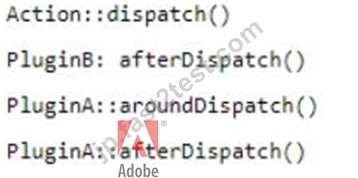
- B.

- C.
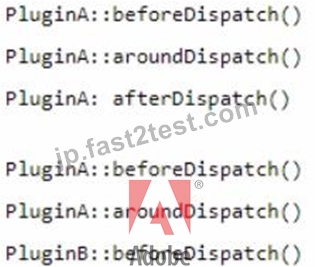
正解:A
解説:
The plugin execution order is as follows:
PluginA::beforeDispatch()
PluginB::beforeDispatch()
PluginA::aroundDispatch()
The code in the around plugin
PluginB::afterDispatch()
PluginA::afterDispatch()
The aroundDispatch() method is executed in a separate scope, so the code in the around plugin will be executed after the beforeDispatch() methods of both plugins, but before the afterDispatch() methods of both plugins.
Here is a diagram that shows the plugin execution order:
PluginA
beforeDispatch()
aroundDispatch()
afterDispatch()
PluginB
beforeDispatch()
afterDispatch()
質問 # 48
An Adobe Commerce developer is about to deploy a critical feature to their Adobe Commerce Cloud (Pro Plan) production. They want to create a snapshot in order to be able to rollback if there is an issue with the feature.
How would they create the snapshot?
- A. Use the Cloud CLI for Commerce dedicated command.
- B. Use the dedicated button on Project Web Interface.
- C. Create a ticket to Adobe Commerce Cloud support.
正解:B
解説:
The developer can create a snapshot before deploying a critical feature to their Adobe Commerce Cloud (Pro Plan) production by using the dedicated button on Project Web Interface. A snapshot is a backup of an entire environment, including code, data, media files, and configuration settings. A snapshot can be used to restore an environment to a previous state in case of any issues or errors during deployment or testing. The developer can create a snapshot by accessing the Project Web Interface, choosing an environment, and clicking Create Snapshot. Verified Reference: [Magento 2.4 DevDocs]
質問 # 49
An Adobe Commerce Developer is tasked with creating a custom form which submits its data to a frontend controller They have decided to create an action and have implemented the
\Magento\Framework\App\Action\HttpPostActioninterface class, but are not seeing the data being persisted in the database, and an error message is being shown on the frontend after submission.
After debugging and ensuring that the data persistence logic is correct, what may be cause and solution to this?
- A. Form key validation runs on all non-AJAX POST requests, the developer needs to add the for_key to their requests.
- B. Magento does not allow POST requests to a frontend controller, therefore, the submission functionality will need to be rewritten as an API endpoint.
- C. The developer forgot to implement a validatePostDataQ method in their action. They should implement this method: all non-validated POST data gets stripped out of the request and an error is thrown.
正解:A
解説:
According to the Magento Stack Exchange answer, form key validation is a security feature that prevents CSRF attacks by checking if the form key in the request matches the one generated by Magento. If the developer does not include the form_key in their custom form, the validation will fail and an error will be shown. Therefore, the developer needs to add the form_key to their requests by using <?=
$block->getBlockHtml ('formkey') ?> in their template file. Verified References:
https://magento.stackexchange.com/questions/95171/magento-2-form-validation
質問 # 50
An international merchant is complaining that changes are taking too long to be reflected on the frontend after a full product import.
Thinking it may be database issues, the Adobe Commerce developer collects the following entity counts:
* Categories: 900
* Products: 300k
* Customers: 700k
* Customer groups : 106
* Orders: 1600k
* Invoices: 500k
* Creditmemos: 50k
* Websites : 15
* Stores : 45
What is a probable cause for this?
- A. The combination of the number of products, customer groups and websites is too big. This leads to a huge amount of values being stored in the price index which is too large to be processed at a normal speed.
- B. The combination of the number of orders, customers, invoices and creditmemos is too big. This leads to a huge amount of values being stored in the customer grid index which is too large to be processed at a normal speed.
- C. The combination of the number of products, categories and stores is too big. This leads to a huge amount of values being stored in the flat catalog indexes which are too large to be processed at a normal speed.
正解:A
解説:
The probable cause for the delay in reflecting the changes on the frontend after a full product import is the combination of the number of products, customer groups and websites. This leads to a huge amount of values being stored in the price index which is too large to be processed at a normal speed. The price index calculates the final price of each product for each customer group and website, taking into account various factors such as tax, discounts, catalog price rules, etc. When there are many products, customer groups and websites, the price index becomes very complex and time-consuming to update. Verified Reference: [Magento 2.4 DevDocs] [Magento Stack Exchange]
質問 # 51
An Adobe Commerce developer is working on a module to manage custom brand entities and wants to replicate the following SQL query using SearchCriteria:
- A.
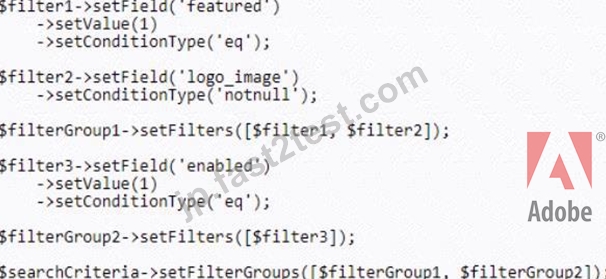
- B.

- C.
正解:C
解説:
The following SearchCriteria query will replicate the SQL query:
$searchCriteria = new \Magento\Framework\Api\SearchCriteriaBuilder();
$searchCriteria->addFilter('name', 'Brand 1', 'eq');
$searchCriteria->addFilter('status', 1, 'eq');
$brandCollection = $this->brandRepository->getList($searchCriteria);
質問 # 52
What are two features with Adobe Commerce Cloud that come out of the box? (Choose Two.)
- A. A built in connector with all major blog platforms
- B. Fastly
- C. Support ACL
- D. Continuous deployment provided with the platform
正解:B、C
解説:
Two features that come out of the box with Adobe Commerce Cloud are Support ACL and Fastly. Support ACL is a feature that allows the developer to manage access control lists for different users and roles on the Adobe Commerce Cloud platform. The developer can create and assign permissions for different actions and resources on the project and environment levels. Fastly is a cloud-based caching service that improves site performance and security for Adobe Commerce Cloud projects. Fastly provides features such as CDN, image optimization, WAF, DDoS protection, etc. Verified References: [Magento 2.4 DevDocs] 3
質問 # 53
An Adobe Commerce Developer is tasked with creating a custom form which submits its data to a frontend controller They have decided to create an action and have implemented the \Magento\Framework\App\Action\HttpPostActioninterface class, but are not seeing the data being persisted in the database, and an error message is being shown on the frontend after submission.
After debugging and ensuring that the data persistence logic is correct, what may be cause and solution to this?
- A. Form key validation runs on all non-AJAX POST requests, the developer needs to add the for_key to their requests.
- B. Magento does not allow POST requests to a frontend controller, therefore, the submission functionality will need to be rewritten as an API endpoint.
- C. The developer forgot to implement a validatePostDataQ method in their action. They should implement this method: all non-validated POST data gets stripped out of the request and an error is thrown.
正解:A
解説:
According to the Magento Stack Exchange answer, form key validation is a security feature that prevents CSRF attacks by checking if the form key in the request matches the one generated by Magento. If the developer does not include the form_key in their custom form, the validation will fail and an error will be shown. Therefore, the developer needs to add the form_key to their requests by using <?= $block->getBlockHtml ('formkey') ?> in their template file. Verified Reference: https://magento.stackexchange.com/questions/95171/magento-2-form-validation
質問 # 54
......
Adobe AD0-E716 認定試験の出題範囲:
| トピック | 出題範囲 |
|---|---|
| トピック 1 |
|
| トピック 2 |
|
| トピック 3 |
|
| トピック 4 |
|
| トピック 5 |
|
| トピック 6 |
|
| トピック 7 |
|
検証済みAD0-E716問題集と解答で最新AD0-E716をダウンロード:https://jp.fast2test.com/AD0-E716-premium-file.html