

更新された2023年11月19日検証済み!AD0-E716問題集と解答で100%合格できる
2023年最新のの問題AD0-E716問題集を試そう!更新されたAdobe試験合格させます
Adobe AD0-E716 認定試験の出題範囲:
| トピック | 出題範囲 |
|---|---|
| トピック 1 |
|
| トピック 2 |
|
| トピック 3 |
|
| トピック 4 |
|
| トピック 5 |
|
| トピック 6 |
|
| トピック 7 |
|
| トピック 8 |
|
| トピック 9 |
|
質問 # 27
An Adobe Commerce developer is working on a Magento 2 instance which contains a B2C and a B2B website, each of which contains 3 different store views for English, Welsh, and French language users. The developer is tasked with adding a link between the B2C and B2B websites using a generic link template which is used throughout the sites, but wants these links to display in English regardless of the store view.
The developer creates a custom block for use with this template, before rendering sets the translate locale and begins environment emulation using the following code:
They find that the template text is still being translated into each stores language. Why does this occur?
- A. setLocate() does not change translation locale after it has been initially set, the $this->_translate->emulate($newLocaiecode) method exists to temporarily modify this by pushing the new locale to the top of the current emuiatedLocales stack.
- B. startEnvironmffntEmulation() SetS and locks the locale by Using the setLocale() Optional Second $lock parameter, i.e. setLocale($newLocaleCode, true), to override and lock the locale of the emulated store. If this is set and locked initially then the environment emulation will not be able to override this.
- C. startEnvironmentEmuiation() resets the translation locale to the one of the emulated stores, which overrides the locale the developer has set when the order of setLocate and startEnvironmentEmulation is used as displayed above.
正解:C
解説:
The startEnvironmentEmulation() method resets the translation locale to the one of the emulated stores, which overrides the locale the developer has set when the order of setLocale() and startEnvironmentEmulation() is used as displayed above.
The correct way to achieve the desired result is to use the emulate() method to temporarily modify the translation locale. The following code shows how to do this:
PHP
$this->_translate->emulate('en_US');
// Render the template
$this->_translate->revert();
This code will set the translation locale to English before rendering the template, and then revert the locale back to the default value after the template has been rendered.
The startEnvironmentEmulation() method is used to emulate a different store view or website. This can be useful for testing purposes, or for developing features that need to work in different environments.
The emulate() method is used to temporarily modify the translation locale. This can be useful for rendering templates in a specific language, or for testing features that need to work in different languages.
質問 # 28
An Adobe Commerce developer added a new API method to search and retrieve a list of Posts for a custom Blog functionality. This is the content of the module's etc/webapi.xml file:
The new code has been deployed to production and the merchant is using https: //merchant. domain. com/swagger to review the new endpoint, but it is not visible in swagger.
What would be a reason for this?
- A. The webapi.xml file should be moved into the etc/webapi_rest/webapi.xml file.
- B. Since the new endpoint is not anonymous, the merchant needs to enter a valid integration token in swagger in order to see the new method.
- C. The greturn annotation is missing in the MyVendor\Blog\Api\PostRepositoryInterf ace class.
正解:B
解説:
The reason why the new endpoint is not visible in swagger is that since the new endpoint is not anonymous, the merchant needs to enter a valid integration token in swagger in order to see the new method. The webapi.xml file specifies that the resource for the new endpoint is MyVendor_Blog::post, which means that only authorized users with this permission can access it. To generate an integration token, the merchant needs to create an integration in the admin panel and activate it. Then they can copy the token and paste it in swagger's authorization field. Verified Reference: [Magento 2.4 DevDocs] [Magento Stack Exchange]
質問 # 29
An Adobe Commerce developer is working on a custom gallery extension.
The module uses the Magento\catalog\Model\iinageUploader class for image uploading. The admin controller for custom image uploads is Vendor\CustomGallery\Controller\Adminhtml\Image\Upload.
The images need to be stored in different basePath and baseTmpPath than the default ones.
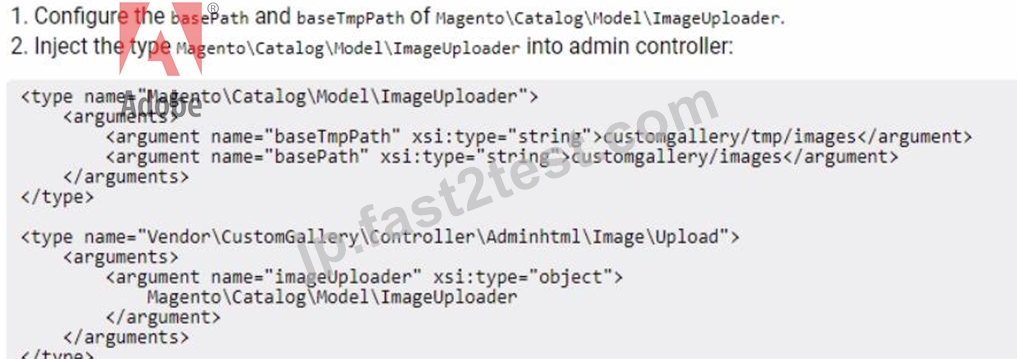
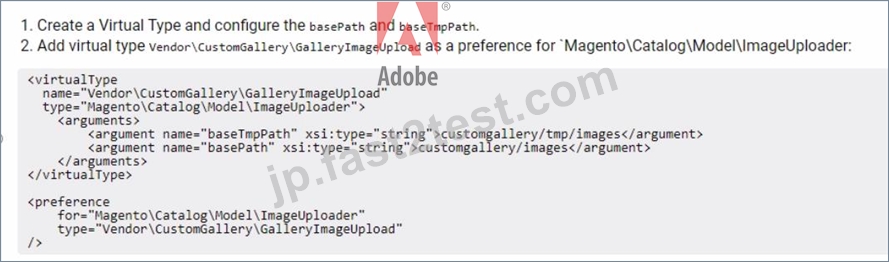
How can the default imageuploader class be extended and used without affecting the other modules that are already using it?
- A.
- B.
- C.
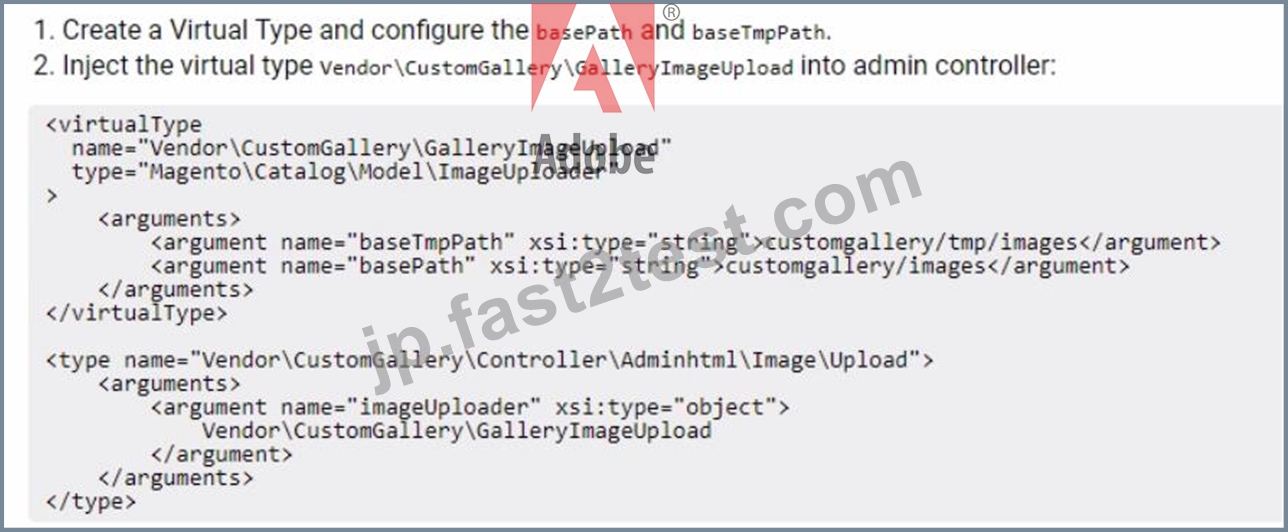
正解:A
解説:
According to the ImageUploader component guide for Magento 2 developers, the ImageUploader UI component gives users the ability to upload images to the Magento Media Gallery. This component is a variation of the FileUploader component and uses the same configuration settings. The ImageUploader component uses the Magento\catalog\Model\iinageUploader class for image uploading, which has properties such as basePath and baseTmpPath that define where the images are stored. To extend the default imageuploader class and use it without affecting the other modules that are already using it, the developer needs to create a virtual type of this class in their module's di.xml file and specify different values for basePath and baseTmpPath. The developer also needs to inject their virtual type into their admin controller using the imageUploader argument. Therefore, option B is the correct answer, as it shows the correct di.xml and controller code to extend and use the imageuploader class. Verified Reference: https://devdocs.magento.com/guides/v2.3/ui_comp_guide/components/image-uploader/
質問 # 30
An Adobe Commerce Cloud merchant has been experiencing significant downtime during production deployment. They have already checked that the application is in ideal state.
In addition to the configuration of the SCD.MATRIX variable to reduce amount of unnecessary theme files, what would be the next steps to reduce the downtime?
- A. 1. Check SCD is configured under the build phase.
2. Check if Adobe Commerce Cloud automatically adjusts SCD.THREADS. - B. 1. Check SCD is configured under deploy phase.
2. Decrease the SCD.THREADS to speed up the build process - C. 1. Check SCD is configured under the build phase.
2. Increase the SCD.THREADS to speed up the build process.
正解:C
解説:
The next steps to reduce the downtime are to check that the SCD is configured under the build phase and to increase the SCD.THREADS to speed up the build process. The SCD stands for static content deployment, which is the process of generating and deploying static files such as CSS, JS, images, etc. By configuring the SCD under the build phase, the static files are generated before the code is deployed to the production environment, which reduces the downtime during deployment. The SCD.THREADS is a variable that determines how many threads are used for parallel processing during the SCD. By increasing the SCD.THREADS, the developer can improve the performance and efficiency of the SCD process. Verified Reference: [Magento 2.4 DevDocs] 12
質問 # 31
An Adobe Commerce developer has created a new shipping carrier Everything has been implemented and the collectRates() and getAllowedMethodsQ functions can be seen below: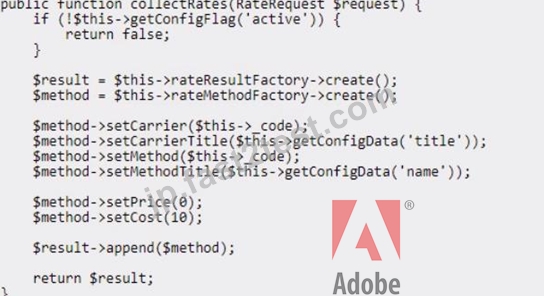

Given the above code, what would be the displayed cost of the shipping method and final amount charged to the customer?
- A. The shipping method would display $0 and customers would pay $0 for using the new shipping method.
- B. The shipping method would display SO but customers would pay a $10 handling fee for their order.
- C. The shipping method would display $10 and customers would pay $10 for using the new shipping method.
正解:C
解説:
The shipping method would display $10 and customers would pay $10 for using the new shipping method. This is because the collectRates method sets the price and cost of the shipping method to 10 in the result object. The price is what is shown to the customer on the frontend and the cost is what is charged to the customer when they place the order. The handling fee is not used in this case because it is set to zero in the config.xml file. Verified Reference: [Magento 2.4 DevDocs] [Magento Stack Exchange]
質問 # 32
An Adobe Commerce developer successfully added a new column to the customers grid. This column needs the data to be formatted before showing its content in the grid.
According to best practices, how would the developer add the custom logic to render the column?
- A. 1. Create an after pluginforMagento\Ui\Component\Listing\Columns\Column::prepareColumn().
2. Add the custom logic within the afterPreparecoiumn method. - B. 1. Create a custom class extending flagento\Ui\Component\Listing\Columns\Colunm.
2. Add the custom logic within the prepareDataSource method.
3. Add an attribute class to the column node within the module's customer_listing.xml. - C. 1. Override the Magento\Customer\Ui\Component\DataProvider Class using a preference.
2. Override the getData() method and add the custom logic per row.
正解:A
質問 # 33
An Adobe Commerce developer is creating a module (Vendor.ModuleName) to be sold on the Marketplace. The new module creates a database table using declarative schema and now the developer needs to make sure the table is removed when the module is disabled.
What must the developer do to accomplish this?
- A. There is nothing further the developer needs to do. The table will be removed when the module is disabled and bin/magento setup:upgrade is run.
- B. There is nothing further the developer needs to do. The table will be removed when the when bin/magento module:uninstall vendor_ModuleName is run.
- C. Add a schema patch that implements Magento\Framework\setup\Patch\PatchRevertabieinterface and drops the table in the revert function.
正解:C
解説:
According to the Declarative Schema Overview guide for Magento 2 developers, declarative schema is a new feature that allows developers to declare the final desired state of the database and has the system adjust to it automatically, without performing redundant operations. However, declarative schema does not support uninstalling modules or reverting changes. To remove a table when a module is disabled, the developer needs to add a schema patch that implements Magento\Framework\setup\Patch\PatchRevertabieinterface and drops the table in the revert function. The revert function will be executed when the module is disabled using bin/magento module:disable command. Verified Reference: https://devdocs.magento.com/guides/v2.3/extension-dev-guide/declarative-schema/
質問 # 34
An Adobe Commerce developer is creating a new module to extend the functionality of the cart. The module is installed in app/code/CompanyName/ModuleName/.
How would an Adobe Commerce developer extend the existing CartltemPrices GraphQL schema to include a custom base_price field?
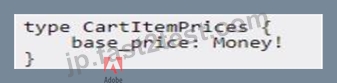
- A. Add the following to the module's etc/schema.graphqis file:
- B. Create and Configure a <prefffrence> for Hagento\QuoteGraphQl\Model\Resolver\CartItemPrices that adds the base_price field in the resolve() function.
- C. Add the following to the module's etc/graphqi/di.xmi file:

正解:A
解説:
The developer can extend the existing CartltemPrices GraphQL schema to include a custom base_price field by adding the following code to the module's etc/schema.graphqls file:
extend type CartltemPrices { base_price: Money! @doc(description: "The base price of the cart item") } This code adds a new field called base_price to the CartltemPrices type and specifies that it is of type Money and it is not nullable. The @doc directive adds a description for the field that will be shown in the schema documentation. The developer also needs to create a custom resolver class for the base_price field and declare it in the di.xml file of the module. Verified Reference: [Magento 2.4 DevDocs] [Magento Stack Exchange]
質問 # 35
How would a developer turn on outgoing emails on an Adobe Commerce Cloud Staging environment?
- A. Access the Project Web Interface and select the Staging environment.
Select Configure environment. - B. From the command line
magento-cloud environment:info -p <project-id> -e <environment-id> enable_smtp true - C. From the command line
ece-tools enable_smtp true
正解:A
解説:
Toggle Outgoing emails On
Explanation:
The developer can turn on outgoing emails on an Adobe Commerce Cloud Staging environment by accessing the Project Web Interface and selecting the Staging environment. Then, the developer can select Configure environment and toggle Outgoing emails On. This will enable the SMTP service for the Staging environment and allow emails to be sent from the application. Verified Reference: [Magento 2.4 DevDocs] 1
質問 # 36
An Adobe Commerce Developer has written an importer and exporter for a custom entity. The client is using this to modify the exported data and then re-importing the file to batch update the entities.
There is a text attribute, which contains information related to imagery in JSON form, media_gallery. This is not a field that the client wants to change, but the software they are using to edit the exported data seems to be modifying it and not allowing it to import correctly.
How would the developer prevent this?
A) Specify a serializer class for the attribute using the $_transformAttrs class property array for both the exporter and importer so it gets converted:
B) Strip the attribute from the imported file by adding it to the s_strippedAttrs class property array: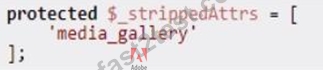
C) Prevent it from being exported by adding it to the $_disat>iedAttrs class property array:
- A. Option C
- B. Option A
- C. Option B
正解:B
解説:
The _transformAttrs class property array of the importer and exporter classes can be used to specify a serializer class for a particular attribute. The serializer class will be used to convert the attribute value from one format to another when the data is exported or imported.
In this case, the developer can specify a serializer class that will convert the JSON data in the media_gallery attribute to a string. This will prevent the software that the client is using to modify the exported data from changing the JSON data.
The following code shows how to specify a serializer class for the media_gallery attribute:
PHP
class MySerializer
{
public function serialize($value)
{
return json_encode($value);
}
public function deserialize($value)
{
return json_decode($value);
}
}
$importer->setSerializer('media_gallery', MySerializer::class);
$exporter->setSerializer('media_gallery', MySerializer::class);
Once the serializer class has been specified, the JSON data in the media_gallery attribute will be converted to a string when the data is exported or imported. This will prevent the software that the client is using to modify the exported data from changing the JSON data.
質問 # 37
An Adobe Commerce developer has added a new configuration field to the admin are a. The path for this option is general/store_information/out_of_hours_phone.
Keeping simplicity in mind, how would the developer ensure this option contains a valid US telephone number?
- A. Add <validate>phoneUS</validate> to the field in system.xml.
- B. Add <validate type="phoneUS"/> to the field in system.xml.
- C. Create a backend model to check the validity of the phone number entered.
正解:A
解説:
According to the Magento Stack Exchange answer, system.xml is a file that defines the configuration fields for the admin area. Each field can have a validate attribute that specifies a validation rule for the field value. Magento provides some built-in validation rules, such as phoneUS, which validates a US telephone number. Therefore, to ensure that the option contains a valid US telephone number, the developer needs to add <validate>phoneUS</validate> to the field in system.xml. Verified Reference: https://magento.stackexchange.com/questions/104570/magento-2-system-xml-validation-rules
質問 # 38
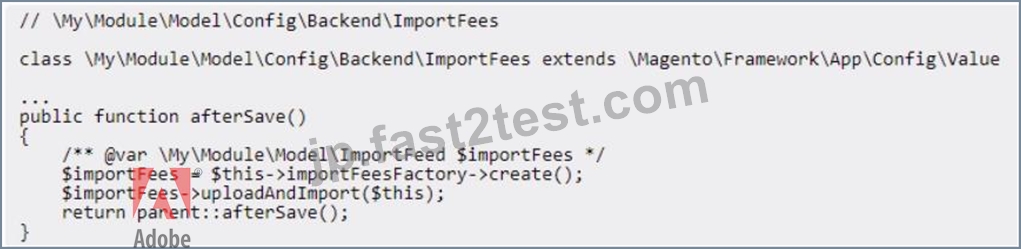
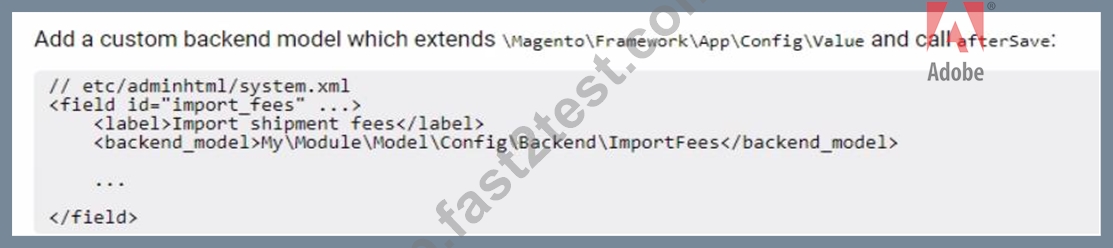
A logistics company with an Adobe Commerce extension sends a list of reviewed shipment fees to all its clients every month in a CSV file. The merchant then uploads this CSV file to a "file upload" field in admin configuration of Adobe Commerce.
What are the two requirements to display the "file upload" field and process the actual CSV import? (Choose two.) A)
- A.

- B.
- C.
- D.

正解:B、C
解説:
To display the "file upload" field and process the actual CSV import, the following two requirements must be met:
The developer must create a new system configuration setting that specifies the path to the CSV file.
The developer must create a new controller action that handles the file upload and import process.
The system.xml file is used to define system configuration settings. The following XML snippet shows how to define a new system configuration setting for the CSV file path:
XML
<config>
<system>
<config>
<shipment_fees_csv_path>/path/to/csv/file</shipment_fees_csv_path>
</config>
</system>
</config>
The Controller\Adminhtml\ShipmentFees controller class is used to handle the file upload and import process. The following code shows how to create a new controller action that handles the file upload and import process:
PHP
public function uploadAction()
{
$file = $this->getRequest()->getFile('shipment_fees_csv_file');
if ($file->isUploaded()) {
$importer = new ShipmentFeesImporter();
$importer->import($file);
}
return $this->redirect('adminhtml/system_config/edit/section/shipment_fees');
}
質問 # 39
An Adobe Commerce developer has created a module that adds a product attribute to all product types via a Data Patch-According to best practices, how would the developer ensure this product attribute is removed in the event that the module is uninstalled at a later date?
- A. Add instructions to the module's README.md file instructing merchants and developers that they must manually remove this attribute if they want to uninstall the module.
- B. Make the Data Patch implement \Magento\Framework\setup\Patch\PatchRevertabieinterface and implement the revert method to remove the product attribute.
- C. Add an Uninstall.php file extending \l1agento\Framework\Setup\UninstallInterface tO the module's Setup directory and implement the uninstall method.
正解:B
解説:
According to the Develop data and schema patches guide for Magento 2 developers, data patches can also implement PatchRevertabieinterface to provide rollback functionality for their changes. The revert() method contains the instructions to undo the data modifications made by the patch. To ensure that the product attribute is removed when the module is uninstalled, the developer should make the data patch implement PatchRevertabieinterface and implement the revert method to remove the product attribute using EavSetupFactory or AttributeRepositoryInterface. Verified Reference: https://devdocs.magento.com/guides/v2.3/extension-dev-guide/declarative-schema/data-patches.html
質問 # 40
An Adobe Commerce Developer wishes to add an action to a pre-existing route, but does not wish to interfere with the functionality of the actions from the original route.
What must the developer do to ensure that their action works without any side effects in the original module?
- A. In the route declaration, use the before or after parameters to load their module in before or after the original module.
- B. Add the action into to the controllers/front_name/ in My.Module, Magento will automatically detect and use it.
- C. Inject the new action into the standard router constructor's $actiomist parameter.
正解:A
解説:
To add an action to a pre-existing route without interfering with the functionality of the original route, the developer must use the before or after parameters in the route declaration. This will load the developer's module in before or after the original module, respectively.
For example, the following code would add an action to the my_module/index route before the action from the original module:
<route id="my_module/index">
<before>my_module_before</before>
<action class="MyModule\Controller\Index">
<arguments>
<argument name="context" type="Magento\Framework\App\Action\Context"/>
</arguments>
</action>
</route>
The my_module_before action would be executed before the MyModule\Controller\Index action, which would allow the developer to perform any necessary setup before the original action is executed.
質問 # 41
During database migration in the Adobe Commerce Cloud integration environment, a developer experienced a disk space error causing the database import to fail.
How would the developer fix this issue?
- A. Add a new database node and enable split database.
- B. Increase the disk space of the database service.
- C. Change the database engine to PostgreSQL that has no disk space limit.
正解:B
解説:
The developer can fix this issue by increasing the disk space of the database service. The database service is one of the services that run on the Adobe Commerce Cloud platform and provide functionality for the application. The database service uses MySQL as the database engine and stores data for products, customers, orders, etc. The disk space of the database service determines how much data can be stored and processed by the database. If the disk space is insufficient, the database import can fail with a disk space error. The developer can increase the disk space of the database service by modifying the .magento/services.yaml file and redeploying the environment. Verified Reference: [Magento 2.4 DevDocs]
質問 # 42
Which hashing algorithm will Adobe Commerce choose to hash customer passwords?
- A. If the Sodium extension is installed, SHA256 will be chosen, otherwise MD5 will be used as the Magento default hashing algorithm.
- B. It does not matter if the Sodium extension is installed or not, the Magento hashing default algorithm will be SHA256.
- C. If the Sodium extension is installed, Argon 2ID13 will be chosen, otherwise SHA256 will be used as the Magento default hashing algorithm.
正解:C
解説:
If the Sodium extension is installed, Argon 2ID13 will be chosen as the Magento default hashing algorithm. Otherwise, SHA256 will be used.
The Sodium extension is a PHP extension that provides cryptographic functions. Argon 2ID13 is a password hashing algorithm that is considered to be more secure than SHA256.
If the Sodium extension is installed, Magento will use Argon 2ID13 as the default hashing algorithm for customer passwords. If the Sodium extension is not installed, Magento will use SHA256 as the default hashing algorithm.
質問 # 43
An Adobe Commerce developer wants to create a product EAV attribute programmatically which should appear as WYSIWYG in the admin panel. They have made sure that wysiwyg_enabled has been set to true, however, the attribute is not appearing as WYSIWYG in the admin panel.
What would be a possible reason?
- A. The input type is not set to textarea.
- B. The is_html_allowed_on_front Option iS Set tO false.
- C. The input type is not set to text.
正解:A
解説:
The input_type attribute of a product EAV attribute specifies the type of input field that will be used to enter the value of the attribute in the admin panel. The textarea input type is used for WYSIWYG fields. If the input_type attribute is not set to textarea, then the attribute will not appear as WYSIWYG in the admin panel.
To fix this, the developer should set the input_type attribute to textarea.
質問 # 44
An Adobe Commerce developer is tasked with adding custom data to orders fetched from the API. While keeping best practices in mind, how would the developer achieve this?
- A. Create a before plugin on Magento\sales\model\ResourceModel\order\collection: :load and alter the query to fetch the additional data. Data will then be automatically added to the items fetched from the API.
- B. Create an extension attribute on Nagento\sales\Api\E)ata\orderinterface and an after plugin on Magento\Sales\Model\Order: :getExtensionAttributes() to add the custom data.
- C. Create an extension attribute On Magento\Sales\Api\Data\OrderInterface and an after plugin On Magento\Sales\Api\OrderRepositoryInterface On geto and getListo to add the custom data.
正解:C
解説:
The developer should create an extension attribute on the Magento\Sales\Api\Data\OrderInterface interface and an after plugin on the Magento\Sales\Api\OrderRepositoryInterface::get() and Magento\Sales\Api\OrderRepositoryInterface::getList() methods.
The extension attribute will store the custom data. The after plugin will be used to add the custom data to the order object when it is fetched from the API.
Here is the code for the extension attribute and after plugin:
PHP
namespace MyVendor\MyModule\Api\Data;
interface OrderExtensionInterface extends \Magento\Sales\Api\Data\OrderInterface
{
/**
* Get custom data.
* * @return string|null
*/
public function getCustomData();
/**
* Set custom data.
* * @param string $customData
* @return $this
*/
public function setCustomData($customData);
}
namespace MyVendor\MyModule\Model;
class OrderRepository extends \Magento\Sales\Api\OrderRepositoryInterface
{
/**
* After get order.
* * @param \Magento\Sales\Api\OrderRepositoryInterface $subject
* @param \Magento\Sales\Api\Data\OrderInterface $order
* @return \Magento\Sales\Api\Data\OrderInterface
*/
public function afterGetOrder($subject, $order)
{
if ($order instanceof OrderExtensionInterface) {
$order->setCustomData('This is custom data');
}
return $order;
}
/**
* After get list.
* * @param \Magento\Sales\Api\OrderRepositoryInterface $subject
* @param \Magento\Sales\Api\Data\OrderInterface[] $orders
* @return \Magento\Sales\Api\Data\OrderInterface[]
*/
public function afterGetList($subject, $orders)
{
foreach ($orders as $order) {
if ($order instanceof OrderExtensionInterface) {
$order->setCustomData('This is custom data');
}
}
return $orders;
}
}
Once the extension attribute and after plugin are created, the custom data will be added to orders fetched from the API.
質問 # 45
An Adobe Commerce Developer is tasked with creating a custom form which submits its data to a frontend controller They have decided to create an action and have implemented the \Magento\Framework\App\Action\HttpPostActioninterface class, but are not seeing the data being persisted in the database, and an error message is being shown on the frontend after submission.
After debugging and ensuring that the data persistence logic is correct, what may be cause and solution to this?
- A. Magento does not allow POST requests to a frontend controller, therefore, the submission functionality will need to be rewritten as an API endpoint.
- B. Form key validation runs on all non-AJAX POST requests, the developer needs to add the for_key to their requests.
- C. The developer forgot to implement a validatePostDataQ method in their action. They should implement this method: all non-validated POST data gets stripped out of the request and an error is thrown.
正解:B
解説:
According to the Magento Stack Exchange answer, form key validation is a security feature that prevents CSRF attacks by checking if the form key in the request matches the one generated by Magento. If the developer does not include the form_key in their custom form, the validation will fail and an error will be shown. Therefore, the developer needs to add the form_key to their requests by using <?= $block->getBlockHtml ('formkey') ?> in their template file. Verified Reference: https://magento.stackexchange.com/questions/95171/magento-2-form-validation
質問 # 46
An Adobe Commerce developer is developing a custom module. As part of their implementation they have decided that all instances of their Custom\Module\Model\Example class should receive a new instance of Magento\Filesystem\Adapter\Local.
How would the developer achieve this using di. xml?
- A.

- B.

- C.

正解:C
解説:
The developer can achieve this by adding the following configuration to their di.xml file:
XML
<config>
<component name="Custom\Module\Model\Example" factory="Custom\Module\Model\ExampleFactory">
<arguments>
<argument name="filesystemAdapter" type="Magento\Filesystem\Adapter\Local" />
</arguments>
</component>
</config>
This configuration will ensure that all instances of the Custom\Module\Model\Example class will receive a new instance of the Magento\Filesystem\Adapter\Local class.
質問 # 47
An integration named Marketing is created on the Adobe Commerce instance. The integration has access on Magento_Customer:: customer resources and the access token is xxxxxx.
How would the rest API be called to search the customers?
- A. Type: application/json'
Use the admin token as Bearer
curl -X GET https://magentourl/rest/Vl/customers/search?searchCriteria... -H 'Authorization: Bearer YYYYYY' - B. Using the integration access token as Bearer:
curl -X GET https://magentourl/rest/Vl/customers/search?searchCriteria... -H 'Authorization: Bearer XXXXXX' - C. Passing integration name and access token as http auth credentials:
curl -X GET https ://Marketing:XXXXXX(Slmagentourl/rest/Vl/customers/search?5earchCriteria . . .
Using integration name as username and access token as password, get the admin token (yyyyyy) via:
curl -X POST https://magentourl/rest/Vl/integration/admin/token -d '{"username":"Marketing", "password":"XXXXXX"}' -H 'Content-
正解:C
解説:
According to the Magento Stack Exchange answer, UI components are used to render various elements on Magento admin pages, such as grids, forms, buttons, etc. UI components are defined in XML files that are located in the view/adminhtml/ui_component directory of each module. To add a custom logic to render a column in a grid, the developer should create a custom class extending MagentoUiComponentListingColumnsColumn and add the custom logic within the prepareDataSource method. This method receives an array of data sources and modifies them according to the column logic. The developer should also add an attribute class to the column node within the module's customer_listing.xml file and specify their custom class name as its value. Verified Reference: https://magento.stackexchange.com/questions/317821/how-to-add-custom-logic-to-render-a-column-in-a-grid-in-magento-2
質問 # 48
An international merchant is complaining that changes are taking too long to be reflected on the frontend after a full product import.
Thinking it may be database issues, the Adobe Commerce developer collects the following entity counts:
* Categories: 900
* Products: 300k
* Customers: 700k
* Customer groups : 106
* Orders: 1600k
* Invoices: 500k
* Creditmemos: 50k
* Websites : 15
* Stores : 45
What is a probable cause for this?
- A. The combination of the number of products, customer groups and websites is too big. This leads to a huge amount of values being stored in the price index which is too large to be processed at a normal speed.
- B. The combination of the number of orders, customers, invoices and creditmemos is too big. This leads to a huge amount of values being stored in the customer grid index which is too large to be processed at a normal speed.
- C. The combination of the number of products, categories and stores is too big. This leads to a huge amount of values being stored in the flat catalog indexes which are too large to be processed at a normal speed.
正解:A
解説:
The probable cause for the delay in reflecting the changes on the frontend after a full product import is the combination of the number of products, customer groups and websites. This leads to a huge amount of values being stored in the price index which is too large to be processed at a normal speed. The price index calculates the final price of each product for each customer group and website, taking into account various factors such as tax, discounts, catalog price rules, etc. When there are many products, customer groups and websites, the price index becomes very complex and time-consuming to update. Verified Reference: [Magento 2.4 DevDocs] [Magento Stack Exchange]
質問 # 49
An Adobe Commerce developer has been asked to modify the PageBuilder slider content type to allow a new custom content type (other than slide) to be assigned as a child. The developer has already created the new content type called improved_slide in their module. They now need to create a new view/adminhtml/pagebuilder/content_type/slider. xml file in their module to allow the new content type to be a child of slider content types.
What is the correct xml to accomplish this?
- A.

- B.

- C.
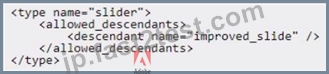
正解:C
解説:
The following XML will allow the new content type to be a child of slider content types:
<pagebuilder_content_type>
<type>slider</type>
<children>
<type>improved_slide</type>
</children>
</pagebuilder_content_type>
Use code with caution. https://bard.google.com/faq
This XML will tell Magento that the slider content type can have improved_slide content types as children.
質問 # 50
A developer is working on an Adobe Commerce Cloud project and wants to get connection data for the environment's deployed services. The developer has all of the necessary permissions to do this.
Which two options would the developer take to get the connection credentials? (Choose Two.)
- A. Connect to server via SSH and read $_ENV['services'] variable.
- B. Execute ece-tools env:config:show services Command.
- C. Get the data from the Project Web Interface dedicated section.
- D. Run the magento-cloud relationships CLI Command.
正解:A、D
解説:
Two options to get the connection credentials for the environment's deployed services are to run the magento-cloud relationships CLI command and to connect to the server via SSH and read $_ENV['services'] variable. The magento-cloud relationships CLI command displays information about the relationships between an environment and its services, such as database, cache, search, etc. The developer can use this command to get the connection data for each service in JSON format. Alternatively, the developer can connect to the server via SSH and read the $_ENV['services'] variable, which contains the same information as the CLI command output. Verified Reference: [Magento 2.4 DevDocs] 3
質問 # 51
On an Adobe Commerce Cloud platform, what type of environment will be provisioned when launching the CLI for Commerce command magento-cloud environment:branch <environment-name> <parent-environment-id>?
- A. An empty integration environment without any code or database.
- B. An integration environment with fresh Adobe Commerce Cloud installation.
- C. An integration environment with the code and database from the parent environment.
正解:C
解説:
The type of environment that will be provisioned when launching the CLI for Commerce command magento-cloud environment:branch <environment-name> <parent-environment-id> is an integration environment with the code and database from the parent environment. Integration environments are temporary environments that are used for testing and development purposes on the Adobe Commerce Cloud platform. They can be created from any branch of code and have their own dedicated database and services. When creating an integration environment using the CLI for Commerce command, the code and database from the parent environment are copied to the new integration environment, creating an exact replica of the parent environment. Verified Reference: [Magento 2.4 DevDocs]
質問 # 52
......
最新のAD0-E716試験問題集でAdobeトレーニング試験には:https://jp.fast2test.com/AD0-E716-premium-file.html