

[2024年最新] 高合格率なAD0-E716テストアンサーかつAdobe AD0-E716テストPDF
完璧AD0-E716問題集試験問題と解答でパス保証されます
Adobe AD0-E716 認定試験の出題範囲:
| トピック | 出題範囲 |
|---|---|
| トピック 1 |
|
| トピック 2 |
|
| トピック 3 |
|
| トピック 4 |
|
| トピック 5 |
|
| トピック 6 |
|
| トピック 7 |
|
| トピック 8 |
|
| トピック 9 |
|
質問 # 39
An Adobe Commerce Developer wishes to add an action to a pre-existing route, but does not wish to interfere with the functionality of the actions from the original route.
What must the developer do to ensure that their action works without any side effects in the original module?
- A. Add the action into to the controllers/front_name/ in My.Module, Magento will automatically detect and use it.
- B. Inject the new action into the standard router constructor's $actiomist parameter.
- C. In the route declaration, use the before or after parameters to load their module in before or after the original module.
正解:C
解説:
To add an action to a pre-existing route without interfering with the functionality of the original route, the developer must use the before or after parameters in the route declaration. This will load the developer's module in before or after the original module, respectively.
For example, the following code would add an action to the my_module/index route before the action from the original module:
<route id="my_module/index">
<before>my_module_before</before>
<action class="MyModule\Controller\Index">
<arguments>
<argument name="context" type="Magento\Framework\App\Action\Context"/>
</arguments>
</action>
</route>
The my_module_before action would be executed before the MyModule\Controller\Index action, which would allow the developer to perform any necessary setup before the original action is executed.
質問 # 40
An Adobe Commerce developer has installed a module from a third-party vendor. This module fires a custom event named third_party_event_after and also defines an observer named third_party_event_after_observer that listens to that event. The developer wants to listen to this custom event in their own module but wants to execute their observer's logic after the third_party_event_after_observer observer has finished executing.
What would the developer do to ensure their observer runs after the observer defined by the third-party module?
- A. This is not possible as observers listening to the same event may be invoked in any order.
- B. Set the sort order of the new observer to be less than that of the third-party vendor's observer.
- C. Ensure the third-party module is listed in the <sequence> node of the developer's module.xmi file.
正解:B
解説:
To ensure that the developer's observer runs after the observer defined by the third-party module, they need to set the sort order of the new observer to be less than that of the third-party vendor's observer.
The sort order is a number that is assigned to each observer. The lower the number, the earlier the observer will be executed.
For example, if the third-party vendor's observer has a sort order of 10, the developer's observer would need to have a sort order of 9 or lower.
質問 # 41
An integration named Marketing is created on the Adobe Commerce instance. The integration has access on Magento_Customer:: customer resources and the access token is xxxxxx.
How would the rest API be called to search the customers?
- A. Type: application/json'
Use the admin token as Bearer
curl -X GET https://magentourl/rest/Vl/customers/search?searchCriteria... -H 'Authorization: Bearer YYYYYY' - B. Passing integration name and access token as http auth credentials:
curl -X GET https ://Marketing:XXXXXX(Slmagentourl/rest/Vl/customers/search?5earchCriteria . . .
Using integration name as username and access token as password, get the admin token (yyyyyy) via:
curl -X POST https://magentourl/rest/Vl/integration/admin/token -d '{"username":"Marketing", "password":"XXXXXX"}' -H 'Content- - C. Using the integration access token as Bearer:
curl -X GET https://magentourl/rest/Vl/customers/search?searchCriteria... -H 'Authorization: Bearer XXXXXX'
正解:B
解説:
According to the Magento Stack Exchange answer, UI components are used to render various elements on Magento admin pages, such as grids, forms, buttons, etc. UI components are defined in XML files that are located in the view/adminhtml/ui_component directory of each module. To add a custom logic to render a column in a grid, the developer should create a custom class extending MagentoUiComponentListingColumnsColumn and add the custom logic within the prepareDataSource method. This method receives an array of data sources and modifies them according to the column logic. The developer should also add an attribute class to the column node within the module's customer_listing.xml file and specify their custom class name as its value. Verified Reference: https://magento.stackexchange.com/questions/317821/how-to-add-custom-logic-to-render-a-column-in-a-grid-in-magento-2
質問 # 42
An Adobe Commerce developer is tasked with adding custom data to orders fetched from the API. While keeping best practices in mind, how would the developer achieve this?
- A. Create an extension attribute on Nagento\sales\Api\E)ata\orderinterface and an after plugin on Magento\Sales\Model\Order: :getExtensionAttributes() to add the custom data.
- B. Create an extension attribute On Magento\Sales\Api\Data\OrderInterface and an after plugin On Magento\Sales\Api\OrderRepositoryInterface On geto and getListo to add the custom data.
- C. Create a before plugin on Magento\sales\model\ResourceModel\order\collection: :load and alter the query to fetch the additional data. Data will then be automatically added to the items fetched from the API.
正解:B
解説:
The developer should create an extension attribute on the Magento\Sales\Api\Data\OrderInterface interface and an after plugin on the Magento\Sales\Api\OrderRepositoryInterface::get() and Magento\Sales\Api\OrderRepositoryInterface::getList() methods.
The extension attribute will store the custom data. The after plugin will be used to add the custom data to the order object when it is fetched from the API.
Here is the code for the extension attribute and after plugin:
PHP
namespace MyVendor\MyModule\Api\Data;
interface OrderExtensionInterface extends \Magento\Sales\Api\Data\OrderInterface
{
/**
* Get custom data.
* * @return string|null
*/
public function getCustomData();
/**
* Set custom data.
* * @param string $customData
* @return $this
*/
public function setCustomData($customData);
}
namespace MyVendor\MyModule\Model;
class OrderRepository extends \Magento\Sales\Api\OrderRepositoryInterface
{
/**
* After get order.
* * @param \Magento\Sales\Api\OrderRepositoryInterface $subject
* @param \Magento\Sales\Api\Data\OrderInterface $order
* @return \Magento\Sales\Api\Data\OrderInterface
*/
public function afterGetOrder($subject, $order)
{
if ($order instanceof OrderExtensionInterface) {
$order->setCustomData('This is custom data');
}
return $order;
}
/**
* After get list.
* * @param \Magento\Sales\Api\OrderRepositoryInterface $subject
* @param \Magento\Sales\Api\Data\OrderInterface[] $orders
* @return \Magento\Sales\Api\Data\OrderInterface[]
*/
public function afterGetList($subject, $orders)
{
foreach ($orders as $order) {
if ($order instanceof OrderExtensionInterface) {
$order->setCustomData('This is custom data');
}
}
return $orders;
}
}
Once the extension attribute and after plugin are created, the custom data will be added to orders fetched from the API.
質問 # 43
When researching some issues with the indexer, an Adobe Commerce developer is seeing errors in the logs similar to Memory size allocated for the temporary table is more than 20% of innodb_buffer_pool_size. It is suggested that the client update innodb_buf f er_pool_size or decrease the batch size value.
Why does decreasing the batch size value improve performance?
- A. This allows for a longer timeout per batch process.
- B. This allows for more PHP threads to be utilized during the process.
- C. This decreases memory usage for the temporary table.
正解:C
解説:
Decreasing the batch size value improves performance by reducing the memory usage for the temporary table. The batch size value determines how many rows of data are processed at a time by the indexer. A large batch size value can cause the allocated memory size for the temporary table to exceed 20% of innodb_buffer_pool_size, which can result in errors and slow down the indexing process. By lowering the batch size value, the indexer can process the data more efficiently and avoid memory issues. Verified Reference: [Magento 2.4 DevDocs] [Magento Stack Exchange]
質問 # 44
During database migration in the Adobe Commerce Cloud integration environment, a developer experienced a disk space error causing the database import to fail.
How would the developer fix this issue?
- A. Add a new database node and enable split database.
- B. Increase the disk space of the database service.
- C. Change the database engine to PostgreSQL that has no disk space limit.
正解:B
解説:
The developer can fix this issue by increasing the disk space of the database service. The database service is one of the services that run on the Adobe Commerce Cloud platform and provide functionality for the application. The database service uses MySQL as the database engine and stores data for products, customers, orders, etc. The disk space of the database service determines how much data can be stored and processed by the database. If the disk space is insufficient, the database import can fail with a disk space error. The developer can increase the disk space of the database service by modifying the .magento/services.yaml file and redeploying the environment. Verified Reference: [Magento 2.4 DevDocs]
質問 # 45
An Adobe Commerce developer is being tasked with creating a new cron job to run a method that has already been written. What are the minimally required steps to accomplish this?
- A. Create a crontab.xmi file and a new system configuration in system.xmi for the schedule.
- B. Create a crontab.xmi file and set a schedule for the new cron job.
- C. Create crontab.xmi and cron_groups.xmi files to assign the new job to a cron group.
正解:B
解説:
According to the Configure and run cron guide for Magento 2 developers, the crontab.xmi file is used to declare and configure cron jobs for a module. The file should specify the name, instance, method and schedule of the cron job. Therefore, creating a crontab.xmi file and setting a schedule for the new cron job are the minimally required steps to accomplish this task. Verified Reference: https://devdocs.magento.com/guides/v2.3/config-guide/cli/config-cli-subcommands-cron.html
質問 # 46
On an Adobe Commerce Cloud platform, at what level is the variable env: composer_auth located in the Project Web Interface?
- A. In the Environment-specific variables.
- B. In the Project variables.
- C. In the Integration variables.
正解:B
解説:
The variable env: composer_auth is located in the Project variables section in the Project Web Interface. This variable is used to store the authentication credentials for Composer repositories that require access keys or tokens. The developer can set this variable at the project level to apply it to all environments, or override it at the environment level if needed. Verified Reference: [Magento 2.4 DevDocs] 2
質問 # 47
On an Adobe Commerce Cloud platform, in which order does the ECE-Tools package apply patches?
- A. 1. Custom patches in the /m2-hotfixes directory in alphabetical order by patch name.
2. All required Magento patches included in the Cloud Patches for Commerce package.
3. Selected optional Magento patches included in the Quality Patches Tool. - B. 1. All required Magento patches included in the Cloud Patches for Commerce package.
2. Custom patches in the /m2-hotfixes directory in alphabetical order by patch name.
3. Selected optional Magento patches included in the Quality Patches Tool. - C. 1. All required Magento patches included in the Cloud Patches for Commerce package.
2. Selected optional Magento patches included in the Quality Patches Tool.
3. Custom patches in the /m2-hotfixes directory in alphabetical order by patch name.
正解:C
解説:
The order in which the ECE-Tools package applies patches is as follows:
All required Magento patches included in the Cloud Patches for Commerce package.
Selected optional Magento patches included in the Quality Patches Tool.
Custom patches in the /m2-hotfixes directory in alphabetical order by patch name.
The ECE-Tools package is a set of scripts and tools designed to manage and deploy Adobe Commerce Cloud projects. The Cloud Patches for Commerce package is a dependency of ECE-Tools that provides a set of required patches for Magento core issues that affect Adobe Commerce Cloud functionality. The Quality Patches Tool is an optional tool that allows developers to apply individual patches for specific Magento issues without waiting for a full product release. The /m2-hotfixes directory is a directory where developers can place their own custom patches for their Adobe Commerce Cloud projects. Verified Reference: [Magento 2.4 DevDocs]
質問 # 48
An Adobe Commerce developer is about to deploy a critical feature to their Adobe Commerce Cloud (Pro Plan) production. They want to create a snapshot in order to be able to rollback if there is an issue with the feature.
How would they create the snapshot?
- A. Use the dedicated button on Project Web Interface.
- B. Use the Cloud CLI for Commerce dedicated command.
- C. Create a ticket to Adobe Commerce Cloud support.
正解:A
解説:
The developer can create a snapshot before deploying a critical feature to their Adobe Commerce Cloud (Pro Plan) production by using the dedicated button on Project Web Interface. A snapshot is a backup of an entire environment, including code, data, media files, and configuration settings. A snapshot can be used to restore an environment to a previous state in case of any issues or errors during deployment or testing. The developer can create a snapshot by accessing the Project Web Interface, choosing an environment, and clicking Create Snapshot. Verified Reference: [Magento 2.4 DevDocs]
質問 # 49
A Project Architect needs to add a new developer who needs to be able to push code in an Adobe Commerce Cloud project. No integration with a third-party repository provider is setup.
What two actions would be required to ensure the developer has access? (Choose Two.)
- A. The developer's email must be added under Users in the Cloud Project Web Ul
- B. The developer needs to add SSH public key in the Cloud Account dashboard settings
- C. The developer's SSH public key must be added into a file named ~/.ssh/authorized_keys
- D. The Adobe Commerce admin user must be created and the developer's SSH public key must be added on their local system
正解:A、B
解説:
To ensure the developer has access to push code in an Adobe Commerce Cloud project, the developer's email must be added under Users in the Cloud Project Web UI and the developer needs to add SSH public key in the Cloud Account dashboard settings. The Cloud Project Web UI is a web interface that allows managing and configuring Adobe Commerce Cloud projects and environments. The developer's email must be added under Users to grant them access to the project and assign them a role and permissions. The Cloud Account dashboard settings is a web interface that allows managing and configuring Adobe Commerce Cloud accounts and SSH keys. The developer needs to add SSH public key in the settings to enable secure connection to the project and environments via SSH. Verified Reference: [Magento 2.4 DevDocs]
質問 # 50
When attempting operations that require lengthy processing, a merchant on Adobe Commerce Cloud receives a timeout error after 180 seconds.
How would the developer deal with this issue?
- A. 1. Modify admin timeout into app/etc/config.php file.
2. Commit and push that code from the local environment.
3. Submit a support ticket to apply the changes. - B. 1. Modify admin timeout into .magento.app.yamifile.
2. Commit and push that code from the local environment.
3. Move code to Production environment. - C. 1. In the Fastly Configuration section > Advanced Configuration.
2. Set the Admin path timeout value in seconds.
3. Save config and Upload VCL to Fastly.
正解:C
解説:
The developer can deal with this issue by modifying the admin path timeout value in seconds in the Fastly Configuration section > Advanced Configuration in the Admin Panel. Fastly is a cloud-based caching service that improves site performance and security for Adobe Commerce Cloud projects. Fastly has a default timeout value of 180 seconds for admin requests, which means that any request that takes longer than 180 seconds will be terminated and result in a timeout error. The developer can increase this value to allow longer processing time for admin requests without causing errors. The developer also needs to save the configuration and upload VCL to Fastly to apply the changes. Verified Reference: [Magento 2.4 DevDocs]
質問 # 51
A new customer registered on the Integration environment of an Adobe Commerce Cloud project but did not receive a welcome email What would be blocking the email from being sent?
- A. On all Integration environments, email is always disabled.
- B. SendGrid has not been configured for this environment.
- C. The Outgoing Emails setting is disabled into Environment Settings in the Project Web Interface.
正解:C
解説:
The reason why the new customer did not receive a welcome email is that the Outgoing Emails setting is disabled in the Environment Settings in the Project Web Interface. This setting controls whether emails are sent from the application or not. By default, this setting is disabled for integration environments to prevent spamming or testing emails from being sent to real customers or recipients. The developer can enable this setting if they want to test email functionality on integration environments. Verified Reference: [Magento 2.4 DevDocs]
質問 # 52
The developer is required to convert a modules database scripts from old install/upgrade setup files to a data patches format and does not want to apply database changes that were already done by install/upgrade scripts.
The current module version is 1.5.4.
What would be the recommended solution to skip changes that were already applied via old format (install/upgrade scripts)?
- A. Implement Patchversioninterface and return 1.5.4 on the getversion() method.
- B. Inside apply() method, check for module version and run the code if version is less than 1.5.4.
- C. This is not possible. A module cannot implement both data patch and install scripts.
正解:A
解説:
According to the Develop data and schema patches guide for Magento 2 developers, data patches are classes that contain data modification instructions. They are defined in a <Vendor>/<Module_Name>/Setup/Patch/Data/<Patch_Name>.php file and implement MagentoFrameworkSetupPatchDataPatchInterface. Data patches can also implement Patchversioninterface to specify the module version that the patch is associated with. The getVersion() method returns the module version as a string. To skip changes that were already applied via old format (install/upgrade scripts), the developer should implement Patchversioninterface and return 1.5.4 on the getVersion() method. This way, the data patch will only be applied if the module version is greater than or equal to 1.5.4. Verified Reference: https://devdocs.magento.com/guides/v2.3/extension-dev-guide/declarative-schema/data-patches.html
質問 # 53
An Adobe Commerce Cloud project is using Enhanced Integration Environments with two install a new payment module.
The developer is using Cloud CLI for Commerce tool.
What would a developer do to test this new feature under the integration environment?
- A. 1. Duplicate one of the integration environment branches.
2. Create a new active branch from integration and install the module.
3. Push the changes. - B. 1. Create a new branch from integration and install the module.
2. Push the changes.
3. Branch active status check is not necessary. - C. 1. Deactivate one of the active integration environment branches.
2. Create a new active branch from integration and install the module.
3. Push the changes.
正解:C
解説:
The developer can test the new feature under the integration environment by deactivating one of the active integration environment branches, creating a new active branch from integration and installing the module, and pushing the changes. This is because Enhanced Integration Environments have a limit of four active branches at a time, and each branch has its own dedicated database and services. The developer can use the Cloud CLI for Commerce tool to manage the branches and deploy the code changes. Verified Reference: [Magento 2.4 DevDocs] 1
質問 # 54
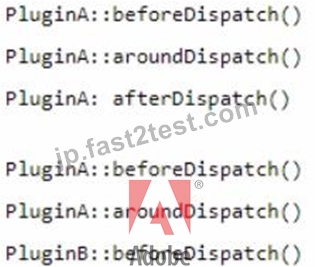
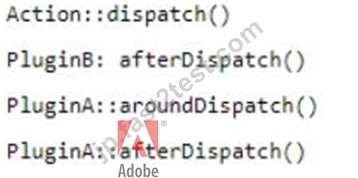
The di. xml file of a module attaches two plugins for the class Action.
The around plugin code is:
What would be the plugin execution order?
- A.
- B.

- C.
正解:C
解説:
The plugin execution order is as follows:
PluginA::beforeDispatch()
PluginB::beforeDispatch()
PluginA::aroundDispatch()
The code in the around plugin
PluginB::afterDispatch()
PluginA::afterDispatch()
The aroundDispatch() method is executed in a separate scope, so the code in the around plugin will be executed after the beforeDispatch() methods of both plugins, but before the afterDispatch() methods of both plugins.
Here is a diagram that shows the plugin execution order:
PluginA
beforeDispatch()
aroundDispatch()
afterDispatch()
PluginB
beforeDispatch()
afterDispatch()
質問 # 55
An Adobe Commerce developer creates a new website using a data patch. Each website will have unique pricing by website. The developer does not have visibility into the production and staging environments so they do not know what the configuration currently is.
How would they ensure the configuration is deployed and consistent across all environments?
A)


- A. Option A
- B. Option B
- C. Option C
正解:B
解説:
To ensure that the configuration is deployed and consistent across all environments, the developer can use the following steps:
Create a data patch that contains the configuration for the new website.
Deploy the data patch to all environments.
Use the magento deploy:status command to verify that the configuration has been deployed to all environments.
質問 # 56
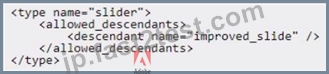
An Adobe Commerce developer has been asked to modify the PageBuilder slider content type to allow a new custom content type (other than slide) to be assigned as a child. The developer has already created the new content type called improved_slide in their module. They now need to create a new view/adminhtml/pagebuilder/content_type/slider. xml file in their module to allow the new content type to be a child of slider content types.
What is the correct xml to accomplish this?
- A.

- B.

- C.
正解:C
解説:
The following XML will allow the new content type to be a child of slider content types:
<pagebuilder_content_type>
<type>slider</type>
<children>
<type>improved_slide</type>
</children>
</pagebuilder_content_type>
Use code with caution. https://bard.google.com/faq
This XML will tell Magento that the slider content type can have improved_slide content types as children.
質問 # 57
......
AD0-E716試験問題高合格率なAD0-E716問題集PDF:https://jp.fast2test.com/AD0-E716-premium-file.html