

2022年02月 Microsoft DP-203認定リアル2022年最新の模擬試験合格させます
DP-203試験問題と有効なDP-203問題集でPDF
質問 122
You need to collect application metrics, streaming query events, and application log messages for an Azure Databrick cluster.
Which type of library and workspace should you implement? To answer, select the appropriate options in the answer area.
NOTE: Each correct selection is worth one point.
正解:
解説:
Explanation
You can send application logs and metrics from Azure Databricks to a Log Analytics workspace. It uses the Azure Databricks Monitoring Library, which is available on GitHub.
References:
https://docs.microsoft.com/en-us/azure/architecture/databricks-monitoring/application-logs
質問 123
You have the following Azure Stream Analytics query.
For each of the following statements, select Yes if the statement is true. Otherwise, select No.
NOTE: Each correct selection is worth one point.
正解:
解説:
Reference:
https://azure.microsoft.com/en-in/blog/maximize-throughput-with-repartitioning-in-azure-stream-analytics/
質問 124
You store files in an Azure Data Lake Storage Gen2 container. The container has the storage policy shown in the following exhibit.
Use the drop-down menus to select the answer choice that completes each statement based on the information presented in the graphic.
NOTE: Each correct selection Is worth one point.
正解:
解説:
質問 125
You have an Azure Data Lake Storage account that contains a staging zone.
You need to design a dairy process to ingest incremental data from the staging zone, transform the data by executing an R script, and then insert the transformed data into a data warehouse in Azure Synapse Analytics.
Solution: You use an Azure Data Factory schedule trigger to execute a pipeline that copies the data to a staging table in the data warehouse, and then uses a stored procedure to execute the R script.
Does this meet the goal?
- A. No
- B. Yes
正解: B
解説:
If you need to transform data in a way that is not supported by Data Factory, you can create a custom activity with your own data processing logic and use the activity in the pipeline.
Note: You can use data transformation activities in Azure Data Factory and Synapse pipelines to transform and process your raw data into predictions and insights at scale.
Reference:
https://docs.microsoft.com/en-us/azure/data-factory/transform-data
質問 126
You need to schedule an Azure Data Factory pipeline to execute when a new file arrives in an Azure Data Lake Storage Gen2 container.
Which type of trigger should you use?
- A. tumbling window
- B. schedule
- C. on-demand
- D. event
正解: D
解説:
Event-driven architecture (EDA) is a common data integration pattern that involves production, detection, consumption, and reaction to events. Data integration scenarios often require Data Factory customers to trigger pipelines based on events happening in storage account, such as the arrival or deletion of a file in Azure Blob Storage account.
Reference:
https://docs.microsoft.com/en-us/azure/data-factory/how-to-create-event-trigger
質問 127
You are monitoring an Azure Stream Analytics job.
The Backlogged Input Events count has been 20 for the last hour.
You need to reduce the Backlogged Input Events count.
What should you do?
- A. Increase the streaming units for the job.
- B. Drop late arriving events from the job.
- C. Add an Azure Storage account to the job.
- D. Stop the job.
正解: A
解説:
General symptoms of the job hitting system resource limits include:
If the backlog event metric keeps increasing, it's an indicator that the system resource is constrained (either because of output sink throttling, or high CPU).
Note: Backlogged Input Events: Number of input events that are backlogged. A non-zero value for this metric implies that your job isn't able to keep up with the number of incoming events. If this value is slowly increasing or consistently non-zero, you should scale out your job: adjust Streaming Units.
Reference:
https://docs.microsoft.com/en-us/azure/stream-analytics/stream-analytics-scale-jobs
https://docs.microsoft.com/en-us/azure/stream-analytics/stream-analytics-monitoring
質問 128
You have files and folders in Azure Data Lake Storage Gen2 for an Azure Synapse workspace as shown in the following exhibit.
You create an external table named ExtTable that has LOCATION='/topfolder/'.
When you query ExtTable by using an Azure Synapse Analytics serverless SQL pool, which files are returned?
- A. File1.csv and File4.csv only
- B. File2.csv and File3.csv only
- C. File1.csv, File2.csv, File3.csv, and File4.csv
- D. File1.csv only
正解: D
解説:
Explanation
To run a T-SQL query over a set of files within a folder or set of folders while treating them as a single entity or rowset, provide a path to a folder or a pattern (using wildcards) over a set of files or folders.
Reference:
https://docs.microsoft.com/en-us/azure/synapse-analytics/sql/query-data-storage#query-multiple-files-or-folders
質問 129
What should you recommend to prevent users outside the Litware on-premises network from accessing the analytical data store?
- A. a server-level virtual network rule
- B. a database-level firewall IP rule
- C. a database-level virtual network rule
- D. a server-level firewall IP rule
正解: A
解説:
Virtual network rules are one firewall security feature that controls whether the database server for your single databases and elastic pool in Azure SQL Database or for your databases in SQL Data Warehouse accepts communications that are sent from particular subnets in virtual networks.
Server-level, not database-level: Each virtual network rule applies to your whole Azure SQL Database server, not just to one particular database on the server. In other words, virtual network rule applies at the serverlevel, not at the database-level.
Reference:
https://docs.microsoft.com/en-us/azure/sql-database/sql-database-vnet-service-endpoint-rule-overview
質問 130
You need to output files from Azure Data Factory.
Which file format should you use for each type of output? To answer, select the appropriate options in the answer area.
NOTE: Each correct selection is worth one point.
正解:
解説: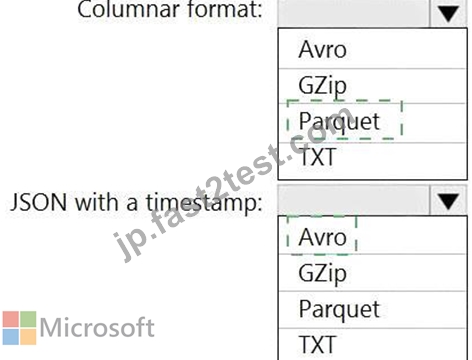
Explanation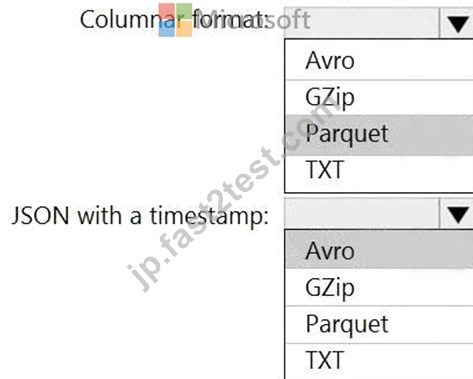
Box 1: Parquet
Parquet stores data in columns, while Avro stores data in a row-based format. By their very nature, column-oriented data stores are optimized for read-heavy analytical workloads, while row-based databases are best for write-heavy transactional workloads.
Box 2: Avro
An Avro schema is created using JSON format.
AVRO supports timestamps.
Note: Azure Data Factory supports the following file formats (not GZip or TXT).
* Avro format
* Binary format
* Delimited text format
* Excel format
* JSON format
* ORC format
* Parquet format
* XML format
Reference:
https://www.datanami.com/2018/05/16/big-data-file-formats-demystified
質問 131
You have an Azure Synapse Analystics dedicated SQL pool that contains a table named Contacts. Contacts contains a column named Phone.
You need to ensure that users in a specific role only see the last four digits of a phone number when querying the Phone column.
What should you include in the solution?
- A. a default value
- B. column encryption
- C. dynamic data masking
- D. table partitions
- E. row-level security (RLS)
正解: C
解説:
Dynamic data masking helps prevent unauthorized access to sensitive data by enabling customers to designate how much of the sensitive data to reveal with minimal impact on the application layer. It's a policy-based security feature that hides the sensitive data in the result set of a query over designated database fields, while the data in the database is not changed.
Reference:
https://docs.microsoft.com/en-us/azure/azure-sql/database/dynamic-data-masking-overview
質問 132
You have an Azure Synapse Analystics dedicated SQL pool that contains a table named Contacts. Contacts contains a column named Phone.
You need to ensure that users in a specific role only see the last four digits of a phone number when querying the Phone column.
What should you include in the solution?
- A. dynamic data masking
- B. a default value
- C. column encryption
- D. row-level security (RLS)
- E. table partitions
正解: D
質問 133
You have an enterprise-wide Azure Data Lake Storage Gen2 account. The data lake is accessible only through an Azure virtual network named VNET1.
You are building a SQL pool in Azure Synapse that will use data from the data lake.
Your company has a sales team. All the members of the sales team are in an Azure Active Directory group named Sales. POSIX controls are used to assign the Sales group access to the files in the data lake.
You plan to load data to the SQL pool every hour.
You need to ensure that the SQL pool can load the sales data from the data lake.
Which three actions should you perform? Each correct answer presents part of the solution.
NOTE: Each area selection is worth one point.
- A. Add the managed identity to the Sales group.
- B. Use the managed identity as the credentials for the data load process.
- C. Create a shared access signature (SAS).
- D. Use the snared access signature (SAS) as the credentials for the data load process.
- E. Create a managed identity.
- F. Add your Azure Active Directory (Azure AD) account to the Sales group.
正解: A,E,F
解説:
Explanation
The managed identity grants permissions to the dedicated SQL pools in the workspace.
Note: Managed identity for Azure resources is a feature of Azure Active Directory. The feature provides Azure services with an automatically managed identity in Azure AD Reference:
https://docs.microsoft.com/en-us/azure/synapse-analytics/security/synapse-workspace-managed-identity
質問 134
You need to create a partitioned table in an Azure Synapse Analytics dedicated SQL pool.
How should you complete the Transact-SQL statement? To answer, drag the appropriate values to the correct targets. Each value may be used once, more than once, or not at all. You may need to drag the split bar between panes or scroll to view content.
NOTE: Each correct selection is worth one point.
正解:
解説:
Reference:
https://docs.microsoft.com/en-us/sql/t-sql/statements/create-table-azure-sql-data-warehouse?
質問 135
You are creating dimensions for a data warehouse in an Azure Synapse Analytics dedicated SQL pool.
You create a table by using the Transact-SQL statement shown in the following exhibit.
Use the drop-down menus to select the answer choice that completes each statement based on the information presented in the graphic.
NOTE: Each correct selection is worth one point.
正解:
解説:
Reference:
https://docs.microsoft.com/en-us/learn/modules/populate-slowly-changing-dimensions-azure-synapse-analytics-pipelines/3-choose-between-dimension-types
質問 136
You have an Azure data solution that contains an enterprise data warehouse in Azure Synapse Analytics named DW1.
Several users execute ad hoc queries to DW1 concurrently.
You regularly perform automated data loads to DW1.
You need to ensure that the automated data loads have enough memory available to complete quickly and successfully when the adhoc queries run.
What should you do?
- A. Hash distribute the large fact tables in DW1 before performing the automated data loads.
- B. Assign a larger resource class to the automated data load queries.
- C. Assign a smaller resource class to the automated data load queries.
- D. Create sampled statistics for every column in each table of DW1.
正解: B
解説:
Explanation
The performance capacity of a query is determined by the user's resource class. Resource classes are pre-determined resource limits in Synapse SQL pool that govern compute resources and concurrency for query execution.
Resource classes can help you configure resources for your queries by setting limits on the number of queries that run concurrently and on the compute-resources assigned to each query. There's a trade-off between memory and concurrency.
Smaller resource classes reduce the maximum memory per query, but increase concurrency.
Larger resource classes increase the maximum memory per query, but reduce concurrency.
Reference:
https://docs.microsoft.com/en-us/azure/synapse-analytics/sql-data-warehouse/resource-classes-for-workload-man
質問 137
You have an enterprise data warehouse in Azure Synapse Analytics that contains a table named FactOnlineSales. The table contains data from the start of 2009 to the end of 2012.
You need to improve the performance of queries against FactOnlineSales by using table partitions. The solution must meet the following requirements:
Create four partitions based on the order date.
Ensure that each partition contains all the orders places during a given calendar year.
How should you complete the T-SQL command? To answer, select the appropriate options in the answer area.
NOTE: Each correct selection is worth one point.
正解:
解説:
Reference:
https://docs.microsoft.com/en-us/sql/t-sql/statements/create-partition-function-transact-sql?view=sql-server-ver15
質問 138
Note: This question is part of a series of questions that present the same scenario. Each question in the series contains a unique solution that might meet the stated goals. Some question sets might have more than one correct solution, while others might not have a correct solution.
After you answer a question in this section, you will NOT be able to return to it. As a result, these questions will not appear in the review screen.
You have an Azure Synapse Analytics dedicated SQL pool that contains a table named Table1.
You have files that are ingested and loaded into an Azure Data Lake Storage Gen2 container named container1.
You plan to insert data from the files in container1 into Table1 and transform the dat a. Each row of data in the files will produce one row in the serving layer of Table1.
You need to ensure that when the source data files are loaded to container1, the DateTime is stored as an additional column in Table1.
Solution: You use an Azure Synapse Analytics serverless SQL pool to create an external table that has an additional DateTime column.
Does this meet the goal?
- A. Yes
- B. No
正解: B
解説:
Instead use the derived column transformation to generate new columns in your data flow or to modify existing fields.
Reference:
https://docs.microsoft.com/en-us/azure/data-factory/data-flow-derived-column
質問 139
You are designing an Azure Databricks table. The table will ingest an average of 20 million streaming events per day.
You need to persist the events in the table for use in incremental load pipeline jobs in Azure Databricks. The solution must minimize storage costs and incremental load times.
What should you include in the solution?
- A. Include a watermark column.
- B. Sink to Azure Queue storage.
- C. Use a JSON format for physical data storage.
- D. Partition by DateTime fields.
正解: D
解説:
The Databricks ABS-AQS connector uses Azure Queue Storage (AQS) to provide an optimized file source that lets you find new files written to an Azure Blob storage (ABS) container without repeatedly listing all of the files.
This provides two major advantages:
Lower latency: no need to list nested directory structures on ABS, which is slow and resource intensive.
Lower costs: no more costly LIST API requests made to ABS.
Reference:
https://docs.microsoft.com/en-us/azure/databricks/spark/latest/structured-streaming/aqs
質問 140
You plan to implement an Azure Data Lake Gen2 storage account.
You need to ensure that the data lake will remain available if a data center fails in the primary Azure region.
The solution must minimize costs.
Which type of replication should you use for the storage account?
- A. geo-redundant storage (GRS)
- B. zone-redundant storage (ZRS)
- C. locally-redundant storage (LRS)
- D. geo-zone-redundant storage (GZRS)
正解: C
解説:
Explanation
Locally redundant storage (LRS) copies your data synchronously three times within a single physical location in the primary region. LRS is the least expensive replication option Reference:
https://docs.microsoft.com/en-us/azure/storage/common/storage-redundancy
質問 141
You are designing a streaming data solution that will ingest variable volumes of data.
You need to ensure that you can change the partition count after creation.
Which service should you use to ingest the data?
- A. Azure Stream Analytics
- B. Azure Event Hubs Dedicated
- C. Azure Synapse Analytics
- D. Azure Data Factory
正解: B
解説:
You can't change the partition count for an event hub after its creation except for the event hub in a dedicated cluster.
Reference:
https://docs.microsoft.com/en-us/azure/event-hubs/event-hubs-features
質問 142
You need to implement versioned changes to the integration pipelines. The solution must meet the data integration requirements.
In which order should you perform the actions? To answer, move all actions from the list of actions to the answer area and arrange them in the correct order.
正解:
解説:
1 - Create a repository and a main branch
2 - Create a feature branch
3 - Create a pull request
4 - Merge changes
5 - Publish changes
Reference:
https://docs.microsoft.com/en-us/azure/devops/pipelines/repos/pipeline-options-for-git
質問 143
You plan to create an Azure Data Lake Storage Gen2 account
You need to recommend a storage solution that meets the following requirements:
* Provides the highest degree of data resiliency
* Ensures that content remains available for writes if a primary data center fails What should you include in the recommendation? To answer, select the appropriate options in the answer area.
正解:
解説:
See the answer in explanation.
Explanation
Answer is below
質問 144
Which Azure Data Factory components should you recommend using together to import the daily inventory data from the SQL server to Azure Data Lake Storage? To answer, select the appropriate options in the answer area.
NOTE: Each correct selection is worth one point.
正解:
解説:
質問 145
......
DP-203問題集を無料PDFゲットせよ最近更新された問題:https://jp.fast2test.com/DP-203-premium-file.html
DP-203ブレーン問題集で学習ガイドには試験合格するための秘訣:https://drive.google.com/open?id=1l_HvXQYy-KptiZbULU-rvCBYCEr7vaGD