

更新された2023年04月16日検証済み!DP-203問題集と解答で100%合格できる
2023年最新のの問題DP-203問題集を試そう!更新されたMicrosoft試験合格させます
Microsoft DP-203 (Microsoft Azure上のデータエンジニアリング)試験は、Microsoft Azureを使用してデータソリューションを構築および管理するデータエンジニアとして活躍するスキルと知識をテストする認定試験です。DP-203試験は、候補者のAzure上でのデータパイプライン、データストレージ、データ処理、およびデータセキュリティの設計、実装、および維持能力を評価するように設計されています。
DP-203試験に合格するためには、複数選択問題とシナリオに基づく問題に答えることで、Azure上でのデータソリューションの設計と実装の能力を証明する必要があります。試験は時間制限があり、150分間続き、合格するには最低でも1000点中700点以上を獲得する必要があります。
質問 # 86
Note: This question is part of a series of questions that present the same scenario. Each question in the series contains a unique solution that might meet the stated goals. Some question sets might have more than one correct solution, while others might not have a correct solution.
After you answer a question in this section, you will NOT be able to return to it. As a result, these questions will not appear in the review screen.
You have an Azure Synapse Analytics dedicated SQL pool that contains a table named Table1.
You have files that are ingested and loaded into an Azure Data Lake Storage Gen2 container named container1.
You plan to insert data from the files in container1 into Table1 and transform the data. Each row of data in the files will produce one row in the serving layer of Table1.
You need to ensure that when the source data files are loaded to container1, the DateTime is stored as an additional column in Table1.
Solution: You use an Azure Synapse Analytics serverless SQL pool to create an external table that has an additional DateTime column.
Does this meet the goal?
- A. No
- B. Yes
正解:A
解説:
Explanation
Instead use the derived column transformation to generate new columns in your data flow or to modify existing fields.
Reference:
https://docs.microsoft.com/en-us/azure/data-factory/data-flow-derived-column
質問 # 87
You have a self-hosted integration runtime in Azure Data Factory.
The current status of the integration runtime has the following configurations:
Status: Running
Type: Self-Hosted
Running / Registered Node(s): 1/1
High Availability Enabled: False
Linked Count: 0
Queue Length: 0
Average Queue Duration. 0.00s
The integration runtime has the following node details:
Name: X-M
Status: Running
Available Memory: 7697MB
CPU Utilization: 6%
Network (In/Out): 1.21KBps/0.83KBps
Concurrent Jobs (Running/Limit): 2/14
Role: Dispatcher/Worker
Credential Status: In Sync
Use the drop-down menus to select the answer choice that completes each statement based on the information presented.
NOTE: Each correct selection is worth one point.
正解:
解説:
Reference:
https://docs.microsoft.com/en-us/azure/data-factory/create-self-hosted-integration-runtime
質問 # 88
You are designing an Azure Synapse Analytics dedicated SQL pool.
You need to ensure that you can audit access to Personally Identifiable information (PII).
What should you include in the solution?
- A. sensitivity classifications
- B. row-level security (RLS)
- C. column-level security
- D. dynamic data masking
正解:C
質問 # 89
You are designing a slowly changing dimension (SCD) for supplier data in an Azure Synapse Analytics dedicated SQL pool.
You plan to keep a record of changes to the available fields.
The supplier data contains the following columns.
Which three additional columns should you add to the data to create a Type 2 SCD? Each correct answer presents part of the solution.
NOTE: Each correct selection is worth one point.
- A. last modified date
- B. effective start date
- C. surrogate primary key
- D. business key
- E. foreign key
- F. effective end date
正解:B、D、E
解説:
Reference:
https://docs.microsoft.com/en-us/sql/integration-services/data-flow/transformations/slowly-changing-dimension-
質問 # 90
You are designing an application that will store petabytes of medical imaging data When the data is first created, the data will be accessed frequently during the first week. After one month, the data must be accessible within 30 seconds, but files will be accessed infrequently. After one year, the data will be accessed infrequently but must be accessible within five minutes.
You need to select a storage strategy for the data. The solution must minimize costs.
Which storage tier should you use for each time frame? To answer, select the appropriate options in the answer area.
NOTE: Each correct selection is worth one point.
正解:
解説:
Explanation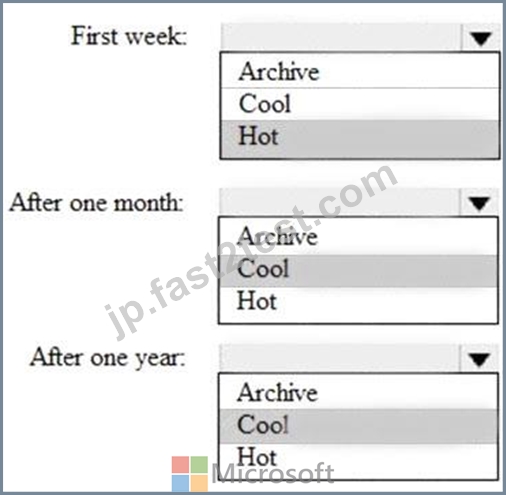
First week: Hot
Hot - Optimized for storing data that is accessed frequently.
After one month: Cool
Cool - Optimized for storing data that is infrequently accessed and stored for at least 30 days.
After one year: Cool
質問 # 91
You need to ensure that the Twitter feed data can be analyzed in the dedicated SQL pool. The solution must meet the customer sentiment analytics requirements.
Which three Transaction-SQL DDL commands should you run in sequence? To answer, move the appropriate commands from the list of commands to the answer area and arrange them in the correct order.
NOTE: More than one order of answer choices is correct. You will receive credit for any of the correct orders you select.
正解:
解説:
Reference:
https://docs.microsoft.com/en-us/azure/synapse-analytics/sql/develop-tables-external-tables
質問 # 92
You have an Azure Synapse Analystics dedicated SQL pool that contains a table named Contacts. Contacts contains a column named Phone.
You need to ensure that users in a specific role only see the last four digits of a phone number when querying the Phone column.
What should you include in the solution?
- A. a default value
- B. row-level security (RLS)
- C. table partitions
- D. dynamic data masking
- E. column encryption
正解:D
解説:
Dynamic data masking helps prevent unauthorized access to sensitive data by enabling customers to designate how much of the sensitive data to reveal with minimal impact on the application layer. It's a policy-based security feature that hides the sensitive data in the result set of a query over designated database fields, while the data in the database is not changed.
Reference:
https://docs.microsoft.com/en-us/azure/azure-sql/database/dynamic-data-masking-overview
質問 # 93
You plan to create a table in an Azure Synapse Analytics dedicated SQL pool.
Data in the table will be retained for five years. Once a year, data that is older than five years will be deleted.
You need to ensure that the data is distributed evenly across partitions. The solution must minimize the amount of time required to delete old data.
How should you complete the Transact-SQL statement? To answer, drag the appropriate values to the correct targets. Each value may be used once, more than once, or not at all. You may need to drag the split bar between panes or scroll to view content.
NOTE: Each correct selection is worth one point.
正解:
解説:
Reference:
https://docs.microsoft.com/en-us/sql/t-sql/statements/create-table-azure-sql-data-warehouse
https://docs.microsoft.com/en-us/azure/synapse-analytics/sql/best-practices-dedicated-sql-pool
質問 # 94
You use PySpark in Azure Databricks to parse the following JSON input.
You need to output the data in the following tabular format.
How should you complete the PySpark code? To answer, drag the appropriate values to he correct targets. Each value may be used once, more than once or not at all. You may need to drag the split bar between panes or scroll to view content.
NOTE: Each correct selection is worth one point.
正解:
解説:
質問 # 95
You have an Azure subscription that contains an Azure Synapse Analytics dedicated SQL pool. You plan to deploy a solution that will analyze sales data and include the following:
* A table named Country that will contain 195 rows
* A table named Sales that will contain 100 million rows
* A query to identify total sales by country and customer from the past 30 days You need to create the tables. The solution must maximize query performance.
How should you complete the script? To answer, select the appropriate options in the answer area.
NOTE: Each correct selection is worth one point.
正解:
解説:
質問 # 96
You are building an Azure Stream Analytics job to retrieve game data.
You need to ensure that the job returns the highest scoring record for each five-minute time interval of each game.
How should you complete the Stream Analytics query? To answer, select the appropriate options in the answer area.
NOTE: Each correct selection is worth one point.
正解:
解説:
Reference:
https://docs.microsoft.com/en-us/stream-analytics-query/topone-azure-stream-analytics
https://docs.microsoft.com/en-us/azure/stream-analytics/stream-analytics-window-functions
質問 # 97
You are building an Azure Stream Analytics job to retrieve game data.
You need to ensure that the job returns the highest scoring record for each five-minute time interval of each game.
How should you complete the Stream Analytics query? To answer, select the appropriate options in the answer area.
NOTE: Each correct selection is worth one point.
正解:
解説:
Reference:
https://docs.microsoft.com/en-us/stream-analytics-query/topone-azure-stream-analytics
https://docs.microsoft.com/en-us/azure/stream-analytics/stream-analytics-window-functions
質問 # 98
You need to create a partitioned table in an Azure Synapse Analytics dedicated SQL pool.
How should you complete the Transact-SQL statement? To answer, drag the appropriate values to the correct targets. Each value may be used once, more than once, or not at all. You may need to drag the split bar between panes or scroll to view content.
NOTE: Each correct selection is worth one point.
正解:
解説:
Reference:
https://docs.microsoft.com/en-us/sql/t-sql/statements/create-table-azure-sql-data-warehouse?
質問 # 99
You have an Azure subscription.
You plan to build a data warehouse in an Azure Synapse Analytics dedicated SQL pool named pool1 that will contain staging tables and a dimensional model Pool1 will contain the following tables.

正解:
解説:
質問 # 100
You are performing exploratory analysis of the bus fare data in an Azure Data Lake Storage Gen2 account by using an Azure Synapse Analytics serverless SQL pool.
You execute the Transact-SQL query shown in the following exhibit.
What do the query results include?
- A. All CSV files that have file names that contain "tripdata_2020".
- B. Only CSV that have file names that beginning with "tripdata_2020".
- C. All files that have file names that beginning with "tripdata_2020".
- D. Only CSV files in the tripdata_2020 subfolder.
正解:B
質問 # 101
You have the following Azure Stream Analytics query.
For each of the following statements, select Yes if the statement is true. Otherwise, select No.
NOTE: Each correct selection is worth one point.
正解:
解説:
Explanation
Box 1: Yes
You can now use a new extension of Azure Stream Analytics SQL to specify the number of partitions of a stream when reshuffling the data.
The outcome is a stream that has the same partition scheme. Please see below for an example:
WITH step1 AS (SELECT * FROM [input1] PARTITION BY DeviceID INTO 10),
step2 AS (SELECT * FROM [input2] PARTITION BY DeviceID INTO 10)
SELECT * INTO [output] FROM step1 PARTITION BY DeviceID UNION step2 PARTITION BY DeviceID Note: The new extension of Azure Stream Analytics SQL includes a keyword INTO that allows you to specify the number of partitions for a stream when performing reshuffling using a PARTITION BY statement.
Box 2: Yes
When joining two streams of data explicitly repartitioned, these streams must have the same partition key and partition count.
Box 3: Yes
10 partitions x six SUs = 60 SUs is fine.
Note: Remember, Streaming Unit (SU) count, which is the unit of scale for Azure Stream Analytics, must be adjusted so the number of physical resources available to the job can fit the partitioned flow. In general, six SUs is a good number to assign to each partition. In case there are insufficient resources assigned to the job, the system will only apply the repartition if it benefits the job.
Reference:
https://azure.microsoft.com/en-in/blog/maximize-throughput-with-repartitioning-in-azure-stream-analytics/
質問 # 102
You are building an Azure Data Factory solution to process data received from Azure Event Hubs, and then ingested into an Azure Data Lake Storage Gen2 container.
The data will be ingested every five minutes from devices into JSON files. The files have the following naming pattern.
/{deviceType}/in/{YYYY}/{MM}/{DD}/{HH}/{deviceID}_{YYYY}{MM}{DD}HH}{mm}.json You need to prepare the data for batch data processing so that there is one dataset per hour per deviceType.
The solution must minimize read times.
How should you configure the sink for the copy activity? To answer, select the appropriate options in the answer area.
NOTE: Each correct selection is worth one point.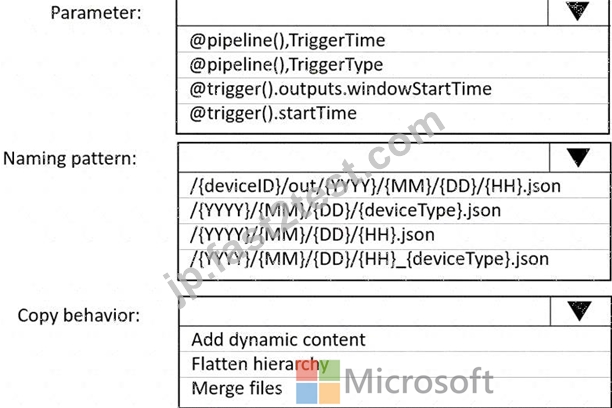
正解:
解説:
Explanation
Box 1: @trigger().startTime
startTime: A date-time value. For basic schedules, the value of the startTime property applies to the first occurrence. For complex schedules, the trigger starts no sooner than the specified startTime value.
Box 2: /{YYYY}/{MM}/{DD}/{HH}_{deviceType}.json
One dataset per hour per deviceType.
Box 3: Flatten hierarchy
- FlattenHierarchy: All files from the source folder are in the first level of the target folder. The target files have autogenerated names.
Reference:
https://docs.microsoft.com/en-us/azure/data-factory/concepts-pipeline-execution-triggers
https://docs.microsoft.com/en-us/azure/data-factory/connector-file-system
質問 # 103
You have an Apache Spark DataFrame named temperatures. A sample of the data is shown in the following table.
You need to produce the following table by using a Spark SQL query.
How should you complete the query? To answer, drag the appropriate values to the correct targets. Each value may be used once, more than once, or not at all. You may need to drag the split bar between panes or scroll to view content.
NOTE: Each correct selection is worth one point.
正解:
解説:
Reference:
https://learnsql.com/cookbook/how-to-convert-an-integer-to-a-decimal-in-sql-server/
https://docs.microsoft.com/en-us/sql/t-sql/queries/from-using-pivot-and-unpivot
質問 # 104
You have an Azure subscription.
You plan to build a data warehouse in an Azure Synapse Analytics dedicated SQL pool named pool1 that will contain staging tables and a dimensional model Pool1 will contain the following tables.

正解:
解説:
質問 # 105
You are building an Azure Stream Analytics job that queries reference data from a product catalog file. The file is updated daily.
The reference data input details for the file are shown in the Input exhibit. (Click the Input tab.)
The storage account container view is shown in the Refdata exhibit. (Click the Refdata tab.)
You need to configure the Stream Analytics job to pick up the new reference data.
What should you configure? To answer, select the appropriate options in the answer area.
NOTE: Each correct selection is worth one point.
正解:
解説:
Explanation
Graphical user interface, application, table Description automatically generated
Box 1: {date}/product.csv
In the 2nd exhibit we see: Location: refdata / 2020-03-20
Note: Path Pattern: This is a required property that is used to locate your blobs within the specified container.
Within the path, you may choose to specify one or more instances of the following 2 variables:
{date}, {time}
Example 1: products/{date}/{time}/product-list.csv
Example 2: products/{date}/product-list.csv
Example 3: product-list.csv
Box 2: YYYY-MM-DD
Note: Date Format [optional]: If you have used {date} within the Path Pattern that you specified, then you can select the date format in which your blobs are organized from the drop-down of supported formats.
Example: YYYY/MM/DD, MM/DD/YYYY, etc.
Reference:
https://docs.microsoft.com/en-us/azure/stream-analytics/stream-analytics-use-reference-data
質問 # 106
You are creating an Azure Data Factory data flow that will ingest data from a CSV file, cast columns to specified types of data, and insert the data into a table in an Azure Synapse Analytic dedicated SQL pool. The CSV file contains three columns named username, comment, and date.
The data flow already contains the following:
A source transformation.
A Derived Column transformation to set the appropriate types of data.
A sink transformation to land the data in the pool.
You need to ensure that the data flow meets the following requirements:
All valid rows must be written to the destination table.
Truncation errors in the comment column must be avoided proactively.
Any rows containing comment values that will cause truncation errors upon insert must be written to a file in blob storage.
Which two actions should you perform? Each correct answer presents part of the solution.
NOTE: Each correct selection is worth one point.
- A. Add a select transformation to select only the rows that will cause truncation errors.
- B. To the data flow, add a filter transformation to filter out rows that will cause truncation errors.
- C. To the data flow, add a Conditional Split transformation to separate the rows that will cause truncation errors.
- D. To the data flow, add a sink transformation to write the rows to a file in blob storage.
正解:C、D
解説:
B: Example:
1. This conditional split transformation defines the maximum length of "title" to be five. Any row that is less than or equal to five will go into the GoodRows stream. Any row that is larger than five will go into the BadRows stream.
2. This conditional split transformation defines the maximum length of "title" to be five. Any row that is less than or equal to five will go into the GoodRows stream. Any row that is larger than five will go into the BadRows stream.
A:
3. Now we need to log the rows that failed. Add a sink transformation to the BadRows stream for logging. Here, we'll "auto-map" all of the fields so that we have logging of the complete transaction record. This is a text-delimited CSV file output to a single file in Blob Storage. We'll call the log file "badrows.csv".
4. The completed data flow is shown below. We are now able to split off error rows to avoid the SQL truncation errors and put those entries into a log file. Meanwhile, successful rows can continue to write to our target database.
Reference:
https://docs.microsoft.com/en-us/azure/data-factory/how-to-data-flow-error-rows
質問 # 107
You have an Azure Data Factory pipeline that has the activity shown in the following exhibit.
Use the drop-down menus to select the answer choice that completes each statement based on the information presented in the graphic.
正解:
解説:
質問 # 108
You have an Azure data factory.
You need to ensure that pipeline-run data is retained for 120 days. The solution must ensure that you can query the data by using the Kusto query language.
Which four actions should you perform in sequence? To answer, move the appropriate actions from the list of actions to the answer area and arrange them in the correct order.
NOTE: More than one order of answer choices is correct. You will receive credit for any of the correct orders you select.
正解:
解説:
Reference:
https://docs.microsoft.com/en-us/azure/data-factory/monitor-using-azure-monitor
質問 # 109
You are designing a financial transactions table in an Azure Synapse Analytics dedicated SQL pool. The table will have a clustered columnstore index and will include the following columns:
* TransactionType: 40 million rows per transaction type
* CustomerSegment: 4 million per customer segment
* TransactionMonth: 65 million rows per month
* AccountType: 500 million per account type
You have the following query requirements:
* Analysts will most commonly analyze transactions for a given month.
* Transactions analysis will typically summarize transactions by transaction type, customer segment, and/or account type You need to recommend a partition strategy for the table to minimize query times.
On which column should you recommend partitioning the table?
- A. CustomerSegment
- B. TransactionMonth
- C. AccountType
- D. TransactionType
正解:B
解説:
Explanation
For optimal compression and performance of clustered columnstore tables, a minimum of 1 million rows per distribution and partition is needed. Before partitions are created, dedicated SQL pool already divides each table into 60 distributed databases.
Example: Any partitioning added to a table is in addition to the distributions created behind the scenes. Using this example, if the sales fact table contained 36 monthly partitions, and given that a dedicated SQL pool has
60 distributions, then the sales fact table should contain 60 million rows per month, or 2.1 billion rows when all months are populated. If a table contains fewer than the recommended minimum number of rows per partition, consider using fewer partitions in order to increase the number of rows per partition.
質問 # 110
You are designing a real-time dashboard solution that will visualize streaming data from remote sensors that connect to the internet. The streaming data must be aggregated to show the average value of each 10-second interval. The data will be discarded after being displayed in the dashboard.
The solution will use Azure Stream Analytics and must meet the following requirements:
Minimize latency from an Azure Event hub to the dashboard.
Minimize the required storage.
Minimize development effort.
What should you include in the solution? To answer, select the appropriate options in the answer area.
NOTE: Each correct selection is worth one point
正解:
解説: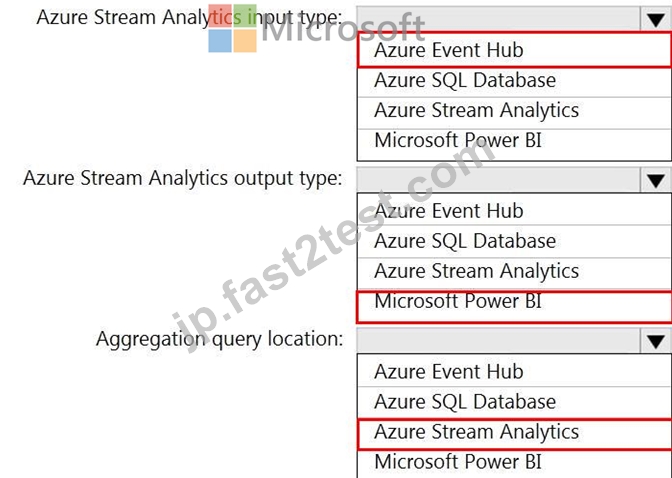
Reference:
https://docs.microsoft.com/en-us/azure/stream-analytics/stream-analytics-power-bi-dashboard
質問 # 111
......
DP-203 試験を受験するには、データモデリング、データ統合、データ変換などのデータエンジニアリングの概念をよく理解している必要があります。また、Hadoop、Spark、NoSQL データベースなどのビッグデータ技術での作業経験が必要です。受験者は、Python、SQL、Scala などのプログラミング言語に精通している必要があります。この試験は、複数選択式の問題と、Azure サービスを使用してデータパイプラインを設計・実装し、データストレージを管理し、データを分析するスキルをデモンストレーションするパフォーマンスベースのタスクで構成されています。DP-203 試験に合格することで、データエンジニアリング分野でのキャリアの可能性を向上させる貴重な認定を取得することができます。
最新のDP-203試験問題集でMicrosoftトレーニング試験には:https://jp.fast2test.com/DP-203-premium-file.html
合格できるMicrosoft DP-203のPDF問題集で最近更新された291問あります:https://drive.google.com/open?id=17ILQ0UUYRzvmt5bm3Tn7Oc4LErOU-iGO