

信頼できるMicrosoft Certified: Azure Data Engineer Associate DP-203問題集PDF 2023年02月14日最近更新された問題
必ず合格できるMicrosoft DP-203試験正確な275問題と解答あります
質問 37
You have an Azure Synapse Analytics workspace named WS1 that contains an Apache Spark pool named Pool1.
You plan to create a database named D61 in Pool1.
You need to ensure that when tables are created in DB1, the tables are available automatically as external tables to the built-in serverless SQL pod.
Which format should you use for the tables in DB1?
- A. ORC
- B. JSON
- C. CSV
- D. Parquet
正解: D
解説:
Serverless SQL pool can automatically synchronize metadata from Apache Spark. A serverless SQL pool database will be created for each database existing in serverless Apache Spark pools.
For each Spark external table based on Parquet or CSV and located in Azure Storage, an external table is created in a serverless SQL pool database.
Reference:
https://docs.microsoft.com/en-us/azure/synapse-analytics/sql/develop-storage-files-spark-tables
質問 38
You manage an enterprise data warehouse in Azure Synapse Analytics.
Users report slow performance when they run commonly used queries. Users do not report performance changes for infrequently used queries.
You need to monitor resource utilization to determine the source of the performance issues.
Which metric should you monitor?
- A. Data IO percentage
- B. Cache used percentage
- C. Local tempdb percentage
- D. DWU percentage
正解: B
解説:
Monitor and troubleshoot slow query performance by determining whether your workload is optimally leveraging the adaptive cache for dedicated SQL pools.
Reference:
https://docs.microsoft.com/en-us/azure/synapse-analytics/sql-data-warehouse/sql-data-warehouse-how-to-monitor-cache
質問 39
You need to output files from Azure Data Factory.
Which file format should you use for each type of output? To answer, select the appropriate options in the answer are a.
NOTE: Each correct selection is worth one point.
正解:
解説:
Reference:
https://www.datanami.com/2018/05/16/big-data-file-formats-demystified
質問 40
You plan to create a dimension table in Azure Synapse Analytics that will be less than 1 GB.
You need to create the table to meet the following requirements:
* Provide the fastest Query time.
* Minimize data movement during queries.
Which type of table should you use?
- A. hash distributed
- B. replicated
- C. round-robin
- D. heap
正解: B
解説:
A replicated table has a full copy of the table accessible on each Compute node. Replicating a table removes the need to transfer data among Compute nodes before a join or aggregation. Since the table has multiple copies, replicated tables work best when the table size is less than 2 GB compressed. 2 GB is not a hard limit.
質問 41
You have a data model that you plan to implement in a data warehouse in Azure Synapse Analytics as shown in the following exhibit.
All the dimension tables will be less than 2 GB after compression, and the fact table will be approximately 6 TB.
Which type of table should you use for each table? To answer, select the appropriate options in the answer area.
NOTE: Each correct selection is worth one point.
正解:
解説:
Explanation
質問 42
You need to design an Azure Synapse Analytics dedicated SQL pool that meets the following requirements:
* Can return an employee record from a given point in time.
* Maintains the latest employee information.
* Minimizes query complexity.
How should you model the employee data?
- A. as a SQL graph table
- B. as a temporal table
- C. as a Type 2 slowly changing dimension (SCD) table
- D. as a degenerate dimension table
正解: C
解説:
Explanation
A Type 2 SCD supports versioning of dimension members. Often the source system doesn't store versions, so the data warehouse load process detects and manages changes in a dimension table. In this case, the dimension table must use a surrogate key to provide a unique reference to a version of the dimension member. It also includes columns that define the date range validity of the version (for example, StartDate and EndDate) and possibly a flag column (for example, IsCurrent) to easily filter by current dimension members.
Reference:
https://docs.microsoft.com/en-us/learn/modules/populate-slowly-changing-dimensions-azure-synapse-analytics-p
質問 43
You need to implement an Azure Databricks cluster that automatically connects to Azure Data lake Storage Gen2 by using Azure Active Directory (Azure AD) integration. How should you configure the new clutter? To answer, select the appropriate options in the answers are a. NOTE: Each correct selection is worth one point.
正解:
解説:
Explanation:
https://docs.azuredatabricks.net/spark/latest/data-sources/azure/adls-passthrough.html
質問 44
You have a SQL pool in Azure Synapse.
A user reports that queries against the pool take longer than expected to complete.
You need to add monitoring to the underlying storage to help diagnose the issue.
Which two metrics should you monitor? Each correct answer presents part of the solution.
NOTE: Each correct selection is worth one point.
- A. Cache hit percentage
- B. DWU Limit
- C. Cache used percentage
- D. Snapshot Storage Size
- E. Active queries
正解: A,C
解説:
Explanation
A: Cache used is the sum of all bytes in the local SSD cache across all nodes and cache capacity is the sum of the storage capacity of the local SSD cache across all nodes.
E: Cache hits is the sum of all columnstore segments hits in the local SSD cache and cache miss is the columnstore segments misses in the local SSD cache summed across all nodes Reference:
https://docs.microsoft.com/en-us/azure/synapse-analytics/sql-data-warehouse/sql-data-warehouse-concept-resou
質問 45
You are designing a statistical analysis solution that will use custom proprietary1 Python functions on near real-time data from Azure Event Hubs.
You need to recommend which Azure service to use to perform the statistical analysis. The solution must minimize latency.
What should you recommend?
- A. Azure SQL Database
- B. Azure Synapse Analytics
- C. Azure Stream Analytics
- D. Azure Databricks
正解: C
解説:
Reference:
https://docs.microsoft.com/en-us/azure/event-hubs/process-data-azure-stream-analytics
質問 46
You are designing a real-time dashboard solution that will visualize streaming data from remote sensors that connect to the internet. The streaming data must be aggregated to show the average value of each 10-second interval. The data will be discarded after being displayed in the dashboard.
The solution will use Azure Stream Analytics and must meet the following requirements:
Minimize latency from an Azure Event hub to the dashboard.
Minimize the required storage.
Minimize development effort.
What should you include in the solution? To answer, select the appropriate options in the answer area.
NOTE: Each correct selection is worth one point
正解:
解説:
Reference:
https://docs.microsoft.com/en-us/azure/stream-analytics/stream-analytics-power-bi-dashboard
質問 47
You use Azure Data Lake Storage Gen2.
You need to ensure that workloads can use filter predicates and column projections to filter data at the time the data is read from disk.
Which two actions should you perform? Each correct answer presents part of the solution.
NOTE: Each correct selection is worth one point.
- A. Reregister the Microsoft Data Lake Store resource provider.
- B. Create a storage policy that is scoped to a container prefix filter.
- C. Create a storage policy that is scoped to a container.
- D. Reregister the Azure Storage resource provider.
- E. Register the query acceleration feature.
正解: D,E
質問 48
You have an Azure Stream Analytics job.
You need to ensure that the job has enough streaming units provisioned.
You configure monitoring of the SU % Utilization metric.
Which two additional metrics should you monitor? Each correct answer presents part of the solution.
NOTE: Each correct selection is worth one point.
- A. Watermark Delay
- B. Out of order Events
- C. Function Events
- D. Late Input Events
- E. Backlogged Input Events
正解: A,E
解説:
To react to increased workloads and increase streaming units, consider setting an alert of 80% on the SU Utilization metric. Also, you can use watermark delay and backlogged events metrics to see if there is an impact.
Note: Backlogged Input Events: Number of input events that are backlogged. A non-zero value for this metric implies that your job isn't able to keep up with the number of incoming events. If this value is slowly increasing or consistently non-zero, you should scale out your job, by increasing the SUs.
Reference:
https://docs.microsoft.com/en-us/azure/stream-analytics/stream-analytics-monitoring
質問 49
You are implementing Azure Stream Analytics windowing functions.
Which windowing function should you use for each requirement? To answer, select the appropriate options in the answer area.
NOTE: Each correct selection is worth one point.
正解:
解説:
質問 50
Which Azure Data Factory components should you recommend using together to import the daily inventory data from the SQL server to Azure Data Lake Storage? To answer, select the appropriate options in the answer area.
NOTE: Each correct selection is worth one point.
正解:
解説:
質問 51
A company plans to use Apache Spark analytics to analyze intrusion detection data.
You need to recommend a solution to analyze network and system activity data for malicious activities and policy violations. The solution must minimize administrative efforts.
What should you recommend?
- A. Azure Databricks
- B. Azure Data Factory
- C. Azure HDInsight
- D. Azure Data Lake Storage
正解: A
解説:
Three common analytics use cases with Microsoft Azure Databricks
Recommendation engines, churn analysis, and intrusion detection are common scenarios that many organizations are solving across multiple industries. They require machine learning, streaming analytics, and utilize massive amounts of data processing that can be difficult to scale without the right tools. Recommendation engines, churn analysis, and intrusion detection are common scenarios that many organizations are solving across multiple industries. They require machine learning, streaming analytics, and utilize massive amounts of data processing that can be difficult to scale without the right tools.
Note: Recommendation engines, churn analysis, and intrusion detection are common scenarios that many organizations are solving across multiple industries. They require machine learning, streaming analytics, and utilize massive amounts of data processing that can be difficult to scale without the right tools.
質問 52
You have an Azure Active Directory (Azure AD) tenant that contains a security group named Group1. You have an Azure Synapse Analytics dedicated SQL pool named dw1 that contains a schema named schema1.
You need to grant Group1 read-only permissions to all the tables and views in schema1. The solution must use the principle of least privilege.
Which three actions should you perform in sequence? To answer, move the appropriate actions from the list of actions to the answer area and arrange them in the correct order.
NOTE: More than one order of answer choices is correct. You will receive credit for any of the correct orders you select.
正解:
解説: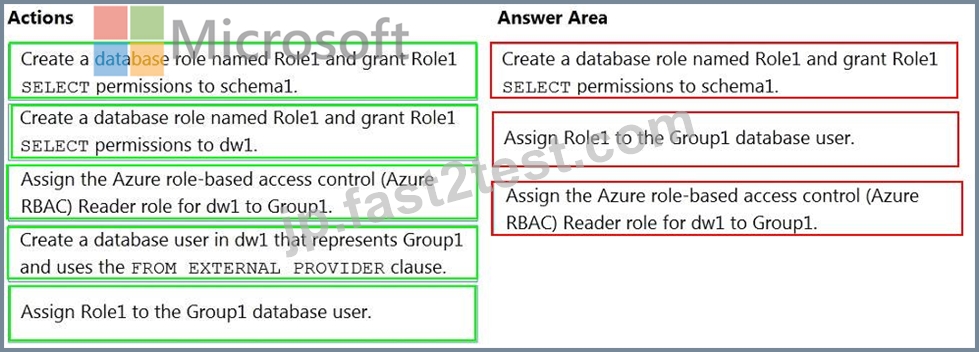
Reference:
https://docs.microsoft.com/en-us/azure/data-share/how-to-share-from-sql
質問 53
You are designing a monitoring solution for a fleet of 500 vehicles. Each vehicle has a GPS tracking device that sends data to an Azure event hub once per minute.
You have a CSV file in an Azure Data Lake Storage Gen2 container. The file maintains the expected geographical area in which each vehicle should be.
You need to ensure that when a GPS position is outside the expected area, a message is added to another event hub for processing within 30 seconds. The solution must minimize cost.
What should you include in the solution? To answer, select the appropriate options in the answer area.
NOTE: Each correct selection is worth one point.
正解:
解説:
Reference:
https://docs.microsoft.com/en-us/azure/stream-analytics/stream-analytics-window-functions
質問 54
You have an Azure Synapse Analytics dedicated SQL pool that contains a large fact table. The table contains
50 columns and 5 billion rows and is a heap.
Most queries against the table aggregate values from approximately 100 million rows and return only two columns.
You discover that the queries against the fact table are very slow.
Which type of index should you add to provide the fastest query times?
- A. clustered
- B. nonclustered
- C. clustered columnstore
- D. nonclustered columnstore
正解: C
解説:
Explanation
Clustered columnstore indexes are one of the most efficient ways you can store your data in dedicated SQL pool.
Columnstore tables won't benefit a query unless the table has more than 60 million rows.
Reference:
https://docs.microsoft.com/en-us/azure/synapse-analytics/sql/best-practices-dedicated-sql-pool
質問 55
......
2023年最新の実際にある検証済みのDP-203問題集:https://jp.fast2test.com/DP-203-premium-file.html
合格させるDP-203試験で更新された275問題あります:https://drive.google.com/open?id=1L3fCd1WEC4rTDvGgH_1CEudEr3uHcvTE