

PECB ISO-9001-Lead-Auditor豪華セット学習ガイドにはオンライン試験エンジン
ISO-9001-Lead-Auditor問題集レビュー専門クイズ学習材料
質問 # 22
Below are four of the seven principles on which ISO 9000 series are based. Match a potential benefit to each of the quality management principles (QMP).
正解:
解説: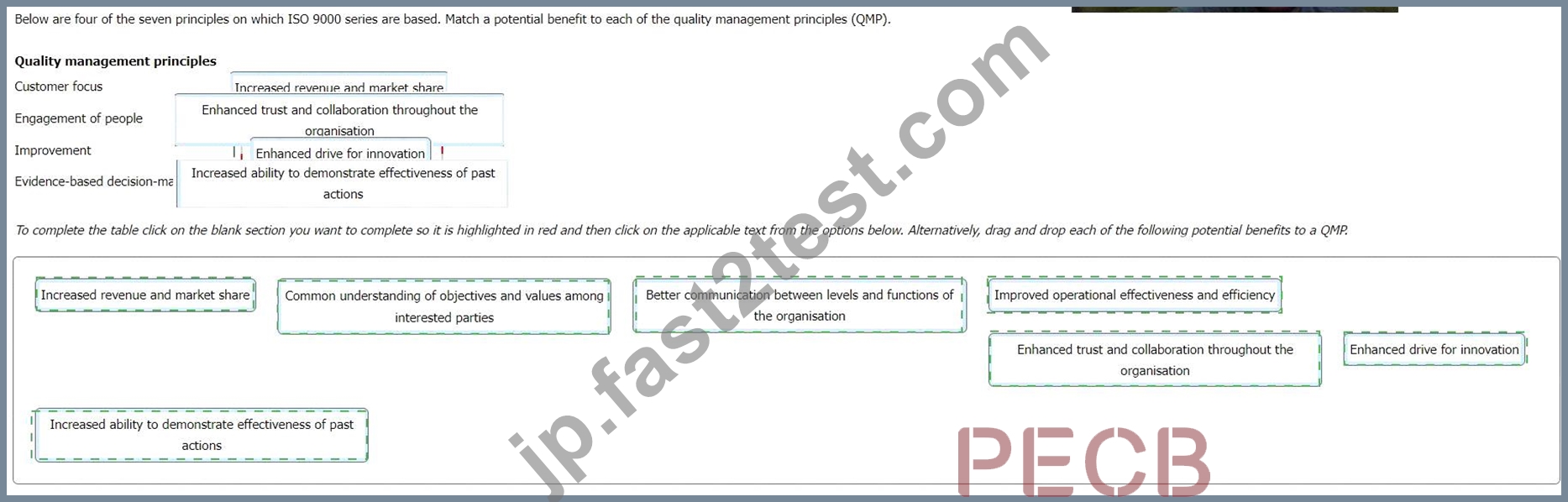
Explanation:
Quality management principles:
Customer focus = Increased revenue and market share
Engagement of people = Enhanced trust and collaboration throughout the organisation Improvement = Enhanced drive for innovation Evidence-based decision-making = Increased ability to demonstrate effectiveness of past actions According to the Quality management principles document published by ISO, each quality management principle has a statement, a rationale, key benefits, and actions you can take to apply it. Based on these descriptions, the potential benefits can be matched to the corresponding principles as follows:
Customer focus: The primary focus of quality management is to meet customer requirements and to strive to exceed customer expectations. The key benefits of this principle include increased customer value, customer satisfaction, customer loyalty, repeat business, reputation, customer base, revenue and market share.
Engagement of people: Competent, empowered and engaged people at all levels throughout the organization are essential to enhance its capability to create and deliver value. The key benefits of this principle include improved understanding of the organization's objectives and values, increased involvement in improvement activities, enhanced personal development, increased motivation and empowerment, enhanced trust and collaboration, and increased recognition and rewards.
Improvement: Successful organizations have an ongoing focus on improvement. The key benefits of this principle include improved organizational capabilities, alignment of improvement activities at all levels, increased ability to anticipate and react to opportunities and threats, enhanced drive for innovation, and increased levels of satisfaction.
Evidence-based decision-making: Decisions based on the analysis and evaluation of data and information are more likely to produce desired results. The key benefits of this principle include improved decision-making processes, increased ability to demonstrate the effectiveness of past decisions, increased ability to review, challenge and change opinions and decisions, and increased ability to improve performance.
質問 # 23
You are conducting a third-party Stage 1 audit at ABC Ltd, a single-site organisation that manufactures wooden furniture. You interview the Technical Director to learn more about the organisation. The Technical Director explains that they have had a successful year and that obtaining ISO 9001 certification will support the further growth of the business. You ask for an overview of the organisation's structure and its interrelationships with external interested parties.
The Technical Director shows you a document detailing all business processes and interrelationships. You notice in this document that another organisation called Teak Ltd manufactures wooden furniture on behalf of ABC Ltd. The Technical Director confirms this capability has been accounted for in the scope of the quality management system. You learn that the furniture manufactured by Teak Ltd has accounted for 40% of the sales revenue over the previous 12 months.
Which two of the following options best describe how you would plan the audit of the interrelationship with Teak Ltd during the Stage 2 audit at ABC Ltd?
- A. Verify Teak Ltd supply arrangements as described in the ABC Ltd quality management system
- B. Verify if Teak Ltd are certified to ISO 9001
- C. Verify the quality management system at Teak Ltd by conducting an audit at their site
- D. Verify how ABC Ltd evaluates the performance of Teak Ltd
- E. Verify whether the design processes of Teak Ltd comply with ISO 9001
- F. Verify the controls concerning customer property implemented by Teak Ltd
正解:A、D
解説:
According to ISO 9001:2015, clause 8.4, an organization is required to control the processes, products and services provided by external providers, including those that affect the quality of the organization's own products and services. This includes determining the controls to be applied to the external provision of processes, products and services, as well as the information to be communicated to the external providers. The organization is also required to monitor, measure, and evaluate the performance of the external providers and retain documented information of these activities.
Therefore, in the scenario given, ABC Ltd is responsible for controlling the processes, products and services provided by Teak Ltd, as they affect the quality of ABC Ltd's own products and services. This means that ABC Ltd should have established criteria and methods for evaluating the performance of Teak Ltd, as well as documented information of the results of such evaluation. ABC Ltd should also have defined the supply arrangements with Teak Ltd, including the specifications, requirements, and verification activities related to the products and services provided by Teak Ltd.
Hence, the best options to describe how to plan the audit of the interrelationship with Teak Ltd during the Stage 2 audit at ABC Ltd are A and D, as they are aligned with the requirements of ISO 9001:2015, clause 8.4.
The other options are either irrelevant or beyond the scope of the audit, as they do not pertain to the control of external provision by ABC Ltd.
References:
ISO 9001:2015(en), Quality management systems - Requirements, clause 8.4 ISO 19011:2018(en), Guidelines for auditing management systems, clause 6.3.1 and 6.4.2 ISO 9001 Lead Auditor Training Course | IRCA Certified | BSI, section "Learning objectives" ISO 9001 Lead Auditor Course Material | 3FOLD Education Centre, module 5 and 6
質問 # 24
Takitup is a small fabrication organisation that manufactures steel fencing, stairs and platforms for the construction sector. It has been certified to ISO 9001 for some time and has appointed a new Quality Manager.
The audit plan during a surveillance audit covers the organisation's improvement actions and the auditor asks to see the most recent management review meeting minutes.
The auditor finds that the management review report records that none of the improvement actions set by the previous review has been realised for a second time. A new Quality Manager has been brought in at the middle management level to rectify the situation as the organisation is concerned that it might lose its certification.
Select three options that would provide evidence of conformance with clause 10.3 of ISO 9001.
- A. Outsource more processes to external providers
- B. An increase in the number of quality staff.
- C. A quality objective to achieve lower reject rates by quality control.
- D. The certification body auditor reporting fewer nonconformities.
- E. An enhanced customer satisfaction survey score than in the previous year.
- F. Considering results from the analysis of the effectiveness of corrective actions to determine improvement opportunities.
- G. Automate the fabrication process to increase profitability.
- H. Removing expensive external providers from the database.
正解:C、E、F
質問 # 25
During a second-party audit of a dairy farm (by a potential customer) complying with ISO 9001:2015, the auditor verifies that there is large variability in the daily production of the milking yard. The current agreement with their only customer is to provide 2,000 litres per day. However, in the last two years, they have noticed an increasing variability in daily production.
If they produce less than 2,000 litres, they are penalised with a fine of 1.5 pesos for every litre that they do not provide. If they produce more than 2,000 litres, they use the extra milk to feed the pigs.
This process has been in operation for decades. The dairy farm was founded by the grandfather of the current owners, who did not want to alter the established practices.
The auditor raises a nonconformity on the basis that the process is not under control (Clause 8.1).
If you had been the auditor, which one of the following actions would you have accepted?
- A. Modify the contract with the current customer to provide them with only 1,500 litres of milk per day and make an agreement with a second customer.
- B. Retain the current contract and try to sell the occasional surplus milk to a second customer.
- C. Analyse the daily dispatch of milk for 7 days to determine its variability.
- D. Apply the existing process of addressing the risks and opportunities of milk production.
正解:D
解説:
The action that the auditor would have accepted is:
*Option B: Apply the existing process of addressing the risks and opportunities of milk production. This option is correct because ISO 9001:2015 clause 8.1 requires the organization to plan, implement and control the processes needed to meet the requirements for the provision of products and services, and to implement actions determined in clause 6.1, which refers to the actions to address risks and opportunities. The organization should apply the existing process of addressing the risks and opportunities of milk production, which may include identifying the sources of variability, assessing the potential impacts and consequences, determining and implementing appropriate actions to reduce or eliminate the variability, monitoring and measuring the effectiveness of the actions, and reviewing and updating the actions as necessary.
The following options are not correct:
*Option A: Modify the contract with the current customer to provide them with only 1,500 litres of milk per day and make an agreement with a second customer. This option is not correct because it does not address the root cause of the variability in the daily production of the milking yard, which may affect the quality and consistency of the products and services provided by the organization. It also does not demonstrate the organization's commitment to meet the customer and applicable statutory and regulatory requirements, as required by ISO 9001:2015 clause 8.2.2.
*Option C: Retain the current contract and try to sell the occasional surplus milk to a second customer. This option is not correct because it does not address the root cause of the variability in the daily production of the milking yard, which may affect the quality and consistency of the products and services provided by the organization. It also does not demonstrate the organization's commitment to meet the customer and applicable statutory and regulatory requirements, as required by ISO 9001:2015 clause 8.2.2.
*Option D: Analyse the daily dispatch of milk for 7 days to determine its variability. This option is not correct because it does not address the root cause of the variability in the daily production of the milking yard, which may affect the quality and consistency of the products and services provided by the organization. It also does not demonstrate the organization's commitment to implement actions to address risks and opportunities, as required by ISO 9001:2015 clause 8.1.
References:
*ISO 9001:2015 Quality management systems - Requirements, Clause 8: Operation, Subclause 8.1:
Operational planning and control, Subclause 8.2: Requirements for products and services
*ISO 9001 Lead Auditor Course Material, Module 4: ISO 9001:2015 Requirements, Slide 23: Clause 8 - Operation
*ISO 9001 Lead Auditor Training Course - IRCA Certified, Section 4.2: ISO 9001:2015 Requirements, Subsection 4.2.8: Clause 8 - Operation
*Lead Auditor Exam Preparation Guide (EPG) Template - PECB, Section 3.2: Exam Content Outline, Subsection 3.2.1: Section 1 - Audit Fundamentals, Subsection 3.2.2: Section 2 - Audit Principles, Subsection
3.2.3: Section 3 - Audit Process, Subsection 3.2.4: Section 4 - Audit Competencies
質問 # 26
You are conducting a third-party audit to ISO 9001 and the next item on your audit plan is 'internal auditing'.
When reviewing a sample of audit records up to 5 years previously, you find that many contain non-conformance reports and no actions have been taken. You interview the Quality Manager.
You: "I have noted that many of the older files contain non-conformances that have not had any corrective action taken." Quality Manager: "Because the business is always changing, the departmental managers tell me that the non-conformances are no longer applicable. I made a decision that any non-conformance over 3 years old is automatically closed" You: "Do you obtain any confirmation beforehand from the appropriate departments that the non-conformances are no longer applicable." Quality Manager: " No, because they are so old I consider that they are no longer appropriate. Please remember that we take a risk-based approach which means we audit where and when it is considered important to do so.
Select one course of action you would now take from the options.
- A. Raise a non-conformance report against clause 9.2.2.e of ISO 9001
- B. Interview Top management to determine whether they were aware of and agreed the actions of the Quality Manager
- C. Review all non-conformances reports related to clause 9.2 of ISO 9001
- D. Interview relevant Departmental managers to assess whether the older non-conformances are still valid.
正解:A
解説:
According to ISO 9001:2015, clause 9.2.2.e, the organization is required to retain documented information as evidence of the implementation of the audit programme and the audit results. This includes the records of the nonconformities identified during the internal audits and the corrective actions taken to address them. The organization is also required to verify the effectiveness of the corrective actions, as per clause 10.2.2.
Therefore, in the scenario given, the Quality Manager's decision to automatically close any nonconformance over 3 years old without obtaining any confirmation from the relevant departments or verifying the effectiveness of the corrective actions is a clear violation of the requirements of clause 9.2.2.e. This indicates a lack of control and follow-up of the internal audit process, as well as a potential risk of recurrence or occurrence of the nonconformities in other areas. This also undermines the credibility and value of the internal audit programme, as well as the risk-based approach claimed by the Quality Manager.
Hence, the best course of action to take is D, to raise a nonconformance report against clause 9.2.2.e of ISO
9001, and to communicate the audit findings to the relevant management. The other options are either insufficient or irrelevant to address the issue, as they do not directly relate to the noncompliance with clause
9.2.2.e.
References:
ISO 9001:2015(en), Quality management systems - Requirements, clause 9.2.2 and 10.2.2 ISO 19011:2018(en), Guidelines for auditing management systems, clause 6.4.4 and 6.7.2 ISO 9001 Lead Auditor Training Course | IRCA Certified | BSI, section "Learning objectives" ISO 9001 Lead Auditor Course Material | 3FOLD Education Centre, module 5 and 6
質問 # 27
Put the following steps of a third-party audit into the correct sequence in which they happen.
正解:
解説:
Explanation:
Sequence:
Stage 1 Audit
Stage 2 Opening Meeting
Interviews
Stage 2 Closing Meeting
Close-out of Stage 2 Audit Findings
Issue Certificate
Surveillance Audit
Follow-up Audit
To complete the sequence, you can drag and drop the options to the appropriate blank section.
Here is a brief explanation of each step:
Stage 1 Audit: This is the initial audit that aims to assess the readiness of the organization for the stage 2 audit. It involves reviewing the documentation of the quality management system, evaluating the scope and objectives of the audit, and identifying any major gaps or nonconformities34.
Stage 2 Opening Meeting: This is the meeting that marks the start of the stage 2 audit. It involves confirming the audit plan, the audit criteria, the audit scope, and the audit team. It also provides an opportunity for the auditee to ask any questions or raise any concerns34.
Interviews: This is the main activity of the stage 2 audit, where the audit team collects evidence by interviewing the personnel involved in the quality management system, observing the processes and activities, and examining the records and documents. The audit team uses various techniques, such as sampling, measurement, analysis, and evaluation, to verify the conformity and effectiveness of the quality management system345.
Stage 2 Closing Meeting: This is the meeting that marks the end of the stage 2 audit. It involves presenting the audit findings, the audit conclusions, and the audit report to the auditee. It also provides an opportunity for the auditee to provide feedback, ask questions, or dispute any findings34.
Close-out of Stage 2 Audit Findings: This is the process of verifying that the auditee has taken appropriate corrective actions to address any nonconformities or opportunities for improvement identified during the stage 2 audit. The audit team may request evidence or conduct a follow-up visit to confirm the effectiveness of the corrective actions34.
Issue Certificate: This is the process of issuing a certificate of conformity to the auditee, if the audit team is satisfied that the quality management system meets the requirements of the standard and that there are no major nonconformities or unresolved issues. The certificate is valid for a specified period, usually three years, and is subject to periodic surveillance audits34.
Surveillance Audit: This is the process of conducting periodic audits, usually once a year, to monitor the continued conformity and effectiveness of the quality management system. It involves reviewing the changes, improvements, and performance of the quality management system, and identifying any new nonconformities or opportunities for improvement34.
Follow-up Audit: This is the process of conducting an additional audit, usually in response to a significant change, a complaint, or a major nonconformity, to verify the impact and the corrective actions taken by the auditee. It may result in the suspension, withdrawal, or renewal of the certificate, depending on the outcome of the audit34.
質問 # 28
You are an auditor from a construction organisation who is conducting a second party audit to ISO 9001 at a steel rolling mill producing structural steelwork. When auditing the rolling process, you find that the operator who is unloading the furnace does not use the adjacent infrared pyrometer to measure the appropriate product temperature in readiness for the next production stage.
You: "How do you tell when the billet is ready for the rolling stage?"
Operator: "I've done this job for 20 years. I can tell by the bright red colour." You: "What happens if the colour is wrong?" Operator: "The billet goes back into the furnace." You: "Is the pyrometer ever used?" Operator: "Only in borderline cases." You continue to interview the operator and find that around 25% of the billets are sent back to the furnace.
This includes 80% of the borderline cases.
Select three options that would provide evidence of conformance with clause 9.1.1 of ISO 9001.
- A. A procedure that provides instruction in taking billet temperature.
- B. A quality objective to achieve lower recycle rates for billets.
- C. Periodic analysis of the results of temperature checks.
- D. Maintenance plan for the furnace.
- E. Annual review records for furnace operators.
- F. An increase in the use of the pyrometer by operators.
- G. Certification of conformance to national standards from the manufacture of the pyrometer.
- H. Planning for monitoring and measuring the billet temperature.
正解:A、C、H
解説:
According to ISO 9001:2015, clause 9.1.1, the organization is required to determine what needs to be monitored and measured, the methods for monitoring, measurement, analysis and evaluation, as applicable, to ensure valid results, and when the monitoring and measuring shall be performed. The organization is also required to retain appropriate documented information as evidence of the results.
Therefore, in the scenario given, the organization should have planned for monitoring and measuring the billet temperature, as it is a critical factor for the quality of the product and the process. The organization should also have established a procedure that provides instruction in taking billet temperature, using the pyrometer or other suitable methods, to ensure consistency and accuracy. The organization should also have performed periodic analysis of the results of temperature checks, to identify trends, problems, and opportunities for improvement.
Hence, the options that would provide evidence of conformance with clause 9.1.1 of ISO 9001 are A, E, and F, as they are aligned with the requirements of the clause. The other options are either irrelevant or not directly related to clause 9.1.1, as they do not pertain to the monitoring and measurement of the billet temperature.
References:
ISO 9001:2015(en), Quality management systems - Requirements, clause 9.1.1 ISO 19011:2018(en), Guidelines for auditing management systems, clause 6.4.4 and 6.7.2 ISO 9001 Lead Auditor Training Course | IRCA Certified | BSI, section "Learning objectives" ISO 9001 Lead Auditor Course Material | 3FOLD Education Centre, module 5 and 6
質問 # 29
An audit team leader arrives at a printing company to carry out a Stage 2 audit for a certification body. At a meeting with the Quality Manager, she is told that they have won their biggest contract from a computer manufacturer to print and compile computer documentation packages. The Quality Manager wants the ISO
9001 certificate to cover the new contract.
During the audit, a team member found that some print jobs had been rejected by several clients over some months due to spelling errors in the print run. The Print Manager blames the new employees they had to take on because of a big contract.
The auditor finds that the responsibility for checking spelling errors is placed on the printer that sets up the print run.
In line with the policy of the certification body, the audit team raise improvement opportunities in the audit report. Which three of the following options would represent acceptable opportunities for improvement in the report?
- A. A business consultant can be recommended for advice on improving operations.
- B. An intensive training plan that involves all production personnel.
- C. Operational planning activities may benefit from a clearer risk-based approach.
- D. The responsibility for checking printing needs to be independent of the operators.
- E. The organisation needs to delay its certification to gain more experience of the QMS.
- F. The recruitment process to include spelling tests to filter out unsuitable candidates.
- G. A plan to determine why the errors occur and to prevent them.
- H. More process time needs to be allocated to the new employees.
正解:C、D、G
解説:
According to the ISO 9001 Auditing Practices Group Guidance on Improvement Opportunities1, an improvement opportunity is a suggestion made by the auditor for the auditee to consider that, if implemented, may enhance the performance of the QMS. Improvement opportunities are not mandatory, but they should be based on objective evidence and aligned with the audit criteria and objectives. Improvement opportunities should also be realistic, feasible, and beneficial for the auditee. In this case, the evidence statements that represent acceptable improvement opportunities in the report are A, C, and E, because they address the potential causes and effects of the spelling errors in the print run, and propose possible actions that may improve the quality of the products and services, and the effectiveness of the QMS. These options are consistent with the requirements and principles of ISO 9001, such as clause 6.1 on actions to address risks and opportunities, clause 8.1 on operational planning and control, clause 8.5.1 on control of production and service provision, and clause 10.2 on nonconformity and corrective action. The other options are not appropriate improvement opportunities, because they are either irrelevant, unrealistic, or unhelpful for the auditee. For example, option B may contradict the audit objective and scope, option D may imply a lack of auditor competence or impartiality, option F may not address the root cause of the problem, option G may not be applicable or effective, and option H may not be feasible or justified. References: ISO 9001 Auditing Practices Group Guidance on Improvement Opportunities, ISO 9001:2015, ISO 9001 Auditing Practices Group Guidance on Audit Evidence
質問 # 30
Match the process descriptions below to the process names:
正解:
解説:
Explanation:
Match the process descriptions below to the process names:
The process by which the accuracy of test equipment is checked against a known standard. = Calibration The process by which a product or service is visually examined to determine conformity to requirements. = Evaluation The process by which data is examined in detail to reach a specific answer or answers. = Analysis The process by which a parameter of a product or service is examined to determine a specific value. = Measurement According to the ISO 9000:2015 - Quality management systems - Fundamentals and vocabulary, the definitions of the process names are as follows:
Calibration: operation that, under specified conditions, in a first step, establishes a relation between the quantity values with measurement uncertainties provided by measurement standards and corresponding indications with associated measurement uncertainties and, in a second step, uses this information to establish a relation for obtaining a measurement result from an indication.
Evaluation: determination of the suitability, adequacy or effectiveness of an object to achieve established objectives.
Analysis: detailed examination of the elements or structure of something.
Measurement: process to experimentally obtain one or more quantity values that can reasonably be attributed to a quantity.
Therefore, the process descriptions can be matched to the process names based on these definitions.
References:
ISO 9000:2015 - Quality management systems - Fundamentals and vocabulary
質問 # 31
Select the word that best completes the sentence:
正解:
解説:
Explanation:
According to the ISO - Management system standards page, the key benefits of an effective management system include improved operational effectiveness and efficiency, improved risk management and protection of people and the environment, and enhanced drive for innovation. The Integrated Use of Management System Standards (IUMSS) handbook also states that the purpose and objectives of management system standards are to help organizations improve their performance by specifying repeatable steps that organizations consciously implement to achieve their goals and objectives.
Therefore, the complete sentence is:
"The purpose of a management system standard is to improve the performance of an organisation."
質問 # 32
Select one option that must be considered when determining the scope of a QMS to ISO 9001.
- A. Business improvement
- B. External issues of the organisation's context
- C. Performance of business processes
- D. Competence of top management
正解:B
解説:
According to ISO 9001:2015, clause 4.3, the organization is required to determine the scope of its quality management system (QMS) by considering the external and internal issues referred to in clause 4.1. Clause 4.1 requires the organization to determine the external and internal issues that are relevant to its purpose and strategic direction, and that affect its ability to achieve the intended results of its QMS. These issues can include positive and negative factors or conditions for consideration, such as legal, technological, competitive, market, cultural, social, and economic environments, whether international, national, regional, or local. The organization is also required to monitor and review these issues.
Therefore, the correct answer is C, as external issues of the organization's context are one of the factors that must be considered when determining the scope of the QMS. The other options are either not directly related to the scope of the QMS, or are not explicitly mentioned in clause 4.3.
References:
ISO 9001:2015(en), Quality management systems - Requirements, clause 4.1 and 4.3 ISO 9001:2015 - How to determine the scope of your QMS - Advisera, section "Considerations for determining the scope of the QMS in ISO 9001" ISO 9001 Lead Auditor Training Course | IRCA Certified | BSI, section "Learning objectives" ISO 9001 Lead Auditor Course Material | 3FOLD Education Centre, module 4
質問 # 33
You work for organisation A. You are asked to lead an internal audit of A's quality management system. It has a head office in Plant A1 and a second Plant A2 nearby. Due to the COVID-19 pandemic, production in A2 was discontinued and it was rented to a logistics organisation B, not related to A. There are no A employees working in A2. Organisation A expects to reassume production in A2 as soon as possible.
Which of the following actions would you consider appropriate when planning the internal audit of A's quality management system?
- A. Visit Plant A2 to interview A's security personnel and B's maintenance department
- B. Visit Plant A2 to interview B's quality manager
- C. Visit Plant A2 to interview personnel of company B
- D. Interview the A2 plant manager, now working in Plant A1
正解:D
解説:
In this scenario, the organisation A has two plants, A1 and A2, but the production in A2 was discontinued due to the COVID-19 pandemic and the plant was rented to another organisation B. There are no A employees working in A2, and the organisation A expects to reassume production in A2 as soon as possible. Therefore, the appropriate action to plan the internal audit of A's quality management system is:
*Interview the A2 plant manager, now working in Plant A1: This action involves interviewing the person who is responsible for the management and operation of the plant A2, and who is currently working in the plant A1. The interview should aim to gather information about the status and condition of the plant A2, the impact of the COVID-19 pandemic on the quality management system, the arrangements and agreements with the organisation B, and the plans and actions to resume production in the plant A25 . This action is relevant and necessary for the internal audit, as it can help to assess the readiness and effectiveness of the quality management system, and to identify any gaps or nonconformities that need to be addressed.
The other options are not appropriate actions to plan the internal audit of A's quality management system, according to the web search results from my internal tool. They are:
*Visit Plant A2 to interview personnel of company B: This action involves visiting the plant A2 and interviewing the personnel of the organisation B, who are not related to the organisation A and who are not part of the quality management system. This action is irrelevant and unnecessary for the internal audit, as it can not provide any evidence or information about the conformity and improvement of the quality management system of the organisation A5 .
*Visit Plant A2 to interview B's quality manager: This action involves visiting the plant A2 and interviewing the quality manager of the organisation B, who is not related to the organisation A and who is not part of the quality management system. This action is irrelevant and unnecessary for the internal audit, as it can not provide any evidence or information about the conformity and improvement of the quality management system of the organisation A5 .
*Visit Plant A2 to interview A's security personnel and B's maintenance department: This action involves visiting the plant A2 and interviewing the security personnel of the organisation A and the maintenance department of the organisation B, who are not directly involved in the quality management system. This action is irrelevant and unnecessary for the internal audit, as it can not provide any evidence or information about the conformity and improvement of the quality management system of the organisation A5 .
Therefore, the correct answer is D.
References: 1: Quality audit - Wikipedia 2: A step-by-step guide to internal quality audits 3: ISO 9001:2015 - Quality management systems - Requirements 4: ISO 19011:2018 - Guidelines for auditing management systems 5: Audit Process | Flowchart | Summary - Accountinguide : What are the Stages of the Auditing Process & Why it is Important ...
質問 # 34
Select the words that best complete the sentence:
正解:
解説:
Explanation:
According to the ISO 19011:2018 document, the audit plan should provide the basis for agreement regarding the conduct and scheduling of the audit activities. The amount of detail provided in the audit plan should reflect the scope and complexity of the audit, as well as the risk of not achieving the audit objectives1. The scope of the audit refers to the extent and boundaries of the audit, such as the audit criteria, the audit objectives, the organizational and functional units, and the processes to be audited1. The complexity of the audit refers to the degree of difficulty or intricacy of the audit, such as the number and diversity of the auditees, the audit criteria, the audit methods, and the audit team composition2. The risk of not achieving the audit objectives refers to the possibility that the audit may fail to provide reliable and sufficient audit evidence to support the audit conclusions and report1.
Therefore, the complete sentence is:
In the context of a third-party audit, the amount of detail provided in the audit plan should reflect the scope and complexity of the audit, as well as the risk of not achieving the audit objectives.
References: 1: ISO 19011:2018 - Guidelines for auditing management systems 2: Audit Complexity - an overview | ScienceDirect Topics
質問 # 35
Which of the following two documents does an auditor need to prepare and complete prior to the on-site audit?
- A. Checklist / Prompts
- B. Findings
- C. Audit Plan
- D. Procedures
- E. Audit Report
- F. Risk Matrices
正解:A、C
解説:
According to ISO 19011:2018, clause 6.3, the audit plan is a document that provides the basis for agreement regarding the conduct of the audit. The audit plan should include the information listed in my previous response, such as the audit objectives, scope, criteria, schedule, team, methods, report, etc. The audit plan should be prepared and completed prior to the on-site audit, and should be communicated to the audit team and the auditee1.
According to ISO 19011:2018, clause 6.4.3, the checklist / prompts are documents that list the questions or topics that need to be covered during an audit. The checklist / prompts can help the auditor to collect and verify information relevant to the audit criteria, and to ensure the consistency and completeness of the audit.
The checklist / prompts should be prepared and completed prior to the on-site audit, and should be based on the audit plan and the audit scope and objectives1.
Therefore, the two documents that an auditor needs to prepare and complete prior to the on-site audit are B and D, as they are essential for planning and conducting the audit. The other options are not correct, as they are either prepared or completed after the on-site audit, or not required by the standard:
*A. Audit Report: The audit report is a document that provides a complete, accurate, concise, and clear record of the audit. The audit report should include the information listed in my previous response, such as the audit objectives, scope, criteria, findings, conclusions, etc. The audit report should be prepared and completed after the on-site audit, and should be distributed to the audit client and the auditee1.
*C. Procedures: Procedures are documents that specify the way activities are to be performed. Procedures may be part of the audit criteria, if they are part of the organization's management system, or part of the audit programme, if they are part of the certification body's or registrar's requirements. Procedures are not prepared or completed by the auditor prior to the on-site audit, but rather reviewed or followed by the auditor during the audit1.
*E. Risk Matrices: Risk matrices are tools that help to assess and prioritize the risks and opportunities associated with the audit programme or the audit. Risk matrices may be part of the audit programme management, if they are used to determine and evaluate the audit programme risks and opportunities, or part of the audit preparation, if they are used to determine and evaluate the audit risks and opportunities. Risk matrices are not prepared or completed by the auditor prior to the on-site audit, but rather used or updated by the auditor during the audit programme management or the audit preparation1.
*F. Findings: Findings are the results of the evaluation of the collected audit evidence against the audit criteria.
Findings can indicate either conformity or nonconformity, as well as positive aspects or opportunities for improvement. Findings are not prepared or completed by the auditor prior to the on-site audit, but rather generated and recorded by the auditor during the audit activities1.
References: ISO 19011:2018(en), Guidelines for auditing management systems
質問 # 36
You will lead a third-party audit next Monday on ABC, an organisation that provides services for cleaning windows from the outside of tall buildings. They work on demand, and usually have 4-5 orders per week. All documented information on these activities is kept at the central office.
On Friday evening, before the audit, you are informed by mail that customers cancelled all orders for the next week; therefore, the auditors will not have the chance to see them working at the customer's premises, but the field supervisors will be available at the ABC offices.
You have prepared the audit plan and the checklist. Choose the best action you would take:
- A. Ask the Certification Body you work for how to proceed with the audit.
- B. Complete the audit but ask the quality manager to clean some windows at the ABC's office, simulating the process they carry out at customers' premises.
- C. Start the audit on Monday as planned, interviewing the functions that regularly work at the central office, and visit another customer's premises they cleaned the week before.
- D. Start the audit on Monday at ABC's as planned, interviewing the functions that regularly work at the central office, and plan visits to ABC customers wherever they may be working during the following week.
正解:A
解説:
According to ISO 19011:2018, clause 6.3.3, the audit plan should be reviewed and revised as necessary to address changes that occur during the audit planning. The audit plan should be agreed upon, preferably in writing, by the audit team leader, the audit client and the auditee1. Therefore, if there is a significant change in the auditee's situation, such as the cancellation of all orders for the next week, the audit plan should be reviewed and revised accordingly, with the agreement of all parties involved.
According to ISO/IEC 17021-1:2015, clause 9.1.4, the certification body should have a process to ensure that the audit team has the competence to achieve the audit objectives, and that the audit methods are appropriate for the scope and complexity of the audit. The certification body should also have a process to ensure that the audit is conducted under reasonable conditions and within a reasonable time frame2. Therefore, if there is a risk that the audit objectives cannot be achieved, or that the audit methods are not suitable, due to the change in the auditee's situation, the certification body should be consulted and informed on how to proceed with the audit.
Therefore, the best action to take is B, ask the certification body you work for how to proceed with the audit.
This action will ensure that the audit plan is revised and agreed upon by all parties, and that the audit team has the competence and the methods to conduct the audit effectively and efficiently. The other options are not correct, as they may compromise the quality and validity of the audit:
*A. Start the audit on Monday at ABC's as planned, interviewing the functions that regularly work at the central office, and plan visits to ABC customers wherever they may be working during the following week:
This action may not be feasible or acceptable, as it may extend the audit duration and cost beyond the agreed terms, and it may not provide sufficient and appropriate audit evidence to verify the conformity and effectiveness of the auditee's processes. Moreover, this action may not be agreed upon by the audit client and the auditee, and it may not be approved by the certification body.
*C. Start the audit on Monday as planned, interviewing the functions that regularly work at the central office, and visit another customer's premises they cleaned the week before: This action may not be relevant or reliable, as it may not reflect the current performance and condition of the auditee's processes. The audit evidence collected from the previous customer may not be valid or representative of the audit criteria, and it may not address the risks and opportunities associated with the auditee's context and objectives. Moreover, this action may not be agreed upon by the audit client and the auditee, and it may not be approved by the certification body.
*D. Complete the audit but ask the quality manager to clean some windows at the ABC's office, simulating the process they carry out at customers' premises: This action may not be objective or impartial, as it may introduce bias and influence in the audit process. The audit evidence collected from the simulated process may not be accurate or authentic, and it may not demonstrate the actual capability and effectiveness of the auditee's processes. Moreover, this action may not be ethical or professional, as it may compromise the integrity and credibility of the audit and the certification.
References: ISO 19011:2018(en), Guidelines for auditing management systems, ISO/IEC 17021-1:2015(en), Conformity assessment - Requirements for bodies providing audit and certification of management systems
- Part 1: Requirements
質問 # 37
Which one of the following options best describes the purpose of a Stage 1 third-party audit?
- A. To get to know the organisation's customers.
- B. To learn about the organisation's procurement processes.
- C. To introduce the audit team to the client.
- D. To determine the auditees understanding of ISO 9001.
正解:D
解説:
The purpose of a Stage 1 third-party audit is to determine an organization's readiness for their Stage 2 Certification Audit. During the Stage 1, the auditor will review the organization's management system documented information, evaluate the site-specific conditions, and have discussions with personnel. The objective is to assess the alignment of the organization's design with ISO 9001 requirements and to identify any areas of concern that could be classified as a nonconformance during the Stage 2 Audit. The auditor will also use the Stage 1 Audit to complete Stage 2 Audit planning, including a review of the allocation of resources and details for the next phase of the audit. Therefore, the option that best describes the purpose of a Stage 1 third-party audit is A, to determine the auditees understanding of ISO 9001. The other options are not correct, as they are not the main focus of a Stage 1 audit:
*B. To get to know the organization's customers: This is not the purpose of a Stage 1 audit, as the auditor is not interested in the specific details of the organization's customers, but rather in the organization's ability to meet customer and applicable statutory and regulatory requirements.
*C. To learn about the organization's procurement processes: This is not the purpose of a Stage 1 audit, as the auditor is not interested in the specific details of the organization's procurement processes, but rather in the organization's ability to control externally provided processes, products and services.
*D. To introduce the audit team to the client: This is not the purpose of a Stage 1 audit, as the auditor is not there to make introductions, but rather to conduct a preliminary examination of the organization's compliance with ISO 9001 standards.
References: What is the difference between Stage 1 and Stage 2 Audits? - ISO Update, The ISO 9001 Audit Process Explained | ISO Explained, What is an ISO Stage 2 Audit? - RiskOptics - Reciprocity
質問 # 38
Which two of the following aspects of a quality management system must the organisation continually improve?
- A. Suitability
- B. Efficiency
- C. Applicability
- D. Responsiveness
- E. Adaptability
- F. Effectiveness
正解:B、F
解説:
According to the ISO 9001:2015 document, the organisation must continually improve the suitability, adequacy, and effectiveness of the quality management system1. However, among the six options given, only effectiveness is directly mentioned as an aspect of the quality management system that must be continually improved. Therefore, C is one of the correct answers.
Efficiency, on the other hand, is not explicitly stated as an aspect of the quality management system that must be continually improved, but it is implied by the quality management principle of improvement, which states that successful organisations have an ongoing focus on improvement2. One of the key benefits of applying this principle is improving operational effectiveness and efficiency2. Therefore, E is another correct answer.
Suitability, adaptability, responsiveness, and applicability are not aspects of the quality management system that must be continually improved, according to the ISO 9001:2015 document. They may be related to the quality management system, but they are not the focus of continual improvement.
Therefore, the correct answer is C and E.
References: 1: ISO 9001:2015 - Quality management systems - Requirements 2: ISO - Quality management principles
質問 # 39
An internal auditor of a manufacturer of polystyrene packaging products for the electronics industry raised a nonconformity against section 10.3 of ISO 9001 in Report IA202. The nonconformity (NC 3) stated:
"The reject rate of 'finished' product of 9.7% needs improvement as it doesn't meet the stated objective of top management of 5%." Just before the Closing meeting of a third-party audit, the audit team leader is invited to a meeting with the Quality Manager. He tells the audit team leader that a member of the audit team was seen taking photographs of the factory on his phone during the day and wants him suspended from the Closing meeting with any nonconformities raised by him rescinded. The issue of photographs was not discussed during the opening meeting.
Select the three options for how the audit team leader might deal with this situation.
- A. Delay the Closing meeting until the audit team leader has consulted his audit programme manager at Head Office
- B. State that the auditor will take no further part in the audit and all his photographs will be deleted
- C. Advise the Quality Manager that the auditor will be reported to Head Office
- D. Advise the Quality Manager that he, as audit team leader, needs to speak to the auditor about the situation and he will report back to the Quality Manager once this is done
- E. Insist that the nonconformities must stand since they have been agreed by the team from other evidence gathered
- F. Apologise for the situation and ensure the Quality Manager that all photographs will be deleted during the Closing meeting
正解:B、D、E
解説:
The audit team leader should deal with this situation in a professional and ethical manner, while maintaining the integrity and credibility of the audit process and the audit findings. The audit team leader should also try to resolve the conflict with the Quality Manager in a constructive and respectful way, without compromising the audit objectives or the audit team's independence and impartiality. According to the ISO 9001 Lead Auditor Reference Materials guides and documents, the possible actions that the audit team leader might take are:
*A. Insist that the nonconformities must stand since they have been agreed by the team from other evidence gathered. This action is consistent with the principle of evidence-based approach, which states that the audit team should collect and verify information that is appropriate, sufficient, and reliable to support the audit findings and conclusions. The audit team leader should explain to the Quality Manager that the nonconformities are not based solely on the photographs, but on other audit evidence that corroborates them.
The audit team leader should also remind the Quality Manager that the nonconformities are subject to review and approval by the certification body, and that any attempt to influence or interfere with the audit results would be considered a breach of the audit agreement and the certification rules.
*D. State that the auditor will take no further part in the audit and all his photographs will be deleted. This action is consistent with the principle of confidentiality, which states that the audit team should exercise discretion in the use and protection of information acquired during the audit. The audit team leader should acknowledge that the auditor's behavior was inappropriate and unprofessional, and that he violated the audit rules and the auditee's rights. The audit team leader should apologize for the inconvenience and the discomfort caused by the auditor, and assure the Quality Manager that the auditor will be removed from the audit team and that his photographs will be erased from his phone and any other device or media. The audit team leader should also inform the auditor of his misconduct and the consequences, and report the incident to the audit program manager and the certification body.
*F. Advise the Quality Manager that he, as audit team leader, needs to speak to the auditor about the situation and he will report back to the Quality Manager once this is done. This action is consistent with the principle of communication, which states that the audit team should exchange information with the auditee in a timely, open, honest, and respectful manner. The audit team leader should express his concern and his willingness to address the issue with the auditor, and ask for the Quality Manager's patience and cooperation. The audit team leader should also explain that the audit process is not finished yet, and that the Closing meeting is an opportunity to present and discuss the audit findings and conclusions, and to seek feedback and clarification from the auditee. The audit team leader should then speak to the auditor privately, and follow the steps described in action D.
The other options are not appropriate or effective ways to deal with this situation, because they either:
*B. Delay the Closing meeting until the audit team leader has consulted his audit program manager at Head Office. This action would disrupt the audit schedule and the audit plan, and create unnecessary delays and costs for both the audit team and the auditee. It would also show a lack of leadership and decision-making skills from the audit team leader, and undermine his authority and credibility. The audit team leader should be able to handle the situation on site, and consult his audit program manager only if the situation escalates or becomes unmanageable.
*C. Advise the Quality Manager that the auditor will be reported to Head Office. This action would escalate the conflict and create a hostile and defensive atmosphere between the audit team and the auditee. It would also imply that the audit team leader is not capable or willing to resolve the issue himself, and that he is threatening or punishing the auditee for raising a legitimate concern. The audit team leader should try to defuse the tension and restore the trust and the rapport with the Quality Manager, and report the auditor to Head Office only after the audit is completed and the audit report is submitted.
*E. Apologise for the situation and ensure the Quality Manager that all photographs will be deleted during the Closing meeting. This action would not address the root cause of the problem, and would not prevent the auditor from taking more photographs or using them for other purposes. It would also expose the audit team and the auditee to unnecessary risks and liabilities, and compromise the confidentiality and the security of the audit information. The audit team leader should delete the photographs as soon as possible, and not wait until the Closing meeting.
References: ISO 9001:2015, ISO 19011:2018, PECB Certified ISO 9001 Lead Auditor, Common Audit Problems and How to Deal with Them, The Auditor's Guide to Conflict Resolution, Conflict Resolution in your Audit Career, How to Be a Good Auditor as a Team Leader
質問 # 40
......
試験問題解答ブレーン問題集でISO-9001-Lead-Auditor試験問題集PDF問題:https://jp.fast2test.com/ISO-9001-Lead-Auditor-premium-file.html
ISO-9001-Lead-Auditorテスト準備トレーニング練習試験問題練習テスト:https://drive.google.com/open?id=1ros5EIfy6eakje5t3yR997hf_YiBBKPp