

Microsoft DP-300問題集で必ず試験合格させる
DP-300試験問題(更新されたのは2024年)100%リアル問題解答
DP-300試験に備えるためには、データベース管理の経験が必要であり、Azureサービスと技術の強い理解も必要です。Microsoftは、講師主導のコース、オンライントレーニング、練習問題など、試験に備えるためのさまざまなトレーニングリソースを提供しています。
質問 # 172
You have an Azure SQL database named DB1 in the General Purpose service tier.
You need to monitor D81 by using SQL insights.
What should you include in the solution? To answer, select the appropriate options in the answer area.
NOTE: Each correct selection is worth one point.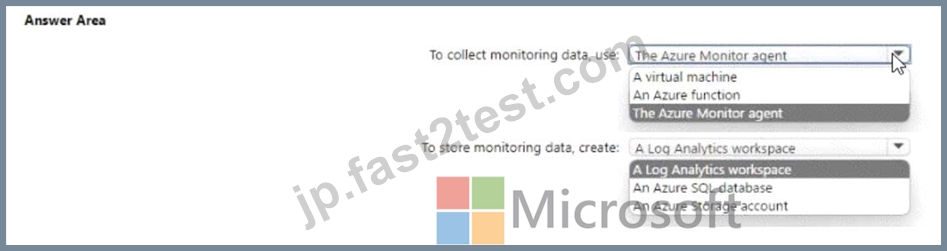
正解:
解説: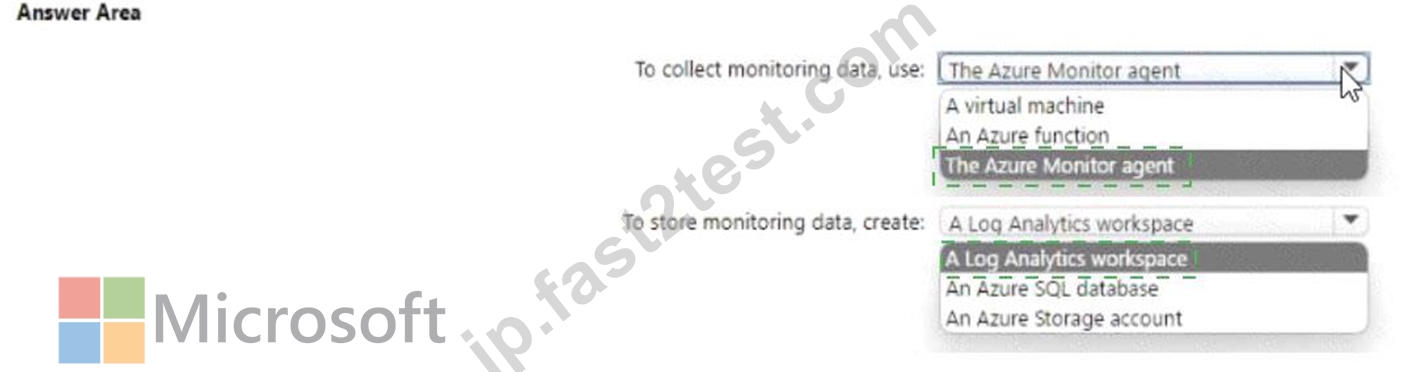
Explanation
質問 # 173
You have an Azure subscription that contains a storage account named databasebackups.
You have an Azure SQL managed instance named DB1.
You need to back up DB1 to databasebackups.
How should you complete the commands? To answer, select the appropriate options in the answer area.
NOTE: Each correct selection is worth one point.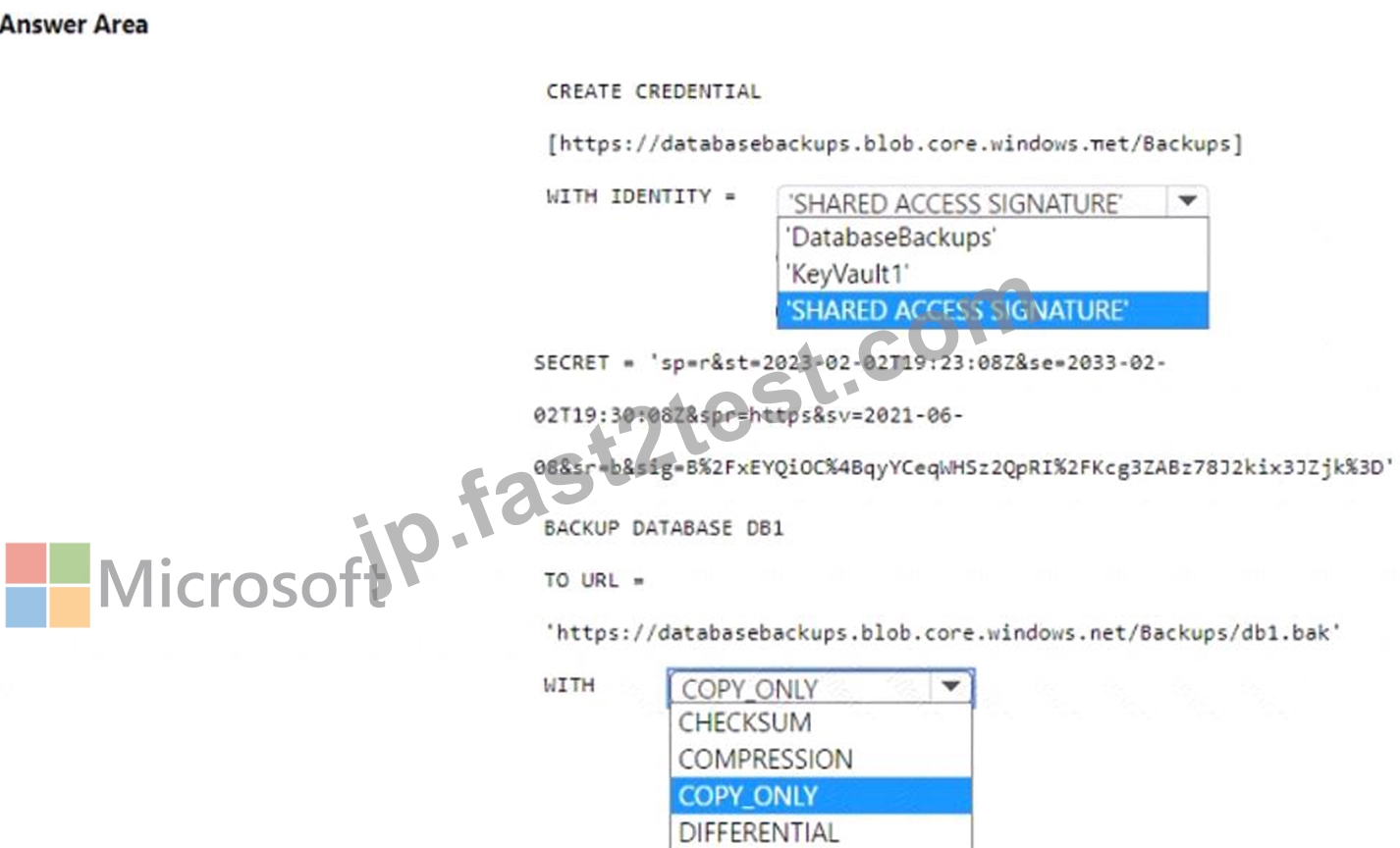
正解:
解説: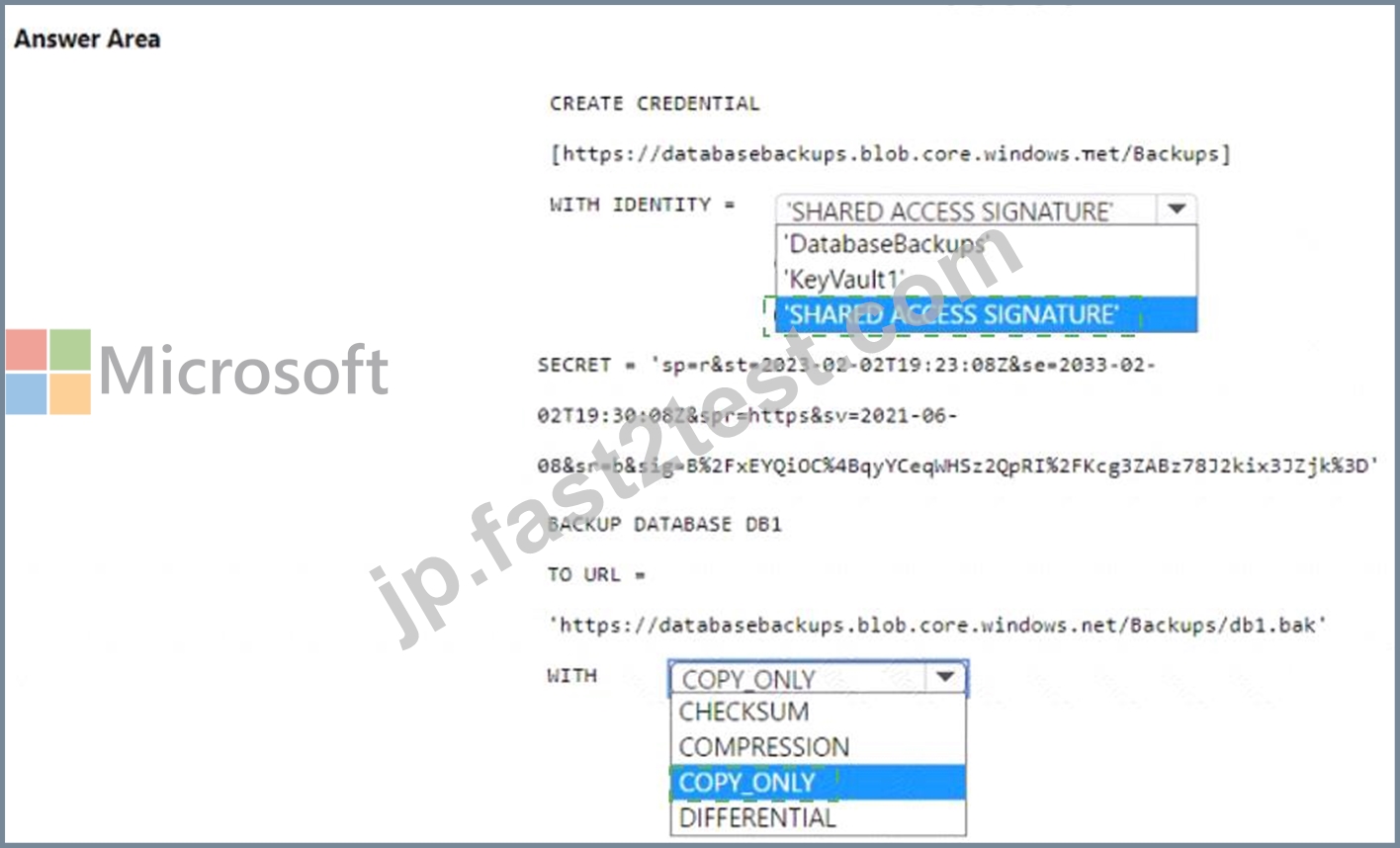
Explanation: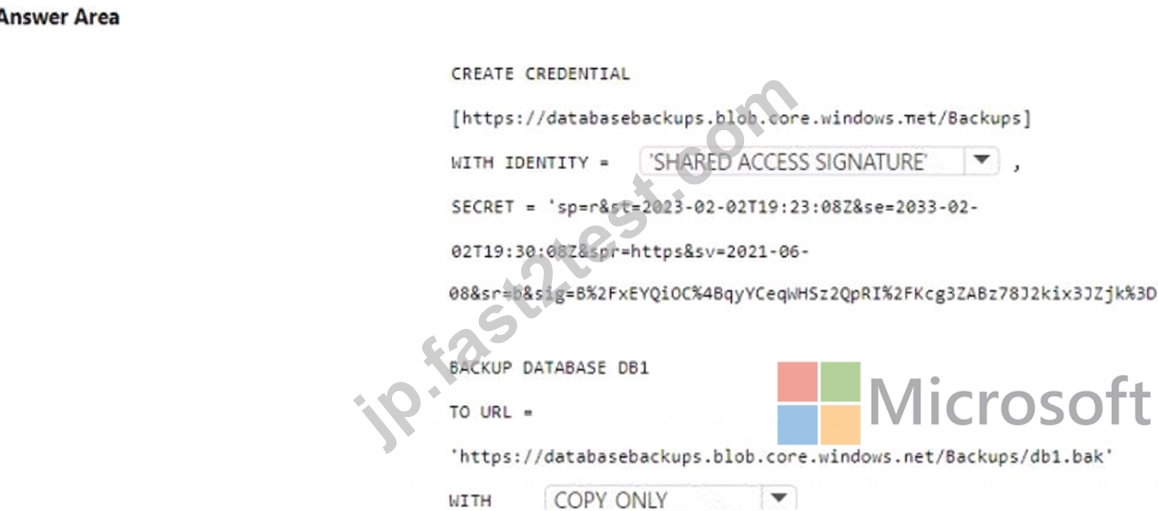
質問 # 174
You are provisioning an Azure SQL database in the Azure portal as shown in the following exhibit.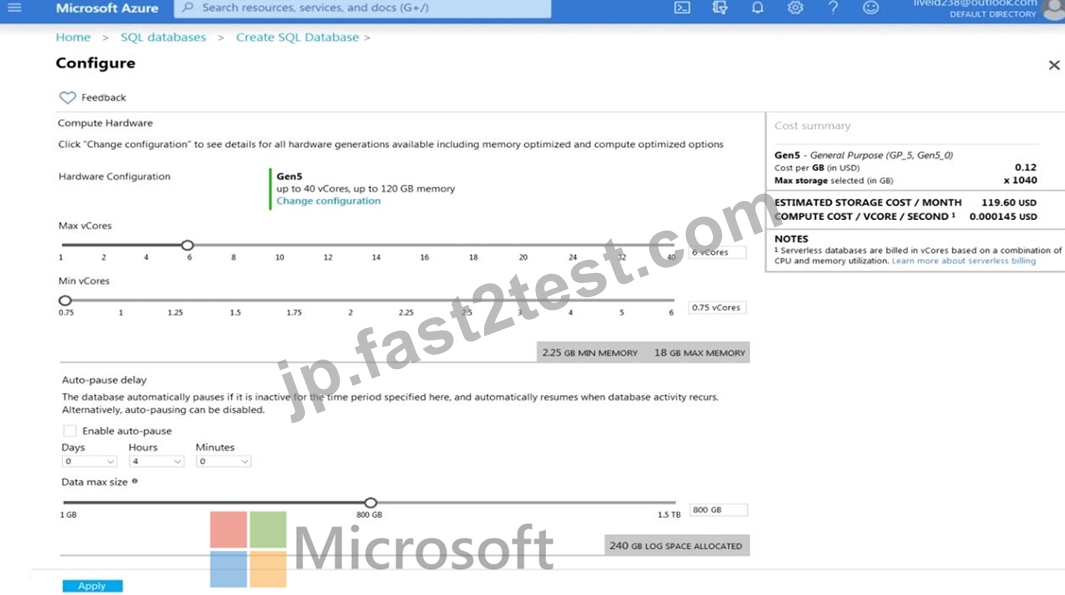
Use the drop-down menus to select the answer choice that completes each statement based on the information presented in the graphic.
NOTE: Each correct selection is worth one point.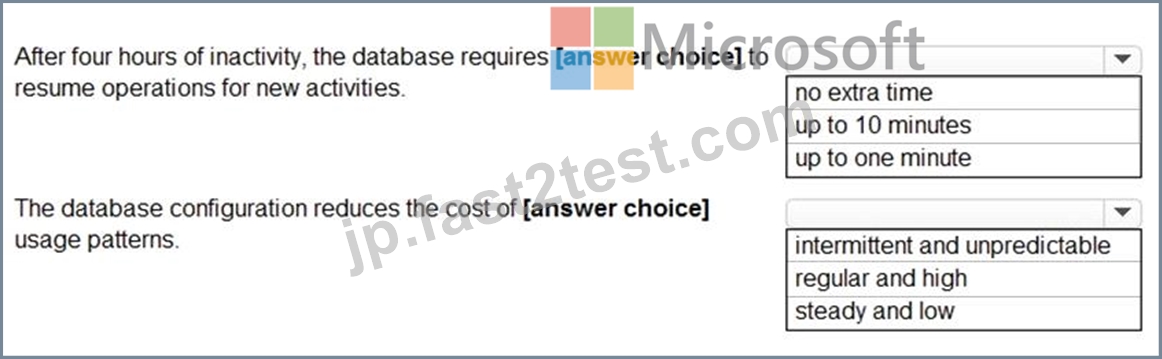
正解:
解説: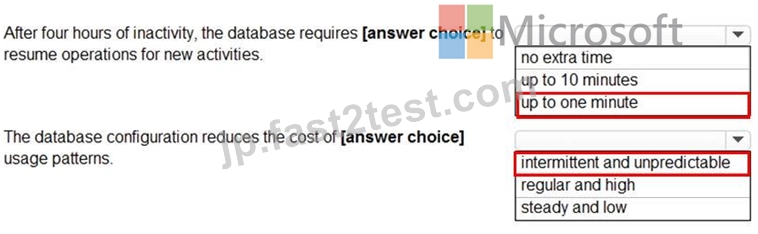
Reference:
https://docs.microsoft.com/en-us/azure/azure-sql/database/serverless-tier-overview
質問 # 175
Task 1
In an Azure SQL database named db1, you need to enable page compression on the PK_SalesOrderHeader_SalesOrderlD clustered index of the SalesLT.SalesOrderHeader table.
正解:
解説:
See the explanation part for the complete Solution
Explanation:
To enable page compression on the PK_SalesOrderHeader_SalesOrderlD clustered index of the SalesLT.SalesOrderHeader table in db1, you can use the following Transact-SQL script:
-- Connect to the Azure SQL database named db1
USE db1;
GO
-- Enable page compression on the clustered index
ALTER INDEX PK_SalesOrderHeader_SalesOrderlD ON SalesLT.SalesOrderHeader REBUILD WITH (DATA_COMPRESSION = PAGE); GO This script will rebuild the clustered index with page compression, which can reduce the storage space and improve the query performance The script solution consists of three parts:
The first part is USE db1; GO. This part connects to the Azure SQL database named db1, where the SalesLT.SalesOrderHeader table is located. The GO command separates the batches of Transact-SQL statements and sends them to the server.
The second part is ALTER INDEX PK_SalesOrderHeader_SalesOrderlD ON SalesLT.SalesOrderHeader REBUILD WITH (DATA_COMPRESSION = PAGE); GO. This part enables page compression on the clustered index named PK_SalesOrderHeader_SalesOrderlD, which is defined on the SalesLT.SalesOrderHeader table. The ALTER INDEX statement modifies the properties of an existing index. The REBUILD option rebuilds the index from scratch, which is required to change the compression setting. The DATA_COMPRESSION = PAGE option specifies that page compression is applied to the index, which means that both row and prefix compression are used. Page compression can reduce the storage space and improve the query performance by compressing the data at the page level. The GO command ends the batch of statements.
The third part is optional, but it can be useful to verify the compression status of the index. It is SELECT name, index_id, data_compression_desc FROM sys.indexes WHERE object_id = OBJECT_ID('SalesLT.SalesOrderHeader');. This part queries the sys.indexes catalog view, which contains information about the indexes in the database. The SELECT statement returns the name, index_id, and data_compression_desc columns for the indexes that belong to the SalesLT.SalesOrderHeader table. The OBJECT_ID function returns the object identification number for the table name. The data_compression_desc column shows the compression type of the index, which should be PAGE for the clustered index after the script is executed.
These are the steps of the script solution for enabling page compression on the clustered index of the SalesLT.SalesOrderHeader table in db1.
質問 # 176
You need to configure user authentication for the SERVER1 databases. The solution must meet the security and compliance requirements.
Which three actions should you perform in sequence? To answer, move the appropriate actions from the list of actions to the answer area and arrange them in the correct order.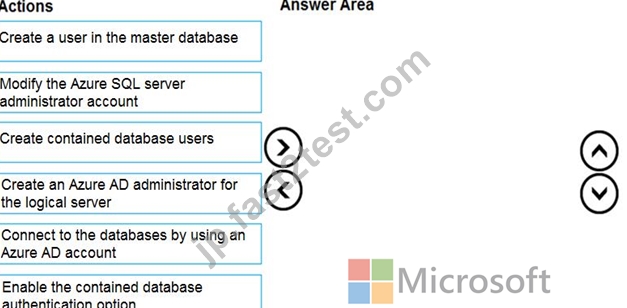
正解:
解説: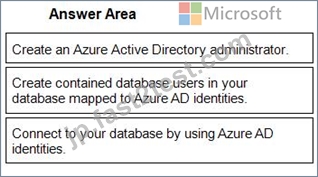
1 - Create an Azure Active Directory administrator.
2 - Create contained database users in your database mapped to Azure AD identities.
3 - Connect to your database by using Azure AD identities.
Reference:
https://docs.microsoft.com/en-us/azure/azure-sql/database/authentication-aad-overview
質問 # 177
You have an on-premises Microsoft SQL Server 2016 server named Server1 that contains a database named DB1.
You need to perform an online migration of DB1 to an Azure SQL Database managed instance by using Azure Database Migration Service.
How should you configure the backup of DB1? To answer, select the appropriate options in the answer area.
NOTE: Each correct selection is worth one point.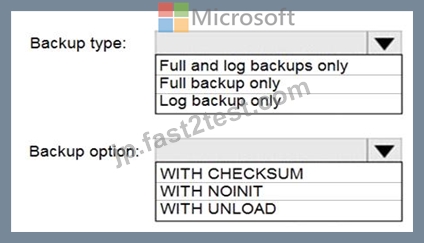
正解:
解説: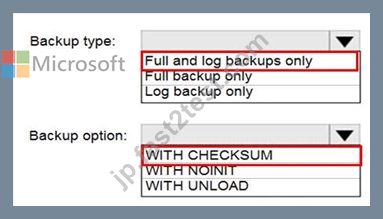
Reference:
https://docs.microsoft.com/en-us/azure/dms/known-issues-azure-sql-db-managed-instance-online
質問 # 178
DRAG DROP
You have SQL Server 2019 on an Azure virtual machine that contains an SSISDB database.
A recent failure causes the master database to be lost.
You discover that all Microsoft SQL Server integration Services (SSIS) packages fail to run on the virtual
machine.
Which four actions should you perform in sequence to resolve the issue? To answer, move the appropriate
actions from the list of actions to the answer area and arrange them in the correct.
Select and Place: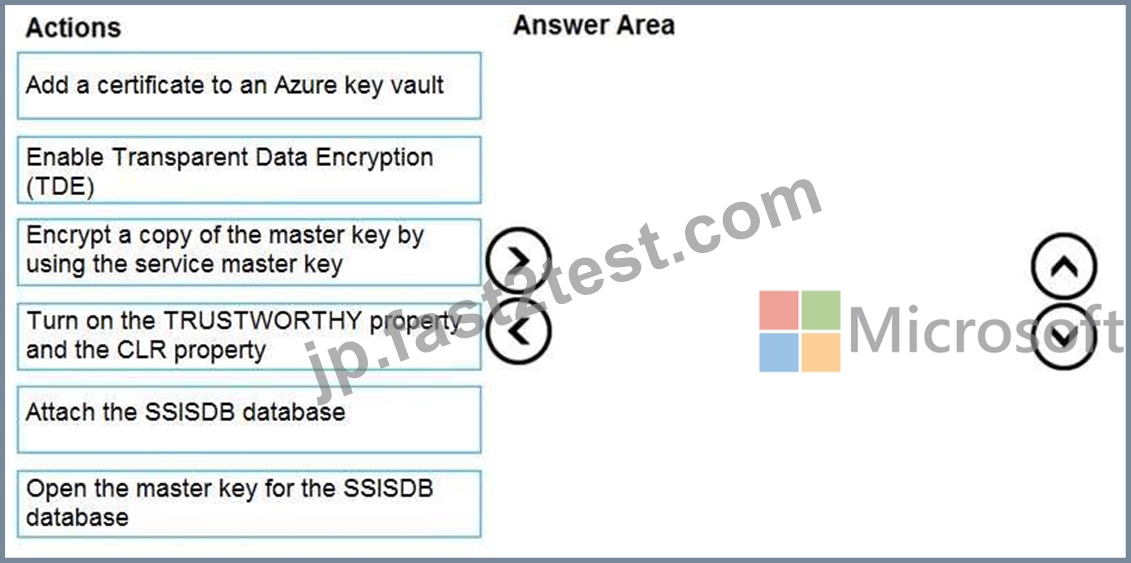
正解:
解説: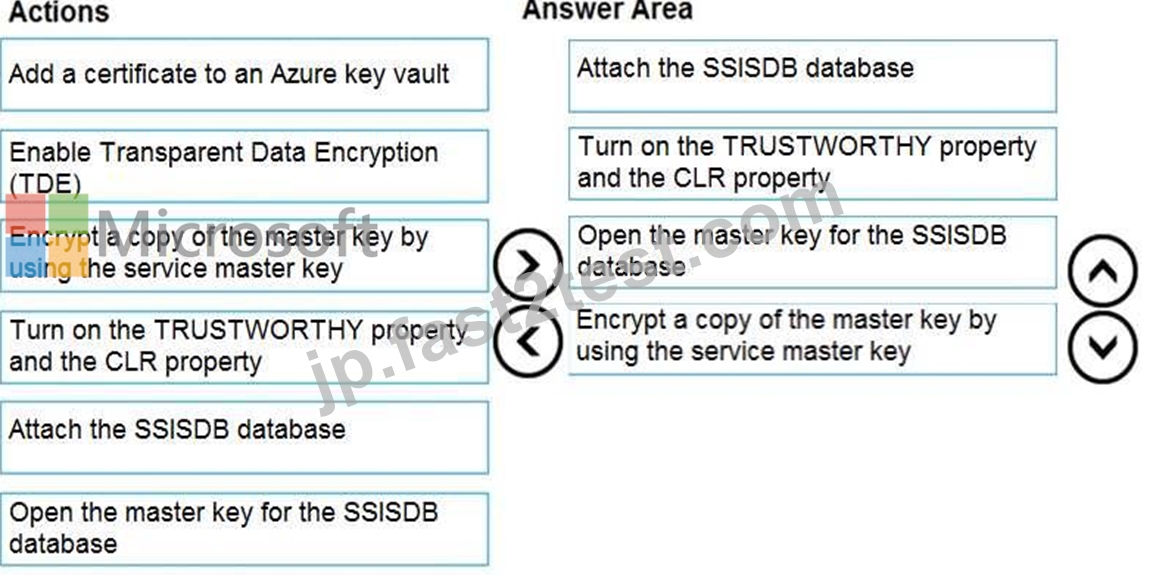
Section: [none]
Explanation:
Step 1: Attach the SSISDB database
Step 2: Turn on the TRUSTWORTHY property and the CLR property
If you are restoring the SSISDB database to an SQL Server instance where the SSISDB catalog was never
created, enable common language runtime (clr)
Step 3: Open the master key for the SSISDB database
Restore the master key by this method if you have the original password that was used to create SSISDB.
open master key decryption by password = 'LS1Setup!' --'Password used when creating SSISDB'
Alter Master Key Add encryption by Service Master Key
Step 4: Encrypt a copy of the mater key by using the service master key
Reference:
https://docs.microsoft.com/en-us/sql/integration-services/backup-restore-and-move-the-ssis-catalog
質問 # 179
You have an Azure SQL database.
You need to implement a disaster recovery solution that meets the following requirements:
* Minimizes how long it takes to recover the database if a datacenter fails
* Minimizes administrative effort
What should you include in the solution?
- A. Azure Site Recovery
- B. Azure Backup
- C. active geo-replication
- D. auto-failover groups
正解:A
質問 # 180
You have an Azure Synapse Analytics workspace named WS1 that contains an Apache Spark pool named Pool1.
You plan to create a database named DB1 in Pool1.
You need to ensure that when tables are created in DB1, the tables are available automatically as external tables to the built-in serverless SQL pool.
Which format should you use for the tables in DB1?
- A. CSV
- B. ORC
- C. JSON
- D. Parquet
正解:D
解説:
Section: [none]
Explanation:
Serverless SQL pool can automatically synchronize metadata from Apache Spark. A serverless SQL pool database will be created for each database existing in serverless Apache Spark pools.
For each Spark external table based on Parquet and located in Azure Storage, an external table is created in a serverless SQL pool database. As such, you can shut down your Spark pools and still query Spark external tables from serverless SQL pool.
Reference:
https://docs.microsoft.com/en-us/azure/synapse-analytics/sql/develop-storage-files-spark-tables
質問 # 181
You need to implement the monitoring of SalesSQLDb1. The solution must meet the technical requirements.
How should you collect and stream metrics? To answer, select the appropriate options in the answer area.
NOTE: Each correct selection is worth one point.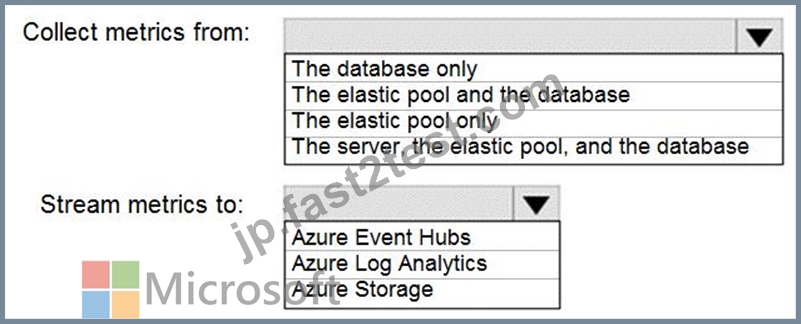
正解:
解説: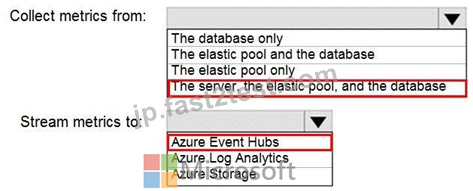
質問 # 182
You are building an Azure Stream Analytics job to retrieve game data.
You need to ensure that the job returns the highest scoring record for each five-minute time interval of each game.
How should you complete the Stream Analytics query? To answer, select the appropriate options in the answer area.
NOTE: Each correct selection is worth one point.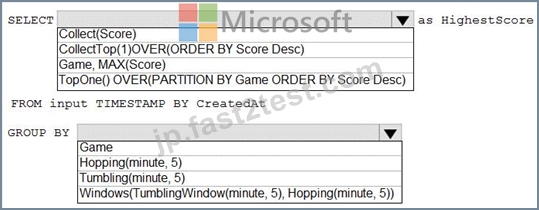
正解:
解説: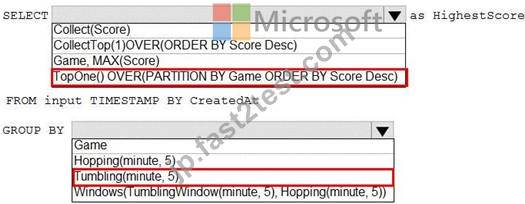
Reference:
https://docs.microsoft.com/en-us/stream-analytics-query/topone-azure-stream-analytics
https://github.com/MicrosoftDocs/azure-docs/blob/master/articles/stream-analytics/stream-analytics-window-functions.md
質問 # 183
You have two on-premises servers that run Windows Server 2019 and host a Microsoft SQL Server 2017 Always On availability group named AG1. AG1 contains a single database named DB1.
You have an Azure subscription. The subscription contains a virtual machine named VM1 that runs Linux.
You need to migrate DB1 to a SQL Server 2019 instance on VM1. The solution must minimize the downtime of DB1 during the migration.
What should you do? To answer, select the appropriate options in the answer area.
NOTE: Each correct selection is worth one point.
正解:
解説:
Answer as in image below.
質問 # 184
You have an Azure SQL database.
You discover that the plan cache is full of compiled plans that were used only once.
You run the select * from sys.database_scoped_configurationsTransact-SQL command and receive the results shown in the following table.
You need relieve the memory pressure.
What should you configure?
- A. QUERY_OPTIMIZER_HOTFIXES
- B. LEGACY_CARDINALITY_ESTIMATION
- C. OPTIMIZE_FOR_AD_HOC_WORKLOADS
- D. ACCELERATED_PLAN_FORCING
正解:C
解説:
OPTIMIZE_FOR_AD_HOC_WORKLOADS = { ON | OFF }
Enables or disables a compiled plan stub to be stored in cache when a batch is compiled for the first time. The default is OFF. Once the database scoped configuration OPTIMIZE_FOR_AD_HOC_WORKLOADS is enabled for a database, a compiled plan stub will be stored in cache when a batch is compiled for the first time.
Plan stubs have a smaller memory footprint compared to the size of the full compiled plan.
Incorrect Answers:
A: LEGACY_CARDINALITY_ESTIMATION = { ON | OFF | PRIMARY }
Enables you to set the query optimizer cardinality estimation model to the SQL Server 2012 and earlier version independent of the compatibility level of the database. The default is OFF, which sets the query optimizer cardinality estimation model based on the compatibility level of the database.
B: QUERY_OPTIMIZER_HOTFIXES = { ON | OFF | PRIMARY }
Enables or disables query optimization hotfixes regardless of the compatibility level of the database. The default is OFF, which disables query optimization hotfixes that were released after the highest available compatibility level was introduced for a specific version (post-RTM).
Reference:
https://docs.microsoft.com/en-us/sql/t-sql/statements/alter-database-scoped-configuration-transact-sql Perform Automation of Tasks Question Set 1
質問 # 185
You have an Azure subscription that is linked to a hybrid Azure Active Directory (Azure AD) tenant. The subscription contains an Azure Synapse Analytics SQL pool named Pool1.
You need to recommend an authentication solution for Pool1. The solution must support multi-factor authentication (MFA) and database-level authentication.
Which authentication solution or solutions should you include in the recommendation? To answer, select the appropriate options in the answer area.
NOTE: Each correct selection is worth one point.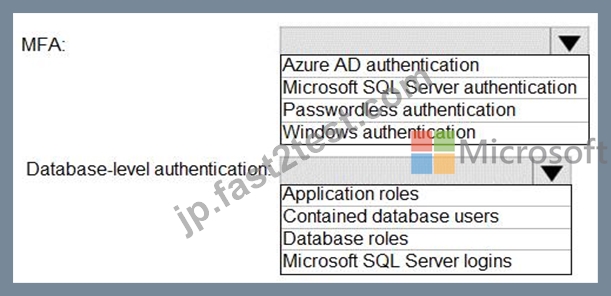
正解:
解説: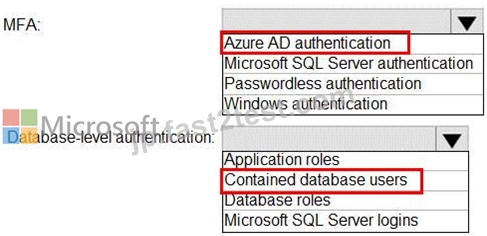
Reference:
https://docs.microsoft.com/en-us/azure/synapse-analytics/sql-data-warehouse/sql-data-warehouse-authentication
質問 # 186
Note: This question is part of a series of questions that present the same scenario. Each question in the series contains a unique solution that might meet the stated goals. Some question sets might have more than one correct solution, while others might not have a correct solution.
After you answer a question in this section, you will NOT be able to return to it. As a result, these questions will not appear in the review screen.
You have two Azure SQL Database servers named Server1 and Server2. Each server contains an Azure SQL database named Database1.
You need to restore Database1 from Server1 to Server2. The solution must replace the existing Database1 on Server2.
Solution: From Microsoft SQL Server Management Studio (SSMS), you rename Database1 on Server2 as Database2. From the Azure portal, you create a new database on Server2 by restoring the backup of Database1 from Server1, and then you delete Database2.
Does this meet the goal?
- A. No
- B. Yes
正解:A
解説:
Explanation
Instead restore Database1 from Server1 to the Server2 by using the RESTORE Transact-SQL command and the REPLACE option.
Note: REPLACE should be used rarely and only after careful consideration. Restore normally prevents accidentally overwriting a database with a different database. If the database specified in a RESTORE statement already exists on the current server and the specified database family GUID differs from the database family GUID recorded in the backup set, the database is not restored. This is an important safeguard.
Reference:
https://docs.microsoft.com/en-us/sql/t-sql/statements/restore-statements-transact-sql
質問 # 187
You have an on-premises datacenter that contains a 14-TB Microsoft SQL Server database.
You plan to create an Azure SQL managed instance and migrate the on-premises database to the new instance.
Which three service tiers support the SQL managed instance? Each correct answer presents a complete solution. NOTE: Each correct selection is worth one point.
- A. Business Critical Memory Optimized Premium
- B. Business Critical Premium
- C. General Purpose Premium
- D. Business Critical Standard
- E. General Purpose Standard
正解:A、B、C
質問 # 188
You have an Azure SQL logical server.
You run the following script.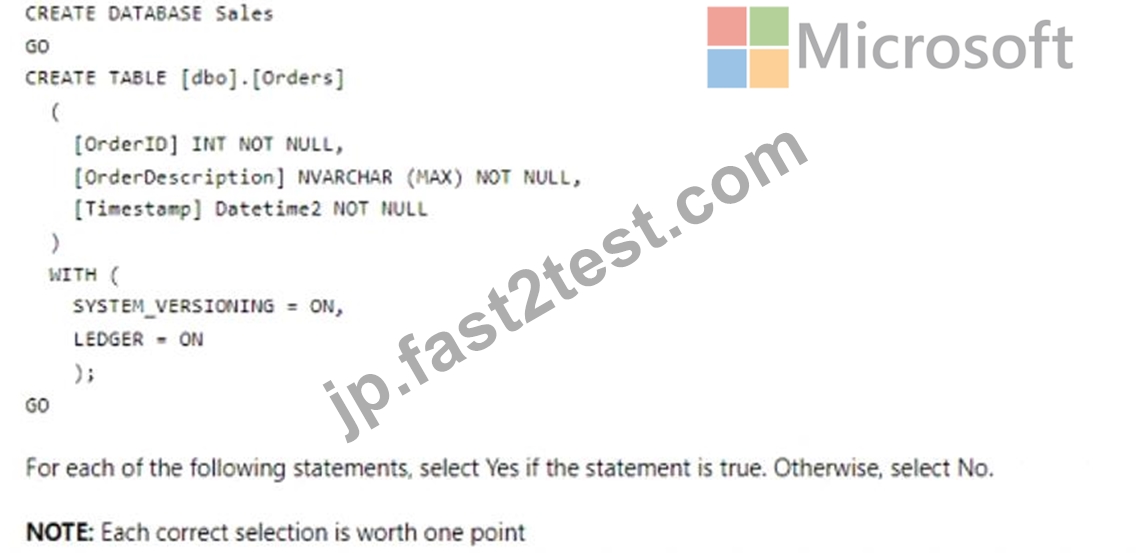
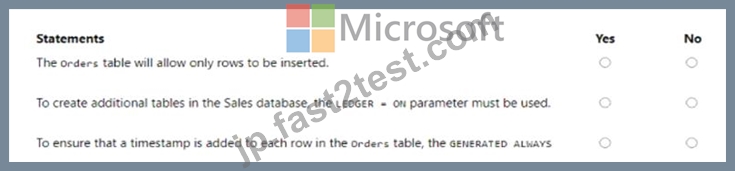
正解:
解説: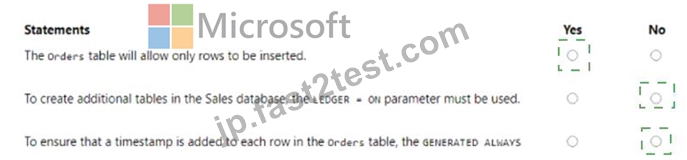
Explanation:
Yes
No
No
質問 # 189
You have an Azure SQL managed instance named SQLMI1 that has Resource Governor enabled and is used by two apps named App1 and App2.
You need to configure SQLMI1 to limit the CPU and memory resources that can be allocated to App1.
Which four actions should you perform in sequence? To answer, move the appropriate actions from the list of actions to the answer area and arrange them in the correct order.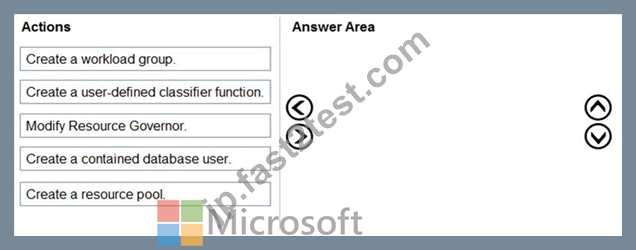
正解:
解説: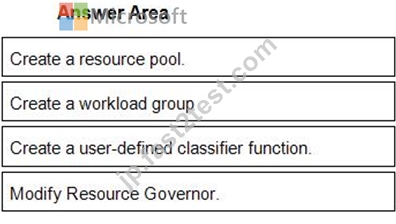
1 - Create a resource pool.
2 - Create a workload group
3 - Create a user-defined classifier function.
4 - Modify Resource Governor.
Reference:
https://docs.microsoft.com/en-us/sql/relational-databases/resource-governor/resource-governor?view=sql-server-ver15
https://docs.microsoft.com/en-us/sql/relational-databases/resource-governor/create-and-test-a-classifier-user-defined-function?view=sql-server-ver15
質問 # 190
You need to design an analytical storage solution for the transactional dat a. The solution must meet the sales transaction dataset requirements.
What should you include in the solution? To answer, select the appropriate options in the answer area.
NOTE: Each correct selection is worth one point.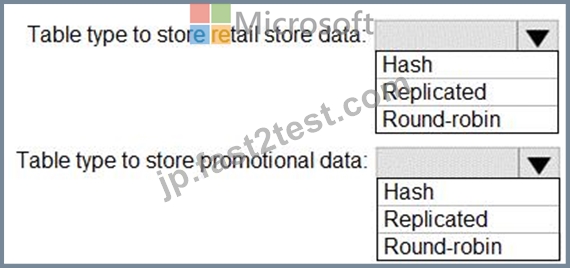
正解:
解説: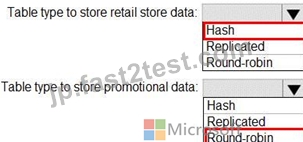
Reference:
https://rajanieshkaushikk.com/2020/09/09/how-to-choose-right-data-distribution-strategy-for-azure-synapse/
質問 # 191
You have an Azure SQL Database server named sqlsrv1 that hosts 10 Azure SQL databases.
The databases perform slower than expected.
You need to identify whether the performance issue relates to the use of tempdb on sqlsrv1.
What should you do?
- A. Review information provided by SQL Server Profiler-based traces
- B. Review information provided by Query Performance Insight
- C. Run dynamic management view-based queries
- D. Run Query Store-based queries
正解:C
解説:
The diagnostics log outputs tempDB contention details. You can use the information as the starting point for troubleshooting.
You can use the Intelligent Insights performance diagnostics log of Azure SQL Database to troubleshoot performance issues.
Reference:
https://docs.microsoft.com/en-us/azure/azure-sql/database/intelligent-insights-troubleshoot-performance#tempdb-contention
https://docs.microsoft.com/en-us/azure/azure-sql/database/intelligent-insights-use-diagnostics-log
質問 # 192
You plan to move two 100-GB databases to Azure.
You need to dynamically scale resources consumption based on workloads. The solution must minimize downtime during scaling operations.
What should you use?
- A. two Azure SQL Databases in an elastic pool
- B. two databases in an Azure SQL Managed instance
- C. two single Azure SQL databases
- D. two databases hosted in SQL Server on an Azure virtual machine
正解:A
解説:
Section: [none]
Explanation:
Azure SQL Database elastic pools are a simple, cost-effective solution for managing and scaling multiple databases that have varying and unpredictable usage demands. The databases in an elastic pool are on a single server and share a set number of resources at a set price.
Reference:
https://docs.microsoft.com/en-us/azure/azure-sql/database/elastic-pool-overview
質問 # 193
You have an Azure SQL database named DB1 that contains a table named Orders. The Orders table contains a row for each sales order. Each sales order includes the name of the user who placed the order.
You need to implement row-level security (RLS). The solution must ensure that the users can view only their respective sales orders.
What should you include in the solution? To answer, select the appropriate options in the answer area.
NOTE: Each correct selection is worth one point.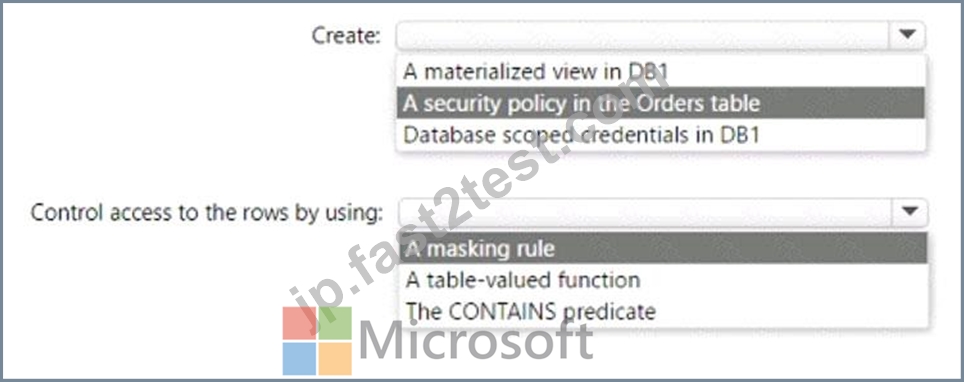
正解:
解説: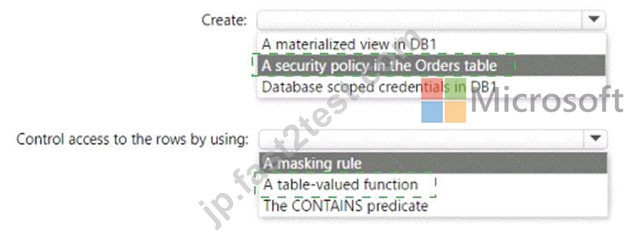
Explanation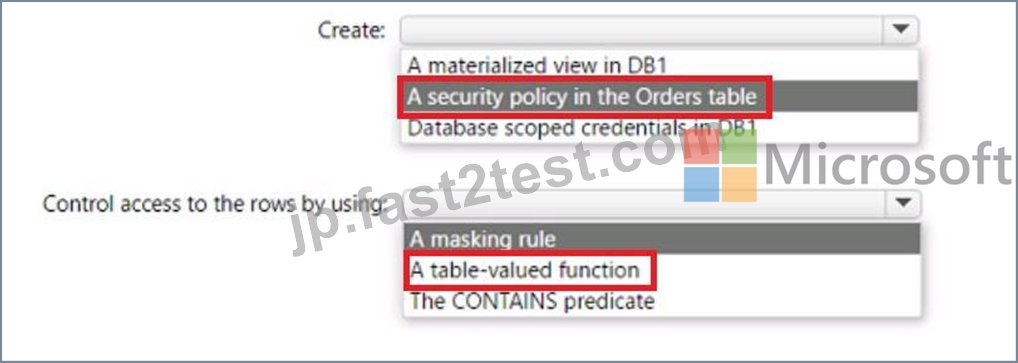
質問 # 194
......
合格させるMicrosoft DP-300試験最速合格にはFast2test:https://jp.fast2test.com/DP-300-premium-file.html
準備DP-300問題解答でDP-300試験問題集:https://drive.google.com/open?id=14wTO2TuP2owVYTiN_1MNGcUJMmWwvkRq