

[2023年05月03日]DP-300試験問題集で100%合格率DP-300試験!
試験問題集リアルMicrosoft Azure問題集232解答を試そう!
質問 63
You have an Azure SQL database. The database contains a table that uses a columnstore index and is
accessed infrequently.
You enable columnstore archival compression.
What are two possible results of the configuration? Each correct answer presents a complete solution.
NOTE: Each correct selection is worth one point.
- A. The index will consume more memory.
- B. Queries that use the index will consume more disk I/O.
- C. The index will consume more disk space.
- D. Queries that use the index will consume more CPU resources.
- E. Queries that use the index will retrieve fewer data pages.
正解: D,E
解説:
Section: [none]
Explanation:
For rowstore tables and indexes, use the data compression feature to help reduce the size of the database. In
addition to saving space, data compression can help improve performance of I/O intensive workloads because
the data is stored in fewer pages and queries need to read fewer pages from disk.
Use columnstore archival compression to further reduce the data size for situations when you can afford extra
time and CPU resources to store and retrieve the data.
Testlet 1
Case study
This is a case study. Case studies are not timed separately. You can use as much exam time as you
would like to complete each case. However, there may be additional case studies and sections on this exam.
You must manage your time to ensure that you are able to complete all questions included on this exam in the
time provided.
To answer the questions included in a case study, you will need to reference information that is provided in the
case study. Case studies might contain exhibits and other resources that provide more information about the
scenario that is described in the case study. Each question is independent of the other questions in this case
study.
At the end of this case study, a review screen will appear. This screen allows you to review your answers and to
make changes before you move to the next section of the exam. After you begin a new section, you cannot
return to this section.
To start the case study
To display the first question in this case study, click the Next button. Use the buttons in the left pane to explore
the content of the case study before you answer the questions. Clicking these buttons displays information such
as business requirements, existing environment, and problem statements. If the case study has an All
Information tab, note that the information displayed is identical to the information displayed on the subsequent
tabs. When you are ready to answer a question, click the Question button to return to the question.
Overview
Litware, Inc. is a renewable energy company that has a main office in Boston. The main office hosts a sales
department and the primary datacenter for the company.
Physical Locations
Existing Environment
Litware has a manufacturing office and a research office is separate locations near Boston. Each office has its
own datacenter and internet connection.
The manufacturing and research datacenters connect to the primary datacenter by using a VPN.
Network Environment
The primary datacenter has an ExpressRoute connection that uses both Microsoft peering and private peering.
The private peering connects to an Azure virtual network named HubVNet.
Identity Environment
Litware has a hybrid Azure Active Directory (Azure AD) deployment that uses a domain named litwareinc.com.
All Azure subscriptions are associated to the litwareinc.com Azure AD tenant.
Database Environment
The sales department has the following database workload:
* An on-premises named SERVER1 hosts an instance of Microsoft SQL Server 2012 and two 1-TB
databases.
* A logical server named SalesSrv01A contains a geo-replicated Azure SQL database named SalesSQLDb1,
SalesSQLDb1 is in an elastic pool named SalesSQLDb1Pool. SalesSQLDb1 uses database firewall rules
and contained database users.
* An application named SalesSQLDb1App1 uses SalesSQLDb1.
The manufacturing office contains two on-premises SQL Server 2016 servers named SERVER2 and
SERVER3. The servers are nodes in the same Always On availability group. The availability group contains a
database named ManufacturingSQLDb1.
Database administrators have two Azure virtual machines in HubVnet named VM1 and VM2 that run Windows
Server 2019 and are used to manage all the Azure databases.
Licensing Agreement
Litware is a Microsoft Volume Licensing customer that has License Mobility through Software Assurance.
Current Problems
Requirements
SalesSQLDb1 experiences performance issues that are likely due to out-of-date statistics and frequent blocking
queries.
Planned Changes
Litware plans to implement the following changes:
* Implement 30 new databases in Azure, which will be used by time-sensitive manufacturing apps that have
varying usage patterns. Each database will be approximately 20 GB.
* Create a new Azure SQL database named ResearchDB1 on a logical server named ResearchSrv01.
ResearchDB1 will contain Personally Identifiable Information (PII) data.
* Develop an app named ResearchApp1 that will be used by the research department to populate and access
ResearchDB1.
* Migrate ManufacturingSQLDb1 to the Azure virtual machine platform.
* Migrate the SERVER1 databases to the Azure SQL Database platform.
Technical Requirements
Litware identifies the following technical requirements:
* Maintenance tasks must be automated.
* The 30 new databases must scale automatically.
* The use of an on-premises infrastructure must be minimized.
* Azure Hybrid Use Benefits must be leveraged for Azure SQL Database deployments.
* All SQL Server and Azure SQL Database metrics related to CPU and storage usage and limits must be
analyzed by using Azure built-in functionality.
Security and Compliance Requirements
Litware identifies the following security and compliance requirements:
* Store encryption keys in Azure Key Vault.
* Retain backups of the PII data for two months.
* Encrypt the PII data at rest, in transit, and in use.
* Use the principle of least privilege whenever possible.
* Authenticate database users by using Active Directory credentials.
* Protect Azure SQL Database instances by using database-level firewall rules.
* Ensure that all databases hosted in Azure are accessible from VM1 and VM2 without relying on public
endpoints.
Business Requirements
Litware identifies the following business requirements:
* Meet an SLA of 99.99% availability for all Azure deployments.
* Minimize downtime during the migration of the SERVER1 databases.
* Use the Azure Hybrid Use Benefits when migrating workloads to Azure.
* Once all requirements are met, minimize costs whenever possible.
質問 64
You have an Azure SQL database named DB1.
You need to display the estimated execution plan of a query by using the query editor in the Azure portal.
What should you do first?
- A. Run the set showplan_all Transact-SQL statement.
- B. Run the set forceplan Transact-SQL statement.
- C. Enable Query Store for DB1.
- D. For DB1, set QUERY_CAPTURE_MODE of Query Store to All.
正解: A
解説:
Reference:
https://docs.microsoft.com/en-us/sql/t-sql/statements/set-showplan-all-transact-sql?view=sql-server-ver15
質問 65
You have an Azure SQL managed instance.
You need to restore a database named DB1 by using Transact-SQL.
Which command should you run? To answer, select the appropriate options in the answer area.
NOTE: Each correct selection is worth one point.
正解:
解説:
質問 66
You have an Azure subscription that is linked to a hybrid Azure Active Directory (Azure AD) tenant. The subscription contains an Azure Synapse Analytics SQL pool named Pool1.
You need to recommend an authentication solution for Pool1. The solution must support multi-factor authentication (MFA) and database-level authentication.
Which authentication solution or solutions should you include in the recommendation? To answer, select the appropriate options in the answer area.
NOTE: Each correct selection is worth one point.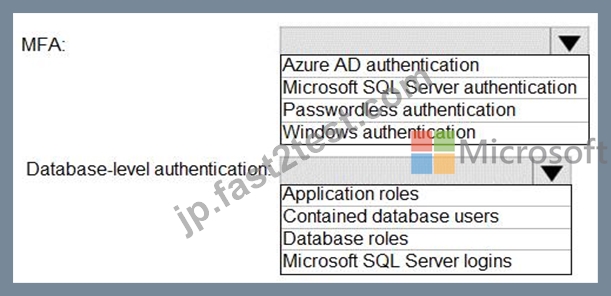
正解:
解説: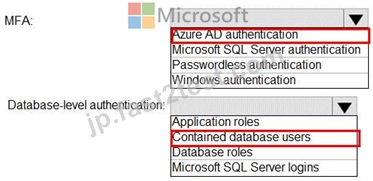
Reference:
https://docs.microsoft.com/en-us/azure/synapse-analytics/sql-data-warehouse/sql-data-warehouse-authentication
質問 67
You have an Azure SQL database named DB1.
You need to ensure that DB1 will support automatic failover without data loss if a datacenter fails. The solution must minimize costs.
Which deployment option and pricing tier should you configure?
- A. Azure SQL Database serverless
- B. Azure SQL Database Standard
- C. Azure SQL Database Premium
- D. Azure SQL Database managed instance Business Critical
正解: C
解説:
By default, the cluster of nodes for the premium availability model is created in the same datacenter. With the introduction of Azure Availability Zones, SQL Database can place different replicas of the Business Critical database to different availability zones in the same region. To eliminate a single point of failure, the control ring is also duplicated across multiple zones as three gateway rings (GW). The routing to a specific gateway ring is controlled by Azure Traffic Manager (ATM). Because the zone redundant configuration in the Premium or Business Critical service tiers does not create additional database redundancy, you can enable it at no extra cost. By selecting a zone redundant configuration, you can make your Premium or Business Critical databases resilient to a much larger set of failures, including catastrophic datacenter outages, without any changes to the application logic. You can also convert any existing Premium or Business Critical databases or pools to the zone redundant configuration.
Incorrect Answers:
Reference:
https://docs.microsoft.com/en-us/azure/azure-sql/database/high-availability-sla
質問 68
You have an Azure Data Factory that contains 10 pipelines.
You need to label each pipeline with its main purpose of either ingest, transform, or load. The labels must be available for grouping and filtering when using the monitoring experience in Data Factory.
What should you add to each pipeline?
- A. a run group ID
- B. a correlation ID
- C. a user property
- D. a resource tag
- E. an annotation
正解: E
解説:
Azure Data Factory annotations help you easily filter different Azure Data Factory objects based on a tag. You can define tags so you can see their performance or find errors faster.
Reference:
https://www.techtalkcorner.com/monitor-azure-data-factory-annotations/
質問 69
You have an Azure subscription that contains an Azure SQL database named SQLDb1. SQLDb1 contains a table named Table1.
You plan to deploy an Azure web app named webapp1 that will export rows in Table1 that have changed.
You need to ensure that webapp1 can identity the changes to Table'. The solution must meet the following requirements:
* Minimize compute times.
* Minimize storage.
Which three actions should you perform in sequence? To answer. move the appropriate actions from the list of actions to the answer area and arrange them in the correct order.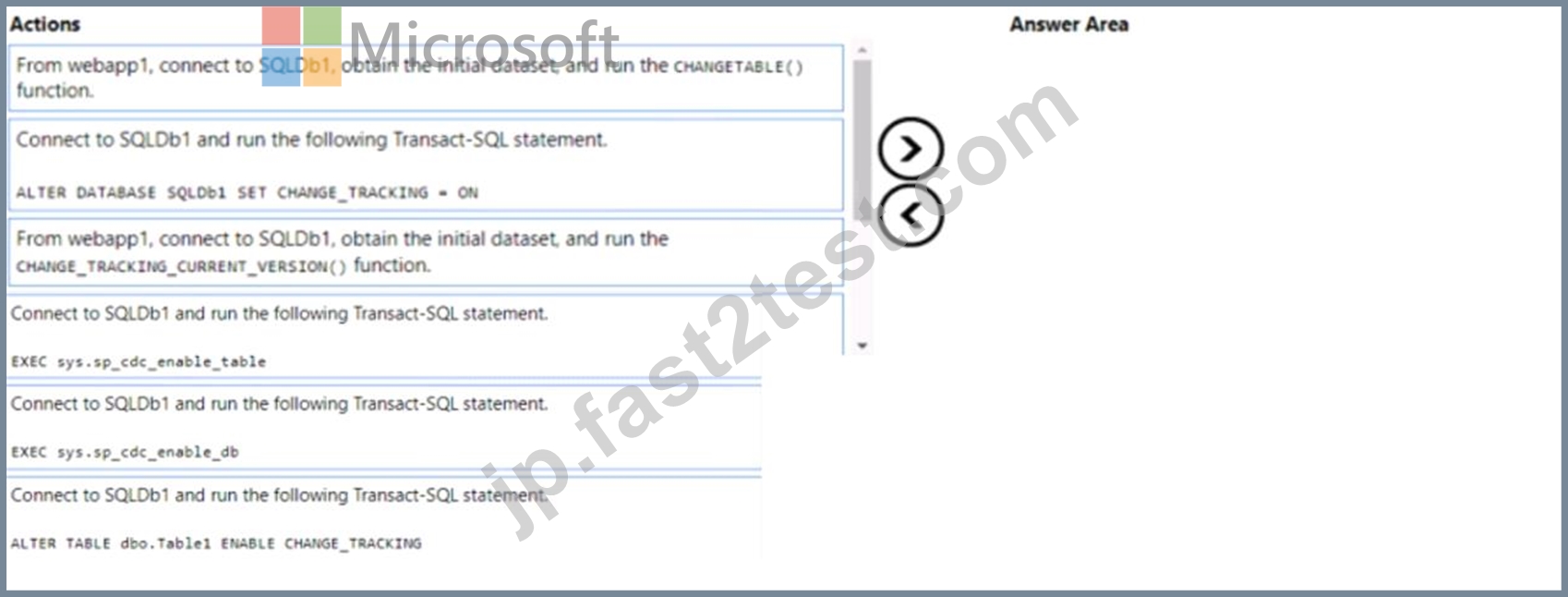
正解:
解説: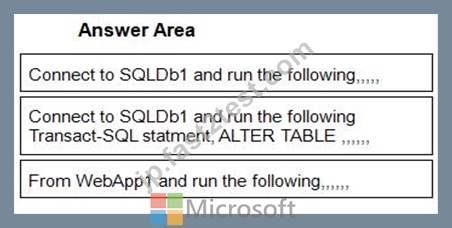
1 - Connect to SQLDb1 and run the following,,,,,
2 - Connect to SQLDb1 and run the following Transact-SQL statment, ALTER TABLE ,,,,,,
3 - From WebApp1 and run the following,,,,,,
質問 70
You deploy a database to an Azure SQL Database managed instance.
You need to prevent read queries from blocking queries that are trying to write to the database.
Which database option should set?
- A. Delayed Durability to Forced
- B. PARAMETERIZATION to FORCED
- C. READ_COMMITTED_SNAPSHOT to ON
- D. PARAMETERIZATION to SIMPLE
正解: C
解説:
In SQL Server, you can also minimize locking contention while protecting transactions from dirty reads of uncommitted data modifications using either:
* The READ COMMITTED isolation level with the READ_COMMITTED_SNAPSHOT database option set to ON.
* The SNAPSHOT isolation level.
If READ_COMMITTED_SNAPSHOT is set to ON (the default on SQL Azure Database), the Database Engine uses row versioning to present each statement with a transactionally consistent snapshot of the data as it existed at the start of the statement. Locks are not used to protect the data from updates by other transactions.
Incorrect Answers:
A: When the PARAMETERIZATION database option is set to SIMPLE, the SQL Server query optimizer may choose to parameterize the queries. This means that any literal values that are contained in a query are substituted with parameters. This process is referred to as simple parameterization. When SIMPLE parameterization is in effect, you cannot control which queries are parameterized and which queries are not.
B: You can specify that all queries in a database be parameterized by setting the PARAMETERIZATION database option to FORCED. This process is referred to as forced parameterization.
C: Delayed transaction durability is accomplished using asynchronous log writes to disk. Transaction log records are kept in a buffer and written to disk when the buffer fills or a buffer flushing event takes place. Delayed transaction durability reduces both latency and contention within the system.
Some of the cases in which you could benefit from using delayed transaction durability are:
* You can tolerate some data loss.
* You are experiencing a bottleneck on transaction log writes.
* Your workloads have a high contention rate.
Reference:
https://docs.microsoft.com/en-us/sql/t-sql/statements/set-transaction-isolation-level-transact-sql
質問 71
Note: This question is part of a series of questions that present the same scenario. Each question in
the series contains a unique solution that might meet the stated goals. Some question sets might have
more than one correct solution, while others might not have a correct solution.
After you answer a question in this section, you will NOT be able to return to it. As a result, these
questions will not appear in the review screen.
You have two Azure SQL Database servers named Server1 and Server2. Each server contains an Azure SQL
database named Database1.
You need to restore Database1 from Server1 to Server2. The solution must replace the existing Database1 on
Server2.
Solution: From the Azure portal, you delete Database1 from Server2, and then you create a new database on
Server2 by using the backup of Database1 from Server1.
Does this meet the goal?
- A. No
- B. Yes
正解: A
解説:
Section: [none]
Explanation:
Instead restore Database1 from Server1 to the Server2 by using the RESTORE Transact-SQL command and
the REPLACE option.
Note: REPLACE should be used rarely and only after careful consideration. Restore normally prevents
accidentally overwriting a database with a different database. If the database specified in a RESTORE
statement already exists on the current server and the specified database family GUID differs from the
database family GUID recorded in the backup set, the database is not restored. This is an important safeguard.
Reference:
https://docs.microsoft.com/en-us/sql/t-sql/statements/restore-statements-transact-sql
質問 72
You are designing an enterprise data warehouse in Azure Synapse Analytics that will store website traffic analytics in a star schema.
You plan to have a fact table for website visits. The table will be approximately 5 GB.
You need to recommend which distribution type and index type to use for the table. The solution must provide the fastest query performance.
What should you recommend? To answer, select the appropriate options in the answer area.
NOTE: Each correct selection is worth one point.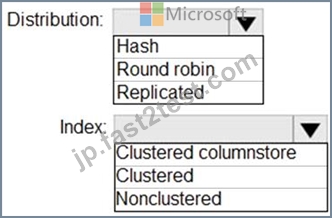
正解:
解説: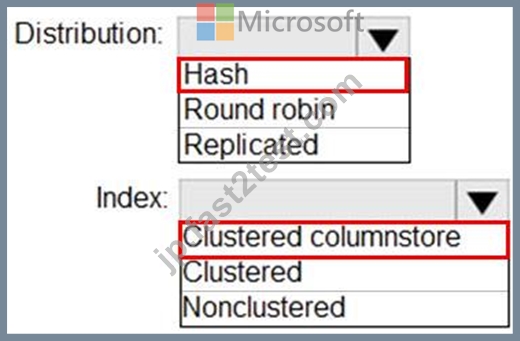
Reference:
https://docs.microsoft.com/en-us/azure/synapse-analytics/sql-data-warehouse/sql-data-warehouse-tables-distribute
https://docs.microsoft.com/en-us/azure/synapse-analytics/sql-data-warehouse/sql-data-warehouse-tables-index
質問 73
You are planning disaster recovery for the failover group of an Azure SQL Database managed instance.
Your company's SLA requires that the database in the failover group become available as quickly as possible if a major outage occurs.
You set the Read/Write failover policy to Automatic.
What are two results of the configuration? Each correct answer presents a complete solution.
NOTE: Each correct selection is worth one point.
- A. In the event of a datacenter or Azure regional outage, the databases will fail over automatically.
- B. In the event of an outage, the minimum delay for the databases to fail over in the primary instance will be one hour.
- C. In the event of an outage, you can set a different grace period to fail over each database.
- D. In the event of an outage, the databases in the primary instance will fail over immediately.
- E. In the event of an outage, you can selectively fail over individual databases.
正解: A,B
解説:
A: Auto-failover groups allow you to manage replication and failover of a group of databases on a server or all
databases in a managed instance to another region.
E: Because verification of the scale of the outage and how quickly it can be mitigated involves human actions
by the operations team, the grace period cannot be set below one hour. This limitation applies to all databases
in the failover group regardless of their data synchronization state.
Incorrect Answers:
C: individual SQL Managed Instance databases cannot be added to or removed from a failover group.
Reference:
https://docs.microsoft.com/en-us/azure/azure-sql/database/auto-failover-group-overview
質問 74
You have SQL Server on an Azure virtual machine that contains a database named Db1.
You need to enable automatic tuning for Db1.
How should you complete the statements? To answer, select the appropriate answer in the answer area.
NOTE: Each correct selection is worth one point.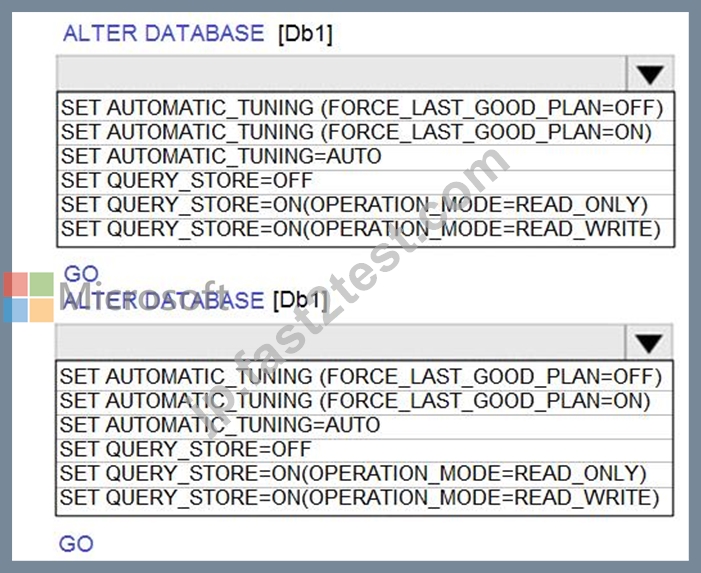
正解:
解説: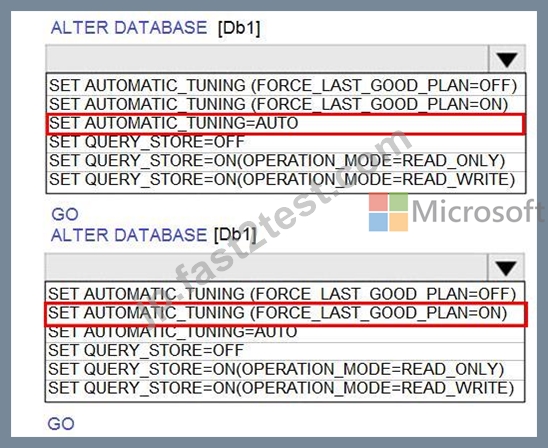
Reference:
https://docs.microsoft.com/en-us/azure/azure-sql/database/automatic-tuning-enable
質問 75
You have a new Azure SQL database named DB1 on an Azure SQL server named AzSQL1.
The only user who was created is the server administrator.
You need to create a contained database user in DB1 who will use Azure Active Directory (Azure AD) for authentication.
Which three actions should you perform in sequence? To answer, move the appropriate actions from the list of actions to the answer area and arrange them in the correct order.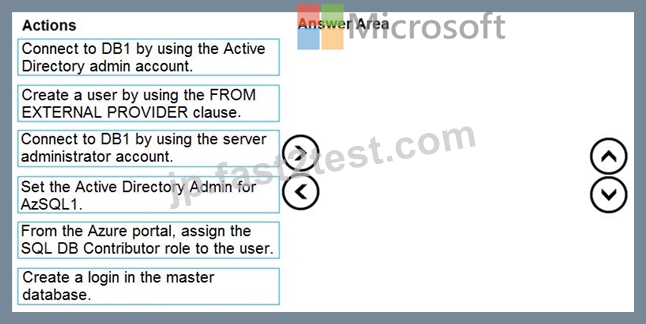
正解:
解説: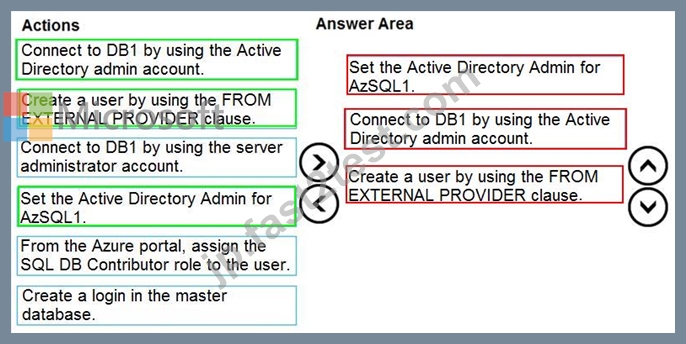
Explanation:
Step 1: Set up the Active Directory Admin for AzSQL1.
Step 2: Connect to DB1 by using the server administrator.
Sign into your managed instance with an Azure AD login granted with the sysadmin role.
Step 3: Create a user by using the FROM EXTERNAL PROVIDER clause.
FROM EXTERNAL PROVIDER is available for creating server-level Azure AD logins in SQL Database managed instance. Azure AD logins allow database-level Azure AD principals to be mapped to server-level Azure AD logins. To create an Azure AD user from an Azure AD login use the following syntax:
CREATE USER [AAD_principal] FROM LOGIN [Azure AD login]
Reference:
https://docs.microsoft.com/en-us/sql/t-sql/statements/create-user-transact-sql
質問 76
You are building an Azure Stream Analytics job to retrieve game data.
You need to ensure that the job returns the highest scoring record for each five-minute time interval of each game.
How should you complete the Stream Analytics query? To answer, select the appropriate options in the answer area.
NOTE: Each correct selection is worth one point.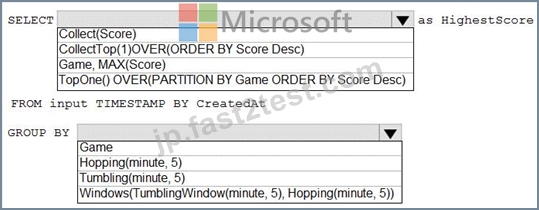
正解:
解説: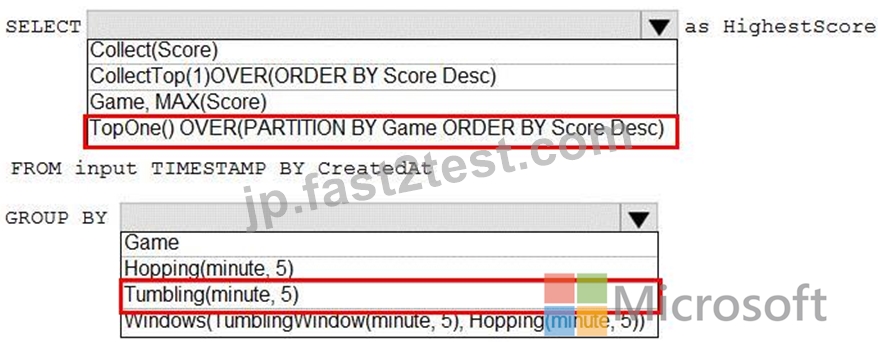
Reference:
https://docs.microsoft.com/en-us/stream-analytics-query/topone-azure-stream-analytics
https://github.com/MicrosoftDocs/azure-docs/blob/master/articles/stream-analytics/stream-analytics-window-functions.md
質問 77
You have SQL Server on an Azure virtual machine that contains a database named DB1.
The database reports a CHECKSUM error.
You need to recover the database.
How should you complete the statements? To answer, select the appropriate options in the answer area.
NOTE: Each correct selection is worth one point.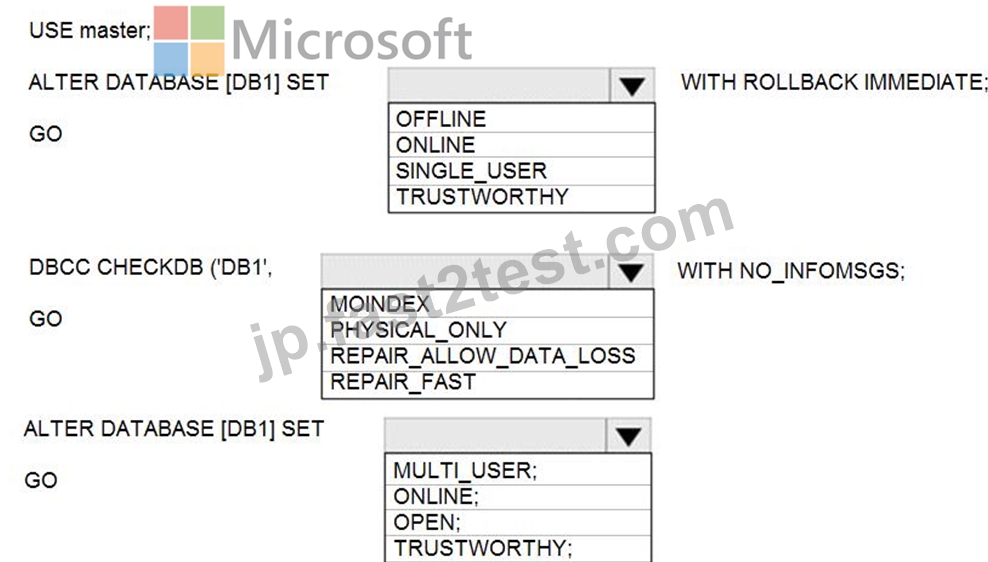
正解:
解説: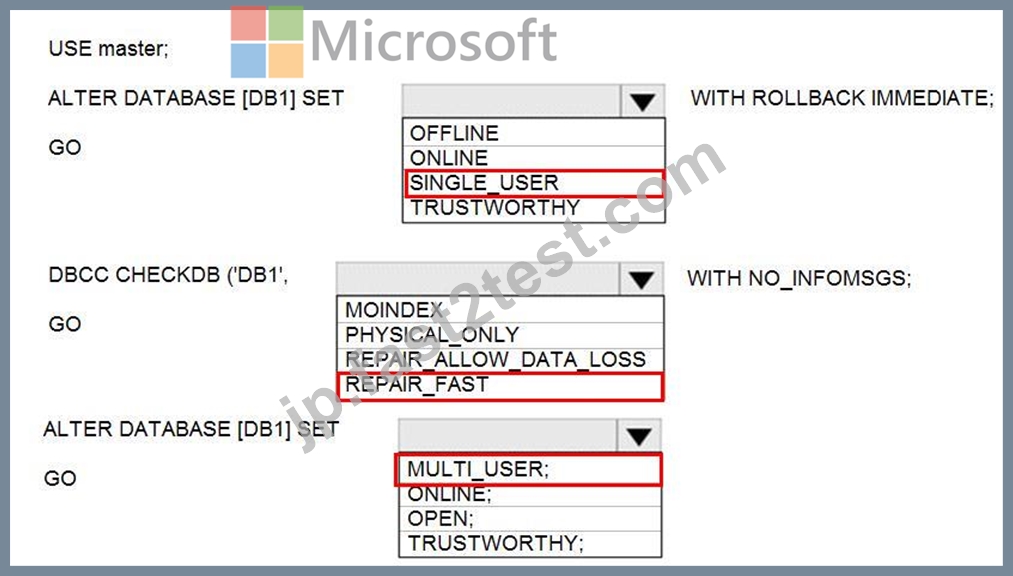
Reference:
https://docs.microsoft.com/en-us/sql/t-sql/database-console-commands/dbcc-checkdb-transact-sql
質問 78
......
Microsoft DP-300 認定試験の出題範囲:
| トピック | 出題範囲 |
|---|---|
| トピック 1 |
|
| トピック 2 |
|
| トピック 3 |
|
| トピック 4 |
|
| トピック 5 |
|
| トピック 6 |
|
| トピック 7 |
|
| トピック 8 |
|
| トピック 9 |
|
あなたを余裕でDP-300試験合格させます!100%高合格率保証:https://jp.fast2test.com/DP-300-premium-file.html
DP-300問題集本日限定!無料アクセス可能に!:https://drive.google.com/open?id=18IZ0N8r5xfwn5AOauieouHzlIgwObtzB