

Microsoftは2025年最新のDP-300テスト解説(更新されたのは343問があります)
DP-300試験問題集を提供していますMicrosoft問題
DP-300認定試験は、Azureのリレーショナルデータベースの管理と管理における知識とスキルを強化したいデータベース管理者、クラウドデータベース管理者、およびデータベース開発者に最適です。この認定試験は、Azureでデータベースソリューションの設計と実装を担当し、スキルと知識を検証したい個人にも適しています。
質問 # 131
You have an Always On availability group deployed to Azure virtual machines. The availability group contains a database named DB1 and has two nodes named SQL1 and SQL2. SQL1 is the primary replica.
You need to initiate a full backup of DB1 on SQL2.
Which statement should you run?
- A. BACKUP DATABASE DB1 TO URL='https://mystorageaccount.blob.core.windows.net/ mycontainer/DB1.bak' with (COPY_ONLY, STATS=5, COMPRESSION);
- B. BACKUP DATABASE DB1 TO URL='https://mystorageaccount.blob.core.windows.net/ mycontainer/DB1.bak' with (NoInit, STATS=5, COMPRESSION);
- C. BACKUP DATABASE DB1 TO URL='https://mystorageaccount.blob.core.windows.net/ mycontainer/DB1.bak' with (File_Snapshot, STATS=5, COMPRESSION);
- D. BACKUP DATABASE DB1 TO URL='https://mystorageaccount.blob.core.windows.net/ mycontainer/DB1.bak' with (Differential, STATS=5, COMPRESSION);
正解:A
解説:
BACKUP DATABASE supports only copy-only full backups of databases, files, or filegroups when it's executed on secondary replicas. Copy-only backups don't impact the log chain or clear the differential bitmap.
Incorrect Answers:
A: Differential backups are not supported on secondary replicas. The software displays this error because the secondary replicas support copy-only database backups.
Reference:
https://docs.microsoft.com/en-us/sql/database-engine/availability-groups/windows/active-secondaries-backup-on-secondary-replicas-always-on-availability-groups
質問 # 132
You need to design an analytical storage solution for the transactional dat a. The solution must meet the sales transaction dataset requirements.
What should you include in the solution? To answer, select the appropriate options in the answer area.
NOTE: Each correct selection is worth one point.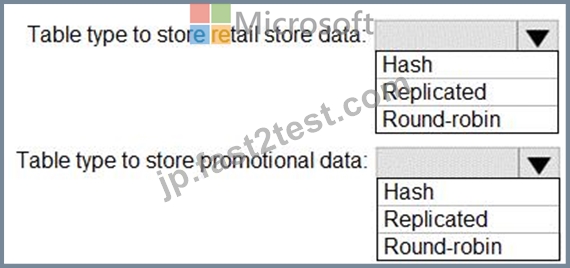
正解:
解説:
Reference:
https://rajanieshkaushikk.com/2020/09/09/how-to-choose-right-data-distribution-strategy-for-azure-synapse/
質問 # 133
You have an Azure SQL database named D61.
You need to identify how much unused space in megabytes was allocated to DB1.
How should you complete the Transact-SQL query? To answer select the appropriate options m the answer area.
NOTE: Each correct selection is worth one point.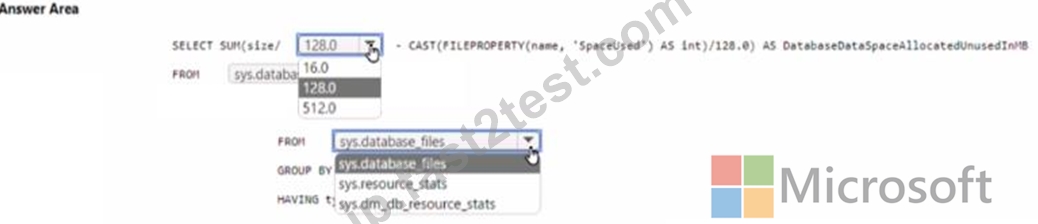
正解:
解説:
質問 # 134
You have an Azure SQL database named DB 1 in the General Purpose service tier.
You need to monitor DB 1 by using SQL Insights.
What should you include in the solution? To answer, select the appropriate options in the answer area.
NOTE: Each correct selection is worth one point.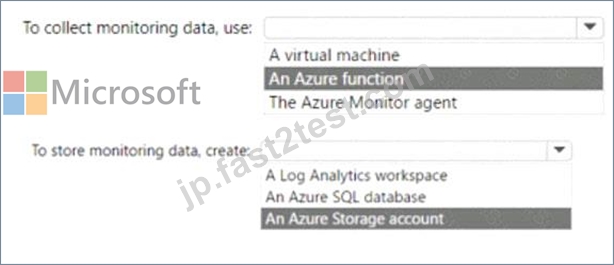
正解:
解説: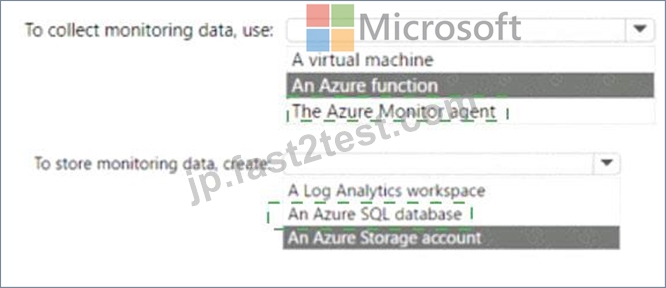
Explanation:
Box 1 = Azure Monitor Agent
Box 2 = An Azure SQL database
https://docs.microsoft.com/en-us/azure/azure-sql/database/sql-database-paas-overview?view=azuresql
質問 # 135
You need to design an analytical storage solution for the transactional data. The solution must meet the sales transaction dataset requirements.
What should you include in the solution? To answer, select the appropriate options in the answer area.
NOTE:Each correct selection is worth one point.
正解:
解説: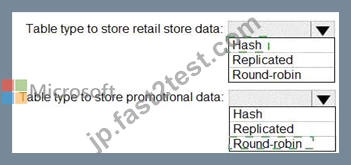
Explanation
Graphical user interface, text, application Description automatically generated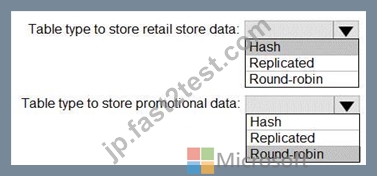
Box 1: Hash
Scenario:
Ensure that queries joining and filtering sales transaction records based on product ID complete as quickly as possible.
A hash distributed table can deliver the highest query performance for joins and aggregations on large tables.
Box 2: Round-robin
Scenario:
You plan to create a promotional table that will contain a promotion ID. The promotion ID will be associated to a specific product. The product will be identified by a product ID. The table will be approximately 5 GB.
A round-robin table is the most straightforward table to create and delivers fast performance when used as a staging table for loads. These are some scenarios where you should choose Round robin distribution:
When you cannot identify a single key to distribute your data.
If your data doesn't frequently join with data from other tables.
When there are no obvious keys to join.
Reference:
https://rajanieshkaushikk.com/2020/09/09/how-to-choose-right-data-distribution-strategy-for-azure-synapse/
質問 # 136
You are building an Azure virtual machine.
You allocate two 1-TiB, P30 premium storage disks to the virtual machine. Each disk provides 5,000 IOPS.
You plan to migrate an on-premises instance of Microsoft SQL Server to the virtual machine. The instance has a database that contains a 1.2-TiB data file. The database requires 10,000 IOPS.
You need to configure storage for the virtual machine to support the database.
Which three objects should you create in sequence? To answer, move the appropriate objects from the list of objects to the answer area and arrange them in the correct order.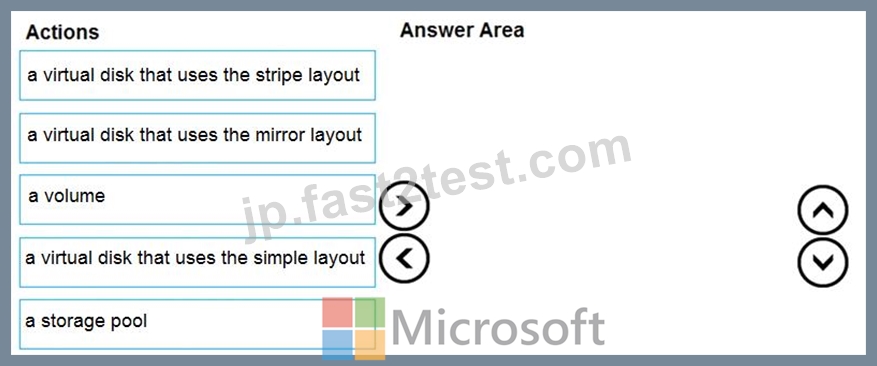
正解:
解説: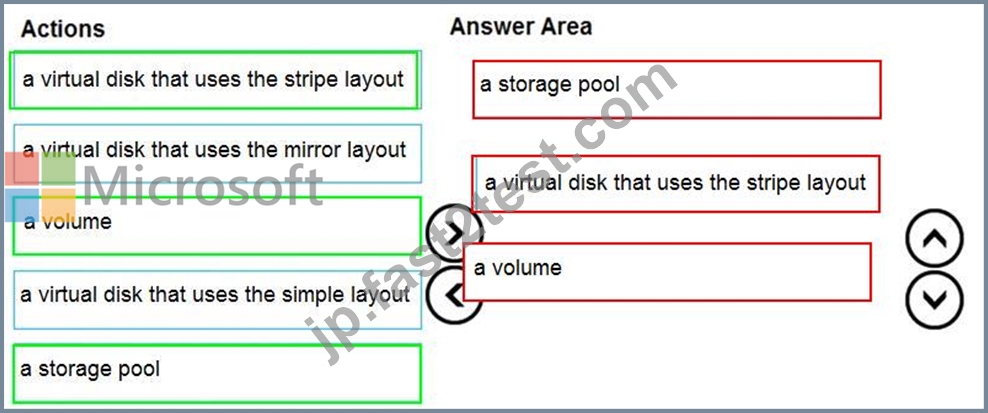
Explanation:
Follow these same steps to create striped virtual disk:
Create Log Storage Pool.
Create Virtual Disk
Create Volume
Box 1: a storage pool
Box 2: a virtual disk that uses stripe layout
Disk Striping: Use multiple disks and stripe them together to get a combined higher IOPS and Throughput limit. The combined limit per VM should be higher than the combined limits of attached premium disks.
Box 3: a volume
Reference:
https://hanu.com/hanu-how-to-striping-of-disks-for-azure-sql-server/
質問 # 137
You receive numerous alerts from Azure Monitor for an Azure SQL database.
You need to reduce the number of alerts. You must only receive alerts if there is a significant change in usage patterns for an extended period.
Which two actions should you perform? Each correct answer presents part of the solution.
NOTE: Each correct selection is worth one point.
- A. Set Force Plan to On
- B. Set Threshold Sensitivity to Low
- C. Set Threshold Sensitivity to High
- D. Set the Alert logic threshold to Dynamic
- E. Set the Alert logic threshold to Static
正解:B、D
解説:
B: Dynamic Thresholds continuously learns the data of the metric series and tries to model it using a set of algorithms and methods. It detects patterns in the data such as seasonality (Hourly
/ Daily / Weekly), and is able to handle noisy metrics (such as machine CPU or memory) as well as metrics with low dispersion (such as availability and error rate).
D: Alert threshold sensitivity is a high-level concept that controls the amount of deviation from metric behavior required to trigger an alert.
Low - The thresholds will be loose with more distance from metric series pattern. An alert rule will only trigger on large deviations, resulting in fewer alerts.
Incorrect Answers:
A: High - The thresholds will be tight and close to the metric series pattern. An alert rule will be triggered on the smallest deviation, resulting in more alerts.
Reference:
https://docs.microsoft.com/en-us/azure/azure-monitor/platform/alerts-dynamic-thresholds
質問 # 138
Hotspot Question
You have an Azure SQL database named db1.
You need to retrieve the resource usage of db1 from the last week.
How should you complete the statement? To answer, select the appropriate options in the answer area.
NOTE: Each correct selection is worth one point.
正解:
解説: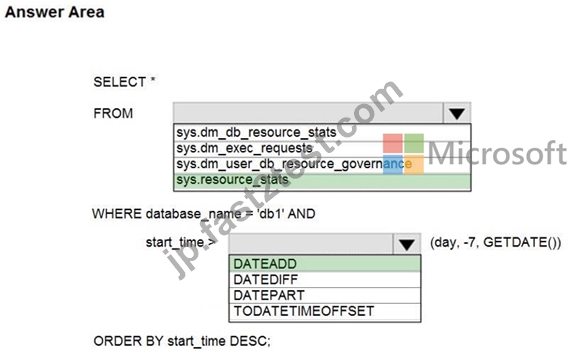
Explanation:
Box 1: sys.resource_stats
sys.resource_stats returns CPU usage and storage data for an Azure SQL Database. It has database_name and start_time columns.
Box 2: DateAdd
The following example returns all databases that are averaging at least 80% of compute utilization over the last one week.
DECLARE @s datetime;
DECLARE @e datetime;
SET @s= DateAdd(d,-7,GetUTCDate());
SET @e= GETUTCDATE();
SELECT database_name, AVG(avg_cpu_percent) AS Average_Compute_Utilization FROM sys.resource_stats WHERE start_time BETWEEN @s AND @e GROUP BY database_name HAVING AVG(avg_cpu_percent) >= 80 Incorrect Answers:
sys.dm_exec_requests:
sys.dm_exec_requests returns information about each request that is executing in SQL Server. It does not have a column named database_name.
sys.dm_db_resource_stats:
sys.dm_db_resource_stats does not have any start_time column.
Note: sys.dm_db_resource_stats returns CPU, I/O, and memory consumption for an Azure SQL Database database. One row exists for every 15 seconds, even if there is no activity in the database. Historical data is maintained for approximately one hour.
Sys.dm_user_db_resource_governance returns actual configuration and capacity settings used by resource governance mechanisms in the current database or elastic pool. It does not have any start_time column.
Reference:
https://docs.microsoft.com/en-us/sql/relational-databases/system-catalog-views/sys-resource-stats-azure-sql-database
質問 # 139
Which counter should you monitor for real-time processing to meet the technical requirements?
- A. CPU% utilization
- B. Data Conversion Errors
- C. Concurrent users
- D. SU% Utilization
正解:A
解説:
Section: [none]
Explanation:
Scenario: Real-time processing must be monitored to ensure that workloads are sized properly based on actual usage patterns.
To monitor the performance of a database in Azure SQL Database and Azure SQL Managed Instance, start by monitoring the CPU and IO resources used by your workload relative to the level of database performance you chose in selecting a particular service tier and performance level.
Reference:
https://docs.microsoft.com/en-us/azure/azure-sql/database/monitor-tune-overview Question Set 4
質問 # 140
Hotspot Question
You have an Azure SQL database that contains a table named Customer. Customer has the columns shown in the following table.
You plan to implement a dynamic data mask for the Customer_Phone column. The mask must meet the following requirements:
- The first six numerals of each customer's phone number must be
masked.
- The last four digits of each customer's phone number must be visible.
- Hyphens must be preserved and displayed.
How should you configure the dynamic data mask? To answer, select the appropriate options in the answer area.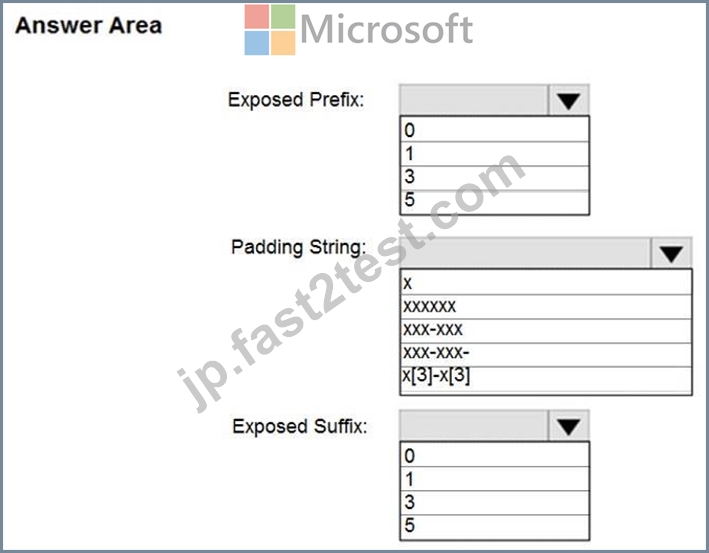
正解:
解説:
Explanation:
Box 1: 0
Custom String : Masking method that exposes the first and last letters and adds a custom padding string in the middle. prefix,[padding],suffix Box 2: xxx-xxx Box 3: 5 Reference:
https://docs.microsoft.com/en-us/sql/relational-databases/security/dynamic-data-masking
質問 # 141
You have SQL Server on an Azure virtual machine that contains a database named DB1.
You view a plan summary that shows the duration in milliseconds of each execution of query 1178902 as shown in the following exhibit: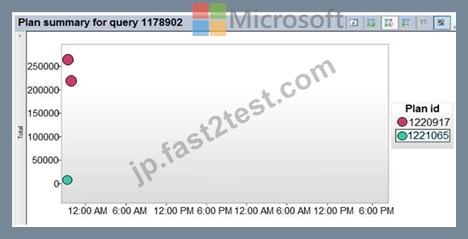
What should you do to ensure that the query uses the execution plan which executes in the least amount of time?
- A. Force the query execution plan for plan 1221065.
- B. Disable parameter sniffing.
- C. Run the DBCC FREEPROCCACHEcommand.
- D. Force the query execution plan for plan 1220917.
正解:D
解説:
Explanation/Reference:
https://docs.microsoft.com/en-us/sql/relational-databases/performance/query-store-usage-scenarios
質問 # 142
You are building a database in an Azure Synapse Analytics serverless SQL pool.
You have data stored in Parquet files in an Azure Data Lake Storage Gen2 container.
Records are structured as shown in the following sample.
The records contain two applicants at most.
You need to build a table that includes only the address fields.
How should you complete the Transact-SQL statement? To answer, select the appropriate options in the answer area.
NOTE: Each correct selection is worth one point.
正解:
解説: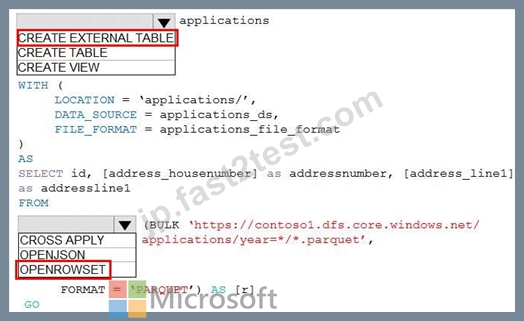
Reference:
https://docs.microsoft.com/en-us/azure/synapse-analytics/sql/develop-tables-external-tables
質問 # 143
You have an Azure SQL database.
You are reviewing a slow performing query as shown in the following exhibit.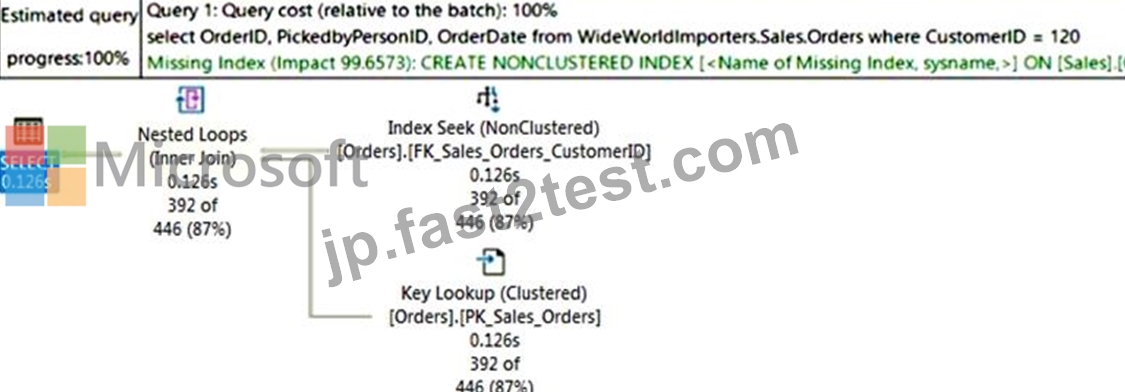
Use the drop-down menus to select the answer choice that completes each statement based on the information presented in the graphic.
NOTE: Each correct selection is worth one point.
正解:
解説: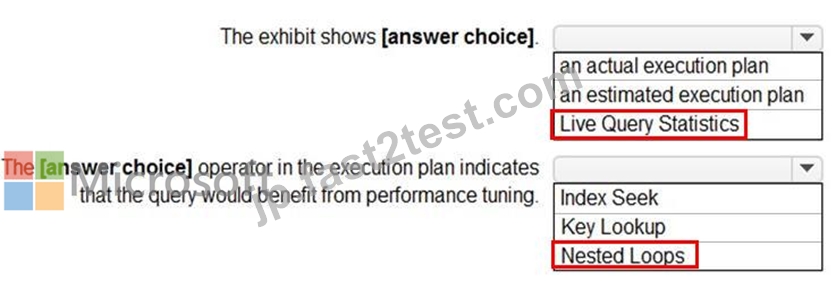
Reference:
https://docs.microsoft.com/en-us/sql/relational-databases/performance/live-query-statistics?view=sql-server-ver15
質問 # 144
You are provisioning an Azure SQL database in the Azure portal as shown in the following exhibit.
Use the drop-down menus to select the answer choice that completes each statement based on the information presented in the graphic.
NOTE: Each correct selection is worth one point.
正解:
解説: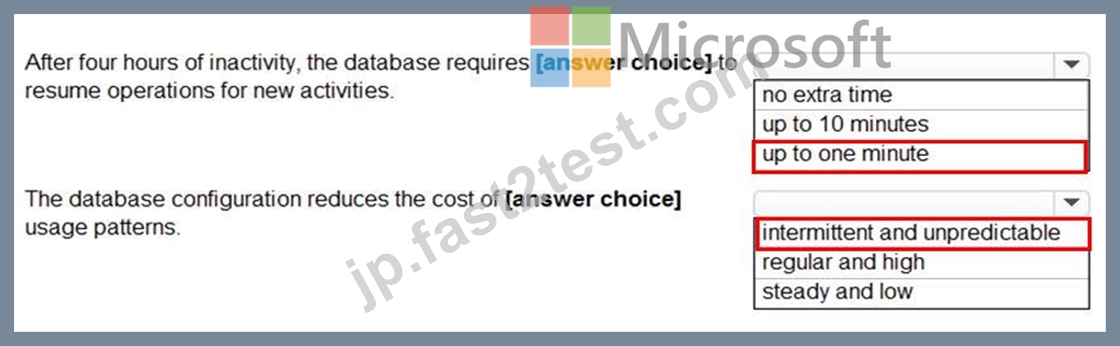
Reference:
https://docs.microsoft.com/en-us/azure/azure-sql/database/serverless-tier-overview
質問 # 145
You are designing a date dimension table in an Azure Synapse Analytics dedicated SQL pool. The date
dimension table will be used by all the fact tables.
Which distribution type should you recommend to minimize data movement?
- A. ROUND_ROBIN
- B. HASH
- C. REPLICATE
正解:C
解説:
A replicated table has a full copy of the table available on every Compute node. Queries run fast on replicated tables since joins on replicated tables don't require data movement. Replication requires extra storage, though, and isn't practical for large tables.
Incorrect Answers:
C: A round-robin distributed table distributes table rows evenly across all distributions. The assignment of rows to distributions is random. Unlike hash-distributed tables, rows with equal values are not guaranteed to be assigned to the same distribution.
As a result, the system sometimes needs to invoke a data movement operation to better organize your data before it can resolve a query.
Reference:
https://docs.microsoft.com/en-us/azure/synapse-analytics/sql-data-warehouse/sql-data-warehouse-tables-distribute
質問 # 146
You have an instance of SQL Server on Azure Virtual Machines named VM1.
You need to use an Azure Automation runbook to initiate a SQL Server database backup on VM1.
How should you complete the command? To answer, select the appropriate options in the answer area.
NOTE: Each correct selection is worth one point.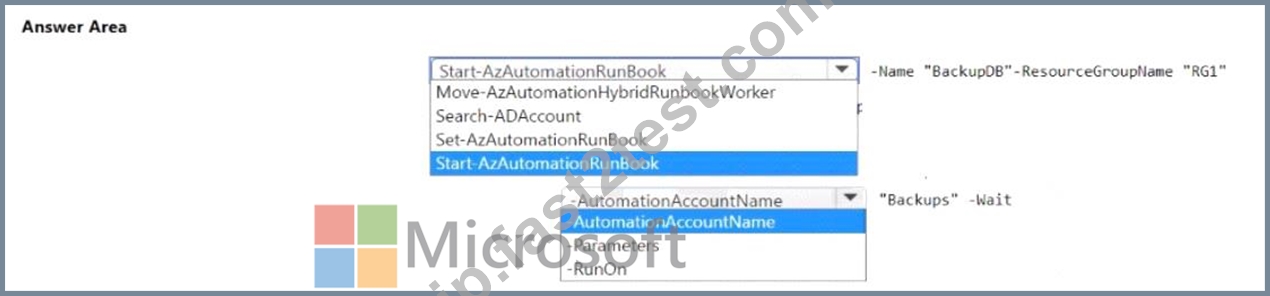
正解:
解説: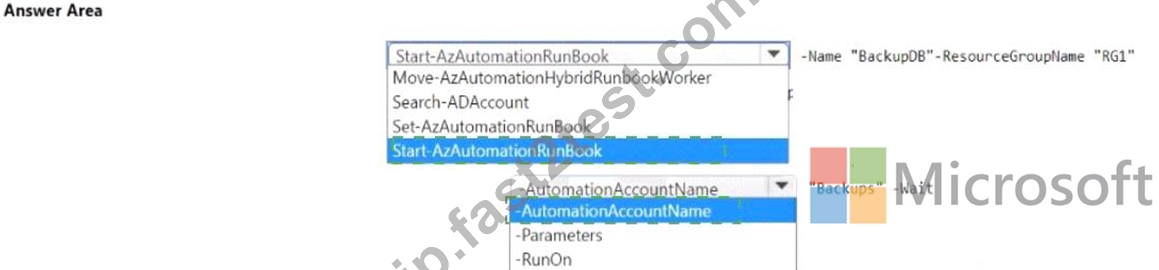
Explanation:
質問 # 147
You have a SQL Server on Azure Virtual Machines instance named VM1 that hosts a database named DB1. You run the following query.
For each of the following statements, select Yes if the statement is true. Otherwise, select No.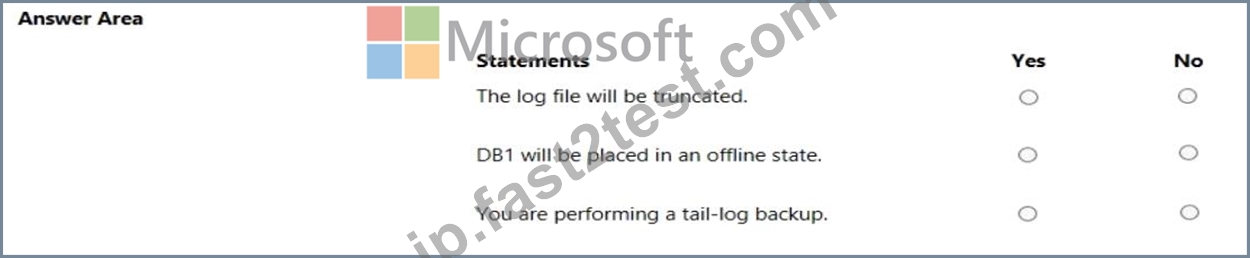
正解:
解説:
質問 # 148
......
DP-300認定ガイドPDFは100%カバー率でリアル試験問題:https://jp.fast2test.com/DP-300-premium-file.html
合格させるDP-300レビューガイド、信頼され続けるDP-300テストエンジン:https://drive.google.com/open?id=18IZ0N8r5xfwn5AOauieouHzlIgwObtzB