

[2024年11月03日] 合格率取得する秘訣はOGBA-101認定試験エンジンPDF
OGBA-101試験問題集合格できるには更新された2024年11月テスト問題集
The Open Group OGBA-101 認定試験の出題範囲:
| トピック | 出題範囲 |
|---|---|
| トピック 1 |
|
| トピック 2 |
|
| トピック 3 |
|
| トピック 4 |
|
| トピック 5 |
|
質問 # 15
Which approach to model, measure, and analyze business value is primarily concerned with identifying the participants involved in creating and delivering value?
- A. Value chains
- B. Value networks
- C. Value streams
- D. Lean value streams
正解:B
解説:
Value networks are primarily concerned with identifying the participants involved in creating and delivering value. They focus on the interactions between different stakeholders, including customers, suppliers, partners, and internal departments. This approach helps in understanding how value is exchanged and co-created across the network, highlighting the roles and relationships that contribute to the overall value delivery.
質問 # 16
Which of the following best describes a business capability?
- A. It is an articulation of the relationships between business entities that make up the enterprise.
- B. It delineates what a business does without an explanation of how, why, or where the capability is used.
- C. It is a qualitative statement of intent that should be met by the enterprise architecture capability developing the business architecture.
- D. It is a detailed description of the architectural approach to realize a particular solution.
正解:B
解説:
According to the TOGAF Series Guide to Business Capabilities (Version 2), a business capability is defined as
"a particular ability or capacity that a business may possess or exchange to achieve a specific purpose or outcome" 4. A business capability delineates what a business does without an explanation of how, why, or where the capability is used4. A business capability can be expressed as a verb phrase that indicates what function or service the capabilityprovides4. For example, some possible business capabilities are "Manage Customer Relationships", "Deliver Products", or "Perform Financial Analysis".
質問 # 17
In what TOGAF ADM phase should the architect locate existing architecture descriptions to create an information map?
- A. Phase E
- B. Preliminary Phase
- C. Phase A
- D. Phase B
正解:C
解説:
In the TOGAF ADM cycle, Phase A, the Architecture Vision phase, is where the architect would locate existing architecture descriptions to create an information map. This phase involves understanding the strategic context for the architecture work, defining the scope, identifying stakeholders, creating the Architecture Vision, and obtaining approvals to proceed with the work. Part of this involves reviewing existing documentation to understand the current state of the architecture and the information that is already available, which would be useful for creating an information map.
質問 # 18
In which part of a business scenario are business capabilities and value streams modelled?
- A. When identifying, documenting and ranking the problem
- B. When identifying the business and technology environment
- C. When identifying and documenting desired outcomes
- D. When identifying the human actors
正解:C
解説:
In the context of TOGAF's business scenarios, business capabilities and value streams are typically modeled during the phase of identifying and documenting the desired outcomes. This is because desired outcomes are directly related to what the business intends to achieve, and therefore, it makes sense to model the capabilities (what the business can do) and the value streams (the series of steps the business undertakes to create value) at this stage. This helps in understanding the required changes or enhancements to business capabilities and processes to achieve those outcomes.
質問 # 19
Which approach to modeling business value is designed to create and end-to-end perspective of value from the customer's perspective?
- A. Value chains
- B. Value streams
- C. Value networks
- D. Lean value streams
正解:B
解説:
A value stream is an approach to modeling business value that focuses on the end-to-end sequence of activities that an organization performs to deliver a product or service to the customer. This perspective is designed to help organizations understand the full lifecycle of value creation, from the initial customer demand to the final delivery of value. It provides a holistic view of the flow of value through the organization and is instrumental in identifying areas of waste and opportunities for improvement to enhance the overall customer experience.
Value streams help in visualizing and optimizing the steps necessary to effect change in the business processes and systems that create value for the customers.
質問 # 20
Which of the following describes how business models are used within the TOGAF standard?
- A. To help formulate architecture and business principles.
- B. To tailor the enterprise architecture for the business.
- C. To identify, classify, and mitigate risks to the business.
- D. To document the factors impacting the business migration plan.
正解:B
解説:
In the TOGAF framework, business models play a critical role in aligning the enterprise architecture with the specific needs and objectives of the business. Here's a detailed explanation referencing key concepts from TOGAF:
* Business Architecture in TOGAF:
* The Business Architecture is one of the four architecture domains in the TOGAF Architecture Development Method (ADM). It describes the business strategy, governance, organization, and key business processes.
* Role of Business Models:
* Business models help in visualizing and understanding the business operations, strategy, and value propositions. They serve as a blueprint to tailor the enterprise architecture to the business requirements.
* TOGAF ADM Phases:
* Phase B: Business Architecture: During this phase, business models are used to understand and define the business strategy and processes. This helps in ensuring that the enterprise architecture is aligned with business goals and can support the delivery of business outcomes.
* Phase A: Architecture Vision: Business models are utilized to create an architecture vision that reflects the business context and strategic intent. This involves tailoring the enterprise architecture to fit the specific business needs.
* Tailoring Enterprise Architecture:
* Customization and Alignment: By using business models, architects can tailor the architecture to align with the business vision and strategy. This ensures that the architecture supports the business in achieving its strategic goals and provides value.
* Stakeholder Engagement: Business models facilitate communication and engagement with stakeholders by providing a clear representation of business operations and strategies. This helps in gaining consensus and support for the architecture.
* TOGAF Reference Models:
* Business Model Canvas: This is a strategic management template used for developing new or documenting existing business models. It describes a firm's value proposition, infrastructure, customers, and finances. The Business Model Canvas is referenced in TOGAF as a tool to help tailor the enterprise architecture.
* Examples and Applications:
* In practical terms, using business models allows architects to identify key business capabilities, value streams, and organizational structures that need to be supported by the IT architecture. This ensures that IT investments and projects are directly aligned with business priorities.
In summary, business models are integral in tailoring the enterprise architecture to the specific needs and strategic objectives of the business within the TOGAF framework. This alignment ensures that the architecture is relevant, efficient, and supportive of business goals.
質問 # 21
Which of the following is a benefit of information mapping?
- A. It enables improved business process integration.
- B. It provides a basis to support decision-making throughout the business.
- C. It provides a framework for effective business requirements analysis.
- D. It highlights information requirements not addressed by a business architecture.
正解:B
解説:
One of the benefits of information mapping is that it provides a basis to support decision-making throughout the business1. Information mapping is a technique that can be used to document and visualize the information concepts and their relationships that are relevant for the business1. Information mapping can help to identify the information needs, sources, flows, quality, and value of the business, as well as the gaps, issues, and opportunities for improvement1. By providing a clear and consistent view of the information landscape, information mapping can enable better informed and more effective decisions at all levels of the business.
質問 # 22
Consider the following example value stream:
Which of the following statements is most correct?
- A. The value stream consists of five sequential subprocesses.
- B. The value stream is mapped to five subsidiary value streams.
- C. The value stream is decomposed into five value stream stages
- D. The value stream is decomposed into five sequential events.
正解:C
解説:
According to the TOGAF Series Guide to Value Streams (Version 1), a value stream stage is defined as "a distinct part of a value stream that represents a group of activities contributing to an overall result" 5. A value stream stage can be expressed as a noun phrase that indicates what outcome or state is achieved by completing the stage5. For example, some possible value stream stages are "Product Ordered", "Payment Processed", or
"Customer Satisfied". The example value stream shows how an online retailer creates and delivers value for its customers by performing five value stream stages: "Acquire Retail Product", "Advertise Channels", "Display Products", "Enable Selection", "Process Payment", and "Deliver Product(s)" 5. Therefore, the value stream is decomposed into five value stream stages.
質問 # 23
In the diagram, what are the items labelled A, B, and C?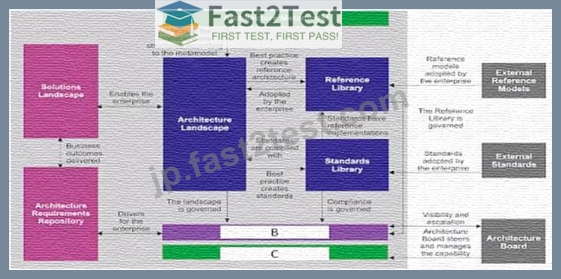
- A. A-Architecture Repository, B-Governance Repository. C-Architecture Capability
- B. A-Architecture Repository, B-Governing Board, C-Enterprise Capability
- C. A-Enterprise Repository, B-Governance Repository. C-Board Repository
- D. Enterprise Repository, B-Board repository, C-Enterprise Capability
正解:B
解説:
In the provided diagram, item A refers to the Architecture Repository, which is a part of the TOGAF framework where all the architecture assets are stored. This includes the architectural models, patterns, architecture descriptions, and other artifacts relevant to the architecture. Item B is labeled as the Governing Board, which is likely referring to the Architecture Board or a similar governance structure responsible for oversight and decision-making regarding the enterprise architecture. Item C refers to Enterprise Capability, which encompasses the processes, tools, skills, and other capabilities that enable the architecture function within the enterprise.
質問 # 24
Consider the following statements;
1. A whole corporation or a division of a corporation
2. A government agency or a single government department
3. Partnerships and alliances of businesses working together, such as a consortium or supply chain What are those examples of according to the TOGAF Standard?
- A. Business Units
- B. Organizations
- C. Enterprises
- D. Architectures Scopes
正解:C
解説:
According to the TOGAF Standard, an enterprise is defined as any collection of organizations that has a common set of goals and/or a single bottom line1. The examples given in the question are all types of enterprises that can be the subject of enterprise architecture1.
In the context of TOGAF, the term 'enterprise' encompasses more than just a single organization. It refers to any collection of organizations that has a common set of goals. This can include, as described in the statements provided, entire corporations or their divisions, government agencies or departments, as well as business partnerships such as consortia or supply chains. TOGAF uses the term 'enterprise' to define the full scope of the entity that is the subject of planning, design, implementation, and operation of an Enterprise Architecture.
質問 # 25
When developing a Business Architecture, which of the following is recommended if an enterprise has existing Architecture Descriptions?
- A. They should be used as the basis for the Baseline Description.
- B. They should be reviewed, and work packages identified for portfolio planning.
- C. They should be added to the Governance Repository within the Architecture Repository.
- D. They should be used to validate the business principles.
正解:A
解説:
When developing a Business Architecture, TOGAF provides guidance on how to leverage existing architecture descriptions to build a comprehensive and accurate Baseline Description. Here's a step-by-step explanation:
* Existing Architecture Descriptions:
* Existing architecture descriptions provide valuable insights into the current state of the enterprise's architecture. These descriptions can include documentation of processes, systems, technologies, and organizational structures.
* Baseline Description:
* The Baseline Description represents the current state of the enterprise architecture. It serves as the starting point for developing the Target Architecture and planning the transition from the current state to the future state.
* Using Existing Descriptions:
* Review and Analyze: Existing architecture descriptions should be reviewed and analyzed to understand the current state accurately. This involves identifying all relevant artifacts, documents, and data.
* Integration into Baseline: The information from the existing descriptions should be integrated into the Baseline Description. This ensures that the Baseline accurately reflects the current state, providing a solid foundation for future planning.
* Gaps and Opportunities: By using existing descriptions, architects can identify gaps in the current architecture and opportunities for improvement. This helps in formulating a more effective Target Architecture.
* TOGAF ADM References:
* Phase A: Architecture Vision: This phase involves establishing the architecture vision, which includes defining the scope and approach for the Baseline Description.
* Phase B: Business Architecture: During this phase, the Baseline Business Architecture is developed using existing architecture descriptions as a key input.
In summary, using existing architecture descriptions as the basis for the Baseline Description ensures that the current state is accurately documented, providing a reliable foundation for developing the Target Architecture and planning the transition.
質問 # 26
Refer to Exhibit
- A. 1 Phase C - 2 Phase F - 3 Phase H - 4 Phase B
- B. 1 Phase C - 2 Phase F - 3 Phase G- 4 Phase D
- C. 1 Phase C - 2 Phase E - 1 Phase H - 4 Phase C
- D. 1 Phase D - 2 Phase B - 3 Phase G - 4 Phase A
正解:D
解説:
The diagram of the ADM phases matches the following purpose descriptions:
1 Phase D: This phase is responsible for developing the Technology Architecture that defines the logical software and hardware capabilities that are required to support the deployment of business, data, and application services1. This includes defining the technology platforms, principles, standards, and policies that will enable and govern the implementation of the Target Architecture1.
2 Phase B: This phase is responsible for developing the Business Architecture that describes how the enterprise needs to operate to achieve the business goals, and respond to the strategic drivers set out in the Architecture Vision1. This includes defining the business strategy, governance, organization, and key business processes1.
3 Phase G: This phase is responsible for implementing governance and management frameworks over architecture contracting, monitoring, and compliance1. This includes establishing an implementation governance model, defining architecture contracts and compliance reviews, and monitoring and supporting the implementation projects1.
4 Phase A: This phase is responsible for developing the Architecture Vision that describes the scope and approach for the overall architecture project1. This includes defining the problem statement, objective, scope, stakeholders, business requirements, and high-level architecture vision1.
質問 # 27
Which ADM phase focuses on defining the problem to be solved, identifying the stakeholders, their concerns, and requirements?
- A. Phase C
- B. Preliminary Phase
- C. Phase A
- D. Phase B
正解:C
解説:
In the TOGAF ADM (Architecture Development Method), Phase A, also known as the Architecture Vision phase, is critical for defining the problem to be solved and identifying the stakeholders, their concerns, and requirements. Here's a detailed explanation:
* Phase A: Architecture Vision:
* Objective: The primary objective of Phase A is to establish a high-level vision of the architecture project. This includes defining the scope, identifying stakeholders, and understanding their concerns and requirements.
* Stakeholder Identification: During this phase, all relevant stakeholders are identified. This includes business leaders, IT leaders, end-users, and other parties who have a vested interest in the architecture project.
* Concerns and Requirements: Once stakeholders are identified, their concerns and requirements are gathered. This involves understanding their needs, expectations, and the issues they face that the architecture project aims to address.
* Key Activities:
* Problem Definition: Phase A focuses on clearly defining the problem or opportunity that the architecture project seeks to address. This sets the stage for developing the architecture vision and ensuring that the project aligns with business goals.
* Developing the Architecture Vision: A key output of Phase A is the architecture vision, which provides a high-level overview of the desired future state. This vision is aligned with the business strategy and objectives.
* Requirements Management: Phase A also involves establishing a requirements management process to ensure that stakeholder needs are captured, analyzed, and addressed throughout the architecture development process.
* TOGAF References:
* Phase A Deliverables: Key deliverables of Phase A include the Architecture Vision document, stakeholder map, and high-level requirements.
* ADM Guidelines and Techniques: TOGAF provides guidelines and techniques for effectively conducting Phase A, including methods for stakeholder analysis, requirements gathering, and developing the architecture vision.
In summary, Phase A of the TOGAF ADM focuses on defining the problem to be solved, identifying stakeholders, understanding their concerns and requirements, and developing a high-level architecture vision that aligns with business objectives.
質問 # 28
Which of the following Business Architecture concepts should the architect examine and search for when developing the Architecture Vision?
- A. Architecture Principles, Business Goals
- B. Organization Map. Business Capabilities
- C. Implementation Factor Catalog. Business Value Assessment Matrix
- D. Architecture Continuum, Architecture Repository
正解:A
解説:
When developing the Architecture Vision, which is part of the TOGAF ADM Phase A, architects should examine the Architecture Principles and Business Goals. These components provide the foundational guidance and the strategic context for the architecture work. They ensure that the resulting architecture aligns with the overall direction and objectives of the enterprise.
質問 # 29
Consider the following graphic illustrating a method supporting the TOGAF ADM.
What does the method help identify?
- A. Architecture Solutions
- B. Business Scenarios
- C. Alternative Target Architectures
- D. Solution Building Blocks
正解:C
解説:
The graphic illustrates a method for developing alternative target architectures in Phase E of the TOGAF ADM1. The method involves identifying and evaluating candidate architectures based on criteria such as business value, cost, risk, and feasibility1. The method helps to identify the most suitable architecture solution for the enterprise.
質問 # 30
Which ADM phase focuses on defining the problem to be solved, identifying the stakeholders, their concerns, and requirements?
- A. Phase C
- B. Preliminary Phase
- C. Phase A
- D. Phase B
正解:C
解説:
Phase A of the TOGAF ADM (Architecture Development Method), also known as the Architecture Vision phase, focuses on defining the problem to be solved, identifying stakeholders, their concerns, and requirements. Here's a detailed explanation:
Phase A: Architecture Vision:
Objective: The primary objective of Phase A is to establish a high-level vision of the architecture project, including defining the scope and identifying key stakeholders and their concerns.
Problem Definition: This phase involves clearly defining the business problem or opportunity that the architecture project seeks to address. This sets the stage for all subsequent architecture work.
Stakeholder Identification:
Identification and Analysis: Stakeholders are identified and their concerns and requirements are gathered. This includes business leaders, IT leaders, end-users, and other relevant parties.
Understanding Needs: Understanding the needs and expectations of stakeholders is crucial for ensuring that the architecture aligns with business objectives and addresses key concerns.
Requirements Gathering:
High-Level Requirements: In Phase A, high-level requirements are identified and documented. These requirements guide the development of the architecture vision and provide a basis for more detailed requirements in later phases.
Requirements Management: A requirements management process is established to ensure that stakeholder needs are continuously captured, analyzed, and addressed throughout the architecture development process.
TOGAF References:
Deliverables: Key deliverables of Phase A include the Architecture Vision document, stakeholder map, and high-level requirements.
ADM Guidelines: TOGAF provides guidelines and techniques for conducting Phase A, including methods for stakeholder analysis, problem definition, and developing the architecture vision.
In summary, Phase A of the TOGAF ADM focuses on defining the problem to be solved, identifying stakeholders, understanding their concerns and requirements, and developing a high-level architecture vision that aligns with business objectives.
質問 # 31
Which approach to modeling business value is designed to create and end-to-end perspective of value from the customer's perspective?
- A. Value chains
- B. Value streams
- C. Value networks
- D. Lean value streams
正解:B
解説:
A value stream is an approach to modeling business value that focuses on the end-to-end sequence of activities that an organization performs to deliver a product or service to the customer. This perspective is designed to help organizations understand the full lifecycle of value creation, from the initial customer demand to the final delivery of value. It provides a holistic view of the flow of value through the organization and is instrumental in identifying areas of waste and opportunities for improvement to enhance the overall customer experience. Value streams help in visualizing and optimizing the steps necessary to effect change in the business processes and systems that create value for the customers.
質問 # 32
Which of the following best describes information mapping?
- A. A technique to create a maturity model for information management.
- B. A technique to construct a high level description of the informational requirements of a business.
- C. A technique to represent business information assets in use, or planned by the enterprise.
- D. A technique to construct a baseline description of the structure and interaction of information assets that support key business functions.
正解:C
解説:
Information mapping in TOGAF is a technique used to represent business information assets that are either currently in use or planned for future use by the enterprise. Here's a detailed explanation:
Purpose of Information Mapping:
Information mapping provides a clear visualization of how information flows within the enterprise, highlighting the information assets and their interactions. This is crucial for understanding the current state and planning the future state of information management.
TOGAF Framework:
Phase C: Information Systems Architectures: Within this phase, information mapping is used to develop the Data Architecture, which outlines the structure of an organization's logical and physical data assets and data management resources.
Supporting Analysis: Information mapping supports various analyses, including gap analysis, impact analysis, and the identification of information dependencies and redundancies.
Benefits:
Clear Representation: It provides a clear and structured representation of business information assets, aiding in the understanding and management of information flows.
Alignment with Business Processes: Helps ensure that information assets are aligned with business processes and objectives, enhancing the efficiency and effectiveness of information usage.
Components:
Current Information Assets: Information mapping identifies and catalogs the information assets currently in use within the enterprise.
Planned Information Assets: It also includes planned information assets that will be needed to support future business processes and strategies.
In summary, information mapping is a technique to represent business information assets in use or planned by the enterprise, providing a structured view of information flows and supporting effective information management.
質問 # 33
What process turns a set of business capabilities into a structure that communicates the right amount of detail to different stakeholder groups?
- A. Mapping
- B. Stratification
- C. Categorization
- D. Layering
正解:A
解説:
Mapping is the process that turns a set of business capabilities into a structure that communicates the right amount of detail to different stakeholder groups. Here's a detailed explanation:
* Definition of Mapping:
* Mapping: In the context of business architecture, mapping refers to the process of visually representing the relationships between business capabilities and other elements such as processes, value streams, and organizational units. This helps in communicating the structure and interactions within the business.
* Purpose:
* Communication: Mapping provides a clear and structured way to communicate the details of business capabilities to different stakeholder groups. It ensures that each group receives the appropriate level of detail needed for their role and decision-making.
* Alignment: Helps in aligning business capabilities with strategic goals, processes, and
* organizational structure, ensuring that the architecture supports the overall business strategy.
* TOGAF References:
* Phase B: Business Architecture: During this phase, mapping is used to represent business capabilities and their relationships with other business elements. This helps in creating a coherent and comprehensive business architecture.
* Capability Mapping: TOGAF emphasizes the use of capability mapping to understand and analyze how different capabilities support business processes and value streams.
* Benefits:
* Clarity and Understanding: Mapping provides a visual representation that enhances clarity and understanding of the business architecture. It helps stakeholders see the big picture and understand how different parts of the business fit together.
* Stakeholder Engagement: By providing the right amount of detail to different stakeholders, mapping ensures effective engagement and collaboration across the organization.
In summary, mapping is the process that turns a set of business capabilities into a structure that communicates the right amount of detail to different stakeholder groups, facilitating clarity, understanding, and alignment.
質問 # 34
Which of the following is a benefit of organization mapping?
- A. An organization map improves the ability to consume, process, and deliver information.
- B. An organization map can be reused for training and employee development.
- C. An organization map improves strategic planning.
- D. An organization map highlights inefficiencies and reduces operational costs.
正解:C
解説:
One of the benefits of organization mapping is that it improves strategic planning2. Organization mapping is a technique that can be used to document and visualize the organizational structure and relationships of an enterprise or a part of it2. Organization mapping can help to align the organizational design with the business strategy, goals, and objectives2. Organization mapping can also help to identify the roles, responsibilities, authorities, accountabilities, and dependencies of different organizational entities2. By providing a clear and consistent view of the organizational landscape, organization mapping can enable better informed and more effective decisions for strategic planning.
質問 # 35
......
OGBA-101テスト問題練習は2024年最新のに更新された96問あります:https://jp.fast2test.com/OGBA-101-premium-file.html
更新されたプレミアムOGBA-101試験エンジンPDF:https://drive.google.com/open?id=1b_KJe--q2NFcKuHZEFYXMRCcQvYB6DuO