

無料提供中のUiPath-ADPv1試験問題集で(2025年最新のPDF問題集)信頼度の高いテストエンジン
UiPath-ADPv1のPDFで最近更新された問題です集試験点数を伸ばそう
質問 # 51
In the Robotic Enterprise (RE) Framework, at which point should a developer log a clear message with the Logging Level set to "Information," adhering to the best practices for automating a production-level process?
- A. Whenever the robot encounters an error on a Queue Item.
- B. Whenever data is fetched from external sources.
- C. Whenever an exception is caught in a Catch block.
- D. Whenever an argument or value is used.
正解:C
解説:
The point at which a developer should log a clear message with the Logging Level set to "Information", adhering to the best practices for automating a production-level process, is whenever data is fetched from external sources. Logging is the process of recording and storing information about the execution and status of a workflow. Logging is essential for debugging, monitoring, and auditing purposes. The Logging Level is a property that determines the level of detail and severity of the information that is logged. The Logging Level can be set to Trace, Verbose, Information, Warning, Error, or Fatal. The Information level is used to log general information about the workflow, such as the start and end of a process, the name and value of a variable, or the result of an operation. The best practice for logging with the Information level is to log whenever data is fetched from external sources, such as databases, web services, or files. This can help the developer to verify the accuracy and completeness of the data, as well as to track the source and destination of the data. Logging whenever data is fetched from external sources can also help the developer to identify any issues or errors that might occur during the data retrieval or processing. References: [Logging Levels],
[Logging Best Practices]
質問 # 52
What do the percentages from the Test Explorer panel represent?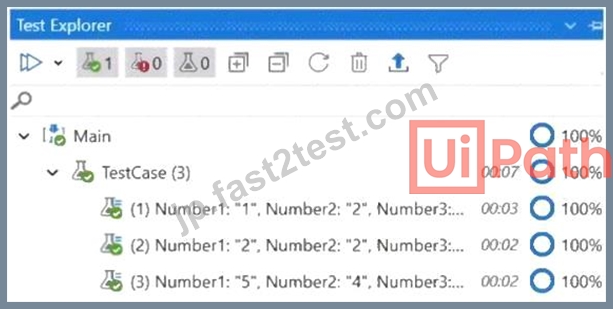
- A. Coverage percent.
- B. Correctness of the code percent.
- C. Passing percent.
- D. Percent of test data run.
正解:C
解説:
The percentages from the Test Explorer panel represent the passing percent of the test cases that are executed.
The Test Explorer panel shows the status of each test case, the total number of test cases, the number of passed test cases, the number of failed test cases, and the passing percent. The passing percent is calculated by dividing the number of passed test cases by the total number of test cases and multiplying by 100. For example, if there are 10 test cases and 8 of them pass, the passing percent is 80%. References: Test Explorer
質問 # 53
Which of the following examples accurately demonstrates using LINQ to perform data operations in a UiPath process?
- A. Utilizing LINQ to split a DataTable into multiple smaller DataTables based on a specific condition by writing dataTable.Splitf'ColumnName = 'Condition'").CopyToData Tablet).
- B. Employing LINQ to concatenate two strings in a list by writing listOfStrings.Concatenate("String_1",
"String_2").ToList(). - C. Using LINQ to filter DataTable rows based on a specific condition by writing dataTable.AsEnumerable().Where(Function(row) row("ColumnName").ToString.Contains("Value")).CopyToDataTable().
- D. Applying LINQ to convert a list of integers to a JSON format by writing listOflntegers.ToJSON().ToList().
正解:C
解説:
LINQ (Language-Integrated Query) is a feature of .NET that allows you to write queries to manipulate data from various sources, such as arrays, collections, databases, XML, etc. LINQ can be used in UiPath Studio to perform complex data operations on variables of different types, such as DataTable, List, Array, etc. LINQ has two syntax forms: query syntax and method syntax. Both forms can achieve the same results, but they have different styles and preferences.
Option B is the correct answer because it demonstrates using LINQ method syntax to filter DataTable rows based on a specific condition. The expression dataTable.AsEnumerable().Where(Function(row) row("ColumnName").ToString.Contains("Value")).CopyToDataTable() does the following:
It converts the DataTable variable dataTable to an IEnumerable(Of DataRow) object using the AsEnumerable extension method1. This allows the use of LINQ methods on the DataTable.
It filters the rows of the DataTable based on a lambda expression using the Where extension method2.
The lambda expression Function(row) row("ColumnName").ToString.Contains("Value") returns true for the rows that have the value "Value" in the column named "ColumnName".
It converts the filtered IEnumerable(Of DataRow) object back to a DataTable using the CopyToDataTable extension method3. This returns a new DataTable that contains only the rows that match the condition.
The other options are incorrect because:
Option A is incorrect because it uses an invalid LINQ method Concatenate. The correct method to concatenate two strings in a list is Concat4, which takes two IEnumerable(Of T) objects as arguments and returns a new IEnumerable(Of T) that contains the elements from both sources. For example, listOfStrings.Concat(new List(Of String) {"String_1", "String_2"}).ToList().
Option C is incorrect because it uses an invalid LINQ method ToJSON. There is no such method in the LINQ library that can convert a list of integers to a JSON format. To achieve this, you need to use a JSON serializer, such as Newtonsoft.Json5, which provides methods to convert .NET objects to JSON and vice versa. For example, JsonConvert.SerializeObject(listOfIntegers).
Option D is incorrect because it uses an invalid LINQ method Split. There is no such method in the LINQ library that can split a DataTable into multiple smaller DataTables based on a specific condition. To achieve this, you need to use a group by clause in LINQ query syntax or a GroupBy extension method in LINQ method syntax6, which groups the rows of a DataTable by a key value and returns an IEnumerable(Of IGrouping(Of TKey, TElement)) object. Then, you can use a Select extension method to project each group into a new DataTable using the CopyToDataTable extension method. For example, dataTable.AsEnumerable().GroupBy(Function(row) row("ColumnName")).Select(Function(group) group.CopyToDataTable()).ToList().
References:
DataTableExtensions.AsEnumerable Method (System.Data) | Microsoft Docs
Enumerable.Where(Of TSource) Method (System.Linq) | Microsoft Docs
DataTableExtensions.CopyToDataTable(Of T) Method (System.Data) | Microsoft Docs Enumerable.Concat(Of TSource) Method (System.Linq) | Microsoft Docs Json.NET - Newtonsoft Grouping Data - C# | Microsoft Docs
質問 # 54
Given the following variables assignments:
What will the output of the following conditional be: outputX = If(CInt(doubleX+Cdbl(intX)
+CDbl(stringX))> 38.30, 1, 0)
- A. 0
- B. Error during runtime
- C. Compilation error
- D. 1
正解:B
解説:
The conditional statement attempts to convert all variables to Double and then adds them up to compare against 38.30. However, the string "9.1" cannot be directly converted to a Double with CDbl because it is not in a correct format that can be recognized as a number (it might be due to the fact that it's a string with a comma instead of a period for a decimal point, depending on the culture settings of the system). This will cause a runtime error during the execution of the conditional statement.References:
Microsoft Visual Basic Guide: Type Conversion Functions
質問 # 55
What is a pre-requisite for running functional test cases in REFramework?
- A. Invoke InitAIISettings XAML file
- B. Invoke Process XAML file
- C. Invoke SetTransactionStatus XAML file
- D. Invoke Main XAML file
正解:A
質問 # 56
The Extract PDF Page Range activity is used to extract a specific set of pages from a PDF file. Which of the following statements correctly describes this activity?
- A. PageCount argument outputs the number of extracted pages.
- B. OutputFileName argument is optional.
- C. Password-protected PDF files cannot be processed with this activity.
- D. Range argument accepts complex range values or "All".
正解:D
解説:
The Extract PDF Page Range activity is used to extract a specific set of pages from a PDF file and save them as a new PDF file1. The activity has the following properties:
*Common
oDisplayName: The display name of the activity1.
*File
oFileName: The path of the PDF file you want to extract a range of pages from. This field supports only strings and String variables1.
oOutputFileName: The name you want to use for the file that is generated from the extracted range of pages.
This field supports only strings and String variables1.
oPassword: The password of the PDF file, if necessary. This field supports only strings and String variables1.
*Input
oRange: The range of pages that you want to retrieve. You can specify a single page (e.g. "7"), a range of pages (e.g. "7-12"), or a complex range, (e.g. "2-5, 7, 15-End" or "All"). Only string variables and strings are supported. By default, this field is cleared1.
*Misc
oPrivate: If selected, the values of variables and arguments are no longer logged at Verbose level1.
The statement that correctly describes this activity is B. Range argument accepts complex range values or
"All". This statement is true because the Range property allows you to specify the pages that you want to extract from the PDF file using different formats, such as single pages, ranges, or complex ranges1. You can also use the keyword "All" to extract all the pages from the PDF file1.
The other statements are incorrect because:
*A. Password-protected PDF files cannot be processed with this activity. This statement is false because the activity has a Password property that allows you to enter the password of the PDF file, if necessary1. This enables the activity to process password-protected PDF files1.
*C. OutputFileName argument is optional. This statement is false because the OutputFileName property is required for the activity to work1. This property specifies the name of the file that is generated from the extracted range of pages1. If this property is not provided, the activity will throw an exception1.
*D. PageCount argument outputs the number of extracted pages. This statement is false because the activity does not have a PageCount argument1. The activity does not output the number of extracted pages, but only the new PDF file that contains the extracted pages1.
質問 # 57
Given the following workflow:
What will be the output of the Log Message activity?
- A. apple, pear, orange, mango, kiwi
- B. "apple pear orange", "mango kiwi"
- C. apple, pear, orange
- D. apple pear orange, mango kiwi
正解:A
質問 # 58
In the context of a linear process, implemented with REFramework, how many times will the process enter the Get Transaction Data state?
- A. Until there are no more queue items left unprocessed in Orchestrator
- B. The process will not enter the Get Transaction Data state because a linear process is not transactional.
- C. 2 times.
- D. 1 lime
正解:D
解説:
In the context of a linear process, implemented with REFramework, the process will enter the Get Transaction Data state only 1 time. This is because the Get Transaction Data state is responsible for fetching the next transaction item from the data source and assigning it to the TransactionItem variable. In a linear process, there is only one transaction item that represents the entire process, and it is fetched at the beginning of the execution. Therefore, the process will enter the Get Transaction Data state only once, and then move to the Process Transaction state, where the main logic of the process is executed. The process will not return to the Get Transaction Data state, unless there is an exception or a retry in the Process Transaction state. References:
[Robotic Enterprise Framework], [REFramework for Linear Processes]
質問 # 59
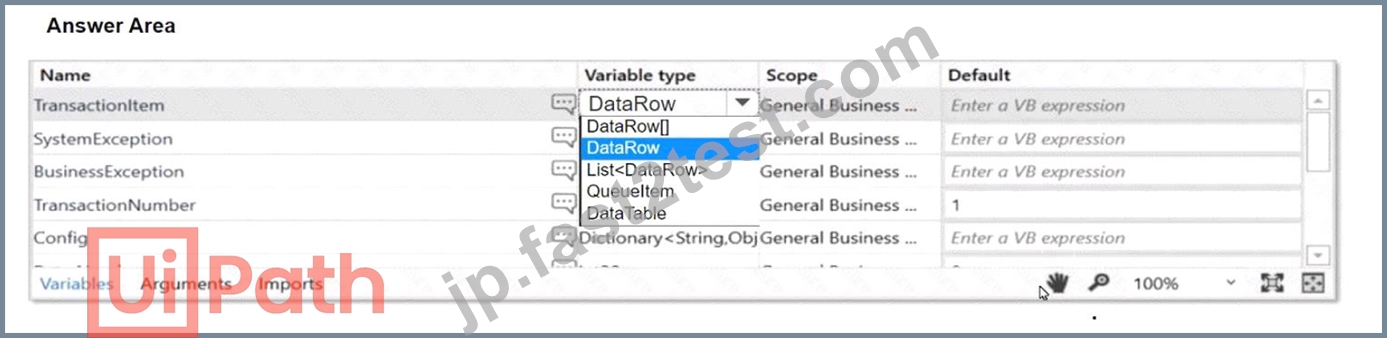
A developer aims to employ the REFramework for automating a business process that Involves a TransactionData collection (DataTable) comprising vendor names and addresses.
Instructions: Choose the appropriate variable type for the Transactionltem from the provided drop-down list in the following exhibit.
正解:
解説: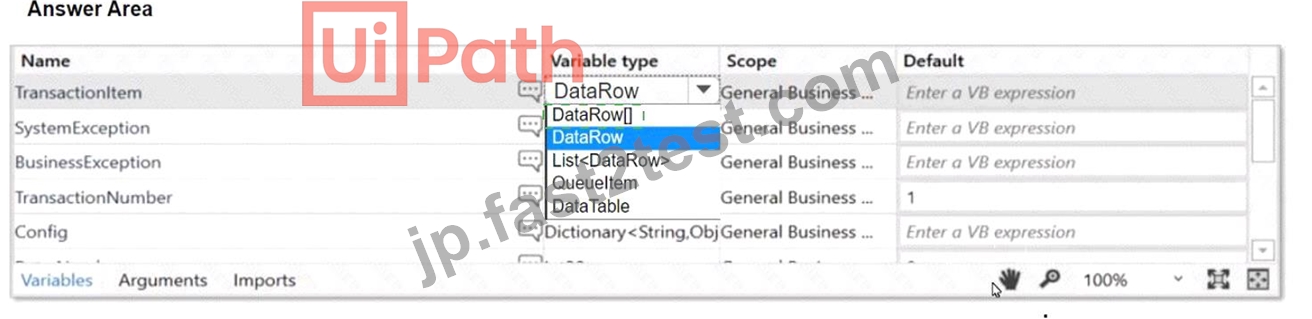
Explanation:
The REFramework (Robotic Enterprise Framework) in UiPath is designed to work with transactional data. For a process that involves iterating over a DataTable where each row represents a transaction item, the appropriate variable type for the TransactionItem would be a DataRow.
In the context of REFramework, a DataRow is typically used to represent a single transaction item when the transaction data is contained within a DataTable. This allows the framework to process each row (or transaction) one by one.
Therefore, the correct variable type for the TransactionItem from the drop-down list should be DataRow.
質問 # 60
A developer has designed a Performer process using the REFramework template in UiPath Studio. The process is published to an Orchestrator folder named "FolderA" and a job is created in Orchestrator from the package. The value of the OrchestratorQueueName setting in "Config.xlsx" is "QueueA" and the value of OrchestratorQueueFolder is "FolderA".
The developer runs the job from Orchestrator with the following argument values:
in_OrchestratorQueueName = "QueueB" in_OrchestratorOueueFolder = empty value Which queue will be consumed by the robot?
- A. QueueB from FolderA.
- B. QueueB from Shared.
- C. OueueA from FolderA.
- D. QueueA from Shared.
正解:A
解説:
The queue that will be consumed by the robot is QueueB from FolderA. This is because the arguments passed from Orchestrator have priority over the settings from the Config file. Therefore, the value of in_OrchestratorQueueName overrides the value of OrchestratorQueueName, and the value of in_OrchestratorQueueFolder overrides the value of OrchestratorQueueFolder. However, since the value of in_OrchestratorQueueFolder is empty, the default folder where the process is published is used, which is FolderA1.
The other options are not correct, because they do not reflect the values of the arguments passed from Orchestrator. For example:
Option A is incorrect, because the queue name is QueueA, not QueueB.
Option B is incorrect, because the queue folder is Shared, not FolderA.
Option D is incorrect, because the queue folder is Shared, not FolderA.
References:
1: Studio - REFramework Configuration - UiPath Documentation Portal
質問 # 61
To retrieve all Outlook emails with the word "UiPath" in the subject, which filtering property and filter schema should a developer use?
- A. Property: Filter
Schema: "@SQL=""urn:schemas:httpmail:subject"" like 'UiPath%'" - B. Property: FilterByMessageIds
Schema: "@SQL=""urn:schemas:httpmail:subject"" like '%UiPath%'" - C. Property: Filter
Schema: "@SQL=""urn:schemas:httpmail:subject"" like '%UiPath%'" - D. Property: FilterByMessageIds
Schema: "@SQL=""urn:schemas:httpmail:subject'"' like 'UiPath%'"
正解:C
解説:
o retrieve all Outlook emails with the word "UiPath" in the subject, the developer should use the Filter property and the filter schema "@SQL=""urn:schemas:httpmail:subject"" like '%UiPath%'". The Filter property allows the developer to specify a condition for retrieving the emails based on the email properties.
The filter schema is a string that follows the SQL syntax and uses the urn:schemas:httpmail namespace to access the email properties. The subject property is accessed by using "urn:schemas:httpmail:subject". The like operator is used to match the value of the subject property with a pattern that contains the word "UiPath".
The percent sign (%) is a wildcard that matches any sequence of characters. Therefore, the filter schema
"@SQL=""urn:schemas:httpmail:subject"" like '%UiPath%'" will match any email that has the word
"UiPath" anywhere in the subject. References: Get Outlook Mail Messages
質問 # 62
Considering a process developed using REFramework, if the status of a transaction was set to "Failed" with the ErrorType specified as "Business", the process will transition to which state?
- A. End Process
- B. Initialization
- C. Process Transaction
- D. Get Transaction Data
正解:D
解説:
The REFramework is a project template based on State Machines, which follows the best practices regarding logging, exception handling, application initialization, and others1. The REFramework uses a queue in Orchestrator to store the transaction items, which are the units of data that need to be processed by the automation process1. The status of a transaction item can be set to Failed or Successful using the Set Transaction Status activity, which also allows specifying the ErrorType as Business or Application2. A Business ErrorType indicates that the transaction failed due to a business rule exception, such as invalid or incomplete data2. An Application ErrorType indicates that the transaction failed due to an application exception, such as a system error or a timeout2.
The REFramework has four main states: Init, Get Transaction Data, Process Transaction, and End Process1.
The process transitions between these states based on the conditions and triggers defined in the state machine1.
The process starts with the Init state, where the application is initialized and the Config file is read1. Then, the process moves to the Get Transaction Data state, where the next transaction item is retrieved from the queue1.
If there is a transaction item available, the process moves to the Process Transaction state, where the main logic of the automation is executed1. If the transaction is processed successfully, the status is set to Successful and the process returns to the Get Transaction Data state1. If the transaction fails due to a Business ErrorType, the status is set to Failed and the process also returns to the Get Transaction Data state, without retrying the transaction1. If the transaction fails due to an Application ErrorType, the status is set to Failed and the process retries the transaction until the maximum number of retries is reached1. If there is no transaction item available, or if the maximum number of retries is reached, or if a System Error occurs, the process moves to the End Process state, where the application is closed and the final report is generated1.
Therefore, considering a process developed using REFramework, if the status of a transaction was set to
"Failed" with the ErrorType specified as "Business", the process will transition to the Get Transaction Data state, where it will fetch the next transaction item from the queue.
質問 # 63
What is the recommended approach for handling tabular data when building a REFramework transactional project in UiPath?
- A. Use separate variables to store each column of the tabular data.D Implement custom activities to handle the tabular data
- B. Utilize a DataTable variable to store and process the tabular data.
- C. Save the tabular data in multiple CSV files for easier manipulation.
正解:B
解説:
The recommended approach for handling tabular data when building a REFramework transactional project in UiPath is to utilize a DataTable variable to store and process the tabular data. A DataTable variable can hold data in a tabular format, with rows and columns, and can be easily manipulated using built-in activities such as Read Range, Write Range, Filter Data Table, For Each Row, etc. A DataTable variable can also be used as the input for the Get Transaction Data state in the REFramework, which retrieves each row of data as a transaction item for processing. References: [UiPath Studio Guide - Data Tables], [UiPath Studio Guide - The REFramework]
質問 # 64
In a UiPath development scenario, which type of process design would be the most appropriate for an automation task that executes actions in a straightforward progression without iteration or branching?
- A. Linear Process
- B. Sequential Process
- C. Transactional Process
- D. Iterative Process
正解:B
解説:
A sequential process is a type of process design that executes actions in a straightforward progression without iteration or branching. A sequential process is composed of a series of activities that are executed one after another, from top to bottom, in a linear fashion. A sequential process is best suited for simple scenarios when activities follow each other and there is no need for complex logic or decision making12.
The other options are not appropriate for an automation task that executes actions in a straightforward progression without iteration or branching, because they involve different types of process design that require more complex structures and logic. For example:
A transactional process is a type of process design that executes actions on a set of data items, one at a time, in a loop. A transactional process is composed of a dispatcher that adds data items to a queue, and a performer that processes each data item from the queue and updates its status. A transactional process is best suited for scenarios when activities need to be repeated for each data item and there is a need for reliability and scalability34.
An iterative process is a type of process design that executes actions repeatedly until a certain condition is met or a certain number of iterations is reached. An iterative process is composed of a loop that contains a set of activities and a condition that controls the exit of the loop. An iterative process is best suited for scenarios when activities need to be performed multiple times and there is a need for dynamic control of the execution flow56.
A linear process is not a type of process design, but a term that refers to a process that has a clear start and end point, and a well-defined sequence of steps that lead to a specific outcome. A linear process can be implemented using different types of process design, depending on the complexity and logic of the steps involved7.
References:
1: Studio - Workflow Design - UiPath Documentation Portal 2: Studio - Sequence - UiPath Activities 3: Studio - Transactional Business Process - UiPath Documentation Portal 4: Studio - Transactional Process - UiPath Activities 5: Studio - Control Flow - UiPath Documentation Portal 6: Studio - Loops - UiPath Activities 7: What is a Linear Process? - Definition from Techopedia
質問 # 65
A developer creates a process that uses data from multiple sources and uploads it to an Orchestrator queue. The data originates from emails in different email inboxes and needs to be processed in the same order in which the email was received. To ensure the Queue Items are processed in the correct order, which property of the Add Queue Item activity should be used?
- A. Postpone
- B. Deadline
- C. Itemlnformation
- D. Reference
正解:A
質問 # 66
What are the primary functions of the UiPath Integration Service?
- A. Enables automation with Ul components, manages API keys, kicks off automations with client-side triggers, provides curated events.
- B. Enables automation with API integration, manages connections with user-provided authentication, kicks off automations based on application-specific triggers, simplifies automation design with the help of third-party libraries.
- C. Automates Ul design, manages API connections, provides limited activities and events, simplifies automation design.
- D. Enables automation with a library of connectors, manages connections easily with standardized authentication, kicks off automations with server-side triggers or events, provides curated activities and events, simplifies automation design.
正解:D
解説:
UiPath Integration Service is a component of the UiPath Platform that allows users to automate third-party applications using both UI and API integration. It has the following primary functions1:
* Enables automation with a library of connectors: Connectors are pre-built API integrations that provide a consistent developer experience and simplify the integration process. Users can browse and import connectors from the Connector Catalog or the UiPath Marketplace, or create their own connectors using the Connector Builder (Preview).
* Manages connections easily with standardized authentication: Users can create and manage secure connections to various applications using standardized authentication methods, such as OAuth 2.0, Basic, API Key, etc. Users can also share connections with other users, groups, or automations within the UiPath Platform.
* Kicks off automations with server-side triggers or events: Users can trigger automations based on events from external applications, such as webhooks, email, or schedules. Users can also configure parameters and filters for the events to customize the automation logic.
* Provides curated activities and events: Users can access a set of curated activities and events that are specific to each connector and application. These activities and events can be used in UiPath Studio or UiPath StudioX to design and execute automations.
* Simplifies automation design: Users can leverage the UiPath Integration Service Designer to create and test integrations in a graphical interface. Users can also import common API formats, such as Swagger, YAML, or Postman collections, to generate connectors automatically.
References:
1: Integration Service - Introduction - UiPath Documentation Portal
質問 # 67
......
UiPath-ADPv1完全版問題集には無料PDF問題で合格させる:https://jp.fast2test.com/UiPath-ADPv1-premium-file.html
無料UiPath Certified Professional - Developer Track UiPath-ADPv1公式認定ガイドPDFダウンロード:https://drive.google.com/open?id=1ufn9oy3wuSni5eyTblpY0yRQkJBDqnWX