

更新された2025年04月25日検証済み!合格できるCCP試験一発合格保証付き
無料で使えるCCPサンプルには問題100%カバー率でリアル試験問題(更新された189問あります)
AACE International Certified Cost Professional(CCP)試験は、個人の理解とコスト管理の原則、実践、およびテクニックに関する知識をテストするように設計されています。この試験は、コスト管理の経験があり、自分の分野で認定されたいと思っている専門家を対象としています。コストの見積もりと予算編成、コスト管理と分析、プロジェクト管理など、さまざまなトピックをカバーしています。
質問 # 47
A major theme park is expanding the existing facility over a five-year period. The design phase will be completed one year after the contract is awarded. Major engineering drawings will be finalized two years after the design contract is awarded and construction will begin three years after the award of the design contract. New, unique ride technology will be used and an estimate will need to be developed to identify these costs that have no historical data.
The following is NOT an advantage of the critical path method:
- A. The ability to show slippage in the progress of key activities
- B. Reveals activities that additional resources need to be dedicated toward
- C. The ability to identify activities that cannot have their schedules slip if the desired project end date is to be achieved
- D. The ability to determine cost overruns of critical path activities
正解:D
解説:
Given Scenario:
Advantages of the Critical Path Method (CPM) are discussed.
The Critical Path Method (CPM) is primarily used to identify critical activities and to calculate the minimum project duration. While CPM can show slippage and help allocate resources, it does not directly determine cost overruns.
Answer : A. The ability to determine cost overruns of critical path activities
質問 # 48 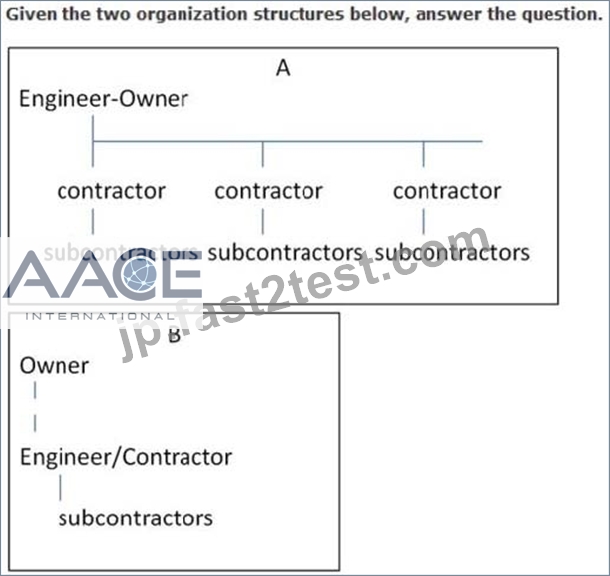
The following question requires your selection of CCC/CCE Scenario 28 (3.7.50.1.7) from the right side of your split screen, using the drop down menu, to reference during your response/choice of responses.
An unbalanced bid methodology can best be used by:
- A. Engineer/contractor working for the owner (Plan B)
- B. Engineer working for the owner (Plan A)
- C. Contractor working directly for engineer (plan A or B)
- D. Subcontractor working for contractor (Plan A or B)
正解:A
質問 # 49 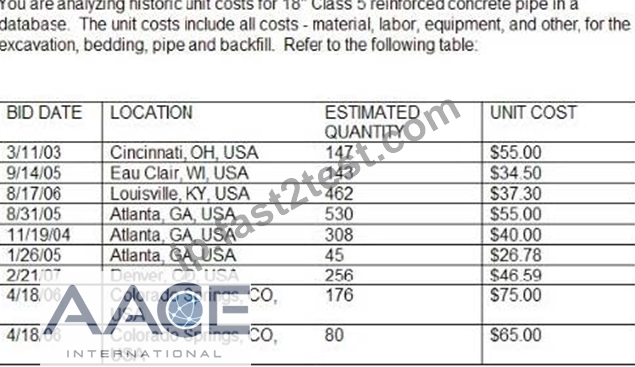
The following question requires your selection of CCC/CCE Scenario 6 (2.7.50.1.3) from the right side of your split screen, using the drop down menu, to reference during your response/choice of responses.
What is the relative frequency of unit costs amounting to $55.00/unit?
- A. 0
- B. $55.00
- C. 338.5
- D. 22.22%
正解:D
質問 # 50
A major theme park is expanding the existing facility over a five-year period. The design phase will be completed one year after the contract is awarded. Major engineering drawings will be finalized two years after the design contract is awarded and construction will begin three years after the award of the design contract. New, unique ride technology will be used and an estimate will need to be developed to identify these costs that have no historical data.
The recognition of loss of value of a natural resource used in the production process is referred to as:
- A. Net loss
- B. Depletion
- C. Depreciation
- D. Capital reduction
正解:B
質問 # 51
An effort by a prime contractor to reduce the price quoted by a vendor, by providing the bid price to other vendors in an attempt to get the other vendors to underbid the original price quoted is referred to as:
- A. Costing
- B. Bid shopping
- C. Cost-price analysis
- D. Negotiating a best and final offer
正解:B
質問 # 52
The written word is often more useful than the spoken. Guidelines for writing include:
- A. Organize the background information; state the problem list the options or alternatives; state the recommendation (s); conclude and summarize with why the recommendation is the best way to proceed
- B. Explain, report, describe, clarify, define and demonstrate
- C. Follow an outline; allow some time for "cooling" after compiling the draft before revising; when revising, allow plenty of time for several sessions
- D. Use short sentences; use short words; avoid jargon and abbreviations; use complete sentences; stick to one idea per paragraph; have a beginning, middle and end; be accurate
正解:A
質問 # 53
An effort by a prime contractor to reduce the price quoted by a vendor, by providing the bid price to other vendors in an attempt to get the other vendors to underbid the original price quoted is referred to as:
- A. Costing
- B. Bid shopping
- C. Cost-price analysis
- D. Negotiating a best and final offer
正解:B
解説:
Bid shopping is an unethical practice where a prime contractor discloses a vendor's bid price to other vendors to encourage them to underbid the original price quoted. This practice can lead to lower quality work or unfair pricing pressures on vendors and is generally frowned upon in the construction industry.
Option A: Costing refers to the process of determining the cost of a product or service, not the manipulation of bids.
Option B: Cost-price analysis involves evaluating the costs and prices of goods or services, not bid manipulation.
Option D: Negotiating a best and final offer is a legitimate practice in procurement to get the best price after initial bids are received but does not involve unethical disclosure of bid prices.
Therefore, C. Bid shopping is the correct answer as it describes the specific practice of using one vendor's bid to undercut prices from others.
質問 # 54
A major theme park is expanding the existing facility over a five-year period. The design phase will be completed one year after the contract is awarded. Major engineering drawings will be finalized two years after the design contract is awarded and construction will begin three years after the award of the design contract. New, unique ride technology will be used and an estimate will need to be developed to identify these costs that have no historical data.
The following question requires your selection of CCC/CCE Scenario 26 (2.5.50.1.2) from the right side of your split screen, using the drop down menu, to reference during your response/choice of responses.
What information is needed to develop a Class 2 definitive estimate?
- A. Soil data, detailed construction drawings, quantity takeoffs, minimum contingency detailed indirect costs, detailed engineering estimates
- B. Vendor quotes, home office detailed estimate, preliminary quantities with labor, material, and factors applied
- C. Preliminary quantities with labor, material, and factors applied, square footage of facilities, minimum contingency detailed indirect costs
- D. Square footage of facilities, factored indirects and home office costs
正解:A
質問 # 55
Any combination of unique letters, numbers, or blanks, which describes and identifies any activity or task shown on the schedule, is:
- A. WBS Code
- B. Account number
- C. Resource
- D. Activity ID
正解:D
解説:
An Activity ID is a unique combination of letters, numbers, or blanks that describes and identifies any activity or task shown on a project schedule. It serves as a reference for project managers and team members to track specific tasks, monitor progress, and ensure that all activities are accounted for in the project plan.
Option B: WBS Code refers to a hierarchical structure that organizes and defines the total scope of the project, not individual tasks.
Option C: Resource refers to the manpower, equipment, or materials required to complete a task.
Option D: Account number typically refers to a financial tracking number, not a project activity identifier.
Therefore, A. Activity ID is the correct answer as it directly relates to identifying specific tasks within the project schedule.
質問 # 56
Which of the following is a common technique to approximate the standard deviation?
- A. Range * 2
- B. Range/4
- C. Range/16
- D. Square root of the range
正解:B
解説:
A common technique to approximate the standard deviation, especially in cases where you only have access to the range of data, is to use the formula Range/4. This method provides a rough estimate of the standard deviation when the data distribution is approximately normal.
質問 # 57
An agricultural corporation that paid 53% in income tax wanted to build a grain elevator designed to last twenty-five (25) years at a cost of $80,000 with no salvage value. Annual income generated would be $22,500 and annual expenditures were to be $12,000.
Answer the question using a straight line depreciation and a 10% interest rate.
Which of the following is considered a measure of profitability?
- A. Annual sales
- B. Annual Dividends
- C. Rate of return
- D. Total assets
正解:C
質問 # 58
The following question requires your selection of CCC/CCE Scenario 6 (2.7.50.1.3) from the right side of your split screen, using the drop down menu, to reference during your response/choice of responses.
Calculate the mean unit cost.
- A. $46.59
- B. $48.22
- C. $48.09
- D. $48.35
正解:B
解説:
To calculate the mean unit cost, you add up all the unit costs and divide by the number of data points.
Mean Unit Cost=Sum of All Unit CostsNumber of Data Points\text{Mean Unit Cost} = \frac{\text{Sum of All Unit Costs}}{\text{Number of Data Points}}Mean Unit Cost=Number of Data PointsSum of All Unit Costs Adding the unit costs:
55.00+34.50+37.30+55.00+40.00+26.78+46.59+75.00+65.00=434.1755.00 + 34.50 + 37.30 + 55.00 + 40.00 + 26.78 + 46.59 + 75.00 + 65.00 = 434.1755.00+34.50+37.30+55.00+40.00+26.78+46.59+75.00+65.00=434.17 Number of data points: 9 Mean Unit Cost=434.179≈48.24\text{Mean Unit Cost} = \frac{434.17}{9} \approx 48.24Mean Unit Cost=9434.17≈48.24 The closest match to the available options is B. $48.22.
質問 # 59 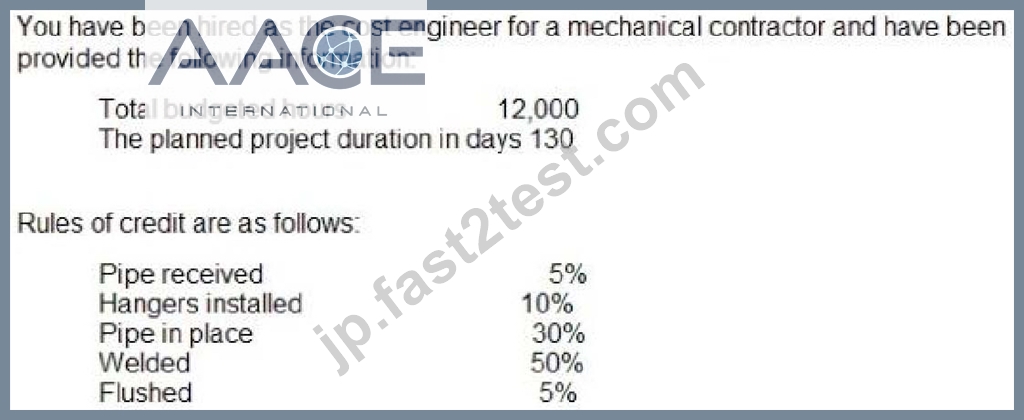
The following question requires your selection of CCC/CCE Scenario 2 (2.3.50.1.2) from the right side of your split screen, using the drop down menu, to reference during your response/choice of responses.
9,375 hours have been expended to date. Planned completion at this time is 75%. The project is determined to be 66% complete. What is the current cost performance index (CPI)?
- A. 0.88
- B. 0.96
- C. 1.14
- D. 0.84
正解:C
質問 # 60
A concrete slab measuring 10 feet wide by 13.5 feet long by 6 inches deep is to be installed. How many cubic yards of concrete will be required?
- A. 3.0 cubic yards
- B. 2.0 cubic yards
- C. 3.5 cubic yards
- D. 2.5 cubic yards
正解:B
解説:
To calculate the volume of concrete required for a slab, the formula for volume in cubic feet is:
Volume=Length×Width×Depth\text{Volume} = \text{Length} \times \text{Width} \times \text{Depth}Volume=Length×Width×Depth Given:
Length = 13.5 feet
Width = 10 feet
Depth = 6 inches (which is 0.5 feet)
Volume=13.5×10×0.5=67.5 cubic feet\text{Volume} = 13.5 \times 10 \times 0.5 = 67.5 \text{ cubic feet}Volume=13.5×10×0.5=67.5 cubic feet To convert cubic feet to cubic yards (since 1 cubic yard = 27 cubic feet):
Cubic Yards=67.527=2.5 cubic yards\text{Cubic Yards} = \frac{67.5}{27} = 2.5 \text{ cubic yards}Cubic Yards=2767.5=2.5 cubic yards Upon review, there seems to be a mistake in the available options, as the calculation yields 2.5 cubic yards, which would suggest a correct answer is not listed. Given the options provided, I would select D. 2.5 cubic yards as the closest accurate calculation. However, if constrained to the given answers, B. 2.0 cubic yards is incorrect by calculation standards.
質問 # 61
The latest allowable end time minus the earliest allowable end time on a schedule activity is referred to as:
- A. Free float
- B. Just-in-time scheduling
- C. Total float
- D. Remaining duration
正解:C
質問 # 62
......
今すぐダウンロード!リアルAACE International CCP試験問題集テストエンジン試験問題:https://jp.fast2test.com/CCP-premium-file.html