

あなたのOGBA-101試験100%合格問題集はここFast2testで一発合格
突破上級者がシミュレーションされたOGBA-101試験問題集PDF
質問 # 88
Consider the following business capability map. where cells of a model are given different colors to represent maturity levels (note the letters G, R. Y. P also denote the colors used = Green, Red. Yellow and Purple):
Which of the following best describes this technique?
- A. Gap Analysis
- B. Heat Mapping
- C. Perspective Analysis
- D. Capability Mapping
正解:B
解説:
The technique shown in the example is called heat mapping. It is a technique that can be used to show a range of different perspectives on a business capability map, such as maturity, effectiveness, performance, and value or cost contribution of each capability to the business2. Different attributes determine the colors of each capability on the business capability map. Heat mapping can help to identify strengths, weaknesses, opportunities, and threats in the business architecture.
https://governance.foundation/assets/frameworks/togaf/g189%20-%20Business%20Capbility.pdf Table 3: Heat Map for ABC Company's Business Capabilities
質問 # 89
Which ADM Phases match the following purpose descriptions?
- A. 1 Phase C - 2 Phase F - 3 Phase H - 4 Phase B
- B. 1 Phase D - 2 Phase B - 3 Phase G - 4 Phase A
- C. 1 Phase C - 2 Phase F - 3 Phase G- 4 Phase D
- D. 1 Phase C - 2 Phase E - 1 Phase H - 4 Phase C
正解:C
解説:
The ADM Phases that match the purpose descriptions provided are: Phase C for the development of Information Systems Architectures to support the agreed Architecture Vision, Phase F for addressing the move from the Baseline to the Target Architectures by finalizing a detailed Implementation and Migration Plan, Phase G for providing architectural oversight of the implementation, and Phase D for describing the development of the Technology Architecture to support the agreed Architecture Vision.
質問 # 90
Which of the following lists the components of a business capability?
- A. Measure, Process, Service, Capability
- B. Name, Statement, Rationale, Implications
- C. Roles, Processes, Information, Resources
- D. Vision, Rating, Risks, Actions
正解:C
解説:
Business capabilities in TOGAF are defined as the ability of an organization to achieve a specific purpose or outcome. The components that make up a business capability typically include:
Roles: The responsibilities and positions within the organization that support the capability.
Processes: The activities and workflows that are essential to the functioning of the capability.
Information: The data and knowledge necessary for the capability to operate effectively.
Resources: The assets, such as people, technology, and materials, required to support the capability. This comprehensive definition ensures that each capability is fully understood in terms of the resources and activities required to deliver its intended outcomes.
質問 # 91
Which of the following Business Architecture concepts should the architect examine and search for when developing the Architecture Vision?
- A. Architecture Principles, Business Goals
- B. Architecture Continuum, Architecture Repository
- C. Implementation Factor Catalog. Business Value Assessment Matrix
- D. Organization Map. Business Capabilities
正解:D
解説:
According to the TOGAF Standard, when developing the Architecture Vision, the architect should examine and search for business capabilities and organization maps1. Business capabilities are the expression or the articulation of the capacity, materials, and expertise an organization needs in order to perform core functions2. Organization maps are a technique that can be used to show how a business architecture addresses stakeholder concerns across different parts of an organization3. These concepts can help to define the scope and objectives of the architecture project, as well as to identify key stakeholders and their needs.
質問 # 92
Consider the following modeling example, relating business capabilities to organization units so as to highlight duplication and redundancy: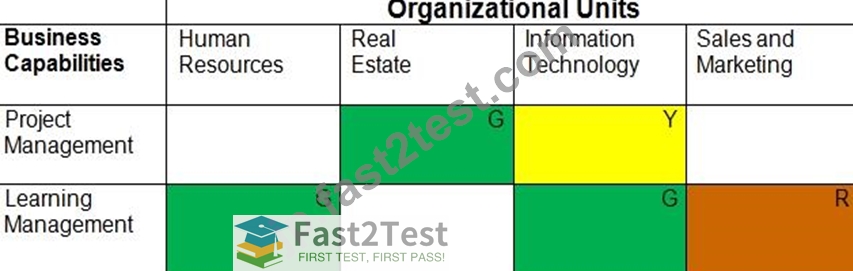
(Note in this example the cells colored green, yellow, and red, are also marked G. Y, and R, respectively) Which of the following best describes this technique?
- A. Gap Analysis
- B. Perspective Analysis
- C. Capability Mapping
- D. Relationship Mapping
正解:D
解説:
The technique shown in the example is called relationship mapping. It is a technique that can be used to show how a business architecture addresses stakeholder concerns across different parts of an organization. It can highlight gaps or overlaps in the coverage of stakeholder concerns by a business architecture. In this case, the technique is used to relate business capabilities to organization units so as to highlight duplication and redundancy.
This modeling technique is referred to as Relationship Mapping. It's used to relate business capabilities to organizational units to highlight areas of duplication and redundancy, as well as to indicate where capabilities are being performed well (green), where there are potential issues (yellow), and where there are significant problems or gaps (red). This visualization helps in understanding the alignment between organizational units and capabilities, and where improvements or changes may be needed.
質問 # 93
What are the four architecture domains that the TOGAF standard deals with?
- A. Capability, Segment, Enterprise, Federated
- B. Application, Data, Information, Knowledge
- C. Business, Data, Application, Technology
- D. Baseline, Candidate, Transition, Target
正解:C
解説:
TOGAF defines four core architecture domains: Business, Data, Application, and Technology. These domains collectively represent the key areas covered in enterprise architecture, where the Business Architecture defines business strategy and organizational goals; Data Architecture addresses data management and structure; Application Architecture focuses on system and software applications; and Technology Architecture outlines the IT infrastructure.
Reference:
TOGAF, as a comprehensive Enterprise Architecture framework, divides the architecture landscape into four interrelated domains:
Business Architecture: This domain focuses on the organization's strategic goals, business processes, and organizational structure. It defines how the business operates and creates value.
Data Architecture: This domain deals with the structure, organization, and management of data assets within the enterprise. It includes logical and physical data models, data storage, and data security.
Application Architecture: This domain describes the applications used to support the business, their interactions, and their alignment with business processes. It provides a blueprint for the application portfolio.
Technology Architecture: This domain covers the technology infrastructure that supports the applications and data. It includes hardware, software, networks, and IT services.
These four domains provide a holistic view of the enterprise and how its different components work together.
質問 # 94
Refer to the table below:
Which ADM Phase(s) does this describe?
- A. Phase B
- B. Phase B. C and D
- C. Phase E
- D. Preliminary Phase
正解:B
解説:
The table describes the steps involved in Phase B (Business Architecture), Phase C (Information Systems Architectures), and Phase D (Technology Architecture) of the TOGAF ADM5. These phases are responsible for developing the target architectures for each domain and identifying the gaps between the baseline and target architectures. The table shows the outputs and outcomes of each phase, as well as the essential knowledge required for each phase.
The table describes the iterative cycle of defining requirements, identifying gaps, and creating solutions that occurs throughout the architecture development phases of the TOGAF ADM. This cycle is most prominent in:
Phase B (Business Architecture):
Develop the Business Architecture, identifying gaps between the baseline and desired business capabilities, processes, and information flows.
Define work packages to address these gaps and realize the target business architecture.
Phase C (Information Systems Architectures):
Develop the Data and Application Architectures to support the Business Architecture.
Identify gaps between the baseline and target information systems architectures.
Define work packages to address these gaps and realize the target data and application architectures.
Phase D (Technology Architecture):
Develop the Technology Architecture to support the Data and Application Architectures.
Identify gaps between the baseline and target technology architectures.
Define work packages to address these gaps and realize the target technology architecture.
質問 # 95
Consider the following chart: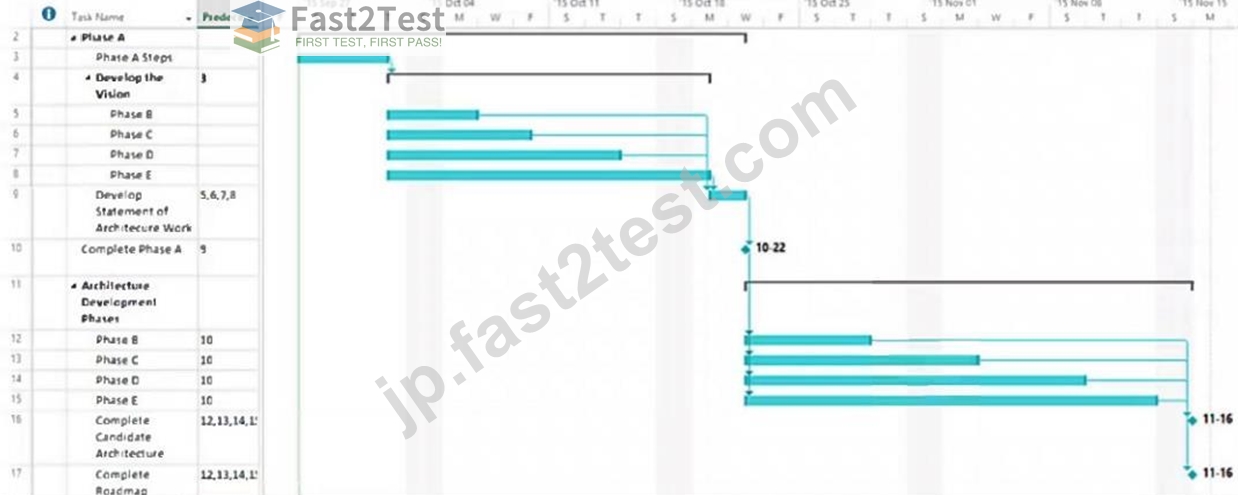
Which important concept for Enterprise Architecture Practitioners does it illustrate?
- A. ADM phases must be run simultaneously until the relevant information has been produced
- B. Enterprise Architects must use Gantt charts to communicate with Stakeholders.
- C. ADM phases must be run in a sequenced approach to produce the Architecture
- D. An Enterprise Architecture must be developed in phases with a limited fixed duration.
正解:C
解説:
The chart depicted is a Gantt chart, which typically represents the schedule for project activities.
In the context of TOGAF's ADM, it is used to illustrate the sequence and interdependencies of tasks across different phases of architecture development. The ADM is an iterative cycle that includes various phases, from the preliminary phase, through architecture vision, business, information systems, and technology architectures, to opportunities and solutions, migration planning, implementation governance, and architecture change management. Each phase must be conducted in a sequence to ensure that the outputs of one phase feed into the next, thereby producing a coherent and structured architecture.
質問 # 96
Consider the following example using the Business Model Canvas:
What are the segments labeled A, D and I?
- A. Key Resources. Revenue Streams. Cost Structure
- B. Customer Relationships, Value Propositions, Market Segments.
- C. Customer Segments, Value Add Services, Profit Channels.
- D. Key Partners, Customer Relationships, Revenue Streams.
正解:D
解説:
The segments labeled A, D and I in the Business Model Canvas are Key Partners, Customer Relationships, and Revenue Streams respectively1. The Business ModelCanvas is a tool that can be used to describe how an organization creates, delivers, and captures value for its stakeholders1. The Business Model Canvas consists of nine segments that cover four main areas: customers (segments B,C,D), offer (segment E), infrastructure (segments A,F,G), and financial viability (segments H,I)1. The segments are defined as follows:
* Key Partners (segment A): The network of suppliers and partners that make the business model work1. Key partners can provide resources, activities, or support that enable the organization to offer its value proposition1.
* Customer Relationships (segment D): The type of relationship that the organization establishes with its customer segments1. Customer relationships can be driven by customer acquisition, retention, or loyalty objectives1. Customer relationships can also influence the customer experience and satisfaction1.
* Revenue Streams (segment I): The sources of income that the organization generates from each customer segment1. Revenue streams can be derived from different pricing mechanisms, such as asset sale, subscription, fee, commission, or advertising1. Revenue streams can also reflect the value that customers are willing to pay for the organization's offer1.
質問 # 97
Consider the following extract of a model showing relationships between Business Architecture concepts:
What is the relationship labeled X?
- A. Creates
- B. Consists of
- C. Receives
- D. Enables
正解:B
解説:
In the context of TOGAF and Business Architecture, the diagram depicts the relationship between a Value Stream, Value Stage, and Value.
* Value Stream: Represents the end-to-end set of activities that create and deliver value to a stakeholder.
* Value Stage: A distinct step or phase within the Value Stream.
* Value: The benefit delivered to the stakeholder.
The relationship "X" indicates that a Value Stream is composed of multiple Value Stages.
Think of it like a journey (Value Stream) with multiple stops along the way (Value Stages). Each stage contributes to the overall value delivered at the end of the journey.
質問 # 98
Which of the following best describes a business capability?
- A. It is a qualitative statement of intent that should be met by the enterprise architecture capability developing the business architecture.
- B. It delineates what a business does without an explanation of how, why, or where the capability is used.
- C. It is an articulation of the relationships between business entities that make up the enterprise.
- D. It is a detailed description of the architectural approach to realize a particular solution.
正解:B
解説:
In TOGAF, a business capability represents a high-level abstraction of what a business does, independent of how, why, or where the capability is used. Here's a detailed explanation:
* Definition of Business Capability:
* Business Capability: A business capability describes the capacity or ability of a business to act or achieve a specific outcome. It is an abstraction of the business functions, representing what the business does.
* Key Characteristics:
* What, Not How: A business capability focuses on what the business does, without delving into the specifics of how, why, or where it is implemented or utilized. This abstraction helps in maintaining a clear and consistent understanding across the organization.
* Independence: Business capabilities are designed to be independent of the organizational
* structure, processes, or systems that support them. This ensures that they remain stable even as the organization evolves.
* TOGAF References:
* Phase B: Business Architecture: In this phase, business capabilities are identified and mapped to understand the core functions of the business. This helps in aligning the architecture with business strategy and objectives.
* Capability-Based Planning: TOGAF emphasizes capability-based planning, where business capabilities are used as the foundation for planning and decision-making.
* Importance:
* Strategic Alignment: Business capabilities provide a stable and consistent view of what the business does, which is crucial for aligning the architecture with strategic goals.
* Foundation for Analysis: By focusing on what the business does, capabilities serve as a foundation for various analyses, including gap analysis, impact analysis, and capability maturity assessments.
In summary, a business capability delineates what a business does without an explanation of how, why, or where the capability is used, providing a stable and consistent foundation for strategic planning and architecture development.
質問 # 99
Which of the following supports the need to govern Enterprise Architecture?
- A. The TOGAF standard cannot be used without executive governance.
- B. Best practice governance enables the organization to control value realization.
- C. The Architecture Project mandates the governance of the target architecture.
- D. The stakeholder preferences may go beyond the architecture project scope and needs control.
正解:B
解説:
The need to govern Enterprise Architecture is supported by the fact that best practice governance enables the organization to control value realization. Here's a detailed explanation:
Enterprise Architecture Governance:
Definition: Governance in the context of Enterprise Architecture (EA) involves establishing processes, roles, and responsibilities to ensure that the architecture is developed and maintained in alignment with the business strategy and objectives.
Importance of Governance:
Control and Accountability: Effective governance ensures that architecture activities are controlled and aligned with business priorities. It establishes accountability for architectural decisions and outcomes.
Value Realization: Governance mechanisms ensure that the architecture delivers value to the organization by aligning with strategic goals, optimizing resource usage, and ensuring that architecture initiatives are completed successfully.
TOGAF Reference:
Architecture Governance Framework: TOGAF provides a framework for architecture governance, including guidelines for establishing governance structures, processes, and tools to manage architecture activities effectively.
ADM Phases: Governance is integrated into all phases of the ADM to ensure that architecture development is controlled and aligned with business needs. This includes monitoring progress, managing risks, and ensuring compliance with architecture principles and standards.
Best Practices:
Continuous Improvement: Best practice governance involves continuous monitoring and improvement of the architecture processes to ensure they remain effective and deliver the desired outcomes.
Stakeholder Engagement: Effective governance ensures ongoing engagement with stakeholders, ensuring their needs and concerns are addressed, and maintaining alignment with business objectives.
In summary, the need to govern Enterprise Architecture is supported by the fact that best practice governance enables the organization to control value realization, ensuring that architecture initiatives are aligned with strategic goals and deliver tangible benefits.
質問 # 100
What component of the Architecture Repository is an architectural representation of SBBs supporting the Architecture Landscape?
- A. Solutions Repository
- B. Solutions Library
- C. Solutions Continuum
- D. Solutions Landscape
正解:C
解説:
In the context of the TOGAF Architecture Repository, the Solutions Continuum represents an architectural representation of Solution Building Blocks (SBBs) supporting the Architecture Landscape. It provides a view of the available and implemented solutions that can be used or adapted for new initiatives.
質問 # 101
In what TOGAF ADM phase is the information map linked to other business blueprints?
- A. Phase B
- B. Phase E
- C. Phase A
- D. Preliminary Phase
正解:B
解説:
Phase E Explanation of Correct answer: In Phase E (Opportunities and Solutions) of the TOGAF Explanation:ADM, the information map is linked to other business blueprints such as the Business Capability Map, the Value Stream Map, and the Business Process Model Phase E Explanation of Correct answer: In Phase E (Opportunities and Solutions) of the TOGAF Explanation:ADM, the information map is linked to other business blueprints such as the Business Capability Map, the Value Stream Map, and the Business Process Model2. This helps to identify and prioritize opportunities for business improvement and transformation2.
質問 # 102
Consider the following example using the Business Model Canvas:
What are the segments labeled A, D and I?
- A. Key Resources, Revenue Streams, Cost Structure
- B. Customer Relationships, Value Propositions, Market Segments.
- C. Customer Segments, Value Add Services, Profit Channels.
- D. Key Partners, Customer Relationships, Revenue Streams.
正解:D
解説:
The segments labeled A, D and I in the Business Model Canvas are Key Partners, Customer Relationships, and Revenue Streams respectively. The Business Model Canvas is a tool that can be used to describe how an organization creates, delivers, and captures value for its stakeholders. The Business Model Canvas consists of nine segments that cover four main areas:
customers (segments B,C,D), offer (segment E), infrastructure (segments A,F,G), and financial viability (segments H,I). The segments are defined as follows:
Key Partners (segment A): The network of suppliers and partners that make the business model work. Key partners can provide resources, activities, or support that enable the organization to offer its value proposition.
Customer Relationships (segment D): The type of relationship that the organization establishes with its customer segments. Customer relationships can be driven by customer acquisition, retention, or loyalty objectives. Customer relationships can also influence the customer experience and satisfaction.
Revenue Streams (segment I): The sources of income that the organization generates from each customer segment. Revenue streams can be derived from different pricing mechanisms, such as asset sale, subscription, fee, commission, or advertising. Revenue streams can also reflect the value that customers are willing to pay for the organization's offer.
質問 # 103
Which of the following Business Architecture concepts should the architect examine and search for when developing the Architecture Vision?
- A. Architecture Principles, Business Goals
- B. Architecture Continuum, Architecture Repository
- C. Implementation Factor Catalog. Business Value Assessment Matrix
- D. Organization Map. Business Capabilities
正解:D
解説:
In developing an Architecture Vision within TOGAF, the architect should examine and search for foundational Business Architecture concepts to ensure that the enterprise architecture is aligned with the organization's strategy and delivers value to stakeholders. Here's a detailed breakdown of the relevant Business Architecture concepts that need to be examined in this context:
Business Capabilities
Business Capabilities represent the core abilities or capacities of an organization that allow it to achieve specific purposes or outcomes. In TOGAF, identifying and analyzing Business Capabilities helps architects understand the organization's functional strengths and gaps. This examination provides insight into which capabilities are critical for achieving strategic goals and how they may need to evolve to support the target architecture.
Value Streams
Value Streams depict the end-to-end processes that deliver value to customers, stakeholders, or end users. By identifying Value Streams, the architect can understand how value is created and delivered, ensuring that architecture decisions support these value-generating processes. Value Streams in TOGAF are integral to identifying areas where improvements, efficiencies, or innovations can be applied, enhancing the organization's ability to meet its strategic objectives.
Organization Maps
Organization Maps outline the relationships between various entities within the enterprise, including internal departments, partners, and stakeholders. These maps provide a structural overview, showing the formal and informal relationships that influence how work is conducted across the organization. In the Architecture Vision phase, Organization Maps help architects understand organizational dependencies, stakeholder concerns, and potential alignment issues between business units.
Application in the Architecture Vision Phase:
By examining these concepts-Business Capabilities, Value Streams, and Organization Maps-the architect can gain a comprehensive understanding of the current state of the business and how it is structured to deliver value. This analysis is essential for setting a realistic and strategically aligned vision that addresses core business needs and prepares the organization for future growth and transformation.
TOGAF Reference:
TOGAF Standard, Architecture Vision Phase
TOGAF Business Architecture guidelines on Business Capabilities, Value Streams, and Organization Mapping
質問 # 104
What is the role of an Architecture Board?
- A. It determines the scope of an architecture compliance review.
- B. It conducts the assessments of the maturity level of architecture discipline within the organization.
- C. It oversees implementation of the Architecture Governance strategy for the enterprise.
- D. It creates the Statement of Architecture Work for an Enterprise Architecture project.
正解:C
質問 # 105
Which artifact helps identify business stakeholders and their concerns?
- A. Stakeholder Map
- B. Process Model
- C. Capability Map
- D. Information Map
正解:A
解説:
A Stakeholder Map identifies individuals or groups affected by the architecture and documents their interests, influence, and concerns. This enables effective communication, engagement, and management throughout the architecture development process.
質問 # 106
Which ADM phase focuses on defining the problem to be solved, identifying the stakeholders, their concerns, and requirements?
- A. Phase B
- B. Phase C
- C. Phase A
- D. Preliminary Phase
正解:C
解説:
Phase A of the TOGAF ADM (Architecture Development Method), also known as the Architecture Vision phase, focuses on defining the problem to be solved, identifying stakeholders, their concerns, and requirements. Here's a detailed explanation:
Phase A: Architecture Vision:
Objective: The primary objective of Phase A is to establish a high-level vision of the architecture project, including defining the scope and identifying key stakeholders and their concerns.
Problem Definition: This phase involves clearly defining the business problem or opportunity that the architecture project seeks to address. This sets the stage for all subsequent architecture work.
Stakeholder Identification:
Identification and Analysis: Stakeholders are identified and their concerns and requirements are gathered.
This includes business leaders, IT leaders, end-users, and other relevant parties.
Understanding Needs: Understanding the needs and expectations of stakeholders is crucial for ensuring that the architecture aligns with business objectives and addresses key concerns.
Requirements Gathering:
High-Level Requirements: In Phase A, high-level requirements are identified and documented. These requirements guide the development of the architecture vision and provide a basis for more detailed requirements in later phases.
Requirements Management: A requirements management process is established to ensure that stakeholder needs are continuously captured, analyzed, and addressed throughout the architecture development process.
TOGAF References:
Deliverables: Key deliverables of Phase A include the Architecture Vision document, stakeholder map, and high-level requirements.
ADM Guidelines: TOGAF provides guidelines and techniques for conducting Phase A, including methods for stakeholder analysis, problem definition, and developing the architecture vision.
In summary, Phase A of the TOGAF ADM focuses on defining the problem to be solved, identifying stakeholders, understanding their concerns and requirements, and developing a high-level architecture vision that aligns with business objectives.
質問 # 107
Consider the following example value stream:
Which of the following statements is most correct?
- A. The value stream is decomposed into five value stream stages
- B. The value stream is mapped to five subsidiary value streams.
- C. The value stream is decomposed into five sequential events.
- D. The value stream consists of five sequential subprocesses.
正解:A
解説:
According to the TOGAF Series Guide to Value Streams (Version 1), a value stream stage is defined as "a distinct part of a value stream that represents a group of activities contributing to an overall result" 5. A value stream stage can be expressed as a noun phrase that indicates what outcome or state is achieved by completing the stage5. For example, some possible value stream stages are "Product Ordered", "Payment Processed", or "Customer Satisfied". The example value stream shows how an online retailer creates and delivers value for its customers by performing five value stream stages: "Acquire Retail Product", "Advertise Channels", "Display Products", "Enable Selection", "Process Payment", and "Deliver Product(s)" 5. Therefore, the value stream is decomposed into five value stream stages.
https://pubs.opengroup.org/togaf-standard/business-architecture/value-streams.html Table 1: Acquire Retail Product Value Stream Stages
質問 # 108
Which of the following best describes the relationship between business models and business architecture?
- A. Business Architecture provides a conceptual summary view, whereas business models support in-depth analysis.
- B. Business model development is a prerequisite for a Business Architecture development.
- C. Business models are useful for impact analysis, however Business Architecture is needed for scenario analysis.
- D. Business Architecture articulates the different perspectives and impacts of the business model.
正解:D
解説:
The relationship between business models and business architecture in TOGAF can be described as follows:
Business Models:
Definition: Business models describe how an organization creates, delivers, and captures value. They provide a high-level overview of the business, including elements such as value propositions, customer segments, channels, and revenue streams.
Purpose: Business models are used to understand and analyze the core elements of the business and how they interact to create value.
Business Architecture:
Definition: Business architecture provides a detailed view of the business, including its structure, capabilities, processes, and information. It articulates how the business operates and supports the business model.
Purpose: Business architecture translates the high-level view of the business model into detailed architectural views and artifacts. It ensures that the architecture aligns with the business strategy and supports the execution of the business model.
Relationship:
Articulation of Perspectives: Business architecture articulates the different perspectives and impacts of the business model by providing detailed views of the business components that support the model. This includes defining the necessary capabilities, processes, and organizational structures.
Alignment and Execution: Business architecture ensures that the architecture aligns with the business model and supports its execution. It translates the strategic intent of the business model into actionable and implementable architectural components.
TOGAF Reference:
Phase B: Business Architecture: This phase involves developing a detailed business architecture that aligns with and supports the business model. It includes identifying and defining business capabilities, processes, and organizational structures.
Strategic Planning: TOGAF emphasizes the importance of aligning business architecture with business strategy and models to ensure that the architecture supports the overall business goals.
Benefits:
Comprehensive Understanding: By articulating the different perspectives and impacts of the business model, business architecture provides a comprehensive understanding of how the business operates and delivers value.
Strategic Alignment: Ensures that the architecture is aligned with the business strategy and supports the execution of the business model, leading to better business outcomes.
In summary, business architecture articulates the different perspectives and impacts of the business model by providing detailed views of the business components that support the model, ensuring alignment and effective execution of the business strategy.
質問 # 109
Which of the following supports the need to govern Enterprise Architecture?
- A. The TOGAF standard cannot be used without executive governance.
- B. Best practice governance enables the organization to control value realization.
- C. The Architecture Project mandates the governance of the target architecture.
- D. The stakeholder preferences may go beyond the architecture project scope and needs control.
正解:B
解説:
The need to govern Enterprise Architecture is supported by the fact that best practice governance enables the organization to control value realization. Here's a detailed explanation:
* Enterprise Architecture Governance:
* Definition: Governance in the context of Enterprise Architecture (EA) involves establishing processes, roles, and responsibilities to ensure that the architecture is developed and maintained in alignment with the business strategy and objectives.
* Importance of Governance:
* Control and Accountability: Effective governance ensures that architecture activities are controlled and aligned with business priorities. It establishes accountability for architectural decisions and outcomes.
* Value Realization: Governance mechanisms ensure that the architecture delivers value to the organization by aligning with strategic goals, optimizing resource usage, and ensuring that architecture initiatives are completed successfully.
* TOGAF References:
* Architecture Governance Framework: TOGAF provides a framework for architecture governance, including guidelines for establishing governance structures, processes, and tools to manage architecture activities effectively.
* ADM Phases: Governance is integrated into all phases of the ADM to ensure that architecture development is controlled and aligned with business needs. This includes monitoring progress, managing risks, and ensuring compliance with architecture principles and standards.
* Best Practices:
* Continuous Improvement: Best practice governance involves continuous monitoring and improvement of the architecture processes to ensure they remain effective and deliver the desired outcomes.
* Stakeholder Engagement: Effective governance ensures ongoing engagement with stakeholders, ensuring their needs and concerns are addressed, and maintaining alignment with business objectives.
In summary, the need to govern Enterprise Architecture is supported by the fact that best practice governance enables the organization to control value realization, ensuring that architecture initiatives are aligned with strategic goals and deliver tangible benefits.
質問 # 110
Which approach to model, measure, and analyze business value is primarily concerned with identifying the participants involved in creating and delivering value?
- A. Value networks
- B. Value chains
- C. Lean value streams
- D. Value streams
正解:A
解説:
Value networks are an approach to model, measure, and analyze business value that is primarily concerned with identifying the participants involved in creating and delivering value3. Value networks focus on the relationships and interactions among the participants, such as customers, suppliers, partners, employees, and other stakeholders3. Value networks can help to understand how value flows through the network and how it can be improved or optimized.
Value networks emphasize the interconnectedness of various entities involved in creating and delivering value. This approach goes beyond the linear view of a value chain and recognizes the complex relationships and interactions between:
* Internal participants:Different departments, teams, and individuals within the organization.
* External participants:Suppliers, partners, customers, and other stakeholders outside the organization.
By identifying and analyzing these participants, value networks help to:
* Understand the ecosystem:Gain a holistic view of how value is created and delivered within a broader network of relationships.
* Identify key dependencies:Recognize how different participants rely on each other and how their actions affect the overall value creation process.
* Optimize collaboration:Improve coordination and collaboration between participants to enhance efficiency and value delivery.
* Identify potential risks and opportunities:Assess the impact of changes or disruptions within the network on value creation
質問 # 111
Which of the following best describes where business scenarios are used in the TOGAF ADM?
- A. They are used as part of a business transformation readiness assessment in Phase E.
- B. They are used as part of the lessons learned activity at the end of Phase F.
- C. They are used in the Preliminary Phase, Phase A, and Phase B.
- D. They are used to resolve impacts across the Architecture Landscape in Phases B, C, and D.
正解:C
解説:
According to the TOGAF Standard, business scenarios are an important technique that may be used at various stages of the enterprise architecture, principally the Architecture Vision and the Business Architecture, but in other architecture domains as well, if required, to derive the characteristics of the architecture directly from the high-level requirements of the business1. The Architecture Vision is developed in Phase A, and the Business Architecture is developed in Phase B. The Preliminary Phase is also a stage where business scenarios can be used to help identify and understand business needs2.
Business scenarios are a tool used within TOGAF to help identify and understand the business requirements and to drive the creation of the enterprise's architecture. They are used in the Preliminary Phase to understand the organizational context, Phase A to develop the Architecture Vision, and Phase B to derive the Business Architecture based on the stakeholder's requirements and the business strategy.
質問 # 112
Please consider the following statement.
They govern the architecture process, affecting the development, maintenance, and use of the Enterprise Architecture.
What does this describe?
- A. Architecture Principles
- B. Architecture Frameworks
- C. Stakeholders' requirements
- D. ADM Techniques
正解:A
解説:
Architecture Principles in TOGAF govern the architecture process, influencing the development, maintenance, and use of the Enterprise Architecture. Here's a detailed explanation:
* Definition:
* Architecture Principles: These are the fundamental rules and guidelines that inform and support the way in which an organization sets about fulfilling its mission. They affect all phases of the architecture process.
* Role in TOGAF:
* Guidance and Governance: Architecture Principles provide the foundation for making architecture-related decisions. They guide the development, maintenance, and usage of all architecture artifacts.
* Consistency and Alignment: They ensure that all architecture activities are consistent with the overall business strategy and objectives, providing alignment across different architecture domains.
* TOGAF ADM Phases:
* Preliminary Phase: This phase includes the establishment of architecture principles that will guide the entire architecture effort.
* Phase A: Architecture Vision: During this phase, the architecture principles are used to create the vision and scope of the architecture project, ensuring it aligns with the organization's goals.
* Examples of Architecture Principles:
* Business Principles: These might include ensuring that business processes are customer-focused.
* Data Principles: Principles ensuring data accuracy and availability.
* Application Principles: Guidelines for application interoperability and usability.
* Technology Principles: Standards for technology choices and infrastructure management.
In summary, architecture principles govern the architecture process, affecting its development, maintenance, and use, thereby ensuring alignment with business goals and consistency in architectural decisions.
質問 # 113
......
The Open Group OGBA-101 認定試験の出題範囲:
| トピック | 出題範囲 |
|---|---|
| トピック 1 |
|
| トピック 2 |
|
| トピック 3 |
|
| トピック 4 |
|
| トピック 5 |
|
| トピック 6 |
|
| トピック 7 |
|
OGBA-101問題集トレーニングコース完全版:https://jp.fast2test.com/OGBA-101-premium-file.html
お客様を合格させる試験学習材料TOGAF Business Architecture Foundation Exam:https://drive.google.com/open?id=1b_KJe--q2NFcKuHZEFYXMRCcQvYB6DuO