

VMware 2V0-21.23リアル試験問題保証付き更新された問題集
検証済み!合格できる2V0-21.23試験一発合格保証付き
VMware 2V0-21.23試験は、vSphereアーキテクチャと技術、vSphereコンポーネントのインストールと設定、仮想マシンの管理、データセンターの管理、ネットワークの管理など、さまざまなトピックをカバーしています。この試験は、vSphere環境で作業する経験を持ち、スキルと知識を向上させたいITプロフェッショナルを対象としています。
VMware 2V0-21.23認証を取得することは、VMware VSPhere 8.Xを使用している専門家にとって貴重な資格情報です。雇用主に、個人がvSphere 8.X環境を展開、管理、トラブルシューティングするために必要な知識とスキルを持っていることを示しています。この認定は、雇用の見通しを改善し、収益の可能性を高め、専門家の信頼性を高めることができます。さらに、仮想化テクノロジーのキャリアの進歩と専門化の機会を提供できます。
VMware vSphere 8.x Professional Examは、仮想化技術とVMware vSphere 8.x製品に経験を持つITプロフェッショナルに適しています。この認定試験は、システム管理者、ネットワーク管理者、および仮想化およびクラウドコンピューティングにおいてキャリアを進めたいITプロフェッショナルに最適です。VMware認定は業界で広く認知されており、ITプロフェッショナルが競争力のある就職市場で際立つのに役立ちます。
質問 # 55
An administrator has been notified that a number of hosts are not compliant with the company policy for time synchronization.
The relevant portion of the policy states:
* All physical servers must synchronize time with an external time source that is accurate to the microsecond.
Which step should the administrator take to ensure compliance with the policy?
- A. Ensure that each ESXi host is configured to use a Network Time Protocol (NTP) source.
- B. Ensure that each ESXi host is configured to use a Precision Time Protocol (PTP) source.
- C. Ensure that each vCenter Server Appliance is configured to use a Network Time Protocol (NTP) source.
- D. Ensure that each vCenter Server Appliance is configured to use a Precision Time Protocol (PTP) source.
正解:B
解説:
Explanation
To comply with the policy of synchronizing time with an external source that is accurate to the microsecond, the administrator needs to ensure that each ESXi host is configured to use a PTP source, which provides higher accuracy than NTP.
References:
https://docs.vmware.com/en/VMware-vSphere/7.0/com.vmware.vsphere.vcenterhost.doc/GUID-F7DF1DD3-E3F
質問 # 56
An administrator is working with VMware Support and Is asked to provide log bundles for the ESXI hosts in an environment.
h three options Joes the administrator have? (Choose three.)
- A. Generate a separate log bundle for each ESXI host using the vSphere Host Client.
- B. Generate a separate log bundle for each ESXI host using the vCenter Management Interface.
- C. Generate a combined log bundle for all ESXI hosts using the vCenter Management Interface.
- D. Generate a combined log bundle for all ESXi hosts using the vSphere Host Client.
- E. Generate a combined log bundle for all ESXI hosts using the vSphere Client.
- F. Generate a separate log bundle for each ESXI host using the vSphere Client.
正解:A、E、F
解説:
Explanation
Option B, C and D are correct because they are valid methods to generate log bundles for individual or multiple ESXi hosts using different interfaces. Option A and E are incorrect because they are not possible options to generate log bundles for all ESXi hosts using the vCenter Management Interface. Option F is incorrect because it is not possible to generate a combined log bundle for all ESXi hosts using the vSphere Host Client. References:
https://docs.vmware.com/en/VMware-vSphere/7.0/com.vmware.vsphere.troubleshooting.doc/GUID-9A94C3D1
質問 # 57
An administrator is tasked with installing VMware vCenter. The vCenter Server Appliance must support an environment of:
* 400 hosts
* 4000 virtual machines
Which two resources must be allocated, at a minimum, to meet the requirements? (Choose two.)
- A. 16 vCPUs
- B. 30 GB Memory
- C. 8 vCPUs
- D. 20 GB Memory
- E. 4 vCPUs
正解:A、B
解説:
Explanation
According to the vCenter Server Appliance sizing guidelines, a large environment with 400 hosts and 4000 virtual machines requires 16 vCPUs and 30 GB of memory for the appliance.
References:
https://docs.vmware.com/en/VMware-vSphere/7.0/com.vmware.vcenter.install.doc/GUID-8E7C1D6D-8E1E-4D
質問 # 58
Exhibit switch
An administrator configures a distributed switch and adds the first VMware ESXi server to it.
The administrator also performs the following activities:
* The administrator assigns two uplinks to the distributed switch.
* The administrator enables uplink teaming.
When attempting to perform a health check of the teaming policy, the health status of the Teaming and Failover reports as ' Unknown?, as seen in the exhibit.
What can the administrator changes in the distributed switch for the health status to report correctly?
- A. Add a minimum of two hosts with two uplinks each
- B. Add a minimum of three hosts with two uplinks each
- C. Add a minimum of three hosts with four uplinks each
- D. Add a minimum of two hosts with one uplink each
正解:A
質問 # 59
Refer to Exhibit: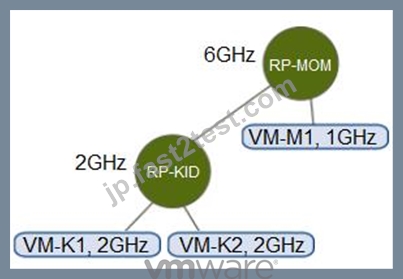
An environment has the following configuration:
* Resource Pool "RP-MOM? has a reservation of 6GHz and one running virtual machine (VM) "VM-M1? with 1 GHz reserved
* Resource Pool ^RP-KID? has a reservation of 2GHz, and expandable reservations is activated The administrator creates two VMs, "VM-K1? and 'VM-K2?, in the ''RP-KID? resource pool with 2GHz reserved for each, and turns on "VM-M1 ?
Given this scenario, which statement is true?
- A. VM-K2 cannot be powered on because there are not enough resources in RP-KID.
- B. The administrator must deactivate expandable reservations to turn on VM-K2
- C. VM-K2 can be powered on because it can get the resources needed from RP-MOM.
- D. The administrator can create a third VM ( VM-K3?) at RP-KID and reserve 6GHz
正解:C
解説:
https://docs.vmware.com/en/VMware-vSphere/8.0/vsphere-resource-management/GUID-60077B40-66FF-4625-934A-641703ED7601.html
質問 # 60
An administrator Is performing maintenance activities and discovers that a Virtual Machine File System (VMFS) datastore has a lot more used capacity than expected. The datastore contains 10 virtual machines (VMs) and, when the administrator reviews the contents of the associated datastore, discovers that five- virtual machines have a snapshot file (-delta.vmdk flies) that has not been modified In over 12 months. The administrator chei kfl the Snapshot Manager within the vSphere Client and confirms that there are no snapshots visible.
Which task should the administrator complete on the virtual machines to free up datastore space?
- A. Inflate the disk files for each VM.
- B. Consolidate the snapshots for each VM.
- C. Storage vMotion each VM to another datastore.
- D. Delete all snapshots for each VM.
正解:B
解説:
Explanation
Consolidating snapshots for each VM will merge any snapshot files that are not associated with a snapshot in Snapshot Manager into the base disk file and free up datastore space.
References:
https://docs.vmware.com/en/VMware-vSphere/7.0/com.vmware.vsphere.vm_admin.doc/GUID-53F65726-A23B
質問 # 61
An administrator is tasked with looking into the disaster recovery (DR) options for a software-defined data center (SDDC).
The following requirements must be met:
* All virtual machines (VMs) must be protected to a secondary site.
* The source VMs must remain online until the failover.
* When failing over to the secondary site, application downtime is allowed
* The DR failover must be managed from the vSphere Client.
* Costs must remain as low as possible.
How can the administrator accomplish this task?
- A. Configure VMware Site Recovery Manager and combine it with array-based storage replication.
- B. Configure a subscribed content library on the secondary site.
- C. Configure VMware a Site Recovery Manager and combine it with vSphere Replication.
- D. Configure VMware Cloud Disaster Recovery (VCDR) and combine it with array-based storage replication
正解:C
解説:
https://blogs.vmware.com/virtualblocks/2017/11/29/vsr-technicaloverview/
質問 # 62
An administrator is responsible for the management of a VMware vCenter instance that is currently experience performance issues. The administrator quickly identifies that the CPU and memory utilization of vCenter is consistently over 90%. Upon further analysis, it seems that the vpxd process is contributing significantly to the performance issue.
A combination of which four steps should the administrator take to resolve the performance issues and ensure that a similar issue can be rectified without required downtime to vCenter moving forward? (Choose four.)
- A. Add a additional CPU and memory to the vCenter Server Appliance.
- B. Gracefully shut down vCenter using the vSphere Client.
- C. Enable CPU Hot add on the vCenter virtual machine.
- D. Enable CPU an Memory Hot add on the vCenter virtual machine.
- E. Add a additional CPU and memory to the vCenter Server Appliance.
- F. Power on the vCenter Server Appliance using the vSphere Host Client.
正解:B、D、E、F
質問 # 63
What is the role of vSphere Distributed Services Engine?
- A. Implement Quality of Service (QoS) on network traffic within a vSphert Distributed Switch
- B. Provide hardware accelerated data processing to boor.t infrastructure performance
- C. Provide a live shadow Instance of a virtual machine (VM) that mirror, the primary VM to prevent data loss and downtime during outages
- D. Redistribute virtual machines across vSphere cluster host affinity rules following host failures or during maintenance operations
正解:B
解説:
Explanation
The role of vSphere Distributed Services Engine is to provide hardware accelerated data processing to boost infrastructure performance by offloading network services from the CPU to the DPU.
References: https://core.vmware.com/resource/whats-new-vsphere-8
質問 # 64
An administrator is investigating user logon failures for a VMware vCenter instance Where can the administrator find log files containing information related to user login activities?
- A. On the vCenter Management Interface
- B. In the vSphere Client when viewing the vCenter virtual machine
- C. On the vCenter Server Appliance
- D. On the ESXi host using the Direct Console User Interface
正解:C
解説:
The administrator can find log files containing information related to user login activities on the vCenter Server Appliance, which is a preconfigured Linux-based virtual machine that runs all vCenter Server services. The log files are located in /var/log/vmware/vmware-vpx/vpxd.log and /var/log/vmware/sso/ssoAdminServer.log directories. Reference: https://docs.vmware.com/en/VMware-vSphere/8.0/com.vmware.vsphere.troubleshooting.doc/GUID-5F9A7E49-5F9E-4F8A-BE6A-CAC5EE8E3734.html
質問 # 65
administrator successfully installs VMware ESXi onto the first host of a new vSphere duster but makes no additional configuration changes. When attempting to log into the vSphere Host Client using the Fully Qualified Domain Name (FQDN) of the host, the administrator receives the following error message:
''server Not Found -we can't connect to the server at esxit101.corp.local.''
* Host FQDN: esxi 101. Corp. local
* Management VLAN ID: 10
* DHCP: No
* Management IP Address: 172.16.10.101/24
* Management IP Gateway: 172.16.10.1
* Corporate DNS Servers: 172.16.10.5, 172.16.10.6
* DNS Domain: corp.local
Which three high level tasks should the administrator complete, at a minimum, in order to successfully log into the the vSphsrs Host Client using the FQDN for the exxi101 and complete the configuration (Choose three.)
- A. Configure at least two network adapters for the VMware ESXI Management Network.
- B. Ensure a DNS A Record Is created for the VMware ESXI host on the corporate DNS servers,
- C. Update the VMware ESXI Management Network DNS configuration to use the corporate DNS servers for name, resolution,
- D. Set the value of the VMware ESXI Management Network VLAN ID to 10.
- E. Update the VMware ESXI Management Network IPv4 configuration to use a static a IPv4 address.
- F. Disable IPv6 for the VMware ESXI Management Network.
正解:B、C
解説:
To successfully log into the vSphere Host Client using the FQDN for the ESXi host, the administrator needs to ensure a DNS A Record is created for the VMware ESXi host on the corporate DNS servers, which maps its FQDN to its IP address; and update the VMware ESXi Management Network DNS configuration to use the corporate DNS servers for name resolution, which allows resolving its FQDN.
質問 # 66
An administrator runs a two-node vSphere cluster, which contains two domain controller virtual machines (VMs). The administrator wants to ensure that VMs run on separate hosts without interfering with normal maintenance operations.
How should the administrator configure Distributed Resource Scheduler (DRS)?
- A. Create a 'Should run Virtual Machines to Hosts' anti-affinity rule.
- B. Create a 'Virtual Machines to Virtual Machines' dependency rule.
- C. Create a 'Must run Virtual Machines to Hosts' anti-affinity rule.
- D. Create a 'Virtual Machines to Virtual Machines' anti-affinity rule.
正解:A
解説:
Explanation
https://docs.vmware.com/en/VMware-vSphere/7.0/com.vmware.vsphere.resmgmt.doc/GUID-793013E2-0976-43
質問 # 67
An administrator is working with VMware Support and Is asked to provide log bundles for the ESXI hosts in an environment.
h three options Joes the administrator have? (Choose three.)
- A. Generate a separate log bundle for each ESXI host using the vSphere Host Client.
- B. Generate a separate log bundle for each ESXI host using the vCenter Management Interface.
- C. Generate a combined log bundle for all ESXI hosts using the vCenter Management Interface.
- D. Generate a combined log bundle for all ESXi hosts using the vSphere Host Client.
- E. Generate a combined log bundle for all ESXI hosts using the vSphere Client.
- F. Generate a separate log bundle for each ESXI host using the vSphere Client.
正解:A、E、F
解説:
Option B, C and D are correct because they are valid methods to generate log bundles for individual or multiple ESXi hosts using different interfaces. Option A and E are incorrect because they are not possible options to generate log bundles for all ESXi hosts using the vCenter Management Interface. Option F is incorrect because it is not possible to generate a combined log bundle for all ESXi hosts using the vSphere Host Client. Reference: https://docs.vmware.com/en/VMware-vSphere/7.0/com.vmware.vsphere.troubleshooting.doc/GUID-9A94C3D1-38A4-4A5F-AFE7-8CDBE8D6D988.html
質問 # 68
Which feature would allow for the non-disruptive migration of a virtual machine between two clusters in a single VMware vCenter instance?
- A. Cross vCenter Migration
- B. vSphere Fault Tolerance
- C. vSphere Storage vMotion
- D. vSphere vMotion
正解:D
解説:
vSphere vMotion allows for the non-disruptive migration of a virtual machine between two clusters in a single vCenter instance, as long as there is shared storage and network connectivity between the clusters.
Reference:
vMotion is used to move the VM to a different cluster within the same vCenter. This only works if both clusters share the same storage. If they don't you also need to perform a Storage vMotion. Cross vCenter Migration is only used to migrate to a different vCenter.
質問 # 69
During the staging of a patch on a vCenter Server Appliance, an error was encountered and the process stopped. An administrator resolved the root cause and is ready to continue with the staging of the patch.
From the vCenter Management Interface, which action should the administrator take to continue the process from the point at which the error occurred?
- A. Use the Unstage option to restart the staging.
- B. Use the Resume option to resume the staging.
- C. Use the Stage and Install option to resume the staging.
- D. Use the Stage Only option to restart the staging.
正解:C
解説:
Explanation
Option A is correct because it allows the administrator to resume the staging of the patch using the Stage and Install option in the vCenter Management Interface, which will continue the process from the point at which the error occurred. Option B is incorrect because there is no Resume option in the vCenter Management Interface. Option C is incorrect because it will unstage the patch and restart the staging from the beginning.
Option D is incorrect because it will restart the staging from the beginning and not install the patch.
References:
https://docs.vmware.com/en/VMware-vSphere/7.0/com.vmware.vcenter.install.doc/GUID-9F9E3F8C-0E2B-4B6
質問 # 70
An administrator is completing the configuration of a new vSphere cluster and has enabled vSphere High Availability (HA) and vSphere Distributed Resource Scheduler (DRS).
After adding the ESXi hosts to the cluster, which networking information will the administrator be prompted to provide when using the Cluster Quickstart workflow?
- A. vMotion networking
- B. Virtual machine networking
- C. Management networking
- D. vSAN networking
正解:A
解説:
https://core.vmware.com/resource/cluster-quickstart#section1
質問 # 71
To keep virtual machines (VMs) up and running at all times in a vSphere cluster, an administrator would like VMs to be migrated automatically when the host hardware health status becomes degraded.
Which cluster feature can be used to meet this requirement?
- A. vSphere HA Orchestrated Restart
- B. Predictive DRS
- C. vSphere Fault Tolerance
- D. Proactive HA
正解:D
解説:
Proactive HA is a cluster feature that can be used to migrate VMs automatically when the host hardware health status becomes degraded, before a failure occurs.
質問 # 72
An administrator is investigating reports of users experiencing difficulties logging into a VMware vCenter instance using LDAP accounts.
Which service should the administrator check as part of troubleshooting?
- A. Lookup Service
- B. vSphere Authentication Proxy Service
- C. Identity Management Service
- D. VMware Authentication Framework Daemon
正解:C
解説:
Identity Management Service is the service that handles authentication requests from LDAP accounts and other identity sources in vCenter Server.
質問 # 73
A vSphere environment is experiencing intermittent short bursts of CPU contention, causing brief production outages for some of the virtual machines (VMs). To understand the cause of the issue, the administrator wants to observe near real-time statistics for all VMs.
Which two vSphere reporting tools could the administrator use? (Choose two.)
- A. resxtop
- B. Advanced Performance Charts
- C. Overview Performance Charts
- D. esxcli
- E. esxtop
正解:B、E
解説:
Advanced Performance Charts and esxtop are both vSphere reporting tools that can be used to observe near real-time statistics for all VMs. Advanced Performance Charts provides a graphical view of performance data, while esxtop is a command-line tool that provides more detailed information.
質問 # 74
A vSphere environment is experiencing intermittent short bursts of CPU contention, causing brief production outages for some of the virtual machines (VMs). To understand the cause of the issue, the administrator wants to observe near real-time statistics for all VMs.
Which two vSphere reporting tools could the administrator use? (Choose two.)
- A. resxtop
- B. Advanced Performance Charts
- C. Overview Performance Charts
- D. esxcli
- E. esxtop
正解:B、E
解説:
Explanation
Advanced Performance Charts and esxtop are both vSphere reporting tools that can be used to observe near real-time statistics for all VMs. Advanced Performance Charts provides a graphical view of performance data, while esxtop is a command-line tool that provides more detailed information.
質問 # 75
An administrator plans to bri ng VMware vCenter offline in order to perform hardware mainte-nance on the host where the vCenter Server Appliance is running.
Which vSphere feature must be configured to ensure that vCenter users experience minimal downtime?
- A. Hybrid Linked Mode
- B. vSphere Distributed Resource Scheduler
- C. Enhanced Linked Mode
- D. vCenter Server High Availability
正解:D
解説:
Explanation
https://docs.vmware.com/en/VMware-vSphere/7.0/com.vmware.vsphere.avail.doc/GUID-4A626993-A829-495C
質問 # 76
An administrator manages VM templates and ISO images for a remote office. Their main requirements are to store these templates in a single repository and manage different versions of the templates.
What solution should the administrator deploy to meet these requirements?
- A. A vSAN datastore
- B. A subscribed content library
- C. A shared VMFS datastore
- D. A local content library
正解:D
解説:
https://4sysops.com/archives/how-to-create-a-vmware-content-library/#:~:text=A%20VMware%20content%20library%20provides,maintain%20consistency%20across%20VM%20deployments.
質問 # 77
An administrator plans to update the Supervisor cluster and has noticed some of the Tanzu Kubemetes Grid clusters are running an incompatible version.
Which action must the administrator take before proceeding with the Supervisor cluster update?
- A. No action is needed - Tanzu Kubernetes Grid clusters will be updated automatically as part of the update process.
- B. Update incompatible Tanzu Kubernetes Grid clusters prior to the Supervisor cluster update.
- C. No action is needed - Incompatible Tanzu Kubernetes Grid clusters can be manually updated after the Supervisor cluster update.
- D. Update all Tanzu Kubernetes Grid clusters to the latest version prior to the Supervisor cluster update.
正解:B
解説:
Explanation
Option D is correct because it indicates that the administrator must update incompatible Tanzu Kubernetes Grid clusters prior to the Supervisor cluster update, as this will ensure that there are no compatibility issues or disruptions during or after the update process. Option A is incorrect because it is not necessary to update all Tanzu Kubernetes Grid clusters to the latest version prior to the Supervisor cluster update, as some clusters may already be compatible with the new version. Option B is incorrect because Tanzu Kubernetes Grid clusters will not be updated automatically as part of the update process, as they require manual intervention from the administrator. Option C is incorrect because incompatible Tanzu Kubernetes Grid clusters cannot be manually updated after the Supervisor cluster update, as they may become inaccessible or unstable due to compatibility issues. References:
https://docs.vmware.com/en/VMware-vSphere/7.0/vmware-vsphere-with-tanzu/GUID-9F9E3F8C-0E2B-4B6A-8
https://docs.vmware.com/en/VMware-vSphere/8.0/vsphere-with-tanzu-maintenance/GUID-292482C2-A5FA-44 If a Tanzu Kubernetes Grid cluster is incompatible with vSphere 8, upgrade the cluster before proceeding with the system upgrade.
質問 # 78
An administrator is planning to upgrade a VMware vCenter instance to version 8. It is currently integrated with the following solutions:
* VMware Aria Automation
* VMware Cloud Director
Which tool can the administrator use to run Interoperability reports before the upgrade process?
- A. vCenter Server Update Planner
- B. vSphere Lifecycle Manager
- C. sphere Update Manager
- D. VMware Aria Suite Lifecycle
正解:A
解説:
Explanation
The tool that can be used to run interoperability reports before upgrading a vCenter Server instance is vCenter Server Update Planner, which allows checking compatibility with other VMware products.
References:
https://docs.vmware.com/en/VMware-vSphere/7.0/com.vmware.vcenter.upgrade.doc/GUID-C3FFBF62-D6BF-4
質問 # 79
A VMkernel port is labelled PROD01 and uses the default TCP/IP stack. Currently, this VMkernel port is configured for supporting live virtual machine (VM) migrations.
Which configuration change should the administrator make to isolate live VM migration traffic from other network traffic?
- A. Modify PROD01 by changing the TCP/IP stack to vSphere vMotion.
- B. Create a new VMkernel port and set the TCP/IP stack to provisioning.
- C. Remove PROD01 and create a new VMkernel port with the TCP/IP stack set to provisioning.
- D. Remove PROD01 and create a new VMkernel port and set the TCP/IP stack to vSphere vMotion.
正解:A
解説:
Explanation
The configuration change that should be made to isolate live VM migration traffic from other network traffic is to modify PROD01 by changing the TCP/IP stack to vSphere vMotion, which allows dedicating a separate stack for vMotion traffic and disabling it from the default TCP/IP stack.
References: https://hyperhci.com/2019/11/20/vmkernel-port-default-stack-vs-vmotion-tcp-ip-stack/
https://vstellar.com/2017/09/configuring-and-managing-vmkernel-tcpip-stacks/
質問 # 80
......
今すぐダウンロード!リアルVMware 2V0-21.23試験問題集テストエンジン試験問題:https://jp.fast2test.com/2V0-21.23-premium-file.html
無料2V0-21.23サンプル問題には100%カバー率リアル試験問題:https://drive.google.com/open?id=1w9HXH3owQP6jxFjELnxqz09UaxSr9nHV