

2V0-21.23問題集PDFで100%合格保証付き
2V0-21.23ブレーン問題集でリアル試験最新問題2024年06月21日には107問題
VMware 2V0-21.23 試験は、VMware製品を使用して仮想化ソリューションを管理および実装する責任を持つITプロフェッショナルを対象としています。この認定試験は、VMware vSphere 8.x環境の構成、管理、トラブルシューティングを含む仮想化技術の知識とスキルをテストします。仮想マシンの管理、vSphereネットワーク、ストレージ管理、vSphereセキュリティなど、さまざまなトピックがカバーされた包括的な試験です。この認定は、IT業界で高く評価され、仮想化プロフェッショナルのトップ認定の1つと考えられています。
VMware 2V0-21.23試験は、VMware vSphereアーキテクチャ、インストール、設定、および管理など、さまざまな分野で候補者の知識とスキルをテストします。この試験は、vSphere 8.xインフラストラクチャを実装、管理、およびトラブルシューティングする能力を検証することを目的としています。
質問 # 57
An administrator has Windows virtual machines (VMs) and VMware Tools is installed in each VM. The administrator performs a status check of VMware Tools using vSphere Lifecycle Manager.
What is the VMware Tools status for the Windows VMs if the version of VMware Tools has a known problem and must be immediately upgraded?
- A. Guest Managed
- B. Unknown
- C. Version Unsupported
- D. Upgrade Available
正解:C
解説:
If VMware Tools has a known problem, the tools status will be Version Unsupported https://docs.vmware.com/en/VMware-vSphere/7.0/com.vmware.vsphere-lifecycle-manager.doc/GUID-12649CBB-F69A-4199-8957-B4C0170B4E9A.html
質問 # 58
An administrator creates a new corporate virtual machine (VM) template every month to include all of the latest patches. The administrator needs to ensure that the new VM template is synchronized from the primary data center site (London) to two secondary data center sites (Tokyo and New York). The administrator is aware that datastore space is limited within the secondary data center sites. The administrator needs to ensure that the VM template is available in the secondary sites the first time a new virtual machine is requested.
Which four steps should the administrator take to meet these requirements? (Choose four.)
- A. Add the virtual machine template to the published content library.
- B. Create a new subscribed content library in each secondary site.
- C. Configure the subscribed content library to download content when needed.
- D. Create a new published content library at the primary site.
- E. Create a new published content library in each secondary site.
- F. Add the virtual machine template to the subscribed content library.
- G. Configure each subscribed content library to download content immediately.
正解:A、B、C、D
解説:
Explanation
To meet the requirements of synchronizing and protecting images and templates with limited datastore space, the administrator needs to create a new published content library at the primary site, which makes it available for subscription by other vCenter Server instances; create a new subscribed content library in each secondary site, which allows accessing content from a published content library; configure the subscribed content library to download content when needed, which saves datastore space by only downloading content on demand; and add the virtual machine template to the published content library, which makes it available for other hosts to use.
References:
https://docs.vmware.com/en/VMware-vSphere/7.0/com.vmware.vsphere.vm_admin.doc/GUID-FBEED81C-F9D
質問 # 59
A VMkernel port is labelled PROD01 and uses the default TCP/IP stack. Currently, this VMkernel port is configured for supporting live virtual machine (VM) migrations.
Which configuration change should the administrator make to isolate live VM migration traffic from other network traffic?
- A. Modify PROD01 by changing the TCP/IP stack to vSphere vMotion.
- B. Create a new VMkernel port and set the TCP/IP stack to provisioning.
- C. Remove PROD01 and create a new VMkernel port and set the TCP/IP stack to vSphere vMotion.
- D. Remove PROD01 and create a new VMkernel port with the TCP/IP stack set to provisioning.
正解:A
解説:
Explanation
The configuration change that should be made to isolate live VM migration traffic from other network traffic is to modify PROD01 by changing the TCP/IP stack to vSphere vMotion, which allows dedicating a separate stack for vMotion traffic and disabling it from the default TCP/IP stack.
References: https://hyperhci.com/2019/11/20/vmkernel-port-default-stack-vs-vmotion-tcp-ip-stack/
https://vstellar.com/2017/09/configuring-and-managing-vmkernel-tcpip-stacks/
質問 # 60
A vSphere cluster has the following configuration:
* Virtual machines (VMs) are running Production and Test workloads
* vSphere Distributed Resource Scheduler (DRS) is enabled
* There are no resource pools in the cluster
Performance monitoring data shows that the Production workload VMs are not receiving their fully allocated memory when the vSphere cluster is fully utilized.
A combination of which two steps could the administrator perform to ensure that the Production VMs are always guaranteed the full allocation of memory? (Choose two.)
- A. Assign a custom memory share value to the resource pool containing the Production VMs.
- B. Create a parent resource pool for the Production VMs.
- C. Assign a memory reservation value to the resource pool containing the Production VMs.
- D. Create a child resource pool for the Test VMs.
- E. Create a sibling resource pool for each of the Production and Test VMs.
正解:C、E
解説:
Explanation
https://docs.vmware.com/en/VMware-vSphere/8.0/vsphere-resource-management/GUID-60077B40-66FF-4625-
質問 # 61
A vSphere cluster has the following configuration:
* Virtual machines (VMs) are running Production and Test workloads
* vSphere Distributed Resource Scheduler (DRS) is enabled
* There are no resource pools in the cluster
Performance monitoring data shows that the Production workload VMs are not receiving their fully allocated memory when the vSphere cluster is fully utilized.
A combination of which two steps could the administrator perform to ensure that the Production VMs are always guaranteed the full allocation of memory? (Choose two.)
- A. Create a child resource pool for the Test VMs.
- B. Assign a custom memory share value to the resource pool containing the Production VMs.
- C. Create a sibling resource pool for each of the Production and Test VMs.
- D. Create a parent resource pool for the Production VMs.
- E. Assign a memory reservation value to the resource pool containing the Production VMs.
正解:A、E
解説:
Explanation
Option B and E are correct because they allow the administrator to create resource pools for the Production and Test VMs and assign memory reservation values to the Production resource pool, which guarantees that the Production VMs are always allocated their full memory. Option A is incorrect because assigning a custom memory share value to the Production resource pool does not guarantee that the Production VMs are always allocated their full memory, but only gives them higher priority when there is contention. Option C is incorrect because creating a parent resource pool for the Production VMs does not change anything unless there are child resource pools under it. Option D is incorrect because creating a sibling resource pool for each of the Production and Test VMs does not change anything unless there are different resource settings for each pool.
References:
https://docs.vmware.com/en/VMware-vSphere/7.0/com.vmware.vsphere.resmgmt.doc/GUID-60077B40-66FF-4
質問 # 62
Which three vSphere features are still supported for Windows-based virtual machines when enabling vSphere's -virtualization-based security feature? (Choose three.)
- A. vSphere Distributed Resources Scheduler (DRS)
- B. vSphere High Availability (HA)
D, vSphere Fault Tolerance - C. Hot Add of CPU or memory
- D. PCI passthrough
- E. vSphere vMotion
正解:A、B、E
解説:
Option A, C and E are correct because they indicate that vSphere features such as vMotion, High Availability (HA) and Distributed Resource Scheduler (DRS) are still supported for Windows-based virtual machines when enabling vSphere's virtualization-based security feature, which provides enhanced protection for guest operating systems and applications against various attacks. Option B is incorrect because PCI passthrough is not supported for Windows-based virtual machines when enabling vSphere's virtualization-based security feature, as this feature requires direct access to physical devices that cannot be shared or protected by hypervisor mechanisms. Option D is incorrect because Fault Tolerance is not supported for Windows-based virtual machines when enabling vSphere's virtualization-based security feature, as this feature requires identical execution states for primary and secondary virtual machines that cannot be guaranteed by hypervisor mechanisms. Option F is incorrect because Hot Add of CPU or memory is not supported for Windows-based virtual machines when enabling vSphere's virtualization-based security feature, as this feature requires dynamic changes to virtual hardware configuration that cannot be handled by hypervisor mechanisms. Reference: https://docs.vmware.com/en/VMware-vSphere/7.0/com.vmware.vsphere.security.doc/GUID-A2A4371A-B888-404C-B23F-C422A8C40F54.html
質問 # 63
What are two uses cases for VMware Tools? (Choose two.)
- A. Ability to shut down a virtual machine remotely
- B. Time synchronization with an NTP server
- C. Direct deployment of the Aria Automation Config minion
- D. Support for unsupported network device drivers
- E. Share folders between ESXi hosts and guest OS file systems
正解:A、C
解説:
https://www.stevenbright.com/2022/03/deploy-salt-minions-automatically-using-vmware-tools/ Two use cases for VMware Tools are direct deployment of the Aria Automation Config minion and ability to shut down a virtual machine remotely. Direct deployment of the Aria Automation Config minion is a feature that allows the administrator to deploy a configuration management agent to a virtual machine using VMware Tools. This feature enables automation and orchestration of virtual machine configuration tasks. Ability to shut down a virtual machine remotely is a feature that allows the administrator to gracefully power off a virtual machine from the vSphere Client or other VMware products. This feature requires VMware Tools to be installed and running on the guest operating system. Reference: https://docs.vmware.com/en/VMware-vSphere/7.0/com.vmware.vsphere.vmwaretools.doc/GUID-28C39A00-743B-4E23-9681-66254A15C2A0.html
質問 # 64
After a recent unexplained peak in virtual machine (VM) CPU usage, an administrator is asked to monitor the VM performance for a recurrence of the issue.
Which two tools can the administrator use? (Choose two.)
- A. ESXi Shell
- B. Direct Console User Interface (DCUI)
- C. vCenter Command Line Interface
- D. vCenter Management Interface
- E. vSphere Performance Charts
正解:A、E
解説:
To monitor the VM performance for a recurrence of the issue, the administrator can use vSphere Performance Charts, which provide graphical views of various performance metrics for VMs and other objects; or ESXi Shell, which provides command-line access to ESXi hosts and allows running various commands to collect performance data.
質問 # 65
An administrator is tasked with configuring vSphere Trust Authority. The administrator has completed the following steps:
* Set up the workstation
* Enabled the Trust Authority Administrator
* Enabled the Trust Authority State
* Collected information about the ESXi hosts and vCenter to be trusted
Which step does the administrator need to complete next?
- A. Import the Trusted Host information to the Trust Authority Cluster
- B. Import the Trusted Host information to the Trusted Cluster
- C. Create the Key Provider on the Trusted Cluster
- D. Import the Trusted Cluster information to the Trusted Hosts
正解:B
解説:
Explanation
To complete the configuration of vSphere Trust Authority, after collecting information about the ESXi hosts and vCenter to be trusted, the administrator needs to import the Trusted Host information to the Trusted Cluster, which establishes trust between them.
References:
https://docs.vmware.com/en/VMware-vSphere/7.0/com.vmware.vsphere.trustauthority.doc/GUID-B1B1CE2D-E
質問 # 66
An administrator has mapped three vSphere zones to three vSphere clusters.
Which two statements are true for this vSphere with Tanzu zonal Supervisor enablement? (Choose two.)
- A. One Supervisor will be created in a specific zone.
- B. Individual vSphere Namespaces will be placed into a specific zone.
- C. One Supervisor will be created across all zones.
- D. Individual vSphere Namespaces will be spread across all zones.
- E. Three Supervisors will be created in Linked Mode.
正解:A、B
解説:
Explanation
When mapping vSphere zones to vSphere clusters, one Supervisor will be created in each zone, and individual vSphere Namespaces will be placed into a specific zone based on their resource requirements and availability constraints.
References:
https://docs.vmware.com/en/VMware-vSphere/7.0/vmware-vsphere-with-tanzu/GUID-C2E9B5C1-D6F1-4E9B-
質問 # 67
Refer to the exhibit.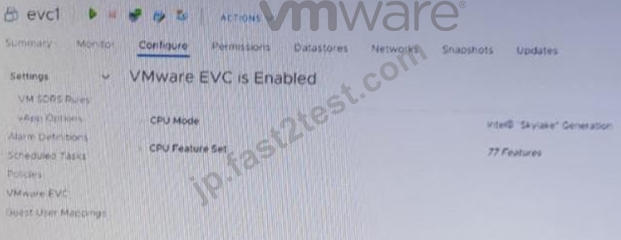
An administrator is tasked with adding new capacity to an existing software-defined data center (SDDC).
* The SDDC currently hosts two vSphere clusters (ClusterA and ClusterB) with different CPU compatibilities.
* vSphere vMotion and vSphere Distributed Resource Scheduler (DRS) are currently in use in the SDDC.
* The new capacity will be implemented by provisioning four ESXi hosts running a new generation of Intel Skylake CPUs.
* All workload virtual machines (VMs) must support live migration to any cluster in the SDDC.
The administrator noticed the running critical "ever virtual machine (VM) shown in the exhibit is not migrating using vSphere vMotion to the original Clusters A or B.
Which three steps must the administrator take to support this functionality? (Choose three.)
- A. Power off the VM.
- B. Disable the Enhanced vMotion Compatibility (EVC) on the VM.
- C. Configure the Enhanced vMotion Compatibility (EVC) on vSphere Cluster A and B to support Intel Skylake.
- D. Reboot the VM.
- E. Configure the Enhanced vMotion Compatibility (EVC) on the VM to Intel Skylake.
- F. Power on the VM.
正解:A、B、D
解説:
Explanation
To enable vSphere vMotion between clusters with different CPU compatibilities, the administrator needs to disable EVC on the VM, reboot the VM to clear any CPU features that are not supported by the destination cluster, and configure EVC on the VM to match the EVC mode of the destination cluster.
References:
https://docs.vmware.com/en/VMware-vSphere/7.0/com.vmware.vsphere.vcenterhost.doc/GUID-39A8C7F4-8D8
質問 # 68
What are two use cases for VMware vSphere+? (Choose two.)
- A. Allow the creation of affinity and anti-affinity rules to be used during failover events
- B. Increase the performance of the native vCenter vMotion capability
- C. Enhance on-premises workloads by managing them through the VMware Cloud Console
- D. Allow live migration between on-premises and VMware Cloud
- E. Simplify vCenter lifecycle management through cloud-enabled automation
正解:C、E
解説:
Explanation
https://www.vmware.com/products/vsphere/vsphere-plus.html
https://blogs.vmware.com/vsphere/2022/06/vmware-vsphereplus-introducing-the-multi-cloud-workload-platform
質問 # 69
An administrator has a host profile named Standard-Config. The administrator wants to change the other host profiles to use only the storage configuration settings that are defined in the Standard-Config host profile.
What should the administrator do to make this change?
- A. Copy the storage settings from Standard-Config to all other host profiles.
- B. Duplicate the Standard-Config host profile and only modify the storage configuration settings.
- C. Export the Standard-Config host profile and attach it to the other hosts.
- D. Export host customizations and import them to the other host profiles.
正解:A
解説:
Option B is correct because it allows the administrator to copy the storage settings from Standard-Config host profile to all other host profiles without affecting other settings. Option A is incorrect because it only exports host customizations and not host profile settings. Option C is incorrect because it creates a new host profile instead of modifying the existing ones. Option D is incorrect because it attaches the Standard-Config host profile to the other hosts instead of changing their host profiles. Reference: https://docs.vmware.com/en/VMware-vSphere/7.0/com.vmware.vsphere.hostprofiles.doc/GUID-F1A1D1D0-D6A3-4F1B-B7A7-B2D2F7C6E9AF.html
質問 # 70
An administrator Is performing maintenance activities and discovers that a Virtual Machine File System (VMFS) datastore has a lot more used capacity than expected. The datastore contains 10 virtual machines (VMs) and, when the administrator reviews the contents of the associated datastore, discovers that five- virtual machines have a snapshot file (-delta.vmdk flies) that has not been modified In over 12 months. The administrator chei kfl the Snapshot Manager within the vSphere Client and confirms that there are no snapshots visible.
Which task should the administrator complete on the virtual machines to free up datastore space?
- A. Storage vMotion each VM to another datastore.
- B. Inflate the disk files for each VM.
- C. Consolidate the snapshots for each VM.
- D. Delete all snapshots for each VM.
正解:C
解説:
Explanation
Consolidating snapshots for each VM will merge any snapshot files that are not associated with a snapshot in Snapshot Manager into the base disk file and free up datastore space.
References:
https://docs.vmware.com/en/VMware-vSphere/7.0/com.vmware.vsphere.vm_admin.doc/GUID-53F65726-A23B
質問 # 71
The vCenter inventory contains a virtual machine (VM) template called Linux-01 The administrator wants to install a software patch into Linux-01 while allowing users to continue to access Linux-01 to deploy VMs.
Which series of steps should the administrator take to accomplish this task?
- A. 1. Convert Linux-01 to a VM
2 Install the software patch
3 Convert the VM back to a VM template
4 Add Linux-01 to the content library. - B. 1. Clone Linux-01.
2. Convert the clone to a VM
3. Install the software patch.
4. Convert the VM back to a template. - C. 1. Verify that Linux-01 is in a content library
2. Checkout Linux-01
3. Install the software patch
4.Check in Linux-01 - D. 1. Verify that Linux-01 is in a content library
2. Clone Linux-01
3. Convert the clone to a VM
4. Install the software patch.
正解:B
解説:
Explanation
The administrator should clone Linux-01, which creates a copy of the virtual machine template. The administrator should then convert the clone to a VM, which allows the administrator to power on and modify the virtual machine. The administrator should then install the software patch on the VM, which updates the application. The administrator should then convert the VM back to a template, which preserves the changes made to the VM and allows users to deploy VMs from it. References:
https://docs.vmware.com/en/VMware-vSphere/8.0/com.vmware.vsphere.vm_admin.doc/GUID-E8E854DD-AA9
質問 # 72
......
2V0-21.23問題集には100%厳密検証された問題と解答で合格保証付きもしくは全額返金:https://jp.fast2test.com/2V0-21.23-premium-file.html
最新2V0-21.23のPDF問題集リアル無料テスト本日更新です:https://drive.google.com/open?id=1w9HXH3owQP6jxFjELnxqz09UaxSr9nHV