

Databricks Databricks-Certified-Data-Engineer-Associate試験問題(更新されたのは2025年)100%リアル問題解答
合格させるDatabricks Databricks-Certified-Data-Engineer-Associate試験最速合格
質問 # 13
A data engineer has a Job with multiple tasks that runs nightly. Each of the tasks runs slowly because the clusters take a long time to start.
Which of the following actions can the data engineer perform to improve the start up time for the clusters used for the Job?
- A. They can configure the clusters to be single-node
- B. They can use endpoints available in Databricks SQL
- C. They can configure the clusters to autoscale for larger data sizes
- D. They can use clusters that are from a cluster pool
- E. They can use jobs clusters instead of all-purpose clusters
正解:E
質問 # 14
An engineering manager wants to monitor the performance of a recent project using a Databricks SQL query.
For the first week following the project's release, the manager wants the query results to be updated every minute. However, the manager is concerned that the compute resources used for the query will be left running and cost the organization a lot of money beyond the first week of the project's release.
Which of the following approaches can the engineering team use to ensure the query does not cost the organization any money beyond the first week of the project's release?
- A. They cannot ensure the query does not cost the organization money beyond the first week of the project's release.
- B. They can set a limit to the number of DBUs that are consumed by the SQL Endpoint.
- C. They can set the query's refresh schedule to end on a certain date in the query scheduler.
- D. They can set a limit to the number of individuals that are able to manage the query's refresh schedule.
- E. They can set the query's refresh schedule to end after a certain number of refreshes.
正解:C
解説:
In Databricks SQL, you can use scheduled query executions to update your dashboards or enable routine alerts. By default, your queries do not have a schedule. To set the schedule, you can use the dropdown pickers to specify the frequency, period, starting time, and time zone. You can also choose to end the schedule on a certain date by selecting the End date checkbox and picking a date from the calendar. This way, you can ensure that the query does not run beyond the first week of the project's release and does not incur any additional cost. Option A is incorrect, as setting a limit to the number of DBUs does not stop the query from running. Option B is incorrect, as there is no option to end the schedule after a certain number of refreshes.
Option C is incorrect, as there is a way to ensure the query does not cost the organization money beyond the first week of the project's release. Option D is incorrect, as setting a limit to the number of individuals who can manage the query's refresh schedule does not affect the query's execution or cost. References: Schedule a query, Schedule a query - Azure Databricks - Databricks SQL
質問 # 15
Which of the following commands can be used to write data into a Delta table while avoiding the writing of duplicate records?
- A. MERGE
- B. DROP
- C. INSERT
- D. APPEND
- E. IGNORE
正解:A
解説:
The MERGE command can be used to upsert data from a source table, view, or DataFrame into a target Delta table. It allows you to specify conditions for matching and updating existing records, and inserting new records when no match is found. This way, you can avoid writing duplicate records into a Delta table1. The other commands (DROP, IGNORE, APPEND, INSERT) do not have this functionality and may result in duplicate records or data loss234. References: 1: Upsert into a Delta Lake table using merge | Databricks on AWS 2: SQL DELETE | Databricks on AWS 3: SQL INSERT INTO | Databricks on AWS 4: SQL UPDATE | Databricks on AWS
質問 # 16
A data engineer that is new to using Python needs to create a Python function to add two integers together and return the sum?
Which of the following code blocks can the data engineer use to complete this task?
- A.

- B.

- C.

- D.

- E.

正解:E
解説:
Explanation
https://www.w3schools.com/python/python_functions.asp
質問 # 17
Which of the following benefits is provided by the array functions from Spark SQL?
- A. An ability to work with data within certain partitions and windows
- B. An ability to work with time-related data in specified intervals
- C. An ability to work with complex, nested data ingested from JSON files
- D. An ability to work with data in a variety of types at once
- E. An ability to work with an array of tables for procedural automation
正解:C
解説:
The array functions from Spark SQL are a subset of the collection functions that operate on array columns1. They provide an ability to work with complex, nested data ingested from JSON files or other sources2. For example, the explode function can be used to transform an array column into multiple rows, one for each element in the array3. The array_contains function can be used to check if a value is present in an array column4. The array_join function can be used to concatenate all elements of an array column with a delimiter. These functions can be useful for processing JSON data that may have nested arrays or objects. References: 1: Spark SQL, Built-in Functions - Apache Spark 2: Spark SQL Array Functions Complete List - Spark By Examples 3: Spark SQL Array Functions - Syntax and Examples - DWgeek.com 4: Spark SQL, Built-in Functions - Apache Spark : Spark SQL, Built-in Functions - Apache Spark : [Working with Nested Data Using Higher Order Functions in SQL on Databricks - The Databricks Blog]
質問 # 18
Which of the following benefits is provided by the array functions from Spark SQL?
- A. An ability to work with time-related data in specified intervals
- B. An ability to work with data within certain partitions and windows
- C. An ability to work with complex, nested data ingested from JSON files
- D. An ability to work with data in a variety of types at once
- E. An ability to work with an array of tables for procedural automation
正解:B
質問 # 19
A data engineer is working with two tables. Each of these tables is displayed below in its entirety.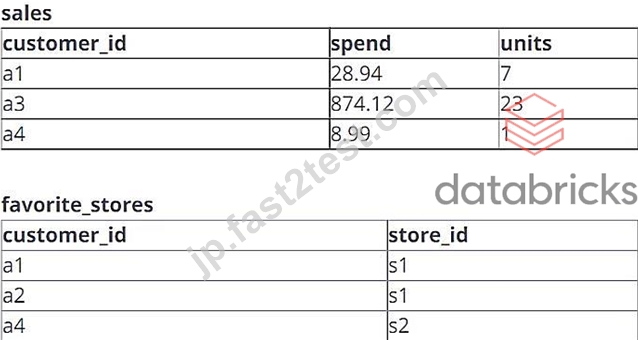
The data engineer runs the following query to join these tables together:
Which of the following will be returned by the above query?
- A. Option C
- B. Option E
- C. Option B
- D. Option D
- E. Option A
正解:A
質問 # 20
A data engineer has configured a Structured Streaming job to read from a table, manipulate the data, and then perform a streaming write into a new table.
The cade block used by the data engineer is below:
If the data engineer only wants the query to execute a micro-batch to process data every 5 seconds, which of the following lines of code should the data engineer use to fill in the blank?
- A. trigger(continuous="5 seconds")
- B. trigger("5 seconds")
- C. trigger()
- D. trigger(processingTime="5 seconds")
- E. trigger(once="5 seconds")
正解:D
解説:
The processingTime option specifies a time-based trigger interval for fixed interval micro-batches. This means that the query will execute a micro-batch to process data every 5 seconds, regardless of how much data is available. This option is suitable for near-real time processing workloads that require low latency and consistent processing frequency. The other options are either invalid syntax (A, C), default behavior (B), or experimental feature (E). Reference: Databricks Documentation - Configure Structured Streaming trigger intervals, Databricks Documentation - Trigger.
質問 # 21
In which of the following scenarios should a data engineer select a Task in the Depends On field of a new Databricks Job Task?
- A. When another task needs to use as little compute resources as possible
- B. When another task has the same dependency libraries as the new task
- C. When another task needs to successfully complete before the new task begins
- D. When another task needs to be replaced by the new task
- E. When another task needs to fail before the new task begins
正解:C
質問 # 22
A data engineer is designing a data pipeline. The source system generates files in a shared directory that is also used by other processes. As a result, the files should be kept as is and will accumulate in the directory. The data engineer needs to identify which files are new since the previous run in the pipeline, and set up the pipeline to only ingest those new files with each run.
Which of the following tools can the data engineer use to solve this problem?
- A. Databricks SQL
- B. Data Explorer
- C. Auto Loader
- D. Unity Catalog
- E. Delta Lake
正解:C
質問 # 23
A single Job runs two notebooks as two separate tasks. A data engineer has noticed that one of the notebooks is running slowly in the Job's current run. The data engineer asks a tech lead for help in identifying why this might be the case.
Which of the following approaches can the tech lead use to identify why the notebook is running slowly as part of the Job?
- A. There is no way to determine why a Job task is running slowly.
- B. They can navigate to the Tasks tab in the Jobs UI to immediately review the processing notebook.
- C. They can navigate to the Runs tab in the Jobs UI and click on the active run to review the processing notebook.
- D. They can navigate to the Runs tab in the Jobs UI to immediately review the processing notebook.
- E. They can navigate to the Tasks tab in the Jobs UI and click on the active run to review the processing notebook.
正解:C
解説:
Explanation
The job run details page contains job output and links to logs, including information about the success or failure of each task in the job run. You can access job run details from the Runs tab for the job. To view job run details from the Runs tab, click the link for the run in the Start time column in the runs list view. To return to the Runs tab for the job, click the Job ID value.
If the job contains multiple tasks, click a task to view task run details, including:
the cluster that ran the task
the Spark UI for the task
logs for the task
metrics for the task
https://docs.databricks.com/en/workflows/jobs/monitor-job-runs.html#job-run-details
質問 # 24
A data engineer needs to create a table in Databricks using data from a CSV file at location /path/to/csv.
They run the following command: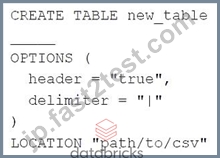
Which of the following lines of code fills in the above blank to successfully complete the task?
- A. USING CSV
- B. USING DELTA
- C. None of these lines of code are needed to successfully complete the task
- D. FROM "path/to/csv"
- E. FROM CSV
正解:D
解説:
A data lakehouse is a new paradigm that can be used to simplify and unify siloed data architectures that are specialized for specific use cases. A data lakehouse combines the best of both data lakes and data warehouses, providing a single platform that supports diverse data types, open standards, low-cost storage, high-performance queries, ACID transactions, schema enforcement, and governance. A data lakehouse enables data engineers to build reliable and scalable data pipelines that can serve various downstream applications and users, such as data science, machine learning, analytics, and reporting. A data lakehouse leverages the power of Delta Lake, a storage layer that brings reliability and performance to data lakes. Reference: What is a data lakehouse?, Delta Lake, Lakehouse: A New Generation of Open Platforms that Unify Data Warehousing and Advanced Analytics
質問 # 25
A data engineer has configured a Structured Streaming job to read from a table, manipulate the data, and then perform a streaming write into a new table.
The code block used by the data engineer is below:
If the data engineer only wants the query to process all of the available data in as many batches as required, which of the following lines of code should the data engineer use to fill in the blank?
- A. trigger(continuous="once")
- B. trigger(parallelBatch=True)
- C. trigger(availableNow=True)
- D. trigger(processingTime="once")
- E. processingTime(1)
正解:C
解説:
Explanation
https://stackoverflow.com/questions/71061809/trigger-availablenow-for-delta-source-streaming-queries-in-pyspa
質問 # 26
Which of the following Structured Streaming queries is performing a hop from a Silver table to a Gold table?
- A.

- B.

- C.
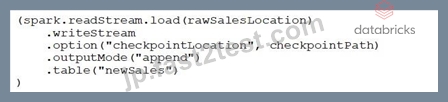
- D.

- E.
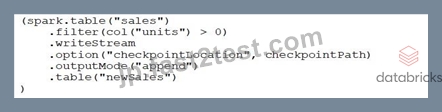
正解:D
質問 # 27
A data engineer has been given a new record of data:
id STRING = 'a1'
rank INTEGER = 6
rating FLOAT = 9.4
Which of the following SQL commands can be used to append the new record to an existing Delta table my_table?
- A. INSERT VALUES ( 'a1' , 6, 9.4) INTO my_table
- B. my_table UNION VALUES ('a1', 6, 9.4)
- C. UPDATE my_table VALUES ('a1', 6, 9.4)
- D. INSERT INTO my_table VALUES ('a1', 6, 9.4)
- E. UPDATE VALUES ('a1', 6, 9.4) my_table
正解:D
解説:
To append a new record to an existing Delta table, you can use the INSERT INTO statement with the VALUES clause. This statement will insert one or more rows into the table with the specified values. Option A is the only code block that follows this syntax correctly. Option B is incorrect, as it uses the UNION operator, which will return a new table that is the union of two tables, not append to an existing table. Option C is incorrect, as it uses the INSERT VALUES statement, which is not a valid SQL syntax. Option D is incorrect, as it uses the UPDATE statement, which will modify existing rows in the table, not append new rows. Option E is incorrect, as it uses the UPDATE VALUES statement, which is also not a valid SQL syntax. Reference: Insert data into a table using SQL | Databricks on AWS, Insert data into a table using SQL - Azure Databricks, Delta Lake Quickstart - Azure Databricks
質問 # 28
Which of the following Git operations must be performed outside of Databricks Repos?
- A. Pull
- B. Clone
- C. Commit
- D. Merge
- E. Push
正解:D
解説:
Databricks Repos is a visual Git client and API in Databricks that supports common Git operations such as commit, pull, push, branch management, and visual comparison of diffs when committing1. However, merge is not supported in the Git dialog2. You need to use the Repos UI or your Git provider to merge branches3. Merge is a way to combine the commit history from one branch into another branch1. During a merge, a merge conflict is encountered when Git cannot automatically combine code from one branch into another. Merge conflicts require manual resolution before a merge can be completed1. References: 4: Run Git operations on Databricks Repos4, 1: CI/CD techniques with Git and Databricks Repos1, 3: Collaborate in Repos3, 2: Databricks Repos - What it is and how we can use it2.
Databricks Repos is a visual Git client and API in Databricks that supports common Git operations such as commit, pull, push, merge, and branch management. However, to clone a remote Git repository to a Databricks repo, you must use the Databricks UI or API. You cannot clone a Git repo using the CLI through a cluster's web terminal, as the files won't display in the Databricks UI1. References: 1: Run Git operations on Databricks Repos | Databricks on AWS2
質問 # 29
In which of the following scenarios should a data engineer use the MERGE INTO command instead of the INSERT INTO command?
- A. When the target table is an external table
- B. When the source table can be deleted
- C. When the source is not a Delta table
- D. When the target table cannot contain duplicate records
- E. When the location of the data needs to be changed
正解:D
解説:
The MERGE INTO command is used to perform upserts, which are a combination of insertions and updates, based on a source table into a target Delta table1. The MERGE INTO command can handle scenarios where the target table cannot contain duplicate records, such as when there is a primary key or a unique constraint on the target table. The MERGE INTO command can match the source and target rows based on a merge condition and perform different actions depending on whether the rows are matched or not. For example, the MERGE INTO command can update the existing target rows with the new source values, insert the new source rows that do not exist in the target table, or delete the target rows that do not exist in the source table1.
The INSERT INTO command is used to append new rows to an existing table or create a new table from a query result2. The INSERT INTO command does not perform any updates or deletions on the existing target table rows. The INSERT INTO command can handle scenarios where the location of the data needs to be changed, such as when the data needs to be moved from one table to another, or when the data needs to be partitioned by a certain column2. The INSERT INTO command can also handle scenarios where the target table is an external table, such as when the data is stored in an external storage system like Amazon S3 or Azure Blob Storage3. The INSERT INTO command can also handle scenarios where the source table can be deleted, such as when the source table is a temporary table or a view4. The INSERT INTO command can also handle scenarios where the source is not a Delta table, such as when the source is a Parquet, CSV, JSON, or Avro file5.
References:
* 1: MERGE INTO | Databricks on AWS
* 2: [INSERT INTO | Databricks on AWS]
* 3: [External tables | Databricks on AWS]
* 4: [Temporary views | Databricks on AWS]
* 5: [Data sources | Databricks on AWS]
質問 # 30
A data analyst has created a Delta table sales that is used by the entire data analysis team. They want help from the data engineering team to implement a series of tests to ensure the data is clean. However, the data engineering team uses Python for its tests rather than SQL.
Which of the following commands could the data engineering team use to access sales in PySpark?
- A. spark.sql("sales")
- B. spark.table("sales")
- C. There is no way to share data between PySpark and SQL.
- D. spark.delta.table("sales")
- E. SELECT * FROM sales
正解:B
質問 # 31
A data engineering team has noticed that their Databricks SQL queries are running too slowly when they are submitted to a non-running SQL endpoint. The data engineering team wants this issue to be resolved.
Which of the following approaches can the team use to reduce the time it takes to return results in this scenario?
- A. They can turn on the Auto Stop feature for the SQL endpoint.
- B. They can increase the cluster size of the SQL endpoint.
- C. They can turn on the Serverless feature for the SQL endpoint.
- D. They can increase the maximum bound of the SQL endpoint's scaling range
- E. They can turn on the Serverless feature for the SQL endpoint and change the Spot Instance Policy to
"Reliability Optimized."
正解:B
解説:
Explanation
https://www.databricks.com/blog/2022/03/10/top-5-databricks-performance-tips.html
質問 # 32
A data engineer has a Job that has a complex run schedule, and they want to transfer that schedule to other Jobs.
Rather than manually selecting each value in the scheduling form in Databricks, which of the following tools can the data engineer use to represent and submit the schedule programmatically?
- A. There is no way to represent and submit this information programmatically
- B. datetime
- C. Cron syntax
- D. pyspark.sql.types.DateType
- E. pyspark.sql.types.TimestampType
正解:C
解説:
Cron syntax is a tool that can be used to represent and submit a complex run schedule programmatically. Cron syntax is a string of six fields that specify the frequency, date, and time of a job run. For example, the cron expression 0 0 12 * * ? means run the job at 12:00 PM every day. The data engineer can use the Databricks REST API to create or update a job with a cron schedule. The data engineer can also use the Databricks CLI to create or update a job with a cron schedule by using a JSON file that contains the cron expression. The other tools are either invalid or not suitable for representing and submitting a complex run schedule programmatically. References: Schedule a job, Jobs API, Databricks CLI, Cron expressions
質問 # 33
Which of the following describes a scenario in which a data engineer will want to use a single-node cluster?
- A. When they are working with SQL within Databricks SQL
- B. When they are concerned about the ability to automatically scale with larger data
- C. When they are working interactively with a small amount of data
- D. When they are manually running reports with a large amount of data
- E. When they are running automated reports to be refreshed as quickly as possible
正解:C
解説:
Explanation
A Single Node cluster is a cluster consisting of an Apache Spark driver and no Spark workers. A Single Node cluster supports Spark jobs and all Spark data sources, including Delta Lake. A Standard cluster requires a minimum of one Spark worker to run Spark jobs.
質問 # 34
......
リアルDatabricks Databricks-Certified-Data-Engineer-Associate試験問題 [更新されたのは2025年]:https://jp.fast2test.com/Databricks-Certified-Data-Engineer-Associate-premium-file.html
準備Databricks-Certified-Data-Engineer-Associate問題解答でDatabricks-Certified-Data-Engineer-Associate試験問題集:https://drive.google.com/open?id=1psBgs3Jn76ublRTL4xMYP_6WmajM9OGM