

2025年更新のDatabricks-Certified-Data-Engineer-Associate問題集合格保証付きで合格できます!
Databricks-Certified-Data-Engineer-Associate試験問題集を試そう!ベストDatabricks-Certified-Data-Engineer-Associate試験問題トレーニングを提供しています
質問 # 15
A dataset has been defined using Delta Live Tables and includes an expectations clause:
CONSTRAINT valid_timestamp EXPECT (timestamp > '2020-01-01') ON VIOLATION FAIL UPDATE What is the expected behavior when a batch of data containing data that violates these constraints is processed?
- A. Records that violate the expectation are dropped from the target dataset and loaded into a quarantine table.
- B. Records that violate the expectation cause the job to fail.
- C. Records that violate the expectation are added to the target dataset and recorded as invalid in the event log.
- D. Records that violate the expectation are added to the target dataset and flagged as invalid in a field added to the target dataset.
- E. Records that violate the expectation are dropped from the target dataset and recorded as invalid in the event log.
正解:B
解説:
The expected behavior when a batch of data containing data that violates the expectation is processed is that the job will fail. This is because the expectation clause has the ON VIOLATION FAIL UPDATE option, which means that if any record in the batch does not meet the expectation, the entire batch will be rejected and the job will fail. This option is useful for enforcing strict data quality rules and preventing invalid data from entering the target dataset.
Option A is not correct, as the ON VIOLATION FAIL UPDATE option does not drop the records that violate the expectation, but fails the entire batch. To drop the records that violate the expectation and record them as invalid in the event log, the ON VIOLATION DROP RECORD option should be used.
Option C is not correct, as the ON VIOLATION FAIL UPDATE option does not drop the records that violate the expectation, but fails the entire batch. To drop the records that violate the expectation and load them into a quarantine table, the ON VIOLATION QUARANTINE RECORD option should be used.
Option D is not correct, as the ON VIOLATION FAIL UPDATE option does not add the records that violate the expectation, but fails the entire batch. To add the records that violate the expectation and record them as invalid in the event log, the ON VIOLATION LOG RECORD option should be used.
Option E is not correct, as the ON VIOLATION FAIL UPDATE option does not add the records that violate the expectation, but fails the entire batch. To add the records that violate the expectation and flag them as invalid in a field added to the target dataset, the ON VIOLATION FLAG RECORD option should be used.
References:
* Delta Live Tables Expectations
* [Databricks Data Engineer Professional Exam Guide]
質問 # 16
Which of the following benefits of using the Databricks Lakehouse Platform is provided by Delta Lake?
- A. The ability to support batch and streaming workloads
- B. The ability to collaborate in real time on a single notebook
- C. The ability to distribute complex data operations
- D. The ability to set up alerts for query failures
- E. The ability to manipulate the same data using a variety of languages
正解:A
解説:
Delta Lake is the optimized storage layer that provides the foundation for storing data and tables in the Databricks lakehouse. Delta Lake is fully compatible with Apache Spark APIs, and was developed for tight integration with Structured Streaming, allowing you to easily use a single copy of data for both batch and streaming operations and providing incremental processing at scale1. Delta Lake supports upserts using the merge operation, which enables you to efficiently update existing data or insert new data into your Delta tables2. Delta Lake also provides time travel capabilities, which allow you to query previous versions of your data or roll back to a specific point in time3. Reference: 1: What is Delta Lake? | Databricks on AWS 2: Upsert into a table using merge | Databricks on AWS 3: [Query an older snapshot of a table (time travel) | Databricks on AWS] Learn more
1learn.microsoft.com2medium.com3slideshare.net4docs.databricks.com5github.com6key2consulting.com
質問 # 17
A data engineer has been using a Databricks SQL dashboard to monitor the cleanliness of the input data to a data analytics dashboard for a retail use case. The job has a Databricks SQL query that returns the number of store-level records where sales is equal to zero. The data engineer wants their entire team to be notified via a messaging webhook whenever this value is greater than 0.
Which of the following approaches can the data engineer use to notify their entire team via a messaging webhook whenever the number of stores with $0 in sales is greater than zero?
- A. They can set up an Alert without notifications.
- B. They can set up an Alert with one-time notifications.
- C. They can set up an Alert with a new email alert destination.
- D. They can set up an Alert with a custom template.
- E. They can set up an Alert with a new webhook alert destination.
正解:E
質問 # 18
A Delta Live Table pipeline includes two datasets defined using STREAMING LIVE TABLE. Three datasets are defined against Delta Lake table sources using LIVE TABLE.
The table is configured to run in Production mode using the Continuous Pipeline Mode.
Assuming previously unprocessed data exists and all definitions are valid, what is the expected outcome after clicking Start to update the pipeline?
- A. All datasets will be updated at set intervals until the pipeline is shut down. The compute resources will be deployed for the update and terminated when the pipeline is stopped.
- B. All datasets will be updated once and the pipeline will shut down. The compute resources will be terminated.
- C. All datasets will be updated once and the pipeline will shut down. The compute resources will persist to allow for additional testing.
- D. All datasets will be updated at set intervals until the pipeline is shut down. The compute resources will persist to allow for additional testing.
- E. All datasets will be updated once and the pipeline will persist without any processing. The compute resources will persist but go unused.
正解:C
質問 # 19
A data engineer is attempting to drop a Spark SQL table my_table. The data engineer wants to delete all table metadata and data.
They run the following command:
DROP TABLE IF EXISTS my_table
While the object no longer appears when they run SHOW TABLES, the data files still exist.
Which of the following describes why the data files still exist and the metadata files were deleted?
- A. The table did not have a location
- B. The table's data was larger than 10 GB
- C. The table's data was smaller than 10 GB
- D. The table was managed
- E. The table was external
正解:E
質問 # 20
A data engineer has been using a Databricks SQL dashboard to monitor the cleanliness of the input data to an ELT job. The ELT job has its Databricks SQL query that returns the number of input records containing unexpected NULL values. The data engineer wants their entire team to be notified via a messaging webhook whenever this value reaches 100.
Which of the following approaches can the data engineer use to notify their entire team via a messaging webhook whenever the number of NULL values reaches 100?
- A. They can set up an Alert without notifications.
- B. They can set up an Alert with one-time notifications.
- C. They can set up an Alert with a new email alert destination.
- D. They can set up an Alert with a custom template.
- E. They can set up an Alert with a new webhook alert destination.
正解:E
解説:
A webhook alert destination is a way to send notifications to external applications or services via HTTP requests. A data engineer can use a webhook alert destination to notify their entire team via a messaging webhook, such as Slack or Microsoft Teams, whenever the number of NULL values in the input data reaches 100. To set up a webhook alert destination, the data engineer needs to do the following steps:
In the Databricks SQL workspace, navigate to the Settings gear icon and select SQL Admin Console.
Click Alert Destinations and click Add New Alert Destination.
Select Webhook and enter the webhook URL and the optional custom template for the notification message.
Click Create to save the webhook alert destination.
In the Databricks SQL editor, create or open the query that returns the number of input records containing unexpected NULL values.
Click the Create Alert icon above the editor window and configure the alert criteria, such as the value column, the condition, and the threshold.
In the Notification section, select the webhook alert destination that was created earlier and click Create Alert. Reference: What are Databricks SQL alerts?, Monitor alerts, Monitoring Your Business with Alerts, Using Automation Runbook Webhooks To Alert on Databricks Status Updates.
質問 # 21
Which of the following can be used to simplify and unify siloed data architectures that are specialized for specific use cases?
- A. Data lakehouse
- B. All of these
- C. None of these
- D. Data lake
- E. Data warehouse
正解:A
質問 # 22
A data engineer has a Python variable table_name that they would like to use in a SQL query. They want to construct a Python code block that will run the query using table_name.
They have the following incomplete code block:
____(f"SELECT customer_id, spend FROM {table_name}")
Which of the following can be used to fill in the blank to successfully complete the task?
- A. spark.delta.table
- B. spark.delta.sql
- C. dbutils.sql
- D. spark.sql
- E. spark.table
正解:D
解説:
The spark.sql method can be used to execute SQL queries programmatically and return the result as a DataFrame. The spark.sql method accepts a string argument that contains a valid SQL statement. The data engineer can use a formatted string literal (f-string) to insert the Python variable table_name into the SQL query. The other methods are either invalid or not suitable for running SQL queries. Reference: Running SQL Queries Programmatically, Formatted string literals, spark.sql
質問 # 23
A data analyst has created a Delta table sales that is used by the entire data analysis team. They want help from the data engineering team to implement a series of tests to ensure the data is clean. However, the data engineering team uses Python for its tests rather than SQL.
Which of the following commands could the data engineering team use to access sales in PySpark?
- A. spark.table("sales")
- B. There is no way to share data between PySpark and SQL.
- C. spark.delta.table("sales")
- D. spark.sql("sales")
- E. SELECT * FROM sales
正解:A
解説:
The data engineering team can use the spark.table method to access the Delta table sales in PySpark. This method returns a DataFrame representation of the Delta table, which can be used for further processing or testing. The spark.table method works for any table that is registered in the Hive metastore or the Spark catalog, regardless of the file format1. Alternatively, the data engineering team can also use the DeltaTable.forPath method to load the Delta table from its path2. References: 1: SparkSession | PySpark
3.2.0 documentation 2: Welcome to Delta Lake's Python documentation page - delta-spark 2.4.0 documentation
質問 # 24
Which of the following commands will return the location of database customer360?
- A. DROP DATABASE customer360;
- B. DESCRIBE DATABASE customer360;
- C. ALTER DATABASE customer360 SET DBPROPERTIES ('location' = '/user'};
- D. USE DATABASE customer360;
- E. DESCRIBE LOCATION customer360;
正解:B
解説:
The command DESCRIBE DATABASE customer360; will return the location of the database customer360, along with its comment and properties. This command is an alias for DESCRIBE SCHEMA customer360;, which can also be used to get the same information. The other commands will either drop the database, alter its properties, or use it as the current database, but will not return its location12. Reference:
DESCRIBE DATABASE | Databricks on AWS
DESCRIBE DATABASE - Azure Databricks - Databricks SQL
質問 # 25
A data engineer has developed a data pipeline to ingest data from a JSON source using Auto Loader, but the engineer has not provided any type inference or schema hints in their pipeline. Upon reviewing the data, the data engineer has noticed that all of the columns in the target table are of the string type despite some of the fields only including float or boolean values.
Which of the following describes why Auto Loader inferred all of the columns to be of the string type?
- A. JSON data is a text-based format
- B. Auto Loader only works with string data
- C. Auto Loader cannot infer the schema of ingested data
- D. There was a type mismatch between the specific schema and the inferred schema
- E. All of the fields had at least one null value
正解:A
解説:
JSON data is a text-based format that represents data as a collection of name-value pairs. By default, when Auto Loader infers the schema of JSON data, it treats all columns as strings. This is because JSON data can have varying data types for the same column across different files or records, and Auto Loader does not attempt to reconcile these differences. For example, a column named "age" may have integer values in some files, but string values in others. To avoid data loss or errors, Auto Loader infers the column as a string type. However, Auto Loader also provides an option to infer more precise column types based on the sample data. This option is called cloudFiles.inferColumnTypes and it can be set to true or false. When set to true, Auto Loader tries to infer the exact data types of the columns, such as integers, floats, booleans, or nested structures. When set to false, Auto Loader infers all columns as strings. The default value of this option is false. Reference: Configure schema inference and evolution in Auto Loader, Schema inference with auto loader (non-DLT and DLT), Using and Abusing Auto Loader's Inferred Schema, Explicit path to data or a defined schema required for Auto loader.
質問 # 26
A data engineer is using the following code block as part of a batch ingestion pipeline to read from a composable table: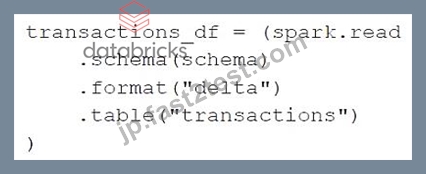
Which of the following changes needs to be made so this code block will work when the transactions table is a stream source?
- A. Replace "transactions" with the path to the location of the Delta table
- B. Replace spark.read with spark.readStream
- C. Replace predict with a stream-friendly prediction function
- D. Replace schema(schema) with option ("maxFilesPerTrigger", 1)
- E. Replace format("delta") with format("stream")
正解:B
解説:
1: To read from a stream source, the data engineer needs to use the spark.readStream method instead of the spark.read method. The spark.readStream method returns a DataStreamReader object that can be used to specify the details of the input source, such as the format, the schema, the path, and the options. The spark.read method is only suitable for batch processing, not streaming processing. The other changes are not necessary or correct for reading from a stream source. Reference: Structured Streaming Programming Guide, Read a stream, Databricks Data Sources
質問 # 27
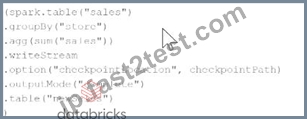
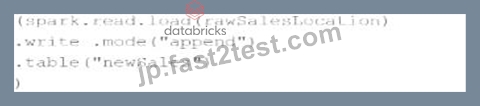
Which query is performing a streaming hop from raw data to a Bronze table?
- A.

- B.
- C.
- D.

正解:D
質問 # 28
Which of the following statements regarding the relationship between Silver tables and Bronze tables is always true?
- A. Silver tables contain more data than Bronze tables.
- B. Silver tables contain less data than Bronze tables.
- C. Silver tables contain a more refined and cleaner view of data than Bronze tables.
- D. Silver tables contain aggregates while Bronze data is unaggregated.
- E. Silver tables contain a less refined, less clean view of data than Bronze data.
正解:C
解説:
Explanation
https://www.databricks.com/glossary/medallion-architecture
質問 # 29
A data engineer is running code in a Databricks Repo that is cloned from a central Git repository. A colleague of the data engineer informs them that changes have been made and synced to the central Git repository. The data engineer now needs to sync their Databricks Repo to get the changes from the central Git repository.
Which of the following Git operations does the data engineer need to run to accomplish this task?
- A. Clone
- B. Pull
- C. Commit
- D. Push
- E. Merge
正解:B
解説:
To sync a Databricks Repo with the changes from a central Git repository, the data engineer needs to run the Git pull operation. This operation fetches the latest updates from the remote repository and merges them with the local repository. The data engineer can use the Pull button in the Databricks Repos UI, or use the git pull command in a terminal session. The other options are not relevant for this task, as they either push changes to the remote repository (Push), combine two branches (Merge), save changes to the local repository (Commit), or create a new local repository from a remote one (Clone). References:
* Run Git operations on Databricks Repos
* Git pull
質問 # 30
Which of the following commands will return the number of null values in the member_id column?
- A. SELECT null(member_id) FROM my_table;
- B. SELECT count(member_id) - count_null(member_id) FROM my_table;
- C. SELECT count(member_id) FROM my_table;
- D. SELECT count_if(member_id IS NULL) FROM my_table;
- E. SELECT count_null(member_id) FROM my_table;
正解:D
解説:
To return the number of null values in the member_id column, the best option is to use the count_if function, which counts the number of rows that satisfy a given condition. In this case, the condition is that the member_id column is null. The other options are either incorrect or not supported by Spark SQL. Option A will return the number of non-null values in the member_id column. Option B will not work because there is no count_null function in Spark SQL. Option D will not work because there is no null function in Spark SQL. Option E will not work because there is no count_null function in Spark SQL. Reference:
Built-in Functions - Spark SQL, Built-in Functions
count_if - Spark SQL, Built-in Functions
質問 # 31
A dataset has been defined using Delta Live Tables and includes an expectations clause:
CONSTRAINT valid_timestamp EXPECT (timestamp > '2020-01-01') ON VIOLATION FAIL UPDATE What is the expected behavior when a batch of data containing data that violates these constraints is processed?
- A. Records that violate the expectation are dropped from the target dataset and loaded into a quarantine table.
- B. Records that violate the expectation cause the job to fail.
- C. Records that violate the expectation are added to the target dataset and recorded as invalid in the event log.
- D. Records that violate the expectation are added to the target dataset and flagged as invalid in a field added to the target dataset.
- E. Records that violate the expectation are dropped from the target dataset and recorded as invalid in the event log.
正解:B
解説:
Explanation
https://docs.databricks.com/en/delta-live-tables/expectations.html
Action
Result
warn (default)
Invalid records are written to the target; failure is reported as a metric for the dataset.
drop
Invalid records are dropped before data is written to the target; failure is reported as a metrics for the dataset.
fail
Invalid records prevent the update from succeeding. Manual intervention is required before re-processing.
質問 # 32
......
最新100%合格率保証付きの素晴らしいDatabricks-Certified-Data-Engineer-Associate試験問題PDF:https://jp.fast2test.com/Databricks-Certified-Data-Engineer-Associate-premium-file.html
実践サンプルと問題集指導には2025年最新のDatabricks-Certified-Data-Engineer-Associate有効なテスト問題集:https://drive.google.com/open?id=1fwCLumfqSSNVU7srIbOV1-7kLnboOVuy