

更新された検証済みのDatabricks-Certified-Data-Engineer-Associate問題集と解答には100%一発合格保証問題集はここ
合格Databricks Certification Databricks-Certified-Data-Engineer-Associate試験問題には102問があります
質問 # 47
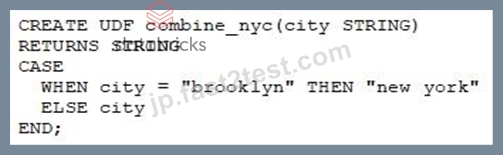
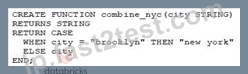
A data engineer needs to apply custom logic to string column city in table stores for a specific use case. In order to apply this custom logic at scale, the data engineer wants to create a SQL user-defined function (UDF).
Which of the following code blocks creates this SQL UDF?
- A.
- B.

- C.

- D.
- E.

正解:B
質問 # 48
A data engineer needs to create a table in Databricks using data from a CSV file at location /path/to/csv.
They run the following command: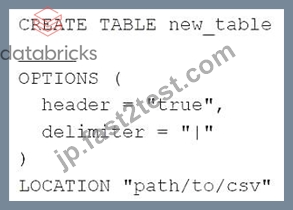
Which of the following lines of code fills in the above blank to successfully complete the task?
- A. USING DELTA
- B. None of these lines of code are needed to successfully complete the task
- C. USING CSV
- D. FROM "path/to/csv"
- E. FROM CSV
正解:D
解説:
A data lakehouse is a new paradigm that can be used to simplify and unify siloed data architectures that are specialized for specific use cases. A data lakehouse combines the best of both data lakes and data warehouses, providing a single platform that supports diverse data types, open standards, low-cost storage, high-performance queries, ACID transactions, schema enforcement, and governance. A data lakehouse enables data engineers to build reliable and scalable data pipelines that can serve various downstream applications and users, such as data science, machine learning, analytics, and reporting. A data lakehouse leverages the power of Delta Lake, a storage layer that brings reliability and performance to data lakes. References: What is a data lakehouse?, Delta Lake, Lakehouse: A New Generation of Open Platforms that Unify Data Warehousing and Advanced Analytics
質問 # 49
A data engineer only wants to execute the final block of a Python program if the Python variable day_of_week is equal to 1 and the Python variable review_period is True.
Which of the following control flow statements should the data engineer use to begin this conditionally executed code block?
- A. if day_of_week = 1 and review_period = "True":
- B. if day_of_week = 1 and review_period:
- C. if day_of_week == 1 and review_period == "True":
- D. if day_of_week == 1 and review_period:
- E. if day_of_week = 1 & review_period: = "True":
正解:D
解説:
In Python, the == operator is used to compare the values of two variables, while the = operator is used to assign a value to a variable. Therefore, option A and E are incorrect, as they use the = operator for comparison. Option B and C are also incorrect, as they compare the review_period variable to a string value "True", which is different from the boolean value True. Option D is the correct answer, as it uses the == operator to compare the day_of_week variable to the integer value 1, and the and operator to check if both conditions are true. If both conditions are true, then the final block of the Python program will be executed. Reference: [Python Operators], [Python If ... Else]
質問 # 50
A data organization leader is upset about the data analysis team's reports being different from the data engineering team's reports. The leader believes the siloed nature of their organization's data engineering and data analysis architectures is to blame.
Which of the following describes how a data lakehouse could alleviate this issue?
- A. Both teams would use the same source of truth for their work
- B. Both teams would autoscale their work as data size evolves
- C. Both teams would reorganize to report to the same department
- D. Both teams would respond more quickly to ad-hoc requests
- E. Both teams would be able to collaborate on projects in real-time
正解:A
質問 # 51
A data engineer runs a statement every day to copy the previous day's sales into the table transactions. Each day's sales are in their own file in the location "/transactions/raw".
Today, the data engineer runs the following command to complete this task: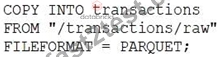
After running the command today, the data engineer notices that the number of records in table transactions has not changed.
Which of the following describes why the statement might not have copied any new records into the table?
- A. The names of the files to be copied were not included with the FILES keyword.
- B. The COPY INTO statement requires the table to be refreshed to view the copied rows.
- C. The format of the files to be copied were not included with the FORMAT_OPTIONS keyword.
- D. The PARQUET file format does not support COPY INTO.
- E. The previous day's file has already been copied into the table.
正解:E
解説:
The COPY INTO statement is an idempotent operation, which means that it will skip any files that have already been loaded into the target table1. This ensures that the data is not duplicated or corrupted by multiple attempts to load the same file. Therefore, if the data engineer runs the same command every day without specifying the names of the files to be copied with the FILES keyword or a glob pattern with the PATTERN keyword, the statement will only copy the first file that matches the source location and ignore the rest. To avoid this problem, the data engineer should either use the FILES or PATTERN keywords to filter the files to be copied based on the date or some other criteria, or delete the files from the source location after they are copied into the table2. References: 1: COPY INTO | Databricks on AWS 2: Get started using COPY INTO to load data | Databricks on AWS
質問 # 52
Which of the following commands can be used to write data into a Delta table while avoiding the writing of duplicate records?
- A. INSERT
- B. MERGE
- C. APPEND
- D. IGNORE
- E. DROP
正解:B
解説:
The MERGE command can be used to upsert data from a source table, view, or DataFrame into a target Delta table. It allows you to specify conditions for matching and updating existing records, and inserting new records when no match is found. This way, you can avoid writing duplicate records into a Delta table1. The other commands (DROP, IGNORE, APPEND, INSERT) do not have this functionality and may result in duplicate records or data loss234. References: 1: Upsert into a Delta Lake table using merge | Databricks on AWS 2: SQL DELETE | Databricks on AWS 3: SQL INSERT INTO | Databricks on AWS 4: SQL UPDATE | Databricks on AWS
質問 # 53
A data engineer needs to apply custom logic to string column city in table stores for a specific use case. In order to apply this custom logic at scale, the data engineer wants to create a SQL user-defined function (UDF).
Which of the following code blocks creates this SQL UDF?
- A.

- B.

- C.

- D.
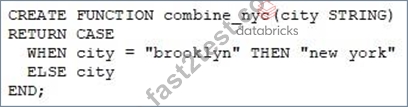
- E.

正解:B
解説:
https://www.databricks.com/blog/2021/10/20/introducing-sql-user-defined-functions.html
質問 # 54
Which of the following must be specified when creating a new Delta Live Tables pipeline?
- A. A key-value pair configuration
- B. At least one notebook library to be executed
- C. The preferred DBU/hour cost
- D. A path to cloud storage location for the written data
- E. A location of a target database for the written data
正解:B
解説:
Option E is the correct answer because it is the only mandatory requirement when creating a new Delta Live Tables pipeline. A pipeline is a data processing workflow that contains materialized views and streaming tables declared in Python or SQL source files. Delta Live Tables infers the dependencies between these tables and ensures updates occur in the correct order. To create a pipeline, you need to specify at least one notebook library to be executed, which contains the Delta Live Tables syntax. You can also specify multiple libraries of different languages within your pipeline. The other options are optional or not applicable for creating a pipeline. Option A is not required, but you can optionally provide a key-value pair configuration to customize the pipeline settings, such as the storage location, the target schema, the notifications, and the pipeline mode.
Option B is not applicable, as the DBU/hour cost is determined by the cluster configuration, not the pipeline creation. Option C is not required, but you can optionally specify a storage location for the output data from the pipeline. If you leave it empty, the system uses a default location. Option D is not required, but you can optionally specify a location of a target database for the written data, either in the Hive metastore or the Unity Catalog.
References: Tutorial: Run your first Delta Live Tables pipeline, What is Delta Live Tables?, Create a pipeline, Pipeline configuration.
質問 # 55
Which of the following describes the type of workloads that are always compatible with Auto Loader?
- A. Machine learning workloads
- B. Batch workloads
- C. Streaming workloads
- D. Dashboard workloads
- E. Serverless workloads
正解:C
解説:
Auto Loader is a Structured Streaming source that incrementally and efficiently processes new data files as they arrive in cloud storage. It supports both Python and SQL in Delta Live Tables, which are ideal for building streaming data pipelines. Auto Loader can handle near real-time ingestion of millions of files per hour and provide exactly-once guarantees when writing data into Delta Lake. Auto Loader is not designed for dashboard, machine learning, serverless, or batch workloads, which have different requirements and characteristics. References: What is Auto Loader?, Delta Live Tables
質問 # 56
A data engineer has a Job with multiple tasks that runs nightly. Each of the tasks runs slowly because the clusters take a long time to start.
Which of the following actions can the data engineer perform to improve the start up time for the clusters used for the Job?
- A. They can use endpoints available in Databricks SQL
- B. They can configure the clusters to be single-node
- C. They can use clusters that are from a cluster pool
- D. They can configure the clusters to autoscale for larger data sizes
- E. They can use jobs clusters instead of all-purpose clusters
正解:C
解説:
The best action that the data engineer can perform to improve the start up time for the clusters used for the Job is to use clusters that are from a cluster pool. A cluster pool is a set of idle clusters that can be used by jobs or interactive sessions. By using a cluster pool, the data engineer can avoid the cluster creation time and reduce the latency of the tasks. Cluster pools also offer cost savings and resource efficiency, as they can be shared by multiple users and jobs.
Option A is not relevant, as endpoints available in Databricks SQL are used for creating and managing SQL analytics workloads, not for improving cluster start up time.
Option B is not correct, as jobs clusters and all-purpose clusters have similar start up times. Jobs clusters are clusters that are dedicated to run a single job and are terminated when the job is completed. All-purpose clusters are clusters that can be used for multiple purposes, such as interactive sessions, notebooks, or multiple jobs. Both types of clusters can benefit from using a cluster pool.
Option C is not advisable, as configuring the clusters to be single-node will reduce the parallelism and performance of the tasks. Single-node clusters are clusters that have only one worker node and are typically used for testing or development purposes. They are not suitable for running production jobs that require high scalability and fault tolerance.
Option E is not helpful, as configuring the clusters to autoscale for larger data sizes will not affect the start up time of the clusters. Autoscaling is a feature that allows clusters to dynamically adjust the number of worker nodes based on the workload. It can help optimize the resource utilization and cost efficiency of the clusters, but it does not speed up the cluster creation process.
References:
* Cluster Pools
* Jobs
* Clusters
* [Databricks Data Engineer Professional Exam Guide]
質問 # 57
A data engineer wants to create a new table containing the names of customers who live in France.
They have written the following command:
CREATE TABLE customersInFrance
_____ AS
SELECT id,
firstName,
lastName
FROM customerLocations
WHERE country = 'FRANCE';
A senior data engineer mentions that it is organization policy to include a table property indicating that the new table includes personally identifiable information (Pll).
Which line of code fills in the above blank to successfully complete the task?
- A. "COMMENT PII"
- B. TBLPROPERTIES PII
- C. 0
- D. COMMENT "Contains PIT
正解:B
解説:
To include a property indicating that a table contains personally identifiable information (PII), the TBLPROPERTIES keyword is used in SQL to add metadata to a table. The correct syntax to define a table property for PII is as follows:
CREATE TABLE customersInFrance
USING DELTA
TBLPROPERTIES ('PII' = 'true')
AS
SELECT id,
firstName,
lastName
FROM customerLocations
WHERE country = 'FRANCE';
The TBLPROPERTIES ('PII' = 'true') line correctly sets a table property that tags the table as containing personally identifiable information. This is in accordance with organizational policies for handling sensitive information.
Reference:
Databricks documentation on Delta Lake: Delta Lake on Databricks
質問 # 58
Which of the following commands can be used to write data into a Delta table while avoiding the writing of duplicate records?
- A. INSERT
- B. MERGE
- C. APPEND
- D. IGNORE
- E. DROP
正解:B
解説:
Explanation
To write data into a Delta table while avoiding the writing of duplicate records, you can use the MERGE command. The MERGE command in Delta Lake allows you to combine the ability to insert new records and update existing records in a single atomic operation. The MERGE command compares the data being written with the existing data in the Delta table based on specified matching criteria, typically using a primary key or unique identifier. It then performs conditional actions, such as inserting new records or updating existing records, depending on the comparison results. By using the MERGE command, you can handle the prevention of duplicate records in a more controlled and efficient manner. It allows you to synchronize and reconcile data from different sources while avoiding duplication and ensuring data integrity.
質問 # 59
Which of the following describes the relationship between Gold tables and Silver tables?
- A. Gold tables are more likely to contain valuable data than Silver tables.
- B. Gold tables are more likely to contain more data than Silver tables.
- C. Gold tables are more likely to contain aggregations than Silver tables.
- D. Gold tables are more likely to contain truthful data than Silver tables.
- E. Gold tables are more likely to contain a less refined view of data than Silver tables.
正解:C
解説:
According to the medallion lakehouse architecture, gold tables are the final layer of data that powers analytics, machine learning, and production applications. They are often highly refined and aggregated, containing data that has been transformed into knowledge, rather than just information. Silver tables, on the other hand, are the intermediate layer of data that represents a validated, enriched version of the raw data from the bronze layer.
They provide an enterprise view of all its key business entities, concepts and transactions, but they may not have all the aggregations and calculations that are required for specific use cases. Therefore, gold tables are more likely to contain aggregations than silver tables. References:
* What is the medallion lakehouse architecture?
* What is a Medallion Architecture?
質問 # 60
A data engineer only wants to execute the final block of a Python program if the Python variable day_of_week is equal to 1 and the Python variable review_period is True.
Which of the following control flow statements should the data engineer use to begin this conditionally executed code block?
- A. if day_of_week = 1 and review_period = "True":
- B. if day_of_week = 1 and review_period:
- C. if day_of_week == 1 and review_period:
- D. if day_of_week = 1 & review_period: = "True":
- E. if day_of_week == 1 and review_period == "True":
正解:E
質問 # 61
A data engineer is running code in a Databricks Repo that is cloned from a central Git repository. A colleague of the data engineer informs them that changes have been made and synced to the central Git repository. The data engineer now needs to sync their Databricks Repo to get the changes from the central Git repository.
Which of the following Git operations does the data engineer need to run to accomplish this task?
- A. Commit
- B. Clone
- C. Merge
- D. Push
- E. Pull
正解:E
解説:
To sync a Databricks Repo with the changes from a central Git repository, the data engineer needs to run the Git pull operation. This operation fetches the latest updates from the remote repository and merges them with the local repository. The data engineer can use the Pull button in the Databricks Repos UI, or use the git pull command in a terminal session. The other options are not relevant for this task, as they either push changes to the remote repository (Push), combine two branches (Merge), save changes to the local repository (Commit), or create a new local repository from a remote one (Clone). Reference:
Run Git operations on Databricks Repos
Git pull
質問 # 62
A data engineer has created a new database using the following command:
CREATE DATABASE IF NOT EXISTS customer360;
In which of the following locations will the customer360 database be located?
- A. More information is needed to determine the correct response
- B. dbfs:/user/hive/customer360
- C. dbfs:/user/hive/database/customer360
- D. dbfs:/user/hive/warehouse
正解:D
解説:
Explanation
dbfs:/user/hive/warehouse - which is the default location
質問 # 63
A data engineer wants to schedule their Databricks SQL dashboard to refresh once per day, but they only want the associated SQL endpoint to be running when it is necessary.
Which of the following approaches can the data engineer use to minimize the total running time of the SQL endpoint used in the refresh schedule of their dashboard?
- A. They can ensure the dashboard's SQL endpoint is not one of the included query's SQL endpoint.
- B. They can reduce the cluster size of the SQL endpoint.
- C. They can set up the dashboard's SQL endpoint to be serverless.
- D. They can turn on the Auto Stop feature for the SQL endpoint.
- E. They can ensure the dashboard's SQL endpoint matches each of the queries' SQL endpoints.
正解:D
質問 # 64
A data engineering team has noticed that their Databricks SQL queries are running too slowly when they are submitted to a non-running SQL endpoint. The data engineering team wants this issue to be resolved.
Which of the following approaches can the team use to reduce the time it takes to return results in this scenario?
- A. They can turn on the Auto Stop feature for the SQL endpoint.
- B. They can increase the maximum bound of the SQL endpoint's scaling range
- C. They can increase the cluster size of the SQL endpoint.
- D. They can turn on the Serverless feature for the SQL endpoint.
- E. They can turn on the Serverless feature for the SQL endpoint and change the Spot Instance Policy to
"Reliability Optimized."
正解:D
解説:
Option D is the correct answer because it enables the Serverless feature for the SQL endpoint, which allows the endpoint to automatically scale up and down based on the query load. This way, the endpoint can handle more concurrent queries and reduce the time it takes to return results. The Serverless feature also reduces the cold start time of the endpoint, which is the time it takes to start the cluster when a query is submitted to a non-running endpoint. The Serverless feature is available for both AWS and Azure Databricks platforms.
References: Databricks SQL Serverless, Serverless SQL endpoints, New Performance Improvements in Databricks SQL
質問 # 65
Which of the following is hosted completely in the control plane of the classic Databricks architecture?
- A. Driver node
- B. Worker node
- C. Databricks Filesystem
- D. Databricks web application
- E. JDBC data source
正解:D
解説:
The Databricks web application is the user interface that allows you to create and manage workspaces, clusters, notebooks, jobs, and other resources. It is hosted completely in the control plane of the classic Databricks architecture, which includes the backend services that Databricks manages in your Databricks account. The other options are part of the compute plane, which is where your data is processed by compute resources such as clusters. The compute plane is in your own cloud account and network. References: Databricks architecture overview, Security and Trust Center
質問 # 66
......
究極の無料ガイド準備Databricks-Certified-Data-Engineer-Associate試験問題と解答:https://drive.google.com/open?id=1fwCLumfqSSNVU7srIbOV1-7kLnboOVuy
合格させるDatabricks-Certified-Data-Engineer-AssociateテストエンジンPDFで完全版無料問題集がここに:https://jp.fast2test.com/Databricks-Certified-Data-Engineer-Associate-premium-file.html