

CompTIA Cybersecurity Analyst (CySA+) Certification Exam練習テスト2023年最新のCS0-003ストレスなしで合格させちゃう!
練習CompTIA Cybersecurity Analyst CS0-003問題集オンライン試験練習テストと詳細な解説付き!
質問 # 29
While reviewing web server logs, an analyst notices several entries with the same time stamps, but all contain odd characters in the request line. Which of the following steps should be taken next?
- A. Utilize the correct attack framework and determine what the incident response will consist of.
- B. Shut the network down immediately and call the next person in the chain of command.
- C. Notify the local law enforcement for incident response
- D. Determine what attack the odd characters are indicative of
正解:D
解説:
Determining what attack the odd characters are indicative of is the next step that should be taken after reviewing web server logs and noticing several entries with the same time stamps, but all contain odd characters in the request line. This step can help the analyst identify the type and severity of the attack, as well as the possible source and motive of the attacker. The odd characters in the request line may indicate that the attacker is trying to exploit a vulnerability or inject malicious code into the web server or application, such as SQL injection, cross-site scripting, buffer overflow, or command injection. The analyst can use tools and techniques such as log analysis, pattern matching, signature detection, or threat intelligence to determine what attack the odd characters are indicative of, and then proceed to the next steps of incident response, such as containment, eradication, recovery, and lessons learned. Official Reference:
https://partners.comptia.org/docs/default-source/resources/comptia-cysa-cs0-002-exam-objectives
https://www.comptia.org/certifications/cybersecurity-analyst
https://www.comptia.org/blog/the-new-comptia-cybersecurity-analyst-your-questions-answered
質問 # 30
A vulnerability management team is unable to patch all vulnerabilities found during their weekly scans. Using the third-party scoring system described below, the team patches the most urgent vulnerabilities:
Additionally, the vulnerability management team feels that the metrics Smear and Channing are less important than the others, so these will be lower in priority. Which of the following vulnerabilities should be patched first, given the above third-party scoring system?
- A. TSpirit:
Cobain: Yes
Grohl: Yes
Novo: Yes
Smear: No
Channing: No - B. InLoud:
Cobain: Yes
Grohl: No
Novo: Yes
Smear: Yes
Channing: No - C. PBleach:
Cobain: Yes
Grohl: No
Novo: No
Smear: No
Channing: Yes - D. ENameless:
Cobain: Yes
Grohl: No
Novo: Yes
Smear: No
Channing: No
正解:A
解説:
Explanation
The vulnerability that should be patched first, given the above third-party scoring system, is:
TSpirit: Cobain: Yes Grohl: Yes Novo: Yes Smear: No Channing: No
This vulnerability has three out of five metrics marked as Yes, which indicates a high severity level. The metrics Cobain, Grohl, and Novo are more important than Smear and Channing, according to the vulnerability management team. Therefore, this vulnerability poses a greater risk than the other vulnerabilities and should be patched first.
質問 # 31
Which of the following items should be included in a vulnerability scan report? (Choose two.)
- A. Playbook
- B. Education plan
- C. Affected hosts
- D. Lessons learned
- E. Risk score
- F. Service-level agreement
正解:C、E
解説:
A vulnerability scan report should include information about the affected hosts, such as their IP addresses, hostnames, operating systems, and services. It should also include a risk score for each vulnerability, which indicates the severity and potential impact of the vulnerability on the host and the organization. Official Reference: https://www.first.org/cvss/
質問 # 32
The developers recently deployed new code to three web servers. A daffy automated external device scan report shows server vulnerabilities that are failure items according to PCI DSS.
If the venerability is not valid, the analyst must take the proper steps to get the scan clean.
If the venerability is valid, the analyst must remediate the finding.
After reviewing the information provided in the network diagram, select the STEP 2 tab to complete the simulation by selecting the correct Validation Result and Remediation Action for each server listed using the drop-down options.
INTRUCTIONS:
The simulation includes 2 steps.
Step1:Review the information provided in the network diagram and then move to the STEP 2 tab.

STEP 2: Given the Scenario, determine which remediation action is required to address the vulnerability.
正解:
解説:
質問 # 33
The security team reviews a web server for XSS and runs the following Nmap scan:
Which of the following most accurately describes the result of the scan?
- A. The vulnerable parameter and unfiltered or encoded characters passed > and " as unsafe
- B. The vulnerable parameter ID hccp://l72.31.15.2/1.php?id-2 and unfiltered characters returned
- C. An output of characters > and " as the parameters used m the attempt
- D. The vulnerable parameter and characters > and " with a reflected XSS attempt
正解:D
解説:
Explanation
A cross-site scripting (XSS) attack is a type of web application attack that injects malicious code into a web page that is then executed by the browser of a victim user. A reflected XSS attack is a type of XSS attack where the malicious code is embedded in a URL or a form parameter that is sent to the web server and then reflected back to the user's browser. In this case, the Nmap scan shows that the web server is vulnerable to a reflected XSS attack, as it returns the characters > and " without any filtering or encoding. The vulnerable parameter is id in the URL http://172.31.15.2/1.php?id=2.
質問 # 34
An analyst is conducting monitoring against an authorized team that win perform adversarial techniques. The analyst interacts with the team twice per day to set the stage for the techniques to be used. Which of the following teams is the analyst a member of?
Orange team
Blue team
Red team
Purple team
The correct answer is
- A. Orange team.
正解:A
解説:
An orange team is a team that is involved in facilitation and training of other teams in cybersecurity. An orange team assists the yellow team, which is the management or leadership team that oversees the cybersecurity strategy and governance of an organization. An orange team helps the yellow team to understand the cybersecurity risks and challenges, as well as the roles and responsibilities of other teams, such as the red, blue, and purple teams12.
In this scenario, the analyst is conducting monitoring against an authorized team that will perform adversarial techniques. This means that the analyst is observing and evaluating the performance of another team that is simulating real-world attacks against the organization's systems or networks. This could be either a red team or a purple team, depending on whether they are working independently or collaboratively with the defensive team345.
The analyst interacts with the team twice per day to set the stage for the techniques to be used. This means that the analyst is providing guidance and feedback to the team on how to conduct their testing and what techniques to use. This could also involve setting up scenarios, objectives, rules of engagement, and success criteria for the testing. This implies that the analyst is facilitating and training the team to improve their skills and capabilities in cybersecurity12.
Therefore, based on these descriptions, the analyst is a member of an orange team, which is involved in facilitation and training of other teams in cybersecurity.
The other options are incorrect because they do not match the role and function of the analyst in this scenario.
Option B is incorrect because a blue team is a defensive security team that monitors and protects the organization's systems and networks from real or simulated attacks. A blue team does not conduct monitoring against an authorized team that will perform adversarial techniques, but rather defends against them345.
Option C is incorrect because a red team is an offensive security team that discovers and exploits vulnerabilities in the organization's systems or networks by simulating real-world attacks. A red team does not conduct monitoring against an authorized team that will perform adversarial techniques, but rather performs them345.
Option D is incorrect because a purple team is not a separate security team, but rather a collaborative approach between the red and blue teams to improve the organization's overall security. A purple team does not conduct monitoring against an authorized team that will perform adversarial techniques, but rather works with them345.
Reference:
1 Infosec Color Wheel & The Difference Between Red & Blue Teams
2 The colors of cybersecurity - UW-Madison Information Technology
3 Red Team vs. Blue Team vs. Purple Team Compared - U.S. Cybersecurity
4 Red Team vs. Blue Team vs. Purple Team: What's The Difference? | Varonis
5 Red, blue, and purple teams: Cybersecurity roles explained | Pluralsight Blog
質問 # 35
A systems analyst is limiting user access to system configuration keys and values in a Windows environment.
Which of the following describes where the analyst can find these configuration items?
- A. ntds.dit
- B. Registry
- C. config. ini
- D. Master boot record
正解:B
質問 # 36
A security engineer is reviewing security products that identify malicious actions by users as part of a company's insider threat program. Which of the following is the most appropriate product category for this purpose?
- A. SOAR
- B. WAF
- C. SCAP
- D. UEBA
正解:D
解説:
UEBA stands for User and Entity Behavior Analytics, which is a category of security products that use machine learning and statistical analysis to identify malicious actions by users or entities on a network. UEBA products can detect anomalous or suspicious behaviors that deviate from normal patterns or baselines, such as data exfiltration, privilege escalation, unauthorized access, insider threats, or compromised accounts. UEBA products can also provide alerts, reports, or recommendations for response actions based on the detected behaviors.
質問 # 37
A Chief Information Security Officer (CISO) is concerned that a specific threat actor who is known to target the company's business type may be able to breach the network and remain inside of it for an extended period of time.
Which of the following techniques should be performed to meet the CISO's goals?
- A. Bug bounty
- B. Vulnerability scanning
- C. Passive discovery
- D. Adversary emulation
正解:D
解説:
Explanation
The correct answer is B. Adversary emulation.
Adversary emulation is a technique that involves mimicking the tactics, techniques, and procedures (TTPs) of a specific threat actor or group to test the effectiveness of the security controls and incident response capabilities of an organization1. Adversary emulation can help identify and address the gaps and weaknesses in the security posture of an organization, as well as improve the readiness and skills of the security team.
Adversary emulation can also help measure the dwell time, which is the duration that a threat actor remains undetected inside the network2.
The other options are not the best techniques to meet the CISO's goals. Vulnerability scanning (A) is a technique that involves scanning the network and systems for known vulnerabilities, but it does not simulate a real attack or test the incident response capabilities. Passive discovery is a technique that involves collecting information about the network and systems without sending any packets or probes, but it does not identify or exploit any vulnerabilities or test the security controls. Bug bounty (D) is a program that involves rewarding external researchers or hackers for finding and reporting vulnerabilities in an organization's systems or applications, but it does not focus on a specific threat actor or group.
質問 # 38
A technician is analyzing output from a popular network mapping tool for a PCI audit:
Which of the following best describes the output?
- A. The host is not up or responding.
- B. The host is running excessive cipher suites.
- C. The host is allowing insecure cipher suites.
- D. The Secure Shell port on this host is closed
正解:C
解説:
Explanation
The output shows the result of running the ssl-enum-ciphers script with Nmap, which is a tool that can scan web servers for supported SSL/TLS cipher suites. Cipher suites are combinations of cryptographic algorithms that are used to establish secure communication between a client and a server. The output shows the cipher suites that are supported by the server, along with a letter grade (A through F) indicating the strength of the connection. The output also shows the least strength, which is the strength of the weakest cipher offered by the server. In this case, the least strength is F, which means that the server is allowing insecure cipher suites that are vulnerable to attacks or have been deprecated. For example, the output shows that the server supports SSLv3, which is an outdated and insecure protocol that is susceptible to the POODLE attack. The output also shows that the server supports RC4, which is a weak and broken stream cipher that should not be used.
Therefore, the best description of the output is that the host is allowing insecure cipher suites. The other descriptions are not accurate, as they do not reflect what the output shows. The host is not up or responding is incorrect, as the output clearly shows that the host is up and responding to the scan. The host is running excessive cipher suites is incorrect, as the output does not indicate how many cipher suites the host is running, only which ones it supports. The Secure Shell port on this host is closed is incorrect, as the output does not show anything about port 22, which is the default port for Secure Shell (SSH). The output only shows information about port 443, which is the default port for HTTPS.
質問 # 39
A security analyst notices the following proxy log entries: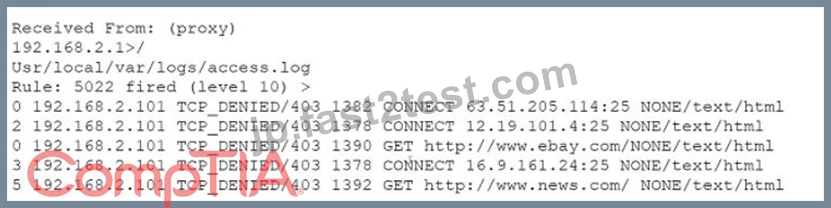
Which of the following is the user attempting to do based on the log entries?
- A. Exfiltrate data.
- B. Use a DoS attack on external hosts.
- C. Scan the network.
- D. Relay email.
正解:C
解説:
Scanning the network is what the user is attempting to do based on the log entries. The log entries show that the user is sending ping requests to various IP addresses on different ports using a proxy server. Ping requests are a common network diagnostic tool that can be used to test network connectivity and latency by sending packets of data and measuring their response time. However, ping requests can also be used by attackers to scan the network and discover active hosts, open ports, or potential vulnerabilities .
質問 # 40
A security analyst needs to automate the incident response process for malware infections. When the following logs are generated, an alert email should automatically be sent within 30 minutes:
Which of the following is the best way for the analyst to automate alert generation?
- A. Deploy a signature-based IDS
- B. Create a custom rule on a SIEM
- C. Implement email protection with SPF
- D. Install a UEBA-capable antivirus
正解:B
解説:
A security information and event management (SIEM) system is a tool that collects and analyzes log data from various sources and provides alerts and reports on security incidents and events. A security analyst can create a custom rule on a SIEM system to automate the incident response process for malware infections. For example, the analyst can create a rule that triggers an alert email when the SIEM system detects logs that match the criteria of malware infection, such as process name, file name, file hash, etc. The alert email can be sent within 30 minutes or any other desired time frame. The other options are not suitable or sufficient for this purpose. Reference: CompTIA Cybersecurity Analyst (CySA+) Certification Exam Objectives (CS0-002), page 15; https://www.sans.org/reading-room/whitepapers/analyst/security-information-event-management-siem-implementation-33969
質問 # 41
The following output is from a tcpdump al the edge of the corporate network:
Which of the following best describes the potential security concern?
- A. This traffic exhibits a reconnaissance technique to create network footprints.
- B. Encapsulated traffic may evade security monitoring and defenses
- C. Payload lengths may be used to overflow buffers enabling code execution.
- D. The content of the traffic payload may permit VLAN hopping.
正解:B
解説:
Encapsulated traffic may evade security monitoring and defenses by hiding or obfuscating the actual content or source of the traffic. Encapsulation is a technique that wraps data packets with additional headers or protocols to enable communication across different network types or layers. Encapsulation can be used for legitimate purposes, such as tunneling, VPNs, or NAT, but it can also be used by attackers to bypass security controls or detection mechanisms that are not able to inspect or analyze the encapsulated traffic .
質問 # 42
The analyst reviews the following endpoint log entry:
Which of the following has occurred?
- A. Privilege escalation
- B. Rename computer
- C. Registry change
- D. New account introduced
正解:D
解説:
Explanation
The endpoint log entry shows that a new account named "admin" has been created on a Windows system with a local group membership of "Administrators". This indicates that a new account has been introduced on the system with administrative privileges. This could be a sign of malicious activity, such as privilege escalation or backdoor creation, by an attacker who has compromised the system.
質問 # 43
The Chief Executive Officer of an organization recently heard that exploitation of new attacks in the industry was happening approximately 45 days after a patch was released. Which of the following would best protect this organization?
- A. A mean time to remediate of 30 days
- B. A mean time to detect of 45 days
- C. Third-party application testing
- D. A mean time to respond of 15 days
正解:A
解説:
A mean time to remediate (MTTR) is a metric that measures how long it takes to fix a vulnerability after it is discovered. A MTTR of 30 days would best protect the organization from the new attacks that are exploited 45 days after a patch is released, as it would ensure that the vulnerabilities are fixed before they are exploited
質問 # 44
A security analyst needs to ensure that systems across the organization are protected based on the sensitivity of the content each system hosts. The analyst is working with the respective system owners to help determine the best methodology that seeks to promote confidentiality, availability, and integrity of the data being hosted. Which of the following should the security analyst perform first to categorize and prioritize the respective systems?
- A. Interview the users who access these systems,
- B. Configure alerts for vendor-specific zero-day exploits.
- C. Determine the asset value of each system.
- D. Scan the systems to see which vulnerabilities currently exist.
正解:C
解説:
Determining the asset value of each system is the best action to perform first, as it helps to categorize and prioritize the systems based on the sensitivity of the data they host. The asset value is a measure of how important a system is to the organization, in terms of its financial, operational, or reputational impact. The asset value can help the security analyst to assign a risk level and a protection level to each system, and to allocate resources accordingly. The other actions are not as effective as determining the asset value, as they do not directly address the goal of promoting confidentiality, availability, and integrity of the data. Interviewing the users who access these systems may provide some insight into how the systems are used and what data they contain, but it may not reflect the actual value or sensitivity of the data from an organizational perspective. Scanning the systems to see which vulnerabilities currently exist may help to identify and remediate some security issues, but it does not help to categorize or prioritize the systems based on their data sensitivity. Configuring alerts for vendor-specific zero-day exploits may help to detect and respond to some emerging threats, but it does not help to protect the systems based on their data sensitivity.
質問 # 45
An organization has activated the CSIRT. A security analyst believes a single virtual server was compromised and immediately isolated from the network. Which of the following should the CSIRT conduct next?
- A. Restore the affected server to remove any malware
- B. Contact the appropriate government agency to investigate
- C. Take a snapshot of the compromised server and verify its integrity
- D. Research the malware strain to perform attribution
正解:C
解説:
The next action that the CSIRT should conduct after isolating the compromised server from the network is to take a snapshot of the compromised server and verify its integrity. Taking a snapshot of the compromised server involves creating an exact copy or image of the server's data and state at a specific point in time.
Verifying its integrity involves ensuring that the snapshot has not been altered, corrupted, or tampered with during or after its creation. Taking a snapshot and verifying its integrity can help preserve and protect any evidence or information related to the incident, as well as prevent any tampering, contamination, or destruction of evidence.
質問 # 46
A cybersecurity team has witnessed numerous vulnerability events recently that have affected operating systems. The team decides to implement host-based IPS, firewalls, and two-factor authentication. Which of the following does this most likely describe?
- A. Hybrid network architecture
- B. Continuous authorization
- C. System hardening
- D. Secure access service edge
正解:C
解説:
Explanation
The correct answer is A. System hardening.
System hardening is the process of securing a system by reducing its attack surface, applying patches and updates, configuring security settings, and implementing security controls. System hardening can help prevent or mitigate vulnerability events that may affect operating systems. Host-based IPS, firewalls, and two-factor authentication are examples of security controls that can be applied to harden a system1.
The other options are not the best descriptions of the scenario. A hybrid network architecture (B) is a network design that combines on-premises and cloud-based resources, which may or may not involve system hardening. Continuous authorization is a security approach that monitors and validates the security posture of a system on an ongoing basis, which is different from system hardening. Secure access service edge (D) is a network architecture that delivers cloud-based security services to remote users and devices, which is also different from system hardening.
質問 # 47
Which of the following ICS network protocols has no inherent security functions on TCP port 502?
- A. SSH
- B. DHCP
- C. CIP
- D. Modbus
正解:D
解説:
Modbus is an industrial control system (ICS) network protocol that is used for communication between devices such as sensors, controllers, actuators, and monitors. Modbus has no inherent security functions on TCP port 502, which is the default port for Modbus TCP/IP communication. Modbus does not provide any encryption, authentication, or integrity protection for the data transmitted over the network, making it vulnerable to various attacks such as replay, modification, spoofing, or denial-of-service.
質問 # 48
An analyst is examining events in multiple systems but is having difficulty correlating data points. Which of the following is most likely the issue with the system?
- A. Access rights
- B. Network segmentation
- C. Time synchronization
- D. Invalid playbook
正解:C
解説:
Time synchronization is the process of ensuring that all systems in a network have the same accurate time, which is essential for correlating data points from different sources. If the system has an issue with time synchronization, the analyst may have difficulty matching events that occurred at the same time or in a specific order. Access rights, network segmentation, and invalid playbook are not directly related to the issue of correlating data points. Verified Reference: [CompTIA CySA+ CS0-002 Certification Study Guide], page 23
質問 # 49
A company is in the process of implementing a vulnerability management program. no-lich of the following scanning methods should be implemented to minimize the risk of OT/ICS devices malfunctioning due to the vulnerability identification process?
- A. Non-credentialed scanning
- B. Agent-based scanning
- C. Credentialed scanning
- D. Passive scanning
正解:D
解説:
Passive scanning is a method of vulnerability identification that does not send any packets or probes to the target devices, but rather observes and analyzes the network traffic passively. Passive scanning can minimize the risk of OT/ICS devices malfunctioning due to the vulnerability identification process, as it does not interfere with the normal operation of the devices or cause any network disruption. Passive scanning can also detect vulnerabilities that active scanning may miss, such as misconfigured devices, rogue devices or unauthorized traffic. Official Reference:
https://partners.comptia.org/docs/default-source/resources/comptia-cysa-cs0-002-exam-objectives
https://www.comptia.org/blog/the-new-comptia-cybersecurity-analyst-your-questions-answered
https://www.comptia.org/certifications/cybersecurity-analyst
質問 # 50
A SOC analyst identifies the following content while examining the output of a debugger command over a client-server application:
getconnection (database01, "alpha " , "AXTV. 127GdCx94GTd") ;
Which of the following is the most likely vulnerability in this system?
- A. Hard-coded credential
- B. Lack of input validation
- C. SQL injection
- D. Buffer overflow attacks
正解:A
解説:
The most likely vulnerability in this system is hard-coded credential. Hard-coded credential is a practice of embedding or storing a username, password, or other sensitive information in the source code or configuration file of a system or application. Hard-coded credential can pose a serious security risk, as it can expose the system or application to unauthorized access, data theft, or compromise if the credential is discovered or leaked by an attacker. Hard-coded credential can also make it difficult to change or update the credential if needed, as it may require modifying the code or file and redeploying the system or application.
質問 # 51
......
CompTIA CS0-003 認定試験の出題範囲:
| トピック | 出題範囲 |
|---|---|
| トピック 1 |
|
| トピック 2 |
|
| トピック 3 |
|
| トピック 4 |
|
| トピック 5 |
|
時間限定!今すぐ無料アクセスCS0-003練習問題:https://drive.google.com/open?id=1mYCLTozfngxpl2klGL6ausS2F83ioGSq
最適なCS0-003試験学習資料と準備材料を提供しています:https://jp.fast2test.com/CS0-003-premium-file.html