

323試験解答は1z0-071最新版 テストエンジン
合格確定1z0-071試験問最新の1z0-071試験問題集PDF2024年更新
Oracle 1z1-071試験は、SQL(Structured Query Language)とOracleデータベースの知識を試験する認定試験であり、データベースの専門家がSQLとデータベース管理の専門知識を認定することを目的としています。Oracle 1z1-071試験は、グローバルに認知され、IT業界の一部のジョブロールに必要な認定であり、人気があります。
Oracle 1z0-071 認定試験の出題範囲:
| トピック | 出題範囲 |
|---|---|
| トピック 1 |
|
| トピック 2 |
|
| トピック 3 |
|
| トピック 4 |
|
| トピック 5 |
|
| トピック 6 |
|
| トピック 7 |
|
| トピック 8 |
|
| トピック 9 |
|
| トピック 10 |
|
| トピック 11 |
|
| トピック 12 |
|
Oracle 1z1-071認定試験の候補者は、SQLとOracleデータベース管理についての堅固な理解が必要です。複雑なSQLクエリを書くことができ、SQLデータ型と関数を理解し、Oracleデータベースのさまざまなコンポーネントについて知識がある必要があります。試験は73問の多肢選択問題からなり、100分以内に回答する必要があります。認定を取得するには、63%以上の合格点が必要で、有効期間は3年間です。全体的に、Oracle 1z1-071認定は、Oracleデータベースの管理における知識と専門知識を証明したいITプロフェッショナルにとって貴重な資格です。
質問 # 63
View the Exhibit and examine the structure of the CUSTOMERS table.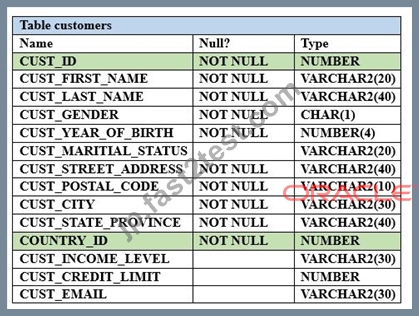
You want to generate a report showing the last names and credit limits of all customers whose last names start with A, B, or C, and credit limit is below 10,000.
Evaluate the following two queries:
SQL> SELECT cust_last_name, cust_credit_limit FROM customers
WHERE (UPPER(cust_last_name) LIKE 'A%' OR
UPPER (cust_last_name) LIKE 'B%' OR UPPER (cust_last_name) LIKE 'C%')
AND cust_credit_limit < 10000;
SQL>SELECT cust_last_name, cust_credit_limit FROM customers
WHERE UPPER (cust_last_name) BETWEEN 'A' AND 'C'
AND cust_credit_limit < 10000;
Which statement is true regarding the execution of the above queries?
- A. Only the first query gives the correct result
- B. Only the second query gives the correct result
- C. Both execute successfully but do not give the required result
- D. Both execute successfully and give the same result
正解:A
質問 # 64
Examine the description of the CUSTOMERS table: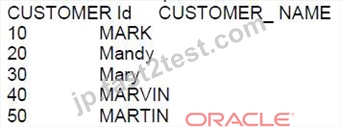
Which two SELECT statements will return these results:
CUSTOMER_ NAME
--------------------
Mandy
Mary
- A. SELECT customer_ name FROM customers WHERE UPPER (customer name) LIKE 'MA&';
- B. SELECT customer_ name FROM customers WHERE customer_ name LIKE ' % a % ' ;
- C. SELECT customer_ name FROM customers WHERE UPPER (customer_ name ) LIKE 'MA*. ;
- D. SELECT customer_ name FROM customers WHERE customer name LIKE 'Ma%' ;
- E. SELECT customer_ name FROM customers WHERE customer_ name='*Ma*';
- F. SELECT customer_ name FROM customers WHERE customer name LIKE 'Ma*';
- G. SELECT customer_ name FROM customers WHERE customer_ name KIKE .*Ma*';
正解:B、D
質問 # 65
Examine the description of the SALES table: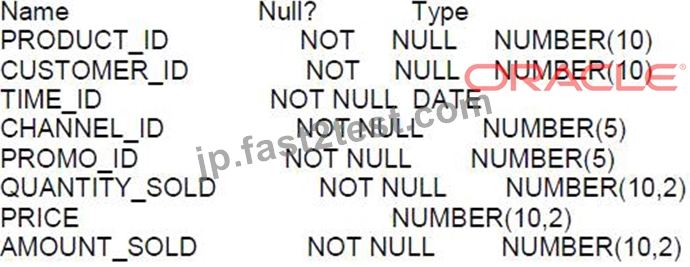
The SALES table has 5,000 rows.
Examine this statement:
CREATE TABLE sales1 (prod id, cust_id, quantity_sold, price)
AS
SELECT product_id, customer_id, quantity_sold, price
FROM sales
WHERE 1=1
Which two statements are true?
- A. SALES1 has PRIMARY KEY and UNIQUE constraints on any selected columns which had those constraints in the SALES table.
- B. SALES1 has NOT NULL constraints on any selected columns which had those constraints in the SALES table.
- C. SALES1 is created with 1 row.
- D. SALES1 Is created with 5,000 rows.
正解:B、D
質問 # 66
Which two are true about granting privileges on objects? (Choose two.)
- A. A table owner must grant the REFERENCESprivilege to allow other users to create FOREIGN KEY constraints using that table.
- B. The WITH GRANT OPTIONclause can be used only by DBA users.
- C. An object privilege can be granted to other users only by the owner of that object.
- D. An object privilege can be granted to a role only by the owner of that object.
- E. The owner of an object acquires all object privileges on that object by default.
正解:A、E
解説:
Explanation/Reference: https://docs.oracle.com/cd/B19306_01/network.102/b14266/authoriz.htm#i1008214
質問 # 67
Which two are true about the WITH GRANT OPTION clause?
- A. It cannot be used to pass on privileges to PUBLIC by the grantee.
- B. The grantee can grant the object privilege to any user in the database, with of without including this option.
- C. It can be used for system and object privileges.
- D. It can be used to pass on privileges to other users by the grantee.
- E. The grantee must have the GRANT ANY OBJECT PRIVILEGE system prvilege to use this option.
- F. It can be used when granting privileges to roles.
正解:A、D
解説:
The WITH GRANT OPTION clause in Oracle SQL allows the grantee to grant the privilege they have received to another user or role.
* E. It cannot be used to pass on privileges to PUBLIC by the grantee: The WITH GRANT OPTION does not allow the grantee to pass on privileges to PUBLIC. Only the object's owner or a user with the GRANT ANY OBJECT PRIVILEGE system privilege can grant privileges to PUBLIC.
* F. It can be used to pass on privileges to other users by the grantee: This is true. When a user receives privileges with the WITH GRANT OPTION, they can grant that privilege to another user or role.
References:
* Oracle Database SQL Language Reference 12c, specifically sections on user privileges and the WITH GRANT OPTION.
質問 # 68
Which two statements are true about the rules of precedence for operators? (Choose two.)
- A. The + binary operator has the highest precedence in an expression in a SQL statement
- B. The concatenation operator | | is always evaluated before addition and subtraction in an expression
- C. NULLS influence the precedence of operators in an expression
- D. Arithmetic operators with equal precedence area evaluated from left to right within an expression
- E. Multiple parentheses can be used to override the default precedence of operators in an expression
正解:A、E
解説:
Explanation/Reference: https://docs.oracle.com/cd/B19306_01/server.102/b14200/operators001.htm
質問 # 69
Examine these two queries and their output:
SELECT deptno, dname FROM dept;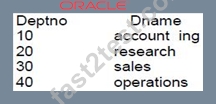
SELECT ename, job, deptno FROM emp ORDER BY deptno;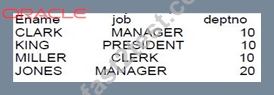
Now examine this query:
SELECT ename, dname
FROM emp CROSS JOIN dept WHERE job = 'MANAGER'
AND dept.deptno IN (10, 20) ;
- A. 0
- B. 1
- C. 2
- D. 3
正解:B
質問 # 70
Examine the description of the ORDERStable: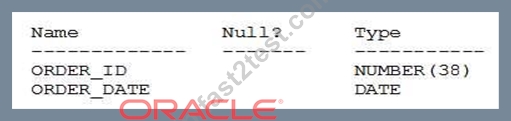
Examine the description of the INVOICEStable: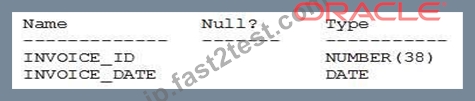
Which three statements execute successfully? (Choose three.)
- A.

- B.

- C.

- D.

- E.

- F.

- G.

正解:E、F、G
質問 # 71
Which three are true about dropping columns from a table?
- A. A primary key column cannot be dropped.
- B. Multiple columns can be dropped simultaneously using the ALTER TABLE command.
- C. A column that is referenced by another column in any other table cannot be dropped.
- D. A column must be set as unused before it is dropped from a table.
- E. A column drop is implicitly committed
- F. A column can be removed only if it contains no data.
正解:B、C、E
質問 # 72
View the exhibit and examine the data in ORDERS_MASTER and MONTHLY_ORDERS tables.
ORDERS_MASTER
ORDER_ID
ORDER_TOTAL
1
1000
2
2000
3
3000
4
MONTHLY_ORDERS
ORDER_ID
ORDER_TOTAL
2
2500
3
Evaluate the following MERGE statement:
MERGE_INTO orders_master o
USING monthly_orders m
ON (o.order_id = m.order_id)
WHEN MATCHED THEN
UPDATE SET o.order_total = m.order_total
DELETE WHERE (m.order_total IS NULL)
WHEN NOT MATCHED THEN
INSERT VALUES (m.order_id, m.order_total)
What would be the outcome of the above statement?
- A. The ORDERS_MASTER table would contain the ORDER_IDs 1, 2 and 3.
- B. The ORDERS_MASTER table would contain the ORDER_IDs 1, 2, 3 and 4.
- C. The ORDERS_MASTER table would contain the ORDER_IDs 1, 2 and 4.
- D. The ORDERS_MASTER table would contain the ORDER_IDs 1 and 2.
正解:C
解説:
References:
https://docs.oracle.com/cd/B28359_01/server.111/b28286/statements_9016.htm
質問 # 73
View the exhibit and examine the structure of the SALES, CUSTOMERS, PRODUCTS and TIMES tables.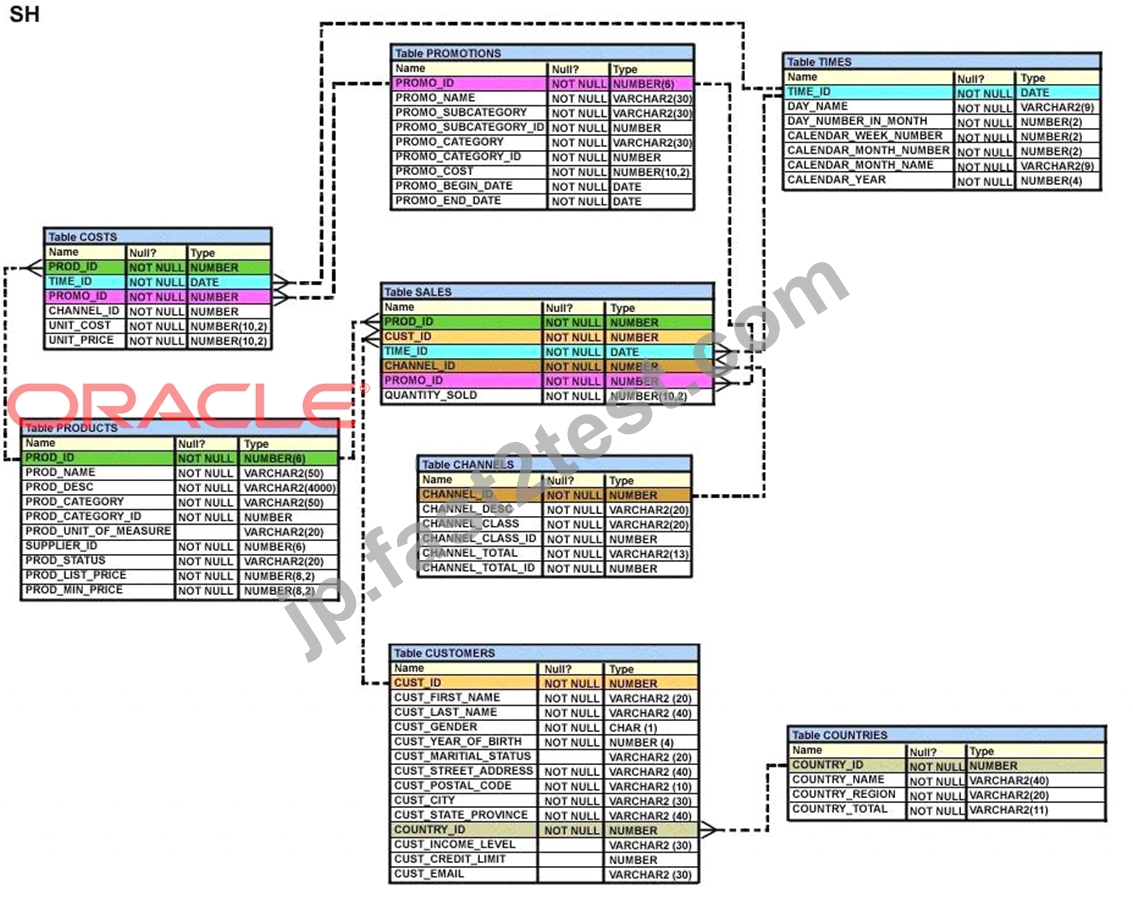
The PROD_ID column is the foreign key in the SALES tables, which references the PRODUCTS table.
Similarly, the CUST_ID and TIME_ID columns are also foreign keys in the SALES table referencing the CUSTOMERS and TIMES tables, respectively.
Evaluate the following CREATE TABLE command:
CREATE TABLE new_sales (prod_id, cust_id, order_date DEFAULT SYSDATE)
AS
SELECT prod_id, cust_id, time_id
FROM sales;
Which statement is true regarding the above command?
- A. The NEW_SALES table would get created and all the FOREIGN KEY constraints defined on the specified columns would be passed to the new table.
- B. The NEW_SALES table would not get created because the column names in the CREATE TABLE command and the SELECT clause do not match.
- C. The NEW_SALES table would get created and all the NOT NULL constraints defined on the specified columns would be passed to the new table.
- D. The NEW_SALES table would not get created because the DEFAULT value cannot be specified in the column definition.
正解:C
質問 # 74
Examine this partial command: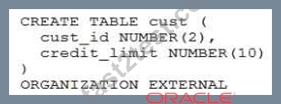
Which two clauses are required for this command to execute successfully? (Choose two.)
- A. the ACCESS PARAMETERSclause
- B. the DEFAULT DIRECTORYclause
- C. the access driver TYPEclause
- D. the REJECT LIMITclause
- E. the LOCATIONclause
正解:C、E
質問 # 75
You must create a SALES table with these column specifications and data types: (Choose the best answer.) SALESID: Number
STOREID: Number
ITEMID: Number
QTY: Number, should be set to 1 when no value is specified
SLSDATE: Date, should be set to current date when no value is specified PAYMENT: Characters up to 30 characters, should be set to CASH when no value is specified Which statement would create the table?
- A. CREATE TABLE Sales
(SALESID NUMBER (4),
STOREID NUMBER (4),
ITEMID NUMBER (4),
QTY NUMBER DEFAULT = 1,
SLSDATE DATE DEFAULT 'SYSDATE',
PAYMENT VARCHAR2(30) DEFAULT CASH); - B. CREATE TABLE Sales
(SALESID NUMBER (4),
STOREID NUMBER (4),
ITEMID NUMBER (4),
QTY NUMBER DEFAULT = 1,
SLSDATE DATE DEFAULT SYSDATE,
PAYMENT VAR
CHAR2(30) DEFAULT = "CASH"); - C. Create Table sales
(salesid NUMBER (4),
Storeid NUMBER (4),
Itemid NUMBER (4),
QTY NUMBER DEFAULT 1,
Slsdate DATE DEFAULT SYSDATE,
payment VARCHAR2(30) DEFAULT 'CASH'); - D. CREATE TABLE Sales
(SALESID NUMBER (4),
STOREID
NUMBER (4),
ITEMID NUMBER (4),
qty NUMBER DEFAULT = 1,
SLSDATE DATE DEFAULT SYSDATE,
PAYMENT VARCHAR2(30) DEFAULT = "CASH");
正解:C
質問 # 76
Which two are true about the USING clause when joining tables?
- A. It can never be used with onatural join.
- B. All column names in a USING clause must be qualified with a table name or table alias.
- C. It can never be used with a full outer join.
- D. It is used to specify an equijoin of columns that have the same name in both tables.
- E. It is used to specify an explicit join condition involving operators.
正解:C、D
解説:
When joining tables in Oracle Database 12c, the USING clause has specific behaviors:
* Option C: It is used to specify an equijoin of columns that have the same name in both tables.
* The USING clause is indeed used to specify an equijoin between two tables based on columns with identical names in the tables being joined. It simplifies the syntax of the JOIN operation by eliminating the need to qualify the joined columns with table names.
* Option D: It can never be used with a full outer join.
* The USING clause cannot be used with a full outer join because the full outer join requires a specification of how to treat each side of the join, including rows that don't match the join condition, which is not compatible with the semantics of the USING clause.
Options A, B, and E are incorrect:
* Option A is incorrect because when using the USING clause, you do not need to qualify the columns with table names or aliases in the select list; Oracle assumes that they are the same in both tables.
* Option B is incorrect because the USING clause can be used with natural joins.
* Option E is incorrect as the USING clause is not meant to specify explicit join conditions with operators; it's specifically for equijoins on columns of the same name.
質問 # 77
Which two statements are true about Oracle databases and SQL?
- A. A query can access only tables within the same schema.
- B. When you execute an UPDATE statement, the database instance locks each updated row.
- C. A user can be the owner of multiple schemas In the same database.
- D. The database guarantees read consistency at select level on user-created tablers.
- E. Updates performed by a database user can be rolled back by another user by using the ROLLBACK command.
正解:B、D
解説:
B). True. Oracle databases guarantee read consistency at the transaction level, meaning that each query can only see data that has been committed before the query began executing.
C). True. When an UPDATE statement is executed, Oracle locks each row as it is updated to prevent other transactions from modifying it until the transaction is committed or rolled back.
A is incorrect because updates made by one user cannot be rolled back by another user. D is incorrect because a query can access tables in other schemas if proper permissions are granted. E is incorrect because a user can own only one schema, which has the same name as the user in an Oracle database.
質問 # 78
View the exhibit and examine the structures of the EMPLOYEESand DEPARTMENTStables.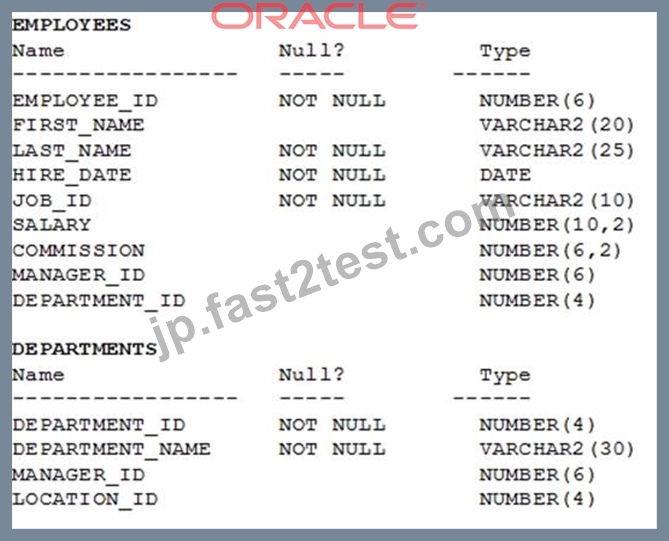
You want to update EMPLOYEEStable as follows:
Update only those employees who work in Boston or Seattle (locations 2900 and 2700).
Set department_idfor these employees to the department_idcorresponding to London
(location_id 2100).
Set the employees' salary in location_id2100 to 1.1 times the average salary of their department.
Set the employees' commission in location_id2100 to 1.5 times the average commission of their
department.
You issue the following command: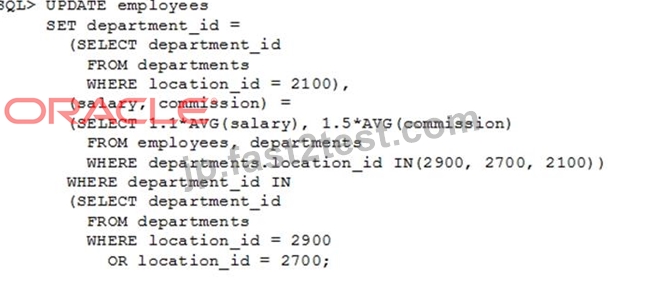
What is outcome?
- A. It generates an error because multiple columns (SALARY, COMMISSION)cannot be specified together in an UPDATEstatement.
- B. It executes successfully and gives the desired update
- C. It executes successfully but does not give the desired update
- D. It generates an error because a subquery cannot have a join condition in a UPDATEstatement.
正解:C
質問 # 79
Which two statements are true regarding the EXISTSoperator used in the correlated subqueries?
(Choose two.)
- A. It is used to test whether the values retrieved by the inner query exist in the result of the outer query.
- B. The outer query continues evaluating the result set of the inner query until all the values in the result set are processed.
- C. The outer query stops evaluating the result set of the inner query when the first value is found.
- D. It is used to test whether the values retrieved by the outer query exist in the result set of the inner query.
正解:C、D
解説:
Explanation/Reference:
References:
http://www.techonthenet.com/oracle/exists.php
質問 # 80
Which three statements are true regarding subqueries? (Choose three.)
- A. Main query and subquery must get data from the same tables.
- B. Only one column or expression can be compared between the main query and subquery.
- C. Main query and subquery can get data from different tables.
- D. Multiple columns or expressions can be compared between the main query and subquery.
- E. Subqueries can contain GROUP BY and ORDER BY clauses.
- F. Subqueries can contain ORDER BY but not the GROUP BY clause.
正解:C、D、E
解説:
http://docs.oracle.com/javadb/10.6.2.1/ref/rrefsqlj13658.html
質問 # 81
Examine this statement which returns the name of each employee and their manager: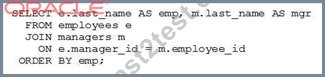
You want to extend the query to include employees with no manager. What must you add before JOINto do this?
- A. CROSS
- B. FULL OUTER
- C. LEFT OUTER
- D. RIGHT OUTER
正解:A
質問 # 82
Examine the description of the PRODUCTS table: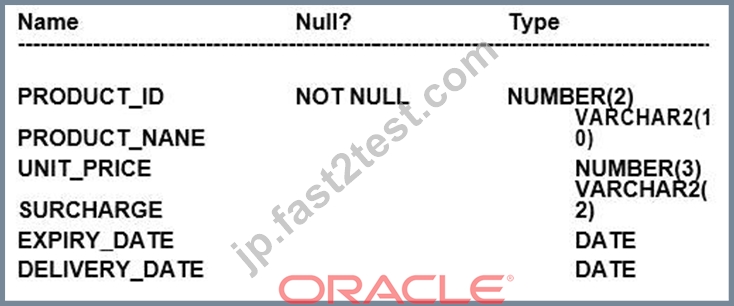
Which three queries use valid expressions?
- A. SELECT ptoduct_id, (expiry_date-delivery_date) * 2 FROM products;
- B. SELECT produet_id, unit_pricer, 5 "Discount",unit_price+surcharge-discount FROM products;
- C. SPLECT product_id, expiry_date * 2 FROM products;
- D. SELEGT product_id, unit_price, unit_price + surcharge FROM products;
- E. SELECT product_id,unit_price || "Discount", unit_price + surcharge-discount FROM products;
- F. SELECT product_id, (unit_price * 0.15 / (4.75 + 552.25)) FROM products;
正解:A、D、F
解説:
B). SELECT product_id, (unit_price * 0.15 / (4.75 + 552.25)) FROM products; C. SELECT product_id, (expiry_date - delivery_date) * 2 FROM products; E. SELECT product_id, unit_price, unit_price + surcharge FROM products; Comprehensive and Detailed Explanation WITH all References:
A). This is invalid because "Discount" is a string literal and cannot be used without quotes in an arithmetic operation. Also, there is a typo in unit_pricer, and 'discount' is not a defined column in the table. B. This is valid. It shows a mathematical calculation with unit_price, which is of NUMBER type. Division and multiplication are valid operations on numbers. C. This is valid. The difference between two DATE values results in the number of days between them, and multiplying this value by a number is a valid operation. D.
This is invalid because expiry_date is of DATE type and cannot be multiplied by a number. Also, there's a typo: "SPLECT" should be "SELECT". E. This is valid. Both unit_price and surcharge are NUMBER types, and adding them together is a valid operation. F. This is invalid because concatenation operator || is used between a number (unit_price) and a string literal "Discount", which is not enclosed in single quotes, and
'discount' is not a defined column in the table.
In SQL, arithmetic operations on numbers and date arithmetic are valid expressions. Concatenation is also a valid expression when used correctly between string values or literals. Operations that involve date types should not include multiplication or division by numbers directly without a proper interval type in Oracle SQL.
These rules are detailed in the Oracle Database SQL Language Reference, where expressions, datatype precedence, and operations are defined.
質問 # 83
View the Exhibit and examine the description of the EMPLOYEEStable.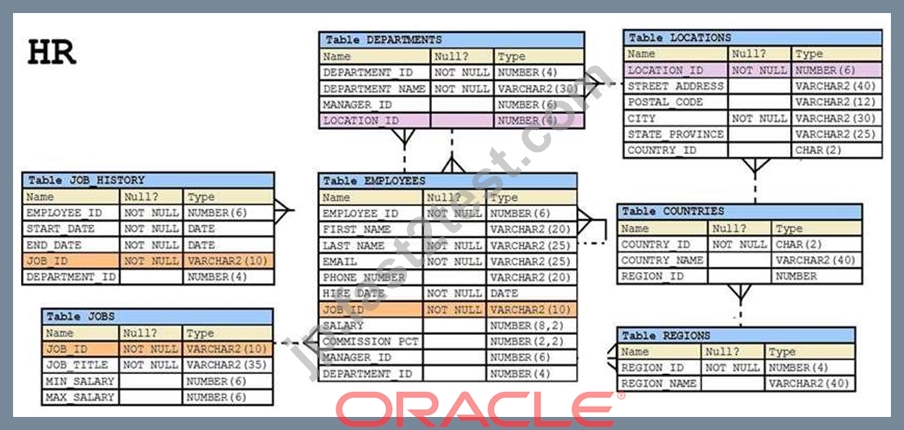
You want to calculate the total remuneration for each employee. Total remuneration is the sum of the annual salary and the percentage commission earned for a year. Only a few employees earn commission.
Which SQL statement would you execute to get the desired output?
SELECT first_name, salary, salary*12+(salary*NVL2 (commission_pct,
- A. FROM EMPLOYEES;
SELECT first_name, salary, salary*12 + NVL(salary,0)*commission_pct, "Total" - B. FROM EMPLOYEES;
SELECT first_name, salary (salary + NVL (commission_pct, 0)*salary)*12 "Total" - C. salary,salary+commission_pct))"Total"
FROM EMPLOYEES;
SELECT first_name, salary, salary*12+salary*commission_pct "Total" - D. FROM EMPLOYEES;
正解:C
質問 # 84
Examine the description of the ENPLOYES table: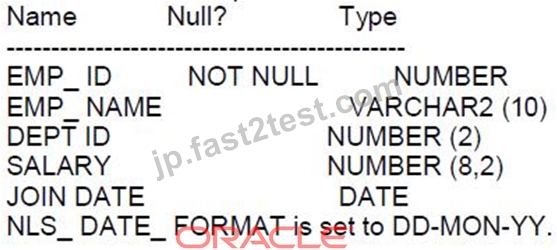
Which query requires explicit data type conversion?
- A. SELECT join_date 11.'11 salary FROM employees;
- B. SELECT join_date FROM employees WHERE join date > '10-02-2018';
- C. SELECT join_date + '20' EROM employees;
- D. SELECT SUBSTR(join date, 1, 2) - 10 FROM employees;
- E. SELECT salary + '120.50' FROM employees;
正解:B
質問 # 85
View the Exhibit and examine the structure of the ORDER_ITEMS and ORDERS tables.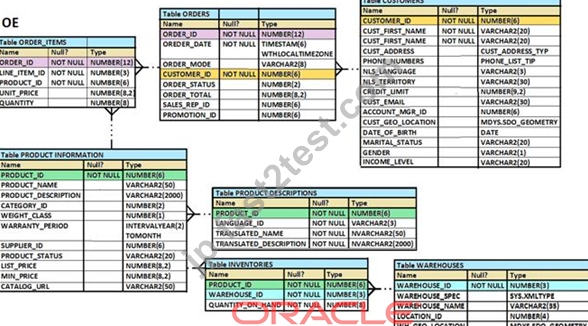
You are asked to retrieve the ORDER_ID, product_ID, and total price (UNIT_PRICE multiplied by QUANTITY), where the total price is greater than 50,000.
You executed the following SQL statement:
SELECT prder_id, product_id, unit_price*quantity "Total Price"
FROM order_items
WHERE unit_price*quantity > 50000
NATURAL JOIN orders;
Which statement is true regarding the execution of the statement?
- A. The statement would not execute because the WHERE clause is before the NATURAL JOIN clause.
- B. The statement would not execute because the USING keyword is missing in the NATURAL JOIN clause.
- C. The statement would not execute because the ON keyword is missing in the NATURAL JOIN clause.
- D. The statement would execute and provide the desired result.
正解:A
質問 # 86
You need to display the date 11-oct-2007 in words as 'Eleventh of October, Two Thousand Seven'.
Which SQL statement would give the required result?
- A. SELECT TO_CHAR (TO_DATE ('11-oct-2007'), 'fmDdspth of month, year')
FROM DUAL - B. SELECT TO_CHAR (TO_DATE ('11-oct-2007'), 'fmDdthsp "of" Month, Year') FROM DUAL
- C. SELECT TO_DATE (TO_CHAR ('11-oct-2007'), 'fmDdspth "of" Month, Year')) FROM DUAL
- D. SELECT TO_CHAR ('11-oct-2007', 'fmDdspth "of" Month, Year')
FROM DUAL
正解:B
質問 # 87
......
1z0-071試験問題集無料サンプル365日更新:https://jp.fast2test.com/1z0-071-premium-file.html
まもなく無料セール終了!- リアル1z0-071のPDF解答を試そう:https://drive.google.com/open?id=1k09O34PMzsnA0H-sRSRAYQeNEYZIYT_8