

[2023年最新] 高合格率な最新無料1z0-071試験問題集アンサーを使おう
1z0-071知能問題集PDF!Oracle 1z0-071試験問セット
質問 76
Which two are true about the data dictionary?
- A. Base tables in the data dictionary have the prefix DBA_.
- B. All user actions are recorded in the data dictionary.
- C. All users have permissions to access all information in the data dictionary by default
- D. The SYS user owns all base tables and user-accessible views in the data dictionary.
- E. The data dictionary is constantly updated to reflect changes to database objects, permissions, and data.
正解: D,E
質問 77
Which three statements are true about performing Data Manipulation Language (DML) operations on a view In an Oracle Database?
- A. Insert statements can always be done on a table through a view.
- B. The WITH CHECK clause has no effect when deleting rows from the underlying table through the view.
- C. Views cannot be used to add or modify rows in an underlying table if the defining query of the view contains the DISTINCT keyword.
- D. Views cannot be used to add on modify rows in an underlying table if the defining query of the view contains aggregating functions.
- E. Views cannot be used to query rows from an underlying table if the table has a PRIPOARY KEY and the PRIMARY KEY columns are not referenced in the defining query of the view.
- F. Views cannot be used to add rows to an underlying table if the table has columns with NOT NULL constraints lacking default values which are not referenced in the defining query of the view.
正解: C,D,F
質問 78
Examine the description of the transactions table:
Which two SQL statements execute successfully?
- A. SELECT customer_id AS "CUSTOMER-ID", transaction_date AS DATE, amount+100 "DUES" from transactions;
- B. SELECT customer_id AS "CUSTOMER-ID", transaction_date AS "DATE", amount+100 DUES FROM transactions;
- C. SELECT customer_id AS 'CUSTOMER-ID',transaction_date AS DATE, amount+100 'DUES' from transactions;
- D. SELECT customer_id CUSTID, transaction_date TRANS_DATE,amount+100 DUES FROM transactions;
- E. SELECT customer id AS CUSTOMER-ID, transaction_date AS TRANS_DATE, amount+100 "DUES AMOUNT" FROM transactions;
正解: B,D
質問 79
View the Exhibit and examine the structure of the CUSTOMERS table.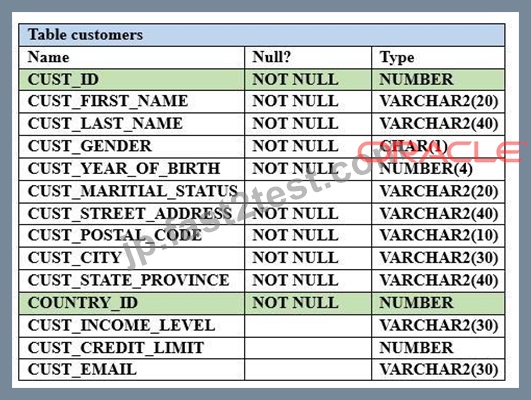
You want to generate a report showing the last names and credit limits of all customers whose last names start with A, B, or C, and credit limit is below 10,000.
Evaluate the following two queries:
SQL> SELECT cust_last_name, cust_credit_limit FROM customers
WHERE (UPPER(cust_last_name) LIKE 'A%' OR
UPPER (cust_last_name) LIKE 'B%' OR UPPER (cust_last_name) LIKE 'C%')
AND cust_credit_limit < 10000;
SQL>SELECT cust_last_name, cust_credit_limit FROM customers
WHERE UPPER (cust_last_name) BETWEEN 'A' AND 'C'
AND cust_credit_limit < 10000;
Which statement is true regarding the execution of the above queries?
- A. Only the second query gives the correct result
- B. Both execute successfully but do not give the required result
- C. Both execute successfully and give the same result
- D. Only the first query gives the correct result
正解: D
質問 80
In which three situations does a transaction complete? (Choose three.)
- A. when a data definition language (DDL) statement is executed
- B. when a ROLLBACK command is executed
- C. when a TRUNCATE statement is executed after the pending transaction
- D. when a DELETE statement is executed
- E. when a PL/SQL anonymous block is executed
正解: A,B,C
解説:
References:
https://docs.oracle.com/cd/B19306_01/server.102/b14220/transact.htm
質問 81
View the Exhibit and examine the structure of the PRODUCT_INFORMATION and INVENTORIES tables.
You have a requirement from the supplies department to give a list containing PRODUCT_ID, SUPPLIER_ID, and QUANTITY_ON_HAND for all the products wherein QUANTITY_ON_HAND is less than five.
Which two SQL statements can accomplish the task? (Choose two.)
- A. SELECT i.product_id, i.quantity_on_hand, pi.supplier_idFROM product_information pi JOIN inventories iON (pi.product_id=i.product_id) AND quantity_on_hand < 5;
- B. SELECT product_id, quantity_on_hand, supplier_idFROM
product_informationNATURAL JOIN inventories AND quantity_on_hand < 5; - C. SELECT i.product_id, i.quantity_on_hand, pi.supplier_idFROM product_information pi JOIN inventories iON (pi.product_id=i.product_id)WHERE quantity_on_hand < 5;
- D. SELECT i.product_id, i.quantity_on_hand, pi.supplier_idFROM product_information pi JOIN inventories iON (pi.product_id=i.product_id)USING (product_id) AND quantity_on_hand < 5;
正解: A,C
質問 82
You must create a SALES table with these column specifications and data types:
SALESID: Number
STOREID: Number
ITEMID: Number
QTY: Number, should be set to 1 when no value is specified
SLSDATE: Date, should be set to current date when no value is specified PAYMENT: Characters up to 30 characters, should be set to CASH when no value is specified Which statement would create the table? (Choose the best answer.)
- A. CREATE TABLE sales(salesid NUMBER(4),storeid NUMBER(4),itemid NUMBER(4),qty NUMBER DEFAULT = 1,slsdate DATE DEFAULT SYSDATE,payment VARCHAR2(30) DEFAULT =
"CASH"); - B. CREATE TABLE sales(salesid NUMBER(4),storeid NUMBER(4),itemid NUMBER(4),qty NUMBER DEFAULT 1,slsdate DATE DEFAULT SYSDATE,payment VARCHAR2(30) DEFAULT 'CASH');
- C. CREATE TABLE sales(salesid NUMBER(4),storeid NUMBER(4),itemid NUMBER(4),qty NUMBER DEFAULT = 1,slsdate DATE DEFAULT SYSDATE,payment VARCHAR2(30) DEFAULT =
"CASH"); - D. CREATE TABLE sales(salesid NUMBER(4),storeid NUMBER(4),itemid NUMBER(4),qty NUMBER DEFAULT 1,slsdate DATE DEFAULT 'SYSDATE',payment VARCHAR2(30) DEFAULT CASH);
正解: B
質問 83
Which statements are correct regarding indexes? (Choose all that apply.)
- A. When a table is dropped, the corresponding indexes are automatically dropped.
- B. For each DML operation performed, the corresponding indexes are automatically updated.
- C. A non-deferrable PRIMARY KEYor UNIQUE KEYconstraint in a table automatically creates a unique index.
- D. Indexes should be created on columns that are frequently referenced as part of any expression.
正解: A,B,C
解説:
Explanation/Reference:
References:
http://viralpatel.net/blogs/understanding-primary-keypk-constraint-in-oracle/
質問 84
View the exhibits and examine the structures of the COSTS and PROMOTIONS tables.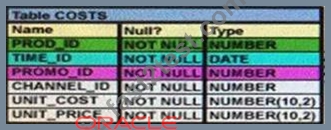
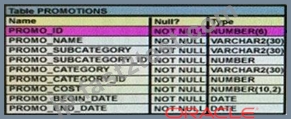
Evaluate the following SQL statement:
SQL> SELECT prod_id FROM costs
WHERE promo_id IN (SELECT promo_id FROM promotions
WHERE promo_cost < ALL
(SELECT MAX(promo_cost) FROM promotions
GROUP BY (promo_end_date-
promo_begin_date)));
What would be the outcome of the above SQL statement?
- A. It displays prod IDs in the promos with the highest cost in the same time interval.
- B. It displays prod IDs in the promo with the lowest cost.
- C. It displays prod IDs in the promos with the lowest cost in the same time interval.
- D. It displays prod IDs in the promos which cost less than the highest cost in the same time interval.
正解: D
質問 85
Which four statements are true about constraints on Oracle tables?
- A. A UNIQUE constraint permits NULLS.
- B. A NOT NULL Constraint can be defined at the table level.
- C. A UNIQUE Constraint can use a pre-existing index on the constrained column or columns.
- D. A CHECK Constraint can refer to values in other rows.
- E. A FOREIGN KEY Column can contain NULLS.
- F. A PRIMARY KEY Constraint can be added after a table has been created and populated.
- G. A Column can have only one CHECK Constraint.
正解: A,C,E,F
質問 86
Examine the description of the PRODUCT_DETAILS table:
Which two statements are true?
- A. EXPIRY_DATE contains the SYSDATE by default if no date is assigned to it.
- B. EXPIRY_DATE cannot be used in arithmetic expressions.
- C. PRODUCT_NAME cannot contain duplicate values.
- D. PRODUCT_PRICE contains the value zero by default if no value is assigned to it.
- E. PRODUCT_ID can be assigned the PRIMARY KEY constraint.
- F. PRODUCT_PRICE can be used in an arithmetic expression even if it has no value stored in it.
正解: B,C
質問 87
Which two queries will result in an error?
- A. SELECT LAST_NAME,12 * SALARY AS ANNUAL_SALARY
FROM EMPLOYEES
WHERE 12 * SALARY > 100000
ORDER BY 12 * SALARY; - B. SELECT FIRST_NAME LAST_NAME FROM EMPLOYEES;
- C. SELECT LAST_NAME,12 * SALARY AS ANNUAL_SALARY
FROM EMPLOYEES
WHERE ANNUAL_SALARY > 100000
ORDER BY 12 * SALARY ; - D. SELECT FIRST_NAME,LAST_NAME FROM EMPLOYEES;
- E. SELECT LAST_NAME,12 * SALARY AS ANNUAL_SALARY
FROM EMPLOYEES
WHERE ANNUAL_SALARY > 100000
ORDER BY ANNUAL_SALARY; - F. SELECT LAST_NAME,12 * SALARY AS ANNUAL_SALARY
FROM EMPLOYEES
WHERE 12 * SALARY > 100000
ORDER BY ANNUAL_SALARY;
正解: C,E
質問 88
View the Exhibits and examine PRODUCTSand SALES tables.
Exhibit 1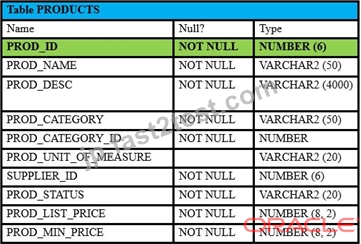
Exhibit 2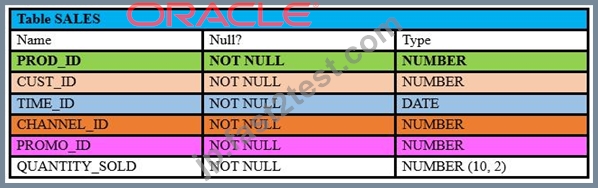
You issue the following query to display product name the number of times the product has been sold:
What happens when the above statement is executed?
- A. The statement executes successfully and produces the required output.
- B. The statement produces an error because the GROUP BYclause cannot be used in a subquery in the FROMclause.
- C. The statement produces an error because ITEM_CNTcannot be displayed in the outer query.
- D. The statement produces an error because a subquery in the FROMclause and outer-joins cannot be used together.
正解: A
質問 89
Examine the structure of the MEMBERStable:
Name Null? Type
------------------ --------------- ------------------------------
MEMBER_ID NOT NULL VARCHAR2 (6)
FIRST_NAME VARCHAR2 (50)
LAST_NAME NOT NULL VARCHAR2 (50)
ADDRESS VARCHAR2 (50)
You execute the SQL statement:
SQL > SELECT member_id, ' ' , first_name, ' ' , last_name "ID FIRSTNAME LASTNAME
" FROM members;
What is the outcome?
- A. It fails because the alias name specified after the column names is invalid.
- B. It executes successfully and displays the column details in a single column with only the alias column heading.
- C. It executes successfully and displays the column details in three separate columns and replaces only the last column heading with the alias.
- D. It fails because the space specified in single quotation marks after the first two column names is invalid.
正解: C
質問 90
Examine the commands used to create DEPARTMENT_DETAILS and
COURSE_DETAILS:
You want to generate a report that shows all course IDs irrespective of whether they have corresponding department IDs or not but no department IDs if they do not have any courses.
Which SQL statement must you use?
- A. SELECT course_id, department_id, FROM department_details d RIGHT OUTER JOIN course_details c USING (department_id)
- B. SELECT c.course_id, d.department_id FROM course_details c RIGHT OUTER JOIN
.department_details d ON (c.depatrment_id=d.department_id) - C. SELECT c.course_id, d.department_id FROM course_details c FULL OUTER JOIN department_details d ON (c.department_id<>d. department_id)
- D. SELECT c.course_id, d.department_id FROM course_details c FULL OUTER JOIN department_details d ON (c.department_id=d. department_id)
正解: D
質問 91
Which two are true about multiple table INSERT statements?
- A. The conditional INSERT FIRST statement always inserts a row into a single table.
- B. They can transform a row from a source table into multiple rows in a target table.
- C. The conditional INSERT ALL statement inserts rows into a single table by aggregating source rows.
- D. They always use subqueries.
- E. The unconditional INSERT ALL statement must have the same number of columns in both the source and target tables.
正解: B,D
質問 92
View the exhibit and examine the structure of the PROMOTIONStable.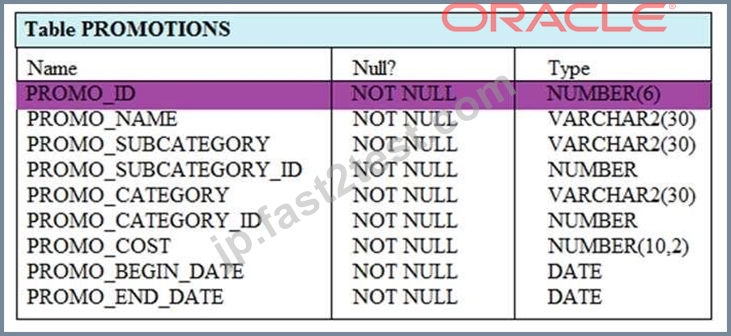
You have to generate a report that displays the promo name and start date for all promos that started after the last promo in the 'INTERNET' category.
Which query would give you the required output?
SELECT promo_name, promo_begin_date FROM promotions
- A. WHERE promo_begin_date> ANY (SELECT promo_begin_date
FROM promotions
WHERE promo_category= 'INTERNET'); - B. WHERE promo_begin_date> ALL (SELECT MAX (promo_begin_date)
FROM promotions) AND
promo_category= 'INTERNET'; - C. WHERE promo_begin_date > ALL (SELECT promo_begin_date
FROM promotions
WHERE promo_category = 'INTERNET');
SELECT promo_name, promo_begin_date FROM promotions - D. SELESELECT promo_name, promo_begin_date FROM promotions
WHERE promo_begin_date IN (SELECT promo_begin_date
FROM promotions
WHERE promo_category= 'INTERNET');
SELECT promo_name, promo_begin_date FROM promotions
正解: C
質問 93
Which statement is true about transactions?
- A. A set of DDL statements executed in a sequence ending with a COMMIT forms a single transaction.
- B. A combination of DDL and DML statements executed in a sequence ending with a COMMIT forms a single transaction.
- C. Each Data Definition Language (DDL) statement executed forms a single transaction.
- D. A set of Data Manipulation Language (DML) statements executed in a sequence ending with a SAVEPOINT forms a single transaction.
正解: C
解説:
Explanation
https://docs.oracle.com/database/121/CNCPT/transact.htm#CNCPT038
質問 94
Examine the structure of the BOOKS_TRANSACTIONS table:
You want to display the member IDs, due date, and late fee as $2 for all transactions.
Which SQL statement must you execute?
- A. SELECT member_id AS MEMBER_ID, due_date AS DUE_DATE, $2 AS LATE_FEE
FROM BOOKS_TRANSACTIONS; - B. SELECT member_id AS "MEMBER ID", due_date AS "DUE DATE", $2 AS "LATE FEE" FROM BOOKS_TRANSACTIONS;
- C. SELECT member_id 'MEMBER ID', due_date 'DUE DATE', '$2 AS LATE FEE' FROM BOOKS_TRANSACTIONS;
- D. SELECT member_id AS "MEMBER ID", due_date AS "DUE DATE", '$2' AS "LATE FEE" FROM BOOKS_TRANSACTIONS;
正解: D
質問 95
......
Oracle 1z0-071問題集PDFを使ってベストオプションを目指そう:https://jp.fast2test.com/1z0-071-premium-file.html
2023年最新の1z0-071サンプル問題は頼もしい1z0-071テストエンジン:https://drive.google.com/open?id=1vj0dmeoDZkQbCx8mZowFqkak7SM-T155