

[2026年最新] 完璧1z0-071問題集問題と解答で一年無料最速更新
更新されたのは2026年リアルな無敵1z0-071問題集で100% 無料1z0-071試験問題集
Oracle 1z0-071認定試験は、データベース管理者、開発者、またはデータアナリストとして働きたい個人に最適です。この試験は、SQLの基礎、データモデリング、データベース設計、およびデータベースセキュリティなど、さまざまなトピックをカバーしています。SQLコンセプトに関する堅固な理解力が必要な難しい試験であり、候補者はSQLプログラミングにおける実践的なスキルを証明することが求められます。試験に合格することで、個人は就職市場で競争優位性を獲得することができ、また、より高い給与やキャリアアップの機会を得ることができます。
質問 # 187
View the Exhibit and examine the data in the PRODUCT_INFORMATION table.
Which two tasks would require subqueries? (Choose two.)
- A. displaying the total number of products supplied by supplier 102071 and having product status OBSOLETE
- B. displaying all the products whose minimum list prices are more than average list price of products having the status orderable
- C. displaying the number of products whose list prices are more than the average list price
- D. displaying all supplier IDs whose average list price is more than 500
- E. displaying the minimum list price for each product status
正解:B、C
質問 # 188
Which three statements execute successfully?
A)
B)
C)
D)
E)
F)
G)
- A. Option B
- B. Option F
- C. Option C
- D. Option G
- E. Option D
- F. Option E
- G. Option A
正解:C、D、G
質問 # 189
View the Exhibit and examine the details of the PRODUCT_INFORMATION table.
Evaluate this SQL statement:
SELECT TO_CHAR (list_price, '$9,999')
From product_information;
Which two statements are true regarding the output? (Choose two.)
- A. A row whose LIST_PRICE column contains value 11235.90 would be displayed as $1,123.
- B. A row whose LIST_PRICE column contains value 11235.90 would be displayed as #######.
- C. A row whose LIST_PRICE column contains value 1123.90 would be displayed as $1,124.
- D. A row whose LIST_PRICE column contains value 1123.90 would be displayed as $1,123.
正解:B、C
質問 # 190
You need to display the date 11-oct-2007 in words as 'Eleventh of October, Two Thousand Seven'.
Which SQL statement would give the required result?
- A. SELECT TO_CHAR (TO_DATE ('11-oct-2007'), 'fmDdspth of month, year')
FROM DUAL - B. SELECT TO_CHAR ('11-oct-2007', 'fmDdspth "of" Month, Year')
FROM DUAL - C. SELECT TO_CHAR (TO_DATE ('11-oct-2007'), 'fmDdthsp "of" Month, Year') FROM DUAL
- D. SELECT TO_DATE (TO_CHAR ('11-oct-2007'), 'fmDdspth "of" Month, Year')) FROM DUAL
正解:C
質問 # 191
View the Exhibit and examine the data in the PRODUCTS table.
You must display product names from the PRODUCTS table that belong to the 'Software/other' category with minimum prices as either $2000 or $4000 and with no unit of measure.
You issue this query: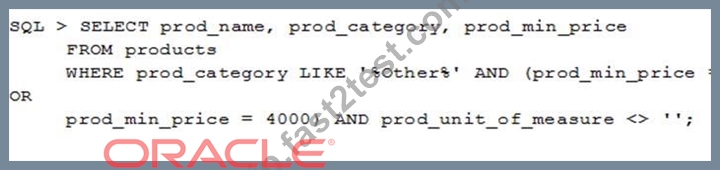
Which statement is true?
- A. It generates an error because the condition specified for the PROD_CATEGORY column is not valid.
- B. It executes successfully and returns the required result.
- C. It generates an error because the condition specified for PROD_UNIT_OF_MEASURE is not valid.
- D. It executes successfully but returns no result.
正解:D
質問 # 192
Which three statements are correct regarding indexes? (Choose three.)
- A. For each DML operation performed, the corresponding indexes are automatically updated.
- B. Indexes should be created on columns that are frequently referenced as part of any expression.
- C. A non-deferrable PRIMARY KEYor UNIQUE KEYconstraint in a table automatically attempts to creates a unique index.
- D. When a table is dropped, the corresponding indexes are automatically dropped.
正解:A、C、D
解説:
Explanation/Reference:
References:
http://viralpatel.net/blogs/understanding-primary-keypk-constraint-in-oracle/
質問 # 193
View the Exhibit and examine the description of the PRODUCT_INFORMATION table. Which SQL statement would retrieve from the table the number of products having
LIST_PRICE as NULL?
- A. SELECT COUNT(list_price)
FROM product_information
WHERE list_price = NULL; - B. SELECT COUNT(NVL(list_price, 0))
FROM product_information
WHERE list_price IS NULL; - C. SELECT COUNT(DISTINCT list_price)
FROM product_information
WHERE list_price IS NULL; - D. SELECT COUNT(list_price)
FROM product_information
WHERE list_price IS NULL;
正解:B
質問 # 194
Which three are true about scalar subquery expressions?
- A. They cannot be used in group by clauses.
- B. They can be nested.
- C. A scalar subquery expression that returns zero rows evaluates to zoro
- D. They can be used as default values for columns in a create table statement.
- E. A scalar subquery expression that returns zero rows evaluates to null.
- F. They cannot be used in the values clause of an insert statement*
正解:B、D、E
解説:
Scalar subquery expressions are used in Oracle SQL to return a single value from a subquery.
* Option C: They can be nested.
* Scalar subqueries can indeed be nested within another scalar subquery, provided each subquery returns a single value.
* Option D: A scalar subquery expression that returns zero rows evaluates to null.
* According to Oracle documentation, if a scalar subquery returns no rows, the result is a NULL value, not zero or any other default.
* Option F: They can be used as default values for columns in a create table statement.
* Scalar subqueries can be specified in the DEFAULT clause of a column in a CREATE TABLE statement to dynamically assign default values based on the result of the subquery.
Options A, B, and E are incorrect based on Oracle SQL standards and functionalities.
質問 # 195
The CUSTOMERS table has a CUST_LAST_NAME column of data type VARCHAR2.
The table has two rows whose COST_LAST_MANE values are Anderson and Ausson.
Which query produces output for CUST_LAST_SAME containing Oder for the first row and Aus for the second?
- A. SELECT REPLACE (TRIM(TRALING'son' FROM cust_last_name),'An','O') FROM customers;
- B. SELECT REPLACE (SUBSTR(cust_last_name,-3),'An','O') FROM customers;
- C. SELECT REPLACE (REPLACE(cust_last_name,'son',''),'An','O') FROM customers;
- D. SELECT INITCAP (REPLACE(TRIM('son' FROM cust_last_name),'An','O')) FROM customers;
正解:C
質問 # 196
Examine these statements executed in a single Oracle session:
CREATE TABLE product (pcode NUMBER(2),pname VARCHAR2(20));
INSERT INTO product VALUES(1,'pen');
INSERT INTO product VALUES (2,'pencil');
INSERT INTO product VALUES(3,'fountain pen');
SAVEPOINT a;
UPDATE product SET pcode=10 WHERE pcode =1;
COMMIT;
DELETE FROM product WHERE pcode =2;
SAVEPOINT b;
UPDATE product SET pcode=30 WHERE pcode =3;
SAVEPOINT c;
DELETE FROM product WHERE pcode =10;
ROLLBACK TO SAVEPOINT b;
COMMIT;
Which three statements are true?
- A. There is no row containing fountain pen.
- B. The code for pen is 10.
- C. The code for pen is 1.
- D. There is no row containing pen
- E. There is no row containing pencil.
- F. The code for fountain pen is 3
正解:B、E、F
質問 # 197
View the Exhibit and examine the structure of the SALES and PRODUCTS tables. (Choose two.)
In the SALES table, PROD_ID is the foreign key referencing PROD_ID in the PRODUCTS table. You must list each product ID and the number of times it has been sold.
Examine this query which is missing a JOIN operator:
Which two JOIN operations can be used to obtain the required output? (Choose two.)
- A. LEFT OUTER JOIN
- B. JOIN
- C. FULL OUTER JOIN
- D. RIGHT OUTER JOIN
正解:A、C
質問 # 198
Examine the data in the COLORS table:
Examine the data in the BRICKS table:
Which two queries return all the rows from COLORS?
- A.

- B.

- C.

- D.

- E.

正解:A、C
解説:
In SQL, to return all rows from one table in a join regardless of whether they match rows in the other table, a LEFT JOIN is used when we want all rows from the left table, or a RIGHT JOIN when we want all rows from the right table. Here's an explanation for each query provided in the context of the COLORS and BRICKS tables:
A : This query uses a LEFT JOIN and will return all the rows from the COLORS table (c) because it is on the left side of the join. Additionally, it joins the BRICKS table (b) on the condition that the color_rgb_hex_value matches. The condition in the WHERE clause (b.brick_id > 0) will not exclude any COLORS rows because it only filters the rows from the right table (BRICKS) after the join.
B : This query uses a RIGHT JOIN, and while it does return all rows from the COLORS table, it doesn't place it on the left side of the join, which is not what is typically expected from a RIGHT JOIN to return all rows from the right side table.
C : This query is a plain JOIN (also known as an inner join), which only returns rows that have matching values in both tables, so it will not return all the rows from the COLORS table if there is no match in the BRICKS table.
D :This query uses a FULL JOIN, which returns all rows when there is a match in one of the tables. Hence, it will return all the rows from both the COLORS and BRICKS tables. While this does return all rows from the COLORS table, it also includes all rows from the BRICKS table, which may not be desired if the requirement was only to return all rows from COLORS.
E : This query is similar to option A and uses the USING clause to specify the join condition. The USING clause is used when both tables have a column with the same name and is meant to simplify the syntax. However, in this case, the columns do not have the same name in both tables (RGB_HEX_VALUE in COLORS and COLOR_RGB_HEX_VALUE in BRICKS), so this query will not execute successfully.
Reference:
Oracle Database SQL Language Reference, 12c Release 1 (12.1): "Joins"
Oracle Database SQL Language Reference, 12c Release 1 (12.1): "LEFT OUTER JOIN" Oracle Database SQL Language Reference, 12c Release 1 (12.1): "RIGHT OUTER JOIN" Oracle Database SQL Language Reference, 12c Release 1 (12.1): "FULL OUTER JOIN" Based on the explanations above, the correct answers that return all rows from the COLORS table are A and D. However, D includes all rows from BRICKS as well, which may not be the intended requirement if the question specifies only rows from COLORS should be returned. Thus, A is the most accurate answer to the question as it adheres to the standard expectation of a LEFT JOIN.
質問 # 199
Which three statements are true about defining relations between tables in a relational database?
- A. Every foreign key value must refer to a matching primary or unique key value.
- B. Foreign key columns allow null values.
- C. Unique key columns allow null values.
- D. Every primary or unique key value must refer to a matching foreign key value.
- E. Primary key columns allow null values.
正解:A、E
質問 # 200
Examine this statement:
Which two things must be changed for it to execute successfully?
- A. The word CONSTRAINT in the foreign key constraint on DEPT_ID must be changed to FOREIGN KEY.
- B. The primary key constraint on BMP_ID must have a name.
- C. The NOT NULL constraint on ENAME must be defined at the column level instead of the table level.
- D. The foreign key constraint on DEPT_ID must be defined at the table level instead of the column level.
- E. One of the LONG columns must be changed to a VARCHAR2 or CLOB.
正解:C、E
解説:
The statement is trying to create a table with columns of different data types and constraints. Here's what needs to be corrected:
C: In Oracle, the LONG data type is used for character data of variable length up to 2 Gigabytes, but it is deprecated, and you should use CLOB or VARCHAR2 instead. Furthermore, a table cannot have more than one LONG column.
D: The NOT NULL constraint should be specified at the column level, not at the table level. The correct syntax for creating a table with a NOT NULL constraint is to define it inline with the column definition, like this:
ename VARCHAR2(15) CONSTRAINT ename_nn NOT NULL,
The other options are incorrect:
A: The foreign key constraint syntax is correct; the word CONSTRAINT is followed by the constraint name and then the REFERENCES clause.
B: The foreign key constraint can be defined at the column level.
E: While it's a good practice to name constraints, it is not mandatory for the primary key constraint to have a name; Oracle will generate one if it's not provided.
Reference:
Oracle Documentation on CREATE TABLE: SQL Language Reference - CREATE TABLE Oracle Documentation on Data Types: SQL Language Reference - Data Types
質問 # 201
Evaluate this ALTER TABLE statement: (Choose the best answer.)
ALTER TABLE orders
SET UNUSED (order_date);
Which statement is true?
- A. ROLLBACK can be used to restore the ORDER_DATE column.
- B. The DESCRIBE command would still display the ORDER_DATE column.
- C. After executing the ALTER TABLE command, a new column called ORDER_DATE can be added to the ORDERS table.
- D. The ORDER_DATE column must be empty for the ALTER TABLE command to execute successfully.
正解:C
質問 # 202
View the Exhibit and examine the structure in the DEPARTMENTS tables. (Choose two.)
Examine this SQL statement:
SELECT department_id "DEPT_ID", department_name, 'b' FROM
departments
WHERE departments_id=90
UNION
SELECT department_id, department_name DEPT_NAME, 'a' FROM
departments
WHERE department_id=10
Which two ORDER BY clauses can be used to sort output?
- A. ORDER BY 3;
- B. ORDER BY 'b';
- C. ORDER BY DEPT_ID;
- D. ORDER BY DEPT_NAME;
正解:A、C
質問 # 203
You issued the following command:
SQL> DROP TABLE employees;
Which three statements are true?
- A. All indexes and constraints defined on the table being dropped are also dropped.
- B. The employees table is moved to the recycle bin
- C. The space used by the employees table is reclaimed immediately.
- D. All uncommitted transactions are committed.
- E. The employees table can be recovered using the rollback command.
- F. Sequences used in the employees table become invalid.
正解:A、B、D
質問 # 204
View the Exhibit and examine the structure of the ORDER_ITEMS table.
You must select the ORDER_ID of the order that has the highest total value among all the orders in the ORDER_ITEMS table.
Which query would produce the desired result?
SELECT order_id
- A. FROM order_items
WHERE(unit_price*quantity) = (SELECT MAX(unit_price*quantity)
FROM order_items)
GROUP BY order_id;
SELECT order_id - B. FROM order_items
WHERE(unit_price*quantity) = MAX(unit_price*quantity)
GROUP BY order_id;
SELECT order_id - C. FROM order_items
WHERE (unit_price*quantity) = (SELECT MAX(unit_price*quantity)
FROM order_items
GROUP BY order_id) - D. FROM order_items
GROUP BY order_id
HAVING SUM(unit_price*quantity) = (SELECT MAX(SUM(unit_price*quantity)) FROM order_items GROUP BY order_id); SELECT order_id
正解:D
質問 # 205
View the Exhibit and examine the details of PRODUCT_INFORMATION table.
PRODUCT_NAME
CATEGORY_ID
SUPPLIER_ID
Inkjet C/8/HQ
12
102094
Inkjet C/4
12
102090
LaserPro 600/6/BW
12
102087
LaserPro 1200/8/BW
12
102099
Inkjet B/6
12
102096
Industrial 700/ID
12
102086
Industrial 600/DQ
12
102088
Compact 400/LQ
12
102087
Compact 400/DQ
12
102088
HD 12GB /R
13
102090
HD 10GB /I
13
102071
HD 12GB @7200 /SE
13
102057
HD 18.2GB @10000 /E
13
102078
HD 18.2GB @10000 /I
13
102050
HD 18GB /SE
13
102083
HD 6GB /I
13
102072
HD 8.2GB@5400
13
102093
You have the requirement to display PRODUCT_NAME from the table where the CATEGORY_ID column has values 12 or 13, and the SUPPLIER_ID column has the value
102088. You executed the following SQL statement:
SELECT product_name
FROM product_information
WHERE (category_id = 12 AND category_id = 13) AND supplier_id = 102088; Which statement is true regarding the execution of the query?
- A. It would not execute because the entire WHERE clause condition is not enclosed within the parentheses.
- B. It would not execute because the same column has been used in both sides of the AND logical operator to form the condition.
- C. It would execute but the output would return no rows.
- D. It would execute and the output would display the desired result.
正解:C
質問 # 206
......
1z0-071問題集PDFとテストエンジン試験問題:https://jp.fast2test.com/1z0-071-premium-file.html
Get2026年最新の無料更新されたOracle 1z0-071試験問題と解答:https://drive.google.com/open?id=1vj0dmeoDZkQbCx8mZowFqkak7SM-T155