

[2025年更新]最新DP-420試験問題集で最新Microsoft試験合格させます
高合格率DP-420問題集解答でDP-420テストエンジンと正解回答
試験DP-420は、COSMOS DBソリューションの設計と実装の経験がある専門家を対象としています。この試験は、Microsoft Azure Cosmos DBを活用することにより、クラウドネイティブアプリケーション開発における知識とスキルを向上させようとしている人を対象としています。この試験では、データモデリング、パーティション化、インデックス作成、クエリ、パフォーマンスチューニングなど、COSMOS DBに関連するさまざまなトピックをカバーしています。
質問 # 22
You have a container m an Azure Cosmos DB for NoSQL account.
Data update volumes are unpredictable.
You need to process the change teed of the container by using a web app that has multiple instances. The change feed will be processed by using the change feed processor from the Azure Cosmos DB SDK. The multiple instances must share the workload.
Which three actions should you perform? Each correct answer presents part of the solution.
NOTE: Each correct selection is worth one point.
- A. Configure the same instance name for all the instances. 13
- B. Configure a different processor name for each instance.
- C. Configure a different instance name for each instance.
- D. Configure the same processor name for all the instances.
- E. Configure the same lease container configuration for all the instances.
- F. Configure a different lease container configuration for each instance.
正解:C、D、E
質問 # 23
You need to identify which connectivity mode to use when implementing App2. The solution must support the planned changes and meet the business requirements.
Which connectivity mode should you identify?
- A. Gateway mode (using HTTPS)
- B. Direct mode over TCP
- C. Direct mode over HTTPS
正解:B
解説:
Scenario: Develop an app named App2 that will run from the retail stores and query the data in account2. App2 must be limited to a single DNS endpoint when accessing account2.
By using Azure Private Link, you can connect to an Azure Cosmos account via a private endpoint. The private endpoint is a set of private IP addresses in a subnet within your virtual network.
When you're using Private Link with an Azure Cosmos account through a direct mode connection, you can use only the TCP protocol. The HTTP protocol is not currently supported.
Reference:
https://docs.microsoft.com/en-us/azure/cosmos-db/how-to-configure-private-endpoints
質問 # 24
You have an Azure Cosmos DB container named container1.
You need to insert an item into contained. The solution must ensure that the item is deleted automatically after two hours.
How should you complete the item definition? To answer, select the appropriate options in the answer area.
NOTE: Each correct selection is worth one point.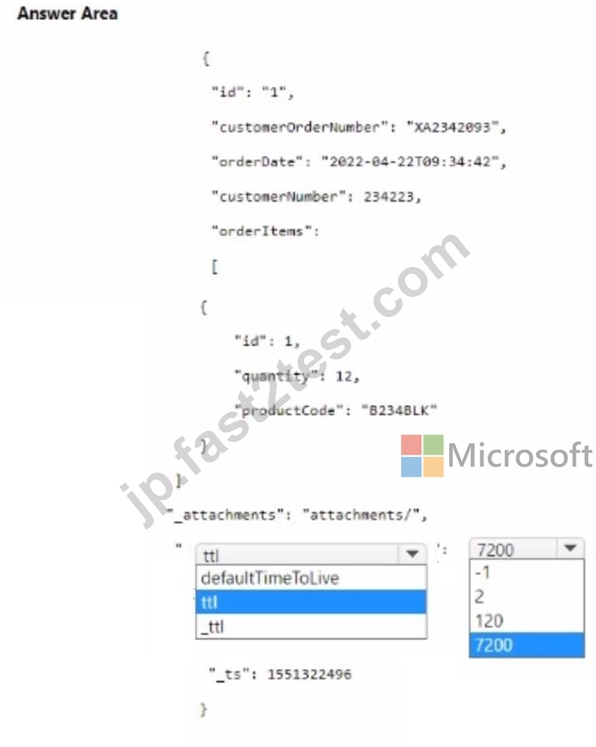
正解:
解説: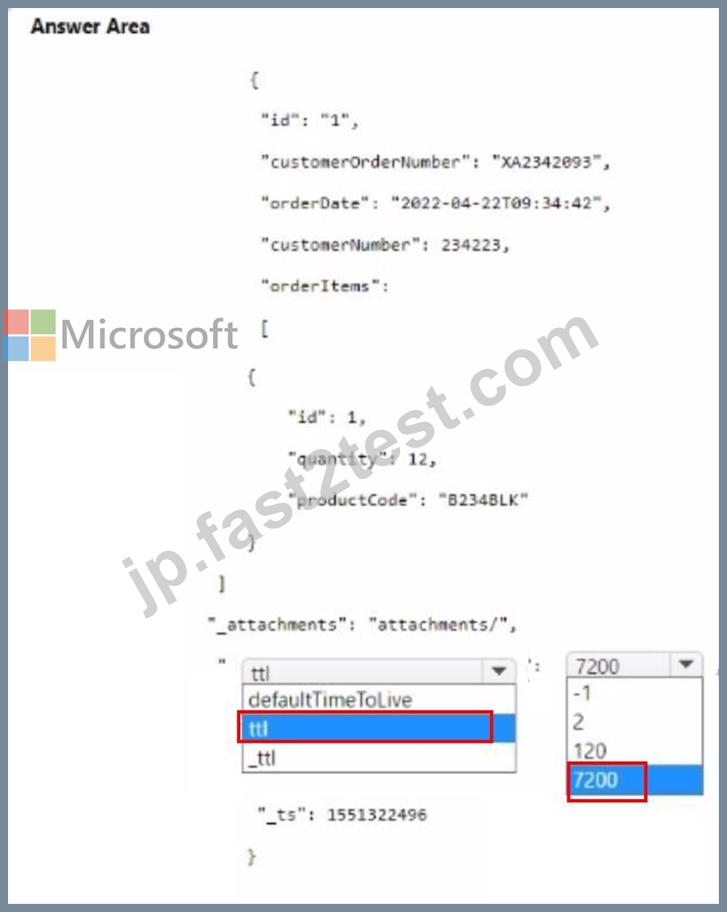
質問 # 25
You are designing a data model for an Azure Cosmos DB for NoSQL account.
What are the partition limits for request units per second (RU/s) and storage? To answer, select the appropriate options in the answer area.
NOTE: Each correct selection is worth one point.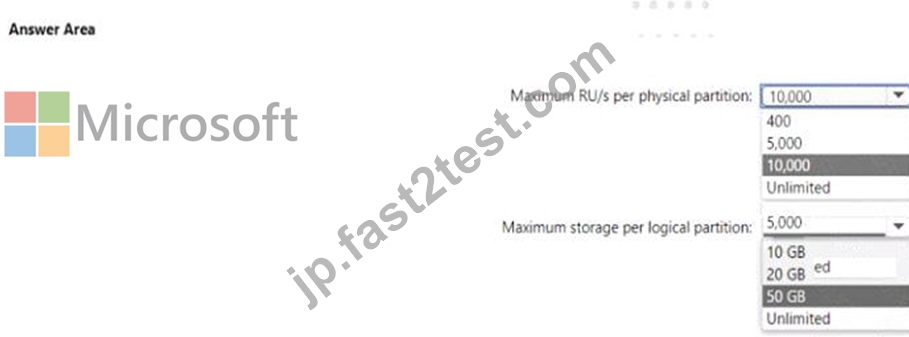
正解:
解説: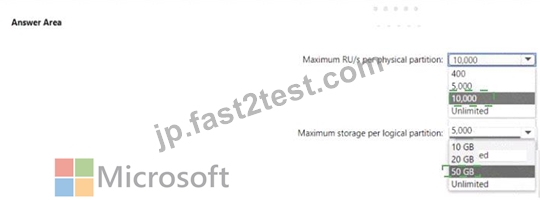
Explanation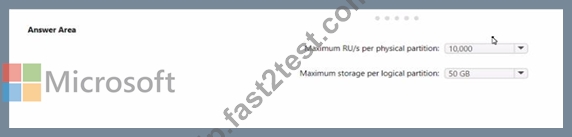
質問 # 26
You have an Azure Cosmos DB for NoSQL account1 that is configured for automatic failover. The account1 account has a single read-write region in West US and a and a read region in East US.
You run the following PowerShell command.
What is the effect of running the command?
- A. A manual failover will occur.
- B. The account will be configured for multi-region writes.
- C. The account will be unavailable to writes during the change.
- D. The provisioned throughput for account1 will increase.
正解:B
解説:
Explanation
You can use the Set-AzCosmosDBAccountRegion cmdlet to update the regions that an Azure Cosmos DB account uses. You can use this cmdlet to add a region or change the region failover order. The cmdlet requires a resource group name, an Azure Cosmos DB account name, and a list of regions in desired failover order1.
For your scenario, based on the PowerShell command, you are using the Set-AzCosmosDBAccountRegion cmdlet to update the regions for an Azure Cosmos DB account named account1 that is configured for automatic failover. The command specifies two regions: West US and East US. The effect of running the command is that the account will be configured for multi-region writes.
Multi-region writes is a feature of Azure Cosmos DB that allows you to write data to any region in your account and have it automatically replicated to all other regions. This feature provides high availability and low latency for write operations across multiple regions. To enable multi-region writes, you need to specify at least two regions in your account and set them as write regions2. In your command, you are setting both West US and East US as write regions by using the -IsZoneRedundant parameter with a value of $true for both regions.
質問 # 27
You have an Azure Cosmos DB Core (SQL) API account.
You run the following query against a container in the account.
SELECT
IS_NUMBER("1234") AS A,
IS_NUMBER(1234) AS B,
IS_NUMBER({prop: 1234}) AS C
What is the output of the query?
- A. [{"A": true, "B": true, "C": false}]
- B. [{"A": true, "B": false, "C": true}]
- C. [{"A": false, "B": true, "C": false}]
- D. [{"A": true, "B": true, "C": true}]
正解:C
解説:
IS_NUMBER returns a Boolean value indicating if the type of the specified expression is a number.
"1234" is a string, not a number.
質問 # 28
You have an Azure Cosmos DB for NoSQL account.
The change feed is enabled on a container named invoice.
You create an Azure function that has a trigger on the change feed.
What is received by the Azure function?
- A. only the changed properties and the system-defined properties of the updated items
- B. only the partition key and the changed properties of the updated items
- C. all the properties of the original items and the updated items
- D. all the properties of the updated items
正解:D
解説:
Explanation
According to the Azure Cosmos DB documentation12, the change feed is a persistent record of changes to a container in the order they occur. The change feed outputs the sorted list of documents that were changed in the order in which they were modified.
The Azure function that has a trigger on the change feed receives all the properties of the updated items2. The change feed does not include the original items or only the changed properties. The change feed also includes some system-defined properties such as _ts (the last modified timestamp) and _lsn (the logical sequence number)3.
Therefore, the correct answer is: A. all the properties of the updated items
質問 # 29
You have the following query.
SELECT * FROM
WHERE c.sensor = "TEMP1"
AND c.value < 22
AND c.timestamp >= 1619146031231
You need to recommend a composite index strategy that will minimize the request units (RUs) consumed by the query.
What should you recommend?
- A. a composite index for (sensor ASC, value ASC) and a composite index for (sensor ASC, timestamp ASC)
- B. a composite index for (value ASC, sensor ASC) and a composite index for (timestamp ASC, sensor ASC)
- C. a composite index for (sensor ASC, value ASC, timestamp ASC)
- D. a composite index for (sensor ASC, value ASC, timestamp ASC) and a composite index for (sensor DESC, value DESC, timestamp DESC)
正解:A
解説:
If a query has a filter with two or more properties, adding a composite index will improve performance.
Consider the following query:
SELECT * FROM c WHERE c.name = "Tim" and c.age > 18
In the absence of a composite index on (name ASC, and age ASC), we will utilize a range index for this query.
We can improve the efficiency of this query by creating a composite index for name and age.
Queries with multiple equality filters and a maximum of one range filter (such as >,<, <=, >=, !=) will utilize the composite index.
Reference:
https://azure.microsoft.com/en-us/blog/three-ways-to-leverage-composite-indexes-in-azure-cosmos-db/
質問 # 30
Note: This question is part of a series of questions that present the same scenario. Each question in the series contains a unique solution that might meet the stated goals. Some question sets might have more than one correct solution, while others might not have a correct solution.
After you answer a question in this section, you will NOT be able to return to it. As a result1 these questions will not appear in the review screen.
You have a database in an Azure Cosmos DB for NoSQL account that is configured for multi-region writes.
You need to use the Azure Cosmos OB SDK to implement the conflict resolution policy for a container. The solution must ensure that any conflicts are sent to the conflicts feed.
Solution: You set ConflictResolutionMode to Laswriterwins and you use the default settings for the policy.
Does this meet the goal?
- A. No
- B. Yes
正解:B
質問 # 31
You plan to store order data in Azure Cosmos DB for NoSQL account. The data contains information about orders and their associated items.
You need to develop a model that supports order read operations. The solution must minimize the number or requests.
- A. Create a single database that contains a container for order and a container for order items.
- B. Create a single database that contains one container. Store orders and order items in separate documents in the container.
- C. Create a database for orders and a database for order items.
- D. Create a single database that contains one container. Create a separate document for each order and embed the order items into the order documents.
正解:D
解説:
Explanation
Azure Cosmos DB is a multi-model database that supports various data models, such as documents, key-value, graph, and column-family3. The core content-model of Cosmos DB's database engine is based on atom-record-sequence (ARS), which allows it to store and query different types of data in a flexible and efficient way3.
To develop a model that supports order read operations and minimizes the number of requests, you should consider the following factors:
The size and shape of your data
The frequency and complexity of your queries
The latency and throughput requirements of your application
The trade-offs between storage efficiency and query performance
Based on these factors, one possible model that you could implement is B. Create a single database that contains one container. Create a separate document for each order and embed the order items into the order documents.
This model has the following advantages:
It stores orders and order items as self-contained documents that can be easily retrieved by order ID1.
It avoids storing redundant data or creating additional containers for order items1.
It allows you to view the order history of a customer with simple queries1.
It leverages the benefits of embedding data, such as reducing the number of requests, improving query performance, and simplifying data consistency2.
This model also has some limitations, such as:
It may not be suitable for some order items that have data that is greater than 2 KB, as it could exceed the maximum document size limit of 2 MB2.
It may not be optimal for scenarios where order items need to be queried independently from orders or aggregated by other criteria2.
It may not support transactions across multiple orders or customers, as transactions are scoped to a single logical partition2.
Depending on your specific use case and requirements, you may need to adjust this model or choose a different one. For example, you could use a hybrid data model that combines embedding and referencing data2
, or you could use a graph data model that expresses entities and relationships as vertices and edges.
質問 # 32
You have an Azure Cosmos DB account named account1.
You have several apps that connect to account1 by using the account's secondary key.
You then configure the apps to authenticate by using service principals.
You need to ensure that account1 will only allow apps to connect by using an Azure AD identity.
Which account property should you modify?
- A. userAssignedldentatxe
- B. disableLocalAuth
- C. disableKeyBasedMetadataWriteAccess ,
- D. allowedOrxgins
正解:B
解説:
Explanation
The disableLocalAuth property is a boolean flag that indicates whether local authentication methods such as primary/secondary keys are disabled for the Azure Cosmos DB account. Setting this property to true improves security by ensuring that Azure Cosmos DB accounts exclusively require Azure Active Directory identities for authentication1.
Topic 1, Litware, inc
Case Study
This is a case study. Case studies are not timed separately. You can use as much exam time as you would like to complete each case. However, there may be additional case studies and sections on this exam. You must manage your time to ensure that you are able to complete all questions included on this exam in the time provided.
To answer the questions included in a case study, you will need to reference information that is provided in the case study. Case studies might contain exhibits and other resources that provide more information about the scenario that is described in the case study. Each question is independent of the other questions in this case study.
At the end of this case study, a review screen will appear. This screen allows you to review your answers and to make changes before you move to the next section of the exam. After you begin a new section, you cannot return to this section.
To start the case study
To display the first question in this case study, click the Next button. Use the buttons in the left pane to explore the content of the case study before you answer the questions. Clicking these buttons displays information such as business requirements, existing environment, and problem statements. If the case study has an All Information tab, note that the information displayed is identical to the information displayed on the subsequent tabs. When you are ready to answer a question, click the Question button to return to the question.
Overview
Litware, Inc. is a United States-based grocery retailer. Litware has a main office and a primary datacenter in Seattle. The company has 50 retail stores across the United States and an emerging online presence. Each store connects directly to the internet.
Existing environment. Cloud and Data Service Environments.
Litware has an Azure subscription that contains the resources shown in the following table.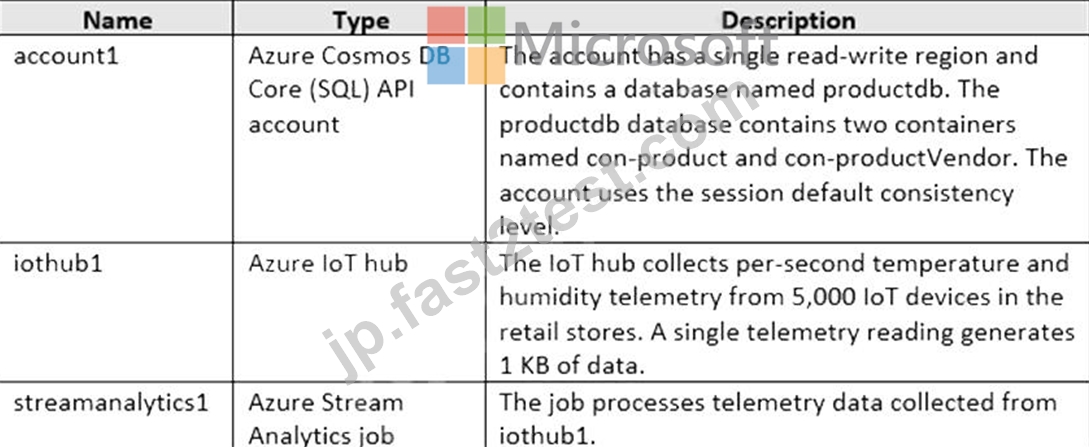
Each container in productdb is configured for manual throughput.
The con-product container stores the company's product catalog data. Each document in con-product includes a con-productvendor value. Most queries targeting the data in con-product are in the following format.
SELECT * FROM con-product p WHERE p.con-productVendor - 'name'
Most queries targeting the data in the con-productVendor container are in the following format SELECT * FROM con-productVendor pv ORDER BY pv.creditRating, pv.yearFounded Existing environment. Current Problems.
Litware identifies the following issues:
Updates to product categories in the con-productVendor container do not propagate automatically to documents in the con-product container.
Application updates in con-product frequently cause HTTP status code 429 "Too many requests". You discover that the 429 status code relates to excessive request unit (RU) consumption during the updates.
Requirements. Planned Changes
Litware plans to implement a new Azure Cosmos DB Core (SQL) API account named account2 that will contain a database named iotdb. The iotdb database will contain two containers named con-iot1 and con-iot2.
Litware plans to make the following changes:
Store the telemetry data in account2.
Configure account1 to support multiple read-write regions.
Implement referential integrity for the con-product container.
Use Azure Functions to send notifications about product updates to different recipients.
Develop an app named App1 that will run from all locations and query the data in account1.
Develop an app named App2 that will run from the retail stores and query the data in account2. App2 must be limited to a single DNS endpoint when accessing account2.
Requirements. Business Requirements
Litware identifies the following business requirements:
Whenever there are multiple solutions for a requirement, select the solution that provides the best performance, as long as there are no additional costs associated.
Ensure that Azure Cosmos DB costs for IoT-related processing are predictable.
Minimize the number of firewall changes in the retail stores.
Requirements. Product Catalog Requirements
Litware identifies the following requirements for the product catalog:
Implement a custom conflict resolution policy for the product catalog data.
Minimize the frequency of errors during updates of the con-product container.
Once multi-region writes are configured, maximize the performance of App1 queries against the data in account1.
Trigger the execution of two Azure functions following every update to any document in the con-product container.
質問 # 33
You are creating a database in an Azure Cosmos DB Core (SQL) API account. The database will be used by an application that will provide users with the ability to share online posts. Users will also be able to submit comments on other users' posts.
You need to store the data shown in the following table.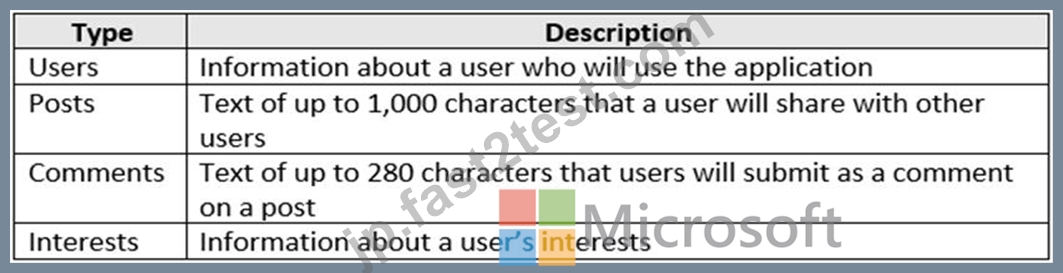
The application has the following characteristics:
Users can submit an unlimited number of posts.
The average number of posts submitted by a user will be more than 1,000.
Posts can have an unlimited number of comments from different users.
The average number of comments per post will be 100, but many posts will exceed 1,000 comments.
Users will be limited to having a maximum of 20 interests.
For each of the following statements, select Yes if the statement is true. Otherwise, select No.
NOTE: Each correct selection is worth one point.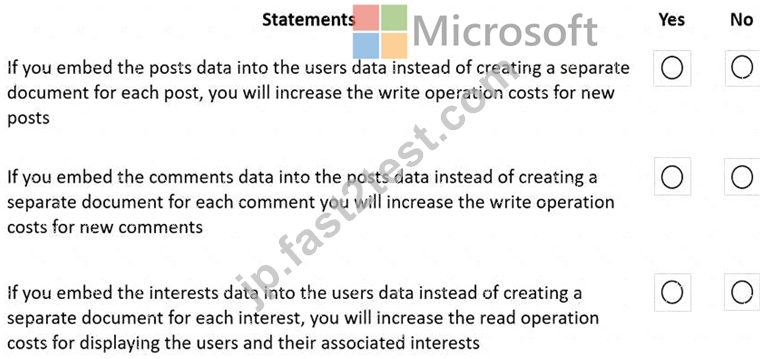
正解:
解説: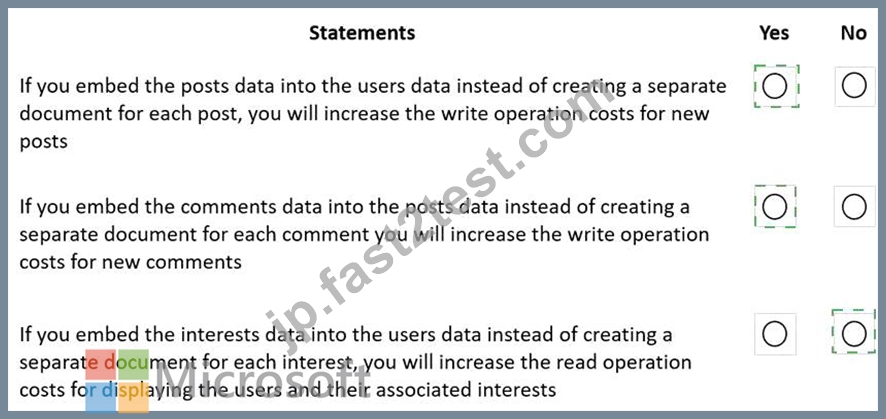
Explanation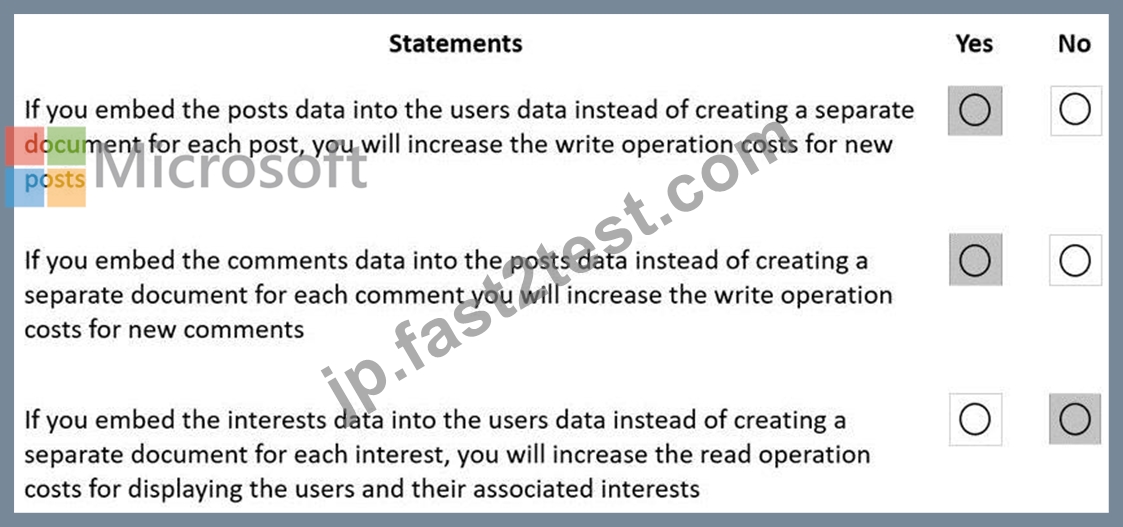
Box 1: Yes
Non-relational data increases write costs, but can decrease read costs.
Box 2: Yes
Non-relational data increases write costs, but can decrease read costs.
Box 3: No
Non-relational data increases write costs, but can decrease read costs.
質問 # 34
You have a database in an Azure Cosmos DB for NoSQL account that is configured for multi-region writes.
You need to use the Azure Cosmos DB SDK to implement the conflict resolution policy for a container. The solution must ensure that any conflict sent to the conflict feed.
Solution: You set ConfilictResolutionMode to Custom. You Set ResolutionProcedures to a custom stored procedure. You configure the custom stored procedure to use the isTomstone parameter to resolve conflict.
Does this meet the goal?
- A. No
- B. Yes
正解:B
解説:
The solution is incorrect because there is no "isTom" parameter in the Azure Cosmos DB SDK. The correct parameter is "isTombstone".
質問 # 35
You have a database named db1 in an Azure Cosmos DB for NoSQL
You are designing an application that will use dbl.
In db1, you are creating a new container named coll1 that will store in coll1.
The following is a sample of a document that will be stored in coll1.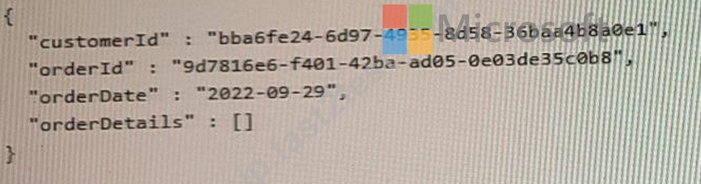
The application will have the following characteristics:
* New orders will be created frequently by different customers.
* Customers will often view their past order history.
You need to select the partition key value for coll1 to support the application. The solution must minimize costs.
To what should you set the partition key?
- A. orderDate
- B. customerId
- C. orderId
- D. id
正解:A
解説:
Based on the characteristics of the application and the provided document structure, the most suitable partition key value for coll1 in the given scenario would be the customerId, Option B.
The application frequently creates new orders by different customers and customers often view their past order history. Using customerId as the partition key would ensure that all orders associated with a particular customer are stored in the same partition. This enables efficient querying of past order history for a specific customer and reduces cross-partition queries, resulting in lower costs and improved performance.
a partition key is a JSON property (or path) within your documents that is used by Azure Cosmos DB to distribute data among multiple partitions3. A partition key should have a high cardinality, which means it should have many distinct values, such as hundreds or thousands1. A partition key should also align with the most common query patterns of your application, so that you can efficiently retrieve data by using the partition key value1.
Based on these criteria, one possible partition key that you could use for coll1 is B. customerId.
This partition key has the following advantages:
It has a high cardinality, as each customer will have a unique ID3.
It aligns with the query patterns of the application, as customers will often view their past order history3.
It minimizes costs, as it reduces the number of cross-partition queries and optimizes the storage and throughput utilization1.
This partition key also has some limitations, such as:
It may not be optimal for scenarios where orders need to be queried independently from customers or aggregated by date or other criteria3.
It may result in hot partitions or throttling if some customers create orders more frequently than others or have more data than others1.
It may not support transactions across multiple customers, as transactions are scoped to a single logical partition2.
Depending on your specific use case and requirements, you may need to adjust this partition key or choose a different one. For example, you could use a synthetic partition key that concatenates multiple properties of an item2, or you could use a partition key with a random or pre-calculated suffix to distribute the workload more evenly2.
質問 # 36
You have an Azure Cosmos DB for NoSQL account1 that is configured for automatic failover. The account1 account has a single read-write region in West US and a and a read region in East US.
You run the following PowerShell command.
What is the effect of running the command?
- A. A manual failover will occur.
- B. The account will be configured for multi-region writes.
- C. The account will be unavailable to writes during the change.
- D. The provisioned throughput for account1 will increase.
正解:B
解説:
Explanation
You can use the Set-AzCosmosDBAccountRegion cmdlet to update the regions that an Azure Cosmos DB account uses. You can use this cmdlet to add a region or change the region failover order. The cmdlet requires a resource group name, an Azure Cosmos DB account name, and a list of regions in desired failover order1.
For your scenario, based on the PowerShell command, you are using the Set-AzCosmosDBAccountRegion cmdlet to update the regions for an Azure Cosmos DB account named account1 that is configured for automatic failover. The command specifies two regions: West US and East US. The effect of running the command is that the account will be configured for multi-region writes.
Multi-region writes is a feature of Azure Cosmos DB that allows you to write data to any region in your account and have it automatically replicated to all other regions. This feature provides high availability and low latency for write operations across multiple regions. To enable multi-region writes, you need to specify at least two regions in your account and set them as write regions . In your command, you are setting both West US and East US as write regions by using the -IsZoneRedundant parameter with a value of $true for both regions.
質問 # 37
You are creating a database in an Azure Cosmos DB Core (SQL) API account. The database will be used by an application that will provide users with the ability to share online posts. Users will also be able to submit comments on other users' posts.
You need to store the data shown in the following table.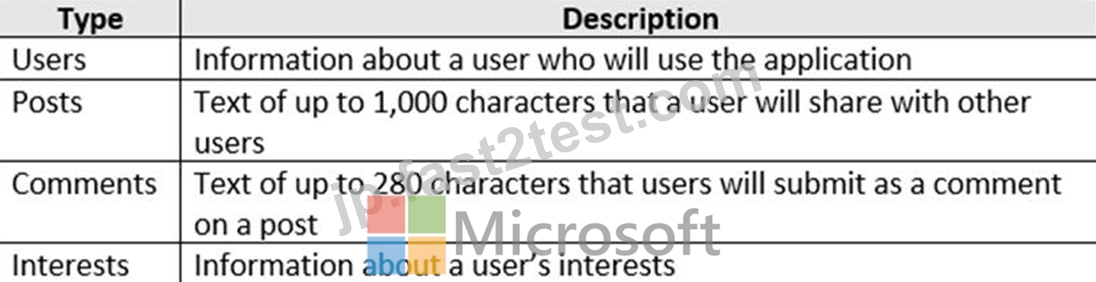
The application has the following characteristics:
Users can submit an unlimited number of posts.
The average number of posts submitted by a user will be more than 1,000.
Posts can have an unlimited number of comments from different users.
The average number of comments per post will be 100, but many posts will exceed 1,000 comments.
Users will be limited to having a maximum of 20 interests.
For each of the following statements, select Yes if the statement is true. Otherwise, select No.
NOTE: Each correct selection is worth one point.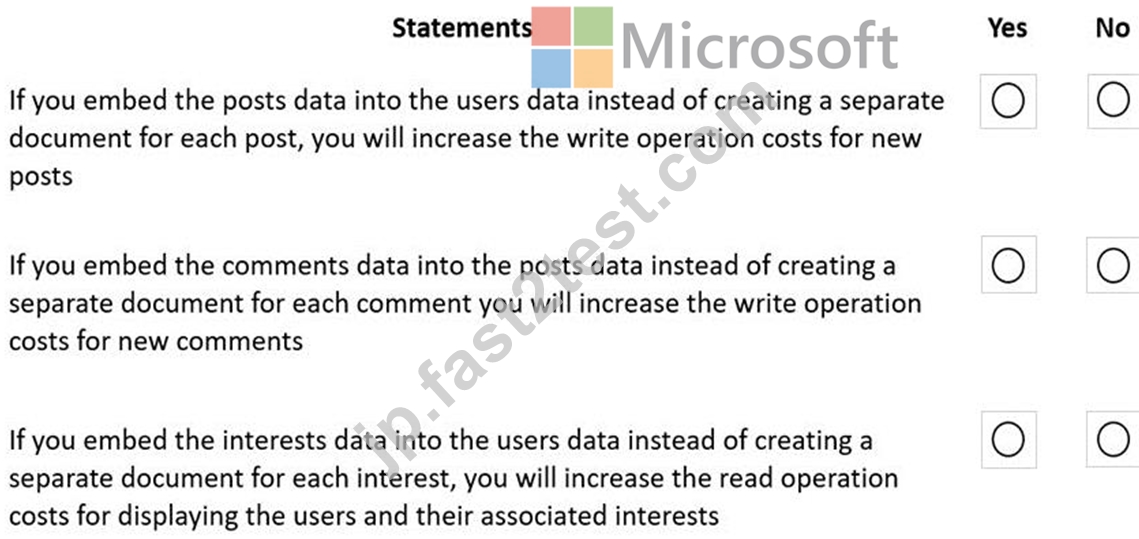
正解:
解説: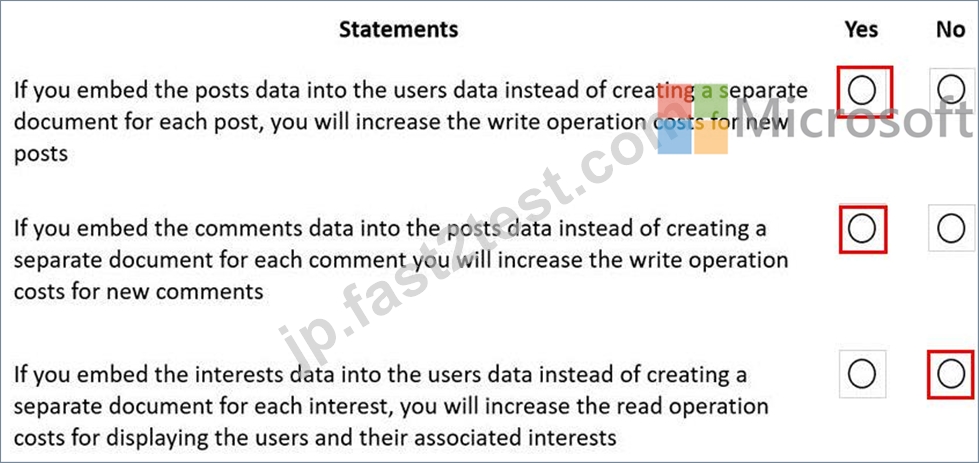
質問 # 38
You plan to create an Azure Cosmos DB database named db1 that will contain two containers. One of the containers will contain blog posts, and the other will contain users. Each item in the blog post container will include:
* A single blog post
* All the comments associated to the blog post
* The names of the users who created the blog post and added the comments.
You need to design a solution to update usernames m the user container without causing data integrity issues.
The solution must minimize administrative and development effort. What should you include in the solution?
To answer, select the appropriate options in the answer area.
NOTE: Each correct selection is worth one point.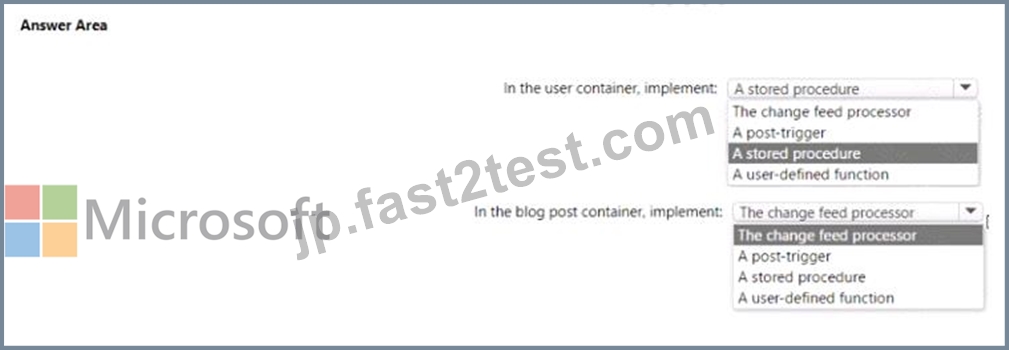
正解:
解説: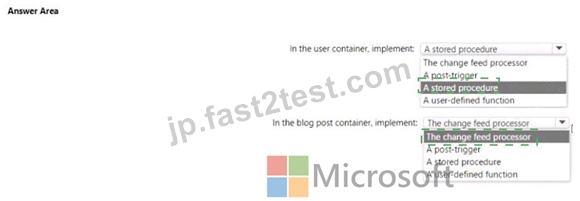
Explanation: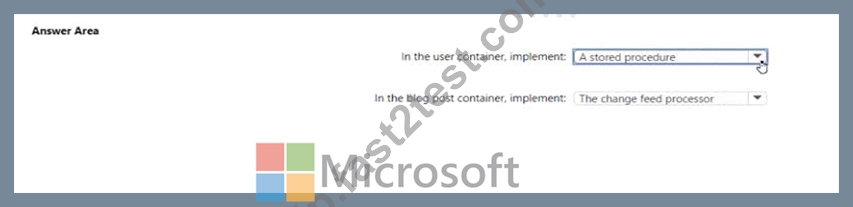
質問 # 39
You need to implement a solution to meet the product catalog requirements.
What should you do to implement the conflict resolution policy.
- A. Create a new container and migrate the product catalog data to the new container.
- B. Remove frequently changed field from the index policy of the con-product container.
- C. Set the default consistency level for account1 to eventual.
- D. Disable indexing on all fields in the index policy of the con-product container.
正解:A
質問 # 40
......
Microsoft DP-420試験は、Microsoft Azure Cosmos DBを使用してクラウドネイティブアプリケーションの設計と実装における専門家のスキルと知識を検証するために設計された高度なレベルの認定です。この認定は業界で非常に評価されており、専門家がクラウドネイティブのアプリケーション開発におけるキャリアを促進するのに役立ちます。この試験の服用に興味がある場合は、必ず徹底的に準備し、Azure Cosmos DBおよびその他の関連技術で実践的な経験を積むようにしてください。
あなたをパスさせるDP-420問題集でPDF2025年最新!138問題:https://jp.fast2test.com/DP-420-premium-file.html
Microsoft DP-420リアルな試験問題と回答無料:https://drive.google.com/open?id=1ISd9_QKFSlU5dIBrGjdMy3ML1oXPBO7m