

113試験解答はDP-420最新版 テストエンジン
合格確定DP-420試験問最新のDP-420試験問題集PDF2023年更新
質問 # 17
You have an Azure Cosmos DB account named account1.
You have several apps that connect to account1 by using the account's secondary key.
You then configure the apps to authenticate by using service principals.
You need to ensure that account1 will only allow apps to connect by using an Azure AD identity.
Which account property should you modify?
- A. userAssignedldentatxe
- B. allowedOrxgins
- C. disableKeyBasedMetadataWriteAccess ,
- D. disableLocalAuth
正解:D
解説:
The disableLocalAuth property is a boolean flag that indicates whether local authentication methods such as primary/secondary keys are disabled for the Azure Cosmos DB account. Setting this property to true improves security by ensuring that Azure Cosmos DB accounts exclusively require Azure Active Directory identities for authentication1.
質問 # 18
You have a multi-region Azure Cosmos DB account named account1 that has a default consistency level of strong.
You have an app named App1 that is configured to request a consistency level of session.
How will the read and write operations of App1 be handled? To answer, select the appropriate options in the answer area.
NOTE: Each correct selection is worth one point.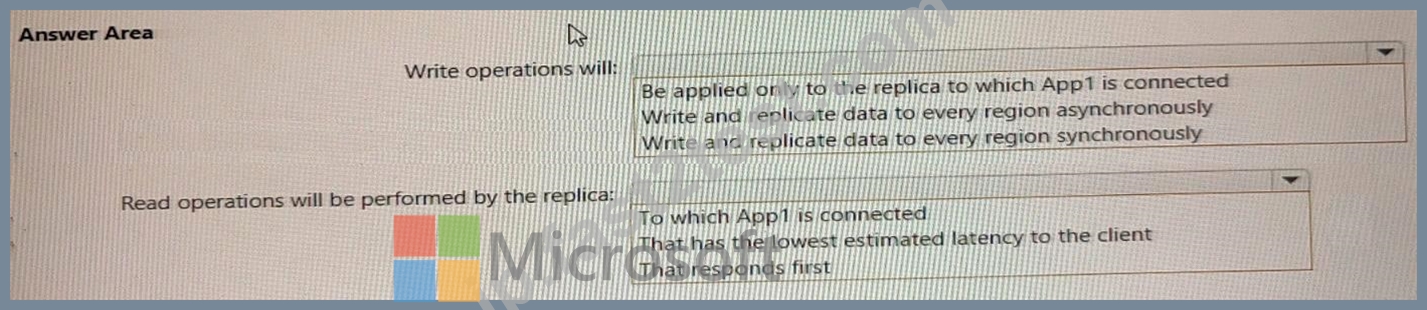
正解:
解説:
Explanation
Box 1 = Write and replicate data to every region synchronously
This is because the write concern is mapped to the default consistency level configured on your Azure Cosmos DB account2, which is strong in this case. Strong consistency ensures that every write operation is synchronously committed to every region associated with your Azure Cosmos DB account1. The request level consistency level of session only applies to the read operations of App11.
Box 2: That has the lowest estimated latency to the client
This is because the read operations of App1 will use the session consistency level that is specified in the request options. Session consistency is a client-centric consistency model that guarantees monotonic reads, monotonic writes, and read-your-own-writes within a session. A session is scoped to a client connection or a stored procedure execution. Session consistency allows clients to read from any region that has the lowest latency to the client.
質問 # 19
You have an Azure Cosmos DB Core (SQL) API account named account1 that has the disableKeyBasedMetadataWriteAccess property enabled.
You are developing an app named App1 that will be used by a user named DevUser1 to create containers in account1. DevUser1 has a non-privileged user account in the Azure Active Directory (Azure AD) tenant.
You need to ensure that DevUser1 can use App1 to create containers in account1.
What should you do? To answer, select the appropriate options in the answer area.
NOTE: Each correct selection is worth one point.
正解:
解説:
Explanation
Box 1: Resource tokens
Resource tokens provide access to the application resources within a database. Resource tokens:
Provide access to specific containers, partition keys, documents, attachments, stored procedures, triggers, and UDFs.
Box 2: Azure Resource Manager API
You can use Azure Resource Manager to help deploy and manage your Azure Cosmos DB accounts, databases, and containers.
Reference:
https://docs.microsoft.com/en-us/azure/cosmos-db/secure-access-to-data
https://docs.microsoft.com/en-us/rest/api/resources/
質問 # 20
You are creating a database in an Azure Cosmos DB Core (SQL) API account. The database will be used by an application that will provide users with the ability to share online posts. Users will also be able to submit comments on other users' posts.
You need to store the data shown in the following table.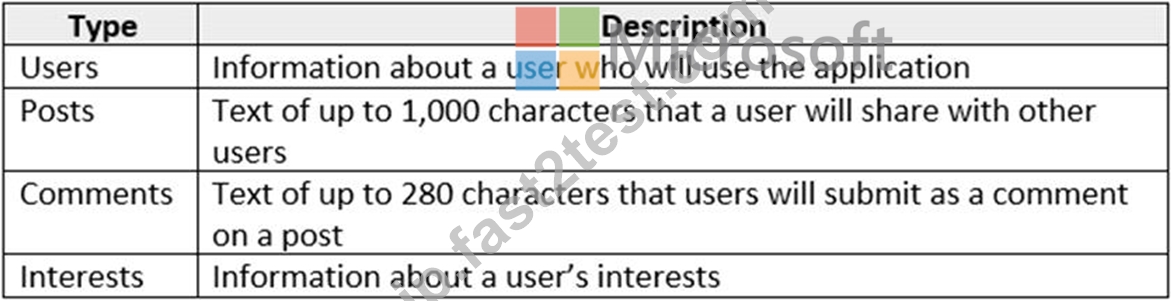
The application has the following characteristics:
Users can submit an unlimited number of posts.
The average number of posts submitted by a user will be more than 1,000.
Posts can have an unlimited number of comments from different users.
The average number of comments per post will be 100, but many posts will exceed 1,000 comments.
Users will be limited to having a maximum of 20 interests.
For each of the following statements, select Yes if the statement is true. Otherwise, select No.
NOTE: Each correct selection is worth one point.
正解:
解説:
質問 # 21
You configure a backup for an Azure Cosmos DB for NoSQL account as shown in the following exhibit.
Use the drop-down menus to select the answer choice that completes each statement based on the information presented in the graphic.
NOTE: Each correct selection is worth one point.
正解:
解説:
質問 # 22
You have a container in an Azure Cosmos DB Core (SQL) API account.
You need to use the Azure Cosmos DB SDK to replace a document by using optimistic concurrency.
What should you include in the code? To answer, select the appropriate options in the answer area.
NOTE: Each correct selection is worth one point.
正解:
解説:
Explanation
Box 1: ConsistencyLevel
The ItemRequestOptions Class ConsistencyLevel property gets or sets the consistency level required for the request in the Azure Cosmos DB service.
Azure Cosmos DB offers 5 different consistency levels. Strong, Bounded Staleness, Session, Consistent Prefix and Eventual - in order of strongest to weakest consistency.
Box 2: _etag
The ItemRequestOptions class helped us implement optimistic concurrency by specifying that we wanted the SDK to use the If-Match header to allow the server to decide whether a resource should be updated. The If-Match value is the ETag value to be checked against. If the ETag value matches the server ETag value, the resource is updated.
Reference:
https://docs.microsoft.com/en-us/dotnet/api/microsoft.azure.cosmos.itemrequestoptions
https://cosmosdb.github.io/labs/dotnet/labs/10-concurrency-control.html
質問 # 23
You have a database in an Azure Cosmos DB for NoSQL account that is configured for multi-region writes.
You need to use the Azure Cosmos DB SDK to implement the conflict resolution policy for a container. The solution must ensure that any conflict sent to the conflict feed.
Solution: You set ConfilictResolutionMode to Custom. You Set ResolutionProcedures to a custom stored procedure. You configure the custom stored procedure to use the isTomstone parameter to resolve conflict.
Does this meet the goal?
- A. Yes
- B. No
正解:B
解説:
The solution is incorrect because there is no "isTom" parameter in the Azure Cosmos DB SDK. The correct parameter is "isTombstone".
質問 # 24
You have a database named telemetry in an Azure Cosmos DB Core (SQL) API account that stores IoT dat a. The database contains two containers named readings and devices.
Documents in readings have the following structure.
id
deviceid
timestamp
ownerid
measures (array)
- type
- value
- metricid
Documents in devices have the following structure.
id
deviceid
owner
- ownerid
- emailaddress
- name
brand
model
For each of the following statements, select Yes if the statement is true. Otherwise, select No.
NOTE: Each correct selection is worth one point.
正解:
解説:
質問 # 25
You have an Azure Cosmos DB Core (SQL) API account named storage1 that uses provisioned throughput capacity mode.
The storage1 account contains the databases shown in the following table.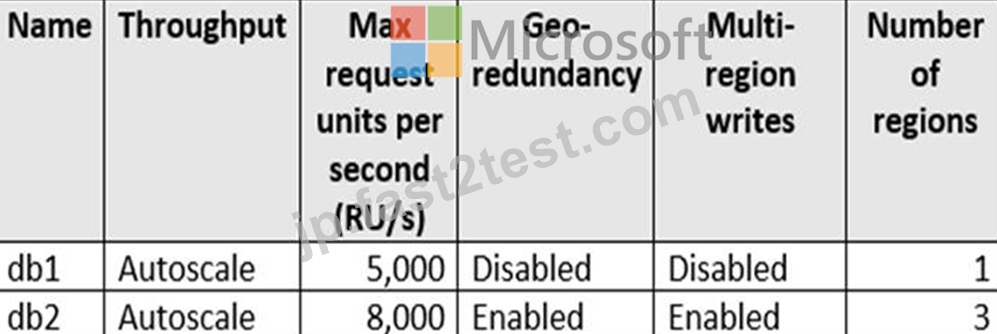
The databases contain the containers shown in the following table.
For each of the following statements, select Yes if the statement is true. Otherwise, select No.
NOTE: Each correct selection is worth one point.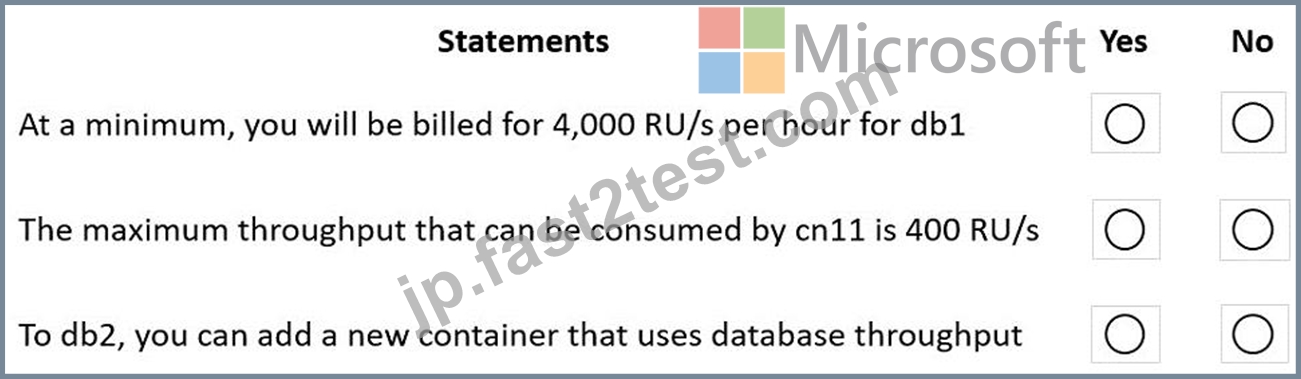
正解:
解説:
Reference:
https://docs.microsoft.com/en-us/azure/cosmos-db/plan-manage-costs
https://azure.microsoft.com/en-us/pricing/details/cosmos-db/
質問 # 26
You are developing an application that will use an Azure Cosmos DB Core (SQL) API account as a data source.
You need to create a report that displays the top five most ordered fruits as shown in the following table.
A collection that contains aggregated data already exists. The following is a sample document:
{
"name": "apple",
"type": ["fruit", "exotic"],
"orders": 10000
}
Which two queries can you use to retrieve data for the report? Each correct answer presents a complete solution.
NOTE: Each correct selection is worth one point.
- A.

- B.

- C.

- D.

正解:A、D
解説:
ARRAY_CONTAINS returns a Boolean indicating whether the array contains the specified value. You can check for a partial or full match of an object by using a boolean expression within the command.
Incorrect Answers:
A: Default sorting ordering is Ascending. Must use Descending order.
C: Order on Orders not on Type.
質問 # 27
You have a database in an Azure Cosmos DB Core (SQL) API account.
You need to create an Azure function that will access the database to retrieve records based on a variable named accountnumber. The solution must protect against SQL injection attacks.
How should you define the command statement in the function?
- A. cmd = "SELECT * FROM Persons p
WHERE p.accountnumber = @accountnumber" - B. cmd = "SELECT * FROM Persons p
WHERE p.accountnumber = LIKE @accountnumber" - C. cmd = "SELECT * FROM Persons p
WHERE p.accountnumber = 'accountnumber'" - D. cmd = "SELECT * FROM Persons p
WHERE p.accountnumber = '" + accountnumber + "'"
正解:A
解説:
Explanation
Azure Cosmos DB supports queries with parameters expressed by the familiar @ notation. Parameterized SQL provides robust handling and escaping of user input, and prevents accidental exposure of data through SQL injection.
For example, you can write a query that takes lastName and address.state as parameters, and execute it for various values of lastName and address.state based on user input.
SELECT *
FROM Families f
WHERE f.lastName = @lastName AND f.address.state = @addressState
Reference: https://docs.microsoft.com/en-us/azure/cosmos-db/sql/sql-query-parameterized-queries
質問 # 28
You are troubleshooting the current issues caused by the application updates.
Which action can address the application updates issue without affecting the functionality of the application?
- A. Set the default consistency level of account1 to bounded staleness.
- B. Enable time to live for the con-product container.
- C. Set the default consistency level of account1 to strong.
- D. Add a custom indexing policy to the con-product container.
正解:A
解説:
Explanation
Bounded staleness is frequently chosen by globally distributed applications that expect low write latencies but require total global order guarantee. Bounded staleness is great for applications featuring group collaboration and sharing, stock ticker, publish-subscribe/queueing etc.
Scenario: Application updates in con-product frequently cause HTTP status code 429 "Too many requests".
You discover that the 429 status code relates to excessive request unit (RU) consumption during the updates.
Reference:
https://docs.microsoft.com/en-us/azure/cosmos-db/consistency-levels
質問 # 29
You have a database in an Azure Cosmos DB for NoSQL account that is configured for multi-region writes.
You need to use the Azure Cosmos DB SDK to implement the conflict resolution policy for a container. The solution must ensure that any conflict sent to the conflict feed.
Solution: You set ConfilictResolutionMode to Custom. You Set ResolutionProcedures to a custom stored procedure. You configure the custom stored procedure to use the isTomstone parameter to resolve conflict.
Does this meet the goal?
- A. Yes
- B. No
正解:A
解説:
Explanation
The solution is incorrect because there is no "isTom" parameter in the Azure Cosmos DB SDK. The correct parameter is "isTombstone".
質問 # 30
You have an Azure Cosmos DB Core (SQL) API account named storage1 that uses provisioned throughput capacity mode.
The storage1 account contains the databases shown in the following table.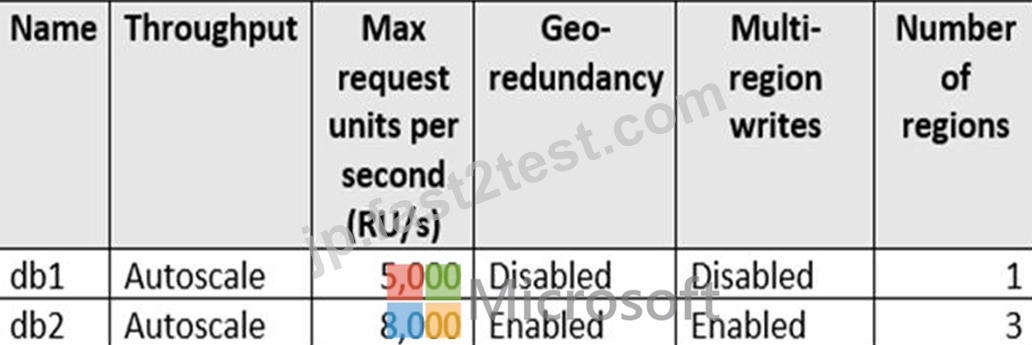
The databases contain the containers shown in the following table.
For each of the following statements, select Yes if the statement is true. Otherwise, select No.
NOTE: Each correct selection is worth one point.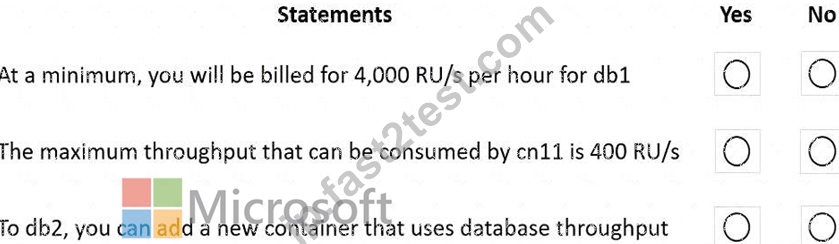
正解:
解説: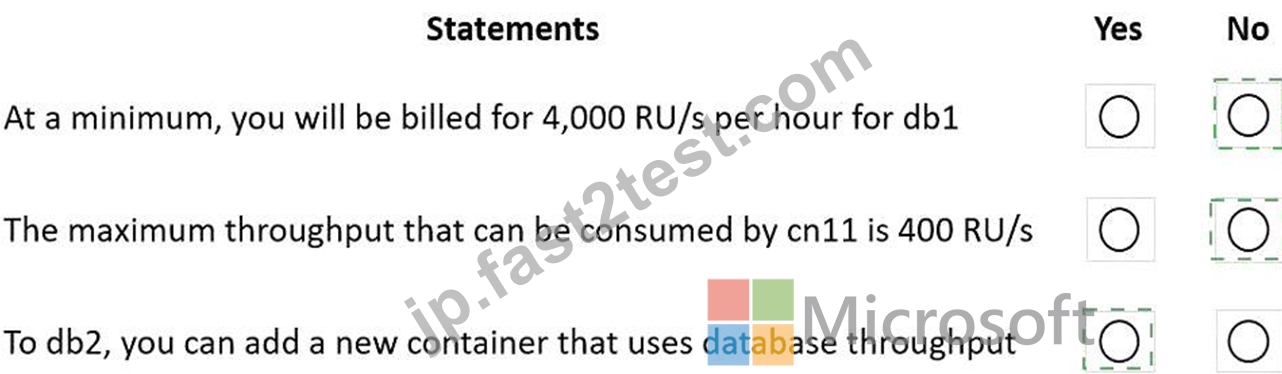
Explanation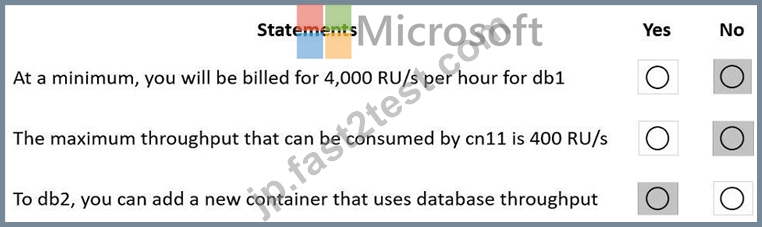
Box 1: No
Four containers with 1000 RU/s each.
Box 2: No
Max 8000 RU/s for db2. 8 containers, so 1000 RU/s for each container.
Box 3: Yes
Max 8000 RU/s for db2. 8 containers, so 1000 RU/s for each container. Can very well add an additional container.
Reference:
https://docs.microsoft.com/en-us/azure/cosmos-db/plan-manage-costs
https://azure.microsoft.com/en-us/pricing/details/cosmos-db/
質問 # 31
You need to recommend indexes for con-product and con-productVendor. The solution must meet the product catalog requirements and the business requirements.
Which type of index should you recommend for each container? To answer, select the appropriate options in the answer area.
NOTE: Each correct selection is worth one point.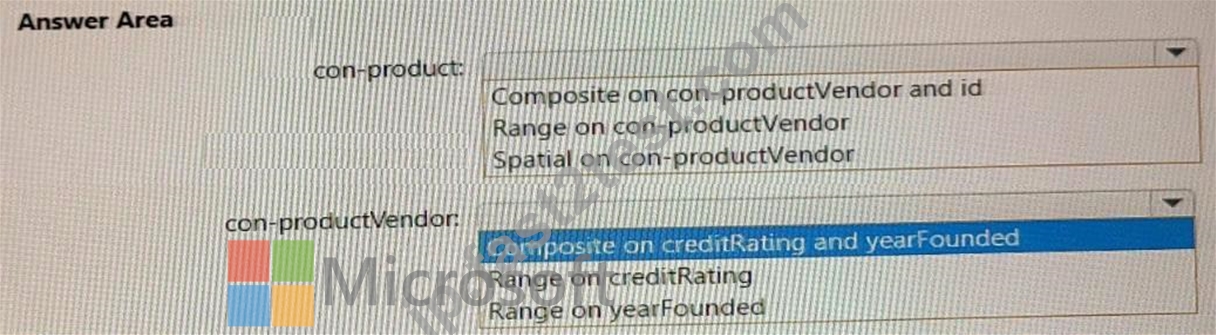
正解:
解説: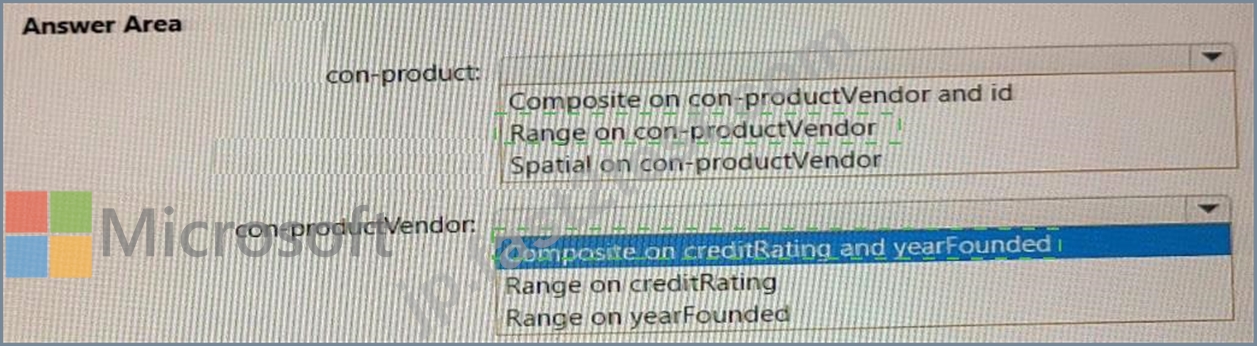
Explanation
質問 # 32
You have the Azure Cosmos DB for NoSQL containers shown in the following table.
You have the items shown in the following table.
When will each item expire? To answer, select the appropriate options in the answer are a.
NOTE: Each correct selection is worth one point.
正解:
解説:
質問 # 33
You have a container m an Azure Cosmos DB for NoSQL account. The container stores data about families.
Data about parents, children, and pets are stored as separate documents.
Each document contains the address of each family. Members of the same family share the same partition key named family Id You need to update the address for each member of the same family that share the same address. The solution must meet the following requirements:
* Be atomic consistent isolated, and durable (ACID).
* Provide the lowest latency.
What should you do?
- A. Update the document of each family member by using a transactional batch operation.
- B. Update the document of each family member separately by using a patch operation.
- C. Update the document of each family member separately and set the consistency level to strong.
正解:A
質問 # 34
You have a container in an Azure Cosmos DB Core (SQL) API account. The container stores telemetry data from IoT devices. The container uses telemetryId as the partition key and has a throughput of 1,000 request units per second (RU/s). Approximately 5,000 IoT devices submit data every five minutes by using the same telemetryId value.
You have an application that performs analytics on the data and frequently reads telemetry data for a single IoT device to perform trend analysis.
The following is a sample of a document in the container.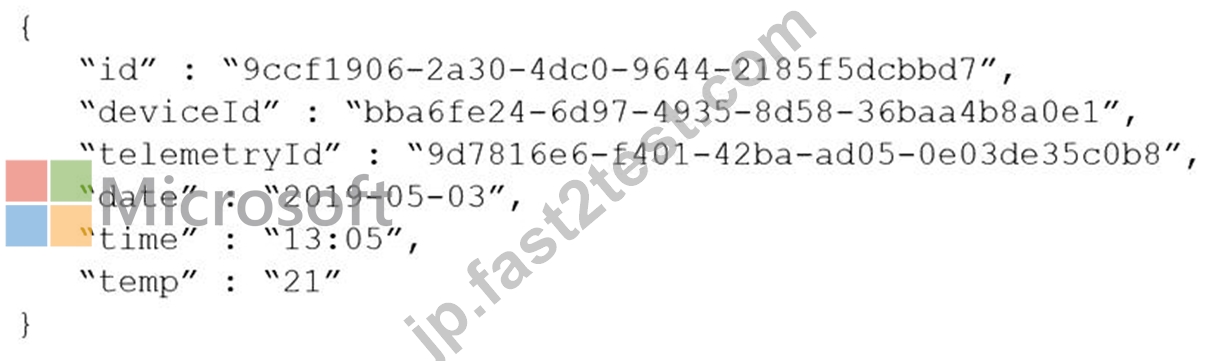
You need to reduce the amount of request units (RUs) consumed by the analytics application.
What should you do?
- A. Increase the offerThroughput value for the container.
- B. Move the data to a new container that has a partition key of deviceId.
- C. Decrease the offerThroughput value for the container.
- D. Move the data to a new container that uses a partition key of date.
正解:B
解説:
Explanation
The partition key is what will determine how data is routed in the various partitions by Cosmos DB and needs to make sense in the context of your specific scenario. The IoT Device ID is generally the "natural" partition key for IoT applications.
Reference: https://docs.microsoft.com/en-us/azure/architecture/solution-ideas/articles/iot-using-cosmos-db
質問 # 35
Note: This question is part of a series of questions that present the same scenario. Each question in the series contains a unique solution that might meet the stated goals. Some question sets might have more than one correct solution, while others might not have a correct solution.
After you answer a question in this section, you will NOT be able to return to it. As a result, these questions will not appear in the review screen.
You have a container named container1 in an Azure Cosmos DB Core (SQL) API account.
You need to make the contents of container1 available as reference data for an Azure Stream Analytics job.
Solution: You create an Azure function that uses Azure Cosmos DB Core (SQL) API change feed as a trigger and Azure event hub as the output.
Does this meet the goal?
- A. Yes
- B. No
正解:B
解説:
Explanation
The Azure Cosmos DB change feed is a mechanism to get a continuous and incremental feed of records from an Azure Cosmos container as those records are being created or modified. Change feed support works by listening to container for any changes. It then outputs the sorted list of documents that were changed in the order in which they were modified.
The following diagram represents the data flow and components involved in the solution:
Reference: https://docs.microsoft.com/en-us/azure/cosmos-db/sql/changefeed-ecommerce-solution
質問 # 36
You are designing a data model for an Azure Cosmos DB for NoSQL account.
What are the partition limits for request units per second (RU/s) and storage? To answer, select the appropriate options in the answer area.
NOTE: Each correct selection is worth one point.
正解:
解説: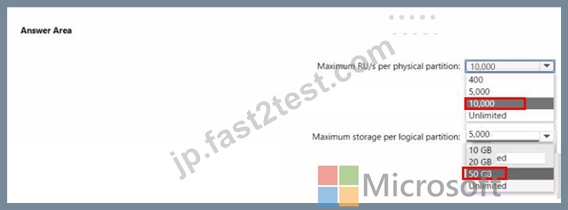
質問 # 37
You have an Apache Spark pool in Azure Synapse Analytics that runs the following Python code in a notebook.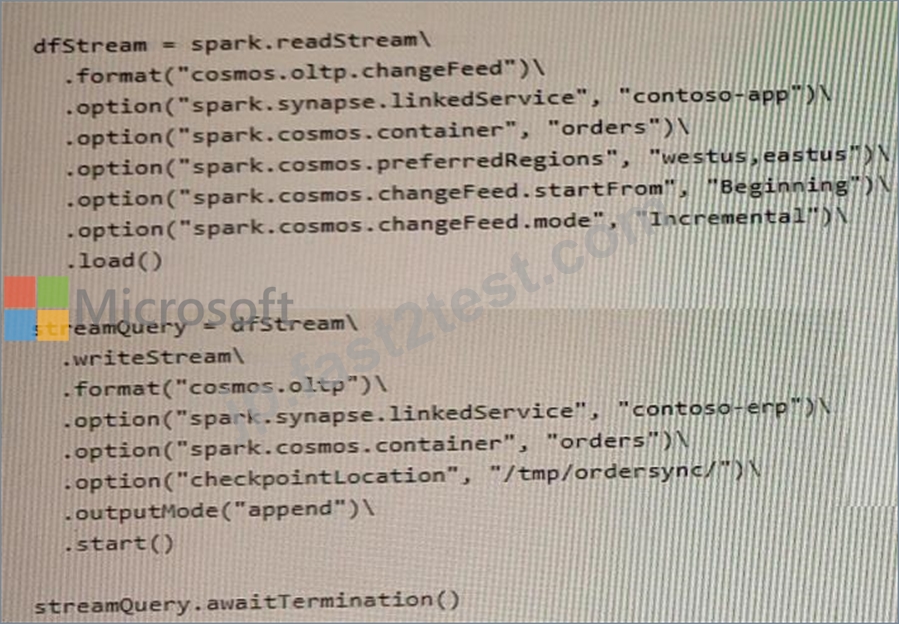
For each of the following statements, select Yes if the statement is true. Otherwise, select No.
NOTE: Each correct selection is worth one point.
正解:
解説:
質問 # 38
You plan to create an Azure Cosmos DB Core (SQL) API account that will use customer-managed keys stored in Azure Key Vault.
You need to configure an access policy in Key Vault to allow Azure Cosmos DB access to the keys.
Which three permissions should you enable in the access policy? Each correct answer presents part of the solution.
NOTE: Each correct selection is worth one point.
- A. Get
- B. Unwrap Key
- C. Update
- D. Verify
- E. Sign
- F. List
- G. Wrap Key
正解:A、B、G
解説:
Reference: https://docs.microsoft.com/en-us/azure/cosmos-db/how-to-setup-cmk
質問 # 39
You are creating a database in an Azure Cosmos DB Core (SQL) API account. The database will be used by an application that will provide users with the ability to share online posts. Users will also be able to submit comments on other users' posts.
You need to store the data shown in the following table.
The application has the following characteristics:
Users can submit an unlimited number of posts.
The average number of posts submitted by a user will be more than 1,000.
Posts can have an unlimited number of comments from different users.
The average number of comments per post will be 100, but many posts will exceed 1,000 comments.
Users will be limited to having a maximum of 20 interests.
For each of the following statements, select Yes if the statement is true. Otherwise, select No.
NOTE: Each correct selection is worth one point.
正解:
解説: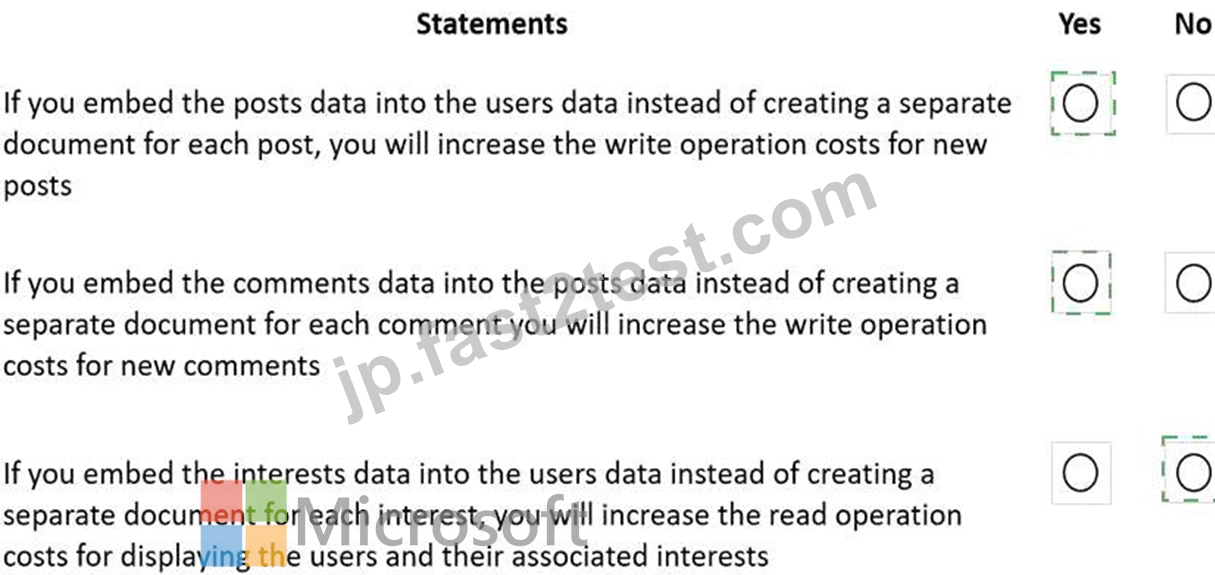
Explanation
Box 1: Yes
Non-relational data increases write costs, but can decrease read costs.
Box 2: Yes
Non-relational data increases write costs, but can decrease read costs.
Box 3: No
Non-relational data increases write costs, but can decrease read costs.
質問 # 40
......
DP-420試験問題集無料サンプル365日更新:https://jp.fast2test.com/DP-420-premium-file.html
まもなく無料セール終了!- リアルDP-420のPDF解答を試そう:https://drive.google.com/open?id=1ISd9_QKFSlU5dIBrGjdMy3ML1oXPBO7m